Honors Chemistry 2020 2021 Anthony Petras Herndon High

- Slides: 14
Honors Chemistry 2020 -2021 Anthony Petras Herndon High
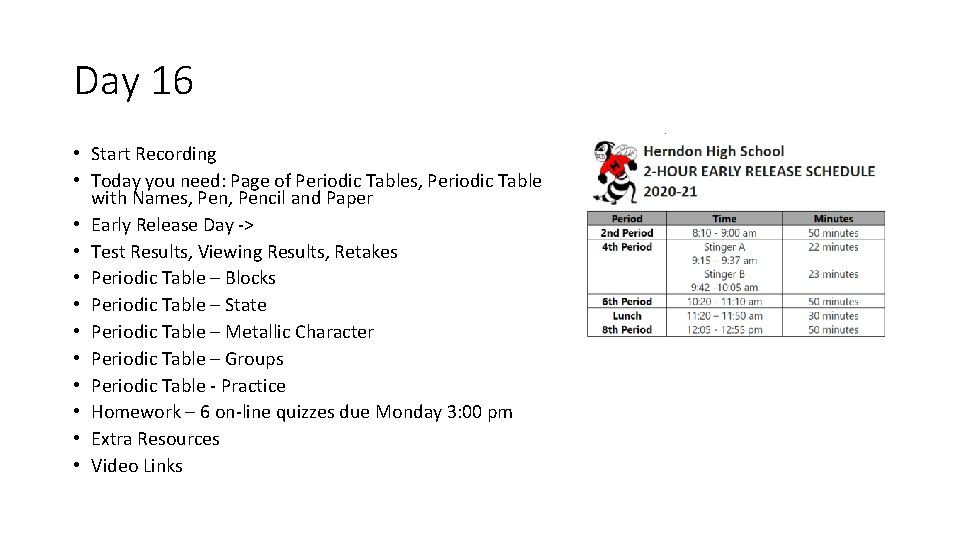
Day 16 • Start Recording • Today you need: Page of Periodic Tables, Periodic Table with Names, Pencil and Paper • Early Release Day -> • Test Results, Viewing Results, Retakes • Periodic Table – Blocks • Periodic Table – State • Periodic Table – Metallic Character • Periodic Table – Groups • Periodic Table - Practice • Homework – 6 on-line quizzes due Monday 3: 00 pm • Extra Resources • Video Links
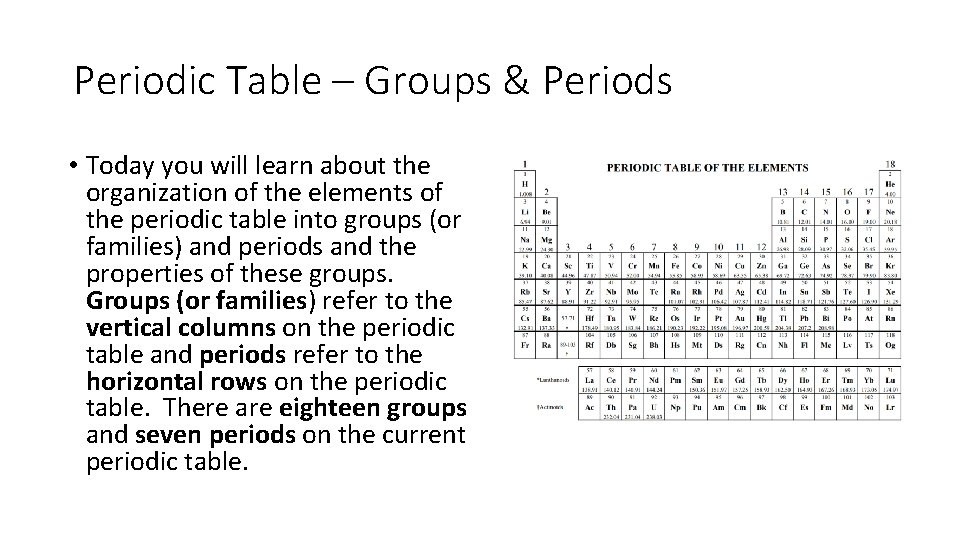
Periodic Table – Groups & Periods • Today you will learn about the organization of the elements of the periodic table into groups (or families) and periods and the properties of these groups. Groups (or families) refer to the vertical columns on the periodic table and periods refer to the horizontal rows on the periodic table. There are eighteen groups and seven periods on the current periodic table.
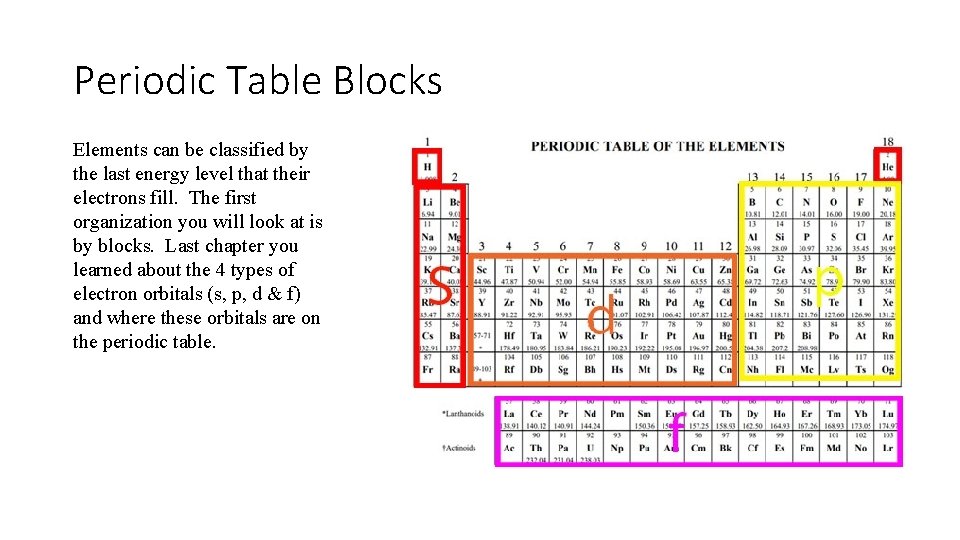
Periodic Table Blocks Elements can be classified by the last energy level that their electrons fill. The first organization you will look at is by blocks. Last chapter you learned about the 4 types of electron orbitals (s, p, d & f) and where these orbitals are on the periodic table.
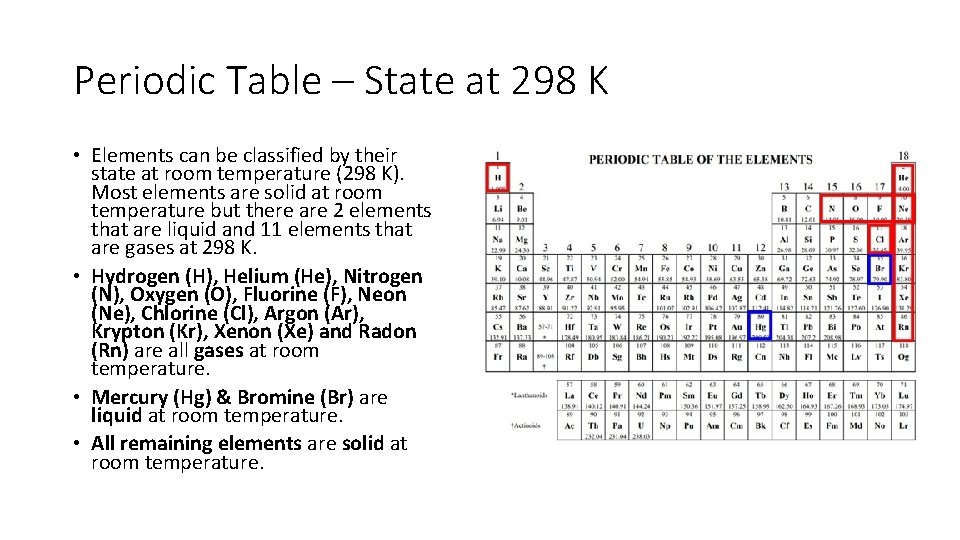
Periodic Table – State at 298 K • Elements can be classified by their state at room temperature (298 K). Most elements are solid at room temperature but there are 2 elements that are liquid and 11 elements that are gases at 298 K. • Hydrogen (H), Helium (He), Nitrogen (N), Oxygen (O), Fluorine (F), Neon (Ne), Chlorine (Cl), Argon (Ar), Krypton (Kr), Xenon (Xe) and Radon (Rn) are all gases at room temperature. • Mercury (Hg) & Bromine (Br) are liquid at room temperature. • All remaining elements are solid at room temperature.
Periodic Table – Metallic Character - Info • Elements can be classified by their metallic character as being a metal, metalloid (semi-metal) or nonmetal. • Metals include all elements that are not considered a metalloid or nonmetal. Metals have the following properties: • • • Shiny metallic appearance. Solid at room temperature (except Mercury). High melting point. High densities. Malleable & ductile. Good conductors of heat & electricity. • Metalloids (also known as semi-metals) include Boron (B), Silicon (Si), Germanium (Ge), Arsenic (As), Antimony (Sb), Tellurium (Te) and Astatine (At). Some tables also list Polonium (Po) as a metalloid, we will not. Metalloids have the following properties: • Have properties of both metals and nonmetals. • Often used as semiconductors. • Nonmetals include all elements to the right of the metalloids and Hydrogen (H). Nonmetals have the following properties: • • Solid nonmetals have little to no metallic luster. Solid nonmetals are brittle. High ionization energy. Poor conductors of heat & electricity.
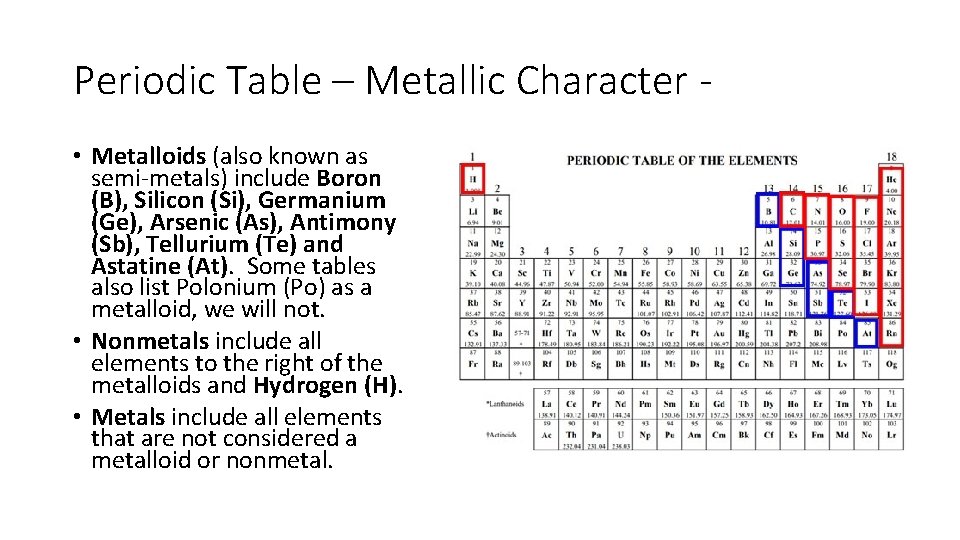
Periodic Table – Metallic Character • Metalloids (also known as semi-metals) include Boron (B), Silicon (Si), Germanium (Ge), Arsenic (As), Antimony (Sb), Tellurium (Te) and Astatine (At). Some tables also list Polonium (Po) as a metalloid, we will not. • Nonmetals include all elements to the right of the metalloids and Hydrogen (H). • Metals include all elements that are not considered a metalloid or nonmetal.
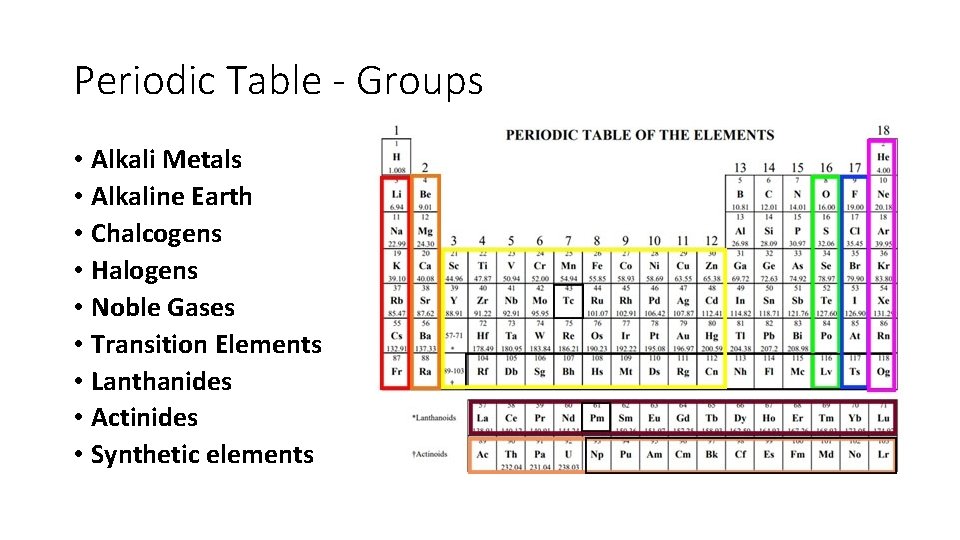
Periodic Table – Main Block Groups - Info • Alkali Metals include all elements in group 1 except Hydrogen (H). Alkali metals have the following properties: • • • Lower densities than other metals. React with water & air. Stored in oil. One valence electron. Easily lose their valence electron to form a univalent cation (1+ charge) • Alkaline Earth elements include all elements in group 2. Alkaline earth elements have the following properties: • • • Harder, denser & stronger than alkali metals. Two valence electrons. Easily lose valence electrons to form divalent cations (2+ charge). • Chalcogens include all elements in group 16. • Halogens include all elements in group 17. Halogens have the following properties: • • • Have 7 valence electrons and only need 1 electron to fill their outer energy level. High electronegativities. Most reactive nonmetals, especially with alkali metals and alkaline earth metals. • Noble Gases include all elements in group 18. Noble gases have the following properties: • • Known as inert gases. All gases at room temperature. Have full outer energy level. High ionization energies but very low electronegativities.
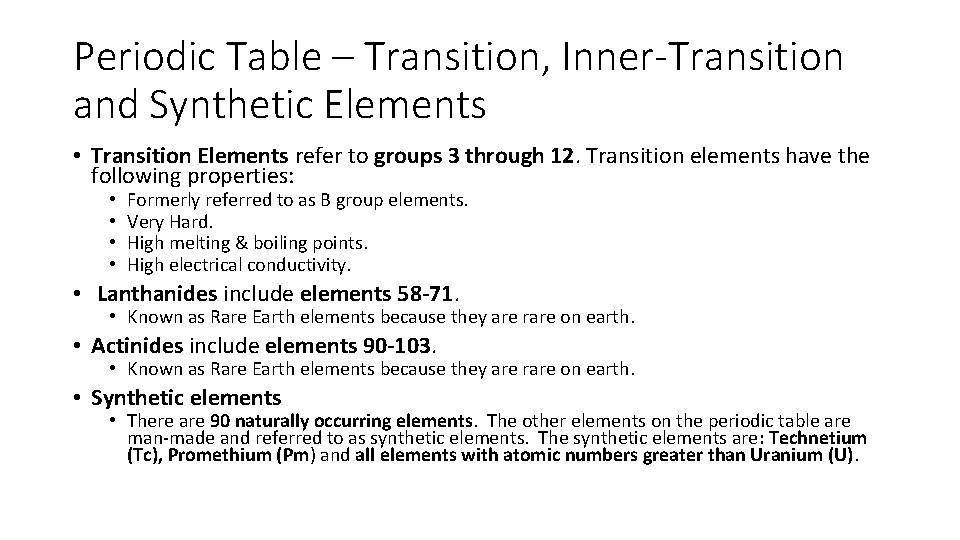
Periodic Table – Transition, Inner-Transition and Synthetic Elements • Transition Elements refer to groups 3 through 12. Transition elements have the following properties: • • Formerly referred to as B group elements. Very Hard. High melting & boiling points. High electrical conductivity. • Lanthanides include elements 58 -71. • Known as Rare Earth elements because they are rare on earth. • Actinides include elements 90 -103. • Known as Rare Earth elements because they are rare on earth. • Synthetic elements • There are 90 naturally occurring elements. The other elements on the periodic table are man-made and referred to as synthetic elements. The synthetic elements are: Technetium (Tc), Promethium (Pm) and all elements with atomic numbers greater than Uranium (U).
Periodic Table - Groups • Alkali Metals • Alkaline Earth • Chalcogens • Halogens • Noble Gases • Transition Elements • Lanthanides • Actinides • Synthetic elements
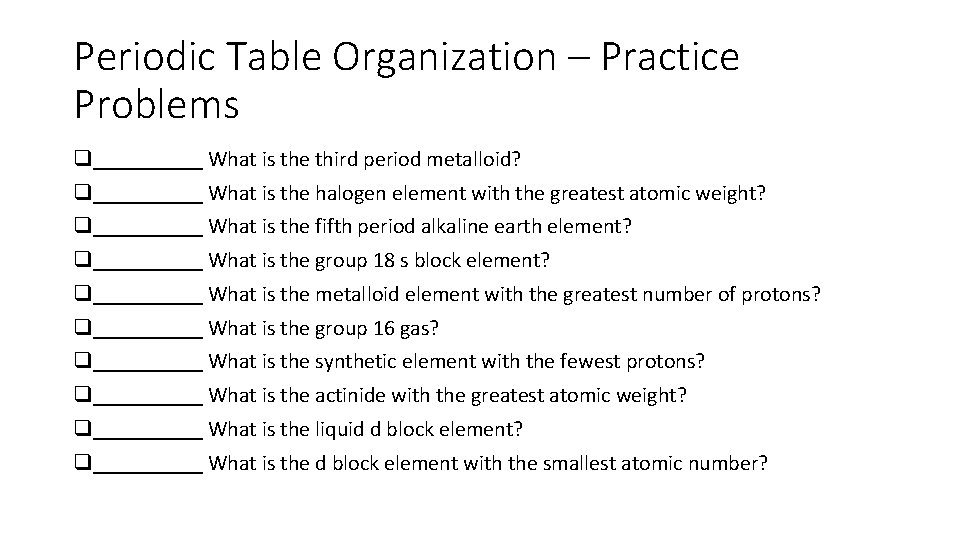
Periodic Table Organization – Practice Problems q_____ What is the third period metalloid? q_____ What is the halogen element with the greatest atomic weight? q_____ What is the fifth period alkaline earth element? q_____ What is the group 18 s block element? q_____ What is the metalloid element with the greatest number of protons? q_____ What is the group 16 gas? q_____ What is the synthetic element with the fewest protons? q_____ What is the actinide with the greatest atomic weight? q_____ What is the liquid d block element? q_____ What is the d block element with the smallest atomic number?
Homework Complete the following 6 Chapter 3 on-line quizzes by 11/2/2020 3 pm. metal nonmetal or metalloid quiz name my family quiz 1 name my family quiz 2 periodic families quiz 1 periodic families quiz 2 periodic families quiz 3
Extra Resources • Today’s Lesson draws upon the work and practice problems found in the documents below. These documents can be found in the Chapter 3 Honors Worksheet section on sartep. com. Pages of Periodic Tables Periodic Table Grouping Answers
Recording Links – New Quarter – New Chapter – New Links • Period 5: • 17. https: //us. bbcollab. com/recording/a 43 ed 5 ce 418040 c 8 bcf 60 a 95679 b 4 ce 3 • Period 6: • 14. https: //us. bbcollab. com/recording/c 2522 b 9 da 3 c 54 c 49 a 0 d 1 bb 432 b 971538 • Period 8: • 13. https: //us. bbcollab. com/recording/affadbac 958 d 467 bb 6 b 4 f 870 e 5 a 2 b 864