HE 2 Muons and Neutrinos 2 1 Muon
- Slides: 65
HE 2: Muons and Neutrinos 2. 1 Muon observations 2. 2 Solar & atmospheric neutrinos 2. 3 Astrophysical neutrinos 2. 4 Calculations 2. 5 New experiments, instrumentation Merida, July 11, 2007 Tom Gaisser 17 16 37 19 18 1
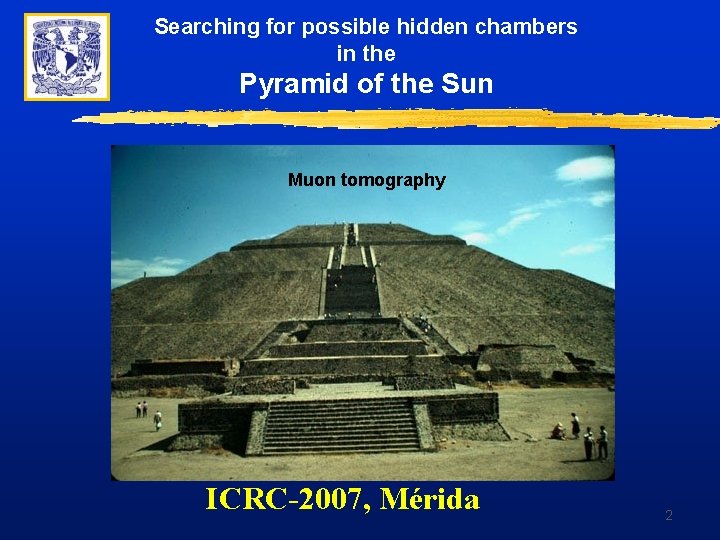
Searching for possible hidden chambers in the Pyramid of the Sun Muon tomography ICRC-2007, Mérida 2
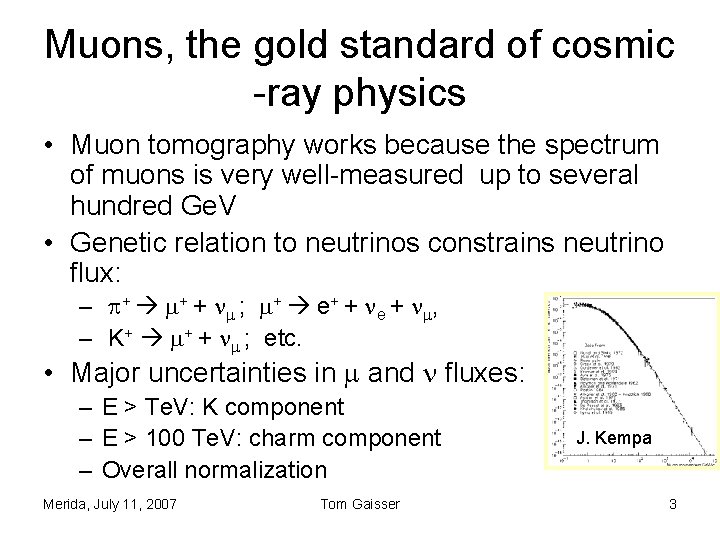
Muons, the gold standard of cosmic -ray physics • Muon tomography works because the spectrum of muons is very well-measured up to several hundred Ge. V • Genetic relation to neutrinos constrains neutrino flux: – + m + + m ; m + e + m, – K+ m+ + m ; etc. • Major uncertainties in m and fluxes: – E > Te. V: K component – E > 100 Te. V: charm component – Overall normalization Merida, July 11, 2007 Tom Gaisser J. Kempa 3
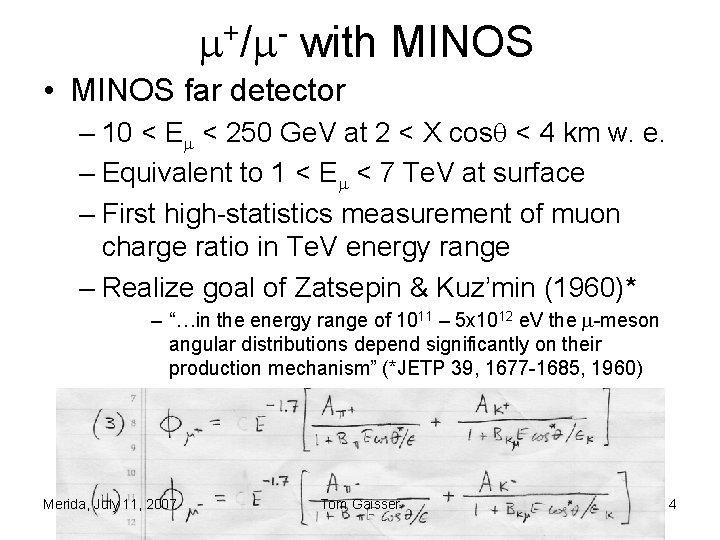
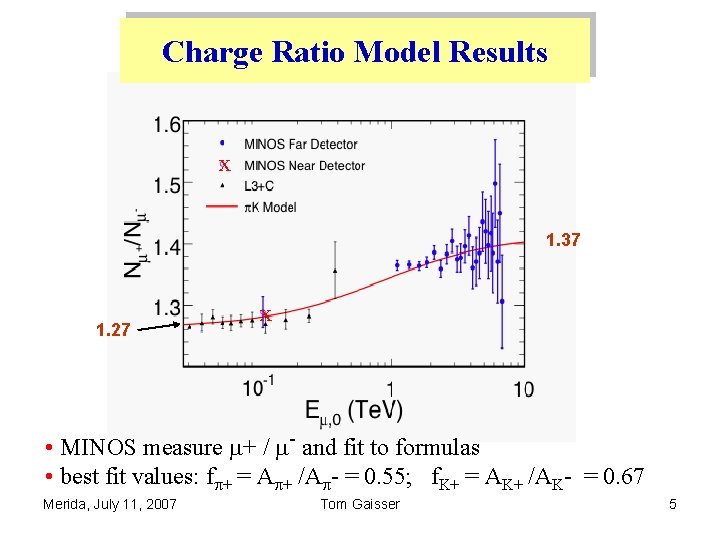
+ m /m with MINOS • MINOS far detector – 10 < Em < 250 Ge. V at 2 < X cosq < 4 km w. e. – Equivalent to 1 < Em < 7 Te. V at surface – First high-statistics measurement of muon charge ratio in Te. V energy range – Realize goal of Zatsepin & Kuz’min (1960)* – “…in the energy range of 1011 – 5 x 10¹² e. V the m-meson angular distributions depend significantly on their production mechanism” (*JETP 39, 1677 -1685, 1960) Merida, July 11, 2007 Tom Gaisser 4
Charge Ratio Model Results x 1. 37 1. 27 x • MINOS measure m+ / m- and fit to formulas • best fit values: f + = A + /A - = 0. 55; f. K+ = AK+ /AK- = 0. 67 Merida, July 11, 2007 Tom Gaisser 5
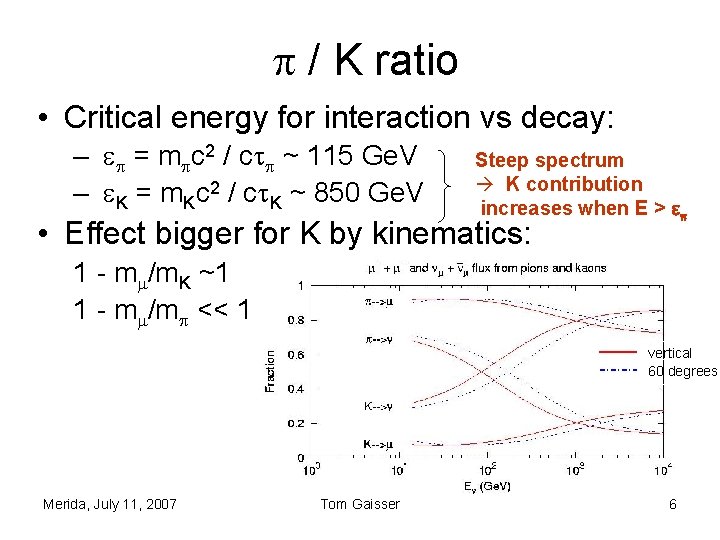
/ K ratio • Critical energy for interaction vs decay: – e = m c 2 / ct ~ 115 Ge. V – e. K = m. Kc 2 / ct. K ~ 850 Ge. V Steep spectrum K contribution increases when E > ep • Effect bigger for K by kinematics: 1 - mm/m. K ~1 1 - mm/m << 1 vertical 60 degrees Merida, July 11, 2007 Tom Gaisser 6
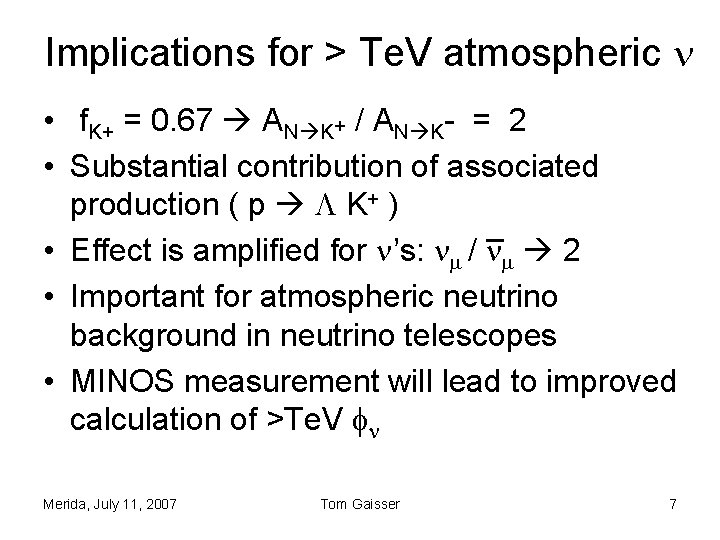
Implications for > Te. V atmospheric • f. K+ = 0. 67 AN K+ / AN K- = 2 • Substantial contribution of associated production ( p L K+ ) • Effect is amplified for ’s: m / m 2 • Important for atmospheric neutrino background in neutrino telescopes • MINOS measurement will lead to improved calculation of >Te. V f Merida, July 11, 2007 Tom Gaisser 7
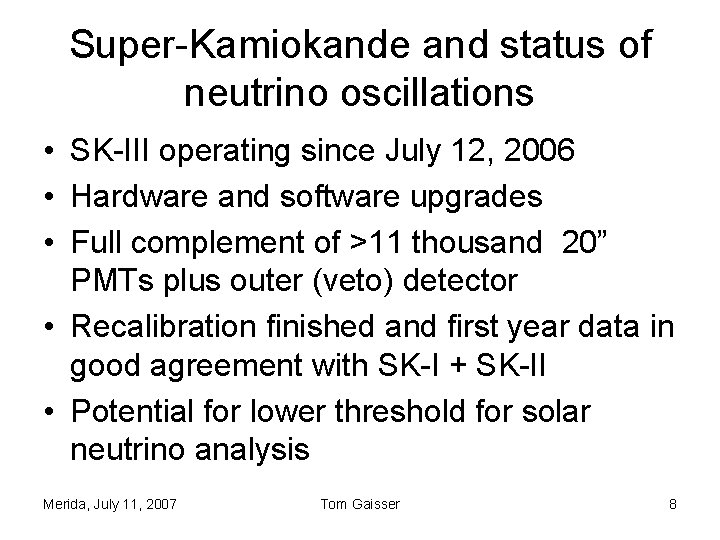
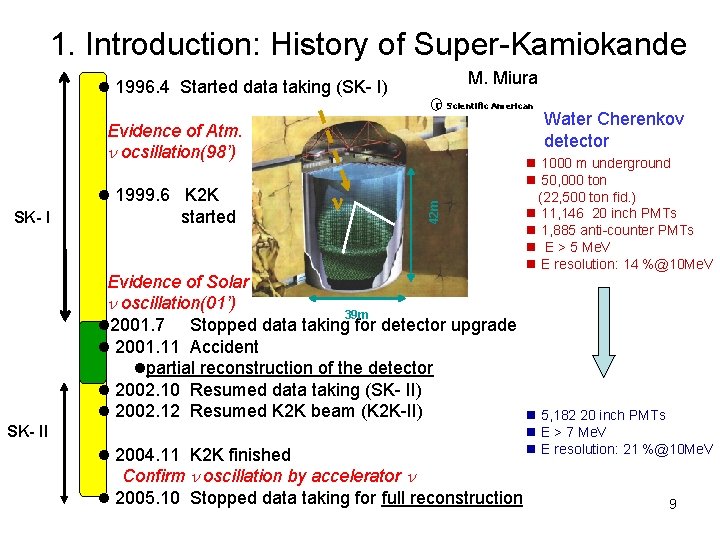
Super-Kamiokande and status of neutrino oscillations • SK-III operating since July 12, 2006 • Hardware and software upgrades • Full complement of >11 thousand 20” PMTs plus outer (veto) detector • Recalibration finished and first year data in good agreement with SK-I + SK-II • Potential for lower threshold for solar neutrino analysis Merida, July 11, 2007 Tom Gaisser 8
1. Introduction: History of Super-Kamiokande M. Miura l 1996. 4 Started data taking (SK- I) C Scientific American SK- II l 1999. 6 K 2 K started 42 m Evidence of Atm. n ocsillation(98’) Water Cherenkov detector n 1000 m underground n 50, 000 ton (22, 500 ton fid. ) n 11, 146 20 inch PMTs n 1, 885 anti-counter PMTs n E > 5 Me. V n E resolution: 14 %@10 Me. V Evidence of Solar n oscillation(01’) 39 m l 2001. 7 Stopped data taking for detector upgrade l 2001. 11 Accident lpartial reconstruction of the detector l 2002. 10 Resumed data taking (SK- II) l 2002. 12 Resumed K 2 K beam (K 2 K-II) n 5, 182 20 inch PMTs l 2004. 11 K 2 K finished Confirm n oscillation by accelerator n l 2005. 10 Stopped data taking for full reconstruction n E > 7 Me. V n E resolution: 21 %@10 Me. V 9
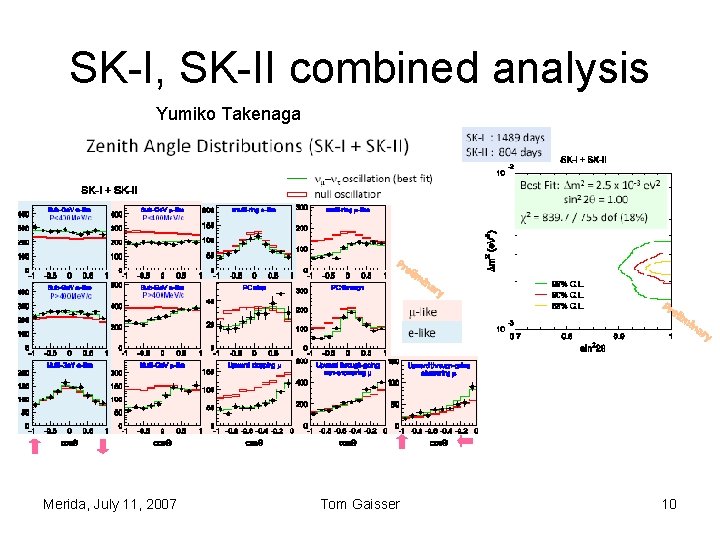
SK-I, SK-II combined analysis Yumiko Takenaga Merida, July 11, 2007 Tom Gaisser 10
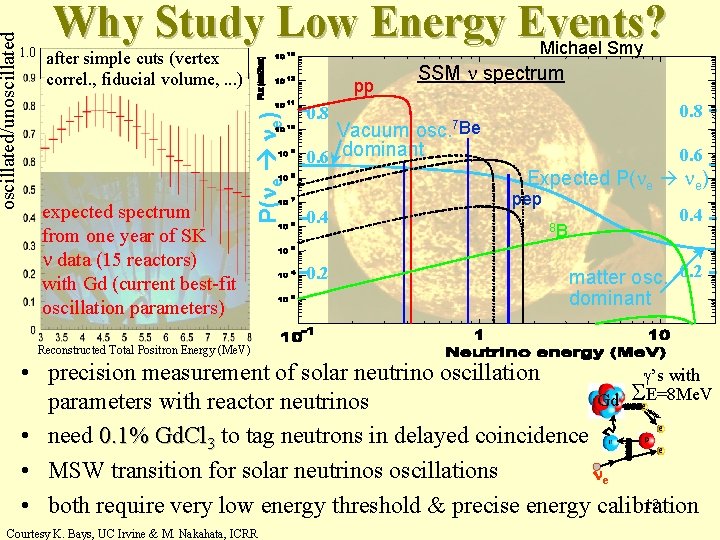
SK extension to low energy • Reconstruction algorithms were refined during SK-II to overcome loss of PMTs • Potential to extend threshold to ~3 Me. V • Solar neutrinos in transition region • Reactor anti-neutrinos – Detection of low-energy e + p n + e+ requires addition of Gd to detect recoil n – Bonus: this will allow improved search for relic supernova e Merida, July 11, 2007 Tom Gaisser 11
after simple cuts (vertex correl. , fiducial volume, . . . ) expected spectrum from one year of SK data (15 reactors) with Gd (current best-fit oscillation parameters) pp P( e e) oscillated/unoscillated 1. 0 Why Study Low Energy Events? Michael Smy 0. 8 SSM spectrum Vacuum osc. 0. 6 dominant 0. 4 0. 2 0. 8 7 Be 0. 6 Expected P( e e) pep 8 B 0. 4 matter osc. 0. 2 dominant Reconstructed Total Positron Energy (Me. V) • precision measurement of solar neutrino oscillation g’s with Gd SE=8 Me. V parameters with reactor neutrinos • need 0. 1% Gd. Cl 3 to tag neutrons in delayed coincidence • MSW transition for solar neutrinos oscillations e 12 • both require very low energy threshold & precise energy calibration Courtesy K. Bays, UC Irvine & M. Nakahata, ICRR
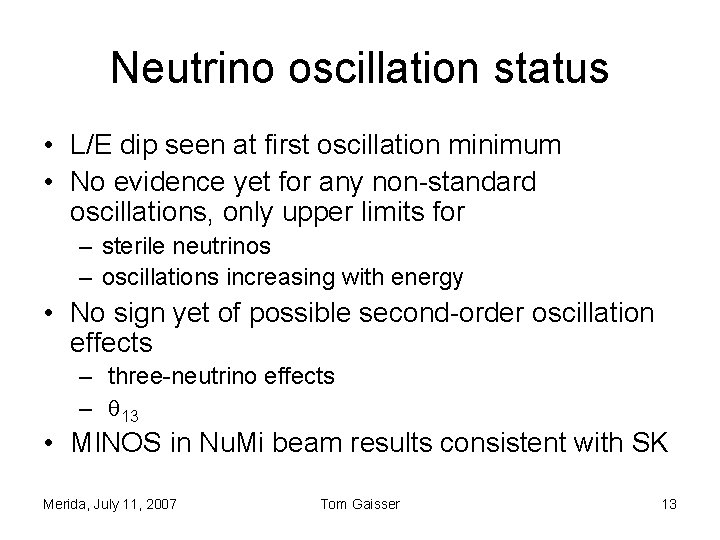
Neutrino oscillation status • L/E dip seen at first oscillation minimum • No evidence yet for any non-standard oscillations, only upper limits for – sterile neutrinos – oscillations increasing with energy • No sign yet of possible second-order oscillation effects – three-neutrino effects – q 13 • MINOS in Nu. Mi beam results consistent with SK Merida, July 11, 2007 Tom Gaisser 13
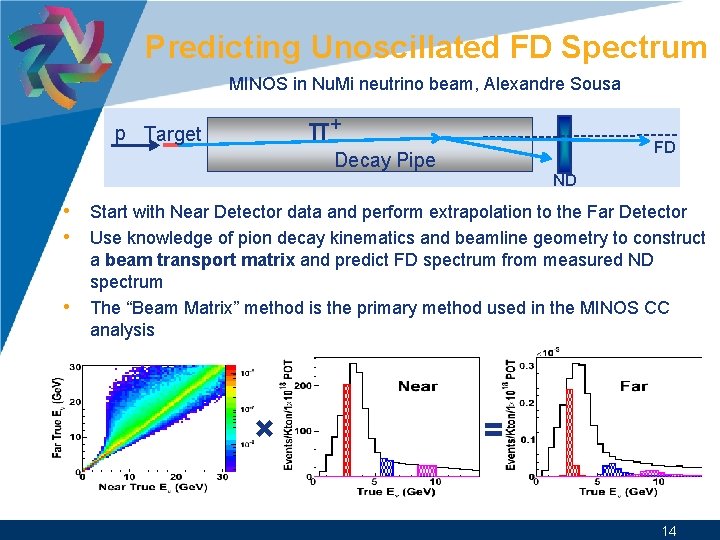
Predicting Unoscillated FD Spectrum MINOS in Nu. Mi neutrino beam, Alexandre Sousa π+ p Target FD Decay Pipe ND • Start with Near Detector data and perform extrapolation to the Far Detector • Use knowledge of pion decay kinematics and beamline geometry to construct • a beam transport matrix and predict FD spectrum from measured ND spectrum The “Beam Matrix” method is the primary method used in the MINOS CC analysis × = 14
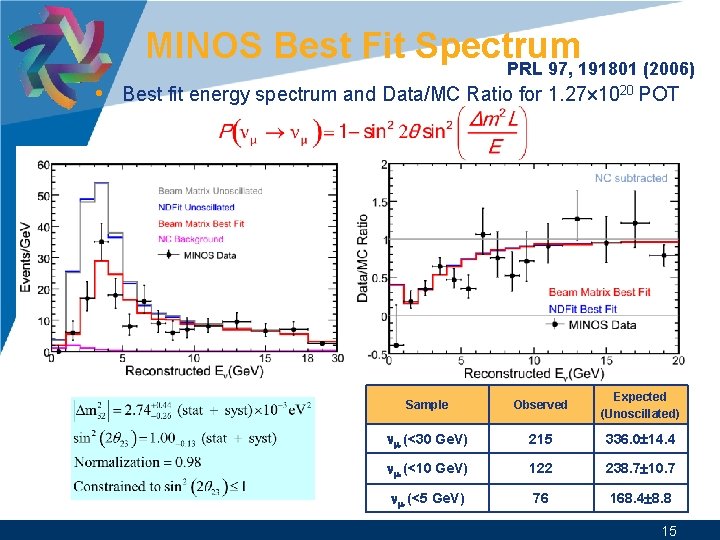
MINOS Best Fit Spectrum PRL 97, 191801 (2006) • Best fit energy spectrum and Data/MC Ratio for 1. 27 1020 POT Sample Observed Expected (Unoscillated) m (<30 Ge. V) 215 336. 0 14. 4 m (<10 Ge. V) 122 238. 7 10. 7 m (<5 Ge. V) 76 168. 4 8. 8 15
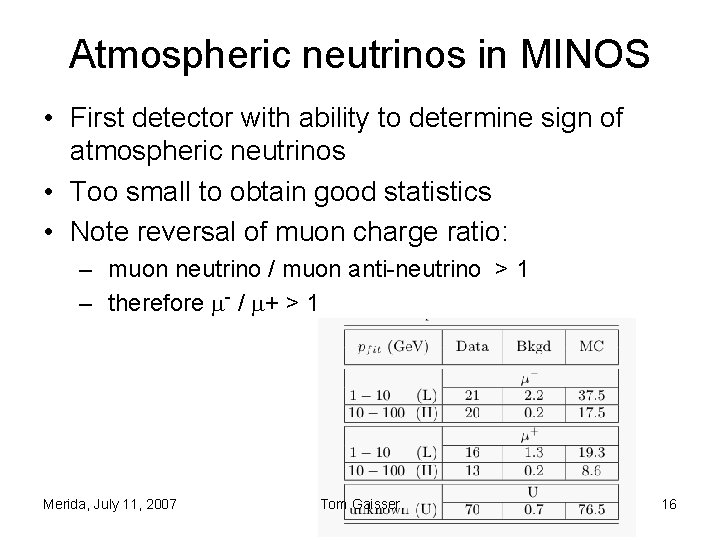
Atmospheric neutrinos in MINOS • First detector with ability to determine sign of atmospheric neutrinos • Too small to obtain good statistics • Note reversal of muon charge ratio: – muon neutrino / muon anti-neutrino > 1 – therefore m- / m+ > 1 Merida, July 11, 2007 Tom Gaisser 16
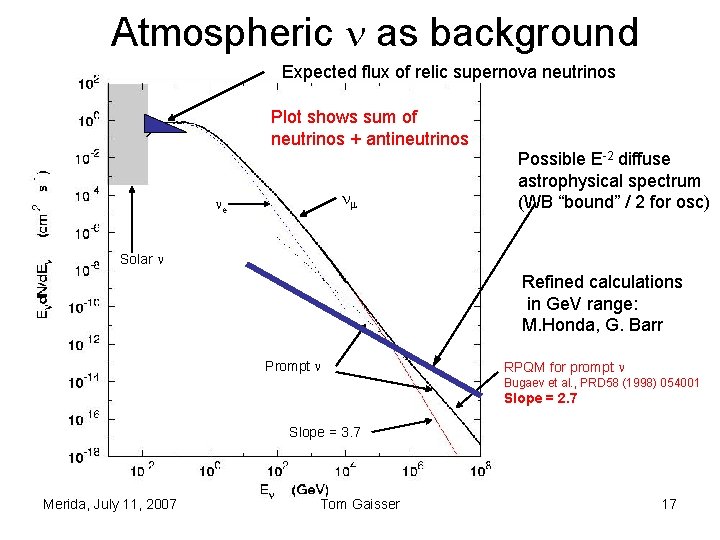
Atmospheric as background Expected flux of relic supernova neutrinos Plot shows sum of neutrinos + antineutrinos m e Possible E-2 diffuse astrophysical spectrum (WB “bound” / 2 for osc) Solar Refined calculations in Ge. V range: M. Honda, G. Barr Prompt RPQM for prompt Bugaev et al. , PRD 58 (1998) 054001 Slope = 2. 7 Slope = 3. 7 Merida, July 11, 2007 Tom Gaisser 17
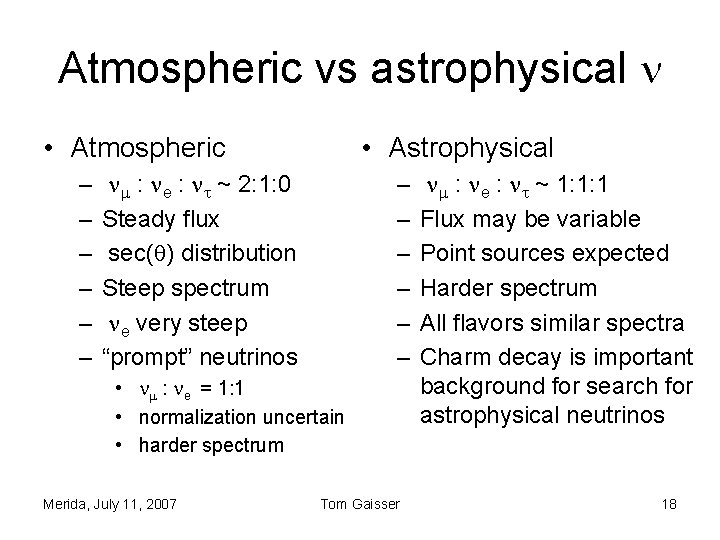
Atmospheric vs astrophysical • Atmospheric – – – • Astrophysical m : e : t ~ 2: 1: 0 Steady flux sec(q) distribution Steep spectrum e very steep “prompt” neutrinos – – – • m : e = 1: 1 • normalization uncertain • harder spectrum Merida, July 11, 2007 Tom Gaisser m : e : t ~ 1: 1: 1 Flux may be variable Point sources expected Harder spectrum All flavors similar spectra Charm decay is important background for search for astrophysical neutrinos 18
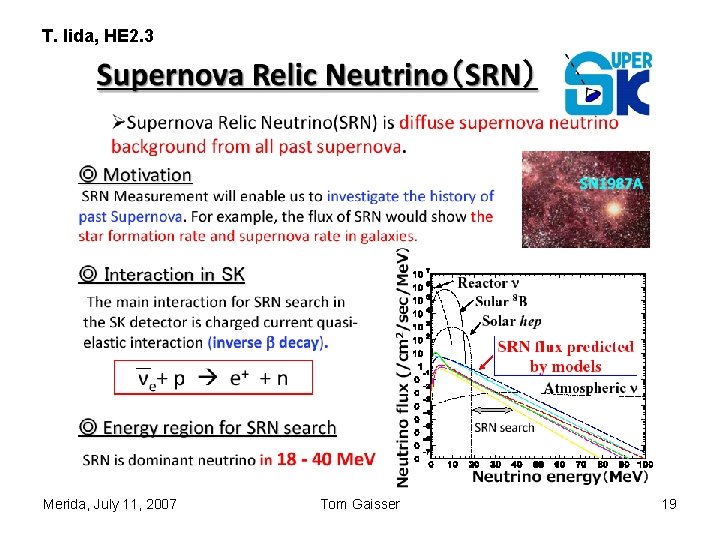
T. Iida, HE 2. 3 Merida, July 11, 2007 Tom Gaisser 19
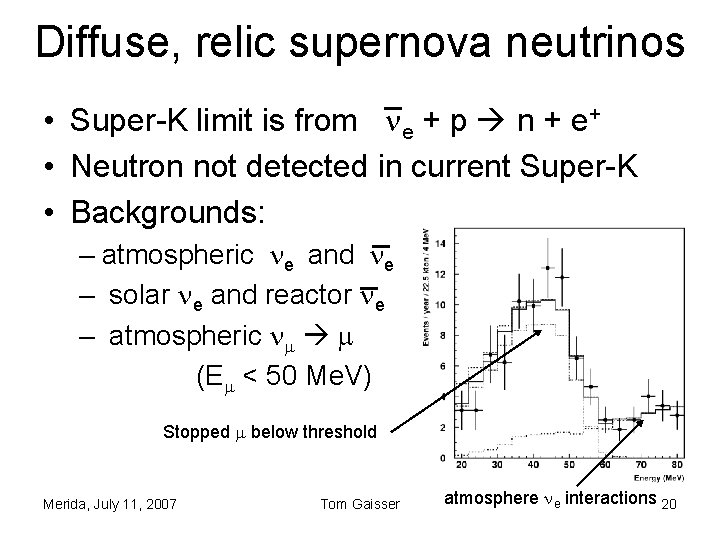
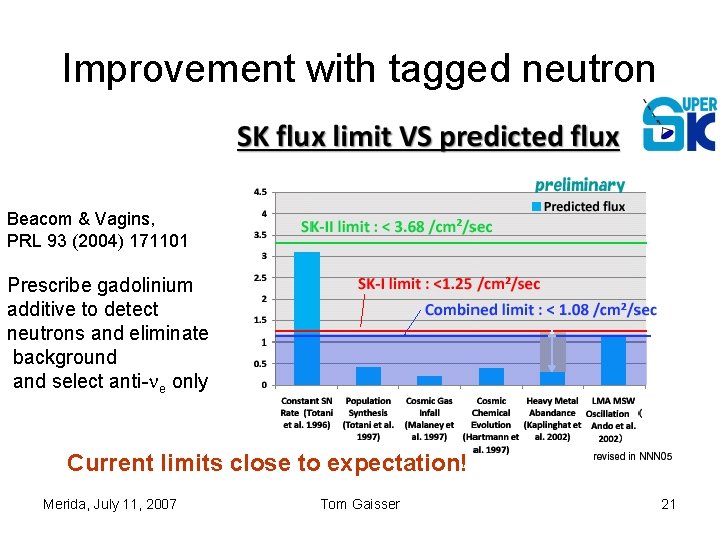
Diffuse, relic supernova neutrinos • Super-K limit is from e + p n + e+ • Neutron not detected in current Super-K • Backgrounds: – atmospheric e and e – solar e and reactor e – atmospheric m m (Em < 50 Me. V) Stopped m below threshold Merida, July 11, 2007 Tom Gaisser atmosphere e interactions 20
Improvement with tagged neutron Beacom & Vagins, PRL 93 (2004) 171101 Prescribe gadolinium additive to detect neutrons and eliminate background and select anti- e only Current limits close to expectation! Merida, July 11, 2007 Tom Gaisser 21
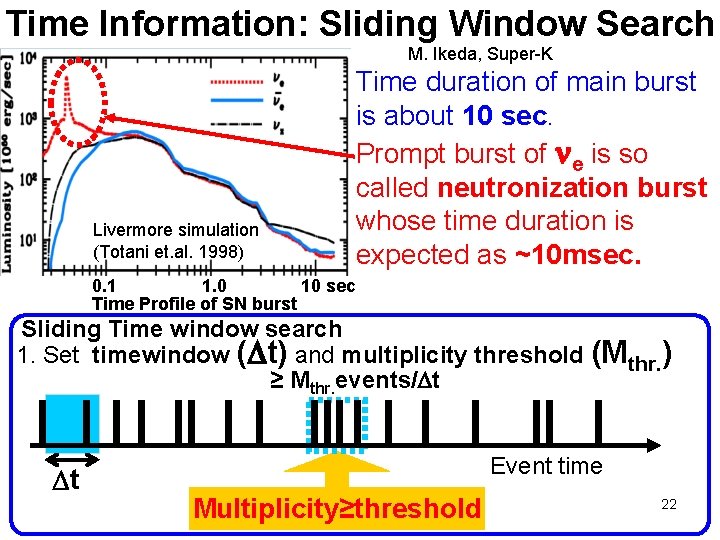
Time Information: Sliding Window Search M. Ikeda, Super-K Livermore simulation (Totani et. al. 1998) Time duration of main burst is about 10 sec. Prompt burst of e is so called neutronization burst whose time duration is expected as ~10 msec. 0. 1 1. 0 10 sec Time Profile of SN burst Sliding Time window search 1. Set timewindow (Dt) and multiplicity threshold (Mthr. ) ≥ Mthr. events/Dt Dt Event time Multiplicity≥threshold 22
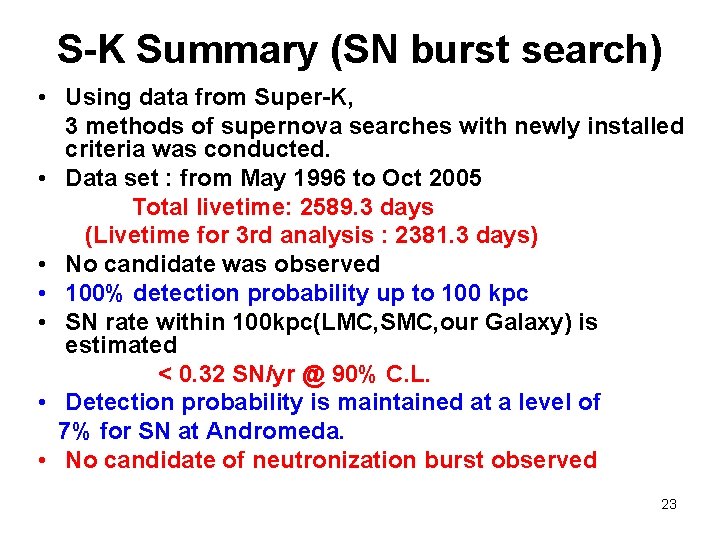
S-K Summary (SN burst search) • Using data from Super-K, 3 methods of supernova searches with newly installed criteria was conducted. • Data set : from May 1996 to Oct 2005 Total livetime: 2589. 3 days (Livetime for 3 rd analysis : 2381. 3 days) • No candidate was observed • 100% detection probability up to 100 kpc • SN rate within 100 kpc(LMC, SMC, our Galaxy) is estimated < 0. 32 SN/yr @ 90% C. L. • Detection probability is maintained at a level of 7% for SN at Andromeda. • No candidate of neutronization burst observed 23
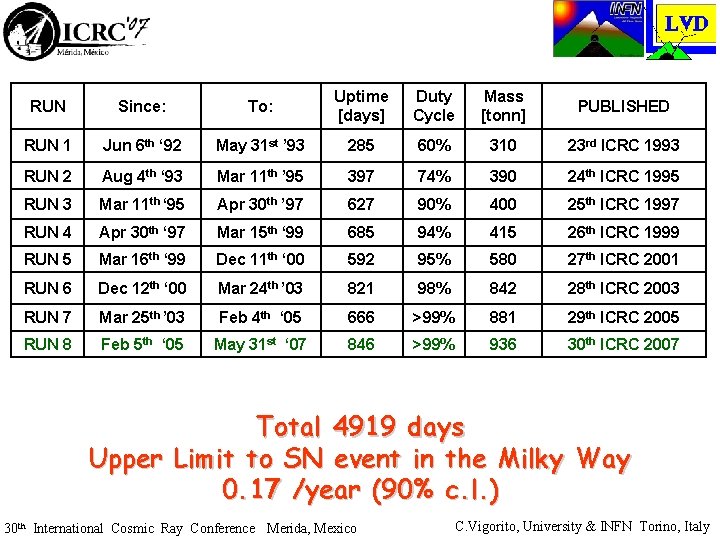
RUN Since: To: Uptime [days] Duty Cycle Mass [tonn] PUBLISHED RUN 1 Jun 6 th ‘ 92 May 31 st ’ 93 285 60% 310 23 rd ICRC 1993 RUN 2 Aug 4 th ‘ 93 Mar 11 th ’ 95 397 74% 390 24 th ICRC 1995 RUN 3 Mar 11 th ‘ 95 Apr 30 th ’ 97 627 90% 400 25 th ICRC 1997 RUN 4 Apr 30 th ‘ 97 Mar 15 th ‘ 99 685 94% 415 26 th ICRC 1999 RUN 5 Mar 16 th ‘ 99 Dec 11 th ‘ 00 592 95% 580 27 th ICRC 2001 RUN 6 Dec 12 th ‘ 00 Mar 24 th ’ 03 821 98% 842 28 th ICRC 2003 RUN 7 Mar 25 th ’ 03 Feb 4 th ‘ 05 666 >99% 881 29 th ICRC 2005 RUN 8 Feb 5 th ‘ 05 May 31 st ‘ 07 846 >99% 936 30 th ICRC 2007 Total 4919 days Upper Limit to SN event in the Milky Way 0. 17 /year (90% c. l. ) 30 th International Cosmic Ray Conference Merida, Mexico C. Vigorito, University & INFN Torino, Italy
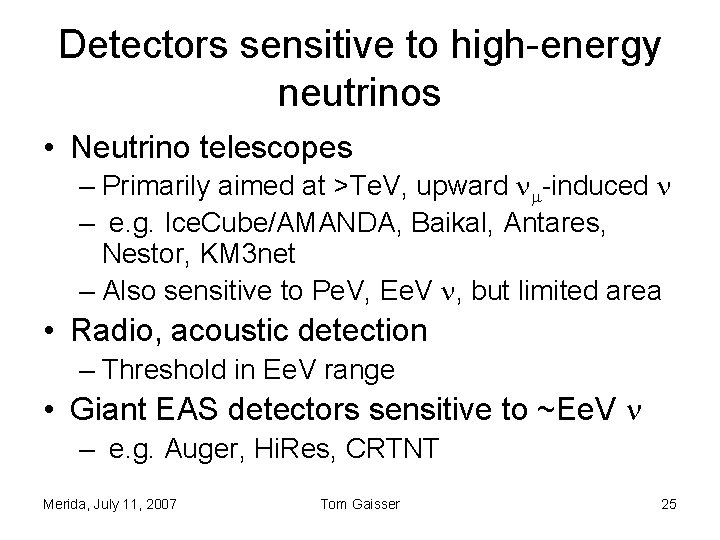
Detectors sensitive to high-energy neutrinos • Neutrino telescopes – Primarily aimed at >Te. V, upward m-induced – e. g. Ice. Cube/AMANDA, Baikal, Antares, Nestor, KM 3 net – Also sensitive to Pe. V, Ee. V , but limited area • Radio, acoustic detection – Threshold in Ee. V range • Giant EAS detectors sensitive to ~Ee. V – e. g. Auger, Hi. Res, CRTNT Merida, July 11, 2007 Tom Gaisser 25
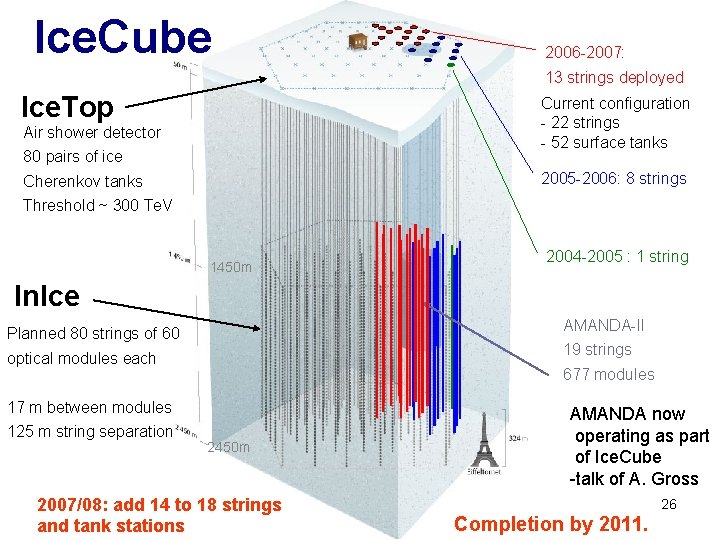
Ice. Cube 2006 -2007: 13 strings deployed Ice. Top Current configuration - 22 strings - 52 surface tanks Air shower detector 80 pairs of ice 2005 -2006: 8 strings Cherenkov tanks Threshold ~ 300 Te. V 1450 m 2004 -2005 : 1 string In. Ice AMANDA-II Planned 80 strings of 60 19 strings optical modules each 677 modules 17 m between modules 125 m string separation 2450 m 2007/08: add 14 to 18 strings and tank stations AMANDA now operating as part of Ice. Cube -talk of A. Gross 26 Completion by 2011.
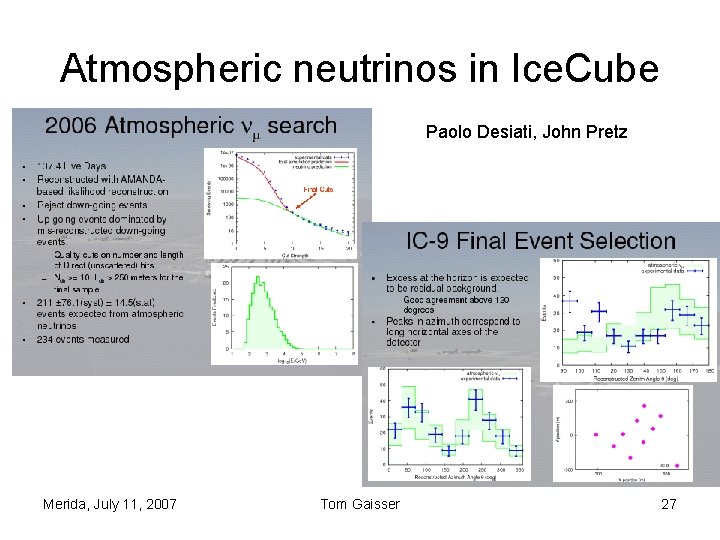
Atmospheric neutrinos in Ice. Cube Paolo Desiati, John Pretz Merida, July 11, 2007 Tom Gaisser 27
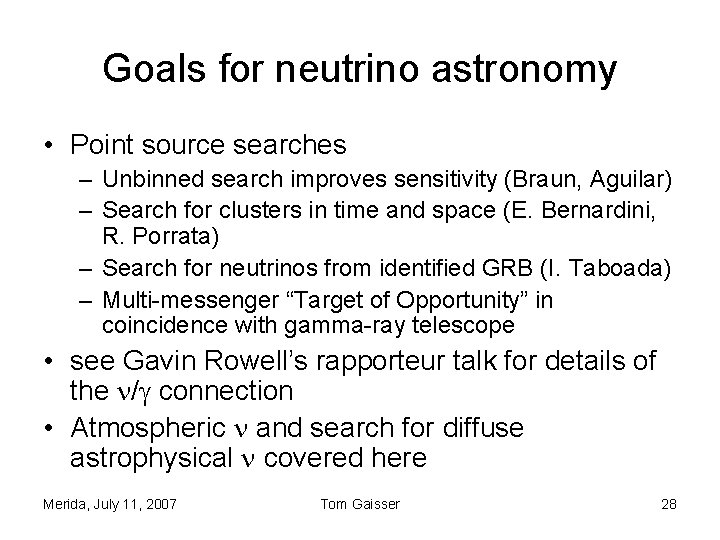
Goals for neutrino astronomy • Point source searches – Unbinned search improves sensitivity (Braun, Aguilar) – Search for clusters in time and space (E. Bernardini, R. Porrata) – Search for neutrinos from identified GRB (I. Taboada) – Multi-messenger “Target of Opportunity” in coincidence with gamma-ray telescope • see Gavin Rowell’s rapporteur talk for details of the /g connection • Atmospheric and search for diffuse astrophysical covered here Merida, July 11, 2007 Tom Gaisser 28
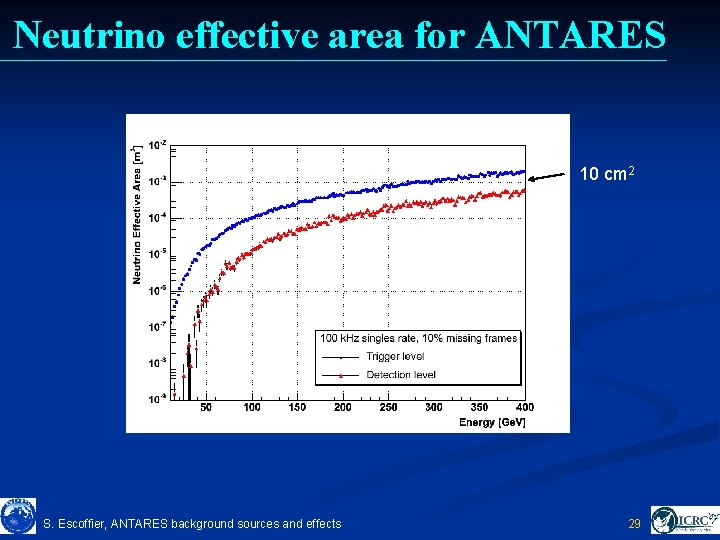
Neutrino effective area for ANTARES 10 cm 2 S. Escoffier, ANTARES background sources and effects 29
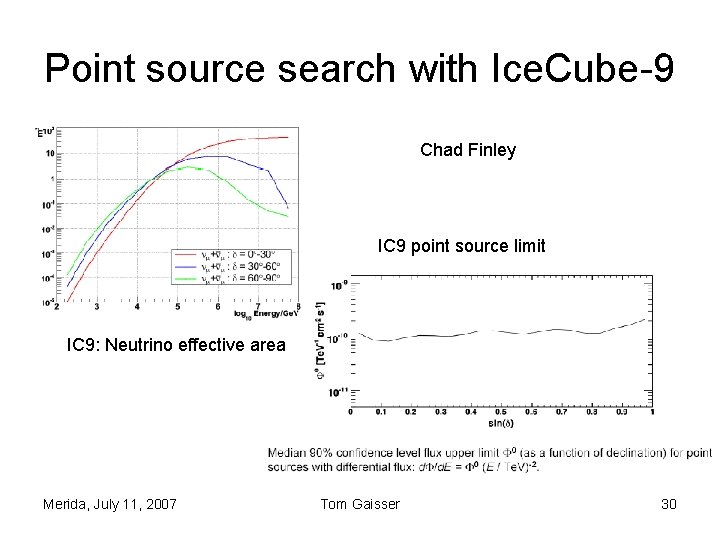
Point source search with Ice. Cube-9 Chad Finley IC 9 point source limit IC 9: Neutrino effective area Merida, July 11, 2007 Tom Gaisser 30
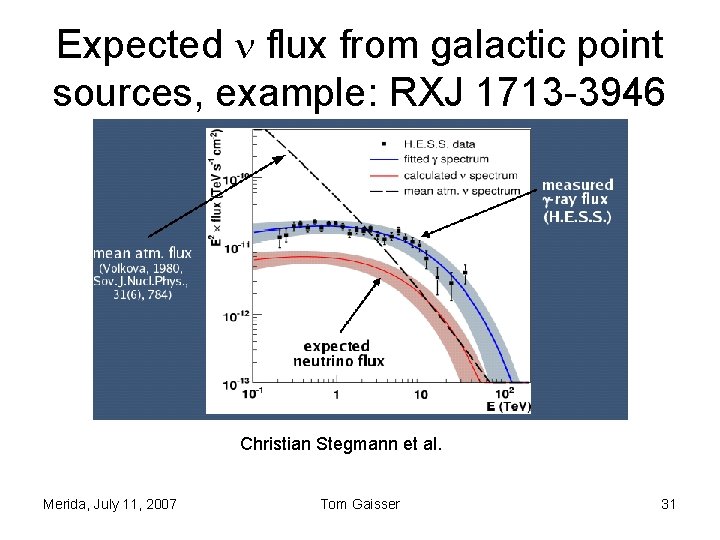
Expected flux from galactic point sources, example: RXJ 1713 -3946 Christian Stegmann et al. Merida, July 11, 2007 Tom Gaisser 31
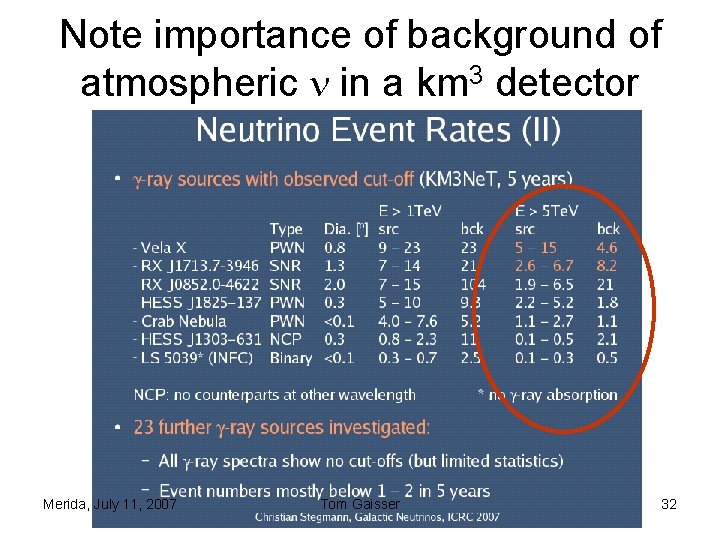
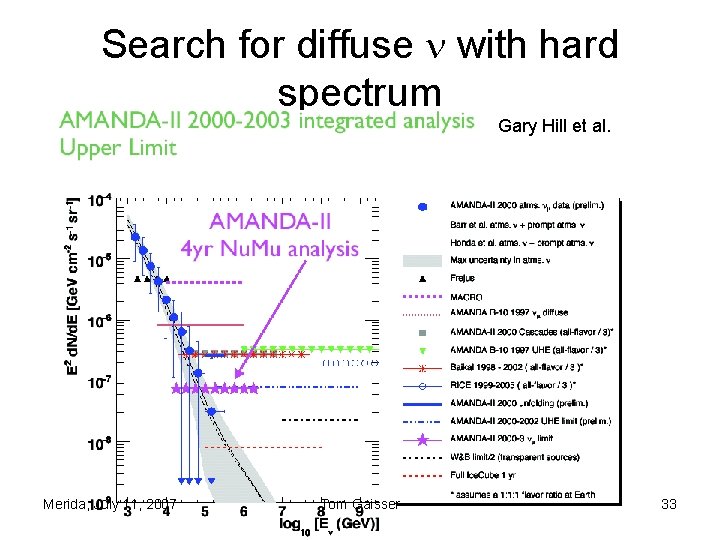
Note importance of background of atmospheric in a km 3 detector Merida, July 11, 2007 Tom Gaisser 32
Search for diffuse with hard spectrum Gary Hill et al. Merida, July 11, 2007 Tom Gaisser 33
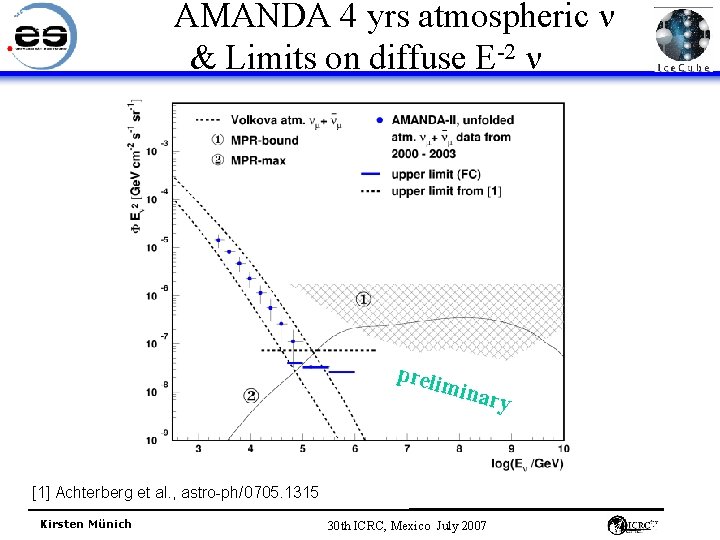
AMANDA 4 yrs atmospheric & Limits on diffuse E-2 preli mina [1] Achterberg et al. , astro-ph/0705. 1315 Kirsten Münich 30 th ICRC, Mexico July 2007 ry
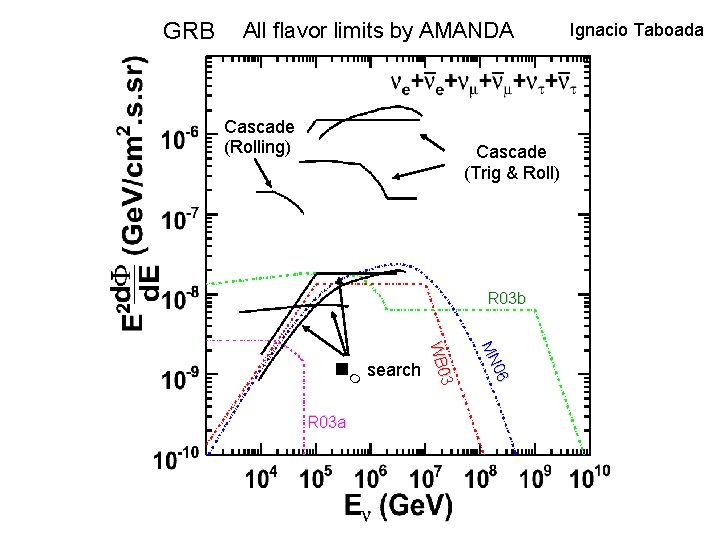
GRB All flavor limits by AMANDA Cascade (Rolling) Cascade (Trig & Roll) R 03 b 06 MN R 03 a 3 WB 0 nm search Ignacio Taboada
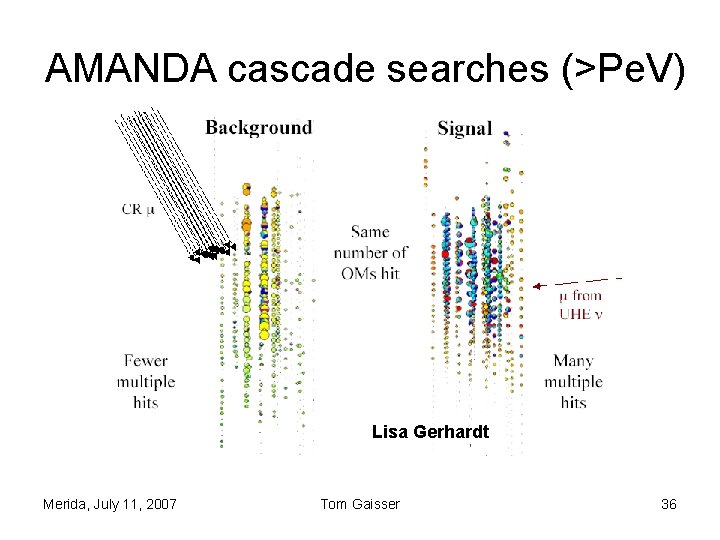
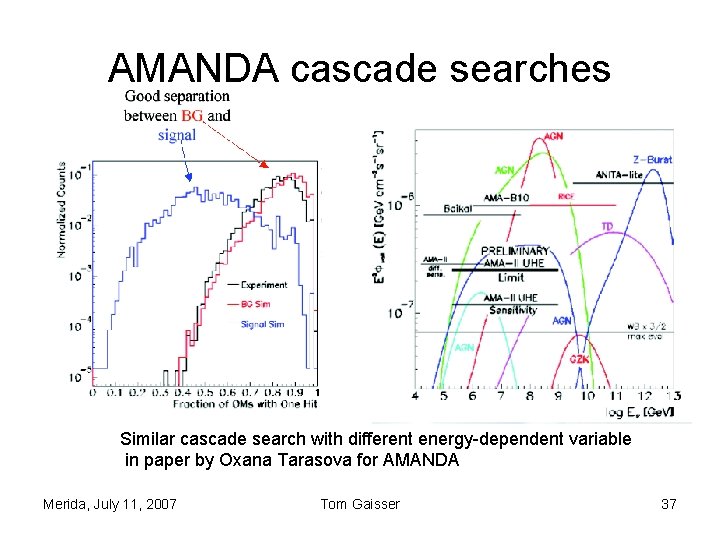
AMANDA cascade searches (>Pe. V) Lisa Gerhardt Merida, July 11, 2007 Tom Gaisser 36
AMANDA cascade searches Similar cascade search with different energy-dependent variable in paper by Oxana Tarasova for AMANDA Merida, July 11, 2007 Tom Gaisser 37
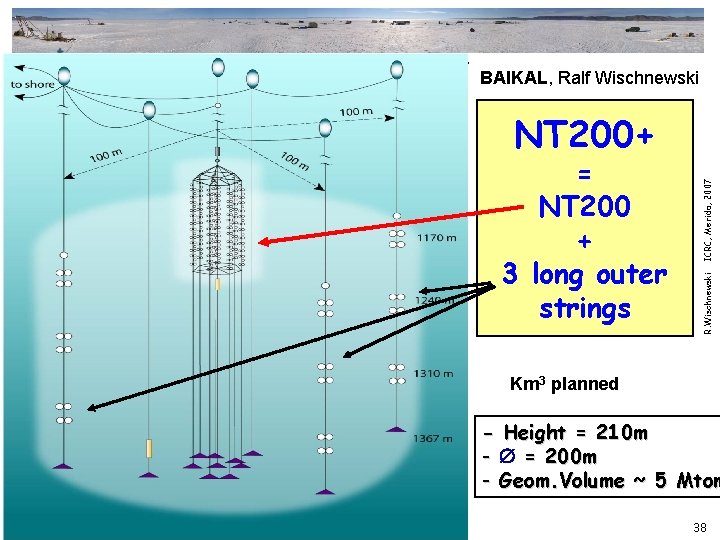
BAIKAL, Ralf Wischnewski R. Wischnewski = NT 200 + 3 long outer strings ICRC, Merida, 2007 NT 200+ Km 3 planned - Height = 210 m - = 200 m - Geom. Volume ~ 5 Mton 38
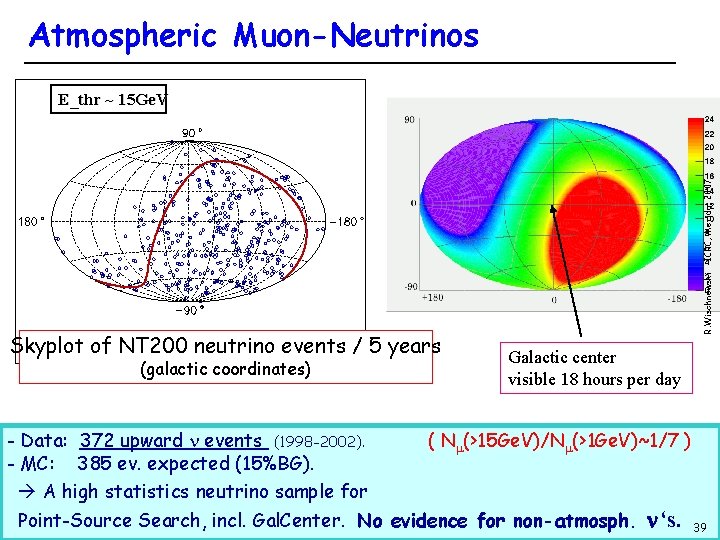
Atmospheric Muon-Neutrinos Skyplot of NT 200 neutrino events / 5 years (galactic coordinates) - Data: 372 upward events (1998 -2002). - MC: 385 ev. expected (15%BG). A high statistics neutrino sample for R. Wischnewski ICRC, Merida, 2007 E_thr ~ 15 Ge. V Galactic center visible 18 hours per day ( Nm(>15 Ge. V)/Nm(>1 Ge. V)~1/7 ) Point-Source Search, incl. Gal. Center. No evidence for non-atmosph. ‘s. 39
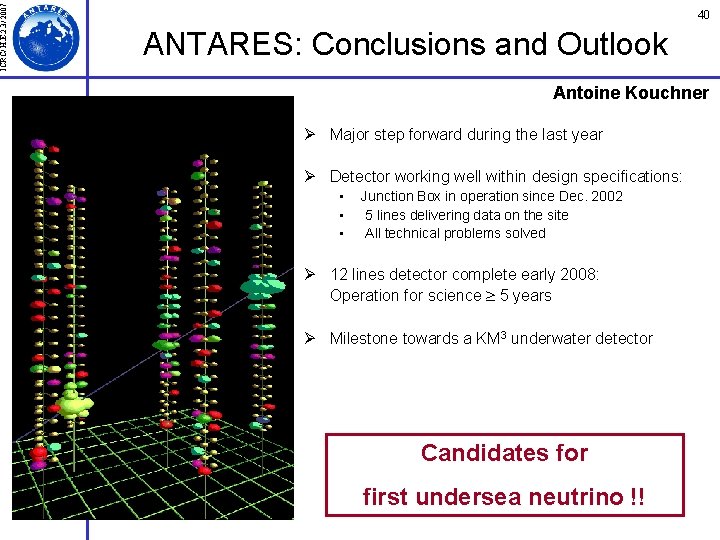
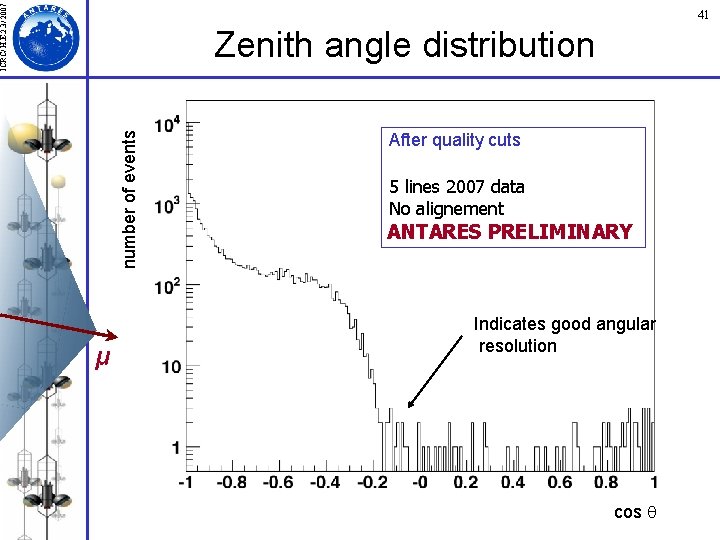
ICRC/ H. E. 2. 3/ 2007 40 ANTARES: Conclusions and Outlook Antoine Kouchner Ø Major step forward during the last year Ø Detector working well within design specifications: • • • Junction Box in operation since Dec. 2002 5 lines delivering data on the site All technical problems solved Ø 12 lines detector complete early 2008: Operation for science 5 years Ø Milestone towards a KM 3 underwater detector Candidates for first undersea neutrino !!
ICRC/ H. E. 2. 3/ 2007 41 number of events Zenith angle distribution μ After quality cuts 5 lines 2007 data No alignement ANTARES PRELIMINARY Indicates good angular resolution cos q
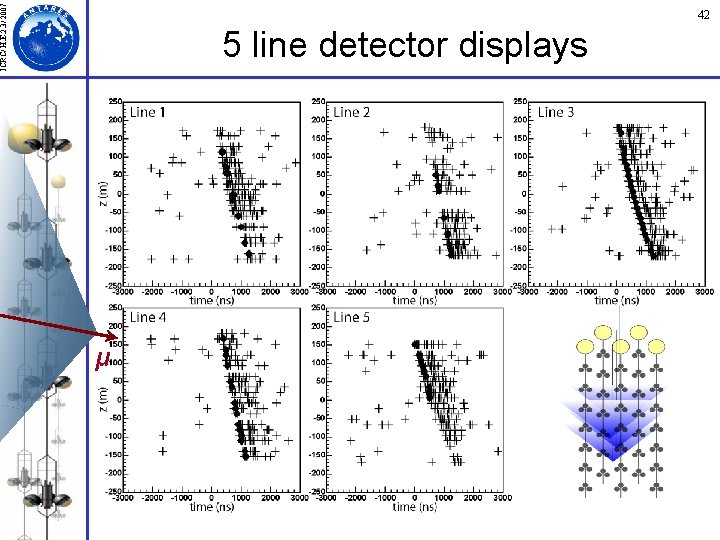
ICRC/ H. E. 2. 3/ 2007 42 5 line detector displays μ
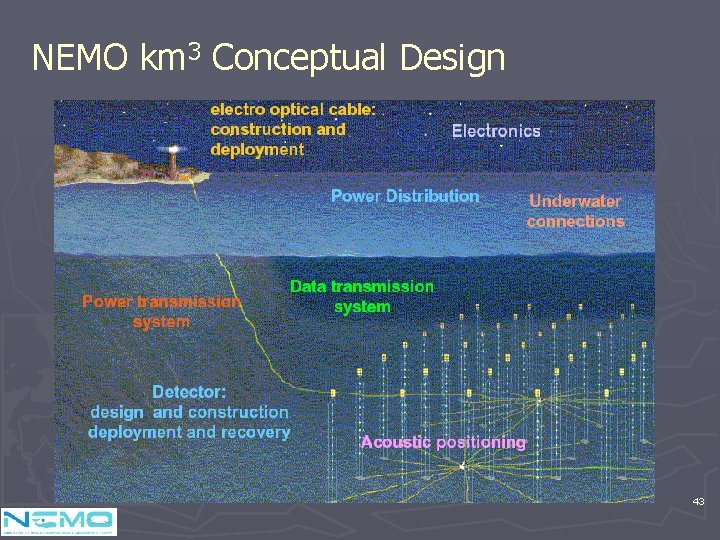
NEMO km 3 Conceptual Design 2000 3000 NEMO 3600 43
Toward the -Telescope ► EU funded the joint activity for a European-scale Design Study for a km 3 -telescope in the Mediterranean Sea § KM 3 Ne. T: ANTARES-NEMO-NESTOR consortium http: //www. km 3 net. org/ ► The experience gained will contribute to the advancement of the KM 3 Ne. T activities 2000 3000 NEMO 3600 44
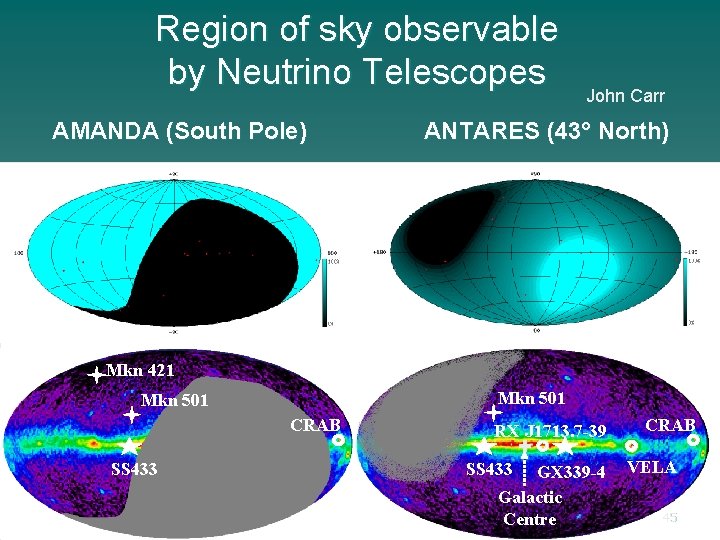
Region of sky observable by Neutrino Telescopes AMANDA (South Pole) John Carr ANTARES (43° North) Mkn 421 Mkn 501 CRAB SS 433 RX J 1713. 7 -39 SS 433 GX 339 -4 Galactic Centre CRAB VELA 45
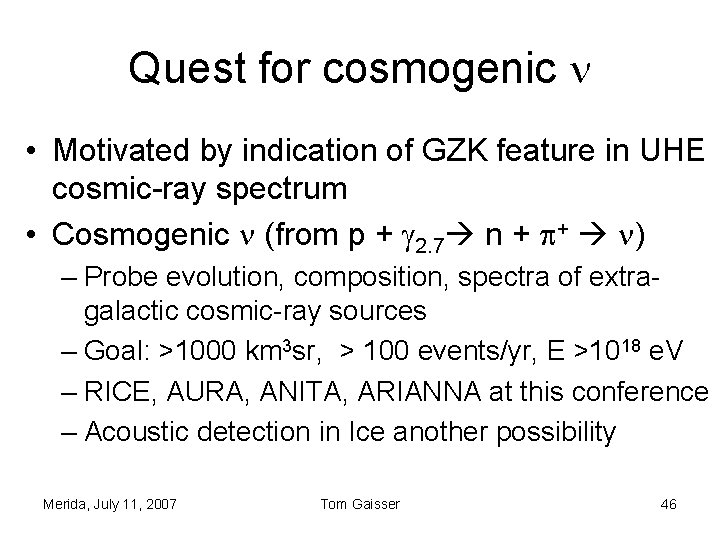
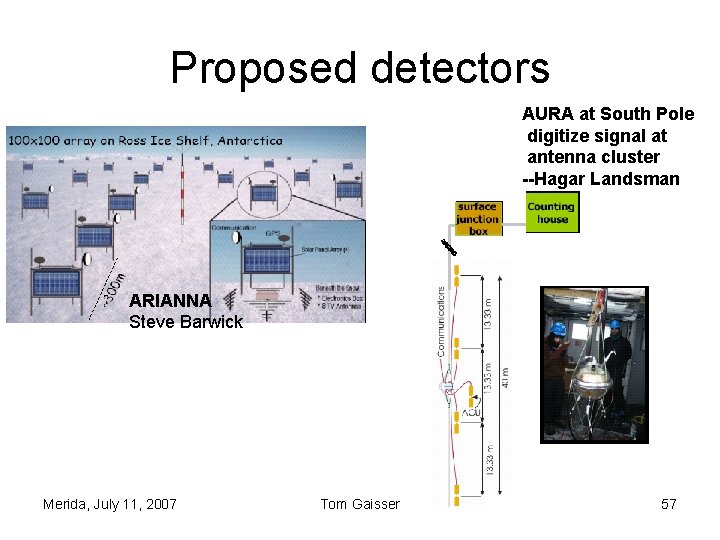
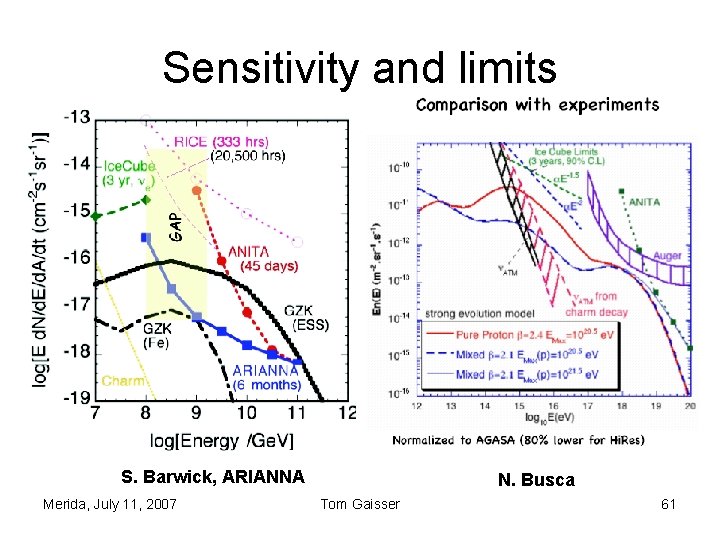
Quest for cosmogenic • Motivated by indication of GZK feature in UHE cosmic-ray spectrum • Cosmogenic (from p + g 2. 7 n + + ) – Probe evolution, composition, spectra of extragalactic cosmic-ray sources – Goal: >1000 km 3 sr, > 100 events/yr, E >1018 e. V – RICE, AURA, ANITA, ARIANNA at this conference – Acoustic detection in Ice another possibility Merida, July 11, 2007 Tom Gaisser 46
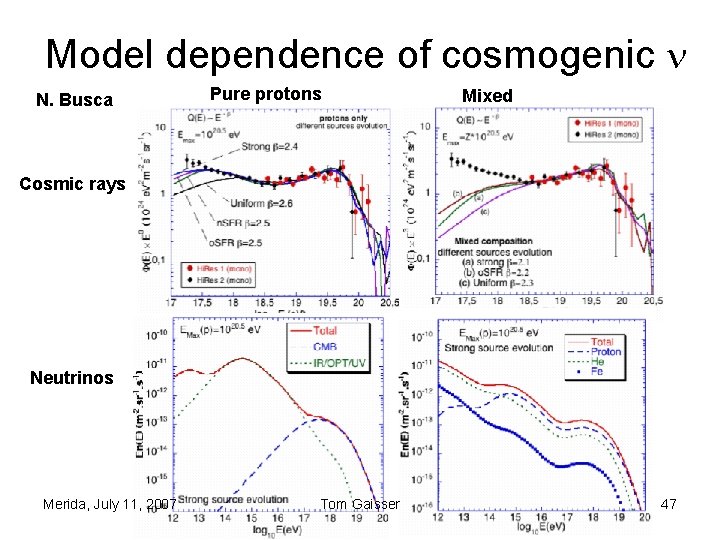
Model dependence of cosmogenic N. Busca Pure protons Mixed Cosmic rays Neutrinos Merida, July 11, 2007 Tom Gaisser 47
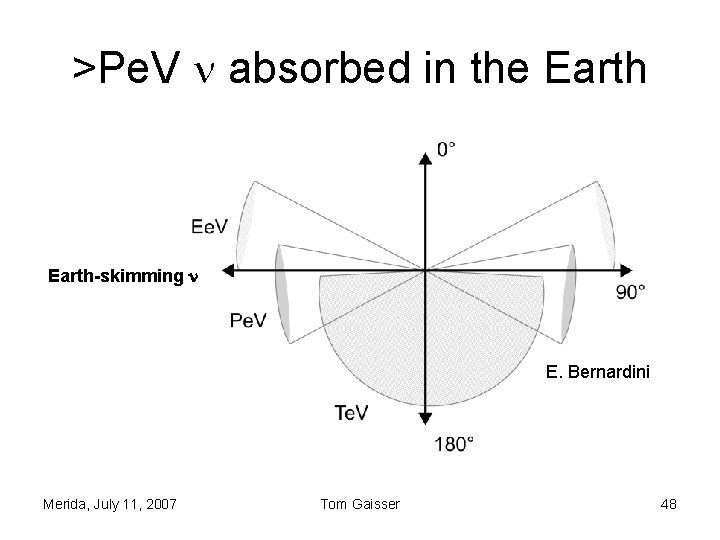
>Pe. V absorbed in the Earth-skimming E. Bernardini Merida, July 11, 2007 Tom Gaisser 48
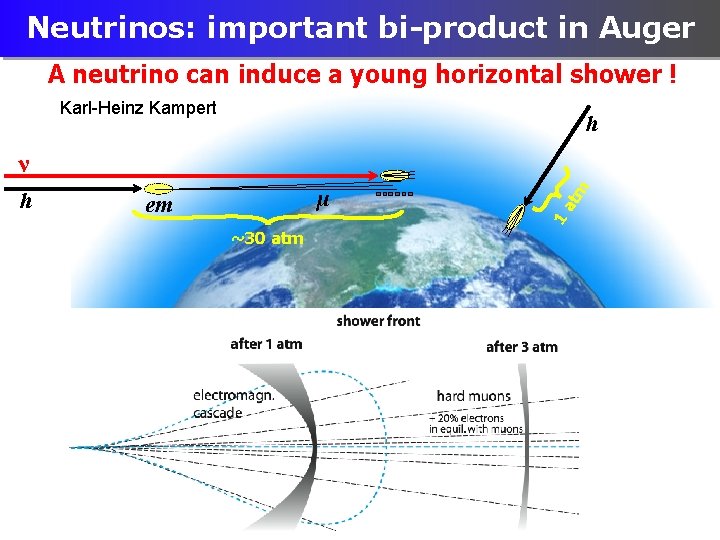
Neutrinos: important bi-product in Auger A neutrino can induce a young horizontal shower ! Karl-Heinz Kampert h at µ em 1 h m ν ~30 atm
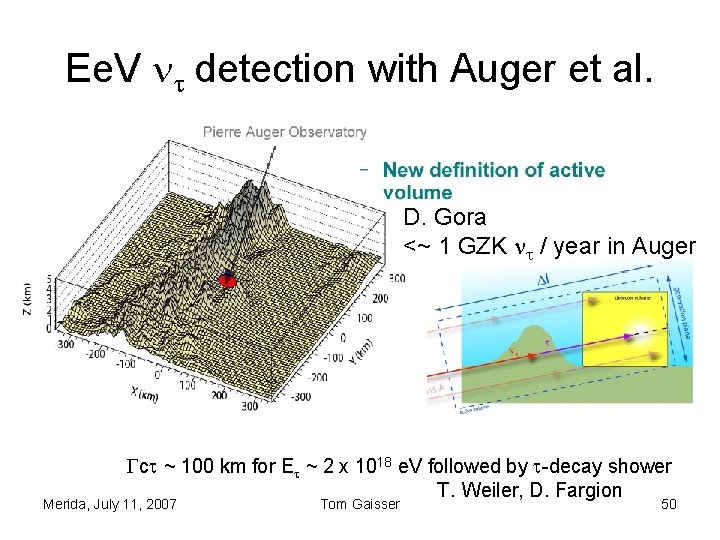
Ee. V t detection with Auger et al. D. Gora <~ 1 GZK t / year in Auger Gct ~ 100 km for Et ~ 2 x 10¹⁸ e. V followed by t-decay shower T. Weiler, D. Fargion Merida, July 11, 2007 Tom Gaisser 50
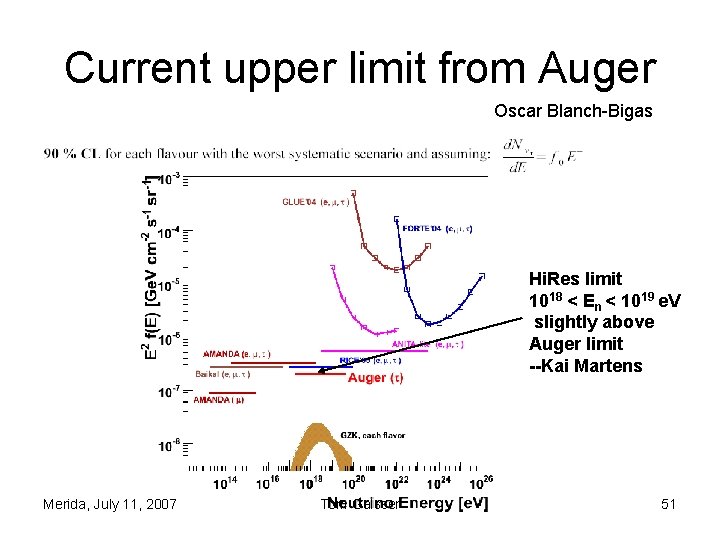
Current upper limit from Auger Oscar Blanch-Bigas Hi. Res limit 1018 < En < 1019 e. V slightly above Auger limit --Kai Martens Merida, July 11, 2007 Tom Gaisser 51
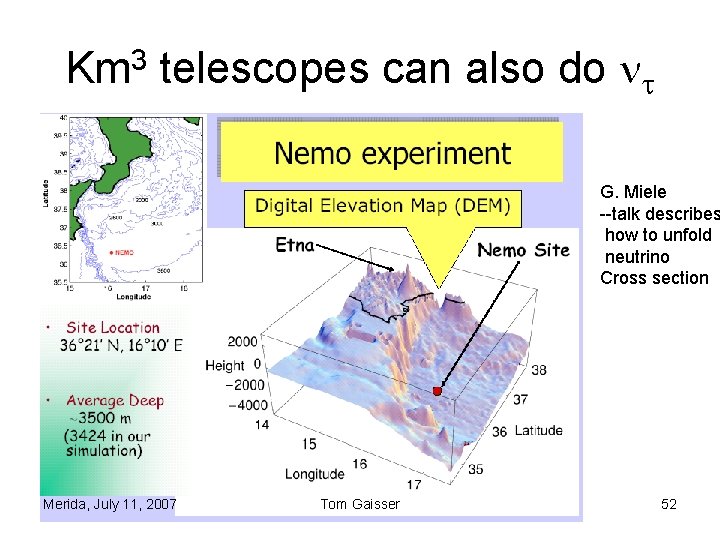
Km 3 telescopes can also do t G. Miele --talk describes how to unfold neutrino Cross section Merida, July 11, 2007 Tom Gaisser 52
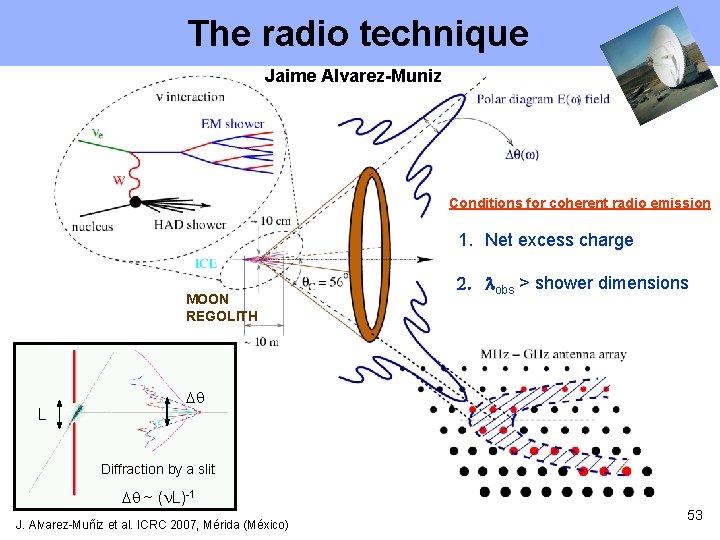
The radio technique Jaime Alvarez-Muniz Conditions for coherent radio emission 1. Net excess charge MOON REGOLITH L 2. lobs > shower dimensions Dq Diffraction by a slit Dq ~ ( L)-1 J. Alvarez-Muñiz et al. ICRC 2007, Mérida (México) 53
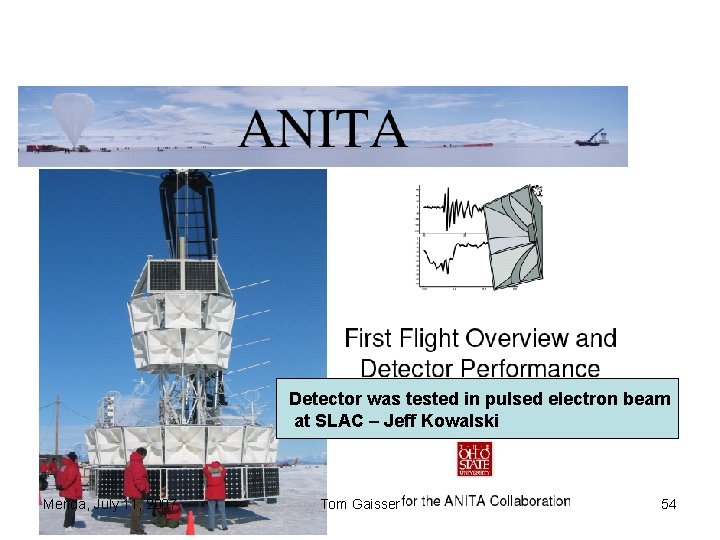
Detector was tested in pulsed electron beam at SLAC – Jeff Kowalski Merida, July 11, 2007 Tom Gaisser 54
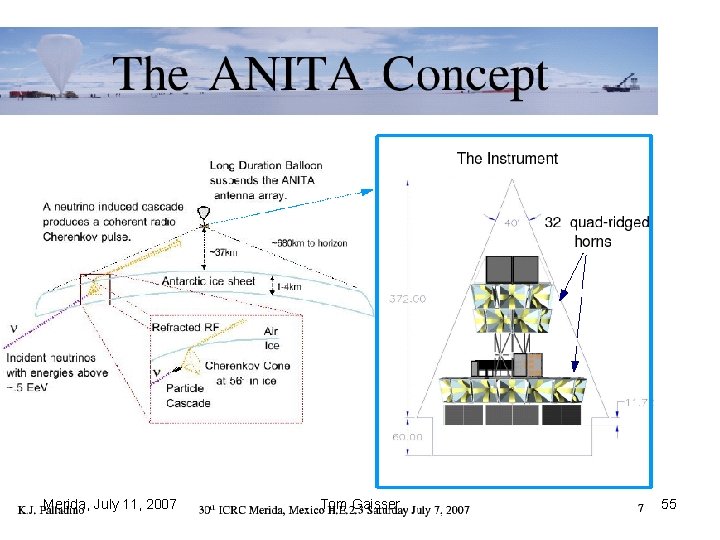
Merida, July 11, 2007 Tom Gaisser 55
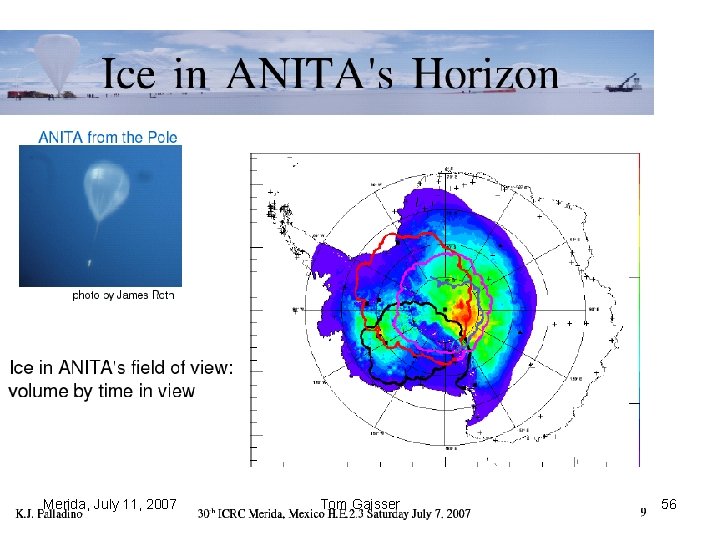
Merida, July 11, 2007 Tom Gaisser 56
Proposed detectors AURA at South Pole digitize signal at antenna cluster --Hagar Landsman ARIANNA Steve Barwick Merida, July 11, 2007 Tom Gaisser 57
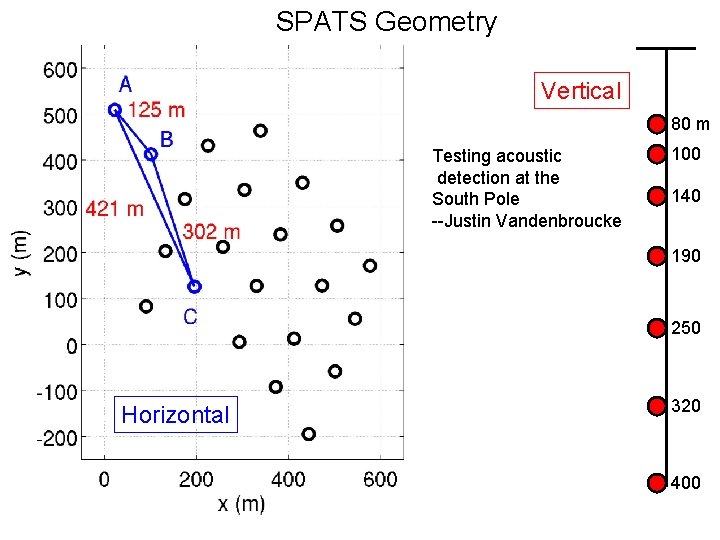
SPATS Geometry Vertical 80 m Testing acoustic detection at the South Pole --Justin Vandenbroucke 100 140 190 250 Horizontal 320 400
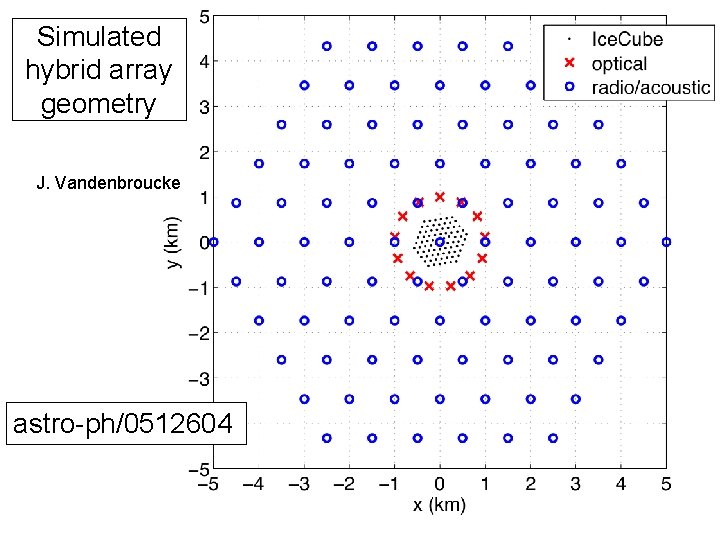
Simulated hybrid array geometry J. Vandenbroucke astro-ph/0512604
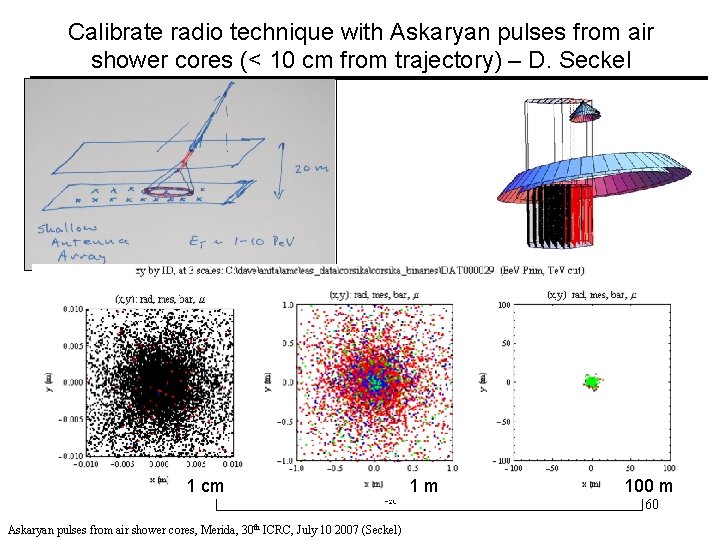
Calibrate radio technique with Askaryan pulses from air shower cores (< 10 cm from trajectory) – D. Seckel 1 cm 1 m 100 m 60 Askaryan pulses from air shower cores, Merida, 30 th ICRC, July 10 2007 (Seckel)
Sensitivity and limits S. Barwick, ARIANNA Merida, July 11, 2007 N. Busca Tom Gaisser 61
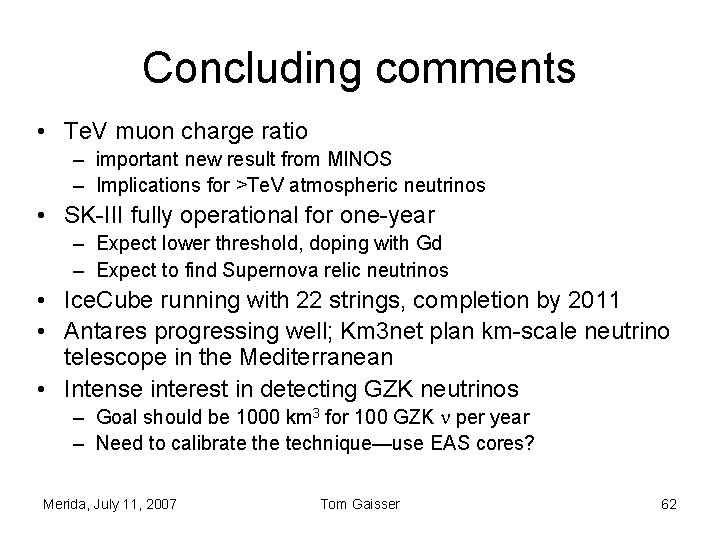
Concluding comments • Te. V muon charge ratio – important new result from MINOS – Implications for >Te. V atmospheric neutrinos • SK-III fully operational for one-year – Expect lower threshold, doping with Gd – Expect to find Supernova relic neutrinos • Ice. Cube running with 22 strings, completion by 2011 • Antares progressing well; Km 3 net plan km-scale neutrino telescope in the Mediterranean • Intense interest in detecting GZK neutrinos – Goal should be 1000 km 3 for 100 GZK per year – Need to calibrate the technique—use EAS cores? Merida, July 11, 2007 Tom Gaisser 62
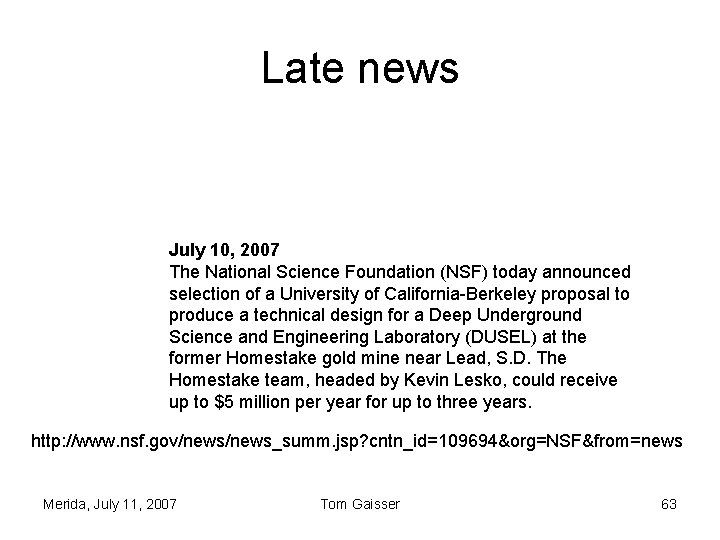
Late news July 10, 2007 The National Science Foundation (NSF) today announced selection of a University of California-Berkeley proposal to produce a technical design for a Deep Underground Science and Engineering Laboratory (DUSEL) at the former Homestake gold mine near Lead, S. D. The Homestake team, headed by Kevin Lesko, could receive up to $5 million per year for up to three years. http: //www. nsf. gov/news_summ. jsp? cntn_id=109694&org=NSF&from=news Merida, July 11, 2007 Tom Gaisser 63
Extras Merida, July 11, 2007 Tom Gaisser 64
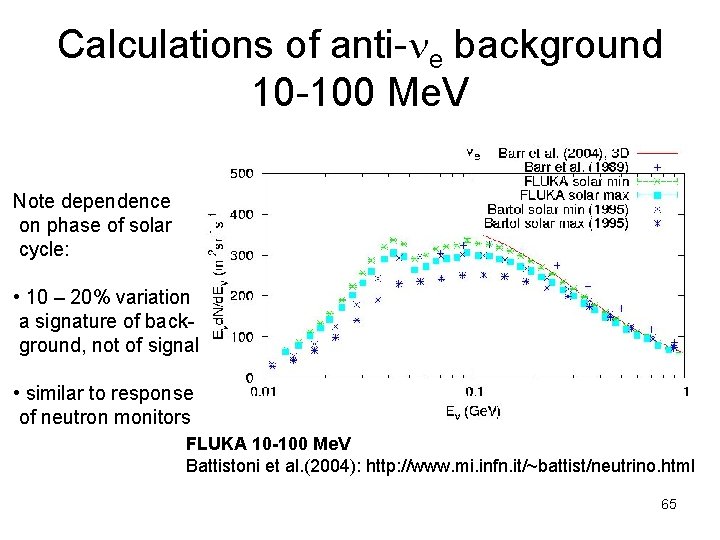
Calculations of anti- e background 10 -100 Me. V Note dependence on phase of solar cycle: • 10 – 20% variation a signature of background, not of signal • similar to response of neutron monitors FLUKA 10 -100 Me. V Battistoni et al. (2004): http: //www. mi. infn. it/~battist/neutrino. html 65