
Beam Instabilities at the ISIS Neutron Muon Source
Beam Instabilities at the ISIS Neutron & Muon Source Rob Williamson Supervisors: Chris Warsop (ISIS), Ivan Konoplev (JAI)
Contents • Introduction • ISIS Synchrotron • Loss Mechanisms at ISIS • Head-tail R&D • Damping Systems • Summary and Plans
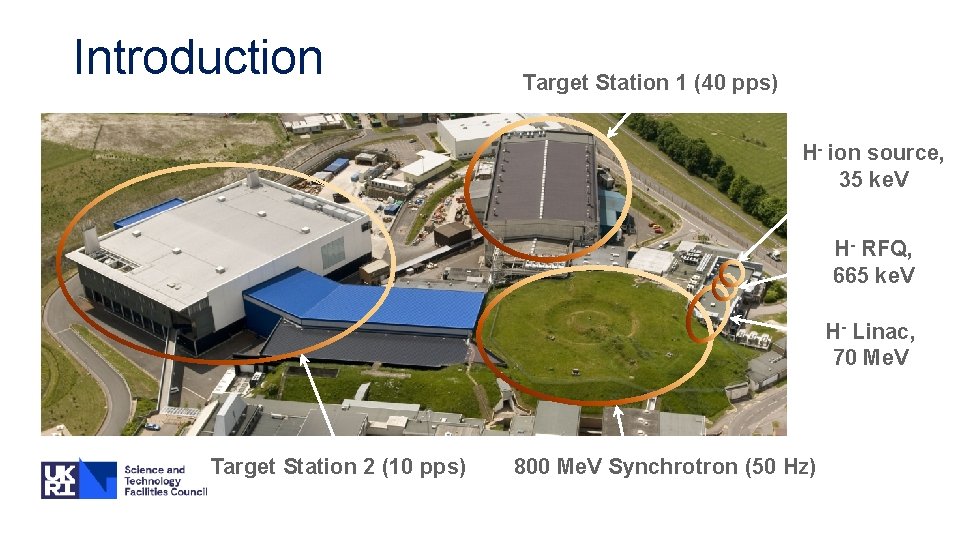
Introduction Target Station 1 (40 pps) H- ion source, 35 ke. V H- RFQ, 665 ke. V H- Linac, 70 Me. V Target Station 2 (10 pps) 800 Me. V Synchrotron (50 Hz)
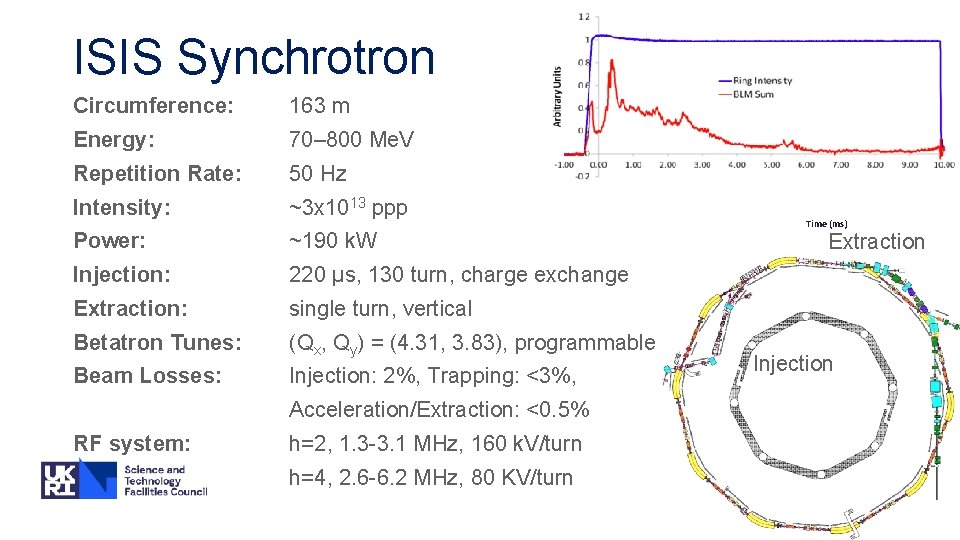
ISIS Synchrotron Circumference: 163 m Energy: 70– 800 Me. V Repetition Rate: 50 Hz Intensity: ~3 x 10¹³ ppp Power: ~190 k. W Injection: 220 µs, 130 turn, charge exchange Extraction: single turn, vertical Betatron Tunes: (Qx, Qy) = (4. 31, 3. 83), programmable Beam Losses: Injection: 2%, Trapping: <3%, Acceleration/Extraction: <0. 5% RF system: h=2, 1. 3 -3. 1 MHz, 160 k. V/turn h=4, 2. 6 -6. 2 MHz, 80 KV/turn Time (ms) Extraction Injection
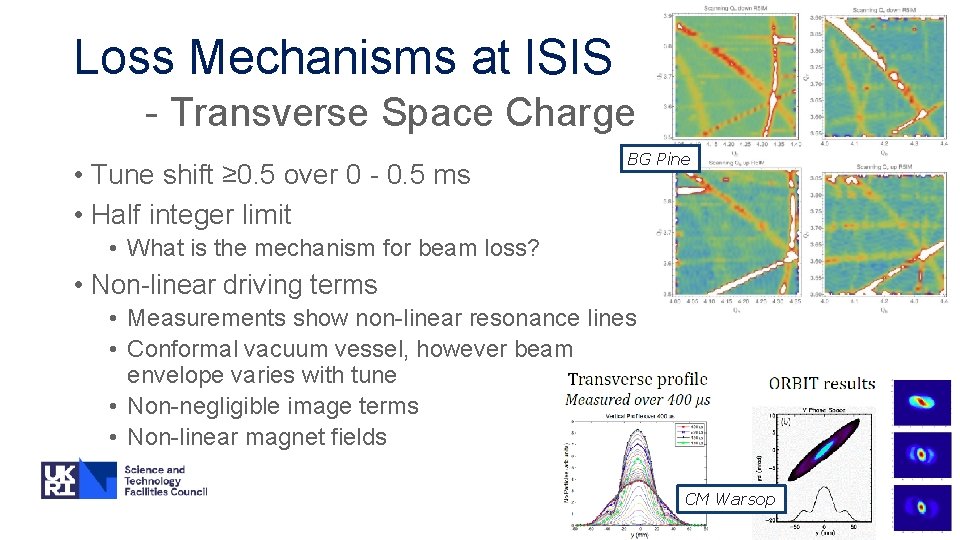
Loss Mechanisms at ISIS - Transverse Space Charge • Tune shift ≥ 0. 5 over 0 - 0. 5 ms • Half integer limit BG Pine • What is the mechanism for beam loss? • Non-linear driving terms • Measurements show non-linear resonance lines • Conformal vacuum vessel, however beam envelope varies with tune • Non-negligible image terms • Non-linear magnet fields CM Warsop
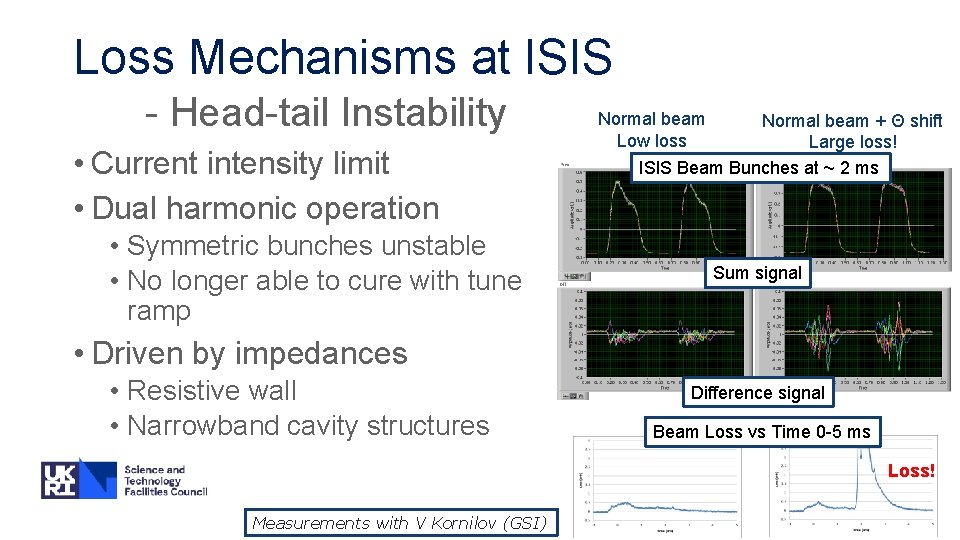
Loss Mechanisms at ISIS - Head-tail Instability • Current intensity limit • Dual harmonic operation • Symmetric bunches unstable • No longer able to cure with tune ramp Normal beam Low loss Normal beam + Θ shift Large loss! ISIS Beam Bunches at ~ 2 ms Sum signal • Driven by impedances • Resistive wall • Narrowband cavity structures Difference signal Beam Loss vs Time 0 -5 ms Loss! Measurements with V Kornilov (GSI)
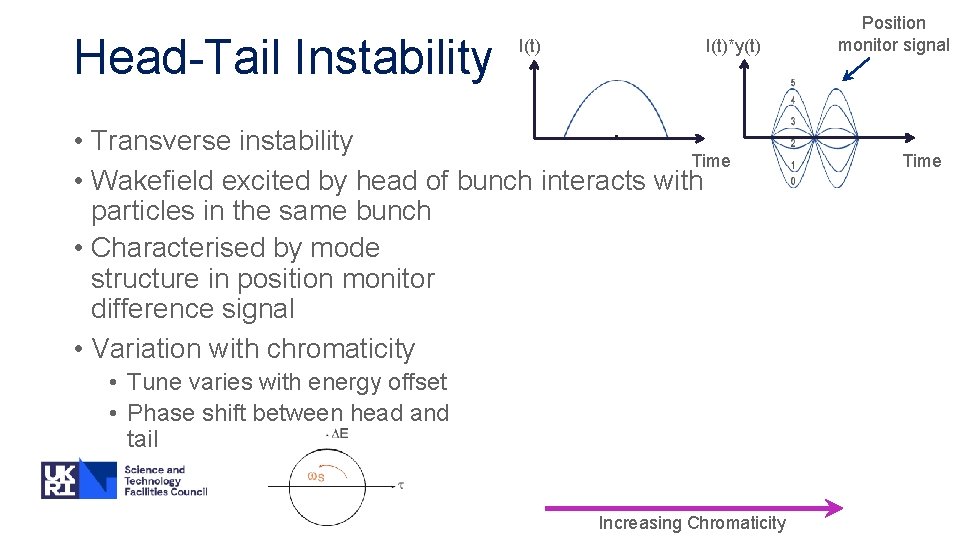
Head-Tail Instability I(t)*y(t) • Transverse instability Time • Wakefield excited by head of bunch interacts with particles in the same bunch • Characterised by mode structure in position monitor difference signal • Variation with chromaticity • Tune varies with energy offset • Phase shift between head and tail Increasing Chromaticity Position monitor signal Time
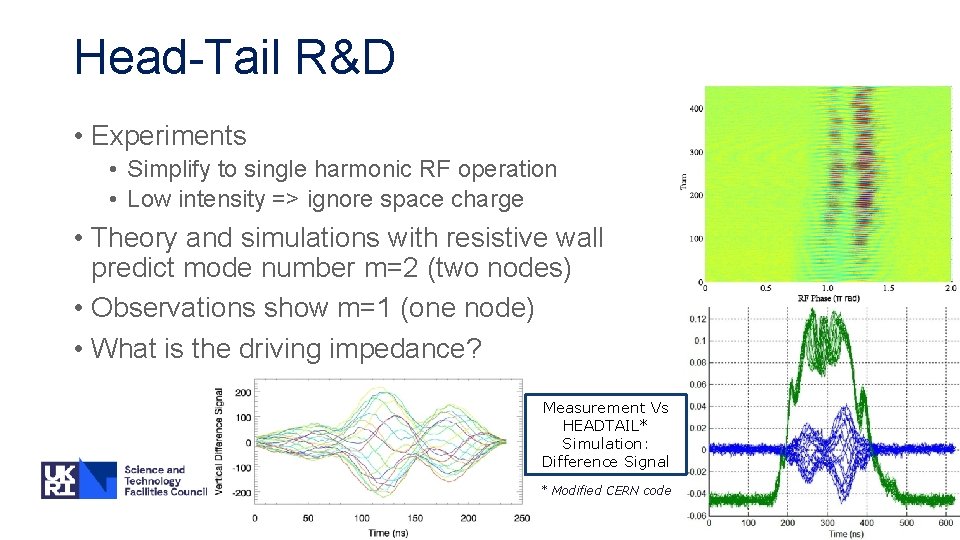
Head-Tail R&D • Experiments • Simplify to single harmonic RF operation • Low intensity => ignore space charge • Theory and simulations with resistive wall predict mode number m=2 (two nodes) • Observations show m=1 (one node) • What is the driving impedance? Measurement Vs HEADTAIL* Simulation: Difference Signal * Modified CERN code
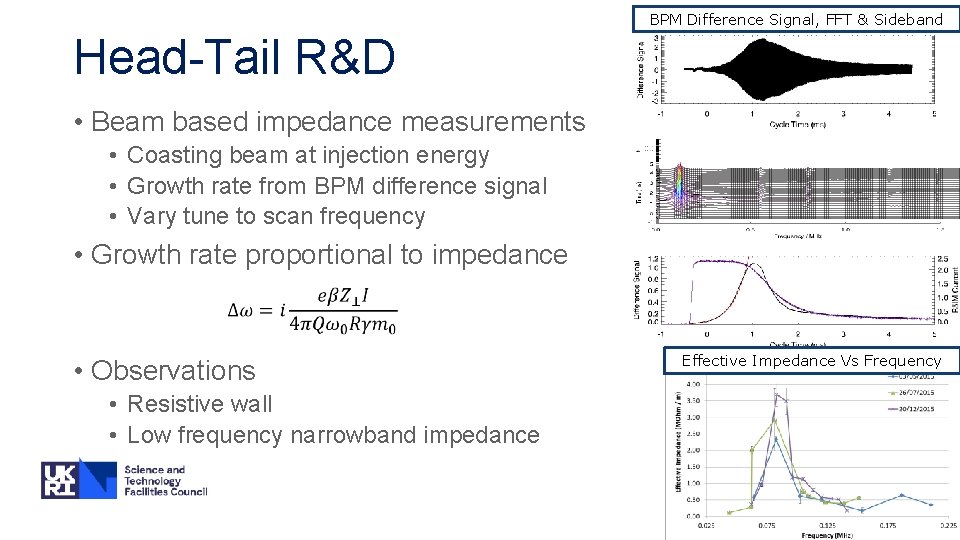
BPM Difference Signal, FFT & Sideband Head-Tail R&D • Beam based impedance measurements • Coasting beam at injection energy • Growth rate from BPM difference signal • Vary tune to scan frequency • Growth rate proportional to impedance • Observations • Resistive wall • Low frequency narrowband impedance Effective Impedance Vs Frequency
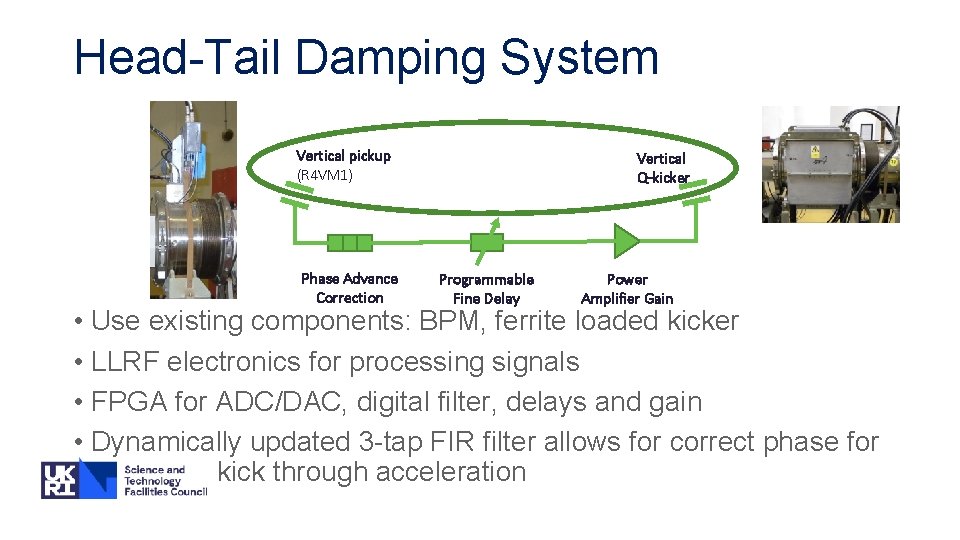
Head-Tail Damping System Vertical pickup (R 4 VM 1) Phase Advance Correction Vertical Q-kicker Programmable Fine Delay Power Amplifier Gain • Use existing components: BPM, ferrite loaded kicker • LLRF electronics for processing signals • FPGA for ADC/DAC, digital filter, delays and gain • Dynamically updated 3 -tap FIR filter allows for correct phase for kick through acceleration
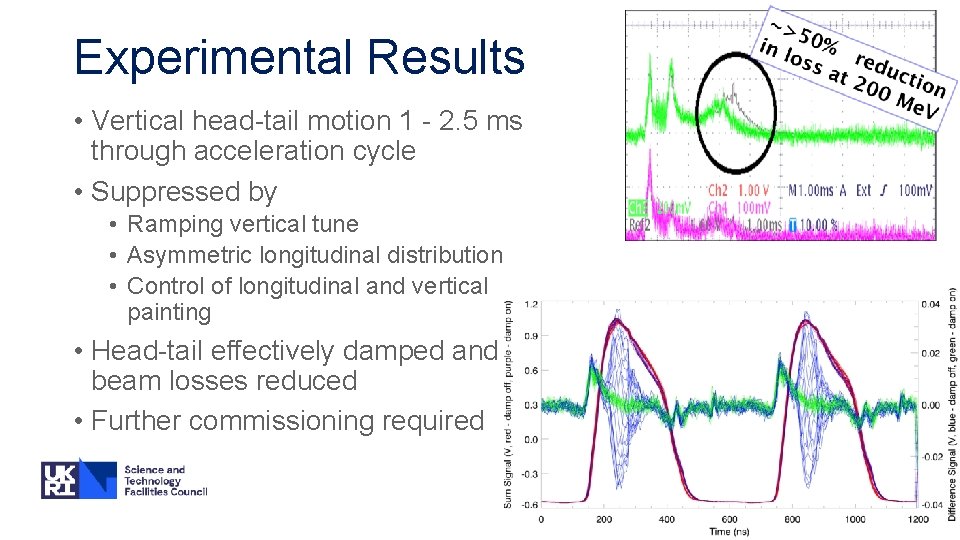
Experimental Results • Vertical head-tail motion 1 - 2. 5 ms through acceleration cycle • Suppressed by • Ramping vertical tune • Asymmetric longitudinal distribution • Control of longitudinal and vertical painting • Head-tail effectively damped and beam losses reduced • Further commissioning required
Summary • High intensity R&D is an important subject of study for ISIS and future high intensity proton machines • Half integer studies • Image effects • Non-linear magnet terms Head-Tail Studies • Experiments • Measurements of the instability at ISIS • Impedance measurements • Simulations • Development/implementation of in-house code • Impedance modelling • Damping System Plans • Improve simulation model & compare with experiment • Improve machine model to aid in impedance diagnosis and damping operation • Automatic tune measurement

- Slides: 13