
Probing neutrinos with 0 n decay Ruben Saakyan
Probing neutrinos with 0 n decay Ruben Saakyan UCL Swansea 31 January 2006
Preview Neutrino oscillations, 0 nbb decay and neutrino mass n bb decay basics n Running experiments n Status of “evidence” n Future projects n
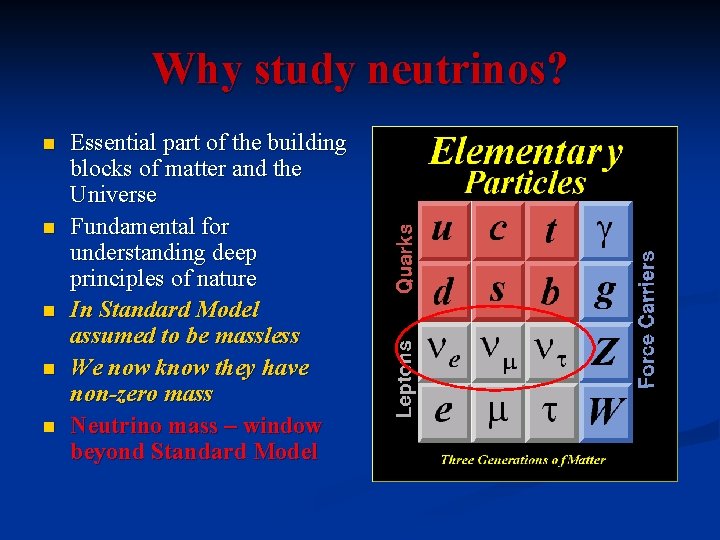
Why study neutrinos? n n n Essential part of the building blocks of matter and the Universe Fundamental for understanding deep principles of nature In Standard Model assumed to be massless We now know they have non-zero mass Neutrino mass – window beyond Standard Model
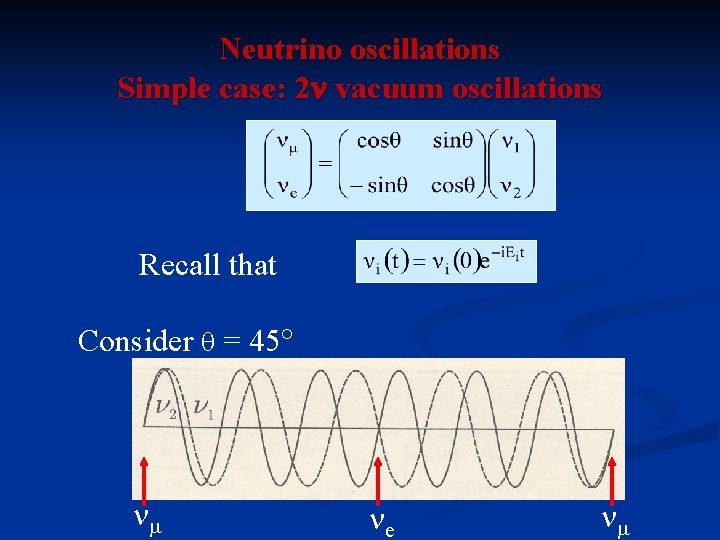
Neutrino oscillations Simple case: 2 n vacuum oscillations Recall that Consider = 45 nm ne nm
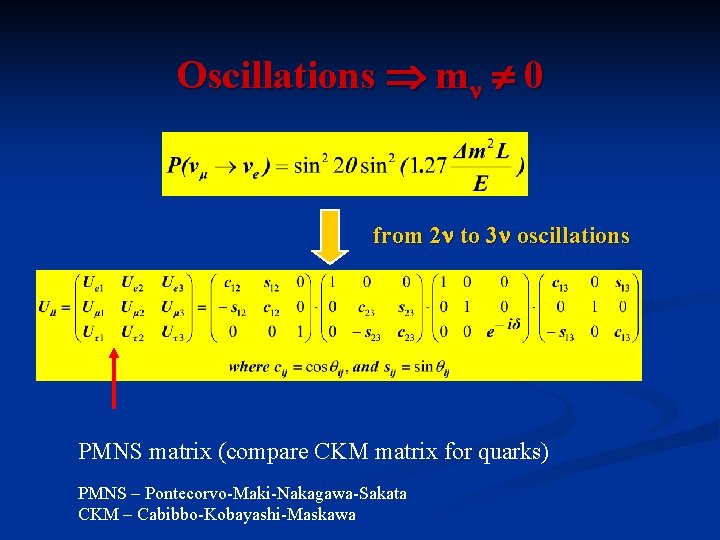
Oscillations mn 0 from 2 n to 3 n oscillations PMNS matrix (compare CKM matrix for quarks) PMNS – Pontecorvo-Maki-Nakagawa-Sakata CKM – Cabibbo-Kobayashi-Maskawa
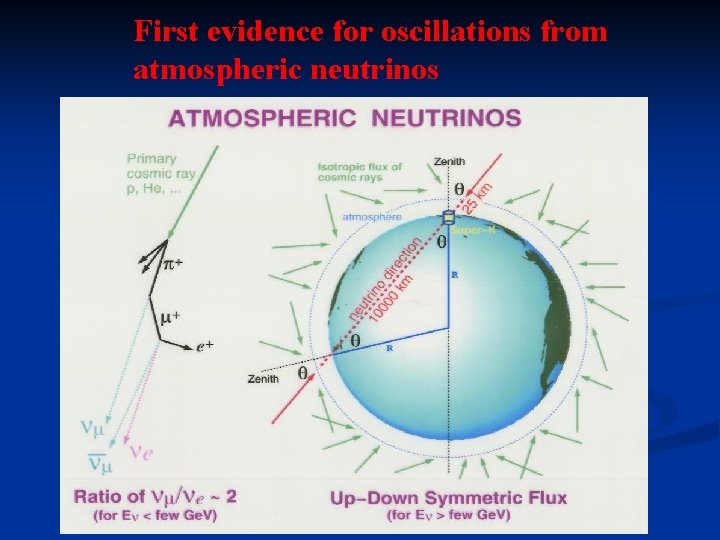
First evidence for oscillations from atmospheric neutrinos
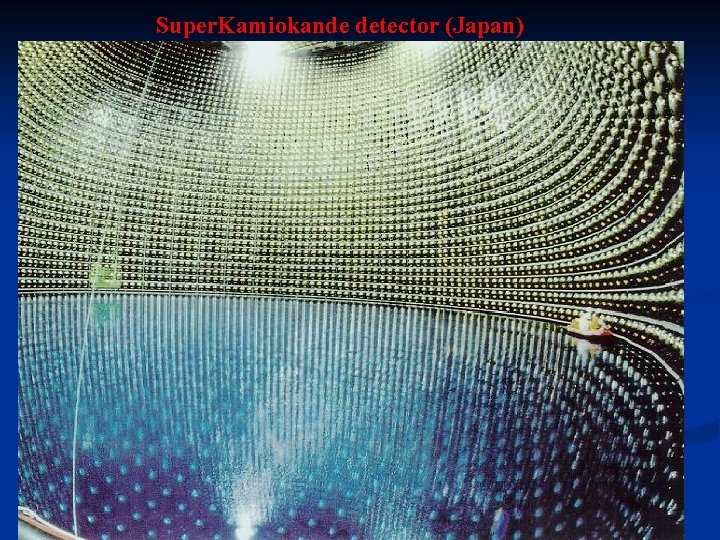
Super. Kamiokande detector (Japan)
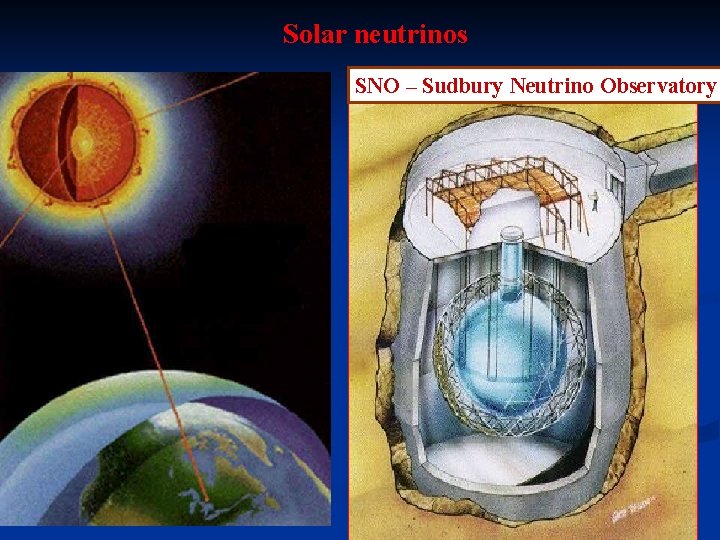
Solar neutrinos SNO – Sudbury Neutrino Observatory
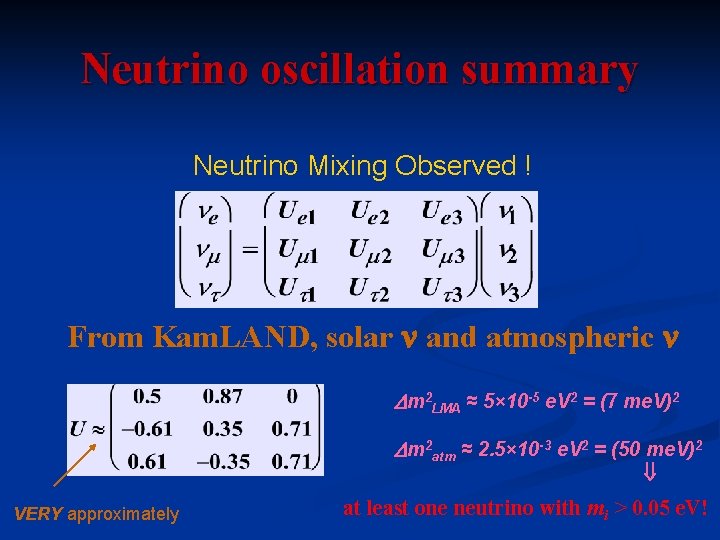
Neutrino oscillation summary Neutrino Mixing Observed ! From Kam. LAND, solar n and atmospheric n Dm 2 LMA ≈ 5× 10 -5 e. V 2 = (7 me. V)2 Dm 2 atm ≈ 2. 5× 10 -3 e. V 2 = (50 me. V)2 VERY approximately at least one neutrino with mi > 0. 05 e. V!
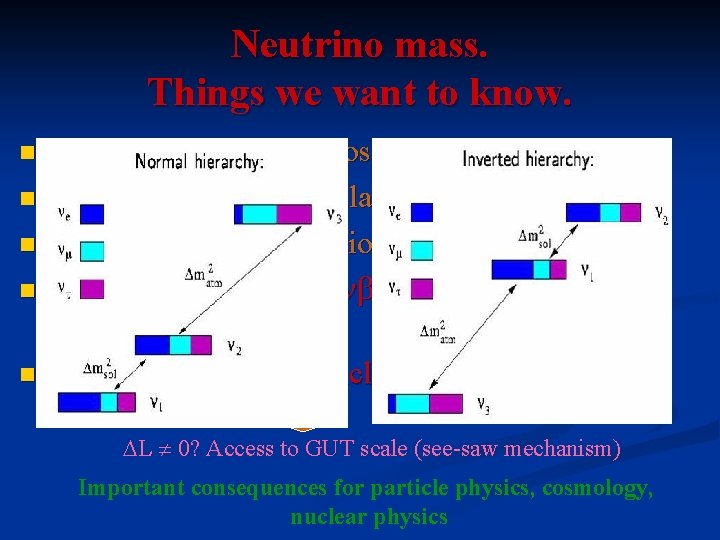
Neutrino mass. Things we want to know. Relative mass scale (n-oscillations) n Mass hierarchy (n-oscillations, 0 nbb) n CP-violation (n-oscillations, 0 nbb) n Absolute mass scale (0 nbb, 3 H-decay, cosmology) n Dirac or Majorana particle (0 nbb only) n DL 0? Access to GUT scale (see-saw mechanism) Important consequences for particle physics, cosmology, nuclear physics
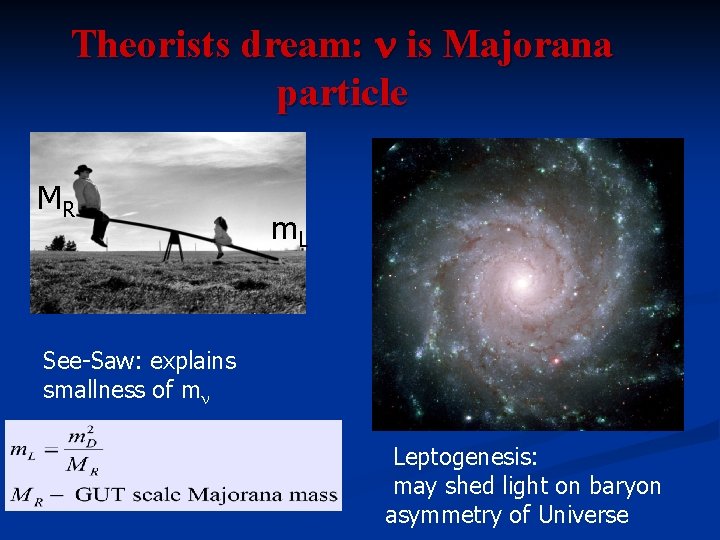
Theorists dream: n is Majorana particle MR m. L See-Saw: explains smallness of mn Leptogenesis: may shed light on baryon asymmetry of Universe

Standard Model 2 n Decay Excited state decays possible Q Phase space ~Qbb 11 |M| - NME, very hard to calculate but in case of 2 nbb can be measured experimentally 2 nbb has been observed for 10 nuclei NME In many even-even nuclei, decay is energetically forbidden. This leaves as the allowed decay mode.
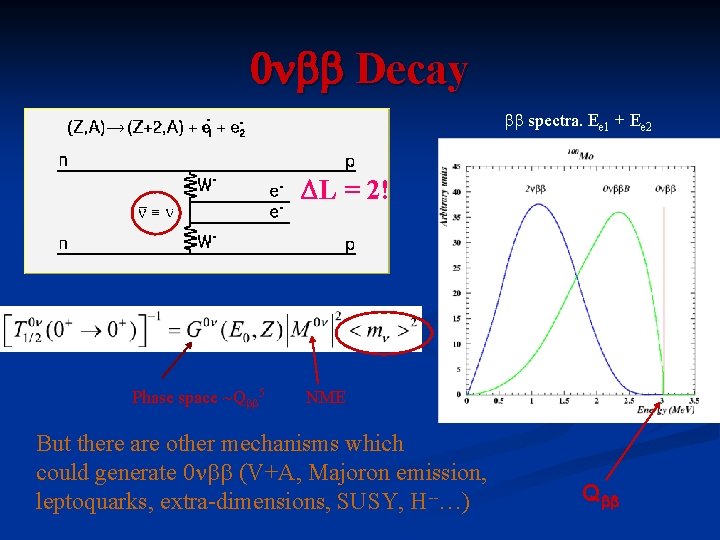
0 n Decay bb spectra. Ee 1 + Ee 2 DL = 2! Phase space ~Qbb 5 NME But there are other mechanisms which could generate 0 nbb (V+A, Majoron emission, leptoquarks, extra-dimensions, SUSY, H--…) Q
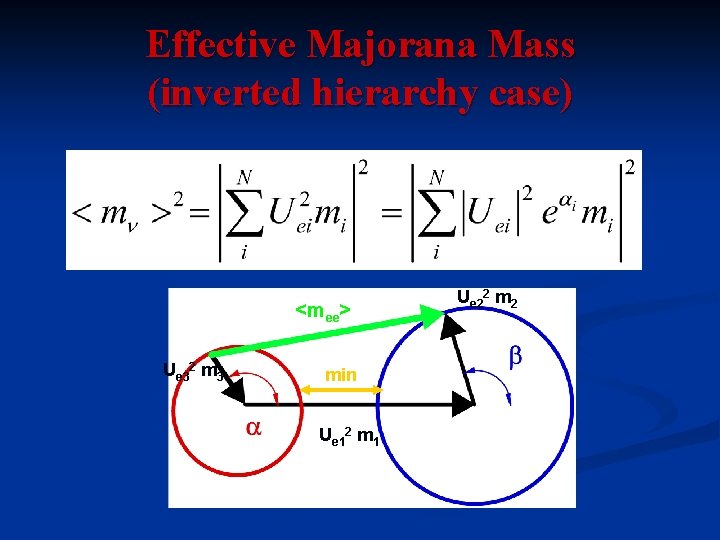
Effective Majorana Mass (inverted hierarchy case) <mee> Ue 32 m 3 min Ue 12 m 1 Ue 22 m 2
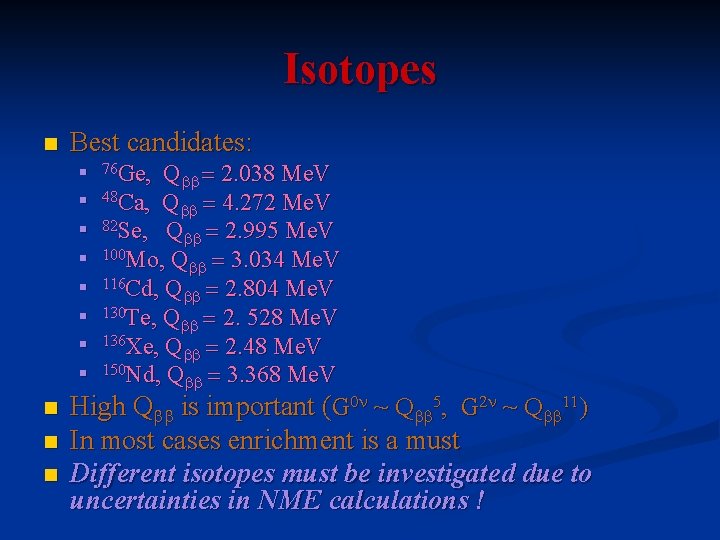
Isotopes n Best candidates: n n n 76 Ge, Q = 2. 038 Me. V bb 48 Ca, Q = 4. 272 Me. V bb 82 Se, Q = 2. 995 Me. V bb 100 Mo, Q = 3. 034 Me. V bb 116 Cd, Q = 2. 804 Me. V bb 130 Te, Q = 2. 528 Me. V bb 136 Xe, Q = 2. 48 Me. V bb 150 Nd, Q = 3. 368 Me. V bb High Qbb is important (G 0 n ~ Qbb 5, G 2 n ~ Qbb 11) In most cases enrichment is a must Different isotopes must be investigated due to uncertainties in NME calculations !
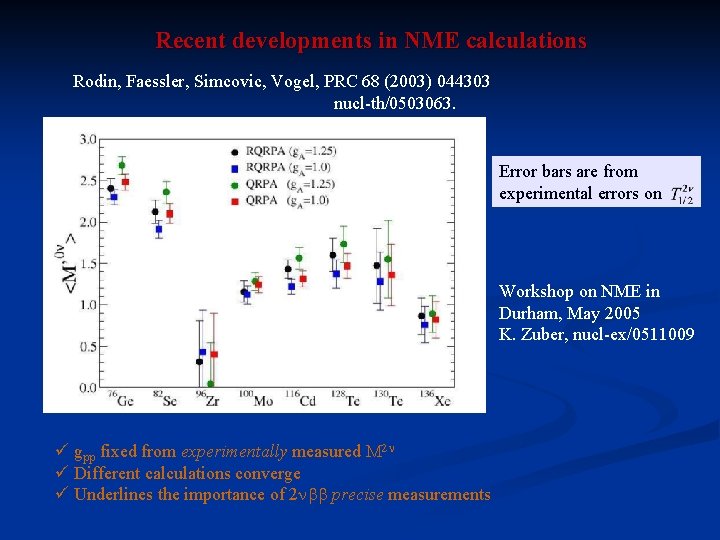
Recent developments in NME calculations Rodin, Faessler, Simcovic, Vogel, PRC 68 (2003) 044303 nucl-th/0503063. Error bars are from experimental errors on Workshop on NME in Durham, May 2005 K. Zuber, nucl-ex/0511009 ü gpp fixed from experimentally measured M 2 n ü Different calculations converge ü Underlines the importance of 2 nbb precise measurements
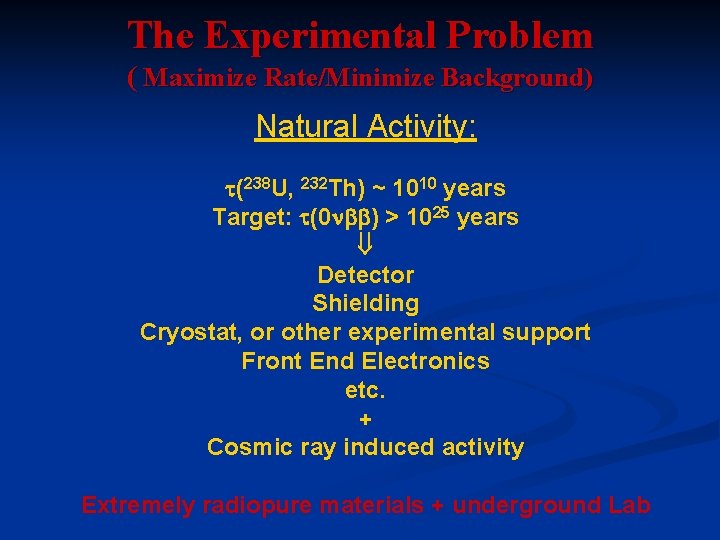
The Experimental Problem ( Maximize Rate/Minimize Background) Natural Activity: t(238 U, 232 Th) ~ 1010 years Target: t(0 n ) > 1025 years Detector Shielding Cryostat, or other experimental support Front End Electronics etc. + Cosmic ray induced activity Extremely radiopure materials + underground Lab
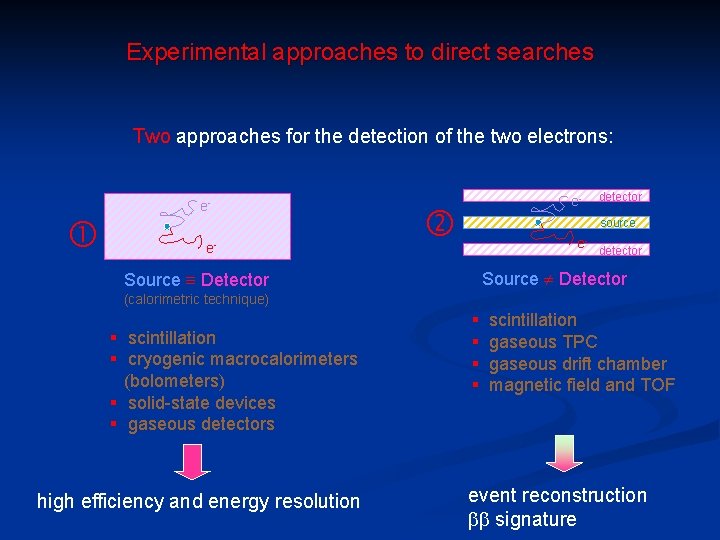
Experimental approaches to direct searches Two approaches for the detection of the two electrons: e- e- e- detector source e- detector Source Detector (calorimetric technique) § scintillation § cryogenic macrocalorimeters (bolometers) § solid-state devices § gaseous detectors high efficiency and energy resolution § § scintillation gaseous TPC gaseous drift chamber magnetic field and TOF event reconstruction bb signature
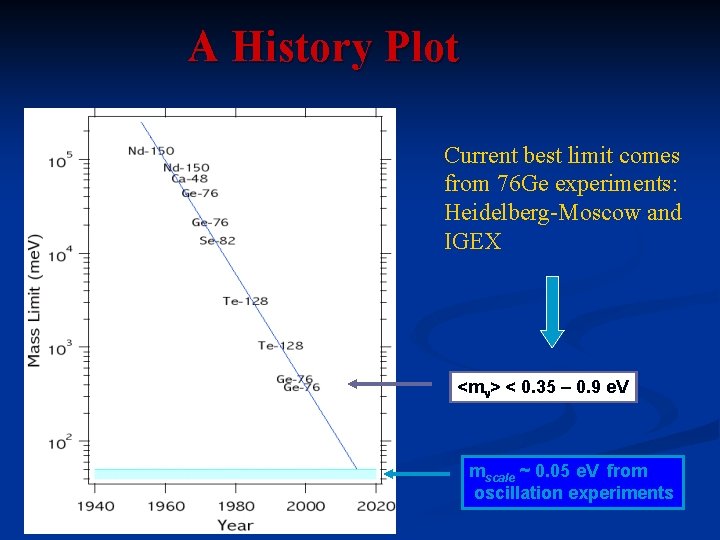
A History Plot Current best limit comes from 76 Ge experiments: Heidelberg-Moscow and IGEX <mn> < 0. 35 – 0. 9 e. V mscale ~ 0. 05 e. V from oscillation experiments
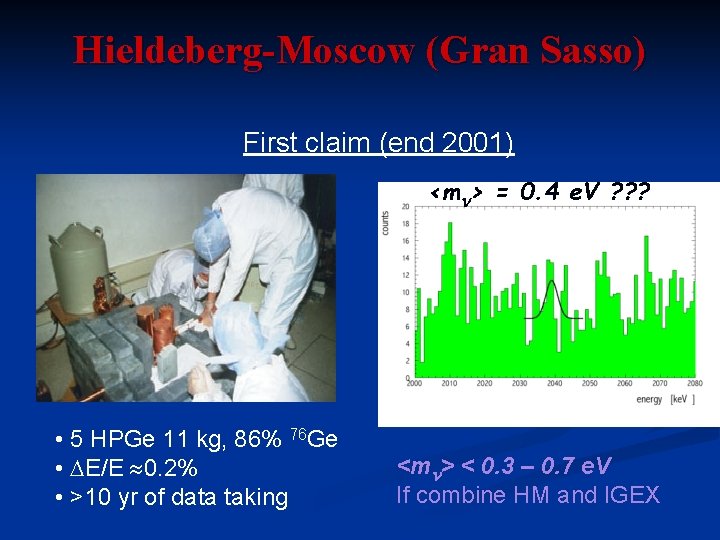
Hieldeberg-Moscow (Gran Sasso) First claim (end 2001) <mn> = 0. 4 e. V ? ? ? • 5 HPGe 11 kg, 86% 76 Ge • DE/E 0. 2% • >10 yr of data taking <mn> < 0. 3 – 0. 7 e. V If combine HM and IGEX
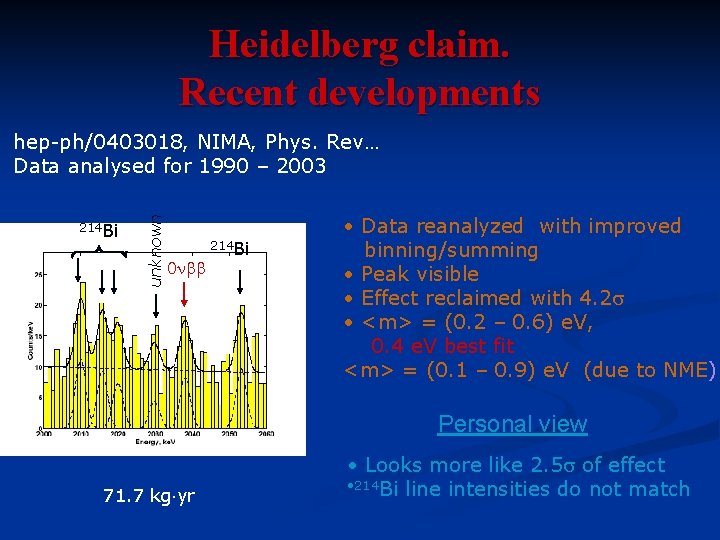
Heidelberg claim. Recent developments 214 Bi unknown hep-ph/0403018, NIMA, Phys. Rev… Data analysed for 1990 – 2003 0 nbb 214 Bi • Data reanalyzed with improved binning/summing • Peak visible • Effect reclaimed with 4. 2 s • <m> = (0. 2 – 0. 6) e. V, 0. 4 e. V best fit <m> = (0. 1 – 0. 9) e. V (due to NME) Personal view 71. 7 kg yr • Looks more like 2. 5 s of effect • 214 Bi line intensities do not match
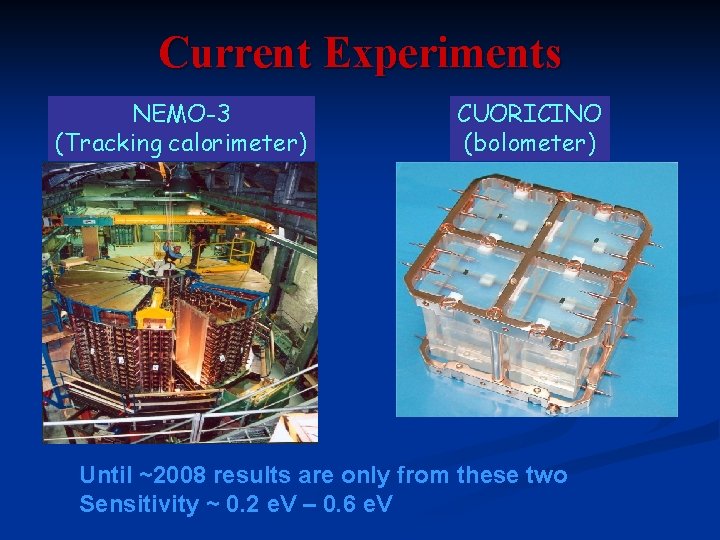
Current Experiments NEMO-3 (Tracking calorimeter) CUORICINO (bolometer) Until ~2008 results are only from these two Sensitivity ~ 0. 2 e. V – 0. 6 e. V
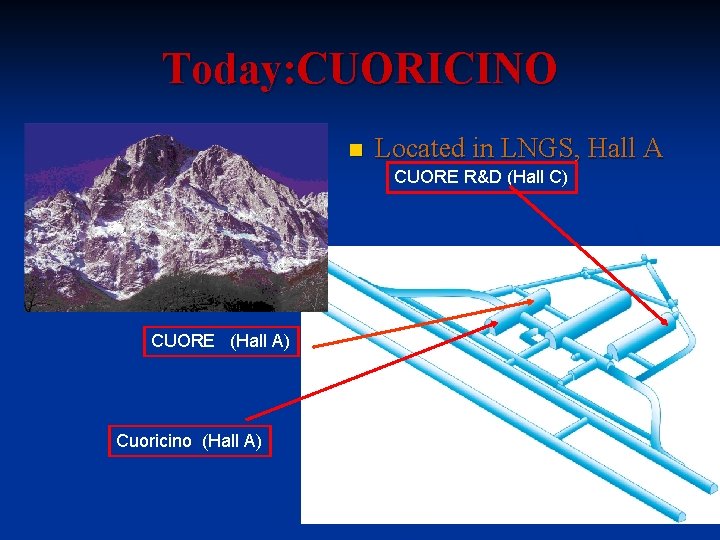
Today: CUORICINO n Located in LNGS, Hall A CUORE R&D (Hall C) CUORE (Hall A) Cuoricino (Hall A)
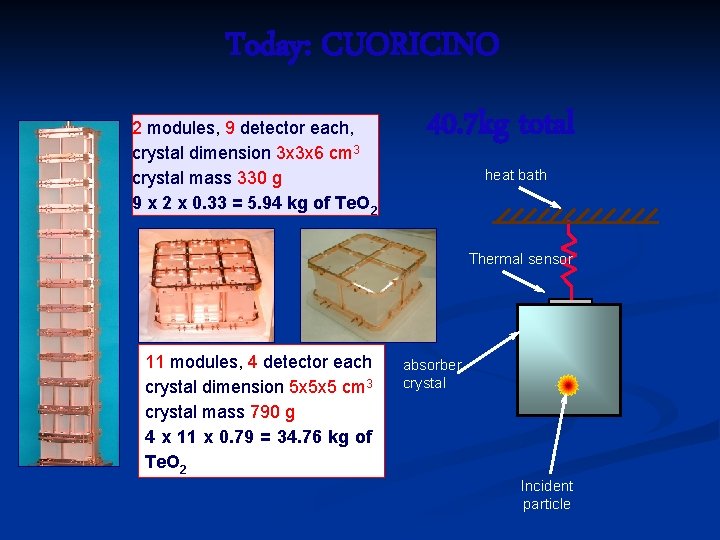
Today: CUORICINO 2 modules, 9 detector each, crystal dimension 3 x 3 x 6 cm 3 crystal mass 330 g 9 x 2 x 0. 33 = 5. 94 kg of Te. O 2 40. 7 kg total heat bath Thermal sensor 11 modules, 4 detector each, crystal dimension 5 x 5 x 5 cm 3 crystal mass 790 g 4 x 11 x 0. 79 = 34. 76 kg of Te. O 2 absorber crystal Incident particle
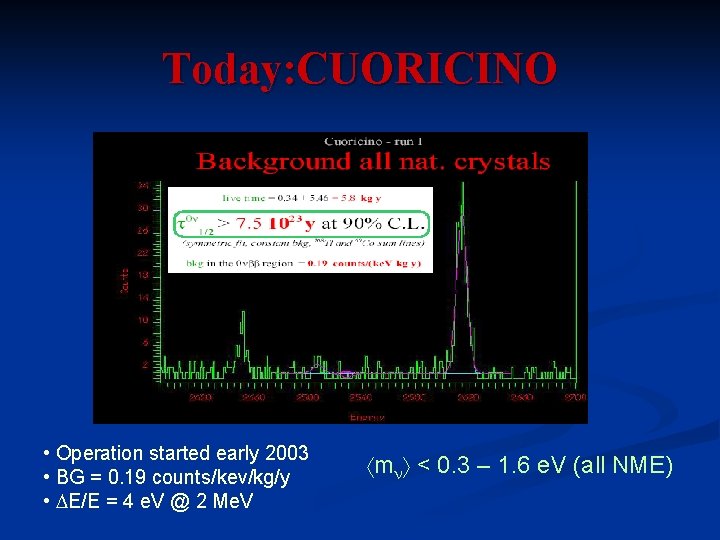
Today: CUORICINO • Operation started early 2003 • BG = 0. 19 counts/kev/kg/y • DE/E = 4 e. V @ 2 Me. V mn < 0. 3 – 1. 6 e. V (all NME)
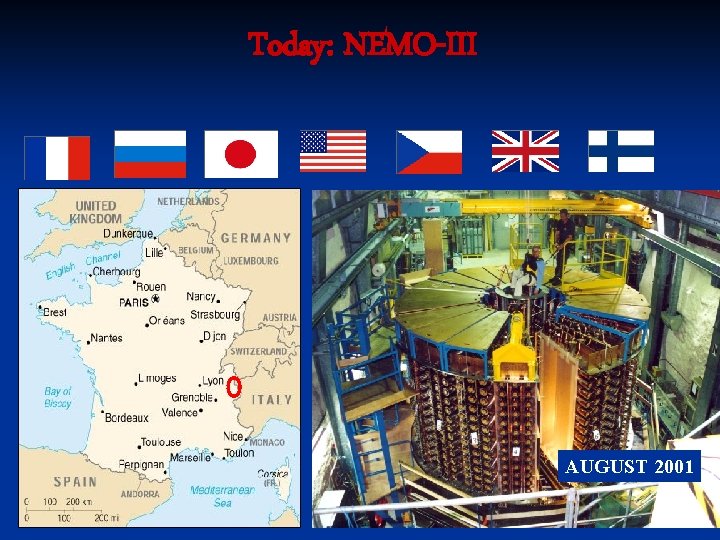
Today: NEMO-III AUGUST 2001

decay isotopes in NEMO-3 detector 2 n measurement 116 Cd 405 g Qbb = 2805 ke. V 96 Zr 9. 4 g Qbb = 3350 ke. V 150 Nd 37. 0 g Qbb = 3367 ke. V 48 Ca 7. 0 g Qbb = 4272 ke. V 130 Te 454 g Qbb = 2529 ke. V 100 Mo 6. 914 Qbb = 3034 ke. V kg 82 Se 0. 932 kg Qbb = 2995 ke. V 0 n search nat. Te 491 g External bkg measurement Cu 621 g (All enriched isotopes produced in Russia)
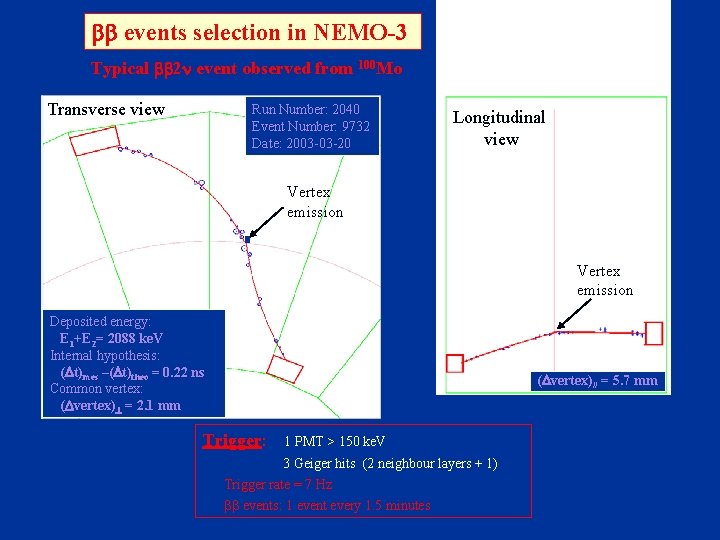
events selection in NEMO-3 Typical 2 n event observed from 100 Mo Transverse view Run Number: 2040 Event Number: 9732 Date: 2003 -03 -20 Vertex emission 100 Mo foil Longitudinal view 100 Mo foil Geiger plasma longitudinal propagation Vertex emission Drift distance Deposited energy: E 1+E 2= 2088 ke. V Internal hypothesis: (Dt)mes –(Dt)theo = 0. 22 ns Common vertex: Scintillator (Dvertex) = 2. 1+ PMT mm (Dvertex)// = 5. 7 mm Trigger: 1 PMT > 150 ke. V Criteria to select events: 3 Geiger hits (2 neighbour layers + 1) • 2 tracks with charge < 0 • Internal hypothesis (external event rejection) • 2 PMT, each > 200 ke. V Trigger rate = 7 Hz • No other isolated PMT (g rejection) • PMT-Track association bb events: 1 event every 1. 5 minutes • No delayed track (214 Bi rejection) • Common vertex
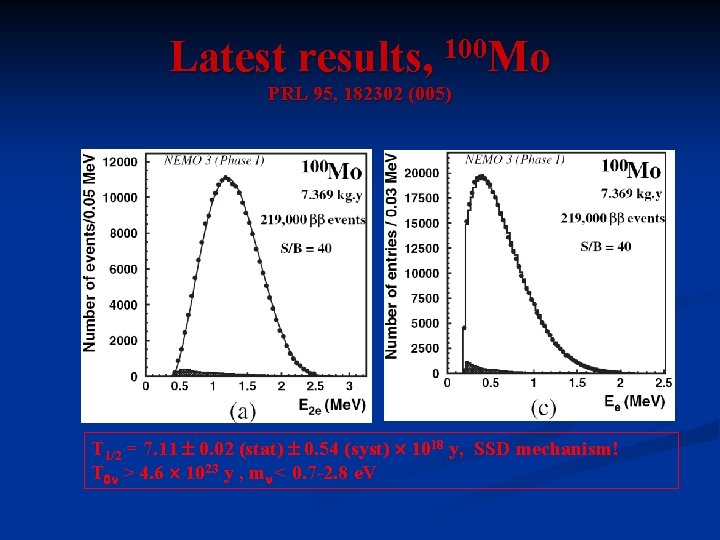
Latest results, 100 Mo PRL 95, 182302 (005) T 1/2 = 7. 11 ± 0. 02 (stat) ± 0. 54 (syst) 1018 y, SSD mechanism! T 0 n > 4. 6 1023 y , mn < 0. 7 -2. 8 e. V
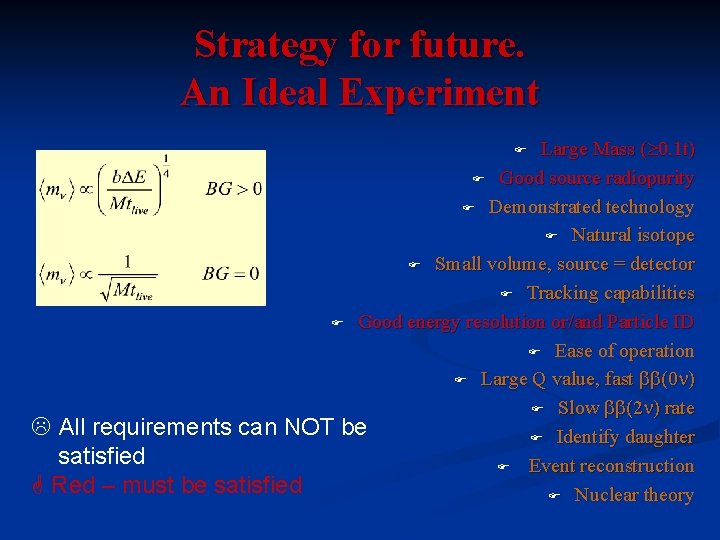
Strategy for future. An Ideal Experiment Large Mass ( 0. 1 t) F Good source radiopurity F Demonstrated technology F Natural isotope F Small volume, source = detector F Tracking capabilities F Good energy resolution or/and Particle ID F Ease of operation F Large Q value, fast bb(0 n) F Slow bb(2 n) rate L All requirements can NOT be F Identify daughter satisfied F Event reconstruction G Red – must be satisfied F Nuclear theory F
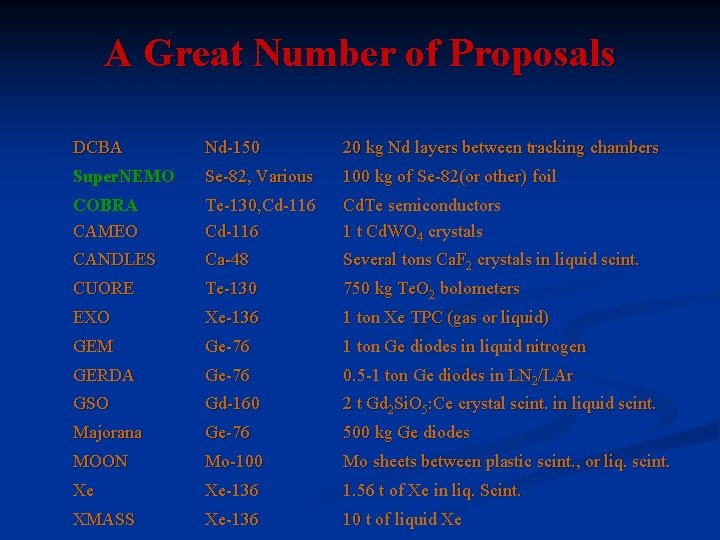
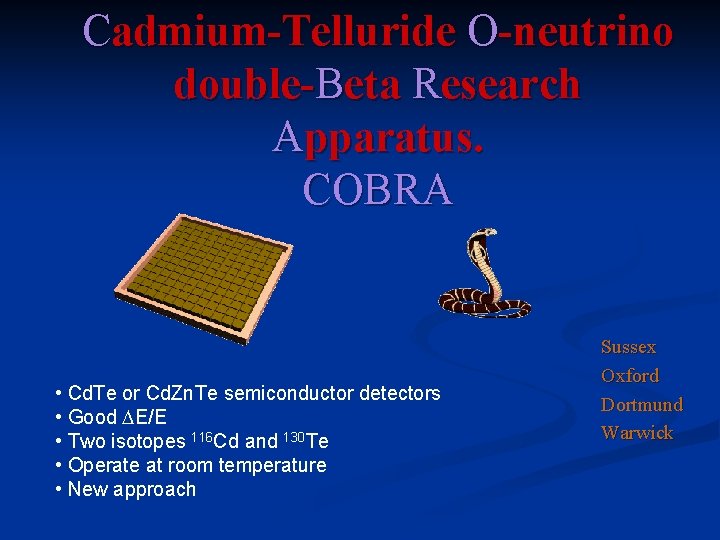
A Great Number of Proposals DCBA Nd-150 20 kg Nd layers between tracking chambers Super. NEMO Se-82, Various 100 kg of Se-82(or other) foil COBRA CAMEO Te-130, Cd-116 Cd. Te semiconductors 1 t Cd. WO 4 crystals CANDLES Ca-48 Several tons Ca. F 2 crystals in liquid scint. CUORE Te-130 750 kg Te. O 2 bolometers EXO Xe-136 1 ton Xe TPC (gas or liquid) GEM Ge-76 1 ton Ge diodes in liquid nitrogen GERDA Ge-76 0. 5 -1 ton Ge diodes in LN 2/LAr GSO Gd-160 2 t Gd 2 Si. O 5: Ce crystal scint. in liquid scint. Majorana Ge-76 500 kg Ge diodes MOON Mo-100 Mo sheets between plastic scint. , or liq. scint. Xe Xe-136 1. 56 t of Xe in liq. Scint. XMASS Xe-136 10 t of liquid Xe
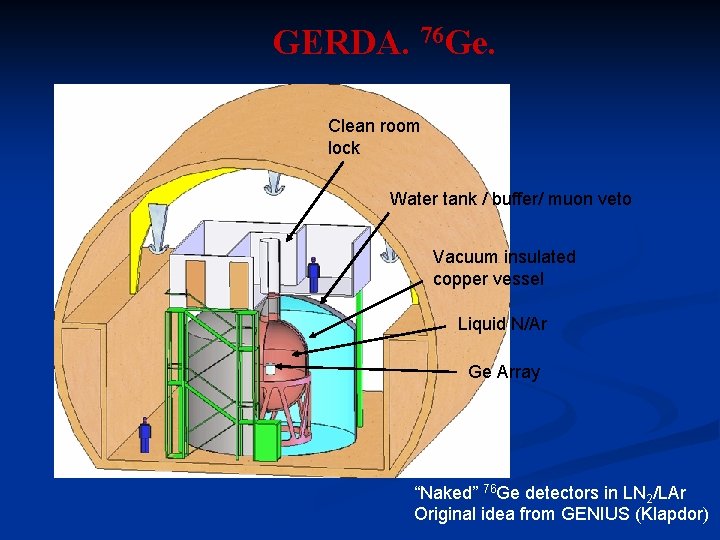
GERDA. 76 Ge. Clean room lock Water tank / buffer/ muon veto Vacuum insulated copper vessel Liquid N/Ar Ge Array “Naked” 76 Ge detectors in LN 2/LAr Original idea from GENIUS (Klapdor)

GERDA. 76 Ge n Phase I: collect 76 Ge detectors from HM(11 kg)+IGEX(8 kg) 15 kg y+BG@0. 01 c/ke. V/kg/y sens-ty: 3· 1025 y, 0. 24 -0. 77 e. V Confirm Klapdor with 5 s OR rule out n n GERDA Phase I and Phase II approved Phase II: increase to ~35 -40 kg BG < 10 -3 c/ke. V/kg/y n within 4 yr ~ 100 kg y n 2· 1026 y, 0. 09 -0. 29 e. V n n Phase III: 0. 5 -1 ton n n Possible merge with Majorana >1027 y, ~ 0. 03 e. V- 0. 09 e. V Site: Gran Sasso Mostly European project
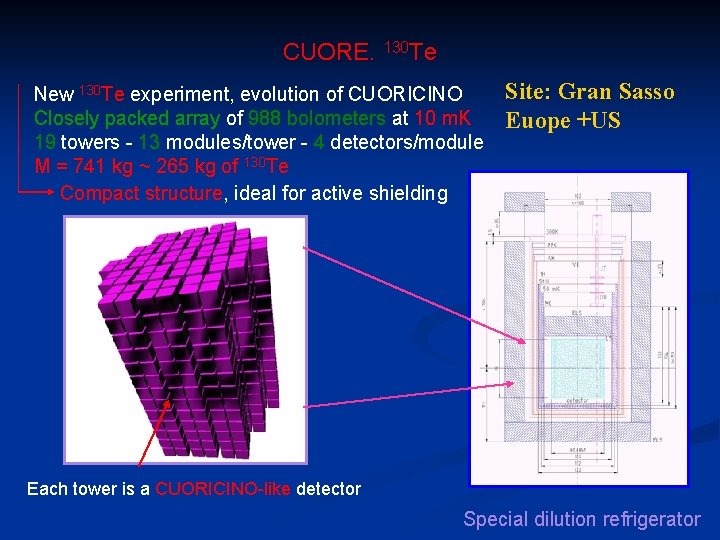
CUORE. 130 Te New 130 Te experiment, evolution of CUORICINO Closely packed array of 988 bolometers at 10 m. K 19 towers - 13 modules/tower - 4 detectors/module M = 741 kg ~ 265 kg of 130 Te Compact structure, ideal for active shielding Site: Gran Sasso Euope +US Each tower is a CUORICINO-like detector Special dilution refrigerator
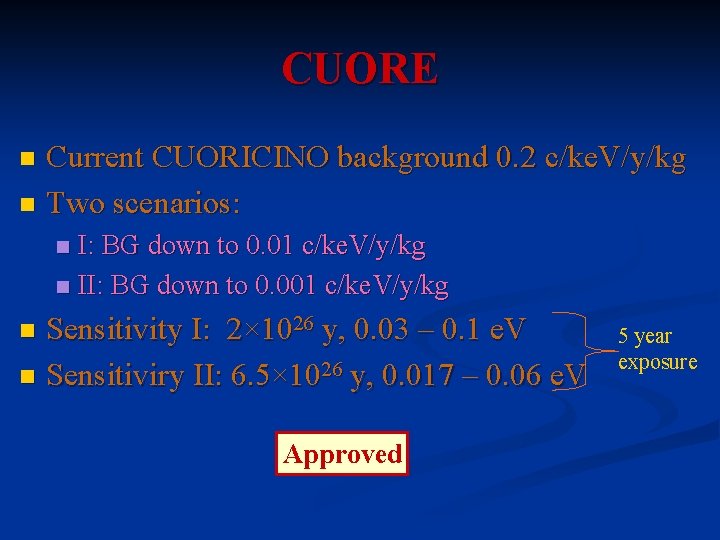
CUORE Current CUORICINO background 0. 2 c/ke. V/y/kg n Two scenarios: n I: BG down to 0. 01 c/ke. V/y/kg n II: BG down to 0. 001 c/ke. V/y/kg n Sensitivity I: 2× 1026 y, 0. 03 – 0. 1 e. V n Sensitiviry II: 6. 5× 1026 y, 0. 017 – 0. 06 e. V n Approved 5 year exposure
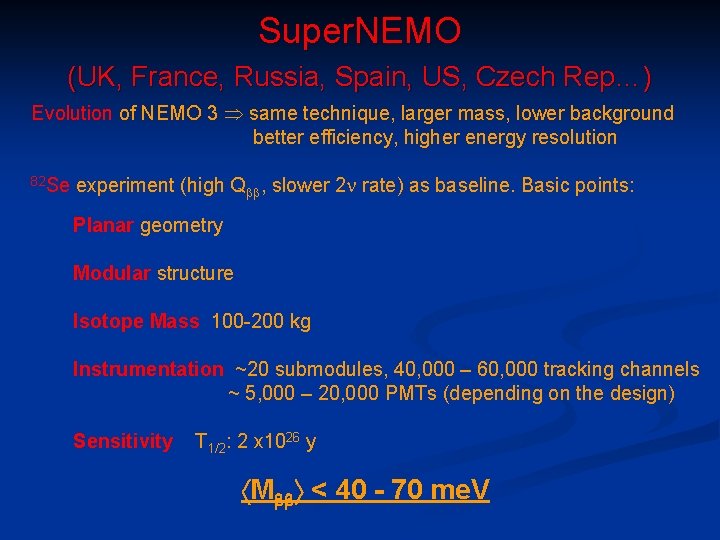
Super. NEMO (UK, France, Russia, Spain, US, Czech Rep…) Evolution of NEMO 3 same technique, larger mass, lower background better efficiency, higher energy resolution 82 Se experiment (high Qbb, slower 2 n rate) as baseline. Basic points: Planar geometry Modular structure Isotope Mass 100 -200 kg Instrumentation ~20 submodules, 40, 000 – 60, 000 tracking channels ~ 5, 000 – 20, 000 PMTs (depending on the design) Sensitivity T 1/2: 2 x 1026 y M < 40 - 70 me. V
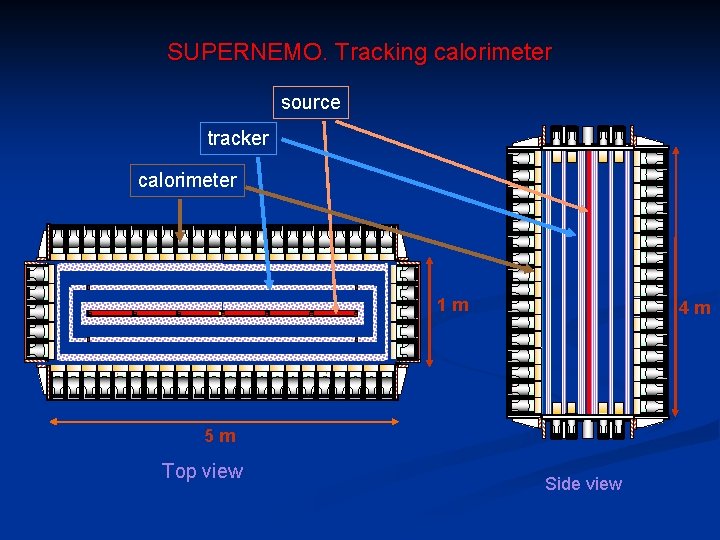
SUPERNEMO. Tracking calorimeter source tracker calorimeter 1 m 4 m 5 m Top view Side view
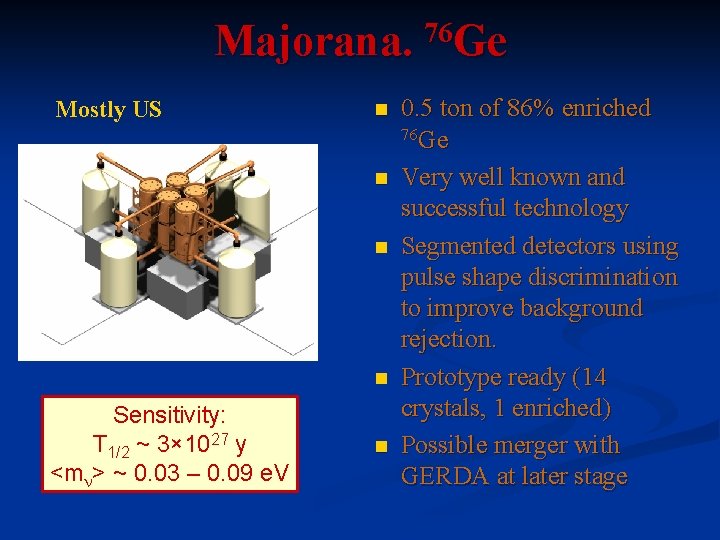
Majorana. 76 Ge Mostly US n n Sensitivity: T 1/2 ~ 3× 1027 y <mn> ~ 0. 03 – 0. 09 e. V n 0. 5 ton of 86% enriched 76 Ge Very well known and successful technology Segmented detectors using pulse shape discrimination to improve background rejection. Prototype ready (14 crystals, 1 enriched) Possible merger with GERDA at later stage
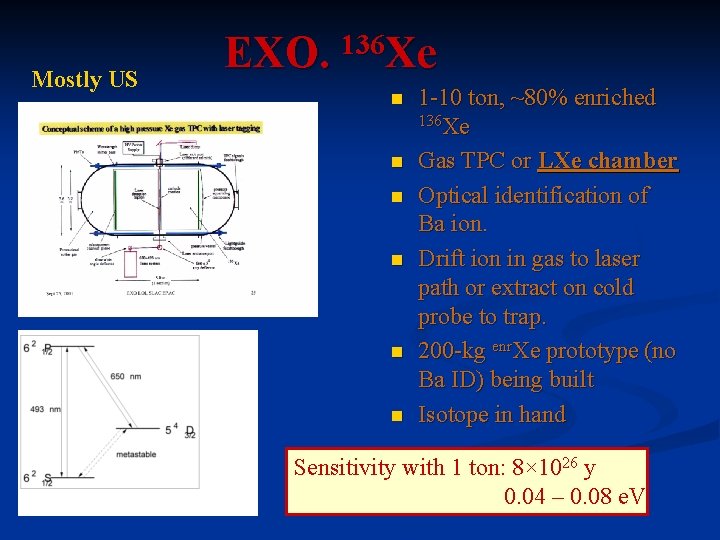
Mostly US EXO. 136 Xe n n n 1 -10 ton, ~80% enriched 136 Xe Gas TPC or LXe chamber Optical identification of Ba ion. Drift ion in gas to laser path or extract on cold probe to trap. 200 -kg enr. Xe prototype (no Ba ID) being built Isotope in hand Sensitivity with 1 ton: 8× 1026 y 0. 04 – 0. 08 e. V
Cadmium-Telluride O-neutrino double-Beta Research Apparatus. COBRA • Cd. Te or Cd. Zn. Te semiconductor detectors • Good DE/E • Two isotopes 116 Cd and 130 Te • Operate at room temperature • New approach Sussex Oxford Dortmund Warwick
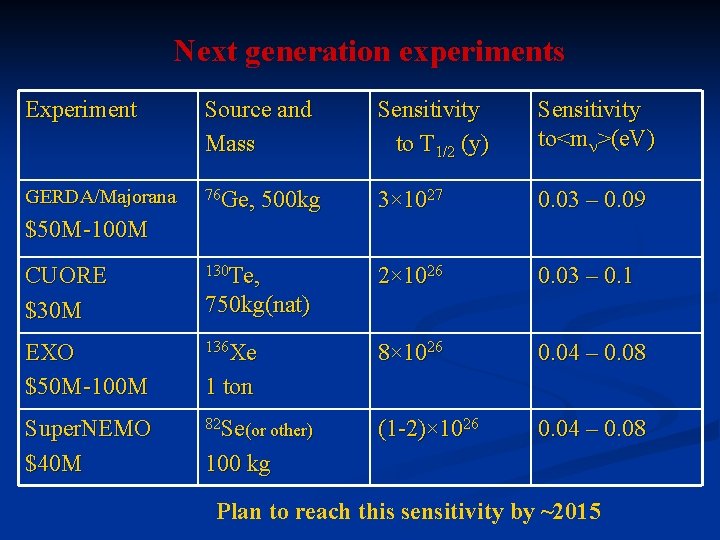
Next generation experiments Experiment Source and Mass Sensitivity to T 1/2 (y) Sensitivity to<mn>(e. V) GERDA/Majorana 76 Ge, 500 kg 3× 1027 0. 03 – 0. 09 CUORE $30 M 130 Te, 2× 1026 0. 03 – 0. 1 EXO $50 M-100 M 136 Xe 8× 1026 0. 04 – 0. 08 Super. NEMO $40 M 82 Se(or other) (1 -2)× 1026 0. 04 – 0. 08 $50 M-100 M 750 kg(nat) 1 ton 100 kg Plan to reach this sensitivity by ~2015
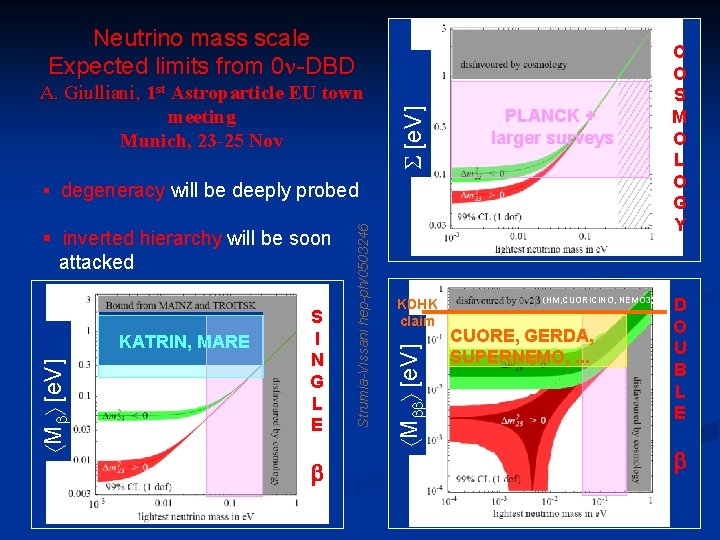
A. Giulliani, 1 st Astroparticle EU town meeting Munich, 23 -25 Nov S [e. V] Neutrino mass scale Expected limits from 0 n-DBD PLANCK + larger surveys Mb [e. V] KATRIN, MARE S I N G L E KDHK claim Mbb [e. V] § inverted hierarchy will be soon attacked Strumia-Vissani hep-ph/0503246 § degeneracy will be deeply probed (HM, CUORICINO, NEMO 3) CUORE, GERDA, SUPERNEMO, . . . C O S M O L O G Y D O U B L E
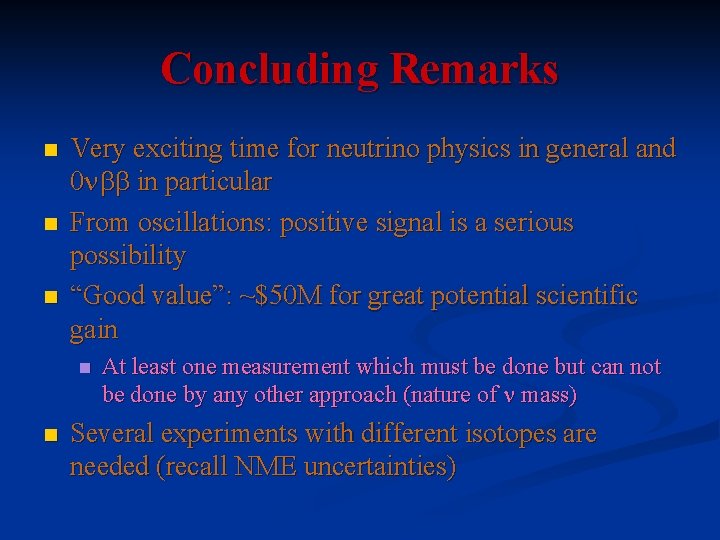
Concluding Remarks n n n Very exciting time for neutrino physics in general and 0 nbb in particular From oscillations: positive signal is a serious possibility “Good value”: ~$50 M for great potential scientific gain n n At least one measurement which must be done but can not be done by any other approach (nature of n mass) Several experiments with different isotopes are needed (recall NME uncertainties)
- Slides: 43