
Muons Inc Recent Innovations in Muon Beam Cooling

Muons, Inc. Recent Innovations in Muon Beam Cooling and Prospects for Muon Colliders and Neutrino Factories Rolland P. Johnson Muon collider And Neutrino factory e. Xperiment Rol Johnson 7/22/2005 JLab Seminar 1
Muon Beam Cooling Innovations n n Muon Colliders need small muon flux to reduce proton driver demands, detector backgrounds, and site boundary radiation levels. Very effective beam cooling is therefore required to produce high luminosity at the beam-beam tune shift limit and to allow the use of high frequency RF for acceleration to very high energy in recirculating Linacs. A Neutrino Factory based on a very cool muon beam which is accelerated in an existing Linac may be very cost-effective. Several new ideas have arisen in the last 4 years which are being developed under SBIR grants which have the potential to form muon beams with transverse emittances of a few mm- mr. The potential impact of this capability on energy-frontier colliders, Higgs factories, and intense neutrino beams is large. A vigorous R&D program is called for. Rol Johnson 7/22/2005 JLab Seminar 2
Muons, Inc. SBIR/STTR Collaboration: n n n (Small Business Innovation Research grants) Fermilab; • Victor Yarba, Chuck Ankenbrandt, Emanuela Barzi, Licia del Frate, Ivan Gonin, Timer Khabiboulline, Al Moretti, Dave Neuffer, Milorad Popovic, Gennady Romanov, Daniele Turrioni IIT; • Dan Kaplan, Katsuya Yonehara JLab; • Slava Derbenev, Alex Bogacz, Kevin Beard, Yu-Chiu Chao Muons, Inc. ; • Rolland Johnson, Mohammad Alsharo’a, Pierrick Hanlet, Bob Hartline, Moyses Kuchnir, Kevin Paul, Tom Roberts Underlined are 6 accelerator physicists in training, supported by SBIR/STTR grants Rol Johnson 7/22/2005 JLab Seminar 3
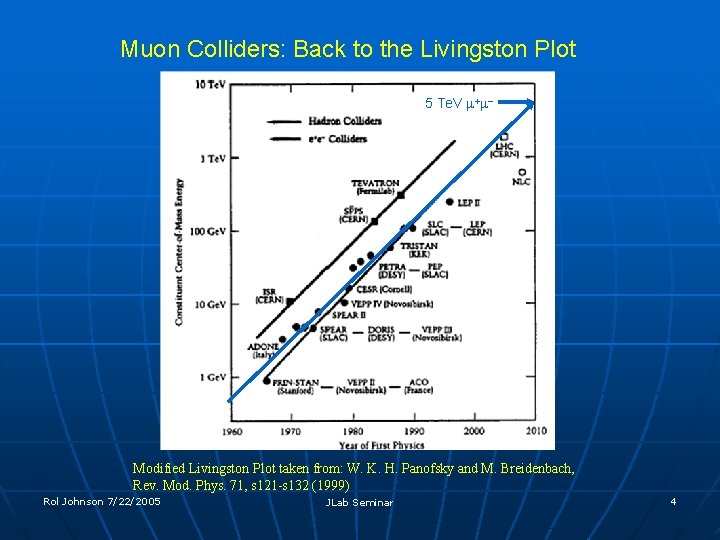
Muon Colliders: Back to the Livingston Plot 5 Te. V m+m- Modified Livingston Plot taken from: W. K. H. Panofsky and M. Breidenbach, Rev. Mod. Phys. 71, s 121 -s 132 (1999) Rol Johnson 7/22/2005 JLab Seminar 4
5 Te. V ~ SSC energy reach ~5 X 2. 5 km footprint Affordable LC length, includes ILC people, ideas High L from small emittance! 1/10 fewer muons than originally imagined: a) easier p driver, targetry b) less detector background c) less site boundary radiation Rol Johnson 7/22/2005 JLab Seminar 5
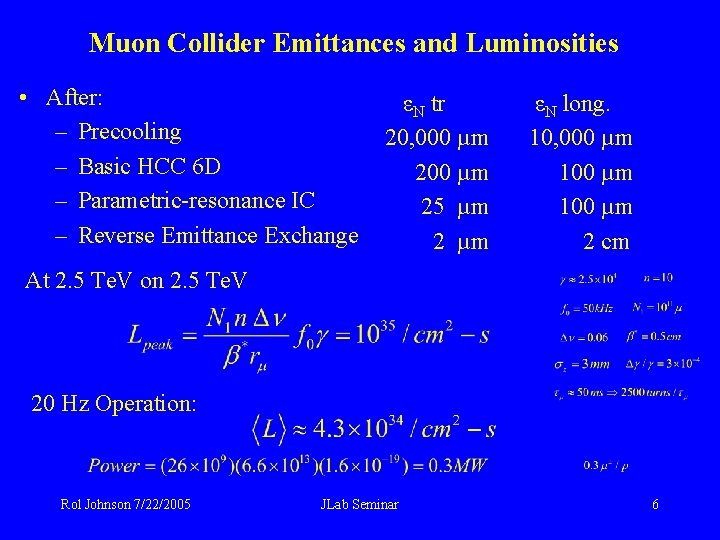
Muon Collider Emittances and Luminosities • After: – Precooling – Basic HCC 6 D – Parametric-resonance IC – Reverse Emittance Exchange εN tr 20, 000 µm 25 µm 2 µm εN long. 10, 000 µm 100 µm 2 cm At 2. 5 Te. V on 2. 5 Te. V 20 Hz Operation: Rol Johnson 7/22/2005 JLab Seminar 6
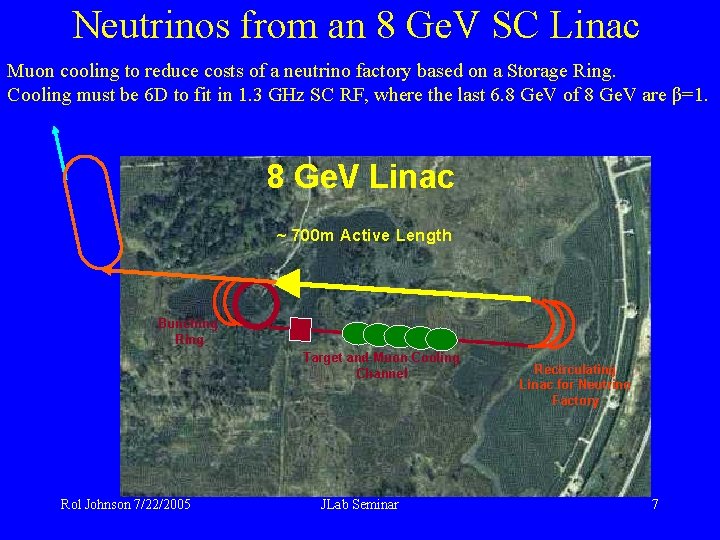
Neutrinos from an 8 Ge. V SC Linac Muon cooling to reduce costs of a neutrino factory based on a Storage Ring. Cooling must be 6 D to fit in 1. 3 GHz SC RF, where the last 6. 8 Ge. V of 8 Ge. V are β=1. 8 Ge. V Linac ~ 700 m Active Length Bunching Ring Target and Muon Cooling Channel Rol Johnson 7/22/2005 JLab Seminar Recirculating Linac for Neutrino Factory 7
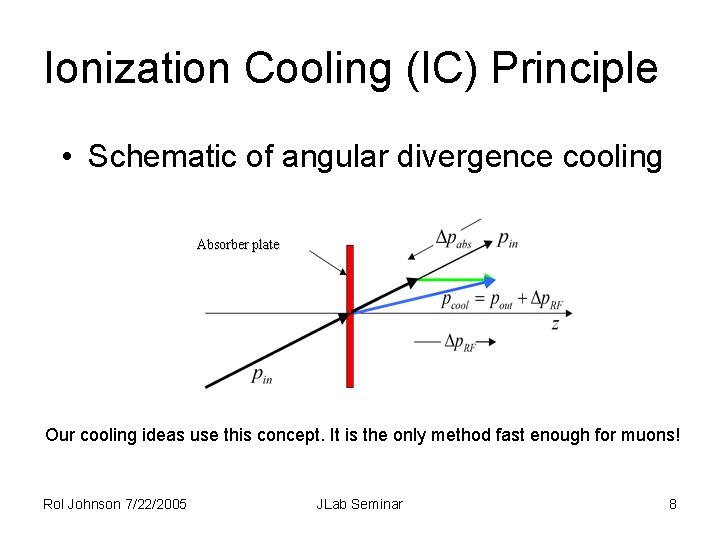
Ionization Cooling (IC) Principle • Schematic of angular divergence cooling Absorber plate Our cooling ideas use this concept. It is the only method fast enough for muons! Rol Johnson 7/22/2005 JLab Seminar 8
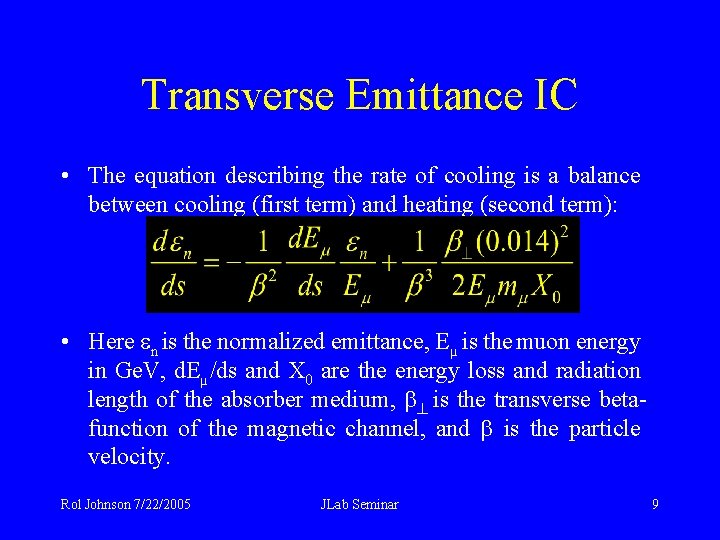
Transverse Emittance IC • The equation describing the rate of cooling is a balance between cooling (first term) and heating (second term): • Here n is the normalized emittance, Eµ is the muon energy in Ge. V, d. Eµ/ds and X 0 are the energy loss and radiation length of the absorber medium, is the transverse betafunction of the magnetic channel, and is the particle velocity. Rol Johnson 7/22/2005 JLab Seminar 9
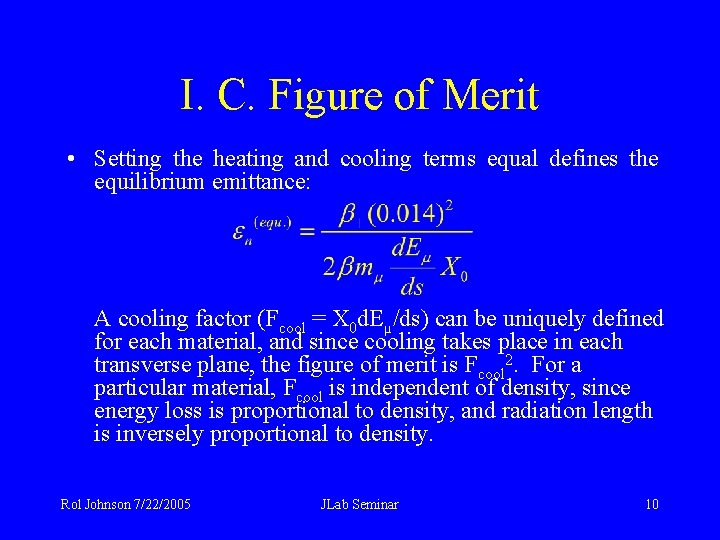
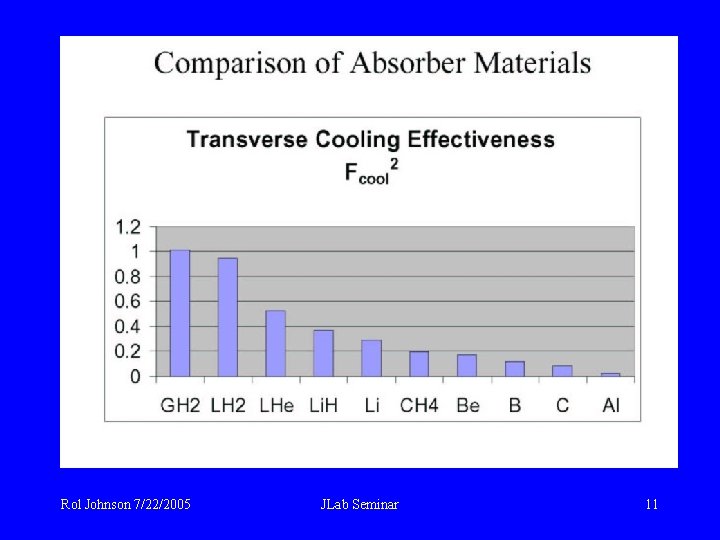
I. C. Figure of Merit • Setting the heating and cooling terms equal defines the equilibrium emittance: A cooling factor (Fcool = X 0 d. Eµ/ds) can be uniquely defined for each material, and since cooling takes place in each transverse plane, the figure of merit is Fcool 2. For a particular material, Fcool is independent of density, since energy loss is proportional to density, and radiation length is inversely proportional to density. Rol Johnson 7/22/2005 JLab Seminar 10
Rol Johnson 7/22/2005 JLab Seminar 11
Hydrogen Gas Virtues/Problems • Best ionization-cooling material – (X 0 * d. E/dx)2 is figure of merit • • Good breakdown suppression High heat capacity – Cools Beryllium RF windows • Scares people – But much like CH 4 Rol Johnson 7/22/2005 JLab Seminar 12
Idea #1: RF Cavities with Pressurized H 2 • Dense GH 2 suppresses high-voltage breakdown –Small MFP inhibits avalanches (Paschen’s Law) • Gas acts as an energy absorber –Needed for ionization cooling • Only works for muons –No strong interaction scattering like protons –More massive than electrons so no showers R. P. Johnson et al. invited talk at LINAC 2004, http: //www. muonsinc. com/TU 203. pdf Pierrick M. Hanlet et al. , Studies of RF Breakdown of Metals in Dense Gases, PAC 05 Kevin Paul et al. , Simultaneous bunching and precooling muon beams with gas-filled RF cavities, PAC 05 Mohammad Alsharo'a et al. , Beryllium RF Windows for Gaseous Cavities for Muon Acceleration, PAC 05 Also see WG 3 talks by D. Cline, S. Kahn, and A. Klier on ring coolers for other use of ideas 1 and 2 Rol Johnson 7/22/2005 JLab Seminar 13
Hardware Development • • • To develop RF cavities, pressurized with dense hydrogen, suitable for use in muon cooling. Measurements of RF parameters (e. g. breakdown voltage, dark current, quality factor) for different temperatures and pressures in magnetic and radiation fields to optimize the design of prototypes for ionization cooling demonstration experiments See Mu. Cool Note 285 for paper Rol Johnson 7/22/2005 JLab Seminar 14
Mark II 805 MHz RF test cell Rol Johnson 7/22/2005 JLab Seminar 15
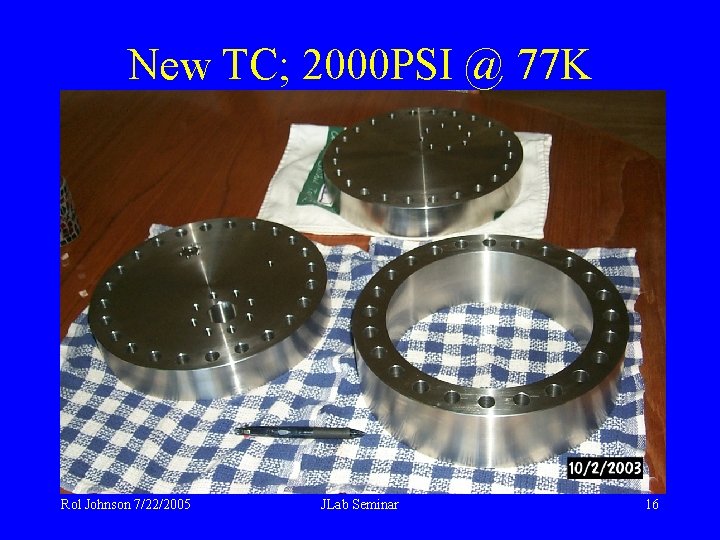
New TC; 2000 PSI @ 77 K Rol Johnson 7/22/2005 JLab Seminar 16
Rol Johnson 7/22/2005 JLab Seminar 17
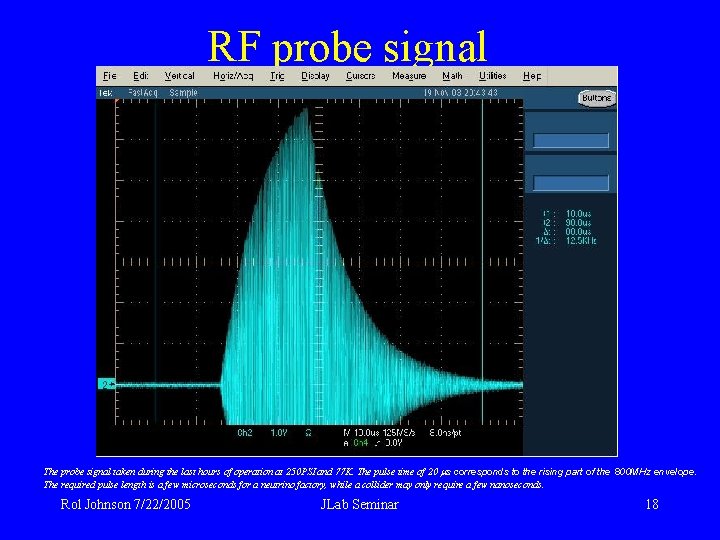
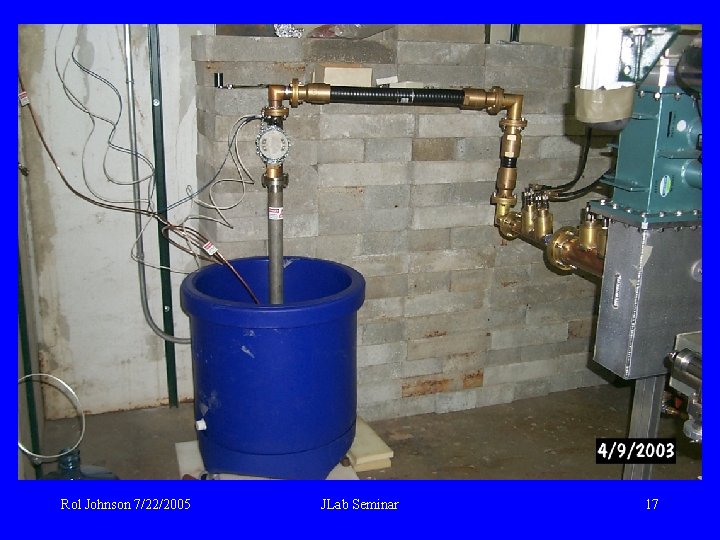
RF probe signal The probe signal taken during the last hours of operation at 250 PSI and 77 K. The pulse time of 20 ms corresponds to the rising part of the 800 MHz envelope. The required pulse length is a few microseconds for a neutrino factory, while a collider may only require a few nanoseconds. Rol Johnson 7/22/2005 JLab Seminar 18
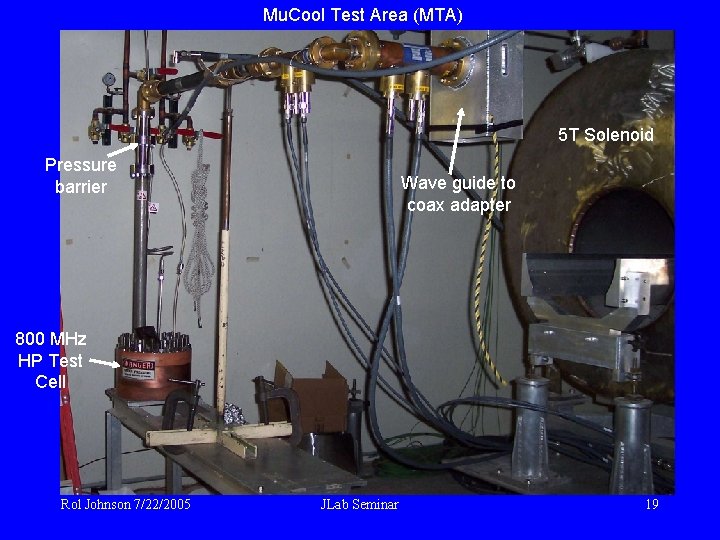
Mu. Cool Test Area (MTA) 5 T Solenoid Pressure barrier Wave guide to coax adapter 800 MHz HP Test Cell Rol Johnson 7/22/2005 JLab Seminar 19
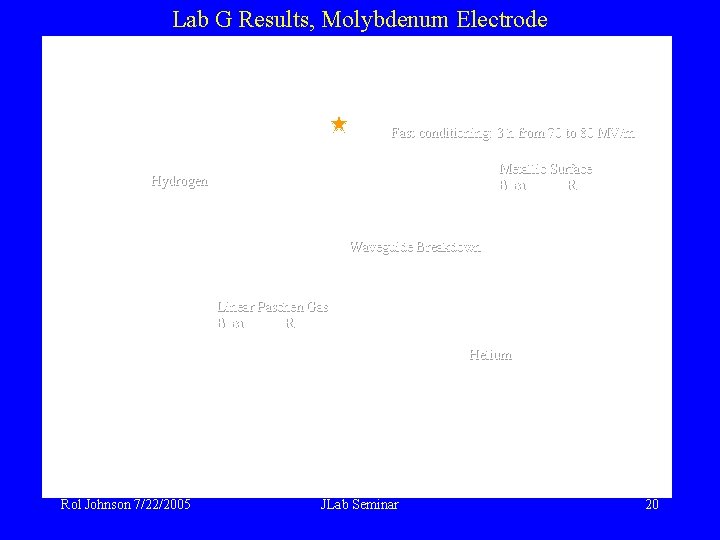
Lab G Results, Molybdenum Electrode Fast conditioning: 3 h from 70 to 80 MV/m Metallic Surface Breakdown Region Hydrogen Waveguide Breakdown Linear Paschen Gas Breakdown Region Helium Rol Johnson 7/22/2005 JLab Seminar 20
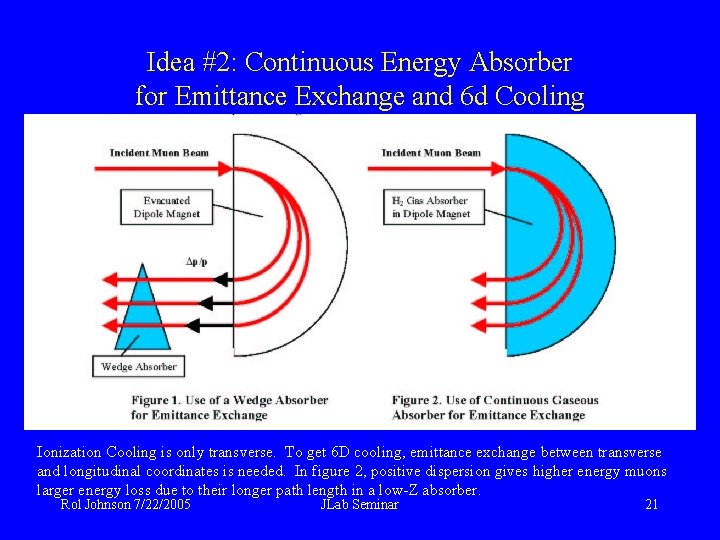
Idea #2: Continuous Energy Absorber for Emittance Exchange and 6 d Cooling Ionization Cooling is only transverse. To get 6 D cooling, emittance exchange between transverse and longitudinal coordinates is needed. In figure 2, positive dispersion gives higher energy muons larger energy loss due to their longer path length in a low-Z absorber. Rol Johnson 7/22/2005 JLab Seminar 21
Idea #3: six dimensional Cooling with HCC and continuous absorber • Helical cooling channel (HCC) – Solenoidal plus transverse helical dipole and quadrupole fields – Helical dipoles known from Siberian Snakes – z-independent Hamiltonian Derbenev & Johnson, Theory of HCC, April/05 PRST-AB Rol Johnson 7/22/2005 JLab Seminar 22
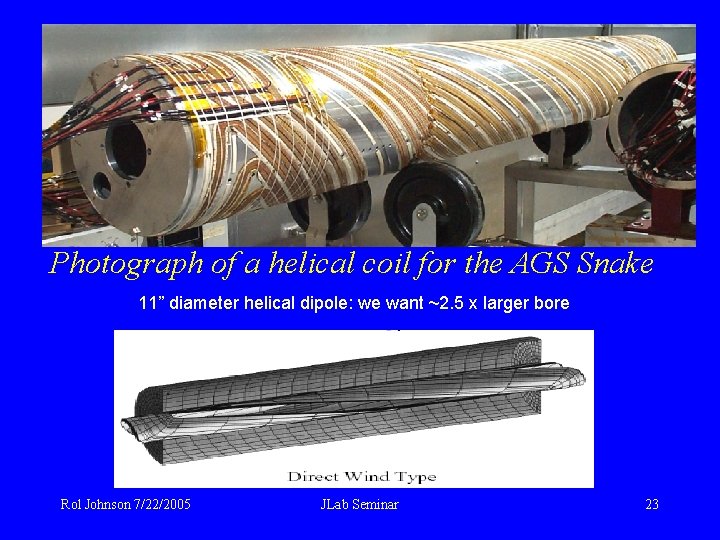
Photograph of a helical coil for the AGS Snake 11” diameter helical dipole: we want ~2. 5 x larger bore Rol Johnson 7/22/2005 JLab Seminar 23
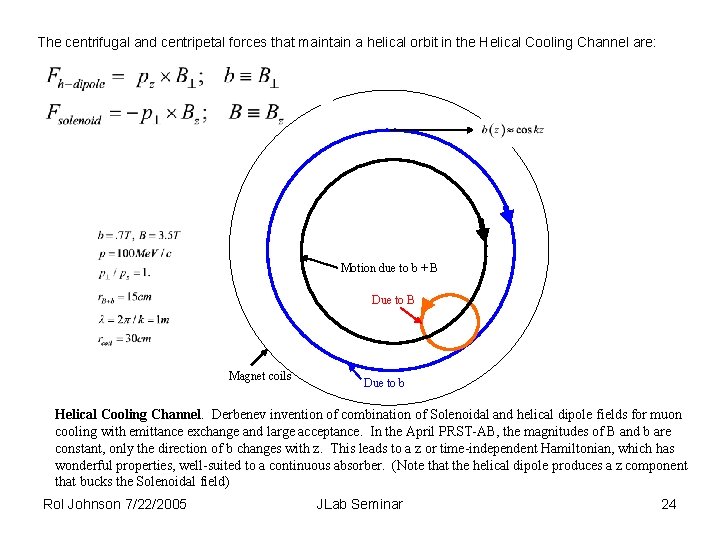
The centrifugal and centripetal forces that maintain a helical orbit in the Helical Cooling Channel are: Motion due to b + B Due to B Magnet coils Due to b Helical Cooling Channel. Derbenev invention of combination of Solenoidal and helical dipole fields for muon cooling with emittance exchange and large acceptance. In the April PRST-AB, the magnitudes of B and b are constant, only the direction of b changes with z. This leads to a z or time-independent Hamiltonian, which has wonderful properties, well-suited to a continuous absorber. (Note that the helical dipole produces a z component that bucks the Solenoidal field) Rol Johnson 7/22/2005 JLab Seminar 24
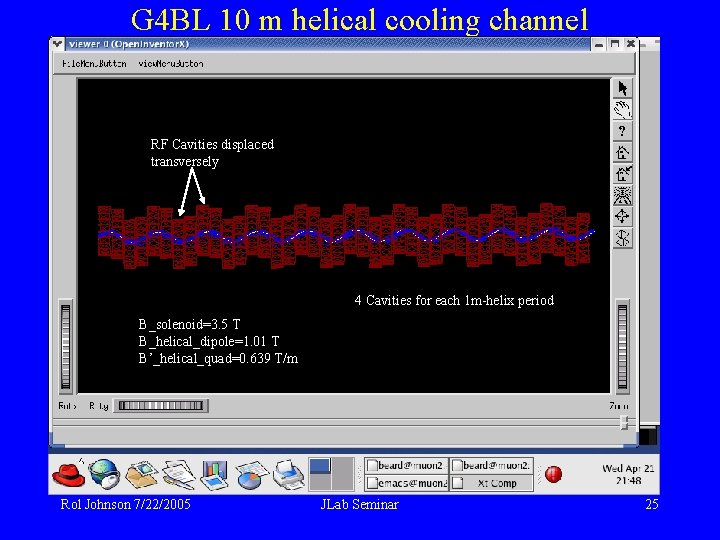
G 4 BL 10 m helical cooling channel RF Cavities displaced transversely 4 Cavities for each 1 m-helix period B_solenoid =3. 5 T B_ B_helical_dipole=1. 01 T B’_helical_quad=0. 639 T/m Rol Johnson 7/22/2005 JLab Seminar 25
G 4 BL End view of 200 Me. V HCC Radially offset RF cavities Beam particles (blue) oscillating about the periodic orbit (white) Rol Johnson 7/22/2005 JLab Seminar 26
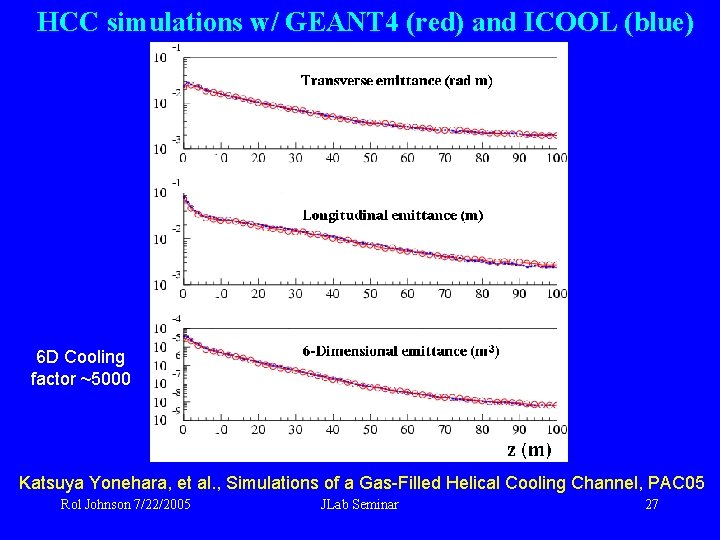
HCC simulations w/ GEANT 4 (red) and ICOOL (blue) 6 D Cooling factor ~5000 Katsuya Yonehara, et al. , Simulations of a Gas-Filled Helical Cooling Channel, PAC 05 Rol Johnson 7/22/2005 JLab Seminar 27
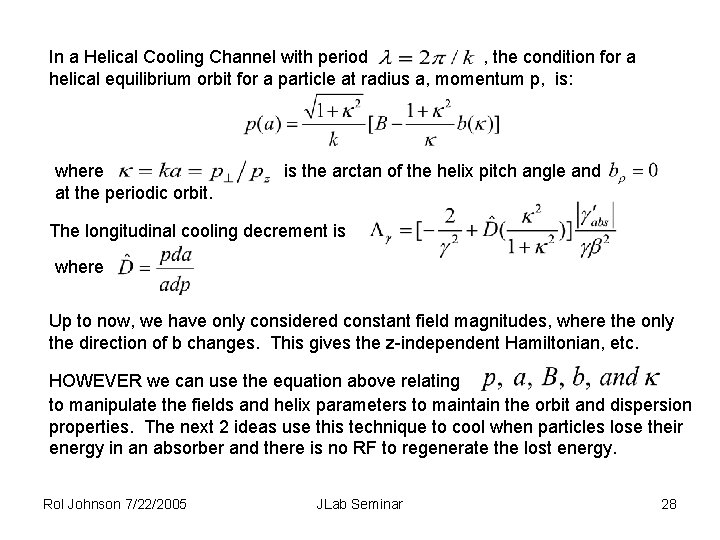
In a Helical Cooling Channel with period , the condition for a helical equilibrium orbit for a particle at radius a, momentum p, is: where at the periodic orbit. is the arctan of the helix pitch angle and The longitudinal cooling decrement is where Up to now, we have only considered constant field magnitudes, where the only the direction of b changes. This gives the z-independent Hamiltonian, etc. HOWEVER we can use the equation above relating to manipulate the fields and helix parameters to maintain the orbit and dispersion properties. The next 2 ideas use this technique to cool when particles lose their energy in an absorber and there is no RF to regenerate the lost energy. Rol Johnson 7/22/2005 JLab Seminar 28
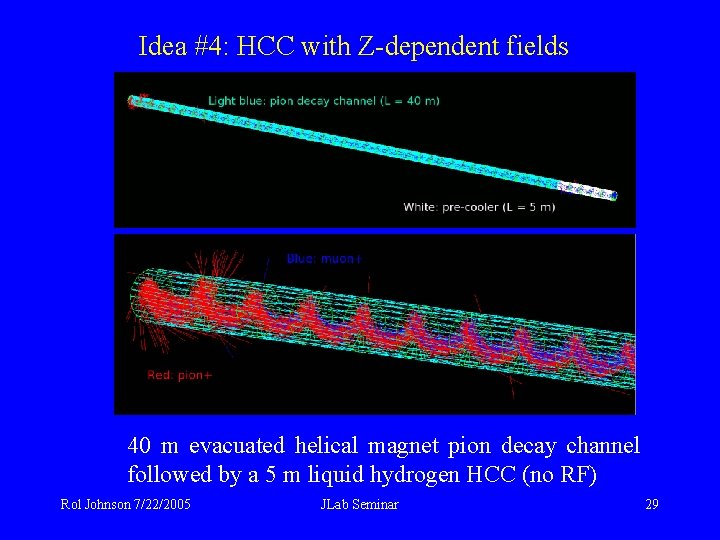
Idea #4: HCC with Z-dependent fields 40 m evacuated helical magnet pion decay channel followed by a 5 m liquid hydrogen HCC (no RF) Rol Johnson 7/22/2005 JLab Seminar 29
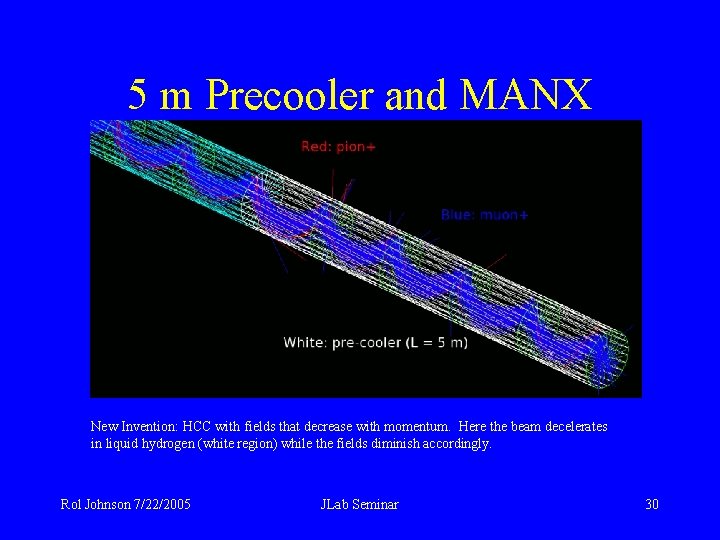
5 m Precooler and MANX New Invention: HCC with fields that decrease with momentum. Here the beam decelerates in liquid hydrogen (white region) while the fields diminish accordingly. Rol Johnson 7/22/2005 JLab Seminar 30
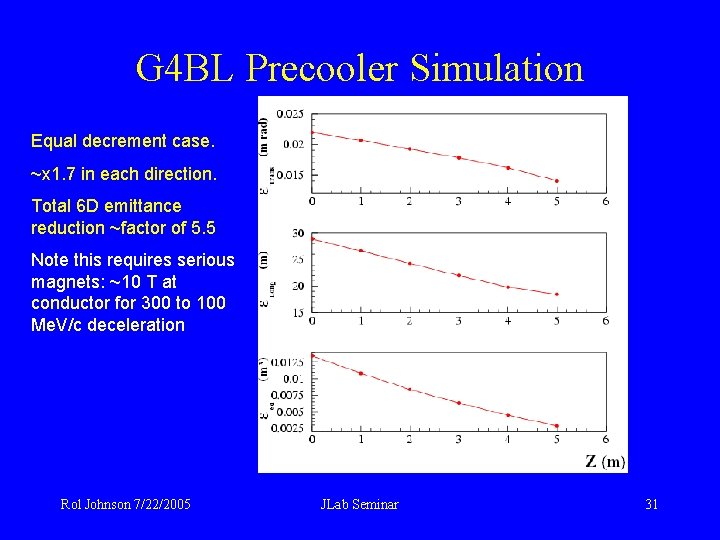
G 4 BL Precooler Simulation Equal decrement case. ~x 1. 7 in each direction. Total 6 D emittance reduction ~factor of 5. 5 Note this requires serious magnets: ~10 T at conductor for 300 to 100 Me. V/c deceleration Rol Johnson 7/22/2005 JLab Seminar 31
Idea #5: MANX 6 -d demonstration experiment Muon Collider And Neutrino Factory e. Xperiment • To Demonstrate – Longitudinal cooling – 6 D cooling in cont. absorber – Prototype precooler – Helical Cooling Channel – Alternate to pressurized RF – New technology Thomas J. Roberts et al. , A Muon Cooling Demonstration Experiment, PAC 05 Rol Johnson 7/22/2005 JLab Seminar 32
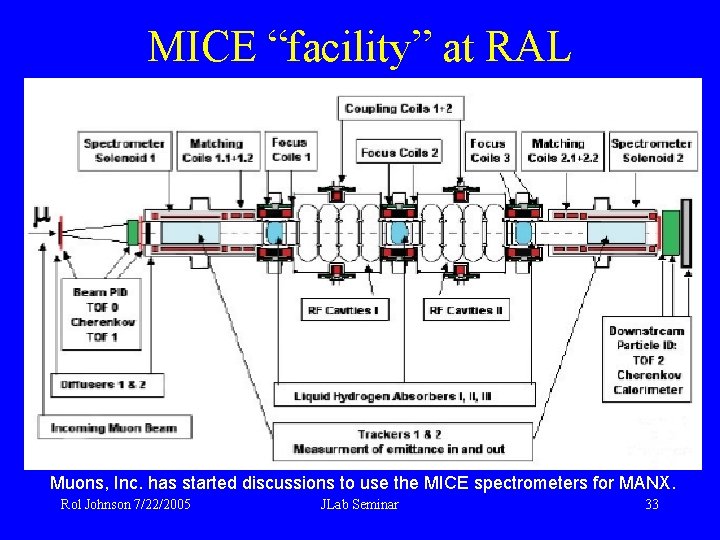
MICE “facility” at RAL Muons, Inc. has started discussions to use the MICE spectrometers for MANX. Rol Johnson 7/22/2005 JLab Seminar 33
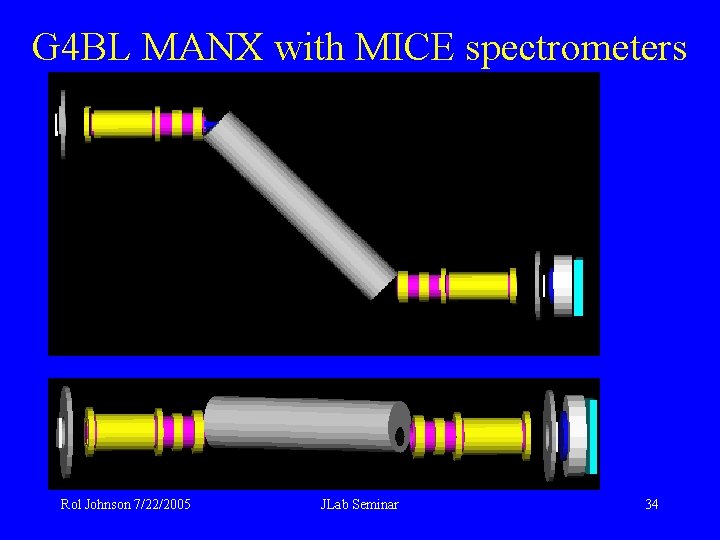
G 4 BL MANX with MICE spectrometers Rol Johnson 7/22/2005 JLab Seminar 34
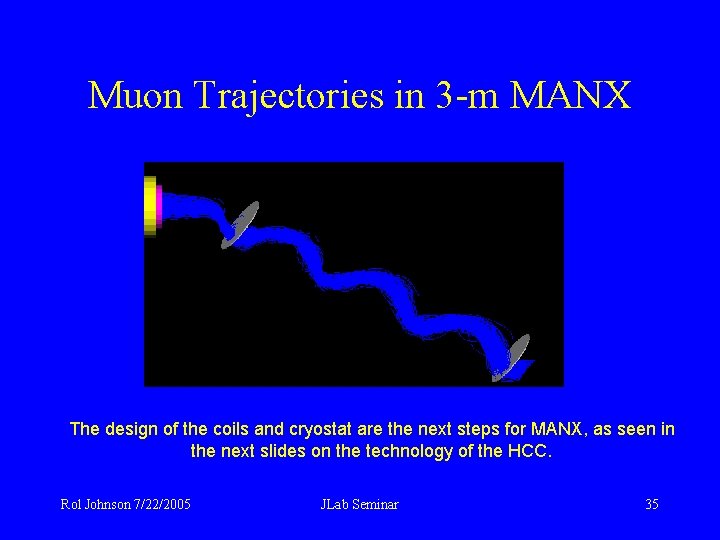
Muon Trajectories in 3 -m MANX The design of the coils and cryostat are the next steps for MANX, as seen in the next slides on the technology of the HCC. Rol Johnson 7/22/2005 JLab Seminar 35
Phase I Fermilab TD Measurements Fig. 9. Comparison of the engineering critical current density, JE, at 14 K as a function of magnetic field between BSCCO-2223 tape and RRP Nb 3 Sn round wire. Licia Del Frate et al. , Novel Muon Cooling Channels Using Hydrogen Refrigeration and HT Superconductor, PAC 05 Rol Johnson 7/22/2005 JLab Seminar 36
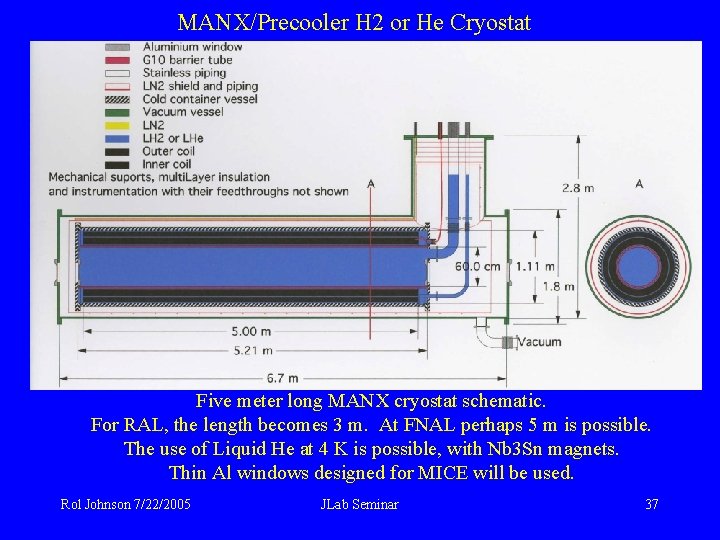
MANX/Precooler H 2 or He Cryostat Five meter long MANX cryostat schematic. For RAL, the length becomes 3 m. At FNAL perhaps 5 m is possible. The use of Liquid He at 4 K is possible, with Nb 3 Sn magnets. Thin Al windows designed for MICE will be used. Rol Johnson 7/22/2005 JLab Seminar 37
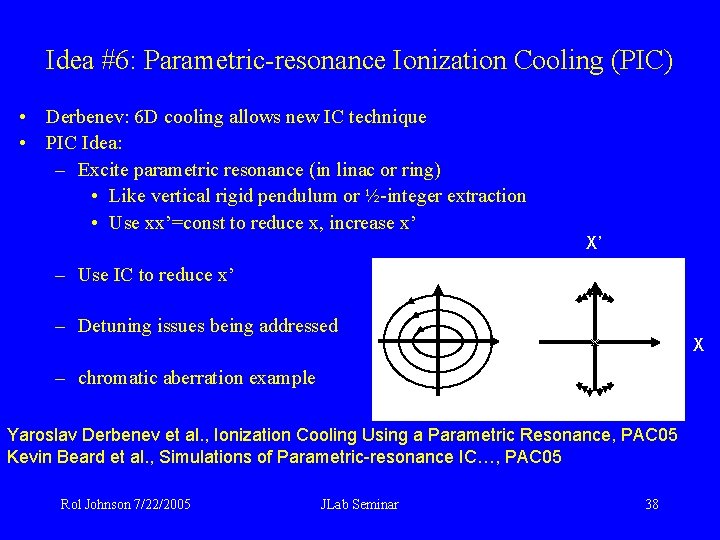
Idea #6: Parametric-resonance Ionization Cooling (PIC) • Derbenev: 6 D cooling allows new IC technique • PIC Idea: – Excite parametric resonance (in linac or ring) • Like vertical rigid pendulum or ½-integer extraction • Use xx’=const to reduce x, increase x’ X’ – Use IC to reduce x’ – Detuning issues being addressed X x – chromatic aberration example Yaroslav Derbenev et al. , Ionization Cooling Using a Parametric Resonance, PAC 05 Kevin Beard et al. , Simulations of Parametric-resonance IC…, PAC 05 Rol Johnson 7/22/2005 JLab Seminar 38
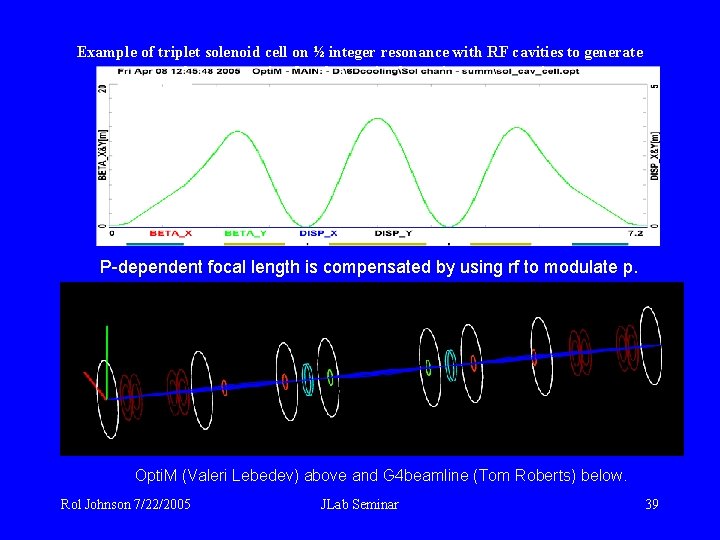
Example of triplet solenoid cell on ½ integer resonance with RF cavities to generate synchrotron motion for chromatic aberration compensation. P-dependent focal length is compensated by using rf to modulate p. Opti. M (Valeri Lebedev) above and G 4 beamline (Tom Roberts) below. Rol Johnson 7/22/2005 JLab Seminar 39
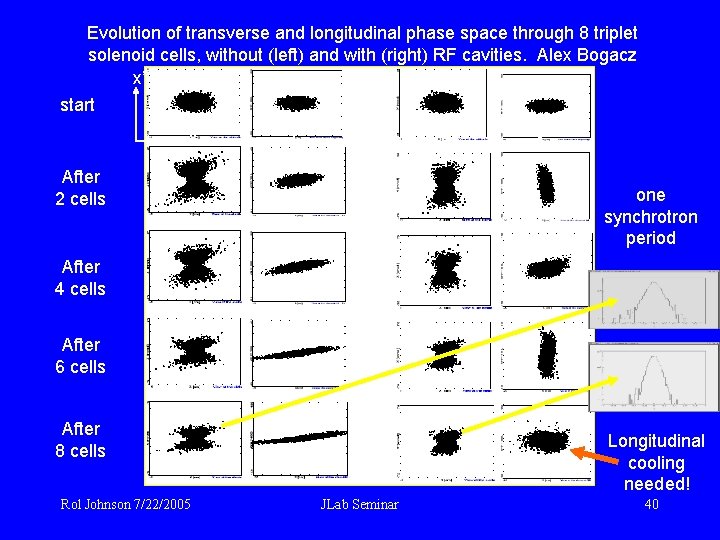
Evolution of transverse and longitudinal phase space through 8 triplet solenoid cells, without (left) and with (right) RF cavities. Alex Bogacz p x’ x’ p start x After 2 cells t one synchrotron period After 4 cells After 6 cells After 8 cells Rol Johnson 7/22/2005 Longitudinal cooling needed! JLab Seminar 40
Idea #7: Reverse Emittance Exchange • At 2. 5 Te. V/c, Δp/p reduced by >1000. • Bunch is then much shorter than needed to match IP beta function • Use wedge absorber to reduce transverse beam dimensions (increasing Luminosity) while increasing Δp/p until bunch length matches IP • Subject of new STTR grant Rol Johnson 7/22/2005 JLab Seminar 41
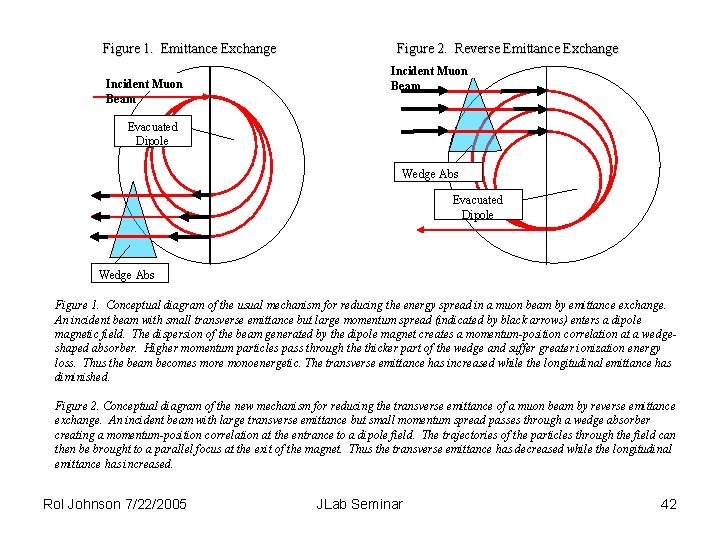
Figure 1. Emittance Exchange Incident Muon Beam Figure 2. Reverse Emittance Exchange Incident Muon Beam Evacuated Dipole Wedge Abs Figure 1. Conceptual diagram of the usual mechanism for reducing the energy spread in a muon beam by emittance exchange. An incident beam with small transverse emittance but large momentum spread (indicated by black arrows) enters a dipole magnetic field. The dispersion of the beam generated by the dipole magnet creates a momentum-position correlation at a wedgeshaped absorber. Higher momentum particles pass through the thicker part of the wedge and suffer greater ionization energy loss. Thus the beam becomes more monoenergetic. The transverse emittance has increased while the longitudinal emittance has diminished. Figure 2. Conceptual diagram of the new mechanism for reducing the transverse emittance of a muon beam by reverse emittance exchange. An incident beam with large transverse emittance but small momentum spread passes through a wedge absorber creating a momentum-position correlation at the entrance to a dipole field. The trajectories of the particles through the field can then be brought to a parallel focus at the exit of the magnet. Thus the transverse emittance has decreased while the longitudinal emittance has increased. Rol Johnson 7/22/2005 JLab Seminar 42
Idea #8: Simultaneous RF Capture, Bunch Rotation and Cooling in HP RF Cavities • Proton bunches have σt ≈ 1 ns such that produced pion bunches do too. • Placing RF cavities close to the production target allows 1/4 synchrotron period rotation to get longer pion bunches with smaller momentum spread. • Subject of new STTR grant Rol Johnson 7/22/2005 JLab Seminar 43
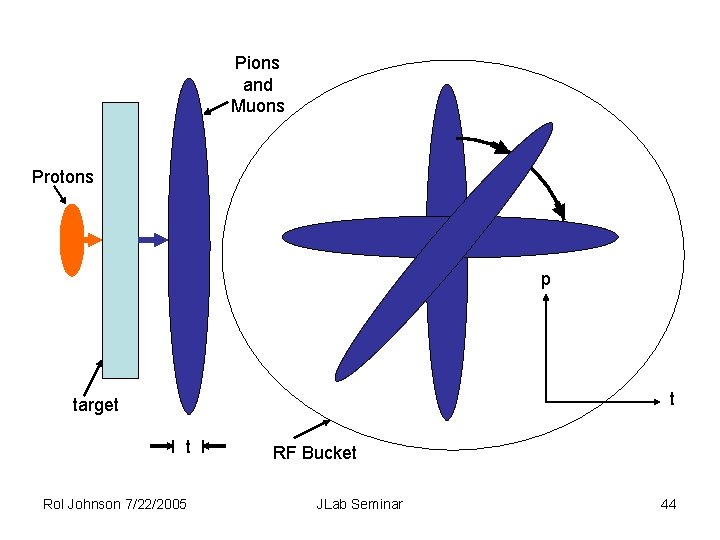
Pions and Muons Protons p t target I Rol Johnson 7/22/2005 RF Bucket JLab Seminar 44
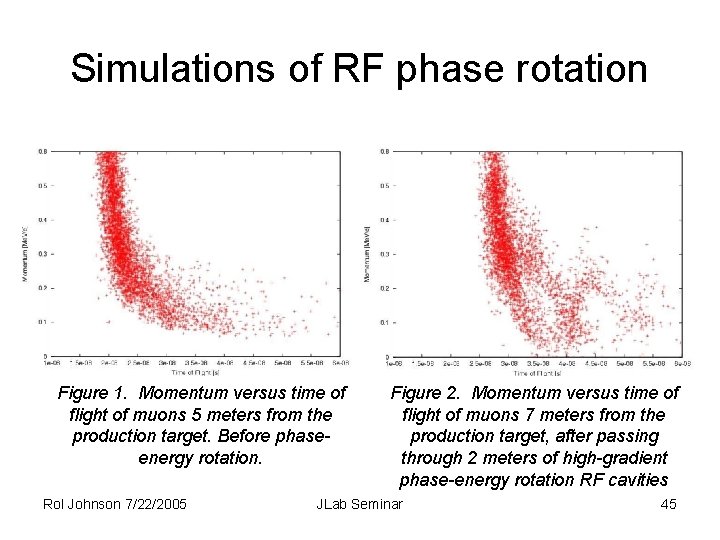
Simulations of RF phase rotation Figure 1. Momentum versus time of flight of muons 5 meters from the production target. Before phaseenergy rotation. Rol Johnson 7/22/2005 Figure 2. Momentum versus time of flight of muons 7 meters from the production target, after passing through 2 meters of high-gradient phase-energy rotation RF cavities JLab Seminar 45
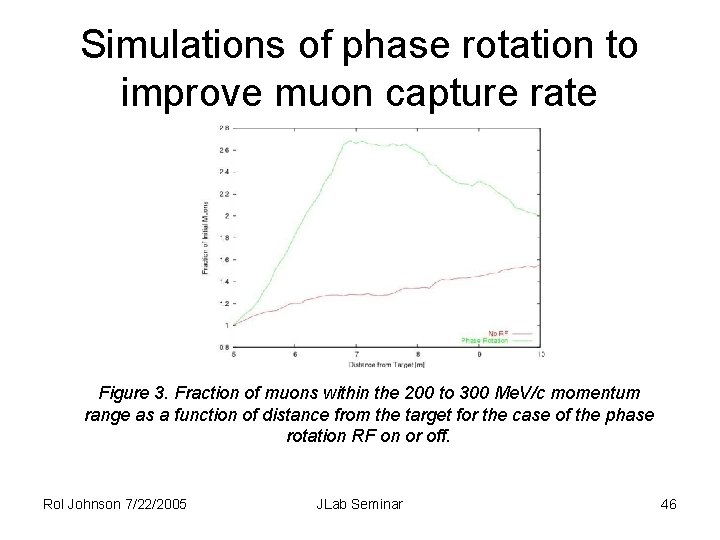
Simulations of phase rotation to improve muon capture rate Figure 3. Fraction of muons within the 200 to 300 Me. V/c momentum range as a function of distance from the target for the case of the phase rotation RF on or off. Rol Johnson 7/22/2005 JLab Seminar 46
Eight New Ideas for Bright Beams for High Luminosity Muon Colliders supported by SBIR/STTR grants H 2 -Pressurized RF Cavities Continuous Absorber for Emittance Exchange Helical Cooling Channel Z-dependent HCC MANX 6 d Cooling Demo Parametric-resonance Ionization Cooling Reverse Emittance Exchange RF capture, phase rotation, cooling in HP RF Cavities If we succeed to develop these ideas, an Energy Frontier Muon Collider will become a compelling option for High Energy Physics! Rol Johnson 7/22/2005 JLab Seminar 47
Funding for muon cooling R&D is needed; additional enthusiastic supporters are needed! • Effective beam cooling for an energy frontier muon collider or Higgs factory is essential – Best hope for getting back to the Livingston curve • Effective muon beam cooling can be used in a SC Linac for a neutrino factory – Additional argument for a SC Linac proton driver – Could attract super beam and beta beam enthusiasts • These possibilities use SC RF – JLab specialty – ILC becomes International Lepton Collider Rol Johnson 7/22/2005 JLab Seminar 48
- Slides: 48