Future Perspectives for Large Cryogenic Systems Laurent Tavian
- Slides: 40
Future Perspectives for Large Cryogenic Systems Laurent Tavian CERN, Geneva, Switzerland Laurent Tavian 01 June 2007
Contents Ø The role of cryogenics in future projects Ø Thermonuclear fusion research (ITER) Ø Particle physics at the energy frontier (ILC, LHC upgrades) Ø High-intensity proton linacs (SPL, EURISOL, IFMIF) Ø Nuclear physics with protons, antiprotons and ions (FAIR) Ø Ultra-fast, intense X-rays to probe condensed matter (the European X-ray FEL and ERLs) Ø Cosmic and rare underground signals (ICARUS) Ø Conclusions Laurent Tavian 01 June 2007
Role of cryogenics Ø Compactness through higher fields • superconducting bending and focussing magnets for circular accelerators. • superconducting acceleration cavities for linear accelerators Ø Reducing of specific project cost Ø Saving energy • in electromagnets • In acceleration cavities Ø Improvement of environment conditions • • Cryogenic pumping Low resistive wall in high intensity accelerators Better transparency of particle spectrometers Reduction of background noise in detectors Ø Detection through calorimetry or tracking Laurent Tavian 01 June 2007
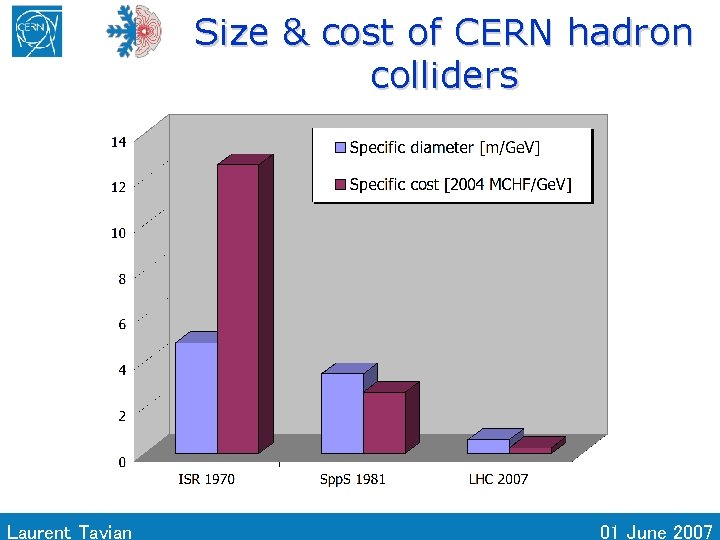
Size & cost of CERN hadron colliders Laurent Tavian 01 June 2007
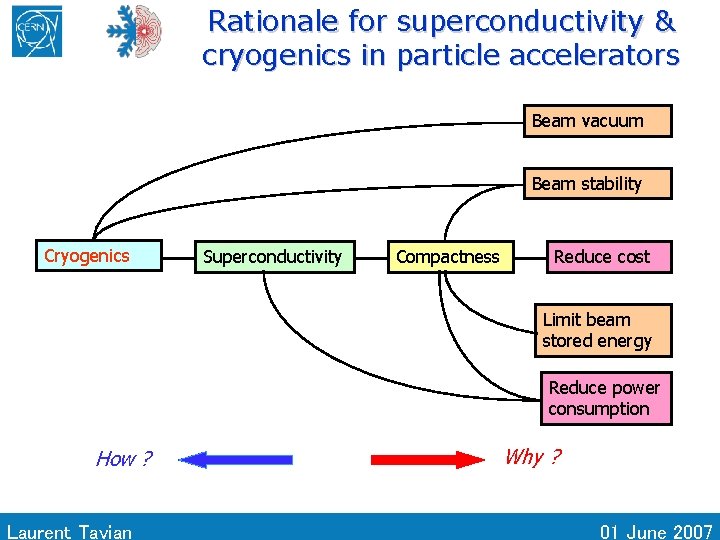
Rationale for superconductivity & cryogenics in particle accelerators Beam vacuum Beam stability Cryogenics Superconductivity Compactness Reduce cost Limit beam stored energy Reduce power consumption How ? Laurent Tavian Why ? 01 June 2007
Contents Ø The role of cryogenics in future projects Ø The thermonuclear fusion research (ITER) Ø Particle physics at the energy frontier (ILC, LHC upgrades) Ø High-intensity proton linacs (SPL, EURISOL, IFMIF) Ø Nuclear physics with protons, antiprotons and ions (FAIR) Ø Ultra-fast, intense X-rays to probe condensed matter (the European X-ray FEL and ERLs) Ø Cosmic and rare underground signals (ICARUS) Ø Conclusions Laurent Tavian 01 June 2007
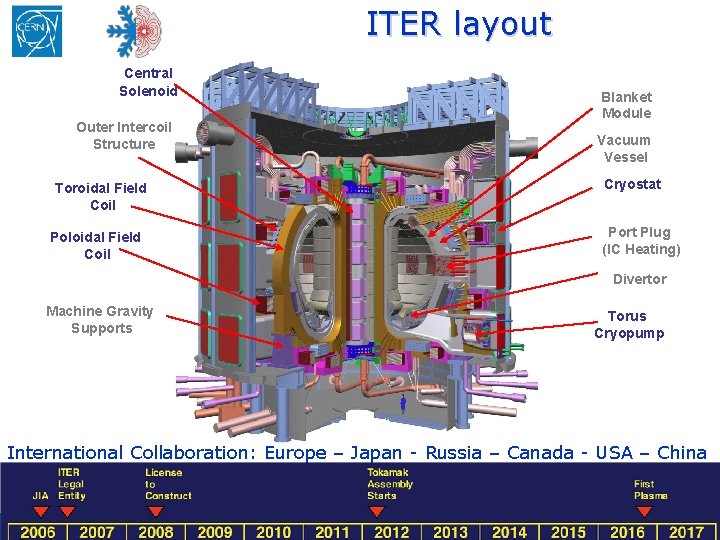
ITER layout Central Solenoid Outer Intercoil Structure Toroidal Field Coil Poloidal Field Coil Blanket Module Vacuum Vessel Cryostat Port Plug (IC Heating) Divertor Machine Gravity Supports Torus Cryopump International Collaboration: Europe – Japan - Russia – Canada - USA – China Laurent Tavian 01 June 2007
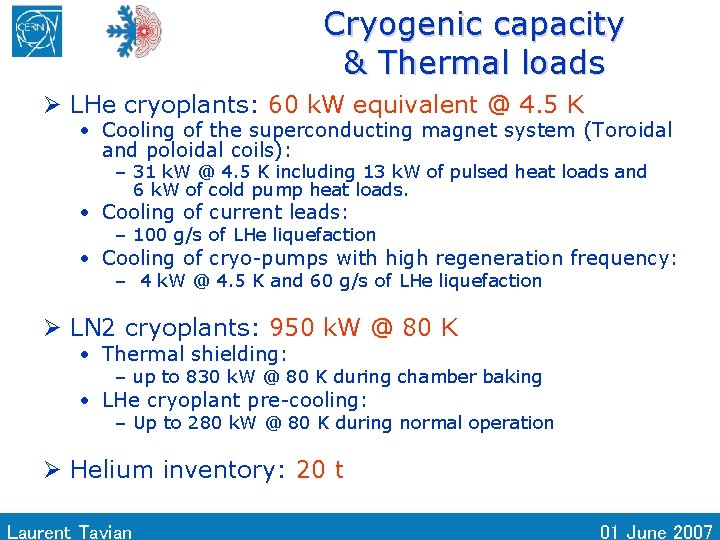
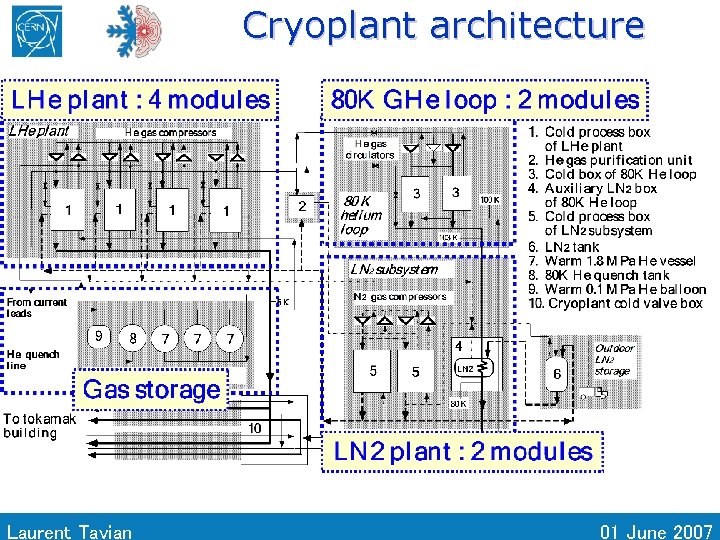
Cryogenic capacity & Thermal loads Ø LHe cryoplants: 60 k. W equivalent @ 4. 5 K • Cooling of the superconducting magnet system (Toroidal and poloidal coils): – 31 k. W @ 4. 5 K including 13 k. W of pulsed heat loads and 6 k. W of cold pump heat loads. • Cooling of current leads: – 100 g/s of LHe liquefaction • Cooling of cryo-pumps with high regeneration frequency: – 4 k. W @ 4. 5 K and 60 g/s of LHe liquefaction Ø LN 2 cryoplants: 950 k. W @ 80 K • Thermal shielding: – up to 830 k. W @ 80 K during chamber baking • LHe cryoplant pre-cooling: – Up to 280 k. W @ 80 K during normal operation Ø Helium inventory: 20 t Laurent Tavian 01 June 2007
Cryoplant architecture Laurent Tavian 01 June 2007
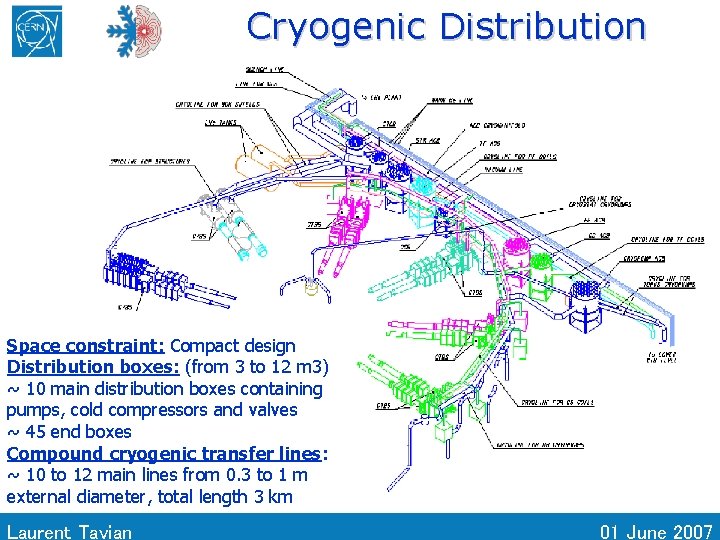
Cryogenic Distribution Space constraint: Compact design Distribution boxes: (from 3 to 12 m 3) ~ 10 main distribution boxes containing pumps, cold compressors and valves ~ 45 end boxes Compound cryogenic transfer lines: ~ 10 to 12 main lines from 0. 3 to 1 m external diameter, total length 3 km Laurent Tavian 01 June 2007
Contents Ø The role of cryogenics in future projects Ø The thermonuclear fusion research (ITER) Ø Particle physics at the energy frontier (ILC, LHC upgrades) Ø High-intensity proton linacs (SPL, EURISOL, IFMIF) Ø Nuclear physics with protons, antiprotons and ions (FAIR) Ø Ultra-fast, intense X-rays to probe condensed matter (the European X-ray FEL and ERLs) Ø Cosmic and rare underground signals (ICARUS) Ø Conclusions Laurent Tavian 01 June 2007
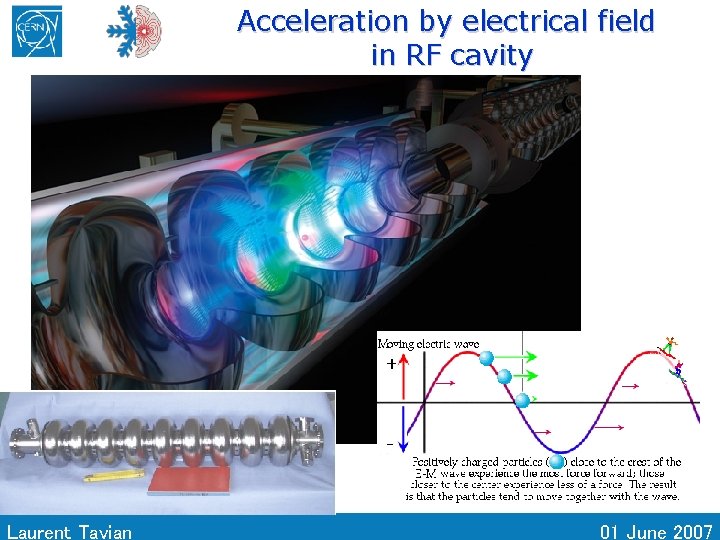
Acceleration by electrical field in RF cavity Laurent Tavian 01 June 2007
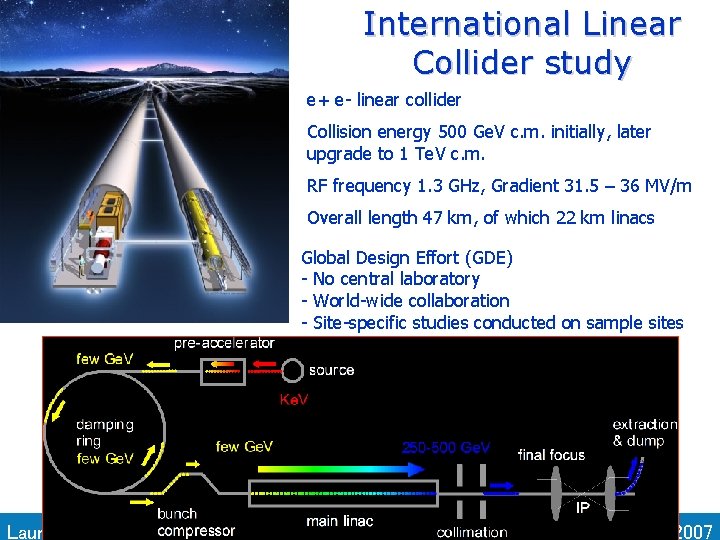
International Linear Collider study e+ e- linear collider Collision energy 500 Ge. V c. m. initially, later upgrade to 1 Te. V c. m. RF frequency 1. 3 GHz, Gradient 31. 5 – 36 MV/m Overall length 47 km, of which 22 km linacs Global Design Effort (GDE) - No central laboratory - World-wide collaboration - Site-specific studies conducted on sample sites Laurent Tavian 01 June 2007
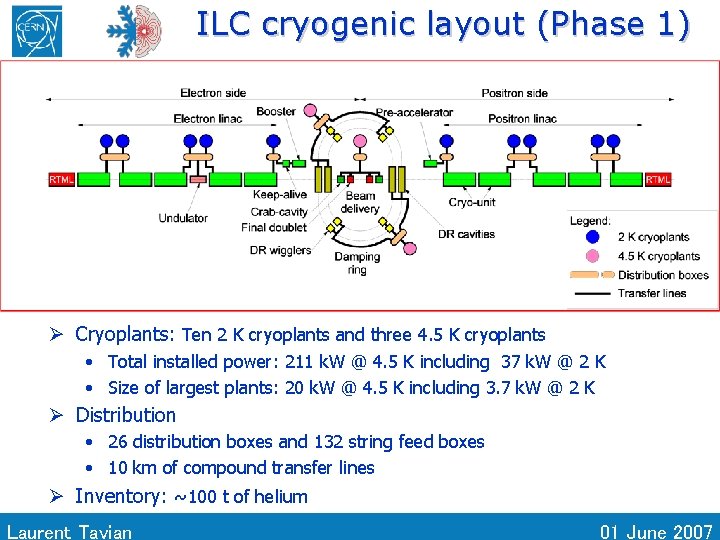
ILC cryogenic layout (Phase 1) Ø Cryoplants: Ten 2 K cryoplants and three 4. 5 K cryoplants • Total installed power: 211 k. W @ 4. 5 K including 37 k. W @ 2 K • Size of largest plants: 20 k. W @ 4. 5 K including 3. 7 k. W @ 2 K Ø Distribution • 26 distribution boxes and 132 string feed boxes • 10 km of compound transfer lines Ø Inventory: ~100 t of helium Laurent Tavian 01 June 2007
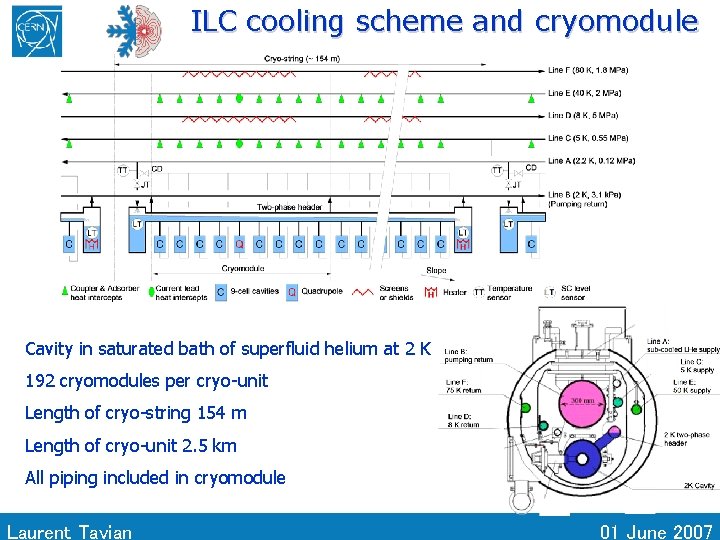
ILC cooling scheme and cryomodule Cavity in saturated bath of superfluid helium at 2 K 192 cryomodules per cryo-unit Length of cryo-string 154 m Length of cryo-unit 2. 5 km All piping included in cryomodule Laurent Tavian 01 June 2007
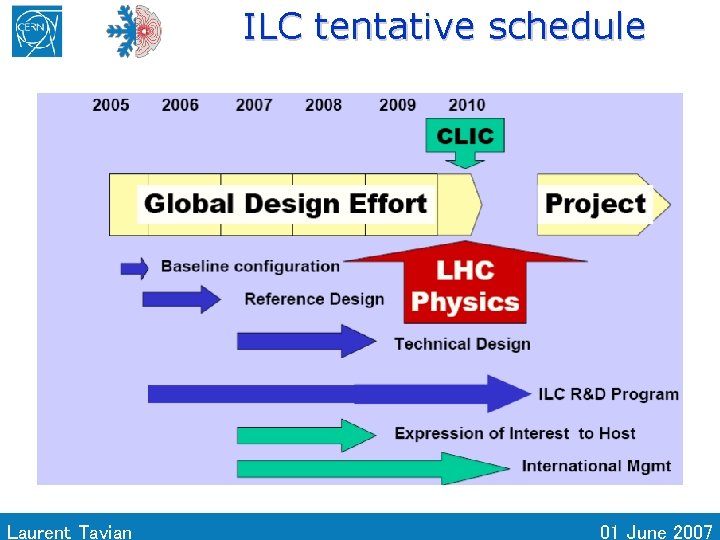
ILC tentative schedule Laurent Tavian 01 June 2007
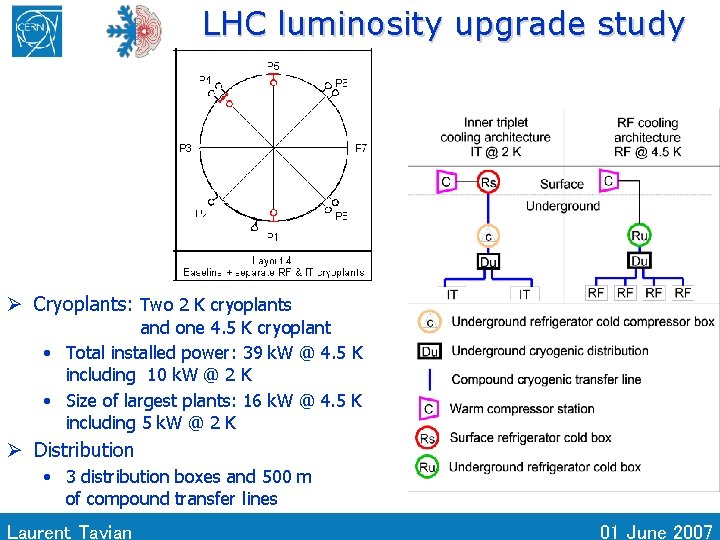
LHC luminosity upgrade study Ø Cryoplants: Two 2 K cryoplants and one 4. 5 K cryoplant • Total installed power: 39 k. W @ 4. 5 K including 10 k. W @ 2 K • Size of largest plants: 16 k. W @ 4. 5 K including 5 k. W @ 2 K Ø Distribution • 3 distribution boxes and 500 m of compound transfer lines Laurent Tavian 01 June 2007
Contents Ø The role of cryogenics in future projects Ø The thermonuclear fusion research (ITER) Ø Particle physics at the energy frontier (ILC, LHC upgrades) Ø High-intensity proton linacs (SPL, EURISOL, IFMIF) Ø Nuclear physics with protons, antiprotons and ions (FAIR) Ø Ultra-fast, intense X-rays to probe condensed matter (the European X-ray FEL and ERLs) Ø Cosmic and rare underground signals (ICARUS) Ø Conclusions Laurent Tavian 01 June 2007
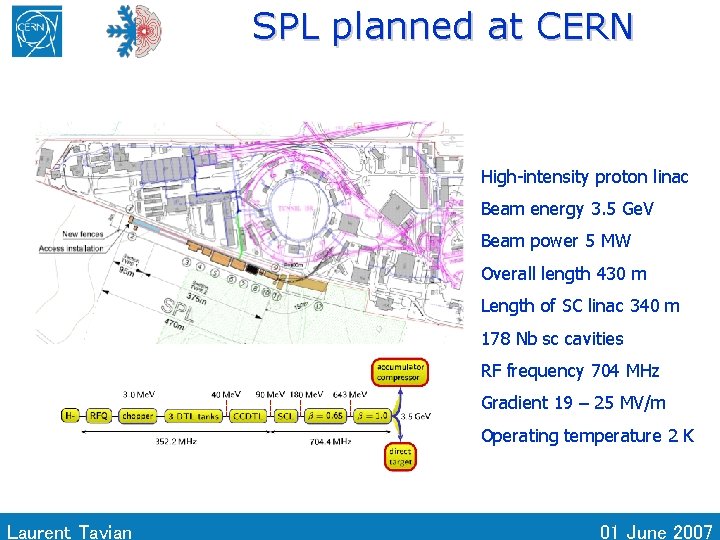
SPL planned at CERN High-intensity proton linac Beam energy 3. 5 Ge. V Beam power 5 MW Overall length 430 m Length of SC linac 340 m 178 Nb sc cavities RF frequency 704 MHz Gradient 19 – 25 MV/m Operating temperature 2 K Laurent Tavian 01 June 2007
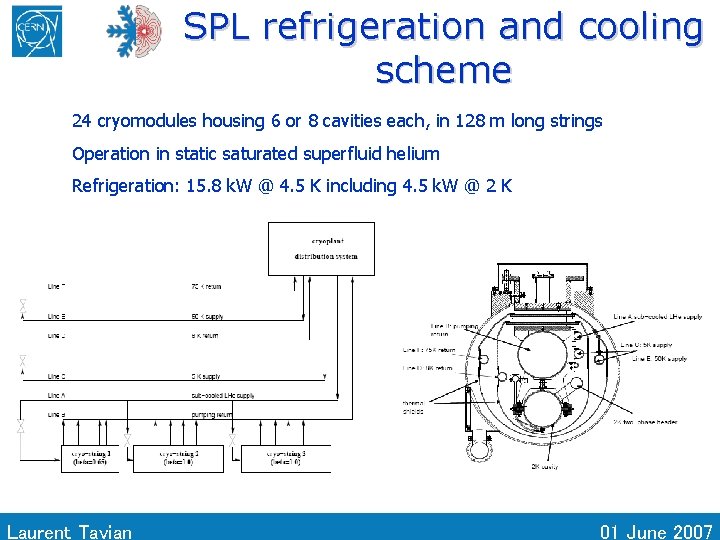
SPL refrigeration and cooling scheme 24 cryomodules housing 6 or 8 cavities each, in 128 m long strings Operation in static saturated superfluid helium Refrigeration: 15. 8 k. W @ 4. 5 K including 4. 5 k. W @ 2 K Laurent Tavian 01 June 2007
Contents Ø The role of cryogenics in future projects Ø The thermonuclear fusion research (ITER) Ø Particle physics at the energy frontier (ILC, LHC upgrades) Ø High-intensity proton linacs (SPL, EURISOL, IFMIF) Ø Nuclear physics with protons, antiprotons and ions (FAIR) Ø Ultra-fast, intense X-rays to probe condensed matter (the European X-ray FEL and ERLs) Ø Cosmic and rare underground signals (ICARUS) Ø Conclusions Laurent Tavian 01 June 2007
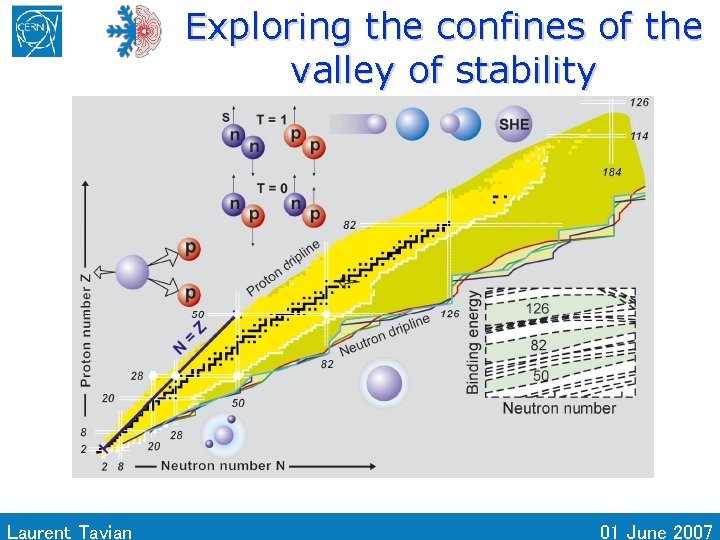
Exploring the confines of the valley of stability Laurent Tavian 01 June 2007
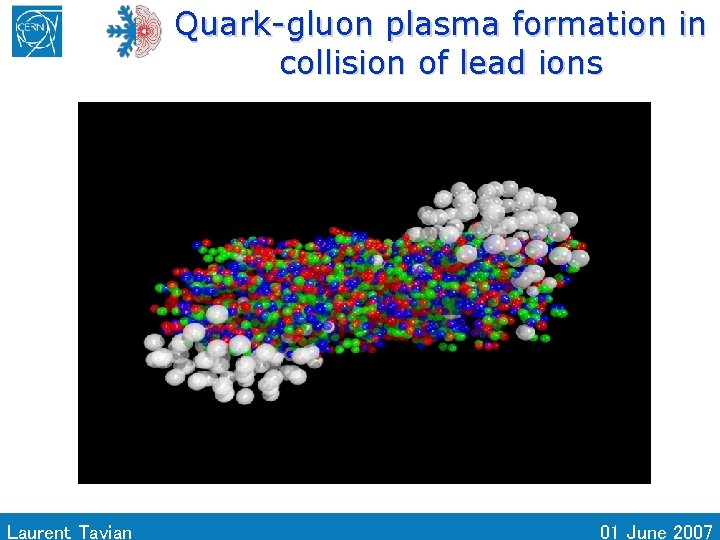
Quark-gluon plasma formation in collision of lead ions Laurent Tavian 01 June 2007
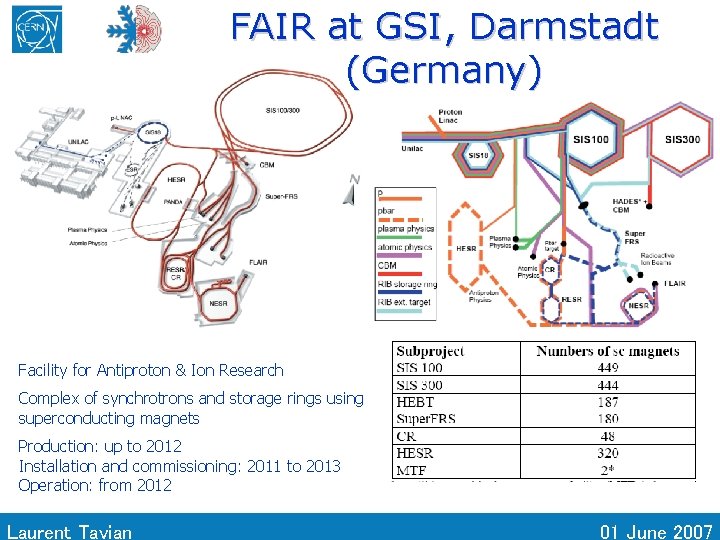
FAIR at GSI, Darmstadt (Germany) Facility for Antiproton & Ion Research Complex of synchrotrons and storage rings using superconducting magnets Production: up to 2012 Installation and commissioning: 2011 to 2013 Operation: from 2012 Laurent Tavian 01 June 2007
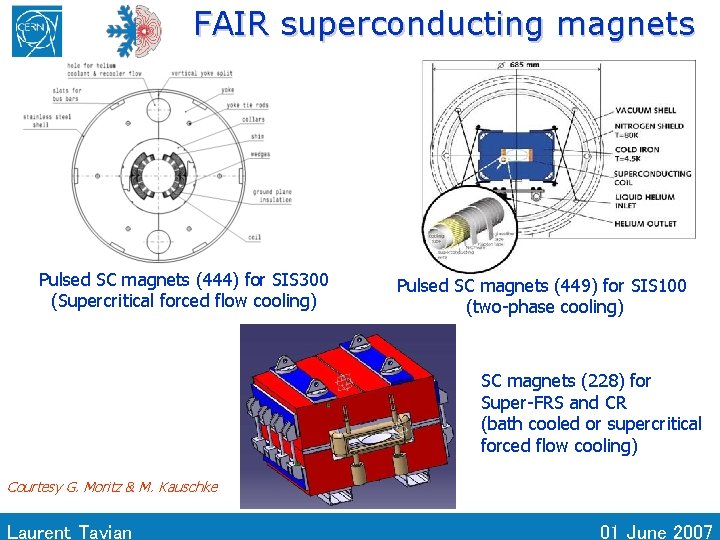
FAIR superconducting magnets Pulsed SC magnets (444) for SIS 300 (Supercritical forced flow cooling) Pulsed SC magnets (449) for SIS 100 (two-phase cooling) SC magnets (228) for Super-FRS and CR (bath cooled or supercritical forced flow cooling) Courtesy G. Moritz & M. Kauschke Laurent Tavian 01 June 2007
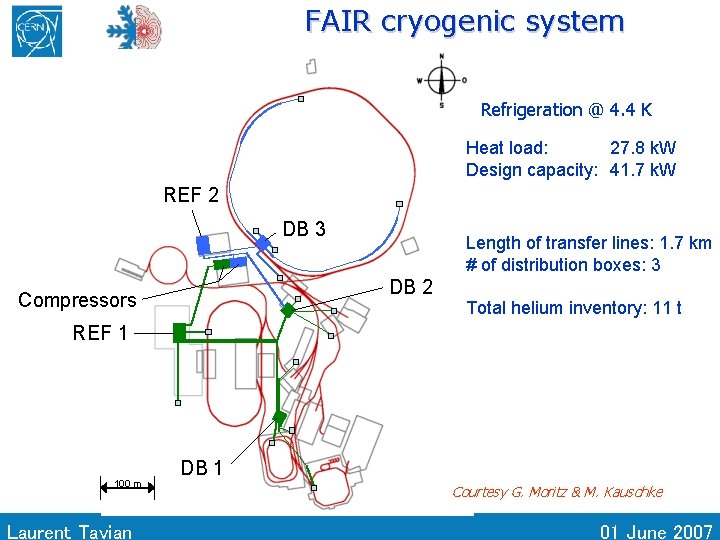
FAIR cryogenic system Refrigeration @ 4. 4 K Heat load: 27. 8 k. W Design capacity: 41. 7 k. W REF 2 DB 3 Length of transfer lines: 1. 7 km # of distribution boxes: 3 DB 2 Compressors Total helium inventory: 11 t REF 1 100 m Laurent Tavian DB 1 Courtesy G. Moritz & M. Kauschke 01 June 2007
Contents Ø The role of cryogenics in future projects Ø The thermonuclear fusion research (ITER) Ø Particle physics at the energy frontier (ILC, LHC upgrades) Ø High-intensity proton linacs (SPL, EURISOL, IFMIF) Ø Nuclear physics with protons, antiprotons and ions (FAIR) Ø Ultra-fast, intense X-rays to probe condensed matter (the European X-ray FEL and ERLs) Ø Cosmic and rare underground signals (ICARUS) Ø Conclusions Laurent Tavian 01 June 2007
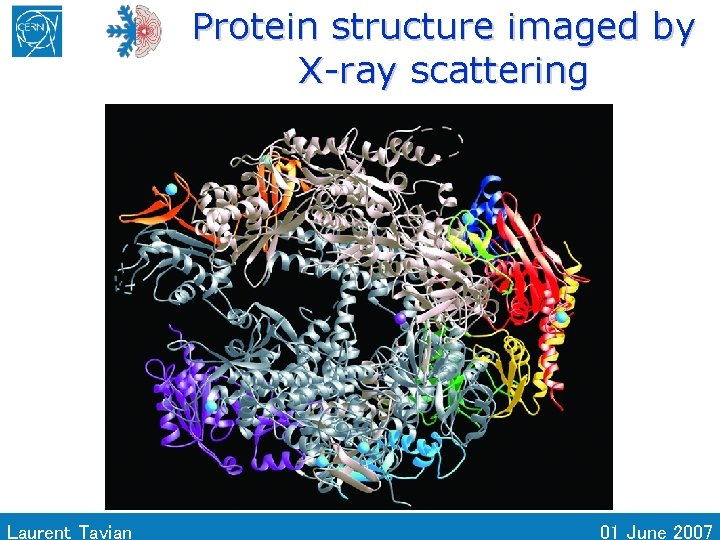
Protein structure imaged by X-ray scattering Laurent Tavian 01 June 2007
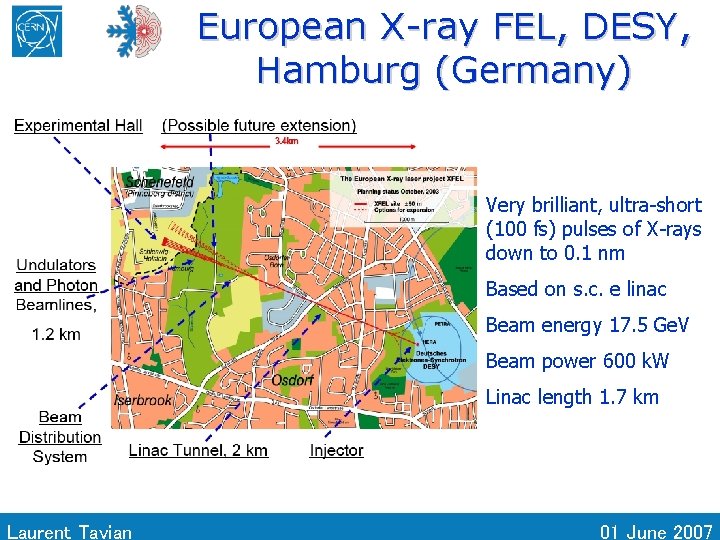
European X-ray FEL, DESY, Hamburg (Germany) Very brilliant, ultra-short (100 fs) pulses of X-rays down to 0. 1 nm Based on s. c. e linac Beam energy 17. 5 Ge. V Beam power 600 k. W Linac length 1. 7 km Laurent Tavian 01 June 2007
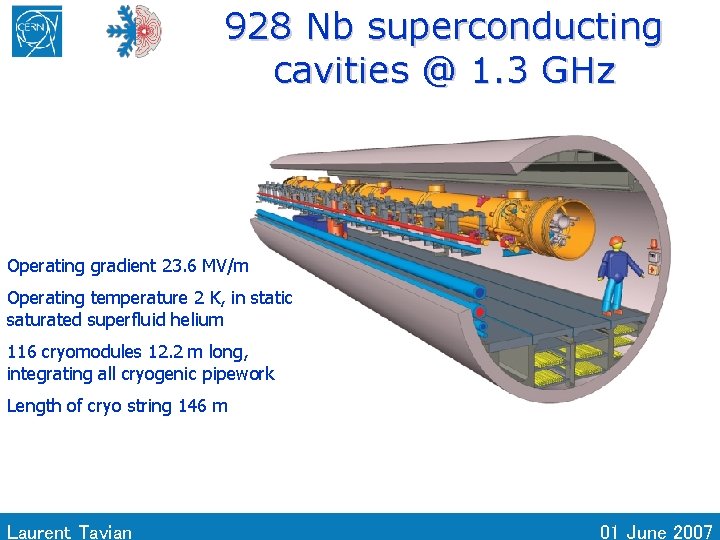
928 Nb superconducting cavities @ 1. 3 GHz Operating gradient 23. 6 MV/m Operating temperature 2 K, in static saturated superfluid helium 116 cryomodules 12. 2 m long, integrating all cryogenic pipework Length of cryo string 146 m Laurent Tavian 01 June 2007
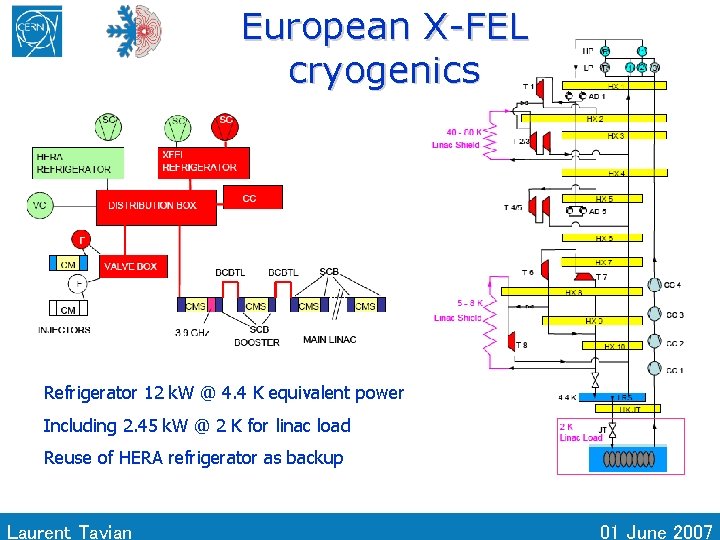
European X-FEL cryogenics Refrigerator 12 k. W @ 4. 4 K equivalent power Including 2. 45 k. W @ 2 K for linac load Reuse of HERA refrigerator as backup Laurent Tavian 01 June 2007
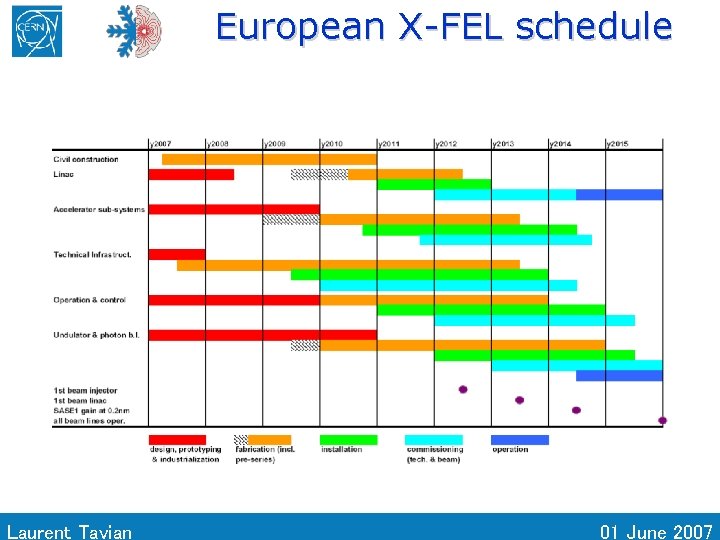
European X-FEL schedule Laurent Tavian 01 June 2007
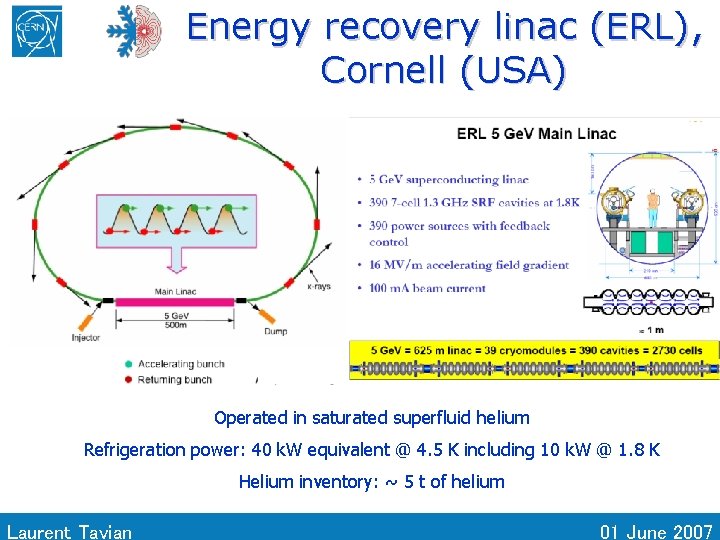
Energy recovery linac (ERL), Cornell (USA) Operated in saturated superfluid helium Refrigeration power: 40 k. W equivalent @ 4. 5 K including 10 k. W @ 1. 8 K Helium inventory: ~ 5 t of helium Laurent Tavian 01 June 2007
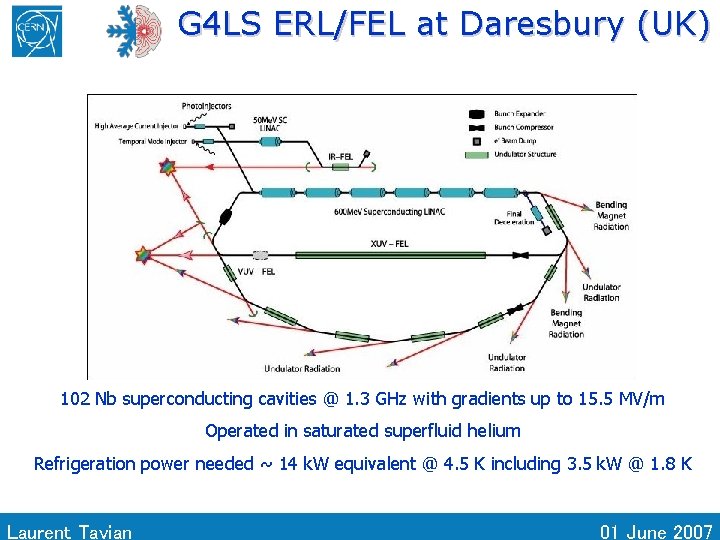
G 4 LS ERL/FEL at Daresbury (UK) 102 Nb superconducting cavities @ 1. 3 GHz with gradients up to 15. 5 MV/m Operated in saturated superfluid helium Refrigeration power needed ~ 14 k. W equivalent @ 4. 5 K including 3. 5 k. W @ 1. 8 K Laurent Tavian 01 June 2007
Contents Ø The role of cryogenics in future projects Ø The thermonuclear fusion research (ITER) Ø Particle physics at the energy frontier (ILC, LHC upgrades) Ø High-intensity proton linacs (SPL, EURISOL, IFMIF) Ø Nuclear physics with protons, antiprotons and ions (FAIR) Ø Ultra-fast, intense X-rays to probe condensed matter (the European X-ray FEL and ERLs) Ø Cosmic and rare underground signals (ICARUS) Ø Conclusions Laurent Tavian 01 June 2007
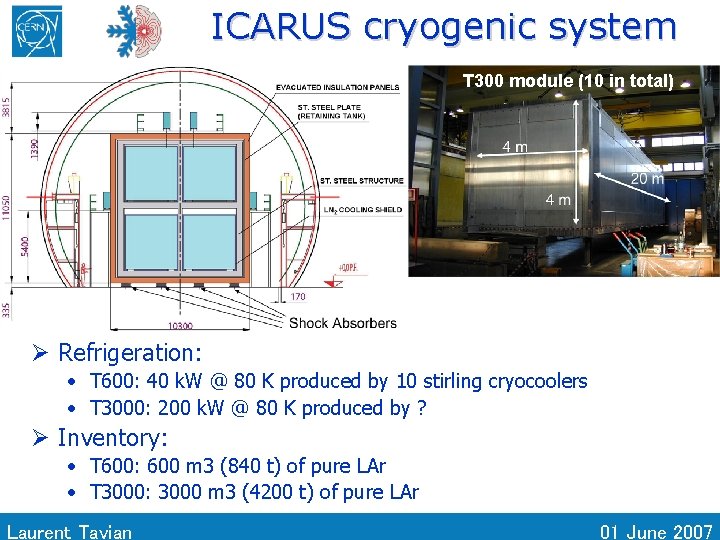
ICARUS physics program T 60 0 cry oge & nic s Laurent Tavian 2 x. T 1200 01 June 2007
ICARUS cryogenic system T 300 module (10 in total) Ø Refrigeration: • T 600: 40 k. W @ 80 K produced by 10 stirling cryocoolers • T 3000: 200 k. W @ 80 K produced by ? Ø Inventory: • T 600: 600 m 3 (840 t) of pure LAr • T 3000: 3000 m 3 (4200 t) of pure LAr Laurent Tavian 01 June 2007
Contents Ø The role of cryogenics in future projects Ø The thermonuclear fusion research (ITER) Ø Particle physics at the energy frontier (ILC, LHC upgrades) Ø High-intensity proton linacs (SPL, EURISOL, IFMIF) Ø Nuclear physics with protons, antiprotons and ions (FAIR) Ø Ultra-fast, intense X-rays to probe condensed matter (the European X-ray FEL and ERLs) Ø Cosmic and rare underground signals (ICARUS) Ø Conclusions Laurent Tavian 01 June 2007
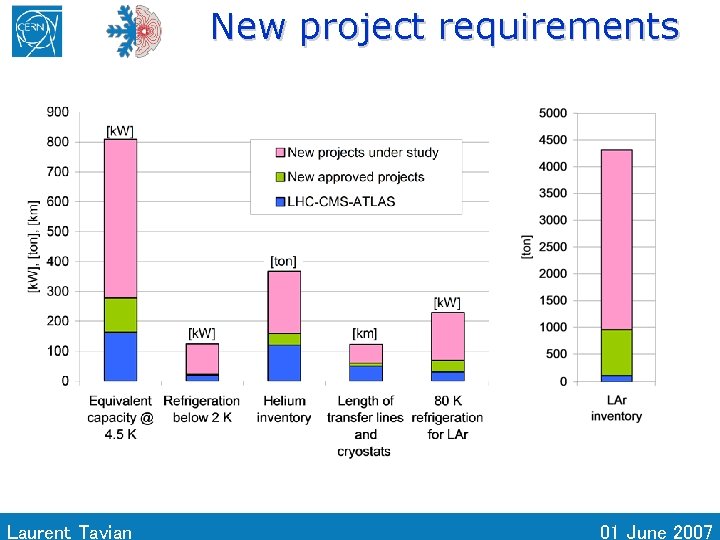
New project requirements Laurent Tavian 01 June 2007
Conclusions Ø Perspectives for large cryogenic systems are existing and are mainly driven by the use of superconductivity in new projects. In some cases, superfluid helium can be used for boosting superconductor performance and cooling extended systems Ø New approved projects (ITER, European X-FEL, FAIR) are already demanding efforts from the cryogenic community. Ø Large cryogenic refrigerators with multi-k. W capacities down to 2 K as well as complex cryogenic distribution systems will be required for future projects. Ø Similarities are existing in between the different projects for devices, cooling method and cryogenic refrigeration. S&D efforts could be mutualized among several projects. Laurent Tavian 01 June 2007