First Results from LIGO Keith Riles University of

- Slides: 55
First Results from LIGO Keith Riles University of Michigan Physics and Astronomy Colloquium University of Rochester January 19, 2005 K. Riles - First Results from LIGO -11/30/04
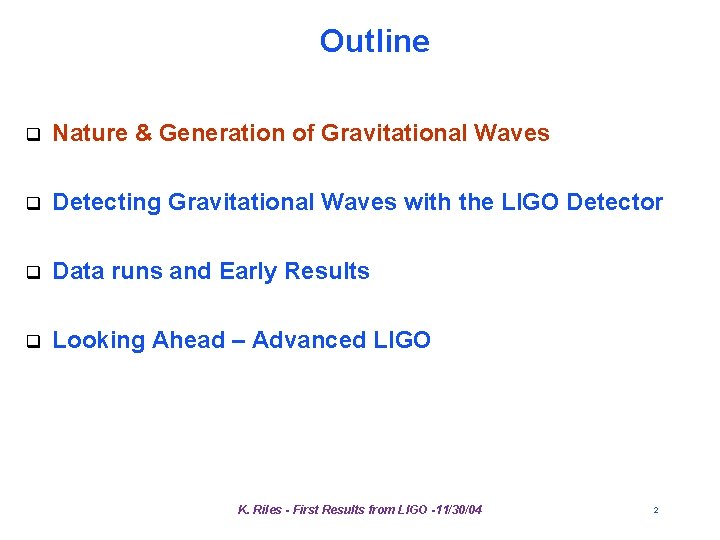
Outline q Nature & Generation of Gravitational Waves q Detecting Gravitational Waves with the LIGO Detector q Data runs and Early Results q Looking Ahead – Advanced LIGO K. Riles - First Results from LIGO -11/30/04 2
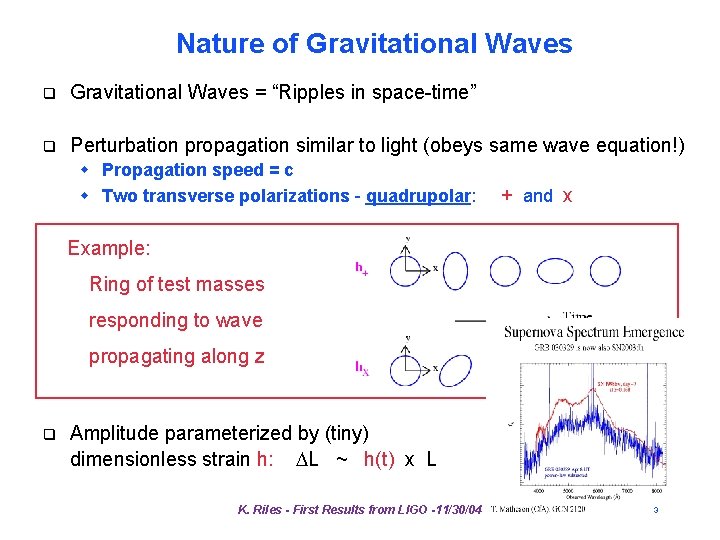
Nature of Gravitational Waves q Gravitational Waves = “Ripples in space-time” q Perturbation propagation similar to light (obeys same wave equation!) w Propagation speed = c w Two transverse polarizations - quadrupolar: + and x Example: Ring of test masses responding to wave propagating along z q Amplitude parameterized by (tiny) dimensionless strain h: DL ~ h(t) x L K. Riles - First Results from LIGO -11/30/04 3
Why look for Gravitational Radiation? q Because it’s there! (presumably) q Test General Relativity: w Quadrupolar radiation? Travels at speed of light? w Unique probe of strong-field gravity q Gain different view of Universe: w Sources cannot be obscured by dust w Detectable sources some of the most interesting, least understood in the Universe w Opens up entirely new non-electromagnetic spectrum K. Riles - First Results from LIGO -11/30/04 4
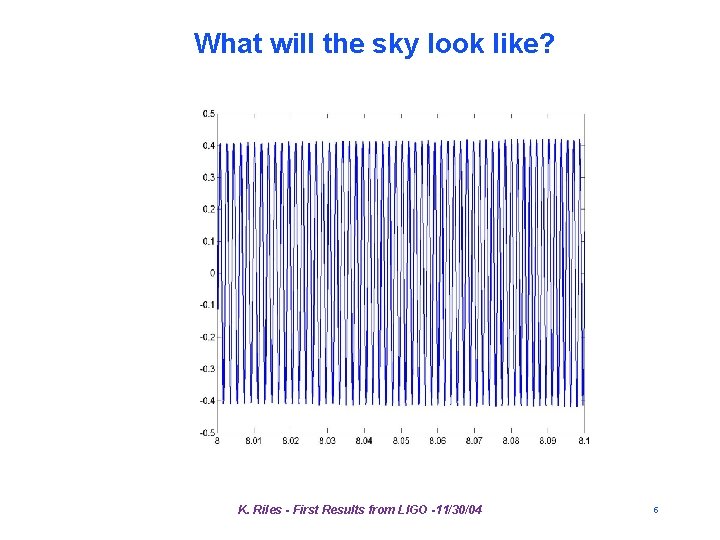
What will the sky look like? K. Riles - First Results from LIGO -11/30/04 5
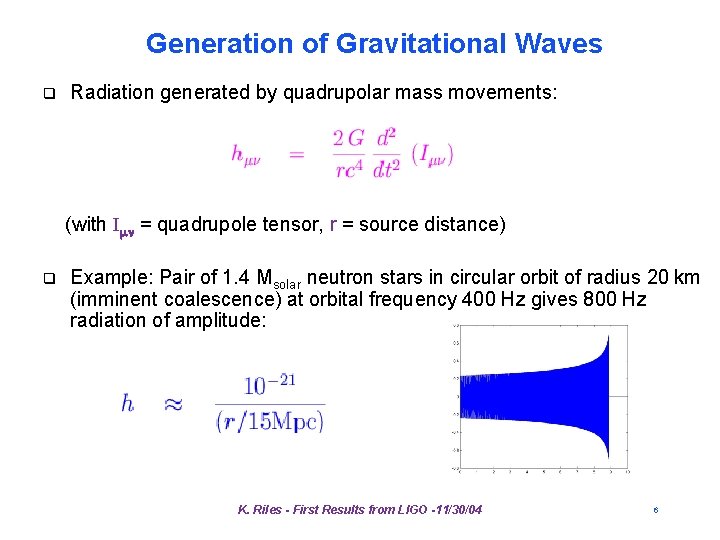
Generation of Gravitational Waves q Radiation generated by quadrupolar mass movements: (with Imn = quadrupole tensor, r = source distance) q Example: Pair of 1. 4 Msolar neutron stars in circular orbit of radius 20 km (imminent coalescence) at orbital frequency 400 Hz gives 800 Hz radiation of amplitude: K. Riles - First Results from LIGO -11/30/04 6
Generation of Gravitational Waves Major expected sources in 10 -1000 Hz “terrestrial” band: q Coalescences of binary compact star systems (NS-NS, NS-BH, BH-BH) q Supernovae (requires asymmetry in explosion) q Spinning neutron stars, e. g. , pulsars (requires axial asymmetry or wobbling spin axis) Also expected (but probably exceedingly weak): q Stochastic background – Big Bang remnant Or from Cosmic Strings? Talk to Adrian! K. Riles - First Results from LIGO -11/30/04 7
Generation of Gravitational Waves q Strong indirect evidence for GW generation: Taylor-Hulse Pulsar System (PSR 1913+16) w. Two neutron stars (one=pulsar) in elliptical 8 -hour orbit w. Measured periastron advance quadratic in time in agreement with absolute GR prediction Orbital decay due to energy loss K. Riles - First Results from LIGO -11/30/04 8
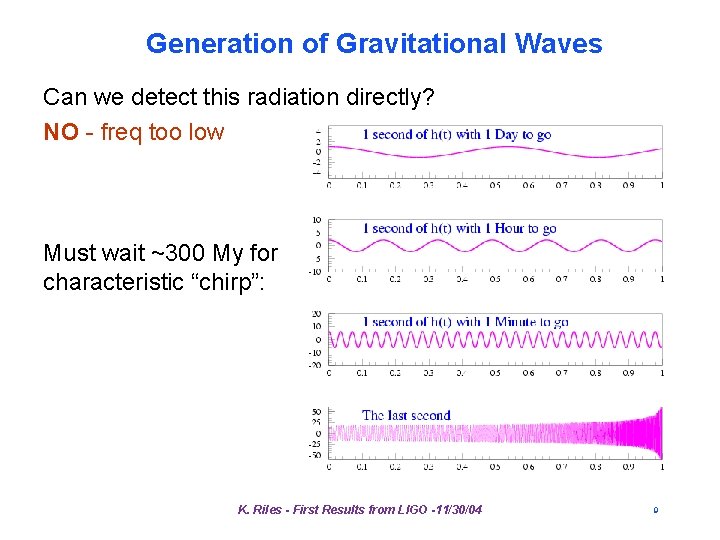
Generation of Gravitational Waves Can we detect this radiation directly? NO - freq too low Must wait ~300 My for characteristic “chirp”: K. Riles - First Results from LIGO -11/30/04 9
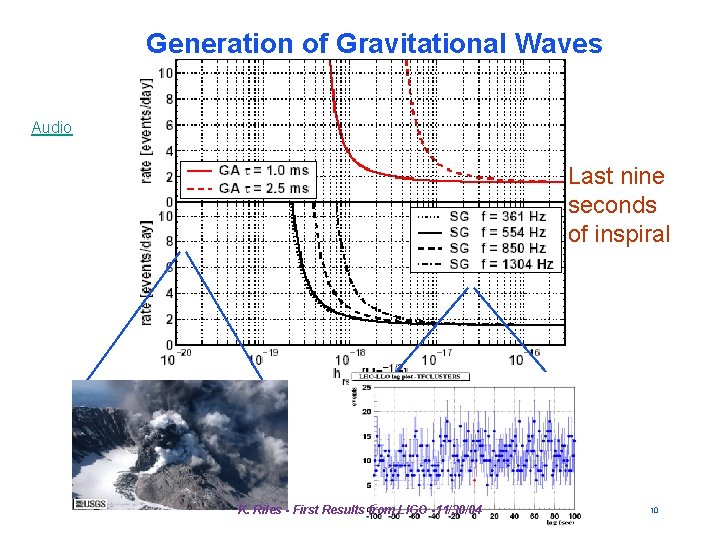
Generation of Gravitational Waves Audio Last nine seconds of inspiral K. Riles - First Results from LIGO -11/30/04 10
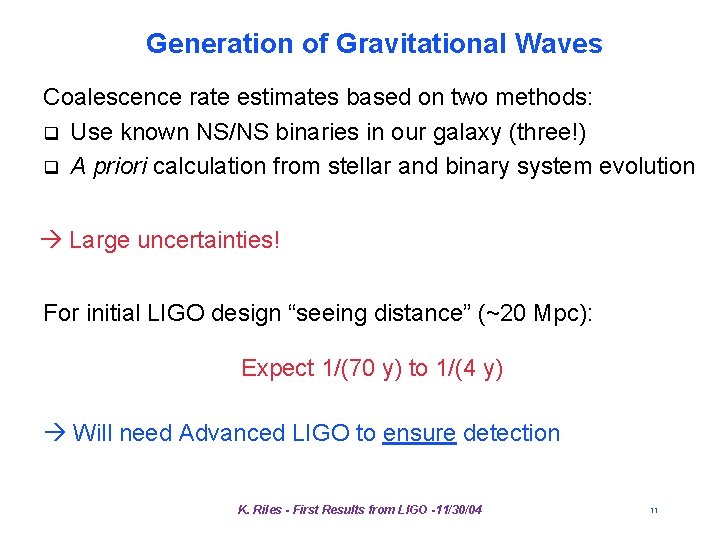
Generation of Gravitational Waves Coalescence rate estimates based on two methods: q Use known NS/NS binaries in our galaxy (three!) q A priori calculation from stellar and binary system evolution Large uncertainties! For initial LIGO design “seeing distance” (~20 Mpc): Expect 1/(70 y) to 1/(4 y) Will need Advanced LIGO to ensure detection K. Riles - First Results from LIGO -11/30/04 11
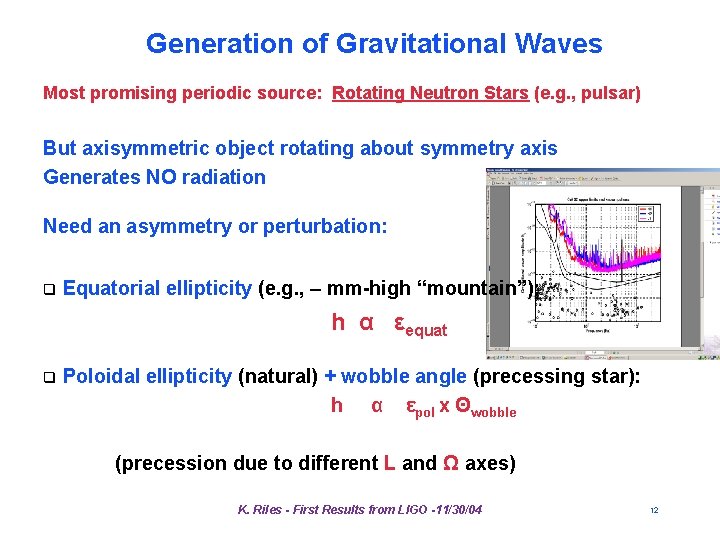
Generation of Gravitational Waves Most promising periodic source: Rotating Neutron Stars (e. g. , pulsar) But axisymmetric object rotating about symmetry axis Generates NO radiation Need an asymmetry or perturbation: q Equatorial ellipticity (e. g. , – mm-high “mountain”): h α εequat q Poloidal ellipticity (natural) + wobble angle (precessing star): h α εpol x Θwobble (precession due to different L and Ω axes) K. Riles - First Results from LIGO -11/30/04 12
Periodic Sources of GW Serious technical difficulty: Doppler frequency shifts w Frequency modulation from earth’s rotation (v/c ~ 10 -6) w Frequency modulation from earth’s orbital motion (v/c ~ 10 -4) Additional, related complications: w Daily amplitude modulation of antenna pattern w Spin-down of source w Orbital motion of sources in binary systems Modulations / drifts complicate analysis enormously: w Simple Fourier transform inadequate w Every sky direction requires different demodulation All-sky survey at full sensitivity = Formidable challenge K. Riles - First Results from LIGO -11/30/04 13
Periodic Sources of GW But two substantial benefits from modulations: w Reality of signal confirmed by need for corrections w Corrections give precise direction of source q Difficult to detect spinning neutron stars! q But search is nonetheless intriguing: w Unknown number of electromagnetically quiet, undiscovered neutron stars in our galactic neighborhood w Realistic values for ε unknown w A nearby source could be buried in the data, waiting for just the right algorithm to tease it into view Much effort underway Expect results in April K. Riles - First Results from LIGO -11/30/04 14
Outline q Nature & Generation of Gravitational Waves q Detecting Gravitational Waves with the LIGO Detector q Data runs and Early Results q Preparing for Advanced LIGO K. Riles - First Results from LIGO -11/30/04 15
Gravitational Wave Detection q Suspended Interferometers (IFO’s) w Suspended mirrors in “free-fall” w Broad-band response (~50 Hz to few k. Hz) w Waveform information (e. g. , chirp reconstruction) w Michelson IFO is “natural” GW detector K. Riles - First Results from LIGO -11/30/04 16
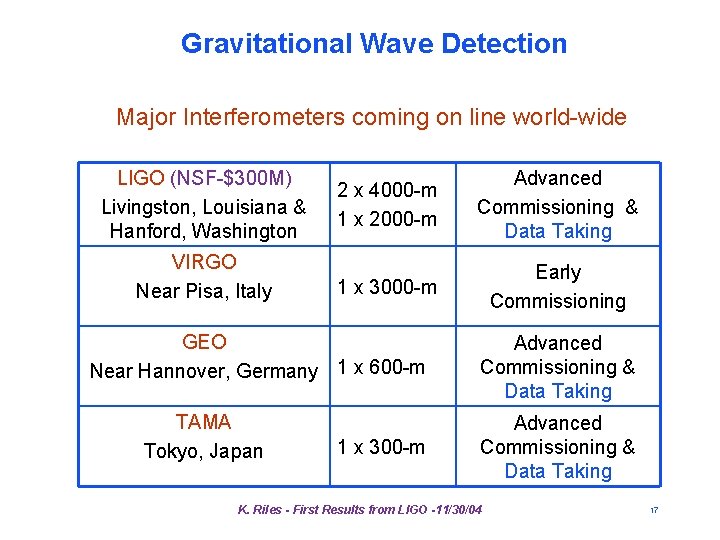
Gravitational Wave Detection Major Interferometers coming on line world-wide LIGO (NSF-$300 M) Livingston, Louisiana & Hanford, Washington VIRGO Near Pisa, Italy 2 x 4000 -m 1 x 2000 -m Advanced Commissioning & Data Taking 1 x 3000 -m Early Commissioning GEO Near Hannover, Germany 1 x 600 -m TAMA Tokyo, Japan 1 x 300 -m Advanced Commissioning & Data Taking K. Riles - First Results from LIGO -11/30/04 17
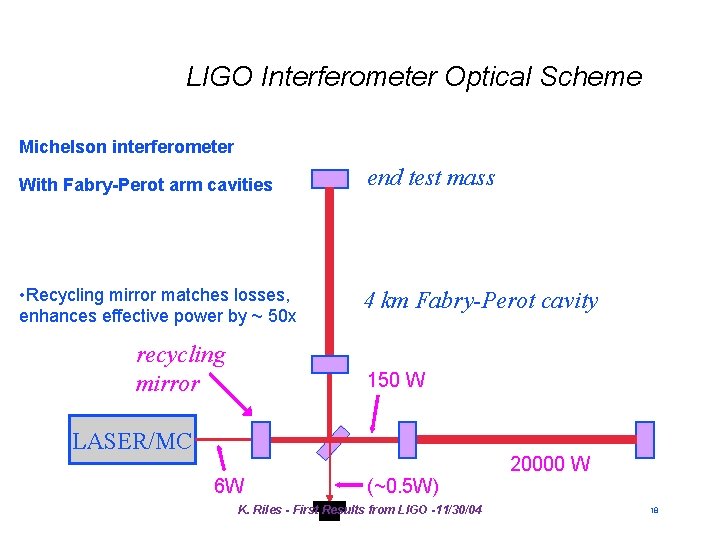
LIGO Interferometer Optical Scheme Michelson interferometer With Fabry-Perot arm cavities end test mass • Recycling mirror matches losses, enhances effective power by ~ 50 x 4 km Fabry-Perot cavity recycling mirror 150 W LASER/MC 6 W (~0. 5 W) K. Riles - First Results from LIGO -11/30/04 20000 W 18
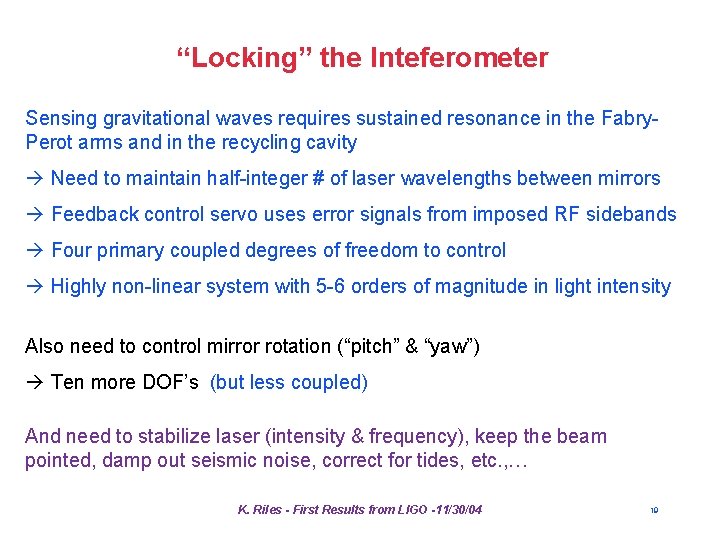
“Locking” the Inteferometer Sensing gravitational waves requires sustained resonance in the Fabry. Perot arms and in the recycling cavity Need to maintain half-integer # of laser wavelengths between mirrors Feedback control servo uses error signals from imposed RF sidebands Four primary coupled degrees of freedom to control Highly non-linear system with 5 -6 orders of magnitude in light intensity Also need to control mirror rotation (“pitch” & “yaw”) Ten more DOF’s (but less coupled) And need to stabilize laser (intensity & frequency), keep the beam pointed, damp out seismic noise, correct for tides, etc. , … K. Riles - First Results from LIGO -11/30/04 19
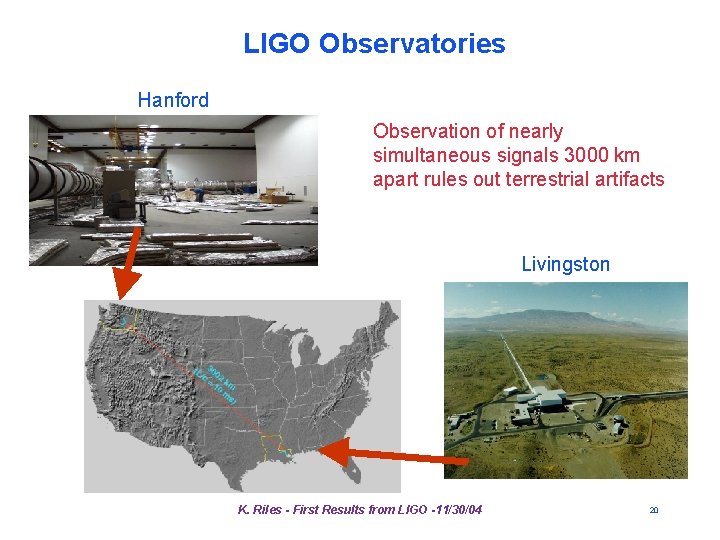
LIGO Observatories Hanford Observation of nearly simultaneous signals 3000 km apart rules out terrestrial artifacts Livingston K. Riles - First Results from LIGO -11/30/04 20
LIGO Detector Facilities • Stainless-steel tubes (1. 24 m diameter, ~10 -8 torr) • Gate valves for optics isolation • Protected by concrete enclosure Vacuum System K. Riles - First Results from LIGO -11/30/04 21
LIGO Detector Facilities LASER q q Infrared (1064 nm, 10 -W) Nd-YAG laser from Lightwave (now commercial product!) Elaborate intensity & frequency stabilization system, including feedback from main interferometer Optics q q q Fused silica (high-Q, low-absorption, 1 nm surface rms, 25 -cm diameter) Suspended by single steel wire Actuation of alignment / position via magnets & coils K. Riles - First Results from LIGO -11/30/04 22
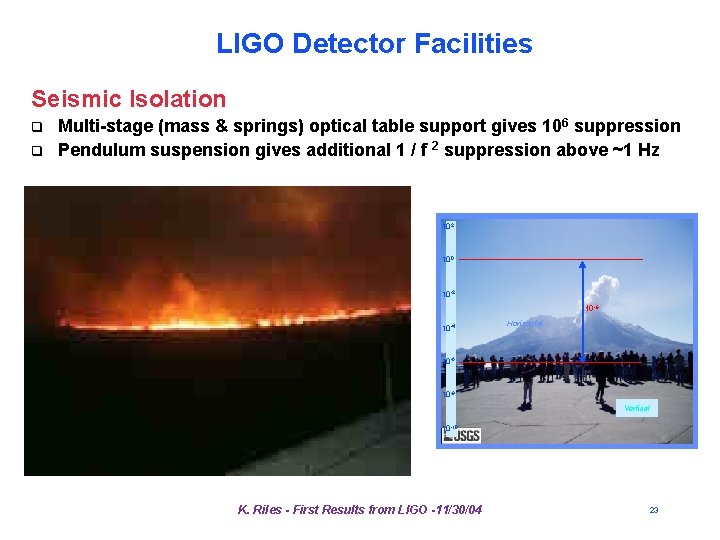
LIGO Detector Facilities Seismic Isolation q q Multi-stage (mass & springs) optical table support gives 106 suppression Pendulum suspension gives additional 1 / f 2 suppression above ~1 Hz 102 100 10 -2 10 -6 10 -4 Horizontal 10 -6 10 -8 Vertical 10 -10 K. Riles - First Results from LIGO -11/30/04 23
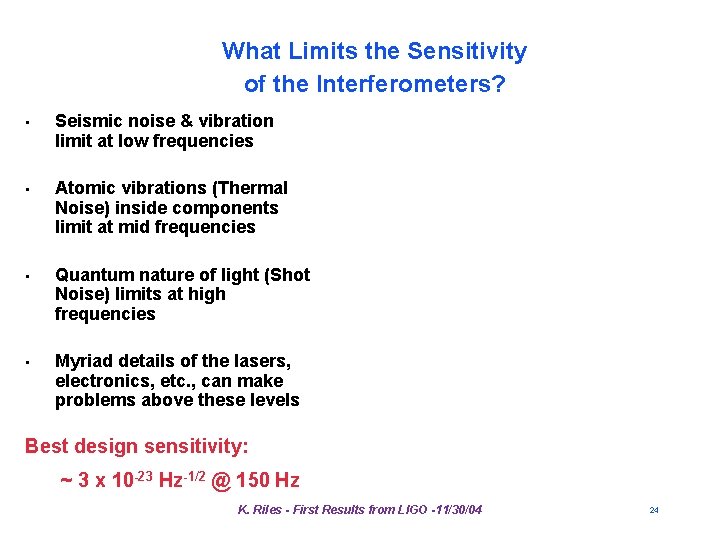
What Limits the Sensitivity of the Interferometers? • Seismic noise & vibration limit at low frequencies • Atomic vibrations (Thermal Noise) inside components limit at mid frequencies • Quantum nature of light (Shot Noise) limits at high frequencies • Myriad details of the lasers, electronics, etc. , can make problems above these levels Best design sensitivity: ~ 3 x 10 -23 Hz-1/2 @ 150 Hz K. Riles - First Results from LIGO -11/30/04 24
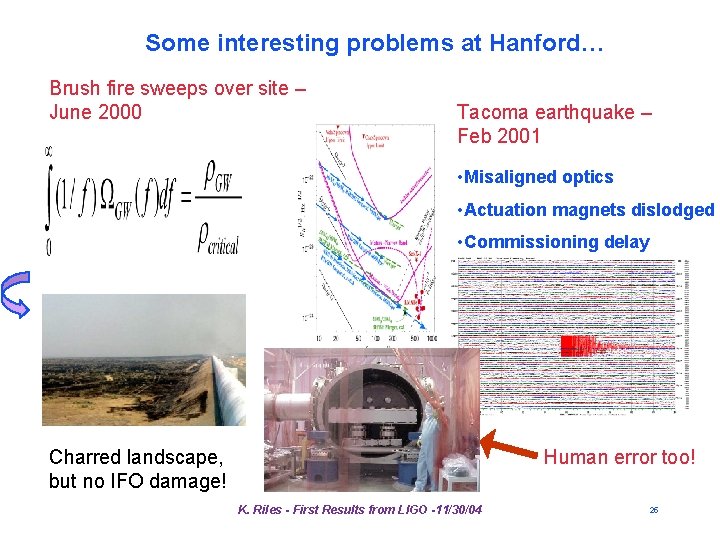
Some interesting problems at Hanford… Brush fire sweeps over site – June 2000 Tacoma earthquake – Feb 2001 • Misaligned optics • Actuation magnets dislodged • Commissioning delay Human error too! Charred landscape, but no IFO damage! K. Riles - First Results from LIGO -11/30/04 25
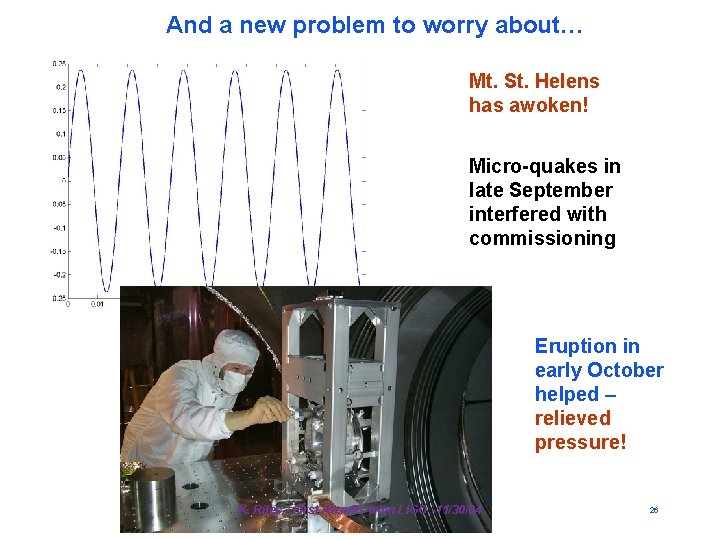
And a new problem to worry about… Mt. St. Helens has awoken! Micro-quakes in late September interfered with commissioning Eruption in early October helped – relieved pressure! K. Riles - First Results from LIGO -11/30/04 26
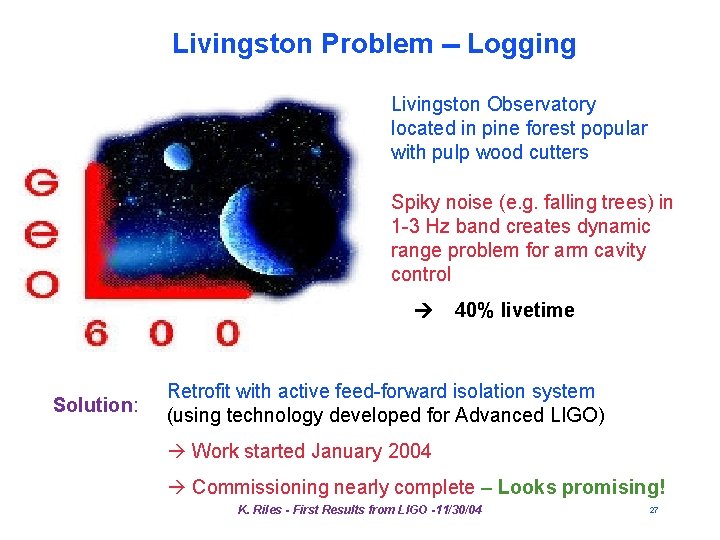
Livingston Problem -- Logging Livingston Observatory located in pine forest popular with pulp wood cutters Spiky noise (e. g. falling trees) in 1 -3 Hz band creates dynamic range problem for arm cavity control Solution: 40% livetime Retrofit with active feed-forward isolation system (using technology developed for Advanced LIGO) Work started January 2004 Commissioning nearly complete – Looks promising! K. Riles - First Results from LIGO -11/30/04 27
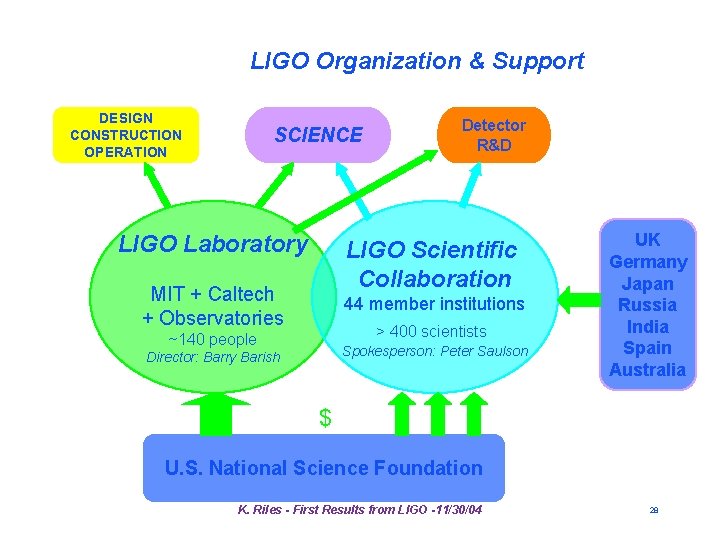
LIGO Organization & Support DESIGN CONSTRUCTION OPERATION SCIENCE LIGO Laboratory Detector R&D LIGO Scientific Collaboration MIT + Caltech + Observatories 44 member institutions > 400 scientists ~140 people Spokesperson: Peter Saulson Director: Barry Barish UK Germany Japan Russia India Spain Australia $ U. S. National Science Foundation K. Riles - First Results from LIGO -11/30/04 28
LIGO Scientific Collaboration The LIGO Logo’s K. Riles - First Results from LIGO -11/30/04 29
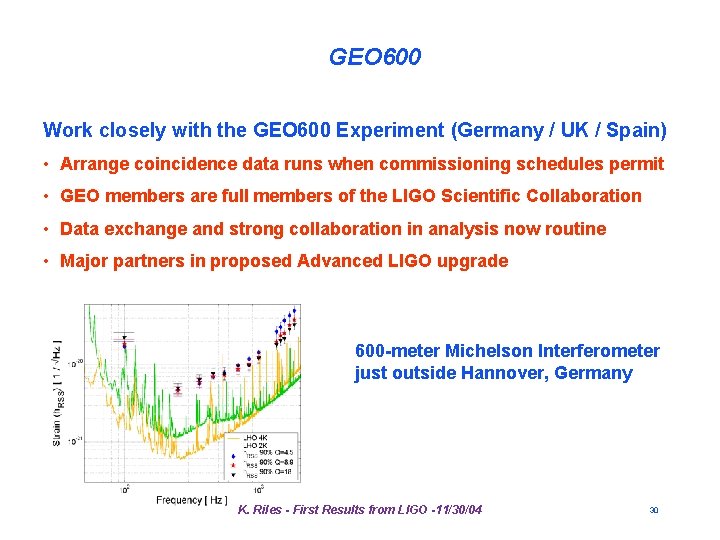
GEO 600 Work closely with the GEO 600 Experiment (Germany / UK / Spain) • Arrange coincidence data runs when commissioning schedules permit • GEO members are full members of the LIGO Scientific Collaboration • Data exchange and strong collaboration in analysis now routine • Major partners in proposed Advanced LIGO upgrade 600 -meter Michelson Interferometer just outside Hannover, Germany K. Riles - First Results from LIGO -11/30/04 30
Outline q Nature & Generation of Gravitational Waves q Detecting Gravitational Waves with the LIGO Detector q Data runs and Early Results q Looking Ahead – Advanced LIGO K. Riles - First Results from LIGO -11/30/04 31
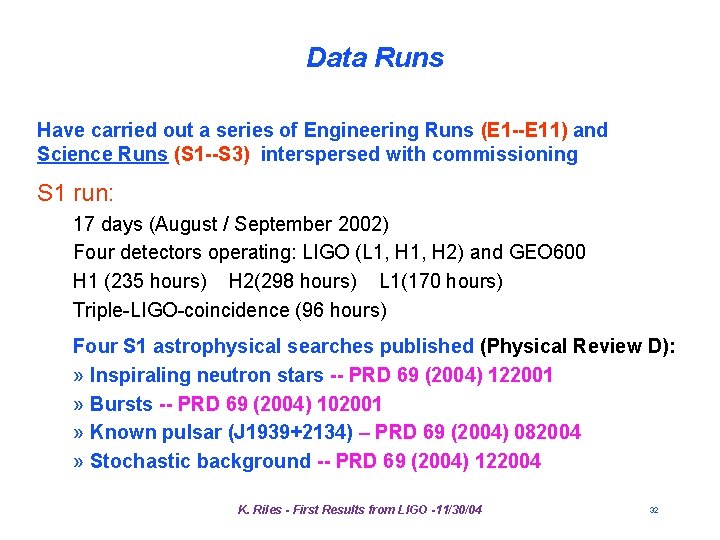
Data Runs Have carried out a series of Engineering Runs (E 1 --E 11) and Science Runs (S 1 --S 3) interspersed with commissioning S 1 run: 17 days (August / September 2002) Four detectors operating: LIGO (L 1, H 2) and GEO 600 H 1 (235 hours) H 2(298 hours) L 1(170 hours) Triple-LIGO-coincidence (96 hours) Four S 1 astrophysical searches published (Physical Review D): » Inspiraling neutron stars -- PRD 69 (2004) 122001 » Bursts -- PRD 69 (2004) 102001 » Known pulsar (J 1939+2134) – PRD 69 (2004) 082004 » Stochastic background -- PRD 69 (2004) 122004 K. Riles - First Results from LIGO -11/30/04 32
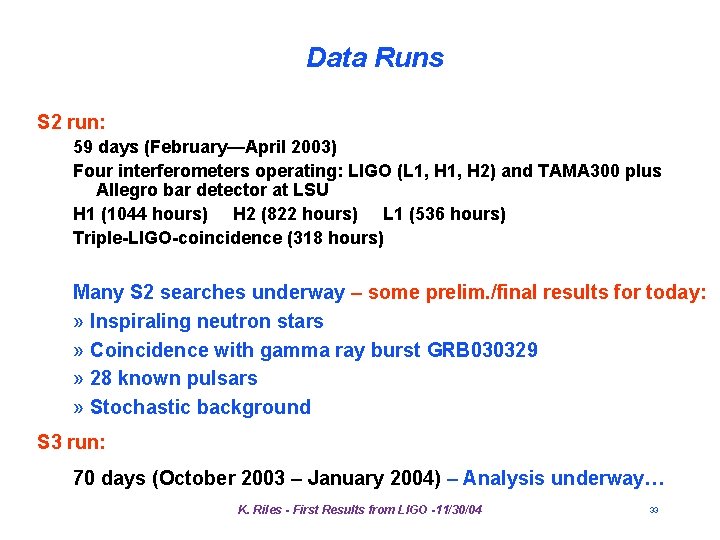
Data Runs S 2 run: 59 days (February—April 2003) Four interferometers operating: LIGO (L 1, H 2) and TAMA 300 plus Allegro bar detector at LSU H 1 (1044 hours) H 2 (822 hours) L 1 (536 hours) Triple-LIGO-coincidence (318 hours) Many S 2 searches underway – some prelim. /final results for today: » Inspiraling neutron stars » Coincidence with gamma ray burst GRB 030329 » 28 known pulsars » Stochastic background S 3 run: 70 days (October 2003 – January 2004) – Analysis underway… K. Riles - First Results from LIGO -11/30/04 33
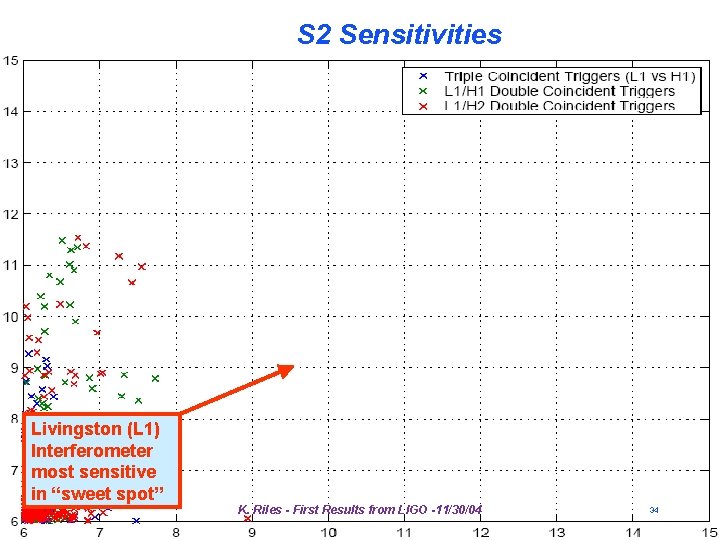
S 2 Sensitivities Livingston (L 1) Interferometer most sensitive in “sweet spot” K. Riles - First Results from LIGO -11/30/04 34
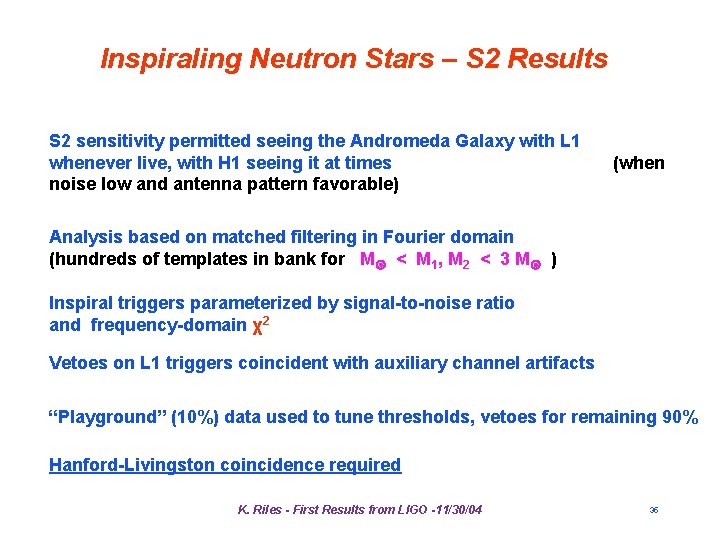
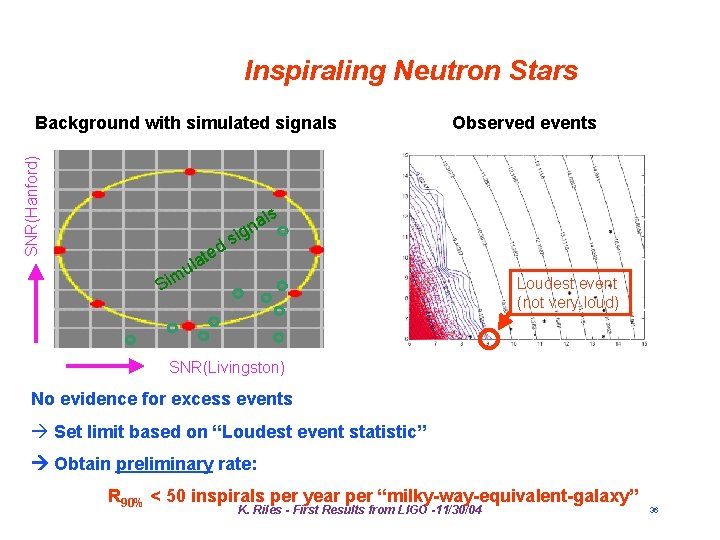
Inspiraling Neutron Stars – S 2 Results S 2 sensitivity permitted seeing the Andromeda Galaxy with L 1 whenever live, with H 1 seeing it at times noise low and antenna pattern favorable) (when Analysis based on matched filtering in Fourier domain (hundreds of templates in bank for M < M 1, M 2 < 3 M ) Inspiral triggers parameterized by signal-to-noise ratio and frequency-domain χ2 Vetoes on L 1 triggers coincident with auxiliary channel artifacts “Playground” (10%) data used to tune thresholds, vetoes for remaining 90% Hanford-Livingston coincidence required K. Riles - First Results from LIGO -11/30/04 35
Inspiraling Neutron Stars SNR(Hanford) Background with simulated signals d ate Observed events als n ig s l u m i S Loudest event (not very loud) SNR(Livingston) No evidence for excess events Set limit based on “Loudest event statistic” Obtain preliminary rate: R 90% < 50 inspirals per year per “milky-way-equivalent-galaxy” K. Riles - First Results from LIGO -11/30/04 36
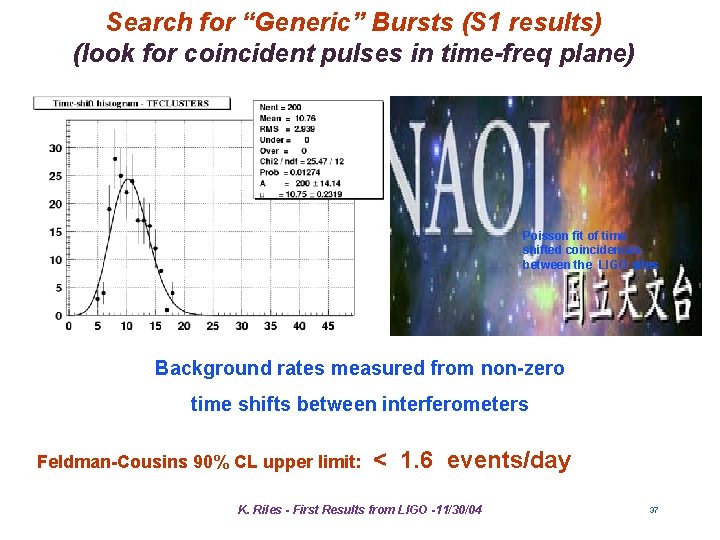
Search for “Generic” Bursts (S 1 results) (look for coincident pulses in time-freq plane) Background estimation for TFCLUSTERS in S 1 Poisson fit of time shifted coincidences between the LIGO sites Zero-lag measurement Background rates measured from non-zero time shifts between interferometers Feldman-Cousins 90% CL upper limit: < 1. 6 events/day K. Riles - First Results from LIGO -11/30/04 37
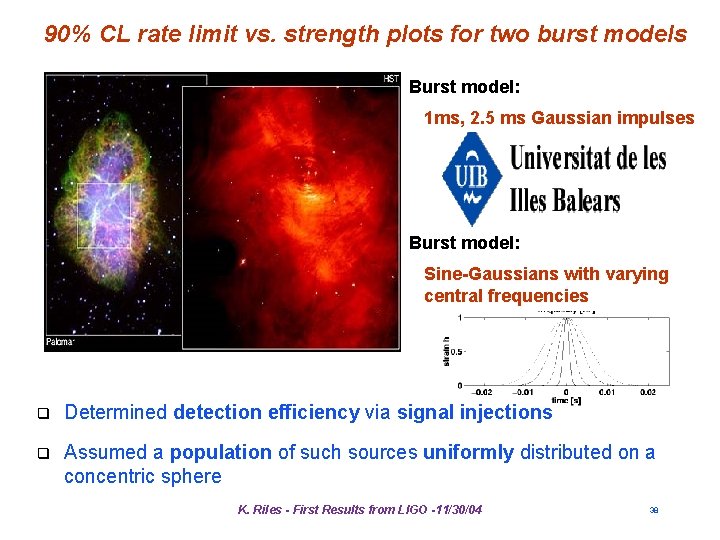
90% CL rate limit vs. strength plots for two burst models Burst model: Optimally oriented (per IFO) 1 ms, 2. 5 ms Gaussian impulses Average over direction, Polarization (per IFO) Burst model: Sine-Gaussians with varying central frequencies q Determined detection efficiency via signal injections q Assumed a population of such sources uniformly distributed on a concentric sphere K. Riles - First Results from LIGO -11/30/04 38
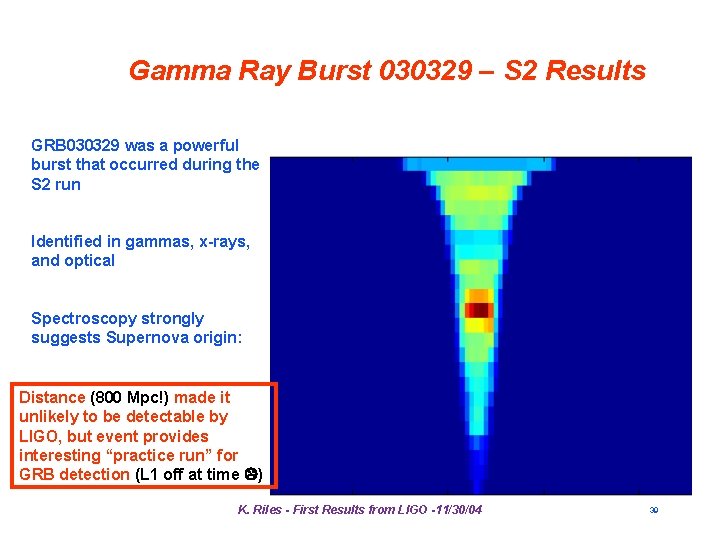
Gamma Ray Burst 030329 – S 2 Results GRB 030329 was a powerful burst that occurred during the S 2 run Identified in gammas, x-rays, and optical Spectroscopy strongly suggests Supernova origin: Distance (800 Mpc!) made it unlikely to be detectable by LIGO, but event provides interesting “practice run” for GRB detection (L 1 off at time ) K. Riles - First Results from LIGO -11/30/04 39
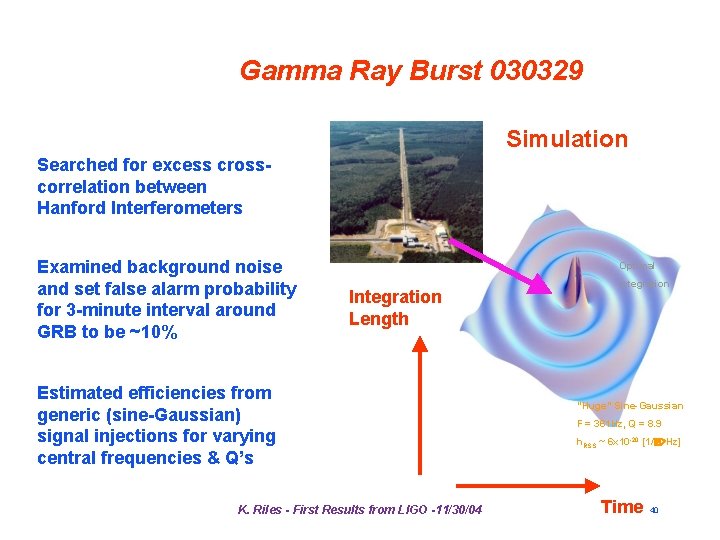
Gamma Ray Burst 030329 Simulation Searched for excess crosscorrelation between Hanford Interferometers Examined background noise and set false alarm probability for 3 -minute interval around GRB to be ~10% Optimal Integration Length Estimated efficiencies from generic (sine-Gaussian) signal injections for varying central frequencies & Q’s K. Riles - First Results from LIGO -11/30/04 integration “Huge” Sine-Gaussian F = 361 Hz, Q = 8. 9 h. RSS ~ 6 x 10 -20 [1/ Hz] Time 40
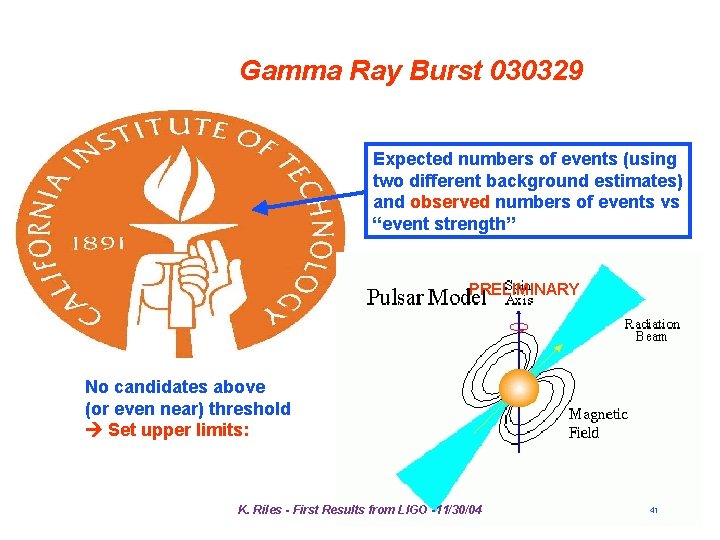
Gamma Ray Burst 030329 Expected numbers of events (using two different background estimates) and observed numbers of events vs “event strength” PRELIMINARY No candidates above (or even near) threshold Set upper limits: K. Riles - First Results from LIGO -11/30/04 41
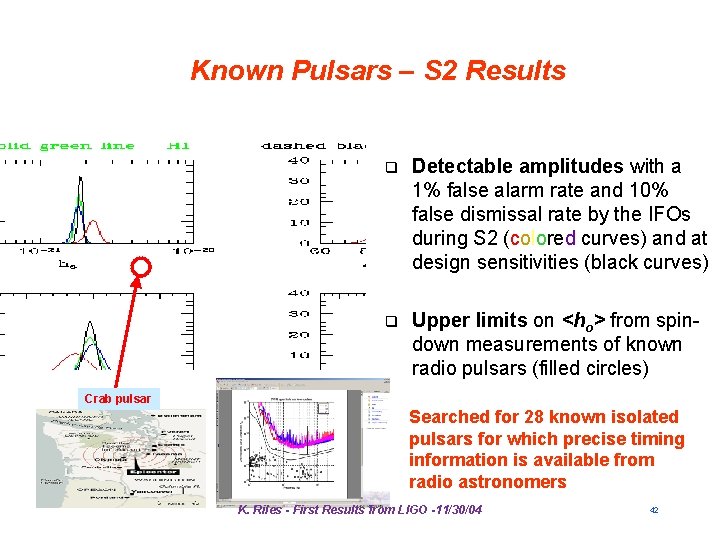
Known Pulsars – S 2 Results q Detectable amplitudes with a 1% false alarm rate and 10% false dismissal rate by the IFOs during S 2 (colored curves) and at design sensitivities (black curves) q Upper limits on <ho> from spindown measurements of known radio pulsars (filled circles) Crab pulsar Searched for 28 known isolated pulsars for which precise timing information is available from radio astronomers K. Riles - First Results from LIGO -11/30/04 42
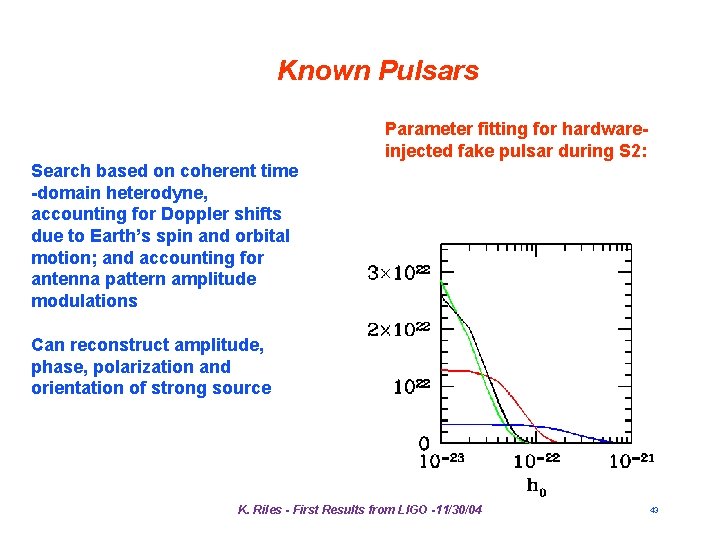
Known Pulsars Parameter fitting for hardwareinjected fake pulsar during S 2: Search based on coherent time -domain heterodyne, accounting for Doppler shifts due to Earth’s spin and orbital motion; and accounting for antenna pattern amplitude modulations Can reconstruct amplitude, phase, polarization and orientation of strong source K. Riles - First Results from LIGO -11/30/04 43
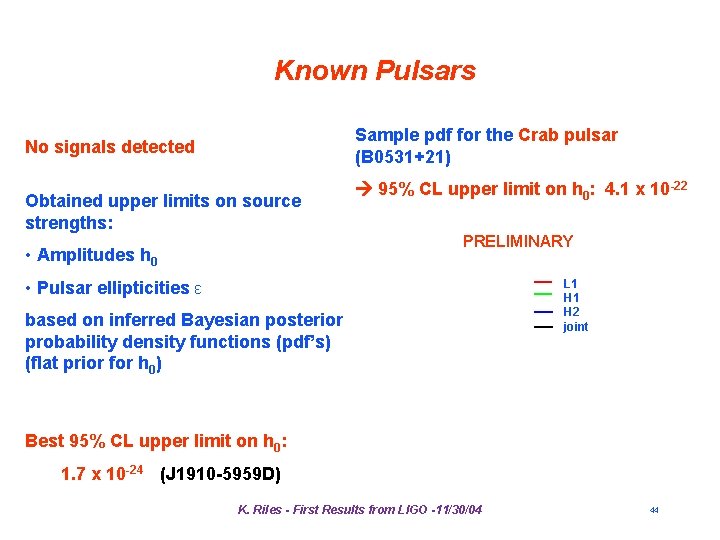
Known Pulsars Sample pdf for the Crab pulsar (B 0531+21) No signals detected Obtained upper limits on source strengths: 95% CL upper limit on h 0: 4. 1 x 10 -22 PRELIMINARY • Amplitudes h 0 • Pulsar ellipticities ε based on inferred Bayesian posterior probability density functions (pdf’s) (flat prior for h 0) L 1 H 2 joint Best 95% CL upper limit on h 0: 1. 7 x 10 -24 (J 1910 -5959 D) K. Riles - First Results from LIGO -11/30/04 44
Stochastic Background – S 2 Results q Sources: early universe, many weak unresolved sources emitting gravitational waves independently Random radiation described by its spectrum (isotropic, unpolarized, stationary and Gaussian) q Analysis goals: constrain contribution of stochastic radiation’s energy r. GW to the total energy required to close the universe rcritical : q Use optimally filtered cross-correlation of detector pairs: L 1 -H 1, L 1 -H 2 and H 1 -H 2 Report L 1 -H 1 results today K. Riles - First Results from LIGO -11/30/04 45
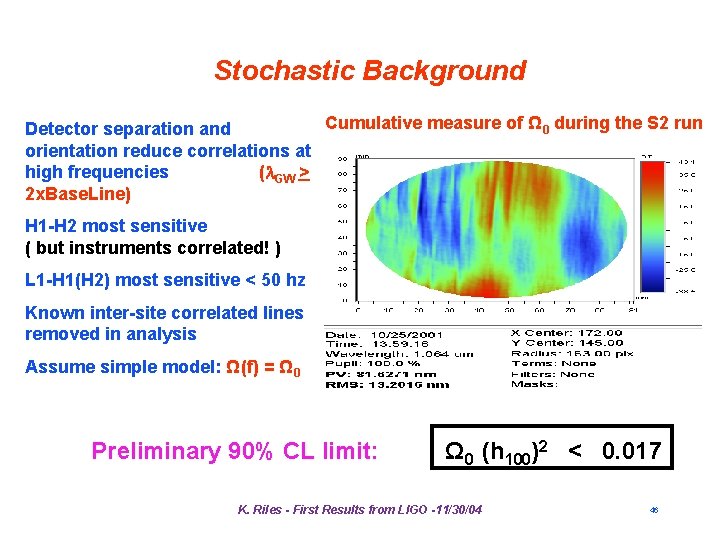
Stochastic Background Cumulative measure of Ω 0 during the S 2 run Detector separation and orientation reduce correlations at high frequencies (l. GW > 2 x. Base. Line) H 1 -H 2 most sensitive ( but instruments correlated! ) L 1 -H 1(H 2) most sensitive < 50 hz Known inter-site correlated lines removed in analysis Assume simple model: Ω(f) = Ω 0 Preliminary 90% CL limit: Ω 0 (h 100)2 < 0. 017 K. Riles - First Results from LIGO -11/30/04 46
Outline q Nature & Generation of Gravitational Waves q Detecting Gravitational Waves with the LIGO Detector q Data runs and Early Results q Looking Ahead – Advanced LIGO K. Riles - First Results from LIGO -11/30/04 47
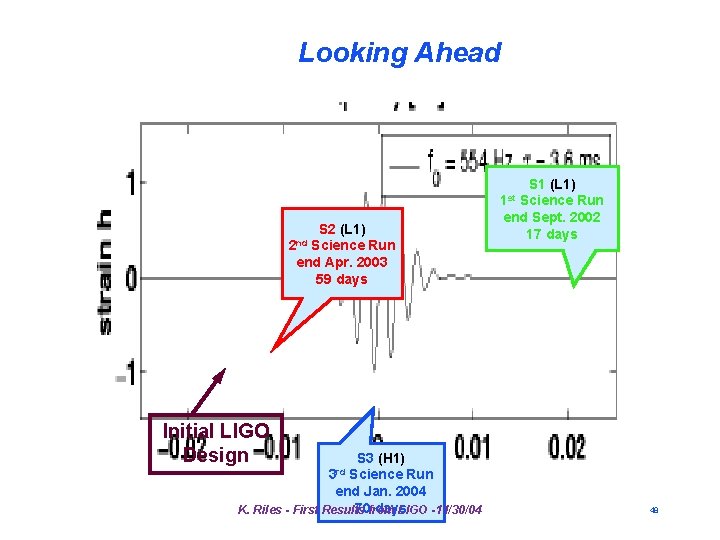
Looking Ahead S 1 (L 1) Science Run end Sept. 2002 17 days 1 st S 2 (L 1) Science Run end Apr. 2003 59 days 2 nd Initial LIGO Design S 3 (H 1) Science Run end Jan. 2004 70 from days K. Riles - First Results LIGO -11/30/04 3 rd 48
Looking Ahead Resume data runs in February 2005: • Verify success of Livingston seismic retrofit • Verify success of sensitivity improvements First true “Search Run” in late 2005 Plan before shutdown for Advanced LIGO upgrade: 1 year of running at Initial LIGO design sensitivity K. Riles - First Results from LIGO -11/30/04 49
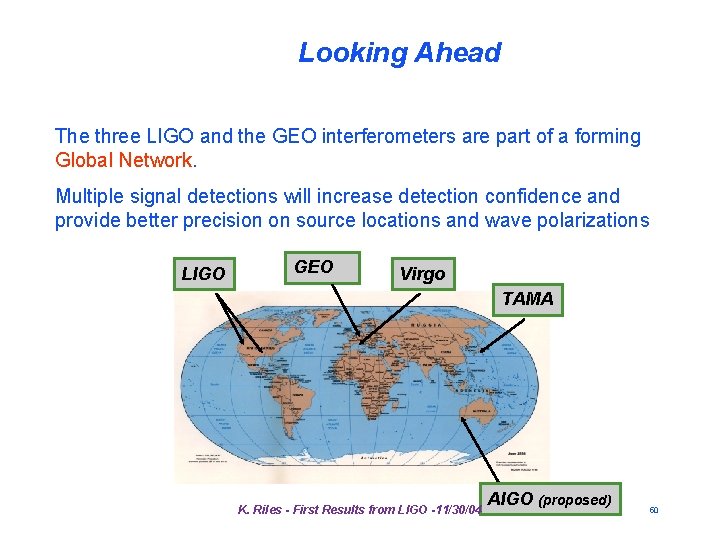
Looking Ahead The three LIGO and the GEO interferometers are part of a forming Global Network. Multiple signal detections will increase detection confidence and provide better precision on source locations and wave polarizations LIGO GEO Virgo TAMA K. Riles - First Results from LIGO -11/30/04 AIGO (proposed) 50
Looking Further Ahead Despite their immense technical challenges, the initial LIGO IFO’s were designed conservatively, based on “tabletop” prototypes, but with expected sensitivity gain of ~1000. Given the expected low rate of detectable GW events, it was always planned that in engineering, building and commissioning initial LIGO, one would learn how reliably to build Advanced LIGO with another factor of ~10 improved sensitivity. Because LIGO measures GW amplitude, an increase in sensitivity by 10 gives an increase in sampling volume, i. e, rate by ~1000 K. Riles - First Results from LIGO -11/30/04 51
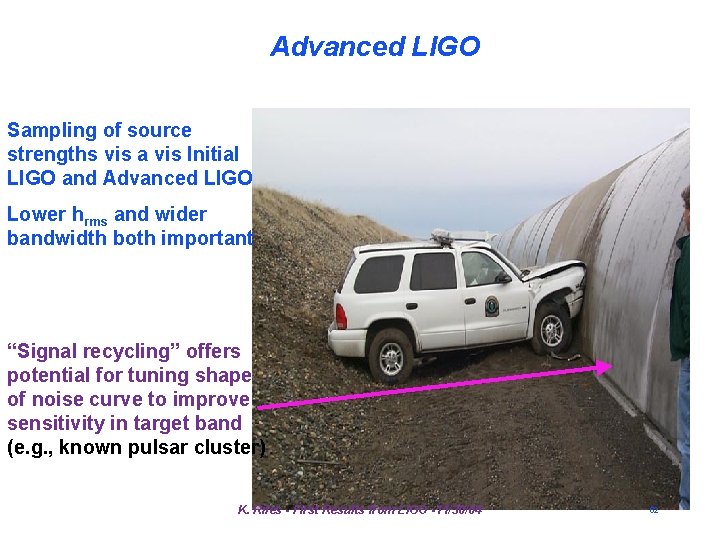
Advanced LIGO Sampling of source strengths vis a vis Initial LIGO and Advanced LIGO Lower hrms and wider bandwidth both important “Signal recycling” offers potential for tuning shape of noise curve to improve sensitivity in target band (e. g. , known pulsar cluster) K. Riles - First Results from LIGO -11/30/04 52
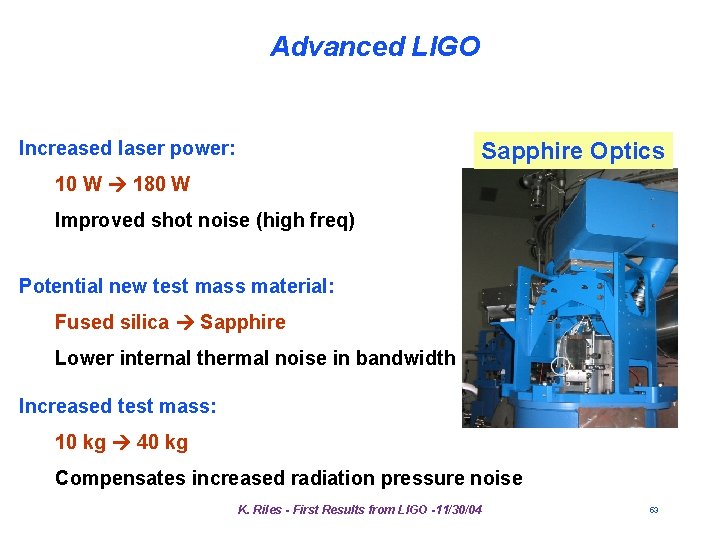
Advanced LIGO Increased laser power: Sapphire Optics 10 W 180 W Improved shot noise (high freq) Potential new test mass material: Fused silica Sapphire Lower internal thermal noise in bandwidth Increased test mass: 10 kg 40 kg Compensates increased radiation pressure noise K. Riles - First Results from LIGO -11/30/04 53
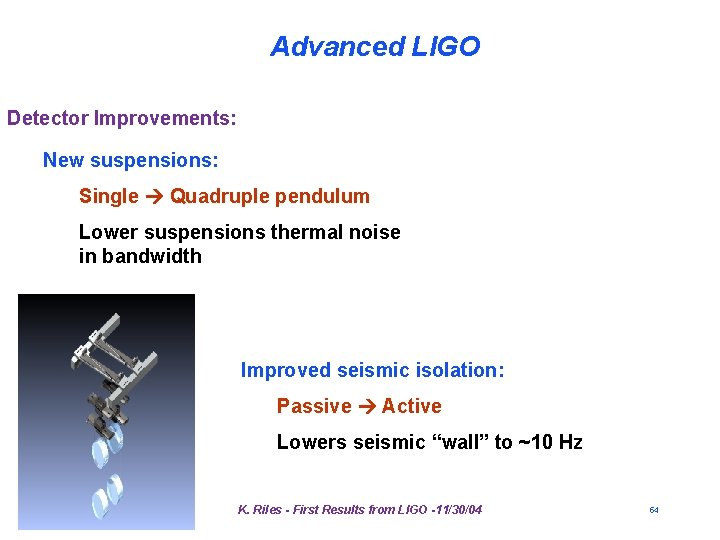
Advanced LIGO Detector Improvements: New suspensions: Single Quadruple pendulum Lower suspensions thermal noise in bandwidth Improved seismic isolation: Passive Active Lowers seismic “wall” to ~10 Hz K. Riles - First Results from LIGO -11/30/04 54
Conclusions LIGO commissioning is well underway • Good progress toward design sensitivity • GEO, other instruments advancing as well Science Running is beginning • Initial results from our first two data runs Our Plan: • Continue commissioning and data runs with GEO & others • Collect one year of data at design sensitivity before starting upgrade • Advanced interferometer with dramatically improved sensitivity – 2009+ (NSF MRE proposal recently approved by National Science Board) We should be detecting gravitational waves routinely within the next 10 years! K. Riles - First Results from LIGO -11/30/04 55