
Dr Keith Corzine Simulation vs Reality ENGR 4296
- Slides: 11
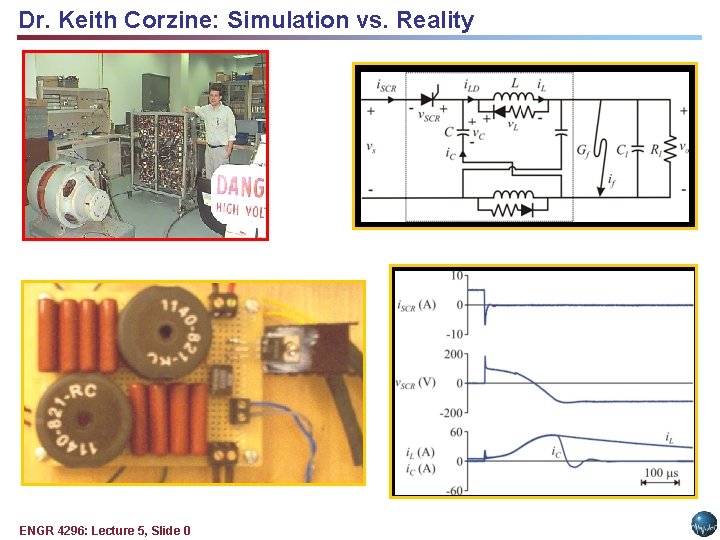
Dr. Keith Corzine: Simulation vs. Reality ENGR 4296: Lecture 5, Slide 0
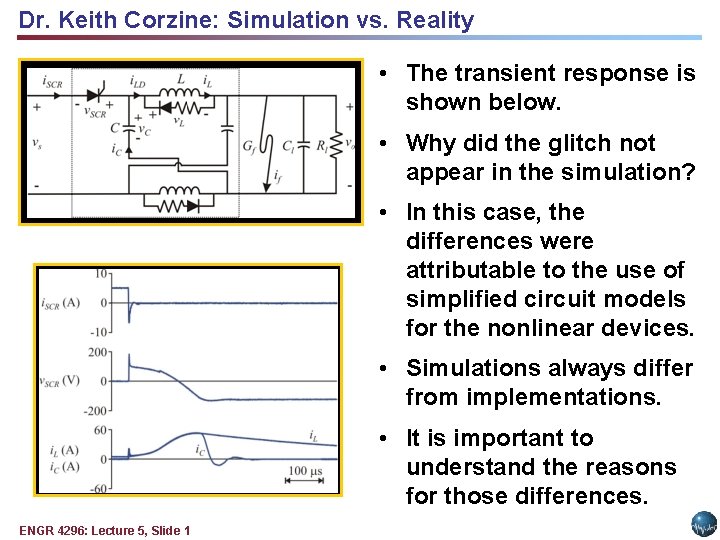
Dr. Keith Corzine: Simulation vs. Reality • The transient response is shown below. • Why did the glitch not appear in the simulation? • In this case, the differences were attributable to the use of simplified circuit models for the nonlinear devices. • Simulations always differ from implementations. • It is important to understand the reasons for those differences. ENGR 4296: Lecture 5, Slide 1
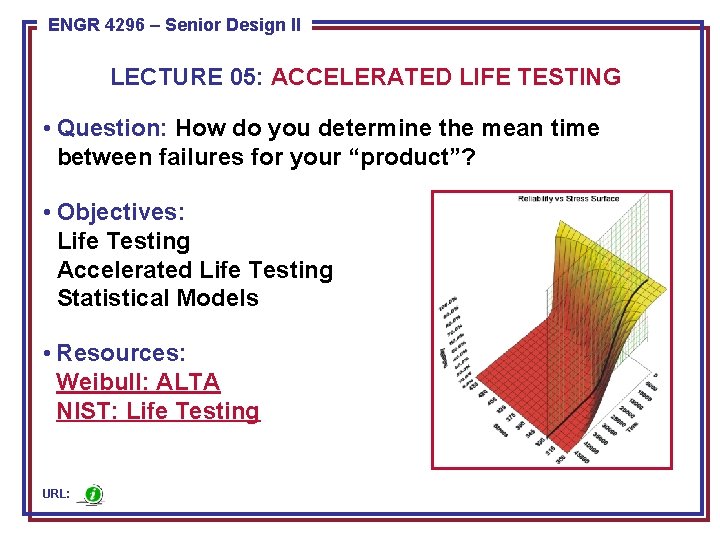
ENGR 4296 – Senior Design II LECTURE 05: ACCELERATED LIFE TESTING • Question: How do you determine the mean time between failures for your “product”? • Objectives: Life Testing Accelerated Life Testing Statistical Models • Resources: Weibull: ALTA NIST: Life Testing URL:
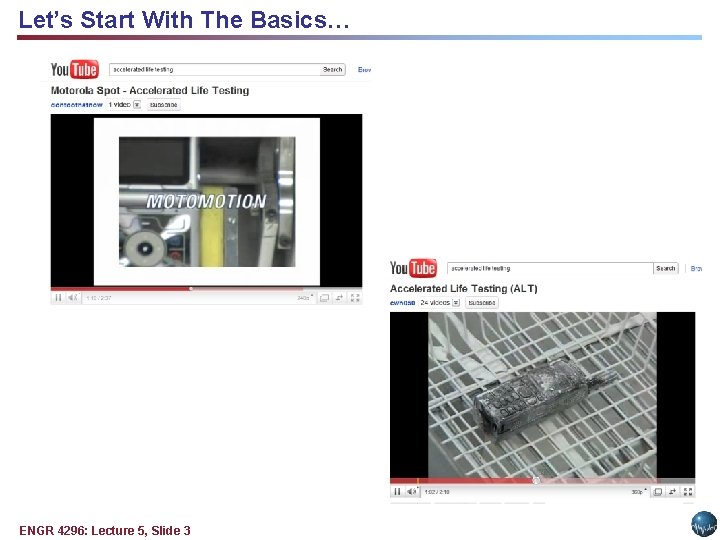
Let’s Start With The Basics… ENGR 4296: Lecture 5, Slide 3
What is Accelerated Life Testing? • Traditional life data analysis involves analyzing times-tofailure data (of a product, system or component) obtained under normal operating conditions in order to quantify the life characteristics of the product, system or component. • In many situations, and for many reasons, such life data (or times-to-failure data) is very difficult, if not impossible, to obtain. • Accelerated life testing involves acceleration of failures with the single purpose of quantification of the life characteristics of the product at normal use conditions. • More specifically, accelerated life testing can be divided into two areas: qualitative accelerated testing and quantitative accelerated life testing. ENGR 4296: Lecture 5, Slide 4
Qualitative Accelerated Life Testing • Qualitative tests are tests that yield failure information (or failure modes) only. • Common names: § elephant tests § torture tests § Highly Accelerated Life Tests (HALT) § shake and bake tests • Qualitative tests are performed on small samples with the specimens subjected to a single severe level of stress, to a number of stresses or to a time-varying stress. • Qualitative tests are used primarily to reveal probable failure modes. ENGR 4296: Lecture 5, Slide 5
Qualitative Accelerated Life Testing (cont. ) • Qualitative tests are not designed to yield life data that can be used in subsequent quantitative accelerated life data analysis. • They do provide valuable information as to the types and level of stresses one may wish to employ during a subsequent quantitative test. • Benefits and Drawbacks of Qualitative Tests: § Benefit: Increase reliability by revealing probable failure modes. § Benefit: Provide valuable feedback in designing quantitative tests and in may cases they are a precursor to a quantitative test. § Drawback: What is the reliability of the product at normal use conditions? ENGR 4296: Lecture 5, Slide 6
Quantitative Accelerated Life Testing • Designed to quantify the life characteristics of the product, component or system under normal use conditions and thereby provide reliability information. • Reliability information can include the determination of the probability of failure of the product under use conditions, mean life under use conditions and projected returns and warranty costs. • It can also be used to assist in the performance of risk assessments, design comparisons, etc. • Quantitative accelerated life testing can take the form of usage rate acceleration or overstress acceleration. ENGR 4296: Lecture 5, Slide 7
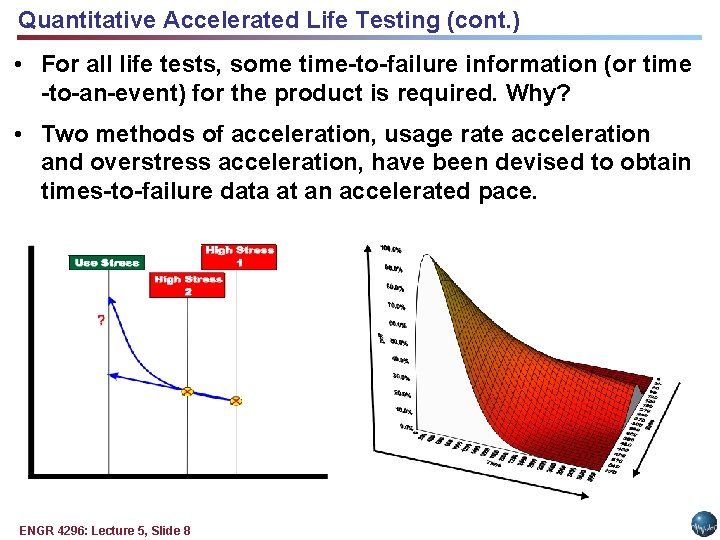
Quantitative Accelerated Life Testing (cont. ) • For all life tests, some time-to-failure information (or time -to-an-event) for the product is required. Why? • Two methods of acceleration, usage rate acceleration and overstress acceleration, have been devised to obtain times-to-failure data at an accelerated pace. ENGR 4296: Lecture 5, Slide 8
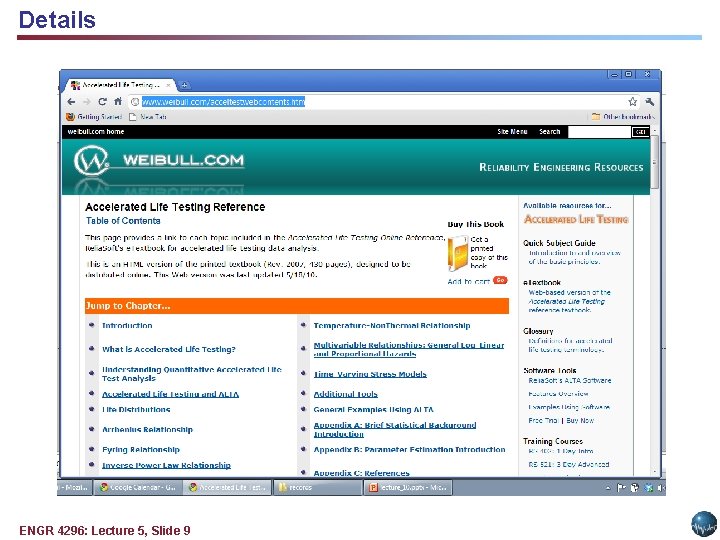
Details ENGR 4296: Lecture 5, Slide 9
Summary • Many of your projects make claims about reliability, durability, low maintenance, etc. • You must demonstrate how your design has been developed to address these constraints. • Over-engineering is not an acceptable solution. • This is an excellent resource: http: //www. weibull. com/acceltestwebcontents. htm ENGR 4296: Lecture 5, Slide 10