
Gravitational Wave Detectors The challenge of Low Frequency
- Slides: 55
Gravitational Wave Detectors The challenge of Low Frequency G. W. Detection Riccardo De. Salvo LIGO laboratory California Institute of Technology LIGO-G 050 XXX-00 -R Gingin’s Australia-Italia workshop on GW Detection
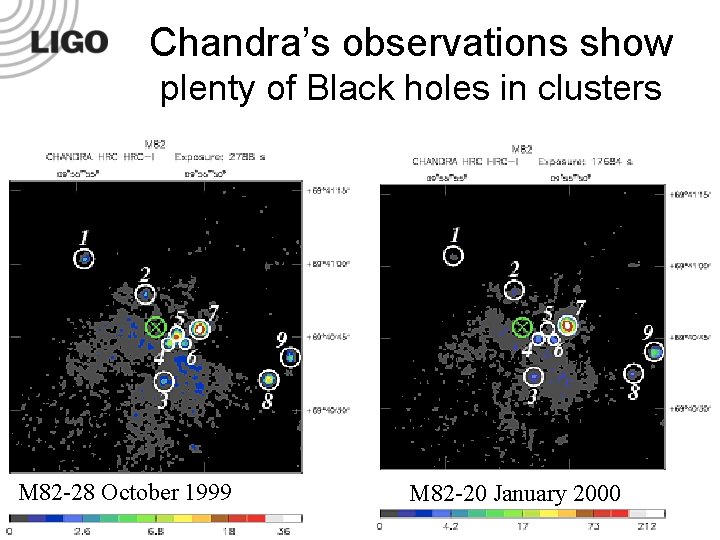
Chandra’s observations show plenty of Black holes in clusters M 82 -28 October 1999 LIGO-G 050 XXX-00 -R M 82 -20 January 2000 Gingin’s Australia-Italia workshop on GW Detection
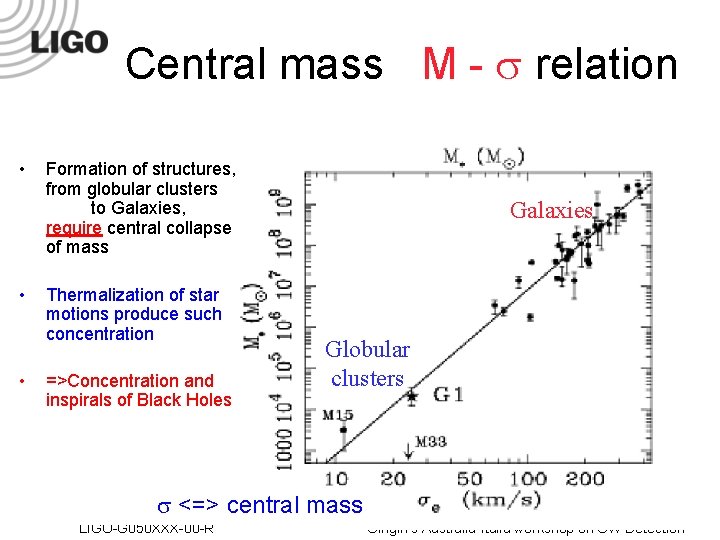
Central mass M - relation • • • Formation of structures, from globular clusters to Galaxies, require central collapse of mass Thermalization of star motions produce such concentration =>Concentration and inspirals of Black Holes Galaxies Globular clusters <=> central mass LIGO-G 050 XXX-00 -R Gingin’s Australia-Italia workshop on GW Detection
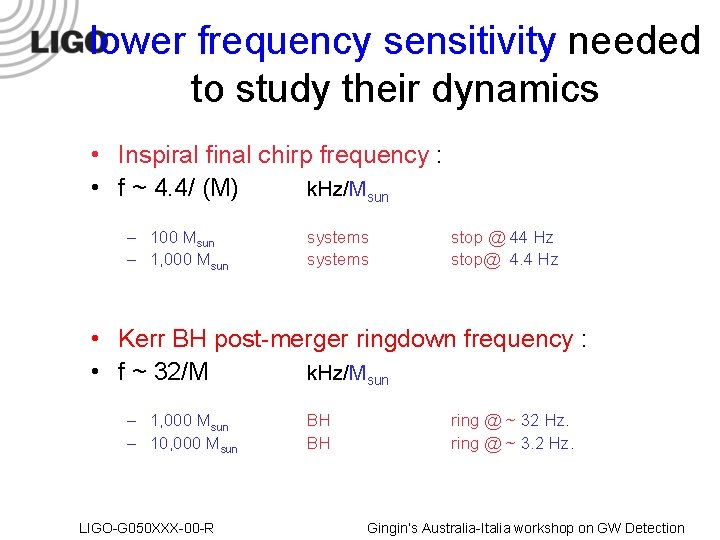
lower frequency sensitivity needed to study their dynamics • Inspiral final chirp frequency : • f ~ 4. 4/ (M) k. Hz/Msun – 100 Msun – 1, 000 Msun systems stop @ 44 Hz stop@ 4. 4 Hz • Kerr BH post-merger ringdown frequency : • f ~ 32/M k. Hz/Msun – 1, 000 Msun – 10, 000 Msun LIGO-G 050 XXX-00 -R BH BH ring @ ~ 32 Hz. ring @ ~ 3. 2 Hz. Gingin’s Australia-Italia workshop on GW Detection
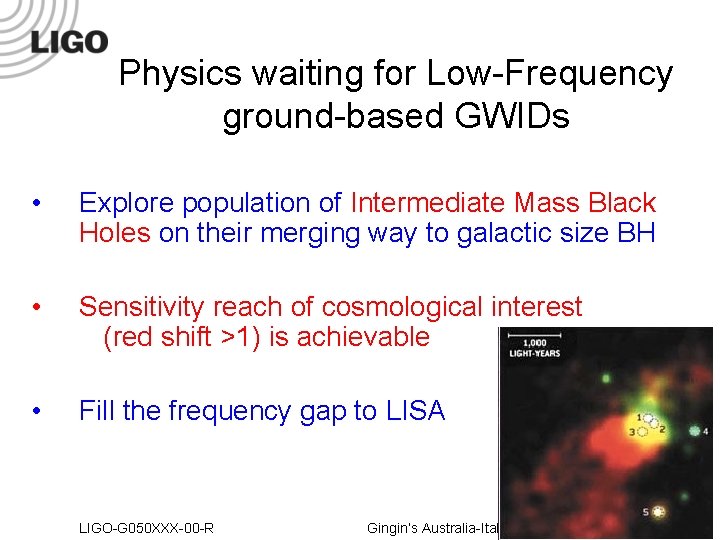
Physics waiting for Low-Frequency ground-based GWIDs • Explore population of Intermediate Mass Black Holes on their merging way to galactic size BH • Sensitivity reach of cosmological interest (red shift >1) is achievable • Fill the frequency gap to LISA LIGO-G 050 XXX-00 -R Gingin’s Australia-Italia workshop on GW Detection
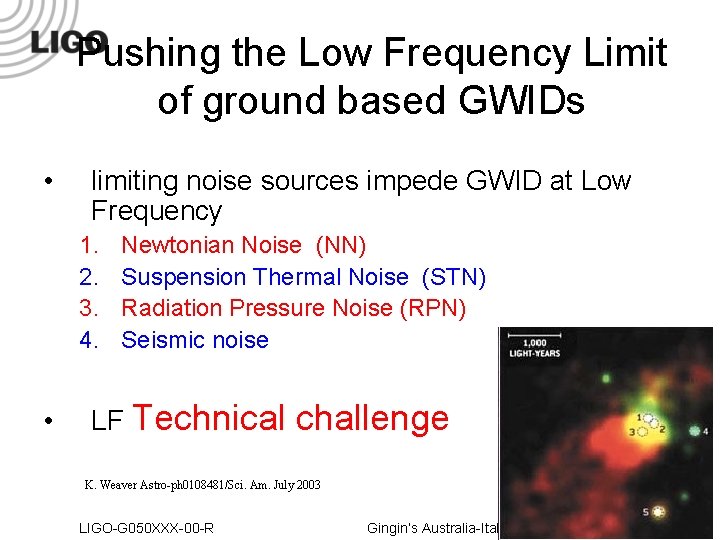
Pushing the Low Frequency Limit of ground based GWIDs • limiting noise sources impede GWID at Low Frequency 1. 2. 3. 4. • Newtonian Noise (NN) Suspension Thermal Noise (STN) Radiation Pressure Noise (RPN) Seismic noise LF Technical challenge K. Weaver Astro-ph 0108481/Sci. Am. July 2003 LIGO-G 050 XXX-00 -R Gingin’s Australia-Italia workshop on GW Detection
The physics, inspiral reach. NN limit Under Ground <|> Above Ground LIGO-G 050 XXX-00 -R Gingin’s Australia-Italia workshop on GW Detection
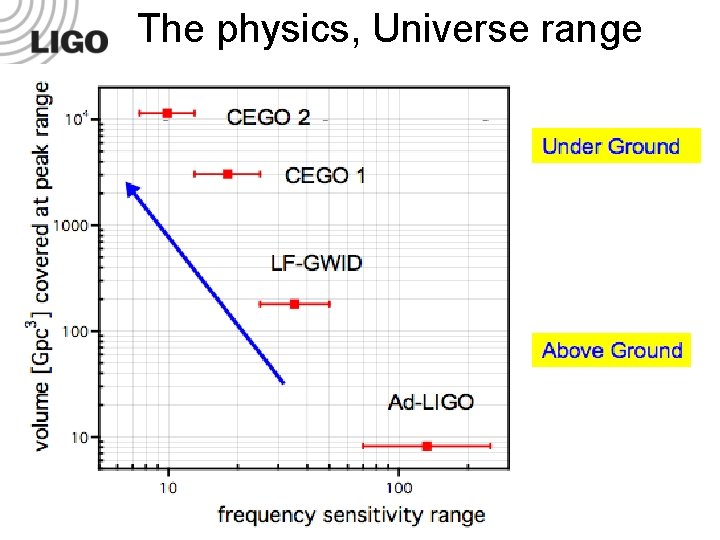
The physics, Universe range 10 1 Under Ground _____ Above Ground 1 LIGO-G 050 XXX-00 -R 10 Gingin’s Australia-Italia workshop on GW Detection
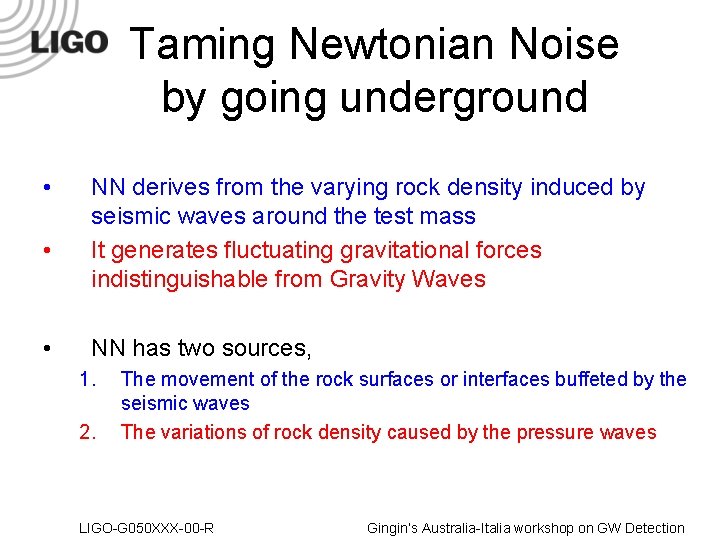
Taming Newtonian Noise by going underground • • • NN derives from the varying rock density induced by seismic waves around the test mass It generates fluctuating gravitational forces indistinguishable from Gravity Waves NN has two sources, 1. 2. The movement of the rock surfaces or interfaces buffeted by the seismic waves The variations of rock density caused by the pressure waves LIGO-G 050 XXX-00 -R Gingin’s Australia-Italia workshop on GW Detection
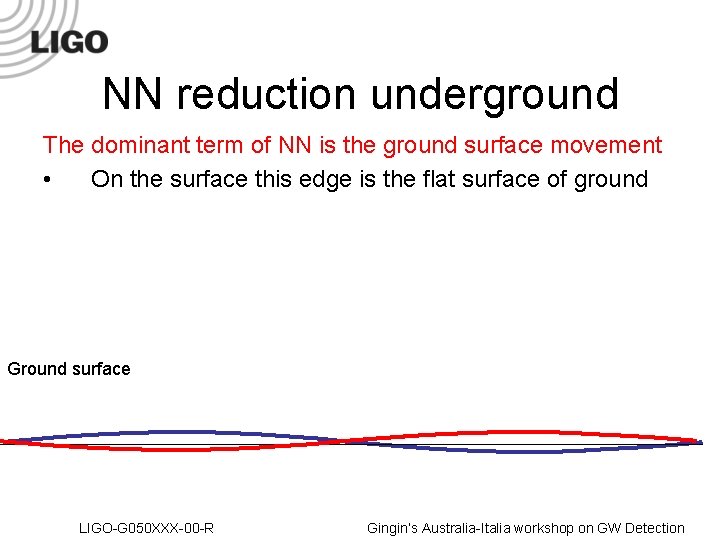
NN reduction underground The dominant term of NN is the ground surface movement • On the surface this edge is the flat surface of ground Ground surface LIGO-G 050 XXX-00 -R Gingin’s Australia-Italia workshop on GW Detection
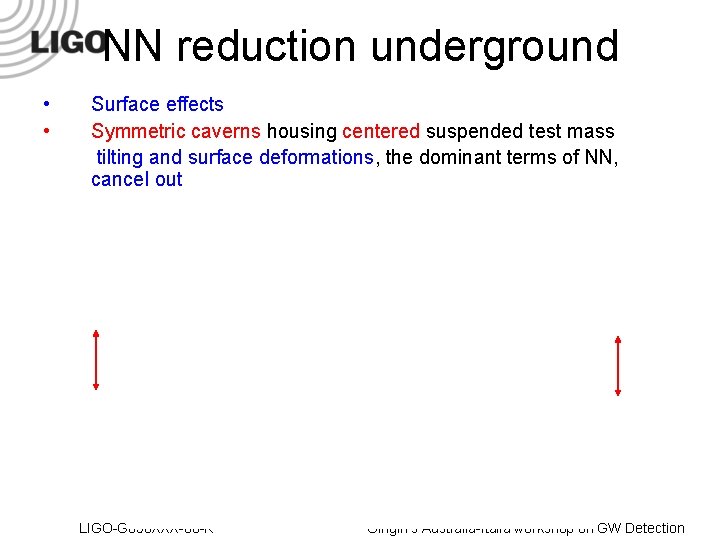
NN reduction underground • • Surface effects Symmetric caverns housing centered suspended test mass tilting and surface deformations, the dominant terms of NN, cancel out LIGO-G 050 XXX-00 -R Gingin’s Australia-Italia workshop on GW Detection
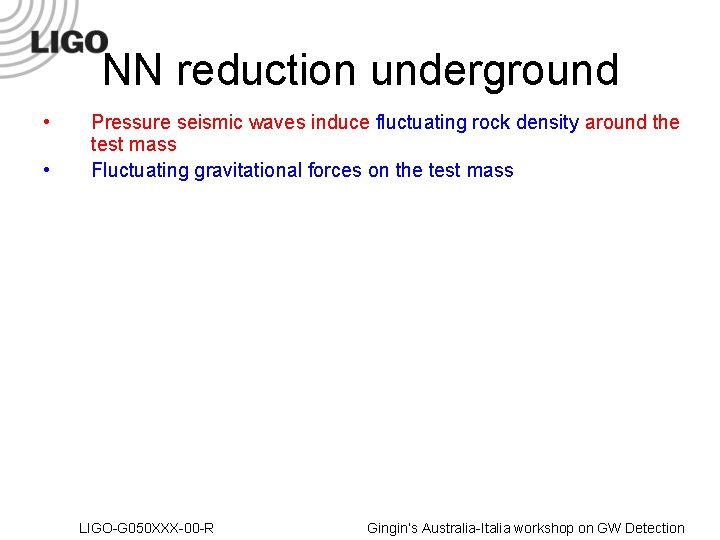
NN reduction underground • • Pressure seismic waves induce fluctuating rock density around the test mass Fluctuating gravitational forces on the test mass LIGO-G 050 XXX-00 -R Gingin’s Australia-Italia workshop on GW Detection
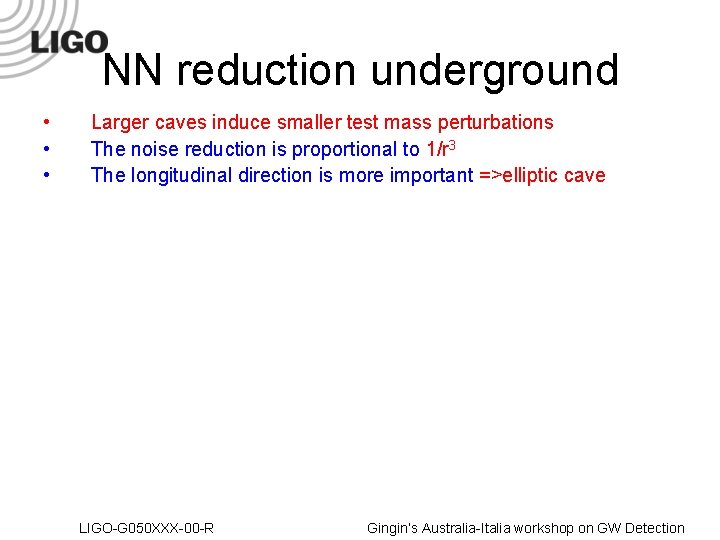
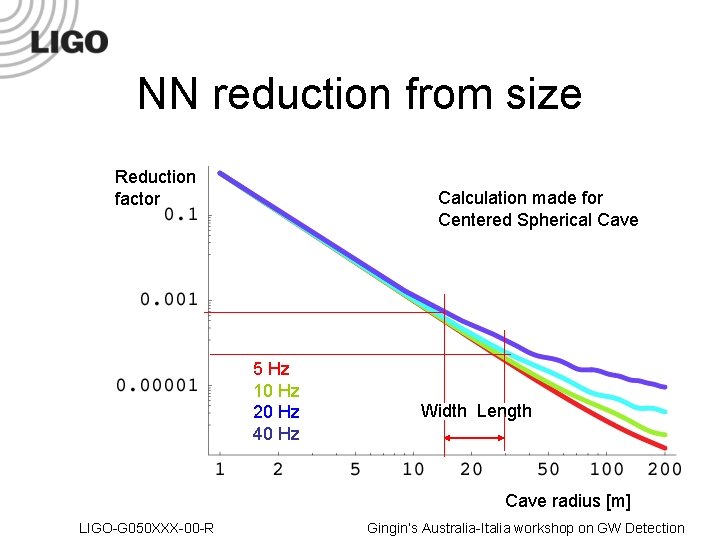
NN reduction underground • • • Larger caves induce smaller test mass perturbations The noise reduction is proportional to 1/r 3 The longitudinal direction is more important =>elliptic cave LIGO-G 050 XXX-00 -R Gingin’s Australia-Italia workshop on GW Detection
NN reduction from size Reduction factor Calculation made for Centered Spherical Cave 5 Hz 10 Hz 20 Hz 40 Hz Width Length Cave radius [m] LIGO-G 050 XXX-00 -R Gingin’s Australia-Italia workshop on GW Detection
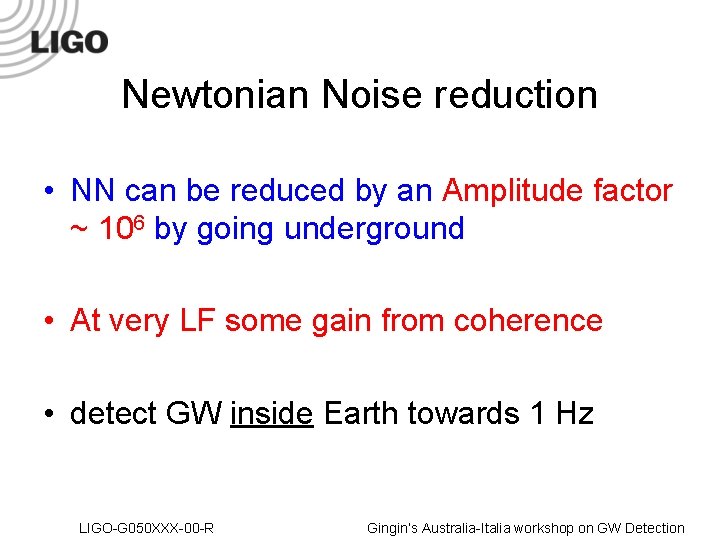
Newtonian Noise reduction • NN can be reduced by an Amplitude factor ~ 106 by going underground • At very LF some gain from coherence • detect GW inside Earth towards 1 Hz LIGO-G 050 XXX-00 -R Gingin’s Australia-Italia workshop on GW Detection
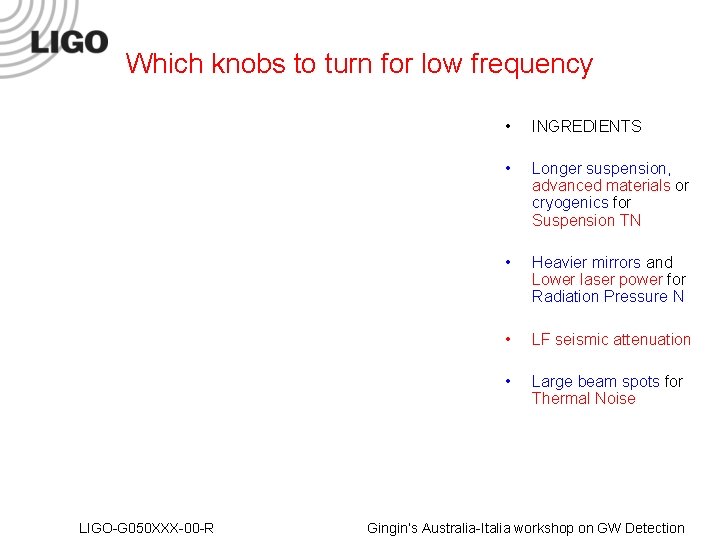
Which knobs to turn for low frequency LIGO-G 050 XXX-00 -R • INGREDIENTS • Longer suspension, advanced materials or cryogenics for Suspension TN • Heavier mirrors and Lower laser power for Radiation Pressure N • LF seismic attenuation • Large beam spots for Thermal Noise Gingin’s Australia-Italia workshop on GW Detection
Which knobs to turn for low frequency LIGO-G 050 XXX-00 -R • INGREDIENTS • Longer suspension, advanced materials or cryogenics for Suspension TN • Heavier mirrors and Lower laser power for Radiation Pressure N • LF seismic attenuation • Large beam spots for Thermal Noise Gingin’s Australia-Italia workshop on GW Detection
Focus on • Advanced seismic attenuation • Composite masses for Radiation Pressure noise • Some Comments on Advanced materials or Cryogenics for suspension Thermal Noise reduction • Where to do underground GW D LIGO-G 050 XXX-00 -R Gingin’s Australia-Italia workshop on GW Detection
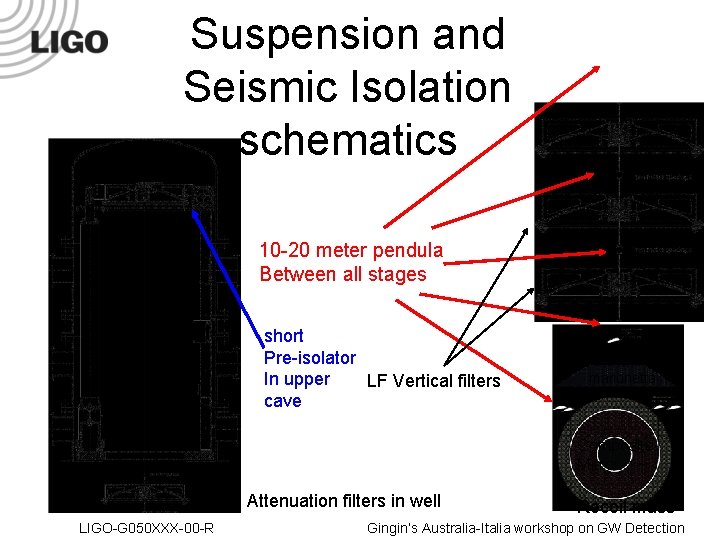
Suspension and Seismic Isolation schematics 10 -20 meter pendula Between all stages short Pre-isolator In upper LF Vertical filters cave marionetta Composite Mirror Attenuation filters in well LIGO-G 050 XXX-00 -R Recoil mass Gingin’s Australia-Italia workshop on GW Detection
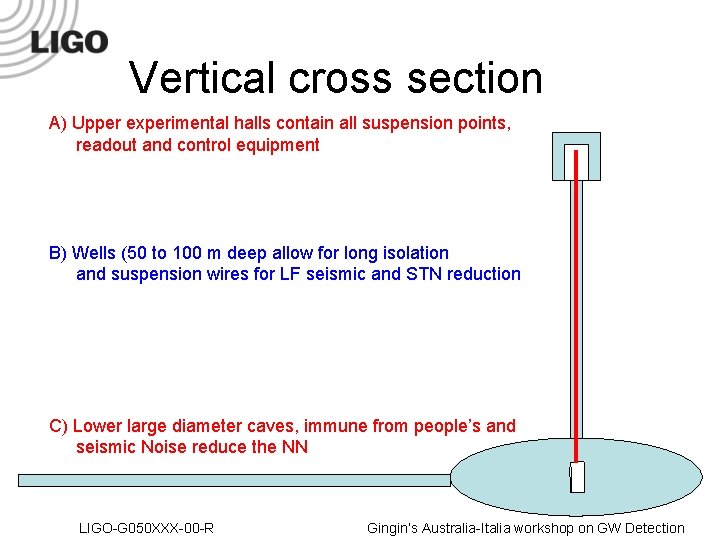
Vertical cross section A) Upper experimental halls contain all suspension points, readout and control equipment B) Wells (50 to 100 m deep allow for long isolation and suspension wires for LF seismic and STN reduction C) Lower large diameter caves, immune from people’s and seismic Noise reduce the NN LIGO-G 050 XXX-00 -R Gingin’s Australia-Italia workshop on GW Detection
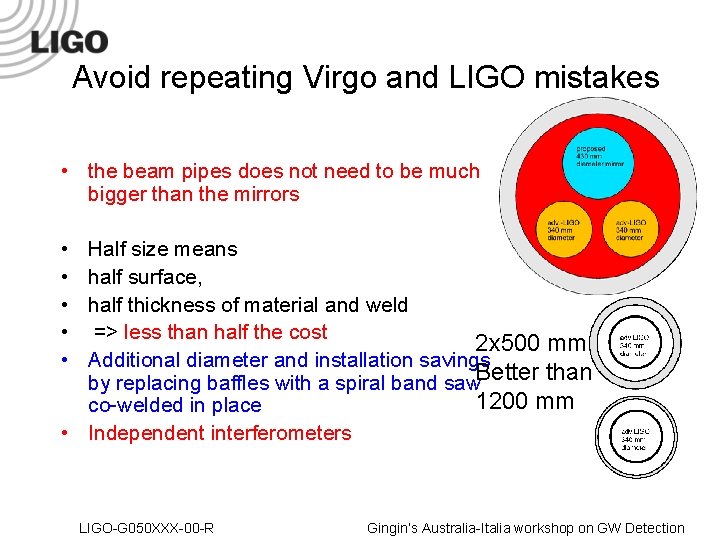
Avoid repeating Virgo and LIGO mistakes • the beam pipes does not need to be much bigger than the mirrors • • • Half size means half surface, half thickness of material and weld => less than half the cost 2 x 500 mm Additional diameter and installation savings by replacing baffles with a spiral band saw. Better than 1200 mm co-welded in place • Independent interferometers LIGO-G 050 XXX-00 -R Gingin’s Australia-Italia workshop on GW Detection
Seismic attenuation desired new developments • Premium in attenuation factor per stage • Premium in low frequency resonant frequency • Horizontal direction probably OK • Vertical direction need further improvements LIGO-G 050 XXX-00 -R Gingin’s Australia-Italia workshop on GW Detection
Horizontal direction • IP filters – Always have been good to ~20 m. Hz – Can deliver > 80 d. B per stage • Nobody doubts wires but f~√length can do better? LIGO-G 050 XXX-00 -R Gingin’s Australia-Italia workshop on GW Detection
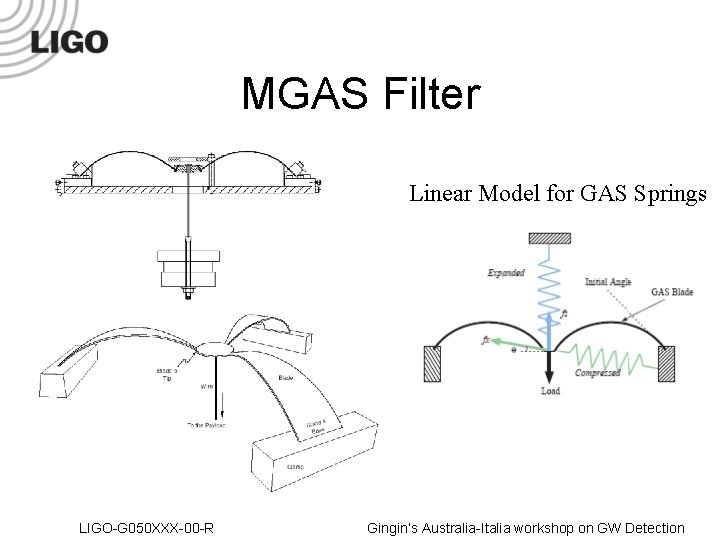
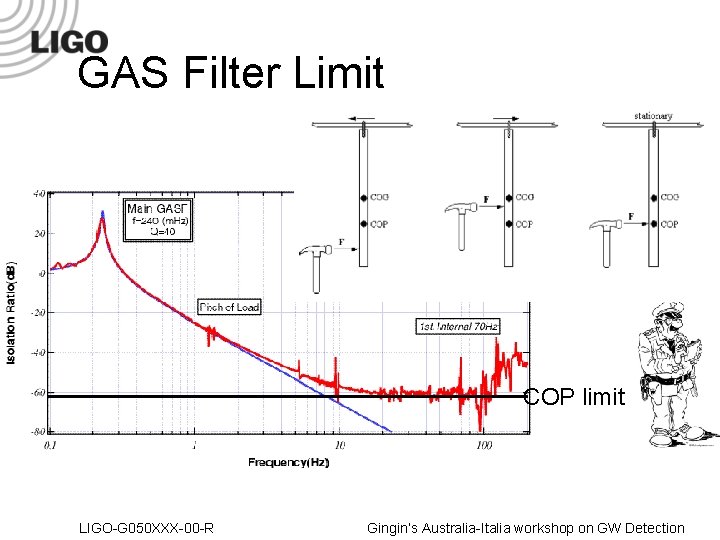
Vertical direction • GAS filters – Used to be limited to > 200 m. Hz – Used to be limited to 60 d. B per stage • Euler springs - Lacoste • All limited by distributed mass (inertia) and dissipation in materials LIGO-G 050 XXX-00 -R Gingin’s Australia-Italia workshop on GW Detection
MGAS Filter Linear Model for GAS Springs LIGO-G 050 XXX-00 -R Gingin’s Australia-Italia workshop on GW Detection
Illustrating the GAS filter LIGO-G 050 XXX-00 -R Gingin’s Australia-Italia workshop on GW Detection
GAS Filter Limit COP limit LIGO-G 050 XXX-00 -R Gingin’s Australia-Italia workshop on GW Detection
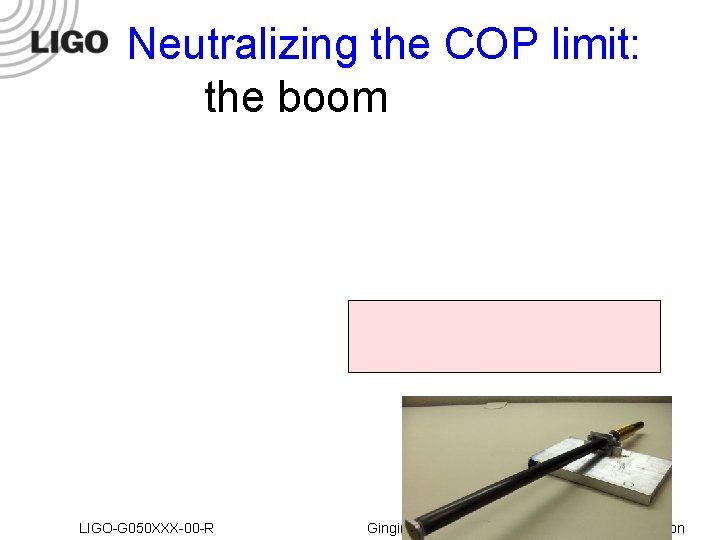
Neutralizing the COP limit: the boom LIGO-G 050 XXX-00 -R Gingin’s Australia-Italia workshop on GW Detection
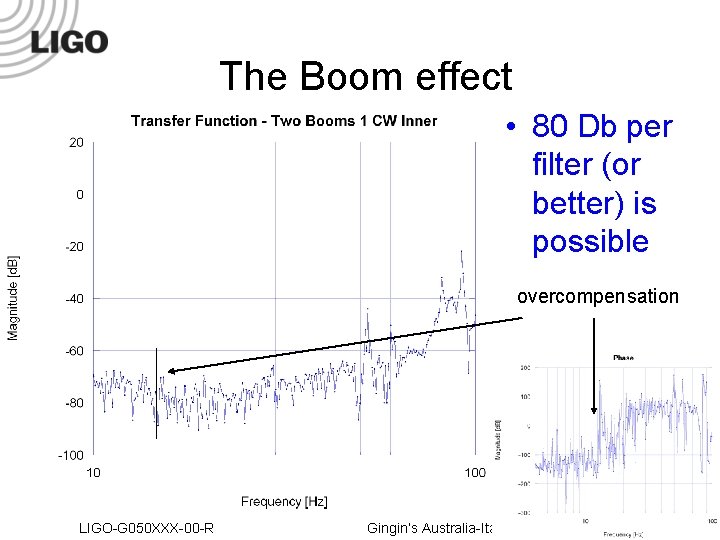
The Boom effect • 80 Db per filter (or better) is possible overcompensation LIGO-G 050 XXX-00 -R Gingin’s Australia-Italia workshop on GW Detection
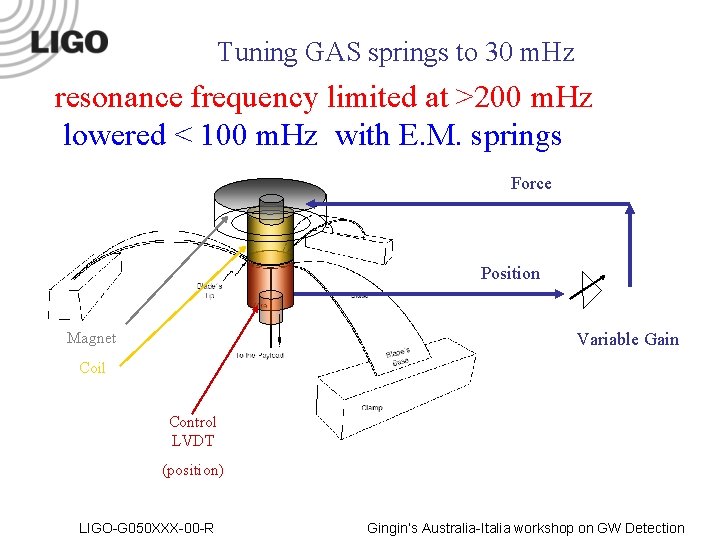
Tuning GAS springs to 30 m. Hz resonance frequency limited at >200 m. Hz lowered < 100 m. Hz with E. M. springs Force Position Magnet Variable Gain Coil Control LVDT (position) LIGO-G 050 XXX-00 -R Gingin’s Australia-Italia workshop on GW Detection
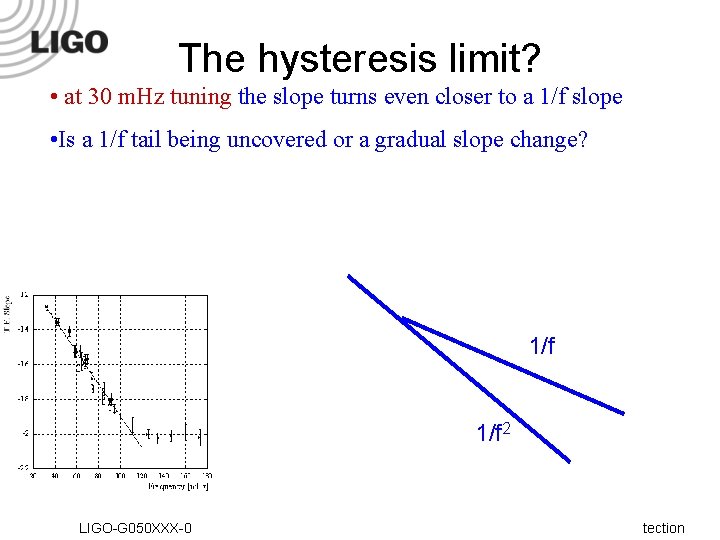
The hysteresis limit? • at 30 m. Hz tuning the slope turns even closer to a 1/f slope • Is a 1/f tail being uncovered or a gradual slope change? 1/f 2 LIGO-G 050 XXX-00 -R Gingin’s Australia-Italia workshop on GW Detection
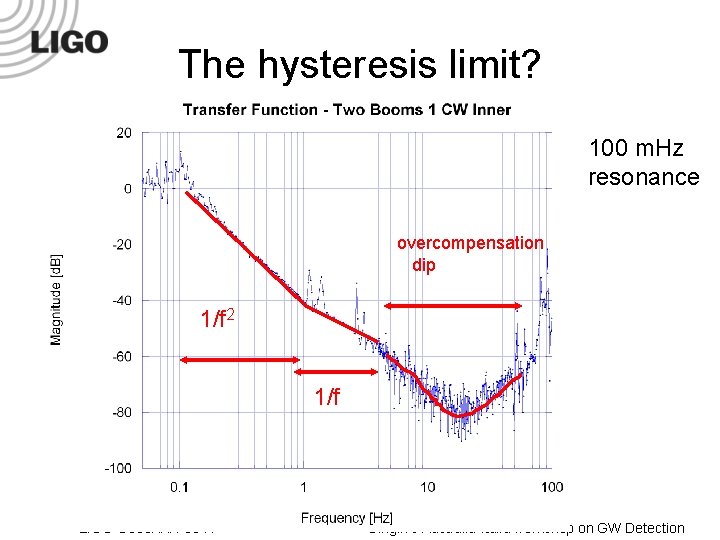
The hysteresis limit? 100 m. Hz resonance overcompensation dip 1/f 2 1/f LIGO-G 050 XXX-00 -R Gingin’s Australia-Italia workshop on GW Detection
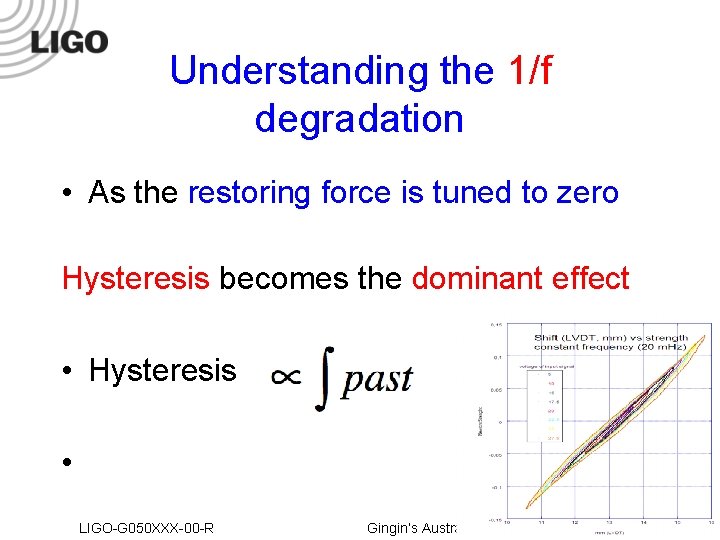
Understanding the 1/f degradation • As the restoring force is tuned to zero Hysteresis becomes the dominant effect • Hysteresis • LIGO-G 050 XXX-00 -R Gingin’s Australia-Italia workshop on GW Detection
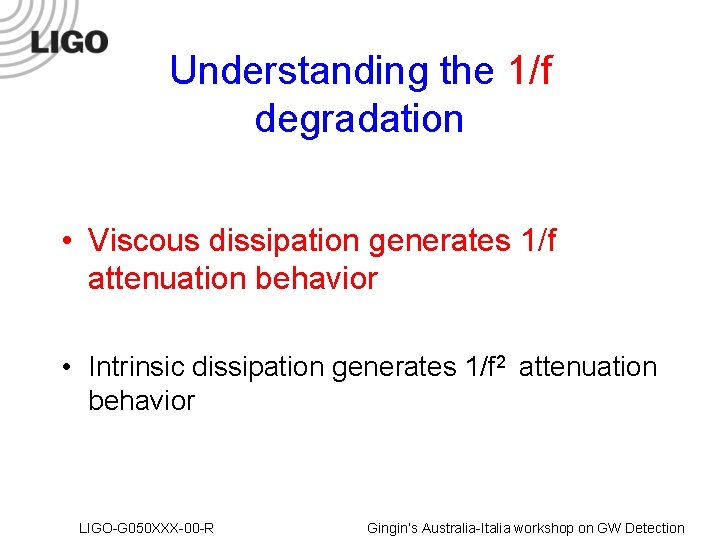
Understanding the 1/f degradation • Viscous dissipation generates 1/f attenuation behavior • Intrinsic dissipation generates 1/f 2 attenuation behavior LIGO-G 050 XXX-00 -R Gingin’s Australia-Italia workshop on GW Detection
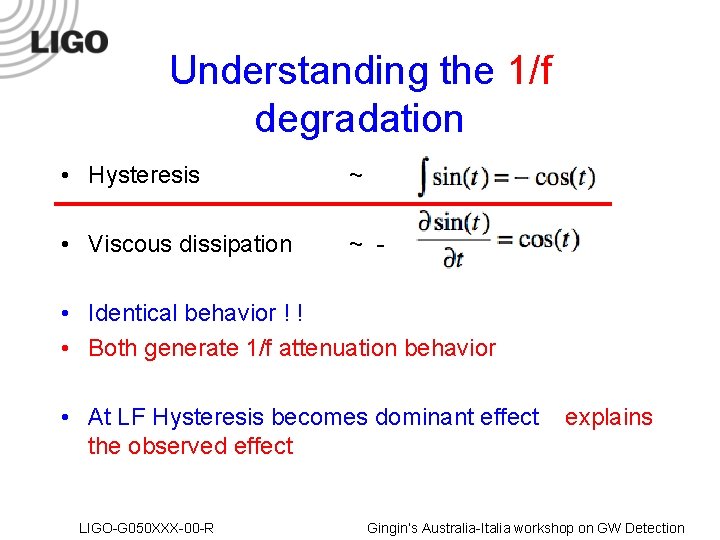
Understanding the 1/f degradation • Hysteresis ~ • Viscous dissipation ~ - • Identical behavior ! ! • Both generate 1/f attenuation behavior • At LF Hysteresis becomes dominant effect the observed effect LIGO-G 050 XXX-00 -R explains Gingin’s Australia-Italia workshop on GW Detection
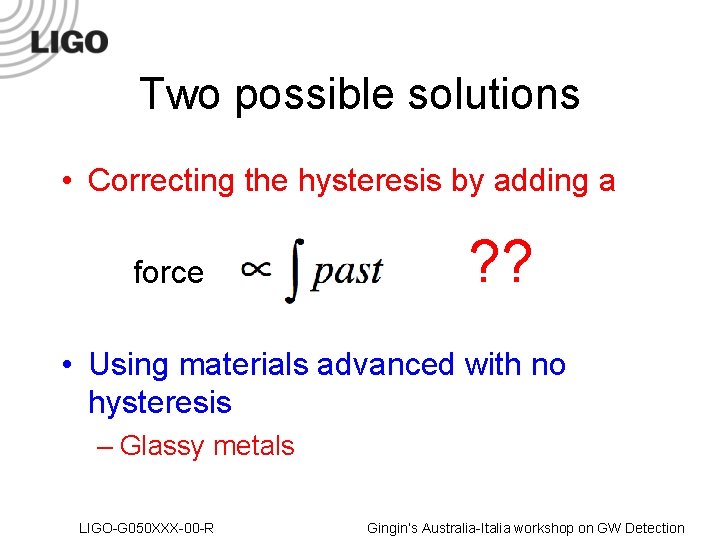
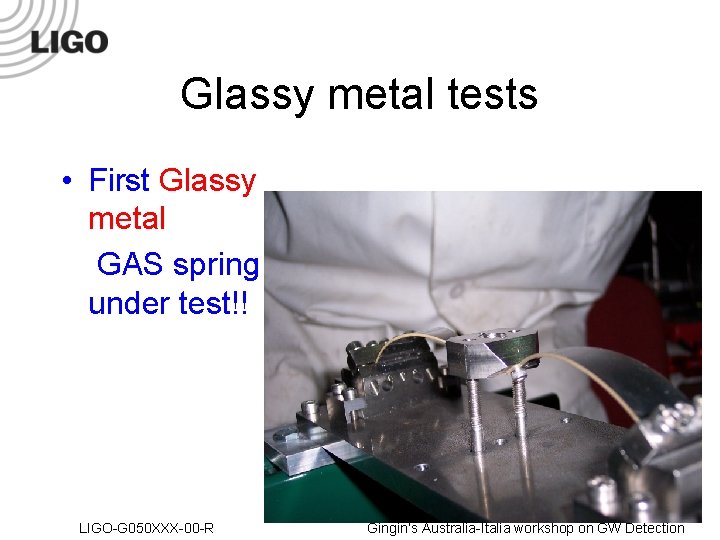
Two possible solutions • Correcting the hysteresis by adding a force ? ? • Using materials advanced with no hysteresis – Glassy metals LIGO-G 050 XXX-00 -R Gingin’s Australia-Italia workshop on GW Detection
Glassy metal tests • First Glassy metal GAS spring under test!! LIGO-G 050 XXX-00 -R Gingin’s Australia-Italia workshop on GW Detection
Reducing the radiation pressure noise The composite Mirror concept • A heavy mirror is necessary to widen the radiation pressure/shot noise canyon • > One ton inertial mass desired • High transparency mirrors available only up to 200 Kg LIGO-G 050 XXX-00 -R Gingin’s Australia-Italia workshop on GW Detection
Composite Mirror concept • Kenji Numata has proven that you can support a mirror from the nodes of a mode without affecting its Q-factor performance. • Kazuhiro Yamamoto (Levin’s theorem) has shown that: – if you consider the action of a pressure with the same profile of the laser beam and – support the mirror from points where this pressure has no action, – thermal noise performances of the mirror is not affected. LIGO-G 050 XXX-00 -R Gingin’s Australia-Italia workshop on GW Detection
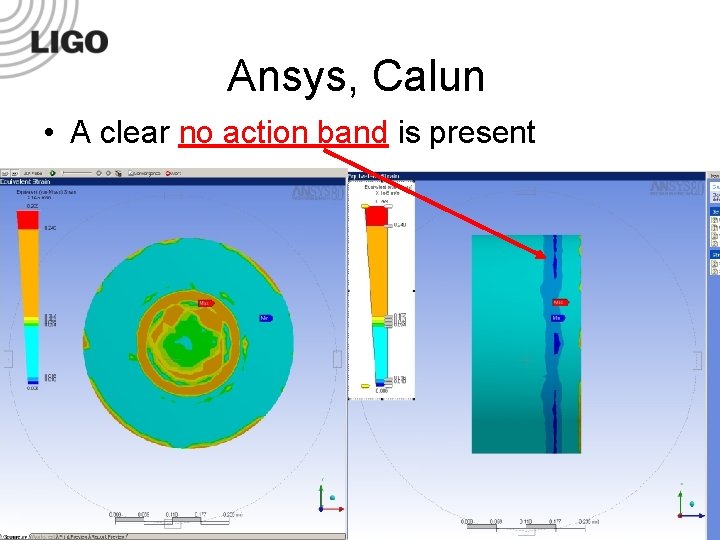
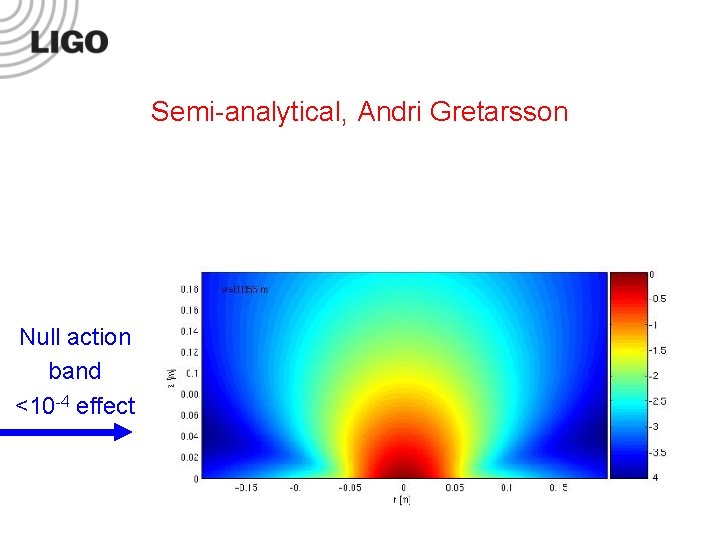
Mirror concept • Calum Torrie Using Ansys simulations and Andri Gretarsson with semi analitic means, both using Levin’s recipe • applied a beam profile pressure on a mirror • found null action areas on the mirror outer surface LIGO-G 050 XXX-00 -R Gingin’s Australia-Italia workshop on GW Detection
Ansys, Calun • A clear no action band is present LIGO-G 050 XXX-00 -R Gingin’s Australia-Italia workshop on GW Detection
Semi-analytical, Andri Gretarsson Null action band <10 -4 effect LIGO-G 050 XXX-00 -R Gingin’s Australia-Italia workshop on GW Detection
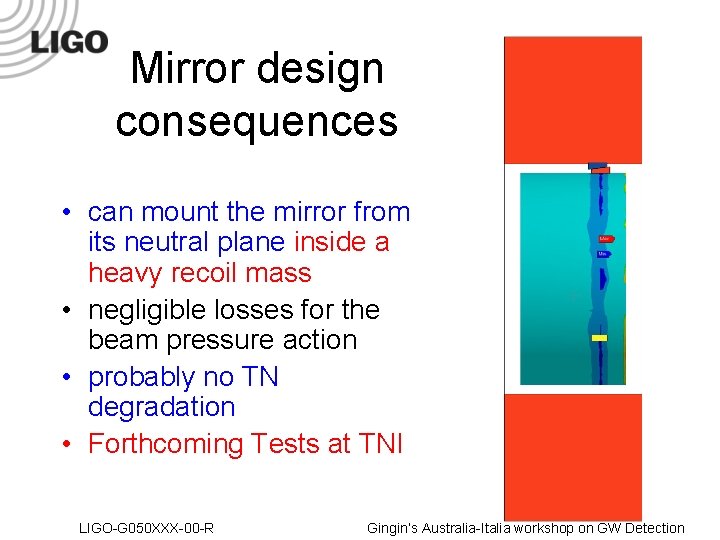
Mirror design consequences • can mount the mirror from its neutral plane inside a heavy recoil mass • negligible losses for the beam pressure action • probably no TN degradation • Forthcoming Tests at TNI LIGO-G 050 XXX-00 -R Gingin’s Australia-Italia workshop on GW Detection
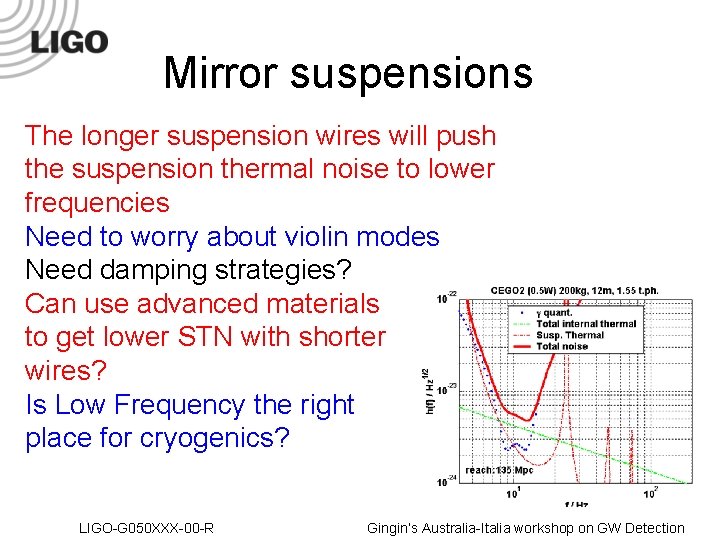
Mirror suspensions The longer suspension wires will push the suspension thermal noise to lower frequencies Need to worry about violin modes Need damping strategies? Can use advanced materials to get lower STN with shorter wires? Is Low Frequency the right place for cryogenics? LIGO-G 050 XXX-00 -R Gingin’s Australia-Italia workshop on GW Detection
Where to dig an underground GWID? • Need uniform rock to dig the mirror caverns for NN suppression • Easy to dig and self supporting rock for cheapness • Salt beds? • Solid rock? LIGO-G 050 XXX-00 -R Gingin’s Australia-Italia workshop on GW Detection
Where to do it? • Salt beds – cheapest dig, but – problems with convergence, may need periodic shavings, also – access costs may be comparable with tunnel and cavern cost itself • Solid rock – – more expensive to dig, but more stable, also faster seismic wave speed, may have crack problems if a crack is found at the mirror cavern point • Examples? LIGO-G 050 XXX-00 -R Gingin’s Australia-Italia workshop on GW Detection
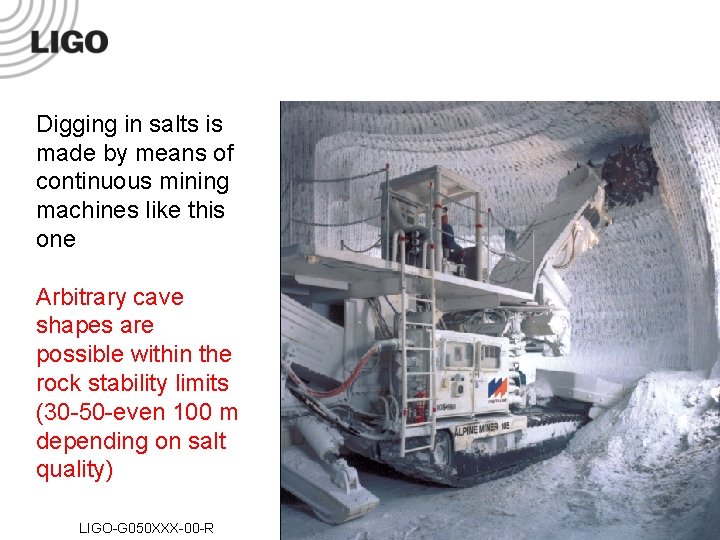
Digging in salts is made by means of continuous mining machines like this one Arbitrary cave shapes are possible within the rock stability limits (30 -50 -even 100 m depending on salt quality) LIGO-G 050 XXX-00 -R Gingin’s Australia-Italia workshop on GW Detection
Kamioka? • Is LCGT looking in the wrong frequency range? • Going underground is expensive and is best justified for a bigger challenge • Should a Low Frequency Observatory be considered on the side of LCGT? LIGO-G 050 XXX-00 -R Gingin’s Australia-Italia workshop on GW Detection
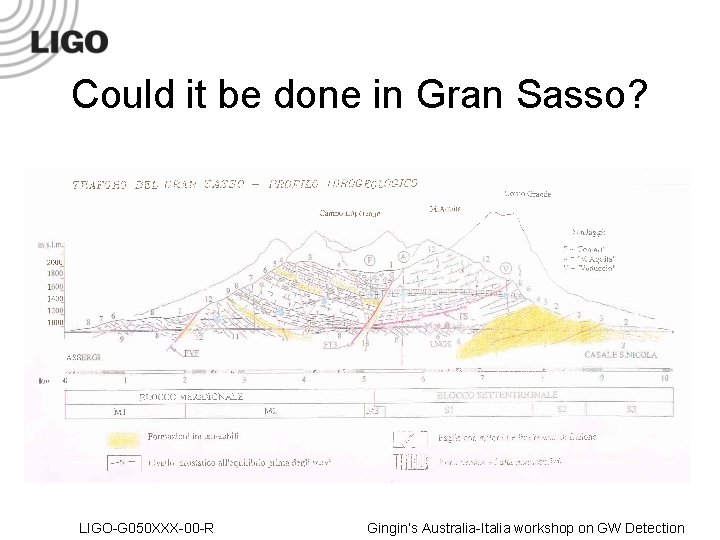
Could it be done in Gran Sasso? LIGO-G 050 XXX-00 -R Gingin’s Australia-Italia workshop on GW Detection
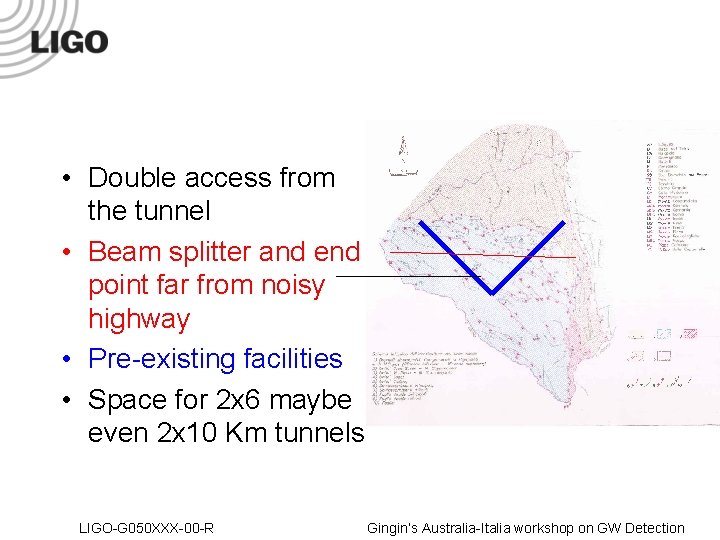
• Double access from the tunnel • Beam splitter and end point far from noisy highway • Pre-existing facilities • Space for 2 x 6 maybe even 2 x 10 Km tunnels LIGO-G 050 XXX-00 -R Gingin’s Australia-Italia workshop on GW Detection
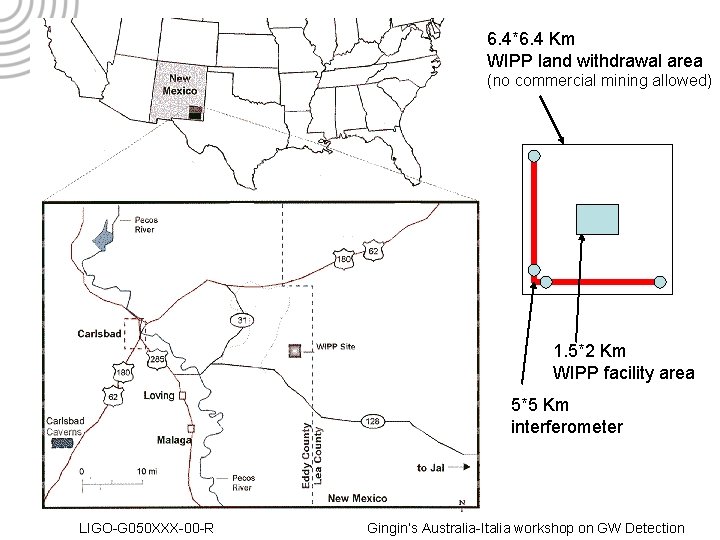
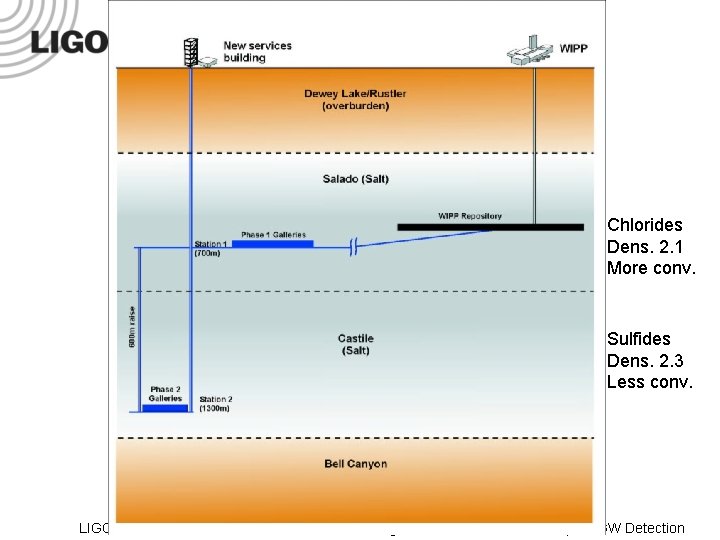
Could it be done at WIPP? • Large salt beds available • Land interdicted to commercial exploitation • Local facilities • Possibly access tunnels already available LIGO-G 050 XXX-00 -R Gingin’s Australia-Italia workshop on GW Detection
6. 4*6. 4 Km WIPP land withdrawal area (no commercial mining allowed) 1. 5*2 Km WIPP facility area 5*5 Km interferometer LIGO-G 050 XXX-00 -R Gingin’s Australia-Italia workshop on GW Detection
Chlorides Dens. 2. 1 More conv. Sulfides Dens. 2. 3 Less conv. LIGO-G 050 XXX-00 -R Gingin’s Australia-Italia workshop on GW Detection
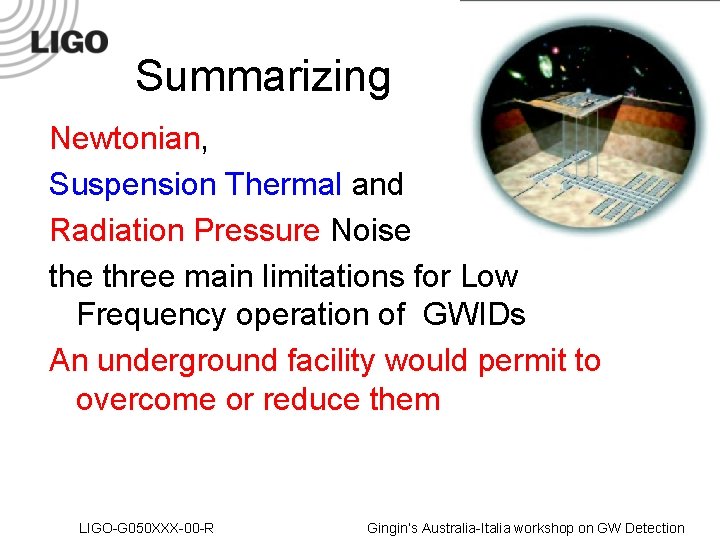
Summarizing Newtonian, Suspension Thermal and Radiation Pressure Noise three main limitations for Low Frequency operation of GWIDs An underground facility would permit to overcome or reduce them LIGO-G 050 XXX-00 -R Gingin’s Australia-Italia workshop on GW Detection
Summarizing • Going underground is the next option to explore the Intermediate Mass BH Universe it is time to start seriously thinking about it ! ! LIGO-G 050 XXX-00 -R Gingin’s Australia-Italia workshop on GW Detection