
Figure 1 Evolution of the FUV flux in
- Slides: 12
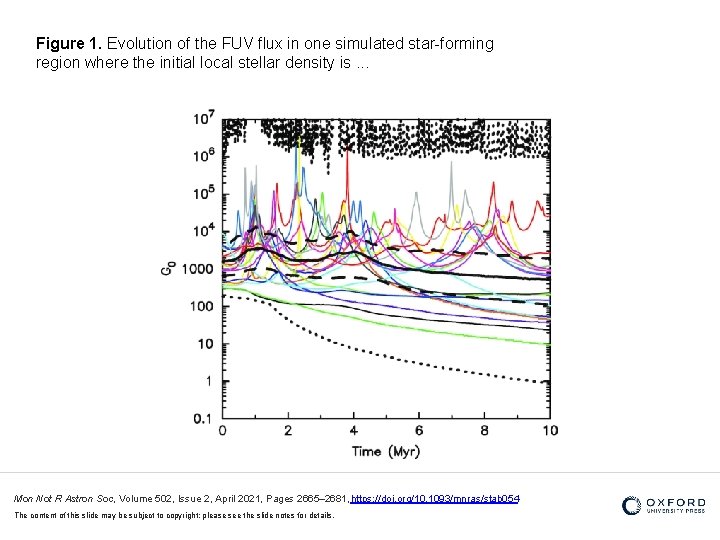
Figure 1. Evolution of the FUV flux in one simulated star-forming region where the initial local stellar density is. . . Mon Not R Astron Soc, Volume 502, Issue 2, April 2021, Pages 2665– 2681, https: //doi. org/10. 1093/mnras/stab 054 The content of this slide may be subject to copyright: please see the slide notes for details.
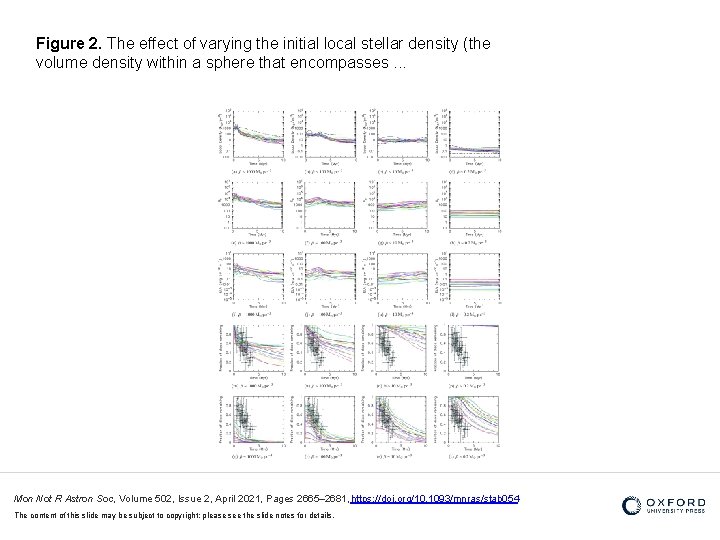
Figure 2. The effect of varying the initial local stellar density (the volume density within a sphere that encompasses. . . Mon Not R Astron Soc, Volume 502, Issue 2, April 2021, Pages 2665– 2681, https: //doi. org/10. 1093/mnras/stab 054 The content of this slide may be subject to copyright: please see the slide notes for details.
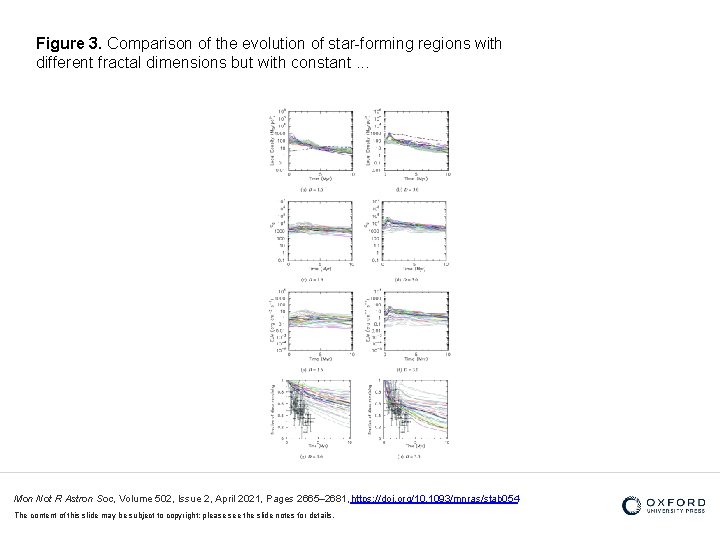
Figure 3. Comparison of the evolution of star-forming regions with different fractal dimensions but with constant. . . Mon Not R Astron Soc, Volume 502, Issue 2, April 2021, Pages 2665– 2681, https: //doi. org/10. 1093/mnras/stab 054 The content of this slide may be subject to copyright: please see the slide notes for details.
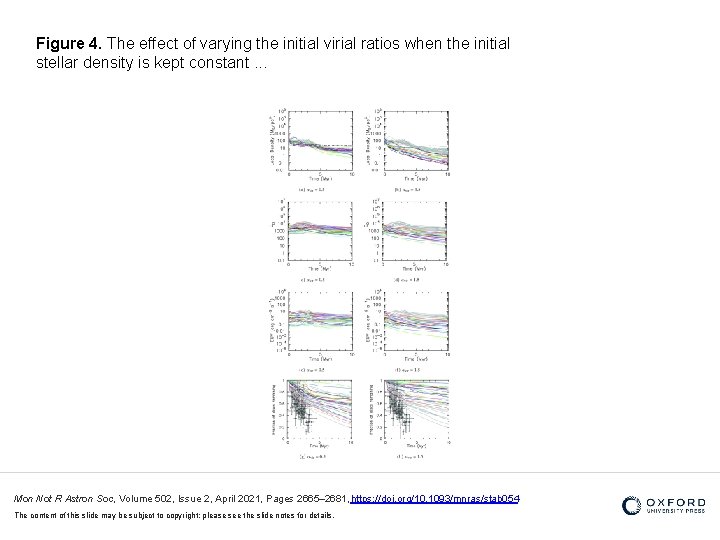
Figure 4. The effect of varying the initial virial ratios when the initial stellar density is kept constant. . . Mon Not R Astron Soc, Volume 502, Issue 2, April 2021, Pages 2665– 2681, https: //doi. org/10. 1093/mnras/stab 054 The content of this slide may be subject to copyright: please see the slide notes for details.
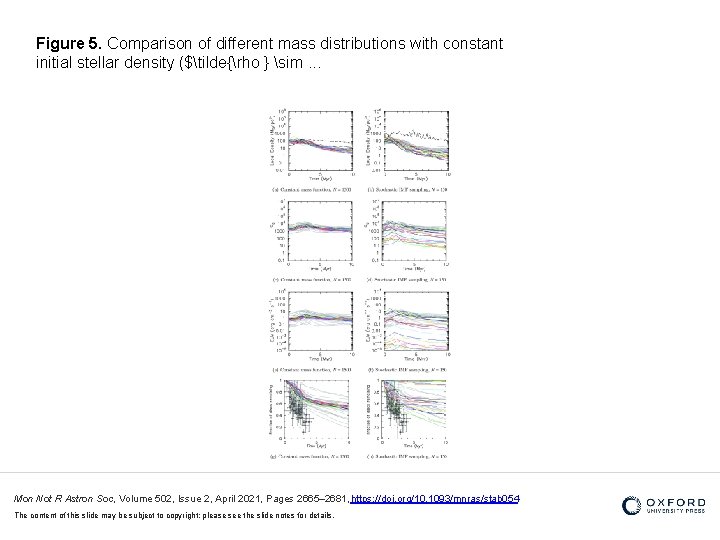
Figure 5. Comparison of different mass distributions with constant initial stellar density ($tilde{rho } sim. . . Mon Not R Astron Soc, Volume 502, Issue 2, April 2021, Pages 2665– 2681, https: //doi. org/10. 1093/mnras/stab 054 The content of this slide may be subject to copyright: please see the slide notes for details.
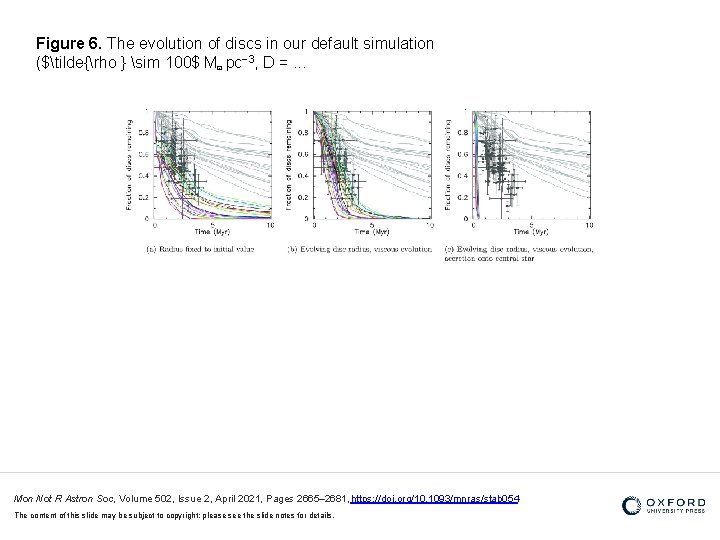
Figure 6. The evolution of discs in our default simulation ($tilde{rho } sim 100$ M⊙ pc− 3, D =. . . Mon Not R Astron Soc, Volume 502, Issue 2, April 2021, Pages 2665– 2681, https: //doi. org/10. 1093/mnras/stab 054 The content of this slide may be subject to copyright: please see the slide notes for details.
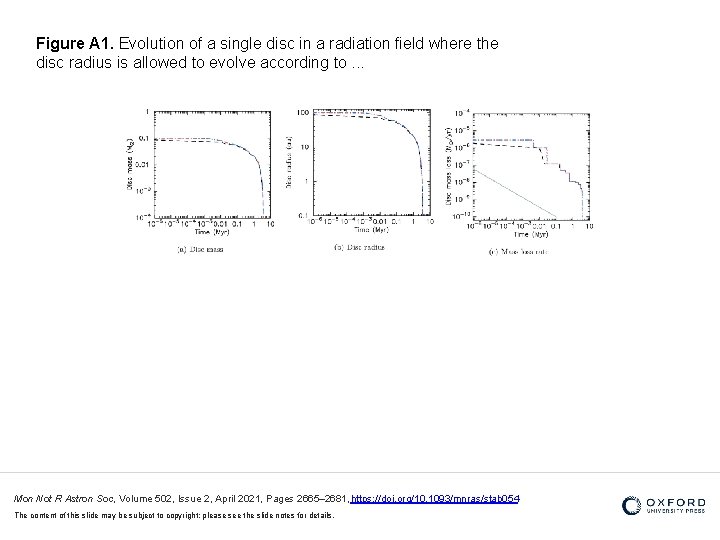
Figure A 1. Evolution of a single disc in a radiation field where the disc radius is allowed to evolve according to. . . Mon Not R Astron Soc, Volume 502, Issue 2, April 2021, Pages 2665– 2681, https: //doi. org/10. 1093/mnras/stab 054 The content of this slide may be subject to copyright: please see the slide notes for details.
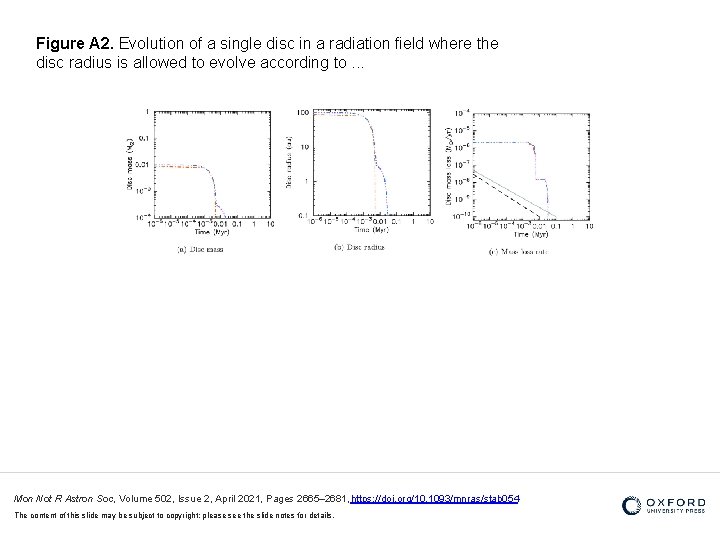
Figure A 2. Evolution of a single disc in a radiation field where the disc radius is allowed to evolve according to. . . Mon Not R Astron Soc, Volume 502, Issue 2, April 2021, Pages 2665– 2681, https: //doi. org/10. 1093/mnras/stab 054 The content of this slide may be subject to copyright: please see the slide notes for details.
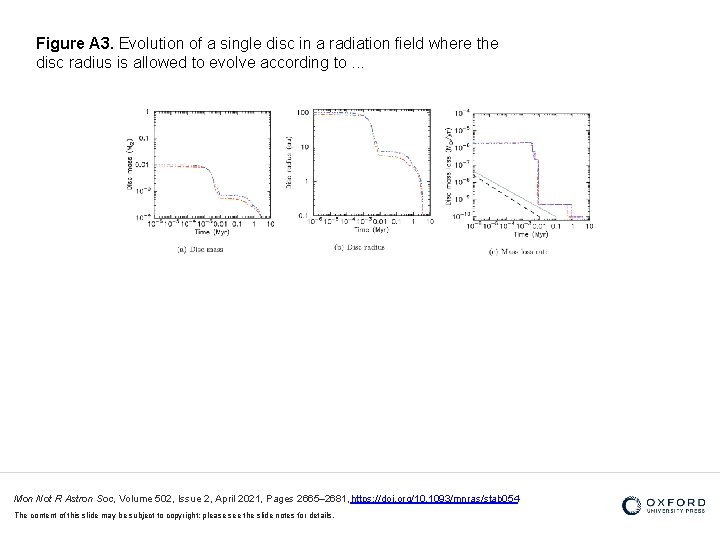
Figure A 3. Evolution of a single disc in a radiation field where the disc radius is allowed to evolve according to. . . Mon Not R Astron Soc, Volume 502, Issue 2, April 2021, Pages 2665– 2681, https: //doi. org/10. 1093/mnras/stab 054 The content of this slide may be subject to copyright: please see the slide notes for details.
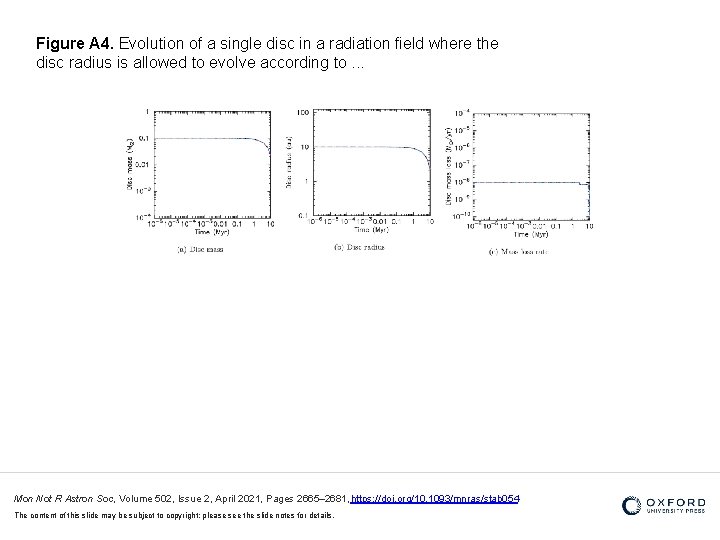
Figure A 4. Evolution of a single disc in a radiation field where the disc radius is allowed to evolve according to. . . Mon Not R Astron Soc, Volume 502, Issue 2, April 2021, Pages 2665– 2681, https: //doi. org/10. 1093/mnras/stab 054 The content of this slide may be subject to copyright: please see the slide notes for details.
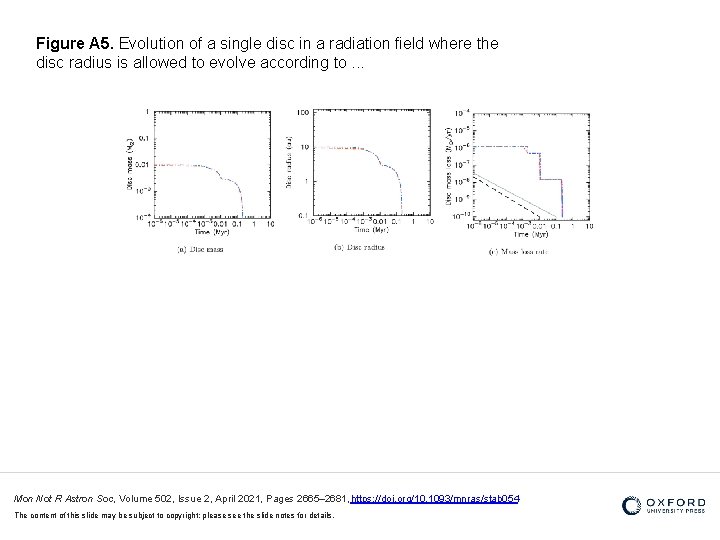
Figure A 5. Evolution of a single disc in a radiation field where the disc radius is allowed to evolve according to. . . Mon Not R Astron Soc, Volume 502, Issue 2, April 2021, Pages 2665– 2681, https: //doi. org/10. 1093/mnras/stab 054 The content of this slide may be subject to copyright: please see the slide notes for details.
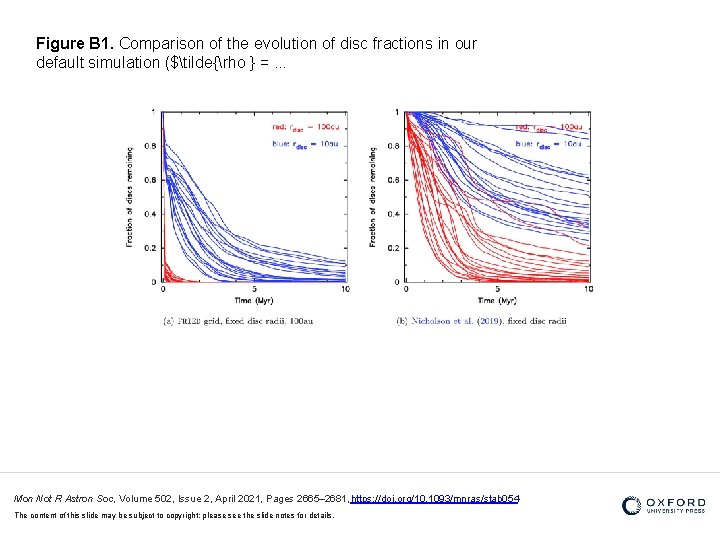
Figure B 1. Comparison of the evolution of disc fractions in our default simulation ($tilde{rho } =. . . Mon Not R Astron Soc, Volume 502, Issue 2, April 2021, Pages 2665– 2681, https: //doi. org/10. 1093/mnras/stab 054 The content of this slide may be subject to copyright: please see the slide notes for details.