Family Planning Dr Amina Rashad Maternity and Gynecology


- Slides: 42
Family Planning Dr. Amina Rashad Maternity and Gynecology Nursing Dep. Faculty of Nursing, Mansoura University FP, Dr. Amina Rashad
Specific objectives: l l l l At the end of this chapter the student should be able to Identify the concept of family planning. List types of family planning. Discuss mechanisms Of action of each method. Enumerate advantages and disadvantages of each method. Explain side effects and complications of each method. Provide health education about of each method. 2/28/2021 FP, Dr. Amina Rashad 2
Definition of family planning l l l The WHO (1975) considered family planning as practice that help individuals or couples to attain certain objectives, which are: 1 - Avoidance of unwanted birth. 2 - Bringing about wanted birth. 3 - Regulation of interval between pregnancies. 4 - Avoid pregnancy for women with serious disease that would place pregnancy at risk. 2/28/2021 FP, Dr. Amina Rashad 3
TYPES OF FAMILY PLANNING METHODS l 1) Hormonal family planning methods: l Oral contraceptives l Injectable contraceptives l Subdermal implants 2/28/2021 FP, Dr. Amina Rashad 4
BARRIER METHODS l l l Barrier methods of contraception include the male condom, female condom, diaphragm, cervical cap and spermicide. All barrier methods are client-dependent. To be effective, they need to be used correctly and consistently with every act of sexual intercourse. 2/28/2021 FP, Dr. Amina Rashad 5
Mechanism of action l These methods work by physically or chemically blocking the passage of sperm. In addition, some methods can prevent the transmission of STDs between partners. 2/28/2021 FP, Dr. Amina Rashad 6
Advantages of barrier methods l Effective at preventing pregnancy if used consistently and correctly; however, some are more effective than others l Condoms are effective in preventing STIS, including HIV, if used consistently and correctly l Safe 2/28/2021 FP, Dr. Amina Rashad 7
l Have no systemic side effects l Easy to initiate and discontinue l Immediate return to fertility l Expect for the diaphragm and cervical cap, barrier methods do not require a clinic visit. 2/28/2021 FP, Dr. Amina Rashad 8
Disadvantages of Barrier methods l Not as effective as other modem methods l Some people find them difficult to use consistently and correctly l Some methods require partner’s participation l 2/28/2021 FP, Dr. Amina Rashad 9
l. May interrupt sexual activity l. Need proper storage in order to maintain the quality of the products l. Need re-supply 2/28/2021 FP, Dr. Amina Rashad 10
LACTATIONAL AMENORRHEA METHOD (LAM) l Def. The lactational amenorrhea method, or LAM, is a temporary contraceptive option for postpartum women. 2/28/2021 FP, Dr. Amina Rashad 11
Who will use LAM l *Within 6 months postpartum l *Amenorrheic l Fully or nearly fully breastfeeding ( at least 85% of the time ) 2/28/2021 FP, Dr. Amina Rashad 12
Mechanism of action The stimulation of the nipples by infant’s suckling sends nerve impulses to the mother’s hypothalamus, causing the release of prolactin and disruption in the release of gonadotrophinreleasing hormone (Gn. RH). The reduction in Gn. RH in turn suppresses the release of follicle stimulating hormone (FSH) and luteinizing hormone (LH) by pituitary gland l The reduction in FSH and LH affects follicular development and suppresses ovulation. l 2/28/2021 FP, Dr. Amina Rashad 13
Advantages of LAM l l l Universally available to all breastfeeding women. At least 98% effective Protection begins immediately postpartum There are proven health benefits of breastfeeding for mother and infant. No commodities or supplies required LAM can be used temporarily while a breastfeeding woman decides what other method of contraception to use. 2/28/2021 FP, Dr. Amina Rashad 14
Disadvantages of LAM l Full or nearly full breastfeeding may be difficult for some women to maintain due to social circumstances l No STI or HIV protection l Duration of method is limited l LAM is a temporary method that can only be used by breastfeeding women 2/28/2021 FP, Dr. Amina Rashad 15
Other Contraceptive Options for Breastfeeding Women l Use of contraceptive methods postpartum is based on what impact, if any, a method may have on lactation, breast milk and infant health. 2/28/2021 FP, Dr. Amina Rashad 16
Methods that can be started immediately postpartum: Non-hormonal methods l IUDs l Barrier methods l Female sterilization (if there is a medical indication ) l 2/28/2021 FP, Dr. Amina Rashad 17
Methods that can be stared 6 weeks postpartum: Progestin-only pills (POPs) l Progestin-only Injectables (DMPA, NETEN) l Subdermal implants ( Norplant ) l Hormonal IUS l 2/28/2021 FP, Dr. Amina Rashad 18
Methods that can be started 6 months postpartum: Methods containing Estrogen Combined oral contraceptives (COCs) l Combined monthly injectables l 2/28/2021 FP, Dr. Amina Rashad 19
Other Non-Hormonal Methods Periodic Abstinence l Periodic abstinence involves abstaining from intercourse during a woman’s fertile phase of the menstrual cycle. A woman uses various signs to identify when she is fertile and during this time abstains from sexual intercourse: 2/28/2021 FP, Dr. Amina Rashad 20
Advantages of periodic Abstinence l l l l User-controlled Readily available Safe and free from side effects Requires skills and motivation Signs of fertility may not be reliable Requires partner’s cooperation to abstain No STI/HIV protection Relatively high failure rates 2/28/2021 FP, Dr. Amina Rashad 21
Withdrawal l Also known as coitus interrupts, it requires removing the penis from the vagina before ejaculation so as to prevent contact between sperm and the egg. 2/28/2021 FP, Dr. Amina Rashad 22
Characteristics of Withdrawal l Contraceptive efficacy is similar to that of barrier methods, with pregnancy rates of about 4% for perfect use and at least 19% for typical use during the first year l Correct and consistent use requires selfcontrol l Probably provides no protection from STIs/HIV 2/28/2021 FP, Dr. Amina Rashad 23
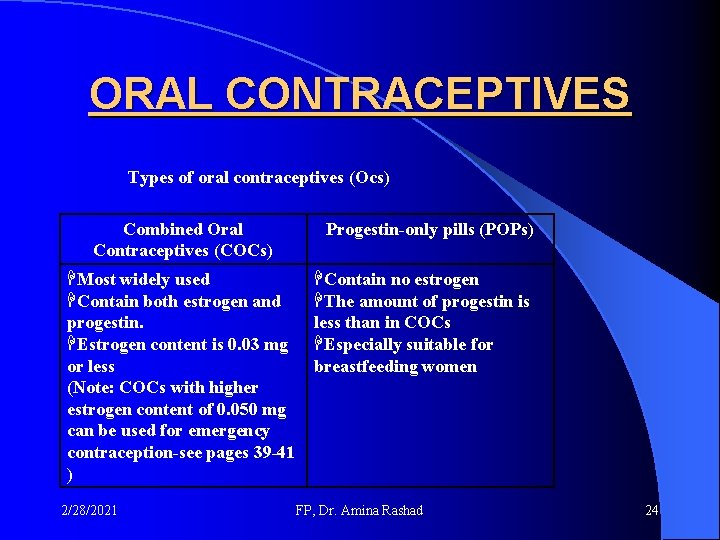
ORAL CONTRACEPTIVES Types of oral contraceptives (Ocs) Combined Oral Contraceptives (COCs) Progestin-only pills (POPs) Most widely used Contain both estrogen and progestin. Estrogen content is 0. 03 mg or less (Note: COCs with higher estrogen content of 0. 050 mg can be used for emergency contraception-see pages 39 -41 ) 2/28/2021 Contain no estrogen The amount of progestin is less than in COCs Especially suitable for breastfeeding women FP, Dr. Amina Rashad 24
Mechanisms Of Action Of Oral Contraceptives Suppression of follicle-stimulating hormone (FSH) and luteinizing hormone (LH) responsible for follicle development and ovulation (primary mechanism for COCs, secondary for POPs) l Thickening of cervical mucus, making it difficult for sperm to enter the uterine cavity (primary mechanism for POPs, secondary for POPs) l 2/28/2021 FP, Dr. Amina Rashad 25
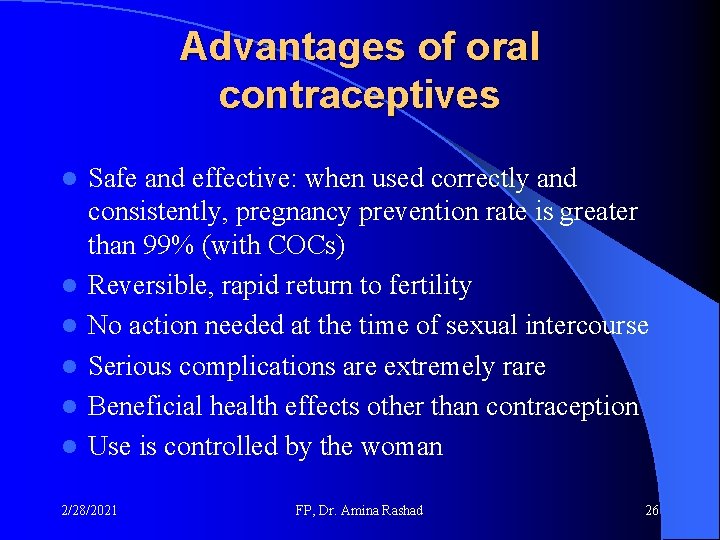
Advantages of oral contraceptives l l l Safe and effective: when used correctly and consistently, pregnancy prevention rate is greater than 99% (with COCs) Reversible, rapid return to fertility No action needed at the time of sexual intercourse Serious complications are extremely rare Beneficial health effects other than contraception Use is controlled by the woman 2/28/2021 FP, Dr. Amina Rashad 26
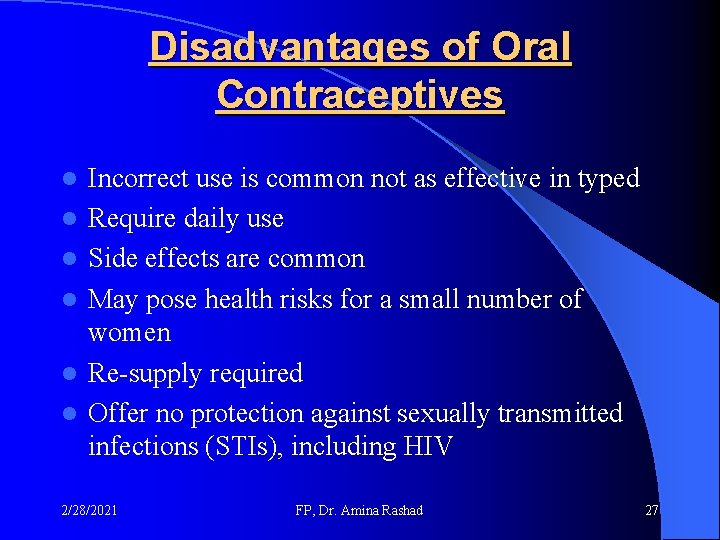
Disadvantages of Oral Contraceptives l l l Incorrect use is common not as effective in typed Require daily use Side effects are common May pose health risks for a small number of women Re-supply required Offer no protection against sexually transmitted infections (STIs), including HIV 2/28/2021 FP, Dr. Amina Rashad 27
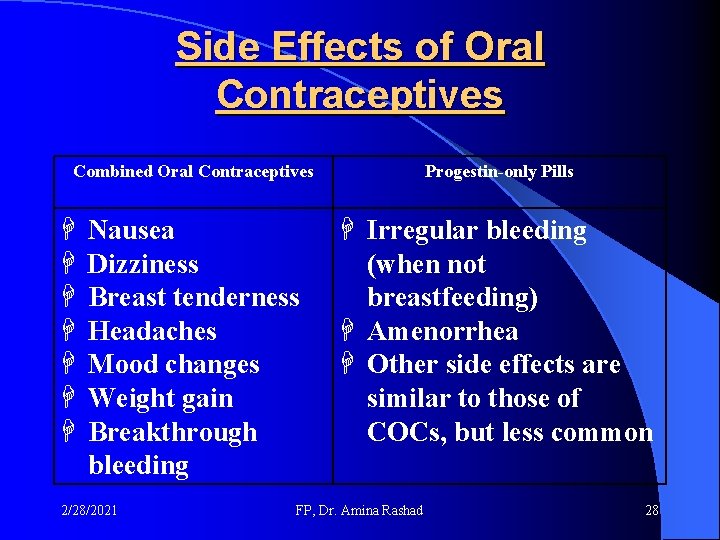
Side Effects of Oral Contraceptives Combined Oral Contraceptives Nausea Dizziness Breast tenderness Headaches Mood changes Weight gain Breakthrough bleeding 2/28/2021 Progestin-only Pills Irregular bleeding (when not breastfeeding) Amenorrhea Other side effects are similar to those of COCs, but less common FP, Dr. Amina Rashad 28
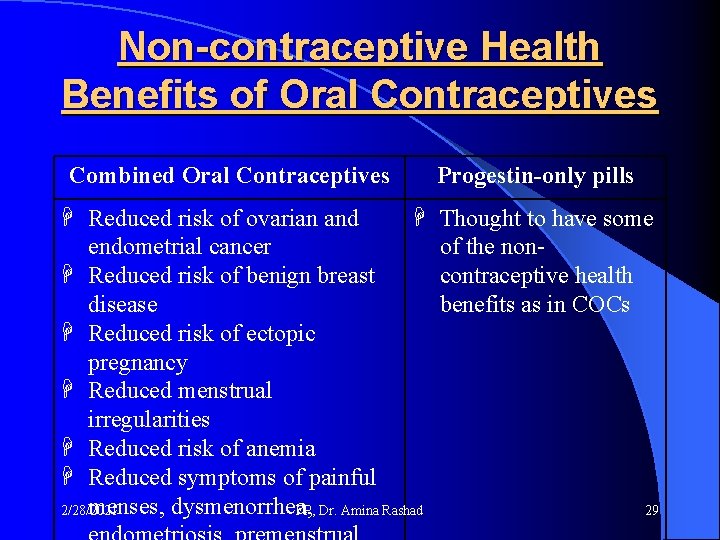
Non-contraceptive Health Benefits of Oral Contraceptives Combined Oral Contraceptives Reduced risk of ovarian and endometrial cancer Reduced risk of benign breast disease Reduced risk of ectopic pregnancy Reduced menstrual irregularities Reduced risk of anemia Reduced symptoms of painful menses, dysmenorrhea, 2/28/2021 FP, Dr. Amina Rashad Progestin-only pills Thought to have some of the noncontraceptive health benefits as in COCs 29
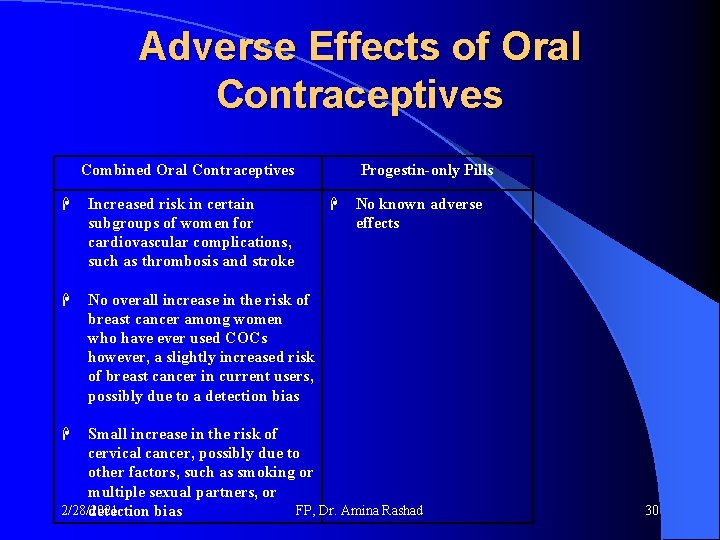
Adverse Effects of Oral Contraceptives Combined Oral Contraceptives Increased risk in certain subgroups of women for cardiovascular complications, such as thrombosis and stroke No overall increase in the risk of breast cancer among women who have ever used COCs however, a slightly increased risk of breast cancer in current users, possibly due to a detection bias Progestin-only Pills No known adverse effects Small increase in the risk of cervical cancer, possibly due to other factors, such as smoking or multiple sexual partners, or 2/28/2021 FP, Dr. Amina Rashad detection bias 30
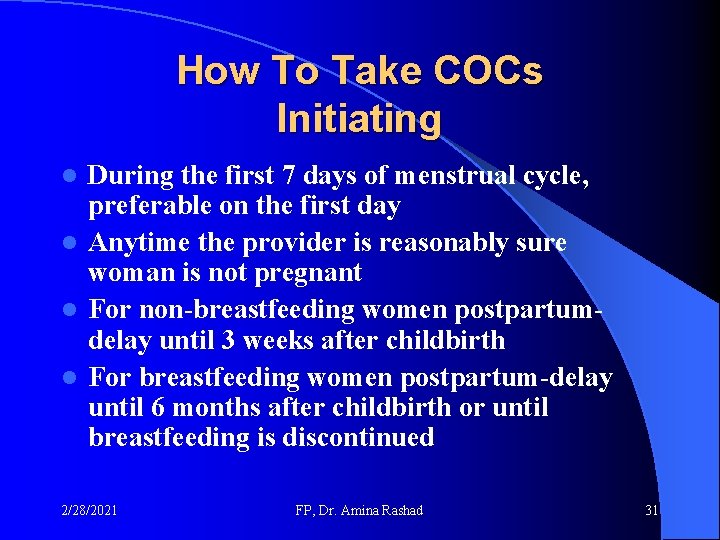
How To Take COCs Initiating During the first 7 days of menstrual cycle, preferable on the first day l Anytime the provider is reasonably sure woman is not pregnant l For non-breastfeeding women postpartumdelay until 3 weeks after childbirth l For breastfeeding women postpartum-delay until 6 months after childbirth or until breastfeeding is discontinued l 2/28/2021 FP, Dr. Amina Rashad 31
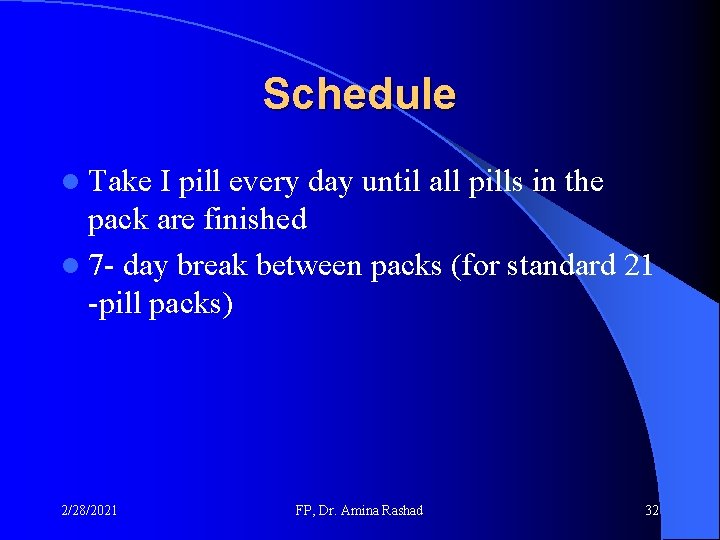
Schedule l Take I pill every day until all pills in the pack are finished l 7 - day break between packs (for standard 21 -pill packs) 2/28/2021 FP, Dr. Amina Rashad 32
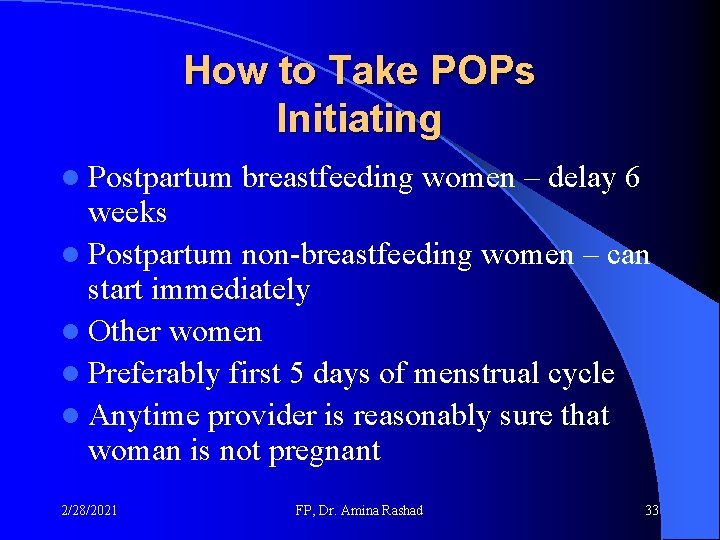
How to Take POPs Initiating l Postpartum breastfeeding women – delay 6 weeks l Postpartum non-breastfeeding women – can start immediately l Other women l Preferably first 5 days of menstrual cycle l Anytime provider is reasonably sure that woman is not pregnant 2/28/2021 FP, Dr. Amina Rashad 33
Schedule l Take I pill each day l Take within 3 hours of the same time each day (preferably the same time) l No break between packs 2/28/2021 FP, Dr. Amina Rashad 34
Missed Pill Regimen l Take most recently missed pill as soon as possible l If not breastfeeding, abstain from sex or use backup method for 48 hours l Take next pll at regular time 2/28/2021 FP, Dr. Amina Rashad 35
Key counseling Topics for Oral Contraceptive Users l l l l Safety and efficacy How oral contraceptives work Advantages and disadvantages Possible side effects and warning symptoms How to take pills and what to do when pills are missed How to obtain and use backup methods and emergency contraception No protection from STIs, including HIV 2/28/2021 FP, Dr. Amina Rashad 36
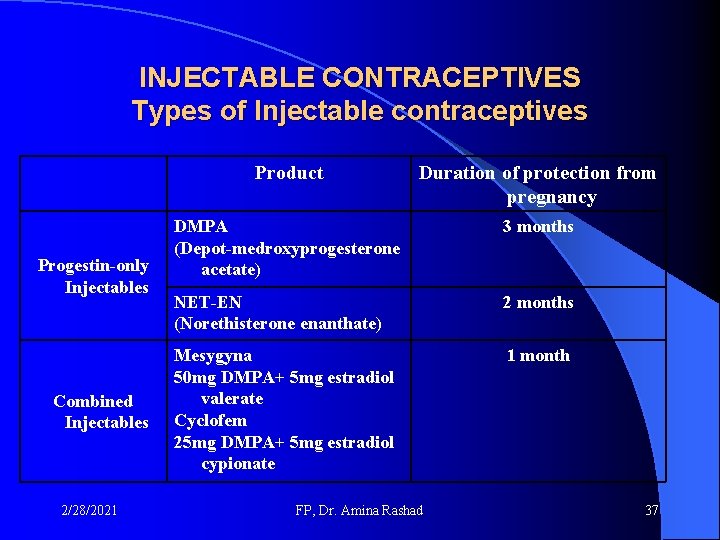
INJECTABLE CONTRACEPTIVES Types of Injectable contraceptives Progestin-only Injectables Combined Injectables 2/28/2021 Product Duration of protection from pregnancy DMPA (Depot-medroxyprogesterone acetate) 3 months NET-EN (Norethisterone enanthate) 2 months Mesygyna 50 mg DMPA+ 5 mg estradiol valerate Cyclofem 25 mg DMPA+ 5 mg estradiol cypionate 1 month FP, Dr. Amina Rashad 37
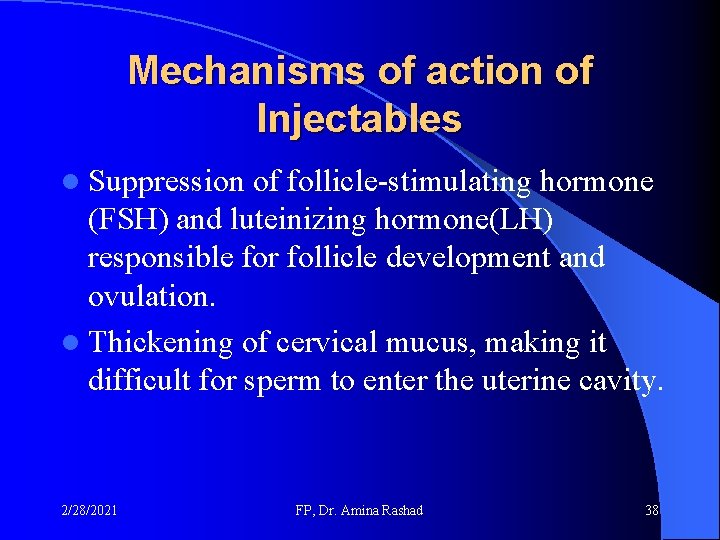
Mechanisms of action of Injectables l Suppression of follicle-stimulating hormone (FSH) and luteinizing hormone(LH) responsible for follicle development and ovulation. l Thickening of cervical mucus, making it difficult for sperm to enter the uterine cavity. 2/28/2021 FP, Dr. Amina Rashad 38
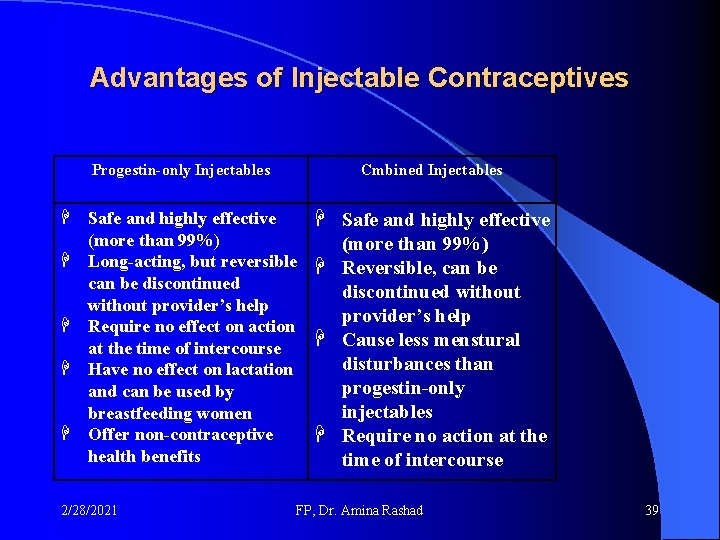
Advantages of Injectable Contraceptives Progestin-only Injectables Cmbined Injectables Safe and highly effective (more than 99%) Long-acting, but reversible can be discontinued without provider’s help Require no effect on action at the time of intercourse Have no effect on lactation and can be used by breastfeeding women Offer non-contraceptive health benefits Safe and highly effective (more than 99%) Reversible, can be discontinued without provider’s help Cause less menstural disturbances than progestin-only injectables Require no action at the time of intercourse 2/28/2021 FP, Dr. Amina Rashad 39
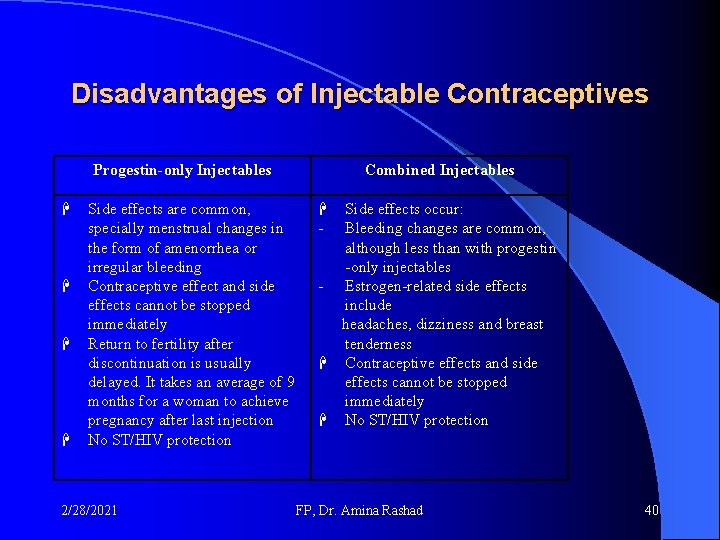
Disadvantages of Injectable Contraceptives Progestin-only Injectables Side effects are common, specially menstrual changes in the form of amenorrhea or irregular bleeding Contraceptive effect and side effects cannot be stopped immediately Return to fertility after discontinuation is usually delayed. It takes an average of 9 months for a woman to achieve pregnancy after last injection No ST/HIV protection 2/28/2021 Combined Injectables - Side effects occur: Bleeding changes are common, although less than with progestin -only injectables - Estrogen-related side effects include headaches, dizziness and breast tenderness Contraceptive effects and side effects cannot be stopped immediately No ST/HIV protection FP, Dr. Amina Rashad 40
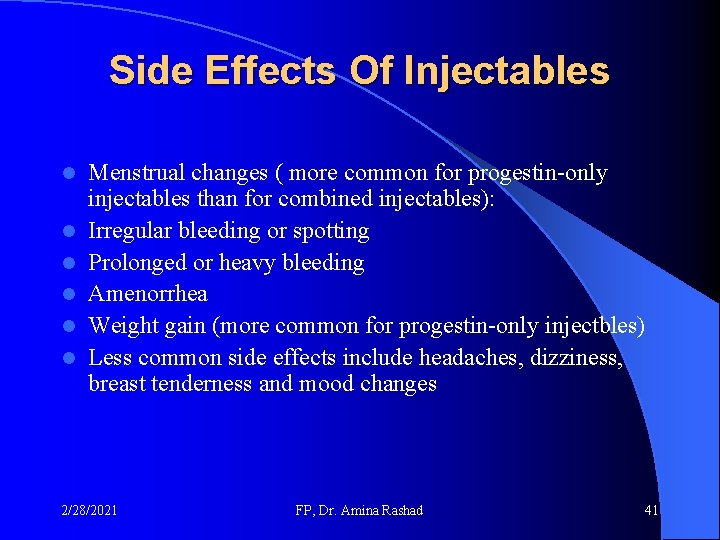
Side Effects Of Injectables l l l Menstrual changes ( more common for progestin-only injectables than for combined injectables): Irregular bleeding or spotting Prolonged or heavy bleeding Amenorrhea Weight gain (more common for progestin-only injectbles) Less common side effects include headaches, dizziness, breast tenderness and mood changes 2/28/2021 FP, Dr. Amina Rashad 41
Non-contraceptive Health Benefits of Progestin-only Injectables Reduced risk of: endometrial cancer and possibly ovarian cancer ectopic pregnancy vaginal yeast infection acute PID fibroids Reduced frequency and severity of sickle-cell disease crises l Reduced symptoms of endometriosis l l l l 2/28/2021 FP, Dr. Amina Rashad 42