
Mc LAB Compiler Tools for MATLAB Amina Aslam
Mc. LAB: Compiler Tools for MATLAB Amina Aslam Toheed Aslam Andrew Casey Maxime Chevalier- Boisvert Jesse Doherty Anton Dubrau Rahul Garg Maja Frydrychowicz Nurudeen Lameed Jun Li Soroush Radpour Olivier Savary Laurie Hendren Mc. Gill University Leverhulme Visiting Professor Department of Computer Science University of Oxford 9/17/2020 Mc. Lab, Laurie Hendren, Leverhulme Lecture Intro - 1
Overview • Why MATLAB? • Introduction to MATLAB – challenges • Overview of the Mc. Lab tools • Resolving names in MATLAB 9/17/2020 Mc. Lab, Laurie Hendren, Leverhulme Lecture Intro - 2
Nature Article: “Why Scientific Computing does not compute” [Merali, Oct 2010] • 38% of scientists spend at least 1/5 th of their time programming. • Codes often buggy, sometimes leading to papers being retracted. Self-taught programmers. • Monster codes, poorly documented, poorly tested, and often used inappropriately. • 45% say scientists spend more time programming than 5 years ago. 9/17/2020 Mc. Lab, Laurie Hendren, Leverhulme Lecture Intro - 3
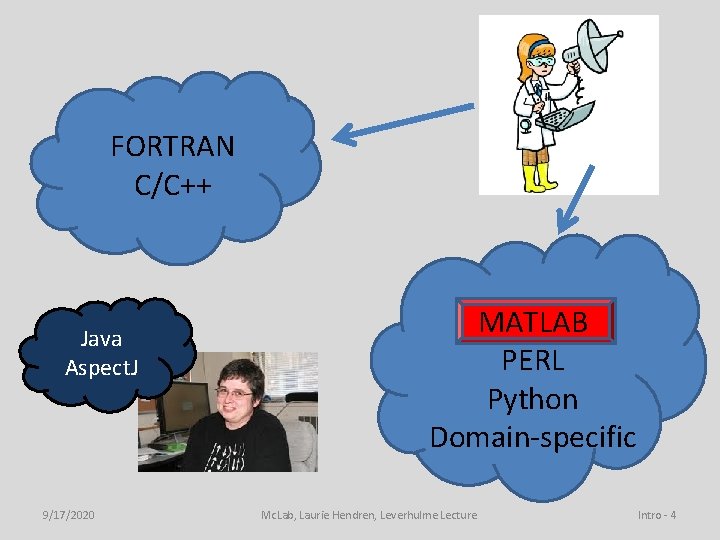
FORTRAN C/C++ Java Aspect. J 9/17/2020 MATLAB PERL Python Domain-specific Mc. Lab, Laurie Hendren, Leverhulme Lecture Intro - 4
A lot of MATLAB programmers! • Started as an interface to standard FORTRAN libraries for use by students. . but now – 1 million MATLAB programmers in 2004, number doubling every 1. 5 to 2 years. – over 1200 MATLAB/Simulink books – used in many sciences and engineering disciplines • Even more “unofficial” MATLAB programmers including those using free systems such as Octave or Sci. Lab. 9/17/2020 Mc. Lab, Laurie Hendren, Leverhulme Lecture Intro - 5

9/17/2020 Mc. Lab, Laurie Hendren, Leverhulme Lecture Intro -6
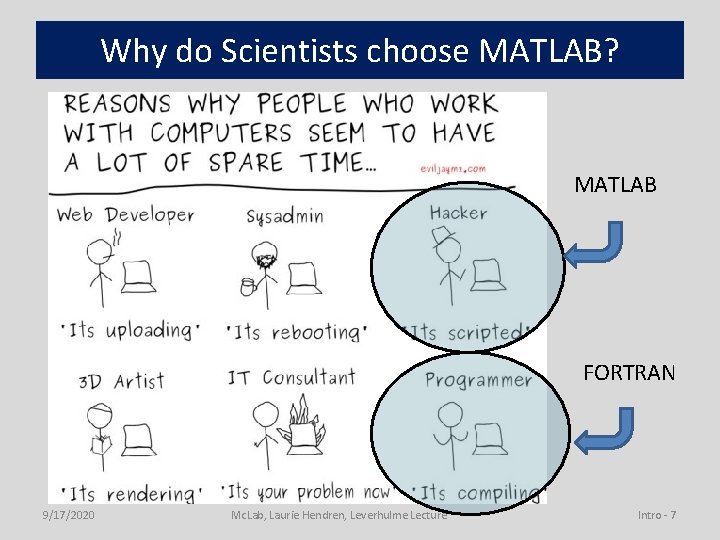
Why do Scientists choose MATLAB? MATLAB FORTRAN 9/17/2020 Mc. Lab, Laurie Hendren, Leverhulme Lecture Intro - 7
Implications of choosing a dynamic, “scripting” language like MATLAB…. 9/17/2020 Mc. Lab, Laurie Hendren, Leverhulme Lecture Intro - 8
Many run-time decisions … Potentially large runtime overhead in both time and space 9/17/2020 Mc. Lab, Laurie Hendren, Leverhulme Lecture 9
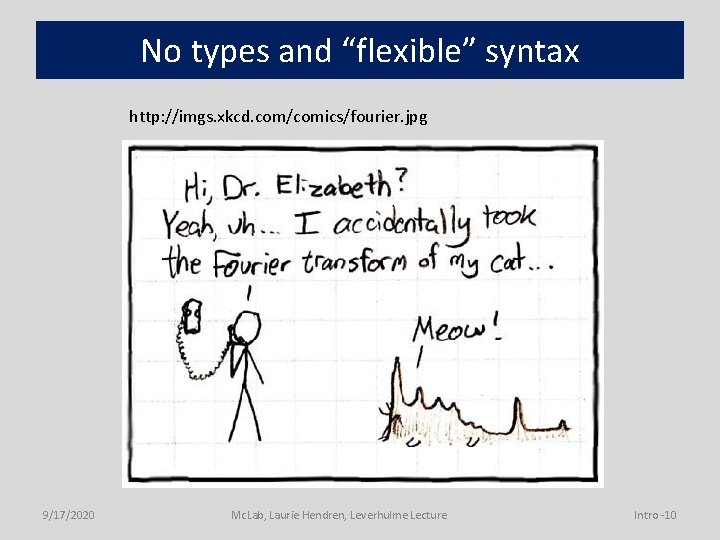
No types and “flexible” syntax http: //imgs. xkcd. com/comics/fourier. jpg 9/17/2020 Mc. Lab, Laurie Hendren, Leverhulme Lecture Intro -10
Most semantic (syntactic) checks made at runtime … No static guarantees 9/17/2020 Mc. Lab, Laurie Hendren, Leverhulme Lecture Intro - 11
No formal standards for MATLAB 9/17/2020 Mc. Lab, Laurie Hendren, Leverhulme Lecture Intro - 12
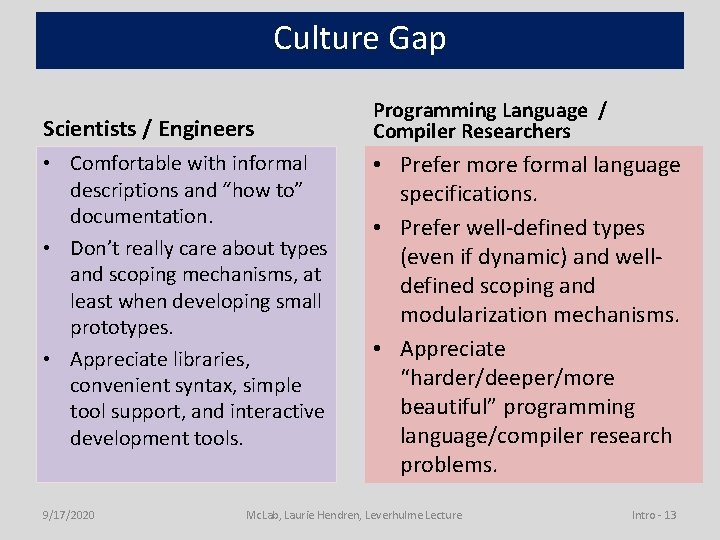
Culture Gap Scientists / Engineers • Comfortable with informal descriptions and “how to” documentation. • Don’t really care about types and scoping mechanisms, at least when developing small prototypes. • Appreciate libraries, convenient syntax, simple tool support, and interactive development tools. 9/17/2020 Programming Language / Compiler Researchers • Prefer more formal language specifications. • Prefer well-defined types (even if dynamic) and welldefined scoping and modularization mechanisms. • Appreciate “harder/deeper/more beautiful” programming language/compiler research problems. Mc. Lab, Laurie Hendren, Leverhulme Lecture Intro - 13
Goals of the Mc. Lab Project • Improve the understanding and documentation of the semantics of MATLAB. • Provide front-end compiler tools suitable for MATLAB and language extensions of MATLAB. • Provide a flow-analysis framework and a suite of analyses suitable for a wide range of compiler/soft. eng. applications. • Provide back-ends that enable experimentation with JIT and ahead-of-time compilation. Enable PL, Compiler and SE Researchers to work on MATLAB 9/17/2020 Mc. Lab, Laurie Hendren, Leverhulme Lecture Intro - 14
Brief Introduction to MATLAB Functions and Scripts in MATLAB 9/17/2020 Mc. Lab, Laurie Hendren, Leverhulme Lecture 15
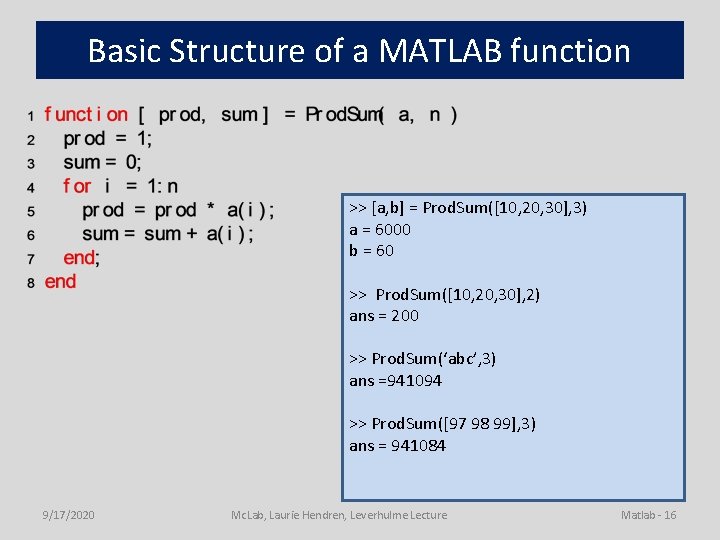
Basic Structure of a MATLAB function >> [a, b] = Prod. Sum([10, 20, 30], 3) a = 6000 b = 60 >> Prod. Sum([10, 20, 30], 2) ans = 200 >> Prod. Sum(‘abc’, 3) ans =941094 >> Prod. Sum([97 98 99], 3) ans = 941084 9/17/2020 Mc. Lab, Laurie Hendren, Leverhulme Lecture Matlab - 16
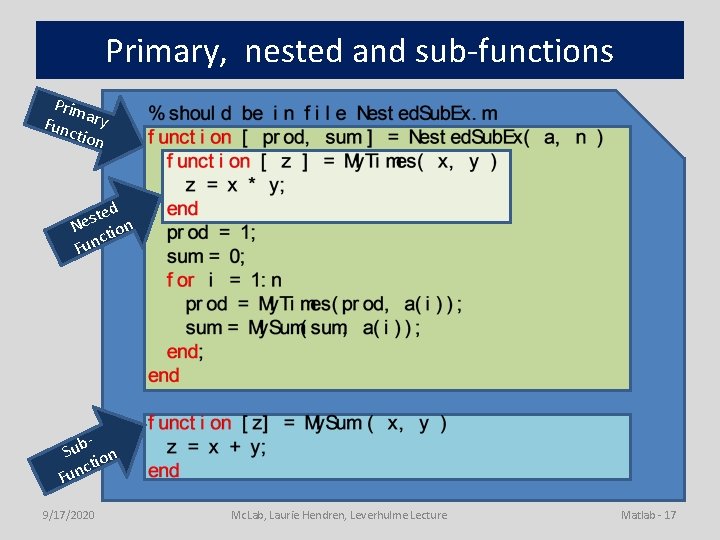
Primary, nested and sub-functions Prim Func ary tion ed t s Ne tion c Fun Sub ion ct n u F 9/17/2020 Mc. Lab, Laurie Hendren, Leverhulme Lecture Matlab - 17
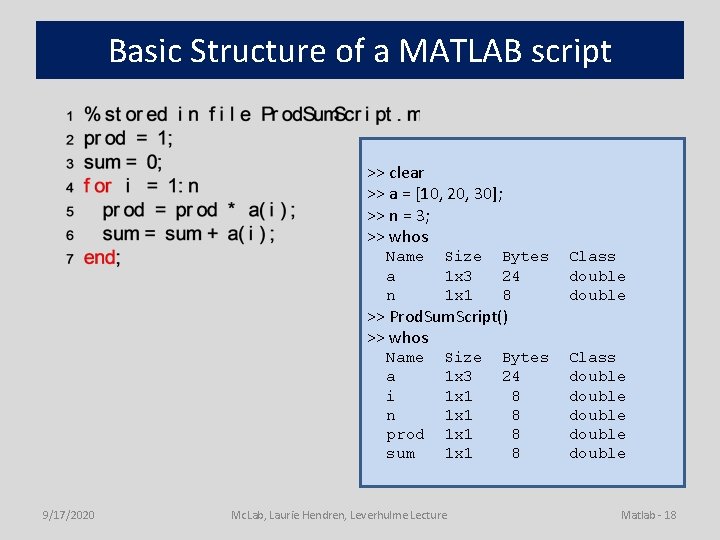
Basic Structure of a MATLAB script >> clear >> a = [10, 20, 30]; >> n = 3; >> whos Name a n Size 1 x 3 1 x 1 Bytes 24 8 Class double >> Prod. Sum. Script() >> whos Name a i n prod sum 9/17/2020 Size 1 x 3 1 x 1 Mc. Lab, Laurie Hendren, Leverhulme Lecture Bytes 24 8 8 Class double double Matlab - 18
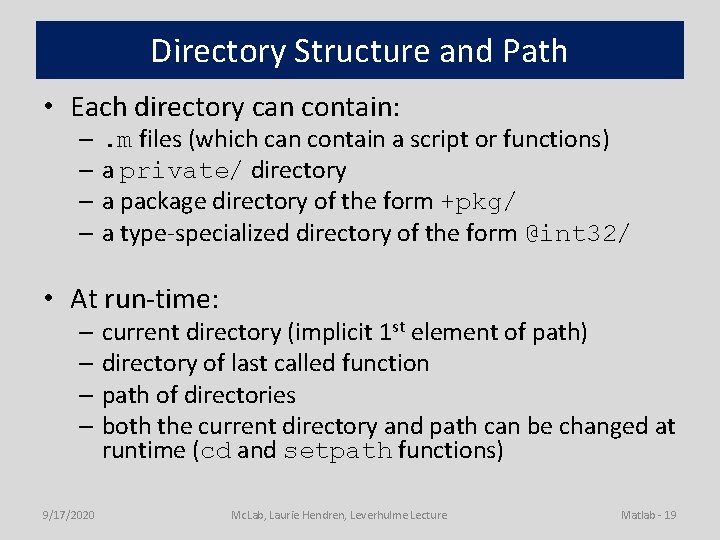
Directory Structure and Path • Each directory can contain: –. m files (which can contain a script or functions) – a private/ directory – a package directory of the form +pkg/ – a type-specialized directory of the form @int 32/ • At run-time: – current directory (implicit 1 st element of path) – directory of last called function – path of directories – both the current directory and path can be changed at runtime (cd and setpath functions) 9/17/2020 Mc. Lab, Laurie Hendren, Leverhulme Lecture Matlab - 19
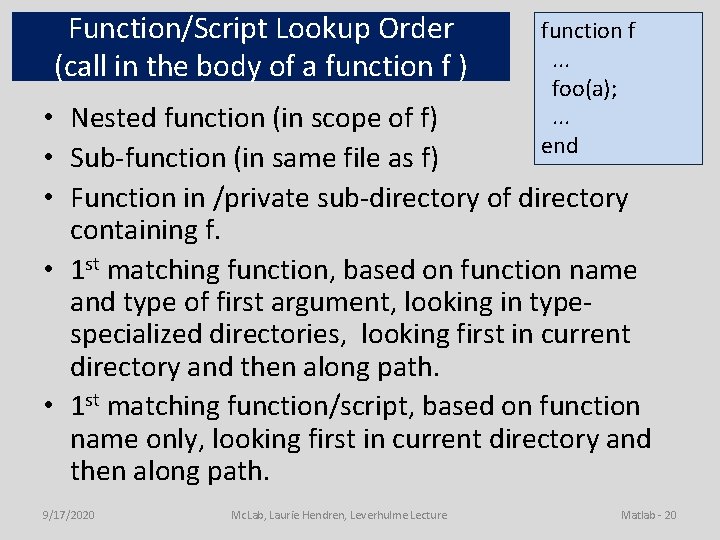
Function/Script Lookup Order (call in the body of a function f ) function f. . . foo(a); . . . end • Nested function (in scope of f) • Sub-function (in same file as f) • Function in /private sub-directory of directory containing f. • 1 st matching function, based on function name and type of first argument, looking in typespecialized directories, looking first in current directory and then along path. • 1 st matching function/script, based on function name only, looking first in current directory and then along path. 9/17/2020 Mc. Lab, Laurie Hendren, Leverhulme Lecture Matlab - 20
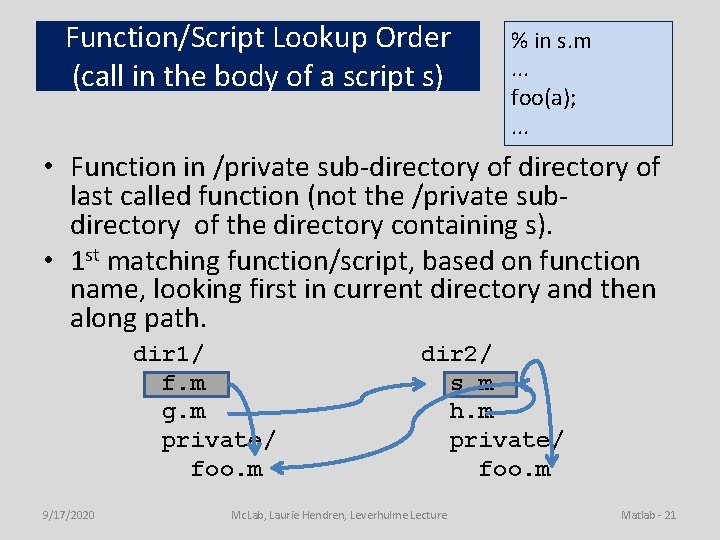
Function/Script Lookup Order (call in the body of a script s) % in s. m. . . foo(a); . . . • Function in /private sub-directory of last called function (not the /private subdirectory of the directory containing s). • 1 st matching function/script, based on function name, looking first in current directory and then along path. dir 1/ f. m g. m private/ foo. m 9/17/2020 dir 2/ s. m h. m private/ foo. m Mc. Lab, Laurie Hendren, Leverhulme Lecture Matlab - 21
Variables and Data in MATLAB 9/17/2020 Mc. Lab, Laurie Hendren, Leverhulme Lecture 22
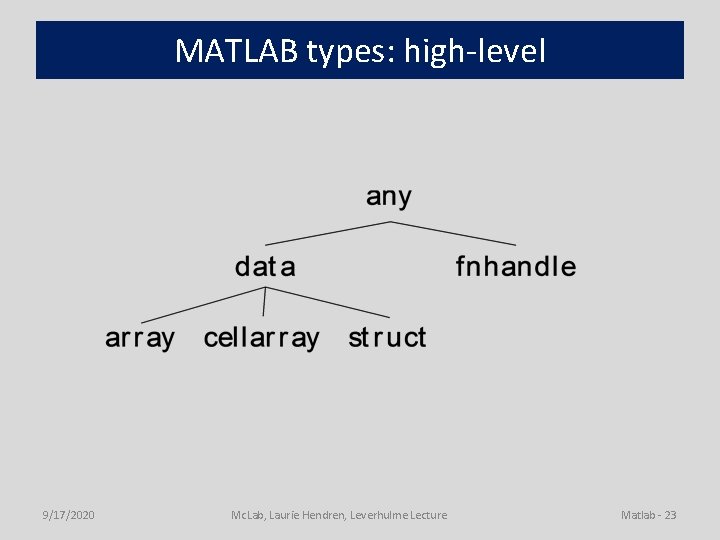
MATLAB types: high-level 9/17/2020 Mc. Lab, Laurie Hendren, Leverhulme Lecture Matlab - 23
Variables • Variables are not explicitly declared. • Local variables are allocated in the current workspace. Global and persistent variables in a special workspace. • All input and output parameters are local. • Local variables are allocated upon their first definition or via a load statement. – x =. . . – x(i) =. . . – load (’f. mat’, ’x’) • Local variables can hold data with different types at different places in a function/script. 9/17/2020 Mc. Lab, Laurie Hendren, Leverhulme Lecture Matlab - 24
Variable Workspaces • There is a workspace for global and persistent variables. • There is a workspace associated with the readeval-print loop. • Each function call creates a new workspace (stack frame). • A script uses the workspace of its caller (either a function workspace or the read-eval-print workspace). 9/17/2020 Mc. Lab, Laurie Hendren, Leverhulme Lecture Matlab - 25
Variable Lookup • If the variable has been declared global or persistent in the function body, look it up in the global/persistent workspace. • Otherwise, lookup in the current workspace (either the read-eval-print workspace or the top-most function call workspace). • For nested functions, use the standard scoping mechanisms. 9/17/2020 Mc. Lab, Laurie Hendren, Leverhulme Lecture Matlab - 26
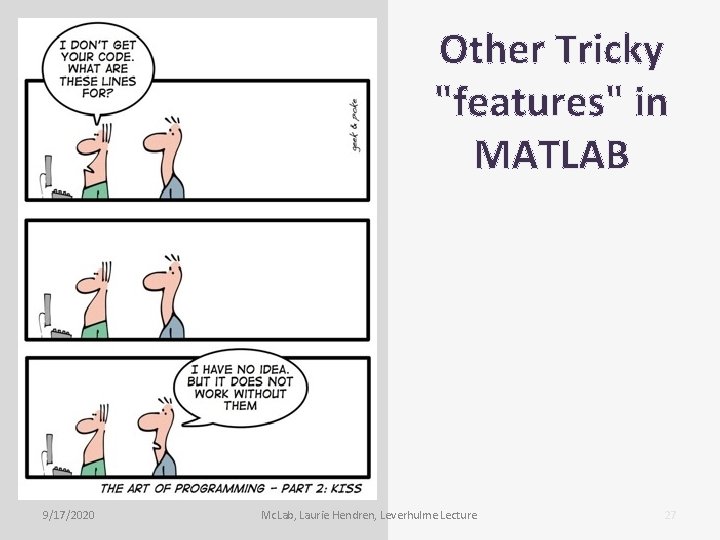
Other Tricky "features" in MATLAB 9/17/2020 Mc. Lab, Laurie Hendren, Leverhulme Lecture 27
Irritating Front-end "Features" • keyword end not always required at the end of a function (often missing in files with only one function). • command syntax – length('x') or length x – cd('mydirname') or cd mydirname • arrays can be defined with or without commas: [10, 20, 30] or [10 20 30] • sometimes newlines have meaning: – a = [ 10 20 30 40 50 60 ]; // defines a 2 x 3 matrix – a = [ 10 20 30 40 50 60]; // defines a 1 x 6 matrix – a = [ 10 20 30; 40 50 60 ]; // defines a 2 x 3 matrix – a = [ 10 20 30; 40 50 60]; // defines a 2 x 3 matrix 9/17/2020 Mc. Lab, Laurie Hendren, Leverhulme Lecture Matlab - 28
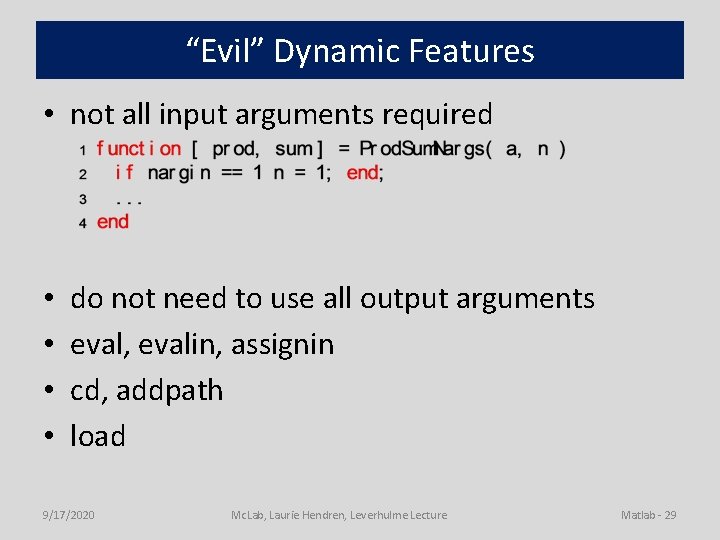
“Evil” Dynamic Features • not all input arguments required • • do not need to use all output arguments eval, evalin, assignin cd, addpath load 9/17/2020 Mc. Lab, Laurie Hendren, Leverhulme Lecture Matlab - 29
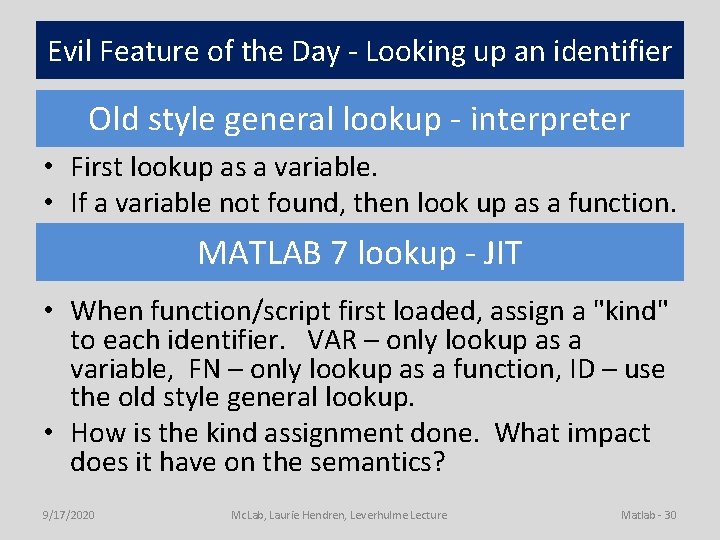
Evil Feature of the Day - Looking up an identifier Old style general lookup - interpreter • First lookup as a variable. • If a variable not found, then look up as a function. MATLAB 7 lookup - JIT • When function/script first loaded, assign a "kind" to each identifier. VAR – only lookup as a variable, FN – only lookup as a function, ID – use the old style general lookup. • How is the kind assignment done. What impact does it have on the semantics? 9/17/2020 Mc. Lab, Laurie Hendren, Leverhulme Lecture Matlab - 30
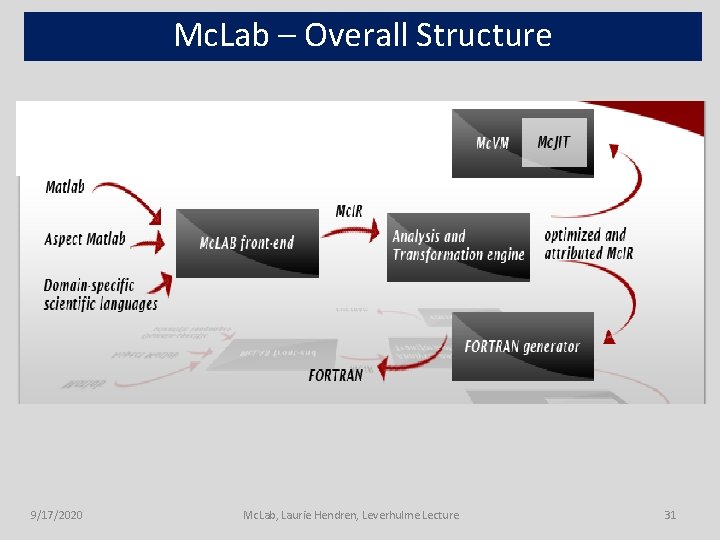
Mc. Lab – Overall Structure 9/17/2020 Mc. Lab, Laurie Hendren, Leverhulme Lecture 31
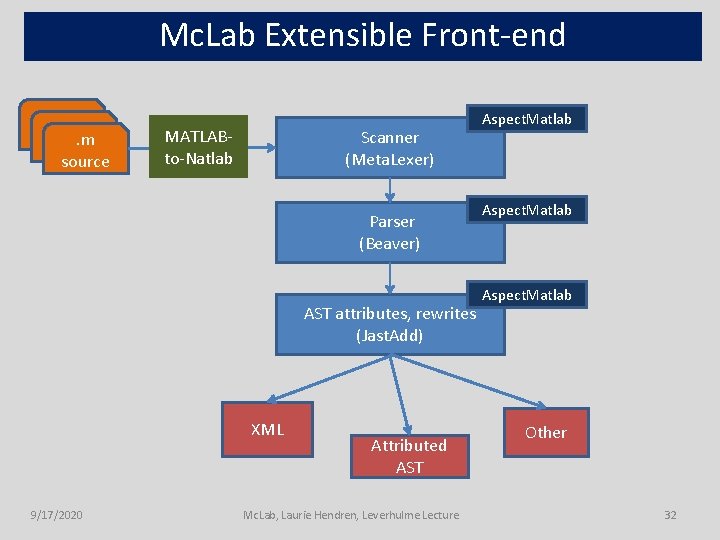
Mc. Lab Extensible Front-end. m. m source MATLABto-Natlab Scanner (Meta. Lexer) Parser (Beaver) AST attributes, rewrites (Jast. Add) XML 9/17/2020 Attributed AST Mc. Lab, Laurie Hendren, Leverhulme Lecture Aspect. Matlab Other 32
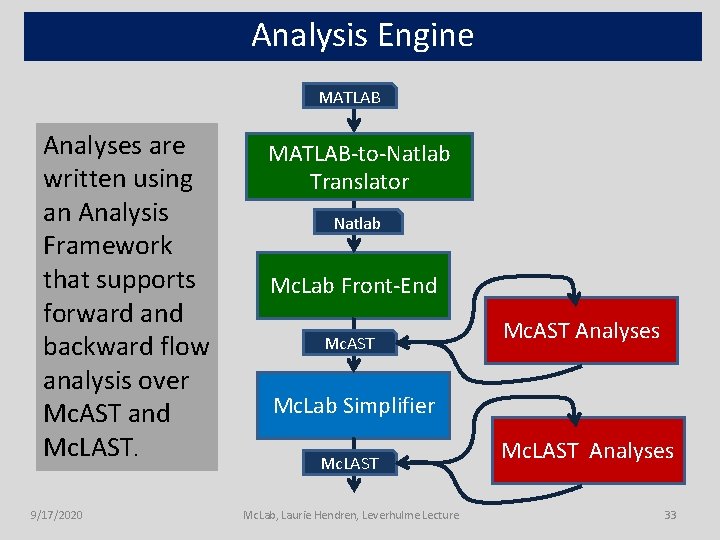
Analysis Engine MATLAB Analyses are written using an Analysis Framework that supports forward and backward flow analysis over Mc. AST and Mc. LAST. 9/17/2020 MATLAB-to-Natlab Translator Natlab Mc. Lab Front-End Mc. AST Analyses Mc. Lab Simplifier Mc. LAST Mc. Lab, Laurie Hendren, Leverhulme Lecture Mc. LAST Analyses 33
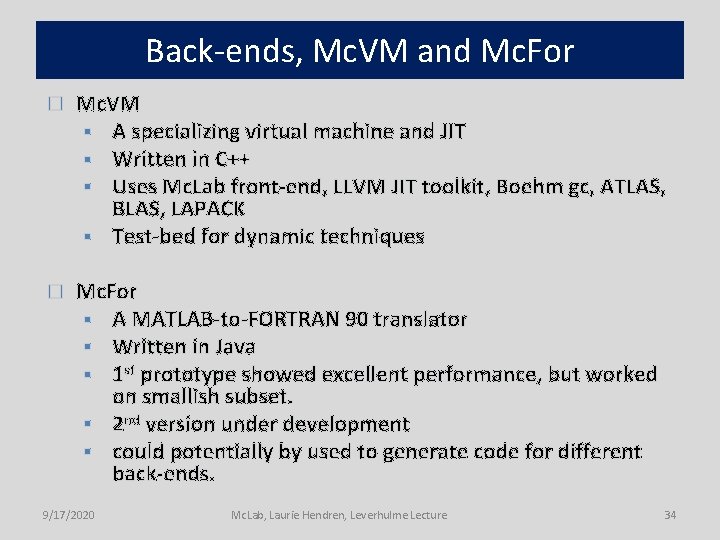
Back-ends, Mc. VM and Mc. For � Mc. VM § A specializing virtual machine and JIT § Written in C++ § Uses Mc. Lab front-end, LLVM JIT toolkit, Boehm gc, ATLAS, BLAS, LAPACK § Test-bed for dynamic techniques � Mc. For § A MATLAB-to-FORTRAN 90 translator § Written in Java § 1 st prototype showed excellent performance, but worked on smallish subset. § 2 nd version under development § could potentially by used to generate code for different back-ends. 9/17/2020 Mc. Lab, Laurie Hendren, Leverhulme Lecture 34
How does MATLAB resolve Names? • No official specification • Motivating example 9/17/2020 Mc. Lab, Laurie Hendren, Leverhulme Lecture 35
9/17/2020 Mc. Lab, Laurie Hendren, Leverhulme Lecture 36
9/17/2020 Mc. Lab, Laurie Hendren, Leverhulme Lecture 37
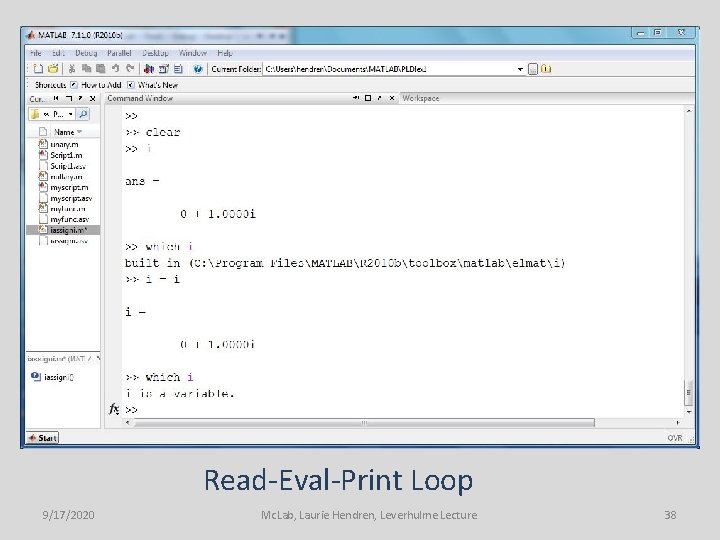
Read-Eval-Print Loop 9/17/2020 Mc. Lab, Laurie Hendren, Leverhulme Lecture 38
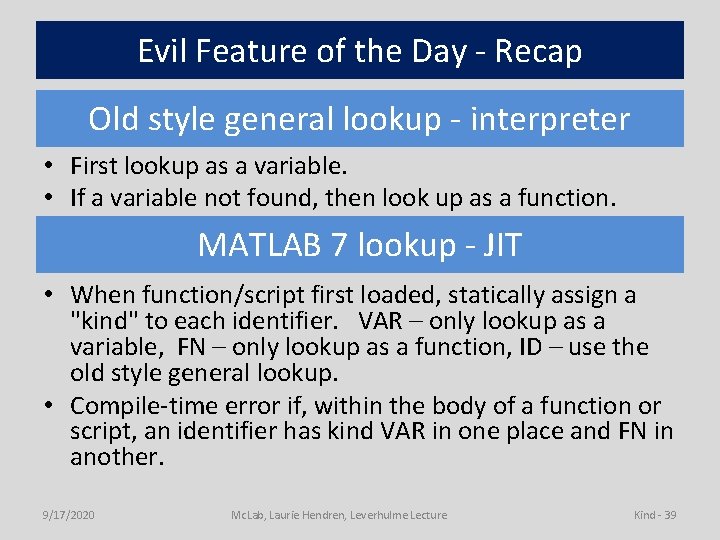
Evil Feature of the Day - Recap Old style general lookup - interpreter • First lookup as a variable. • If a variable not found, then look up as a function. MATLAB 7 lookup - JIT • When function/script first loaded, statically assign a "kind" to each identifier. VAR – only lookup as a variable, FN – only lookup as a function, ID – use the old style general lookup. • Compile-time error if, within the body of a function or script, an identifier has kind VAR in one place and FN in another. 9/17/2020 Mc. Lab, Laurie Hendren, Leverhulme Lecture Kind - 39
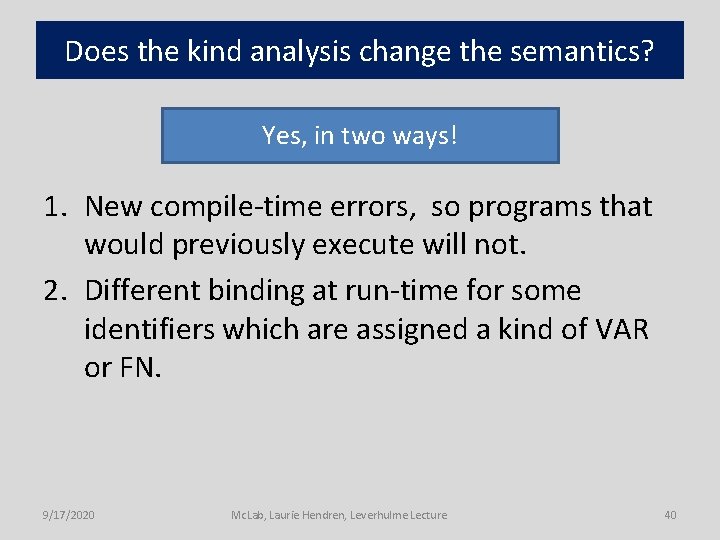
Does the kind analysis change the semantics? Yes, in two ways! 1. New compile-time errors, so programs that would previously execute will not. 2. Different binding at run-time for some identifiers which are assigned a kind of VAR or FN. 9/17/2020 Mc. Lab, Laurie Hendren, Leverhulme Lecture 40
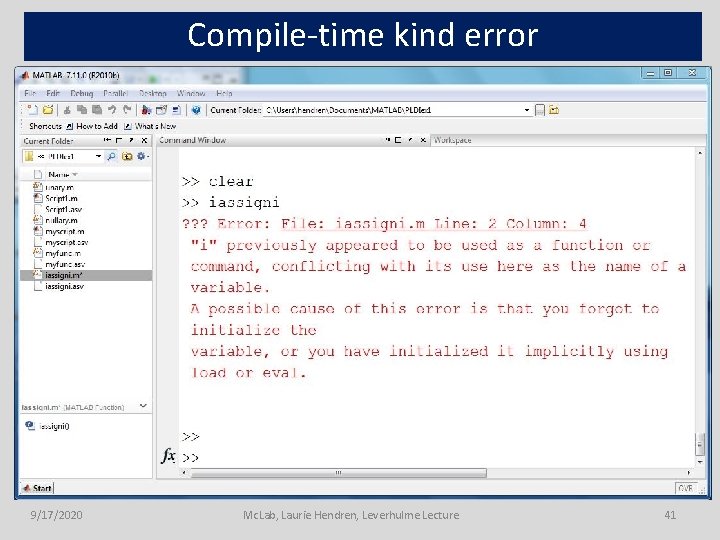
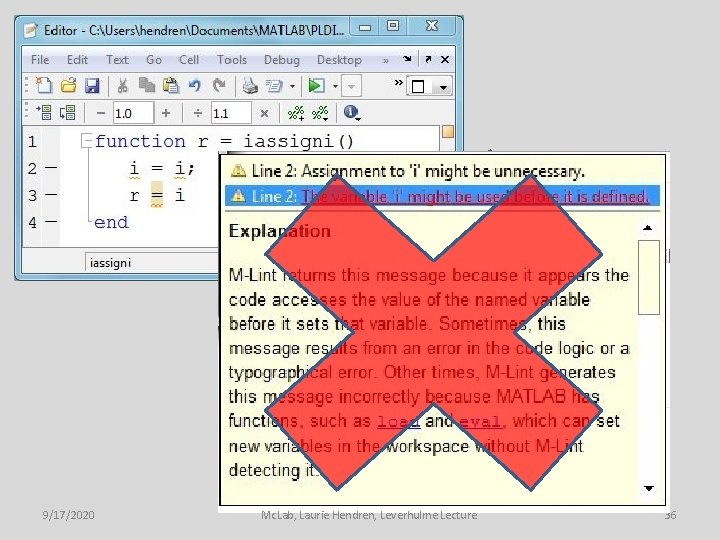
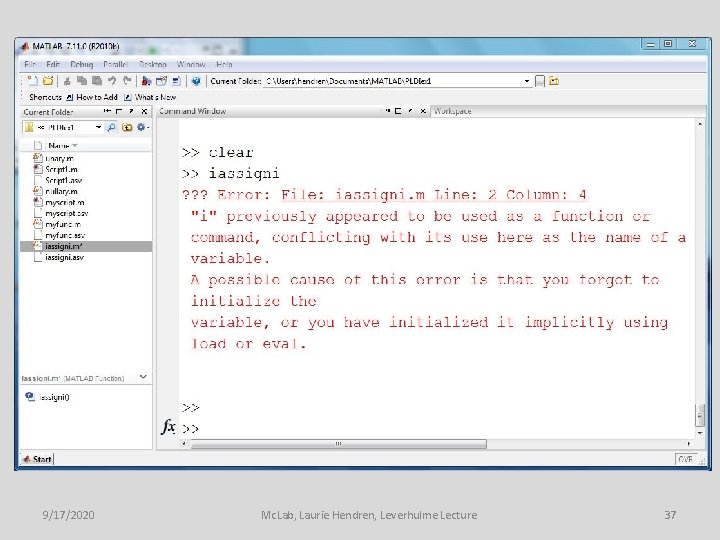
Compile-time kind error 9/17/2020 Mc. Lab, Laurie Hendren, Leverhulme Lecture 41
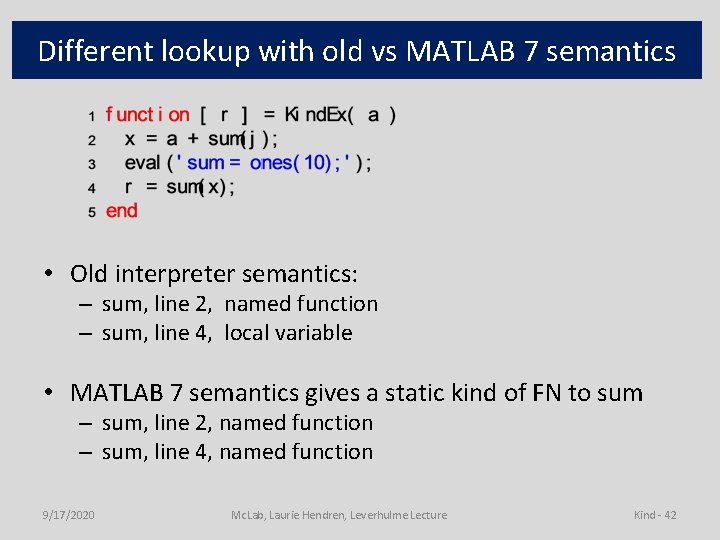
Different lookup with old vs MATLAB 7 semantics • Old interpreter semantics: – sum, line 2, named function – sum, line 4, local variable • MATLAB 7 semantics gives a static kind of FN to sum – sum, line 2, named function – sum, line 4, named function 9/17/2020 Mc. Lab, Laurie Hendren, Leverhulme Lecture Kind - 42
Our approach to the Kind Analysis Problem • Identify that a kind analysis is needed to match MATLAB 7 semantics. • Specify and implement a kind assignment algorithm that matches the observed behaviour of MATLAB 7. (both for functions and for scripts) • Identify any weaknesses in the MATLAB 7 approach and suggest two more clearly defined alternatives, one flow-sensitive and one flowinsensitive. • Determine if the alternatives could be used without significant change to the behaviour of existing MATLAB programs. 9/17/2020 Mc. Lab, Laurie Hendren, Leverhulme Lecture 43
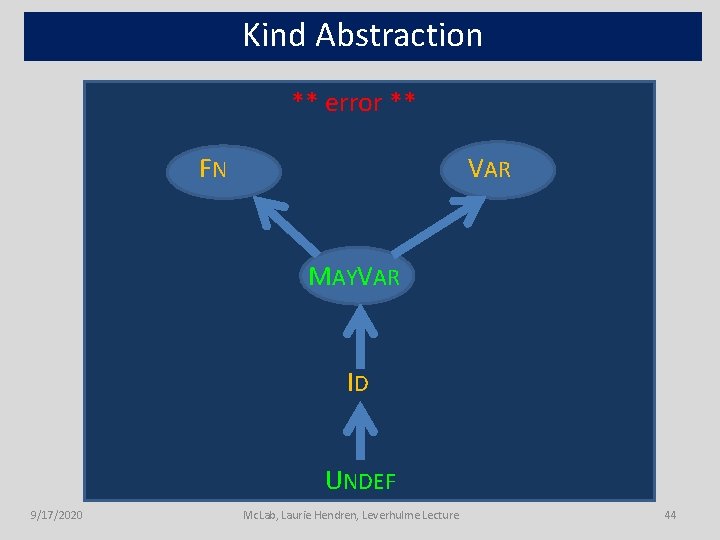
Kind Abstraction ** error ** FN VAR MAYVAR ID UNDEF 9/17/2020 Mc. Lab, Laurie Hendren, Leverhulme Lecture 44
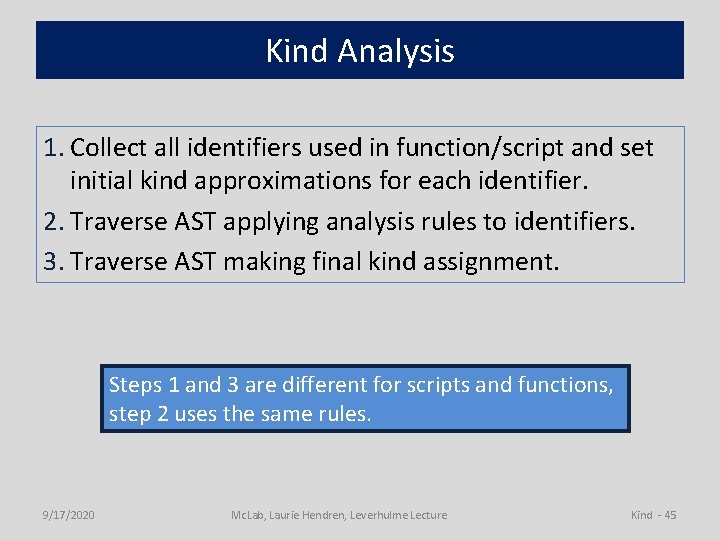
Kind Analysis 1. Collect all identifiers used in function/script and set initial kind approximations for each identifier. 2. Traverse AST applying analysis rules to identifiers. 3. Traverse AST making final kind assignment. Steps 1 and 3 are different for scripts and functions, step 2 uses the same rules. 9/17/2020 Mc. Lab, Laurie Hendren, Leverhulme Lecture Kind - 45
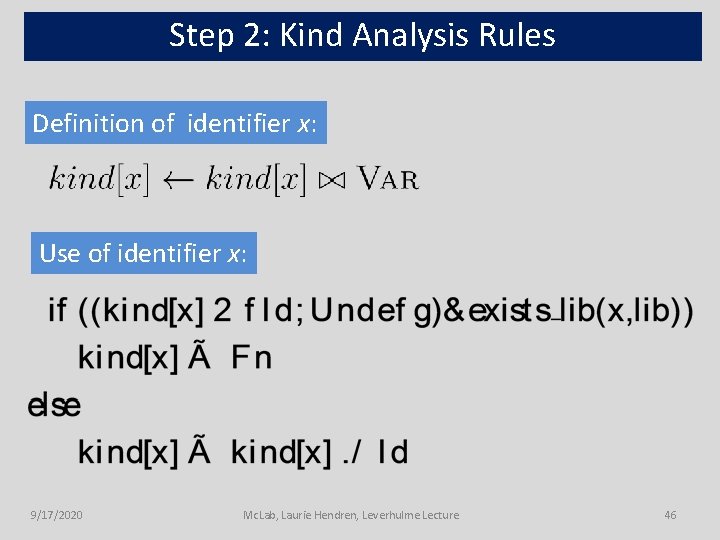
Step 2: Kind Analysis Rules Definition of identifier x: Use of identifier x: 9/17/2020 Mc. Lab, Laurie Hendren, Leverhulme Lecture 46
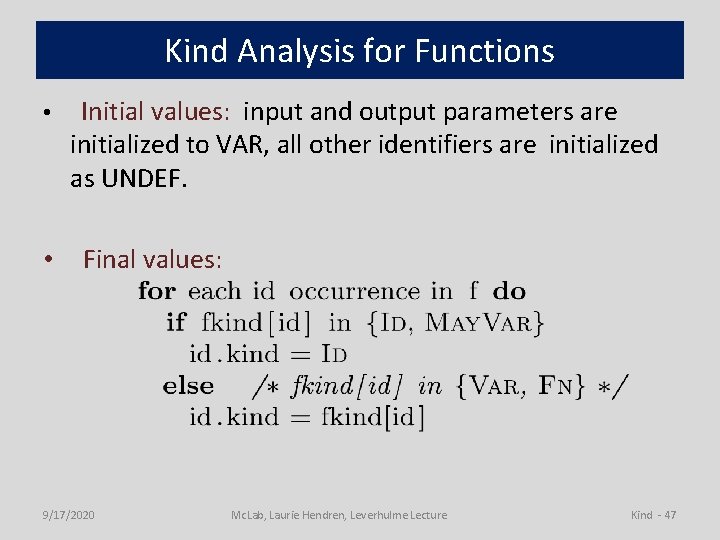
Kind Analysis for Functions • • Initial values: input and output parameters are initialized to VAR, all other identifiers are initialized as UNDEF. Final values: 9/17/2020 Mc. Lab, Laurie Hendren, Leverhulme Lecture Kind - 47
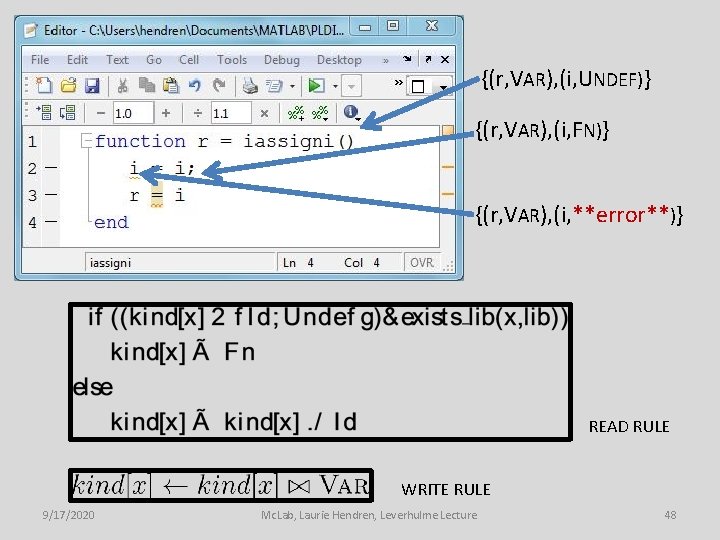
{(r, VAR), (i, UNDEF)} {(r, VAR), (i, FN)} {(r, VAR), (i, **error**)} READ RULE WRITE RULE 9/17/2020 Mc. Lab, Laurie Hendren, Leverhulme Lecture 48
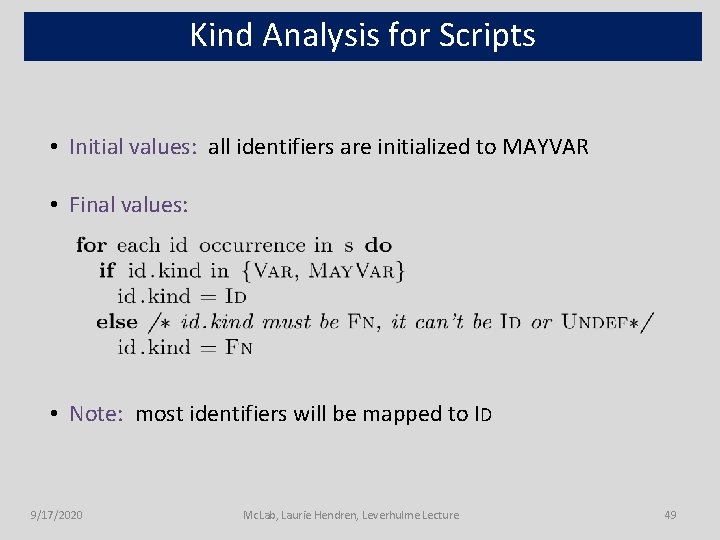
Kind Analysis for Scripts • Initial values: all identifiers are initialized to MAYVAR • Final values: • Note: most identifiers will be mapped to ID 9/17/2020 Mc. Lab, Laurie Hendren, Leverhulme Lecture 49
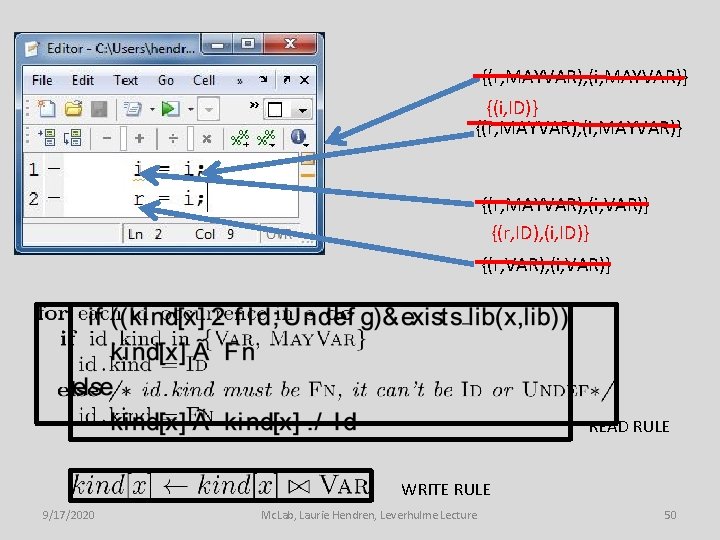
{(r, MAYVAR), (i, MAYVAR)} {(i, ID)} {(r, MAYVAR), (i, MAYVAR)} {(r, MAYVAR), (i, VAR)} {(r, ID), (i, ID)} {(r, VAR), (i, VAR)} READ RULE WRITE RULE 9/17/2020 Mc. Lab, Laurie Hendren, Leverhulme Lecture 50
Problems with MATLAB 7 kind analysis • apparently not clearly documented, in some ways just a side-effect of a JIT implementation decision • without a clear specification, confusing for the programmer and compiler/tool developer • loses almost all information about variables in scripts • some strange anomalies due to a "traversalsensitive" analysis 9/17/2020 Mc. Lab, Laurie Hendren, Leverhulme Lecture Kind - 51
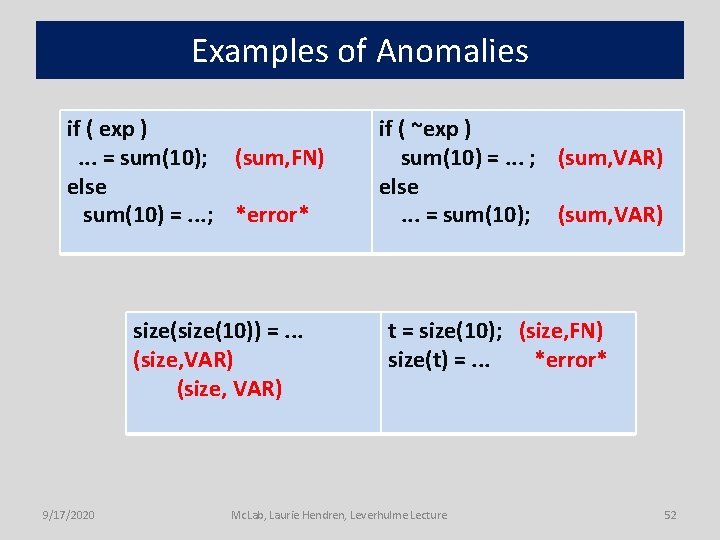
Examples of Anomalies if ( exp ). . . = sum(10); (sum, FN) else sum(10) =. . . ; *error* size(10)) =. . . (size, VAR) 9/17/2020 if ( ~exp ) sum(10) =. . . ; (sum, VAR) else. . . = sum(10); (sum, VAR) t = size(10); (size, FN) size(t) =. . . *error* Mc. Lab, Laurie Hendren, Leverhulme Lecture 52
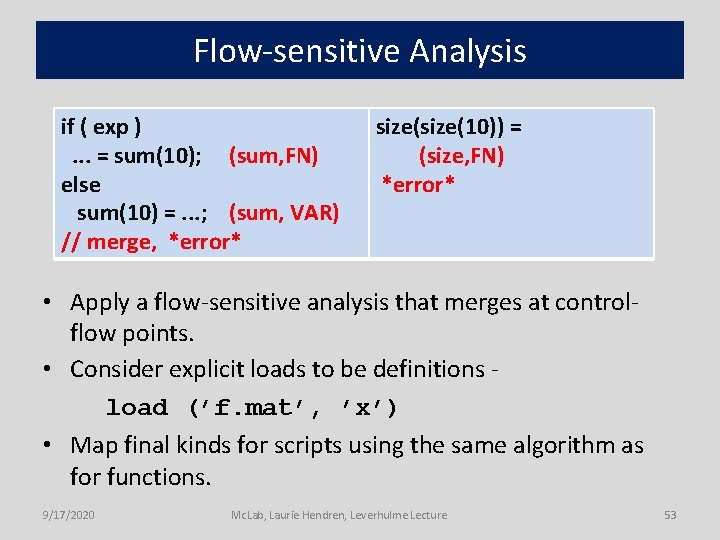
Flow-sensitive Analysis if ( exp ). . . = sum(10); (sum, FN) else sum(10) =. . . ; (sum, VAR) // merge, *error* size(10)) = (size, FN) *error* • Apply a flow-sensitive analysis that merges at controlflow points. • Consider explicit loads to be definitions load (’f. mat’, ’x’) • Map final kinds for scripts using the same algorithm as for functions. 9/17/2020 Mc. Lab, Laurie Hendren, Leverhulme Lecture 53
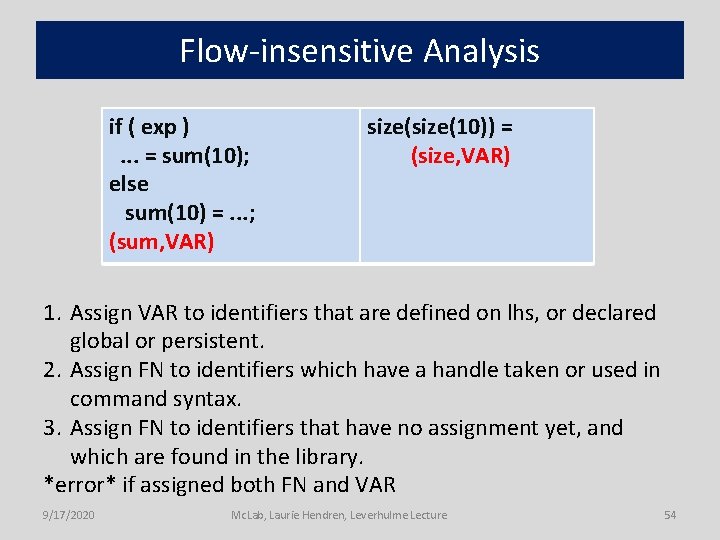
Flow-insensitive Analysis if ( exp ). . . = sum(10); else sum(10) =. . . ; (sum, VAR) size(10)) = (size, VAR) 1. Assign VAR to identifiers that are defined on lhs, or declared global or persistent. 2. Assign FN to identifiers which have a handle taken or used in command syntax. 3. Assign FN to identifiers that have no assignment yet, and which are found in the library. *error* if assigned both FN and VAR 9/17/2020 Mc. Lab, Laurie Hendren, Leverhulme Lecture 54
Results: What is the distribution of kinds for functions/scripts in real MATLAB programs? 9/17/2020 Mc. Lab, Laurie Hendren, Leverhulme Lecture 55
Various-sized benchmarks from a wide variety of application areas Send benchmarks or links to hendren@cs. mcgill. ca 9/17/2020 Mc. Lab, Laurie Hendren, Leverhulme Lecture 56
Results for Functions - number of identifiers with each Kind 11698 functions 9/17/2020 Mc. Lab, Laurie Hendren, Leverhulme Lecture Exper - 57
Results for Scripts – number of identifier instances with each Kind 2035 scripts 9/17/2020 Mc. Lab, Laurie Hendren, Leverhulme Lecture Exper - 58
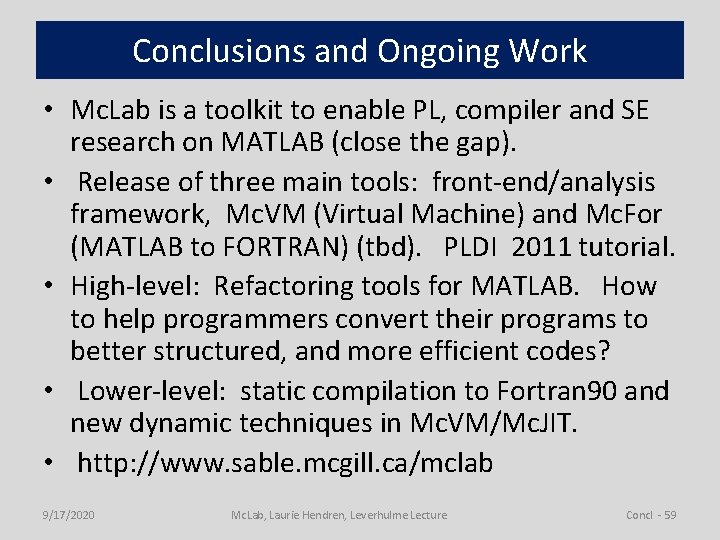
Conclusions and Ongoing Work • Mc. Lab is a toolkit to enable PL, compiler and SE research on MATLAB (close the gap). • Release of three main tools: front-end/analysis framework, Mc. VM (Virtual Machine) and Mc. For (MATLAB to FORTRAN) (tbd). PLDI 2011 tutorial. • High-level: Refactoring tools for MATLAB. How to help programmers convert their programs to better structured, and more efficient codes? • Lower-level: static compilation to Fortran 90 and new dynamic techniques in Mc. VM/Mc. JIT. • http: //www. sable. mcgill. ca/mclab 9/17/2020 Mc. Lab, Laurie Hendren, Leverhulme Lecture Concl - 59
- Slides: 59