Families in Lithuania listening to the voice of

- Slides: 39
Families in Lithuania: listening to the voice of social worker Julija Eidukevičiūtė Vytautas Magnus University, LITHUANIA
Settings and contexts are in large part made up of reproduced social relations and that means that social forms are reproduced over time because people generally replicate the habits, traditions, rules and stocks of knowledge that sustain there social forms. Layder (1998)
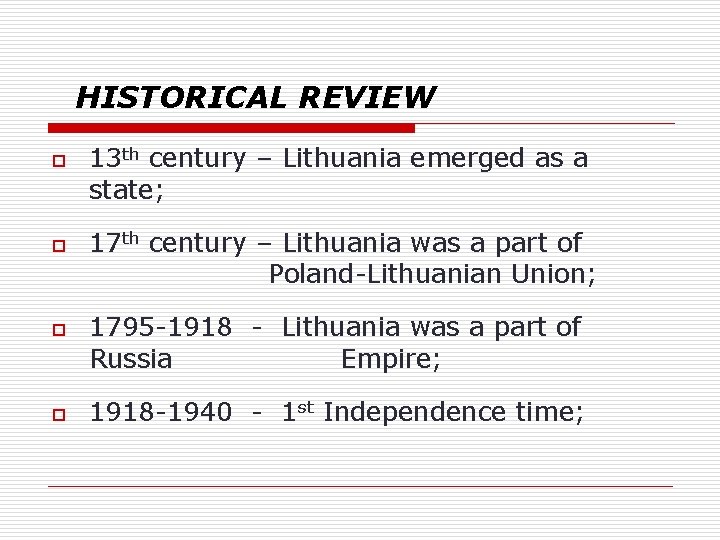
HISTORICAL REVIEW o o 13 th century – Lithuania emerged as a state; 17 th century – Lithuania was a part of Poland-Lithuanian Union; 1795 -1918 - Lithuania was a part of Russia Empire; 1918 -1940 - 1 st Independence time;
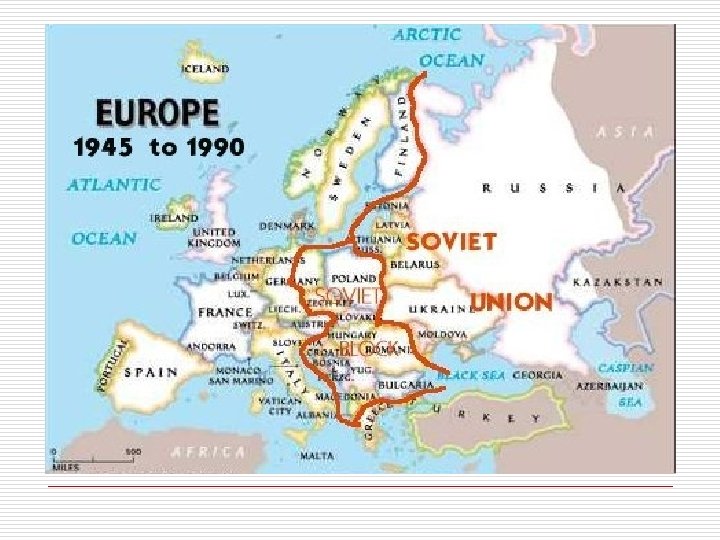
o o o 1940 -1990 - Lithuania was a part of Soviet Union; March 11 , 1990 – Lithuania proclaimed independence; May 1, 2004 - Lithuania becomes a member of Europe Union.
Main features of Lithuanian social work o o Social work is new profession (just 15 years) Social work does not have clear identity for many people Overemphasized material support Reactive period blur proactive period.
• • Social exclusion existed in Lithuania during Soviet times, but not officially Most social services were institutionalised and structured according to communist ideology.
Family transformation: Transition from traditional to mordern families
Fundamentals for the transition of family model • • Individualization Emancipation Freedom of person Development of medical technologies: modern contraception (Stankūnienė, 2003):
Traditional family: • • • Early marriages Family created by marriage High rate of marriages First child early age Dominates avarage families Law rate of children born in extramarital families
Modern families: § § § Decrease of marriages Marriage delayed for later Fertility decrease Average family has 1 -2 children Increases number of bachelors
There appears changes not only in in economics, but also in family models. Changes in labor market changes relationship in family.
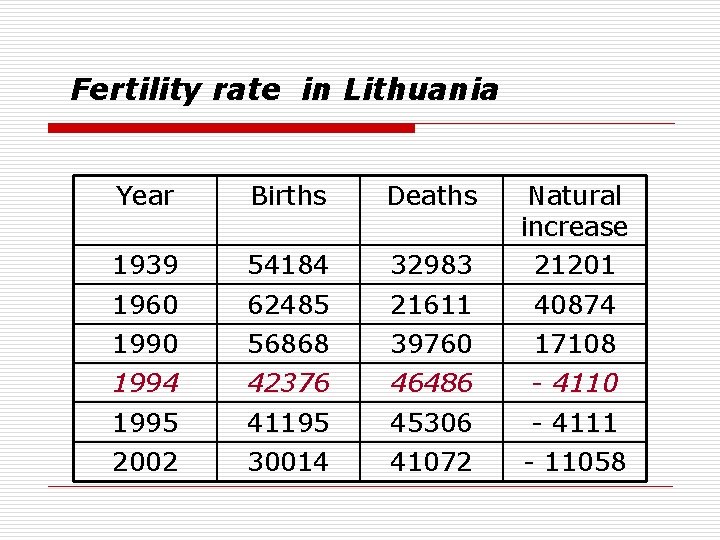
Fertility rate in Lithuania Year Births Deaths 1939 54184 32983 Natural increase 21201 1960 62485 21611 40874 1990 56868 39760 17108 1994 42376 46486 - 4110 1995 41195 45306 - 4111 2002 30014 41072 - 11058
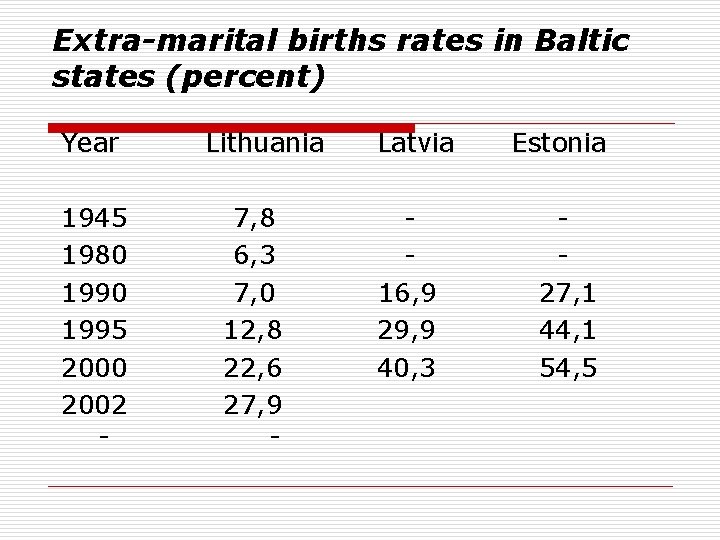
Extra-marital births rates in Baltic states (percent) Year 1945 1980 1995 2000 2002 - Lithuania 7, 8 6, 3 7, 0 12, 8 22, 6 27, 9 - Latvia 16, 9 29, 9 40, 3 Estonia 27, 1 44, 1 54, 5
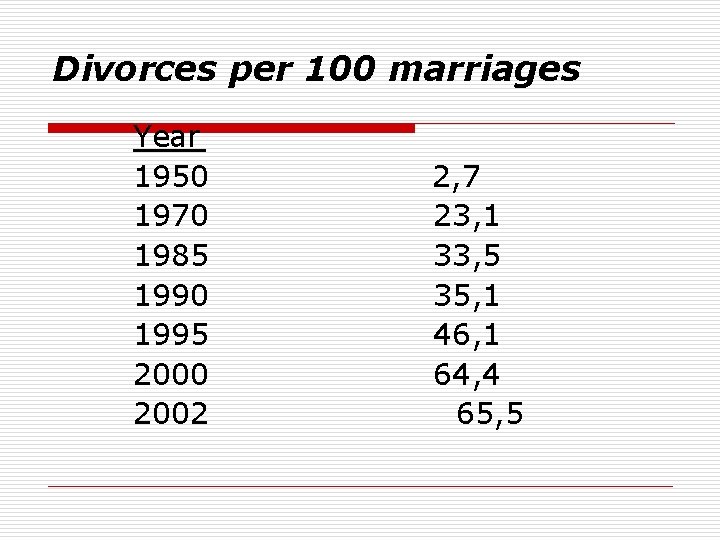
Divorces per 100 marriages Year 1950 1970 1985 1990 1995 2000 2002 2, 7 23, 1 33, 5 35, 1 46, 1 64, 4 65, 5
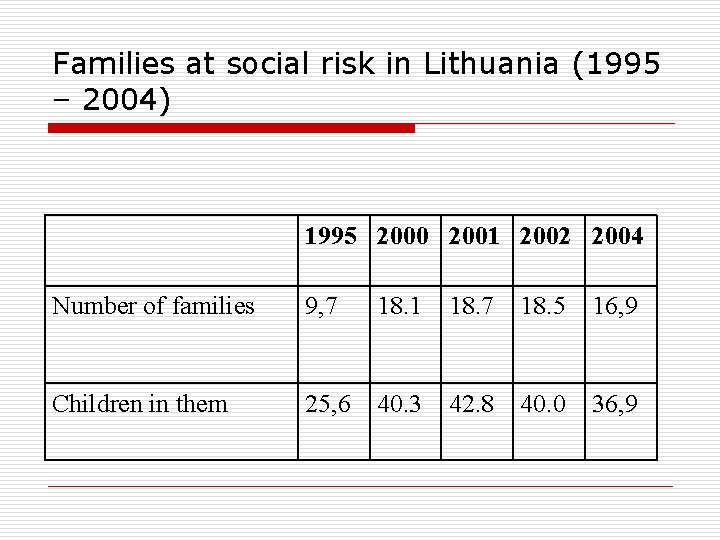
Families at social risk in Lithuania (1995 – 2004) 1995 2000 2001 2002 2004 Number of families 9, 7 18. 1 18. 7 18. 5 16, 9 Children in them 25, 6 40. 3 42. 8 40. 0 36, 9
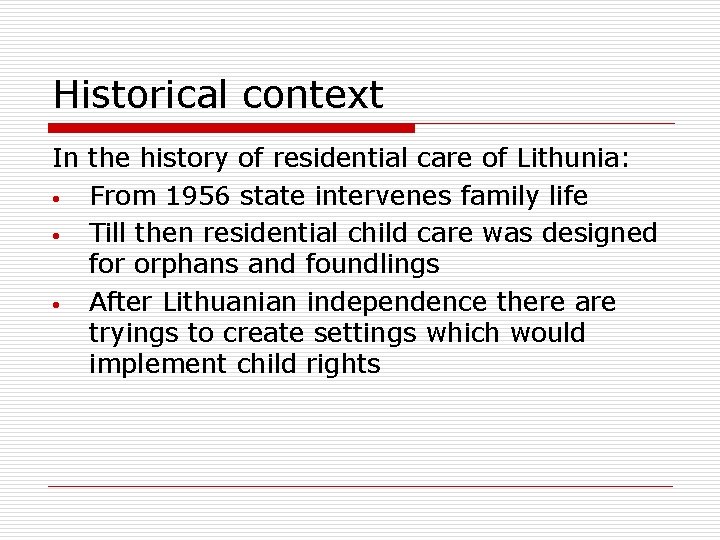
Historical context In the history of residential care of Lithunia: • From 1956 state intervenes family life • Till then residential child care was designed for orphans and foundlings • After Lithuanian independence there are tryings to create settings which would implement child rights
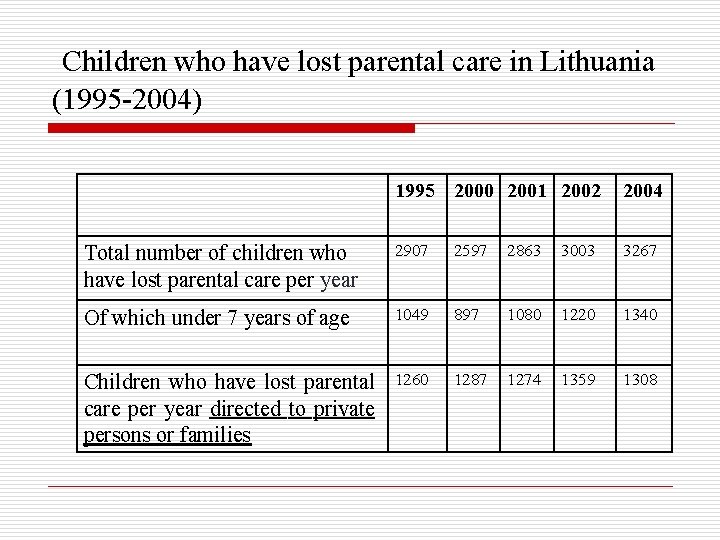
Children who have lost parental care in Lithuania (1995 -2004) 1995 2000 2001 2002 2004 Total number of children who have lost parental care per year 2907 2597 2863 3003 3267 Of which under 7 years of age 1049 897 1080 1220 1340 Children who have lost parental care per year directed to private persons or families 1260 1287 1274 1359 1308
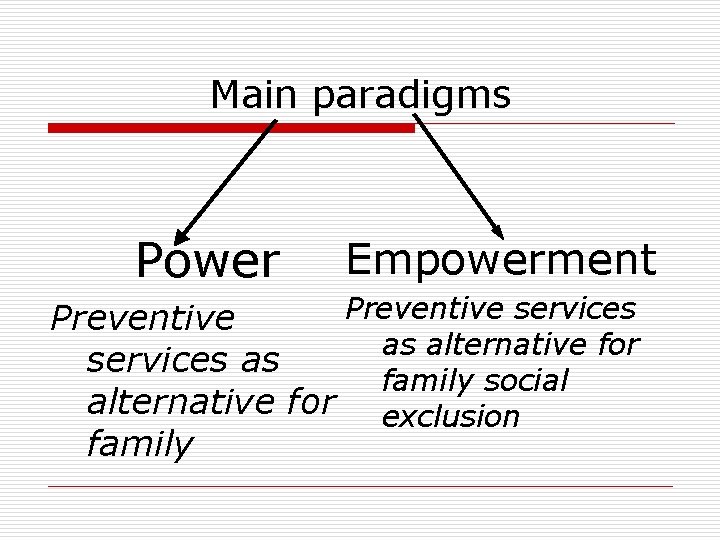
Main paradigms Power Empowerment Preventive services Preventive as alternative for services as family social alternative for exclusion family
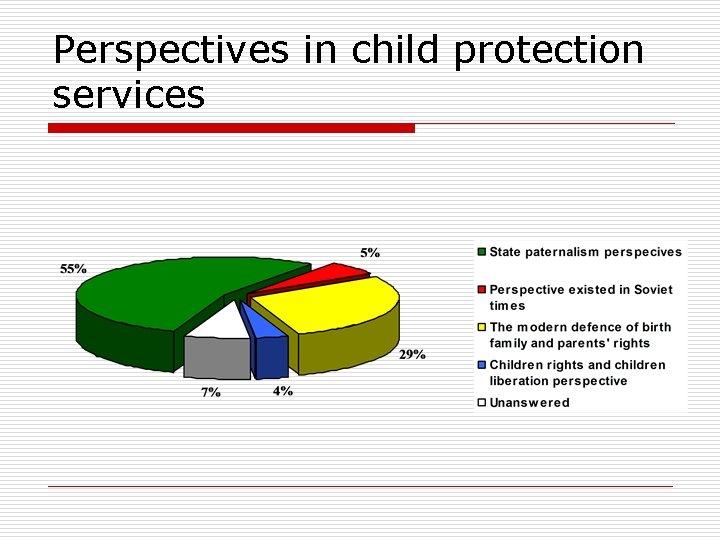
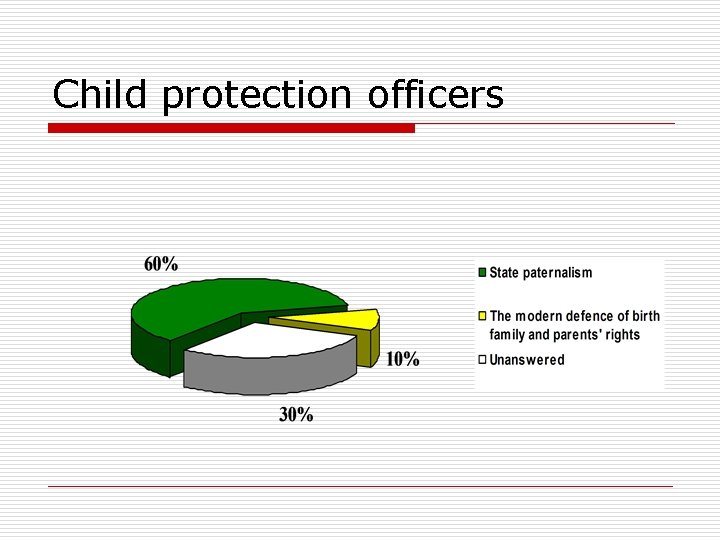
Ways to intervene into family life • State paternalism • Child protection during Soviet times • The modern defence of birth family and parents’ rights
Perspective during period of Soviet Union • • • Care of neglected children was taken over the State which was considered of politics and ideology of Soviet Union. Generation, which was taken into custody, was future communist society, Future communist society was priority of all educational system
Perspective during period of Soviet Union • • • Just at the end would be noted child’s needs, which weren’t individualized. Parents had right and duty to care about their children according morality and values Parental care shouldn’t differ from the ideology and future vision of the State.
Perspective during period of Soviet Union • Special attitude to parents addicted to alcohol • Perception that parental rights can be terminated only then parents can change their behaviour but they are not making efforts.
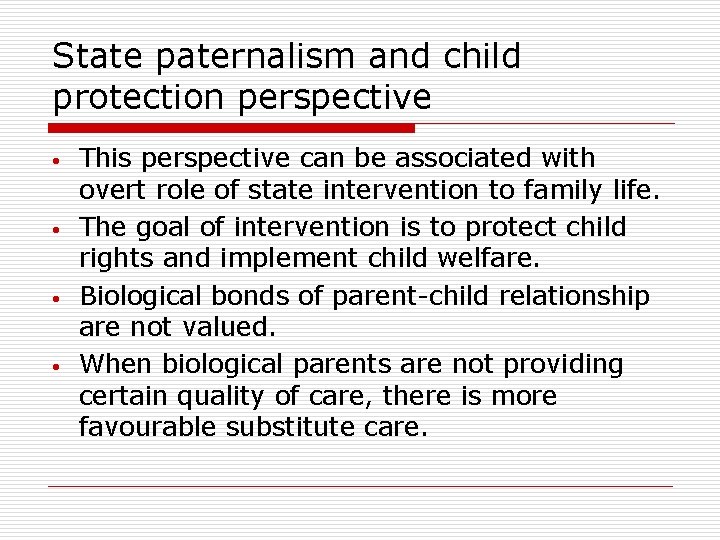
State paternalism and child protection perspective • • This perspective can be associated with overt role of state intervention to family life. The goal of intervention is to protect child rights and implement child welfare. Biological bonds of parent-child relationship are not valued. When biological parents are not providing certain quality of care, there is more favourable substitute care.
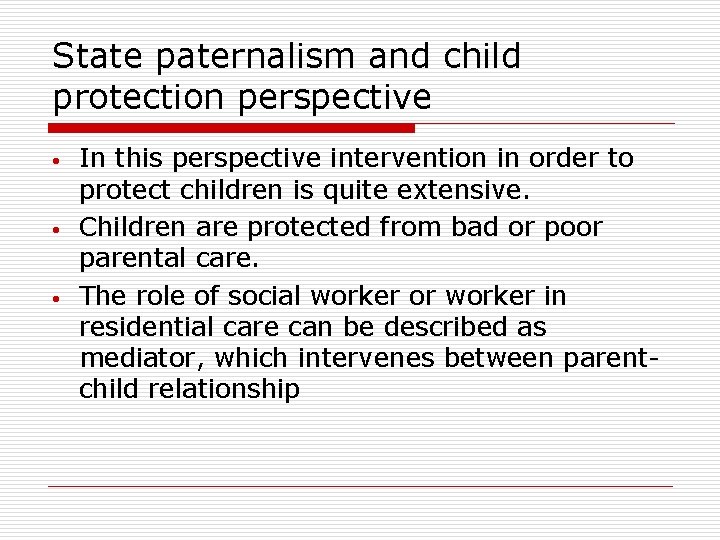
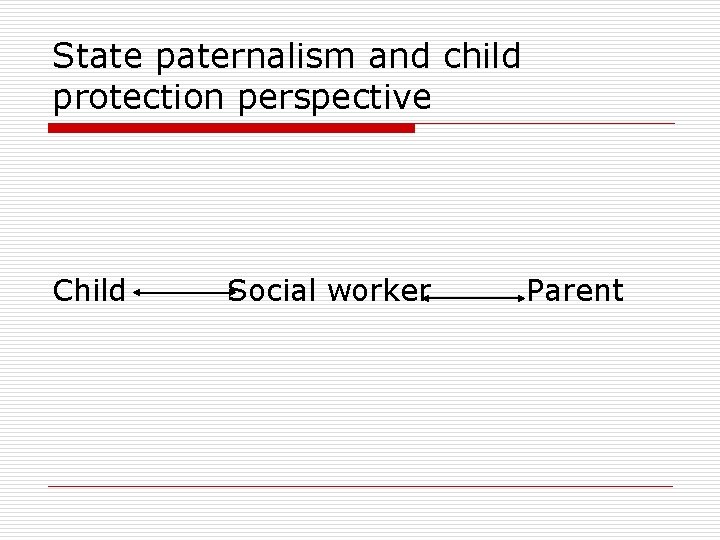
State paternalism and child protection perspective • • • In this perspective intervention in order to protect children is quite extensive. Children are protected from bad or poor parental care. The role of social worker or worker in residential care can be described as mediator, which intervenes between parentchild relationship
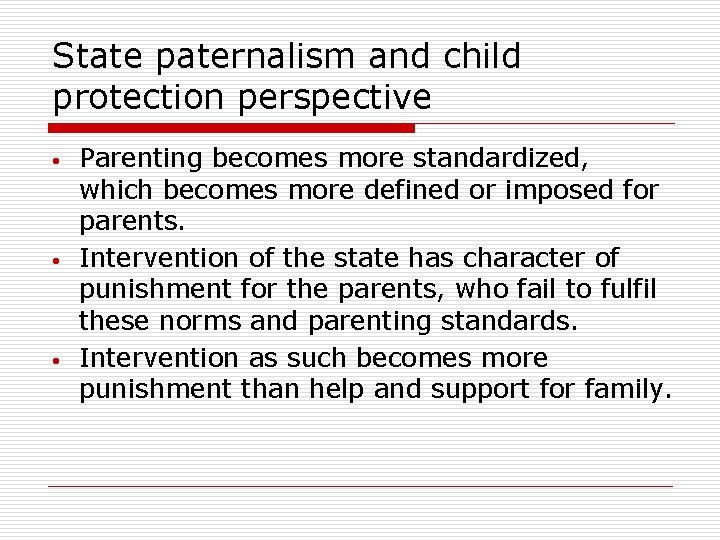
State paternalism and child protection perspective • • • Parenting becomes more standardized, which becomes more defined or imposed for parents. Intervention of the state has character of punishment for the parents, who fail to fulfil these norms and parenting standards. Intervention as such becomes more punishment than help and support for family.
State paternalism and child protection perspective Child Social worker Parent
State paternalism and child protection perspective • • • Workers would intervene family life having notion “if …, then…”. Usually planning intervention into family life, first step would be separate family, placing children to foster care, after as punishment there would be presented requirements for parents, commonly mother, and social support would be prescribed as punishment.
State paternalism and child protection perspective • • • Parents are not participating in decision making. Low priority is given for rights and liberties of parents. There is decided for parents as for children too.
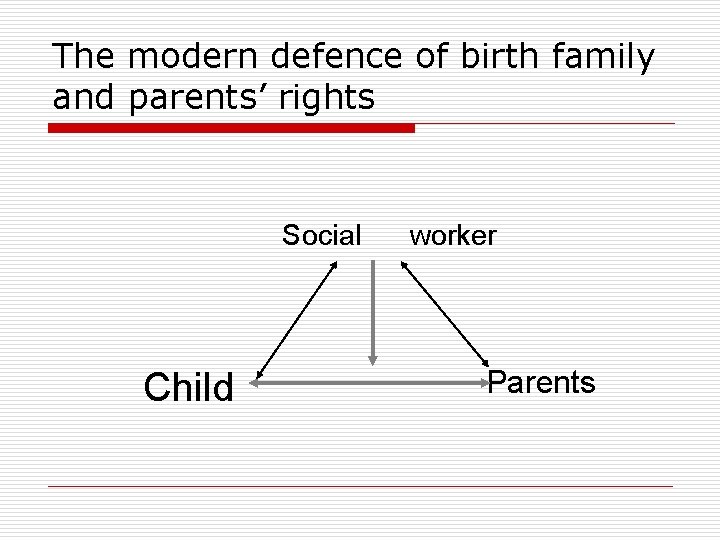
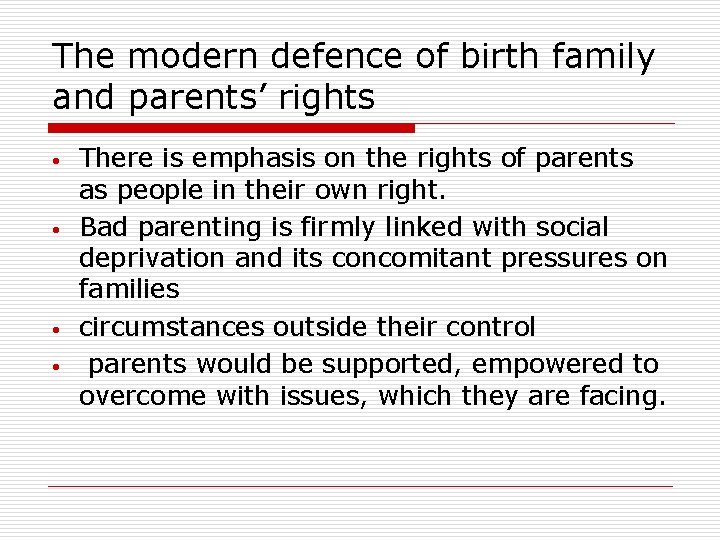
The modern defence of birth family and parents’ rights • • Biological bonds are important for children and for parents and is it possible family should be maintained Bad parenting is linked to oppression of circumstances outside their control Social worker is not the only active participant in helping process Support and strength perspective
The modern defence of birth family and parents’ rights Social Child worker Parents
The modern defence of birth family and parents’ rights • • There is emphasis on the rights of parents as people in their own right. Bad parenting is firmly linked with social deprivation and its concomitant pressures on families circumstances outside their control parents would be supported, empowered to overcome with issues, which they are facing.
Perspectives in child protection services
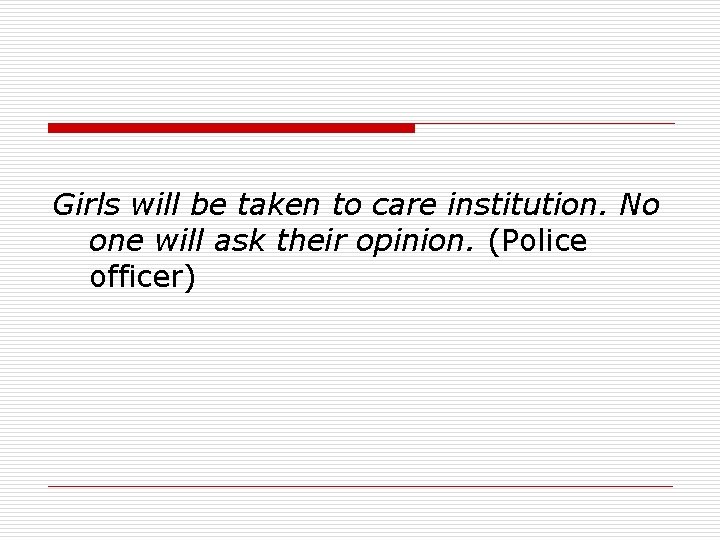
Girls will be taken to care institution. No one will ask their opinion. (Police officer)
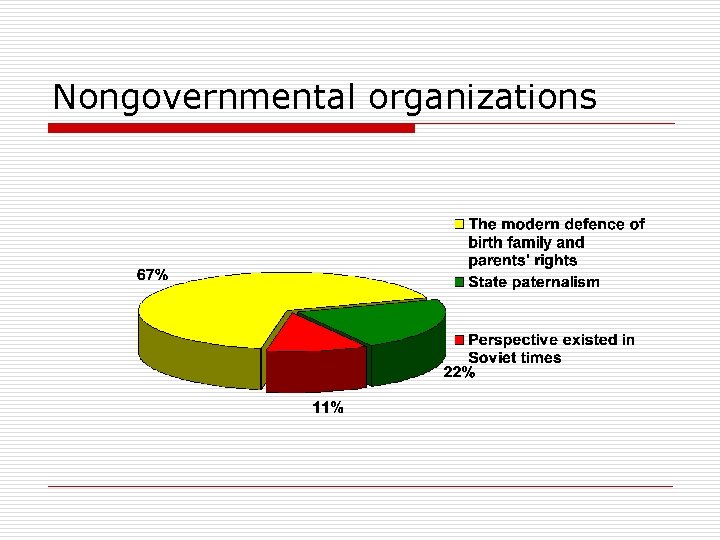
Nongovernmental organizations
Communicating with Lina would be important to reveal as much as it is possible to accept: knowing about ongoing processes and possible processes, that family situcation will change after mother will stop to drink. . . (Social worker in nongovermantal organization)
Child protection officers
There is neet to visit the family house, take a look how they are living, what is real situation (Municipality social worker)
Thank You for attention