EYITT Early Years Initial Teacher Training Graduate Employment
- Slides: 60
EYITT Early Years Initial Teacher Training Graduate Employment Based Programme CPLD day Effective Practice with Toddlers and Young Children 13 th February 2020
Aims • Apply knowledge of reading and rhyme to effective practice and provision with toddlers and young children • Understand the relevance of cultural capital and how young children learn • Explore approaches to reading with toddlers and young children • Review priorities for individual development
Tracy Smith – Deputy Head and Foundations Stage Lead at Leigh Beck Infant Academy Deliver the ETFS specialism for SCITT Previously an AST for Foundation Stage and Phonics 3
Lead Practitioner • Story sacks
Reading • There is a direct correlation between enjoyment of reading and better life chances • Reading supports: Ø Hunger for knowledge Ø Self efficacy Ø Scanning Ø Emotions (self and others i. e. Theory of Mind) • Rhymes, songs and musical games support: Ø Auditory skills Ø Vocabulary
Reading aspirations • By the time they leave you, all children will be able to……. . • What has been your impact?
Impact of quality reading opportunities could include…. . • Every child has an interest in books • They know how books work – how to hold them, pages, running finger under sentences, words etc. • in children’s play, words and phrases are used that originated in a book • Children retell favourite stories • Children tell their own stories, using phrases and hand gestures
Use of rhymes aspirations • By the time they leave you, all children will be able to……. . • What has been your impact?
Impact of quality rhyming opportunities could include…. . • • • Children know a number (plan how many) Children say/sing rhymes unprompted Children use them in their play Children recognise rhyming words and pattern Children make up their own
Planning for reading opportunities • Plan provision of books, stories and rhymes as a journey, otherwise children may not develop a range of knowledge and skills • Involve parents in the journey • Have core books • Principles of choosing books (intent): Ø Books that both adults and children enjoy Ø Books at the correct language level of the children Ø Quality illustrations (they support comprehension of new vocabulary) Ø Books that sound good when read aloud Ø Balance of what’s familiar/novel
Planning the reading journey • Different categories offer different vocabulary: Ø Transport Ø Places Ø Family Ø Jobs Ø Animals/pets Ø Fiction that prompts discussions about emotions/feelings Ø Rhymes Ø Time Ø Weather/seasons Ø Colours/patterns
Reading progression • Pictures and single words • Very short sentences, few words and high levels of repetition with a simple plot • 2 sentences on a page with some description • 2 -3 sentences on a page and new vocabulary • 4 -6 sentences on a page – language and themes are more complex
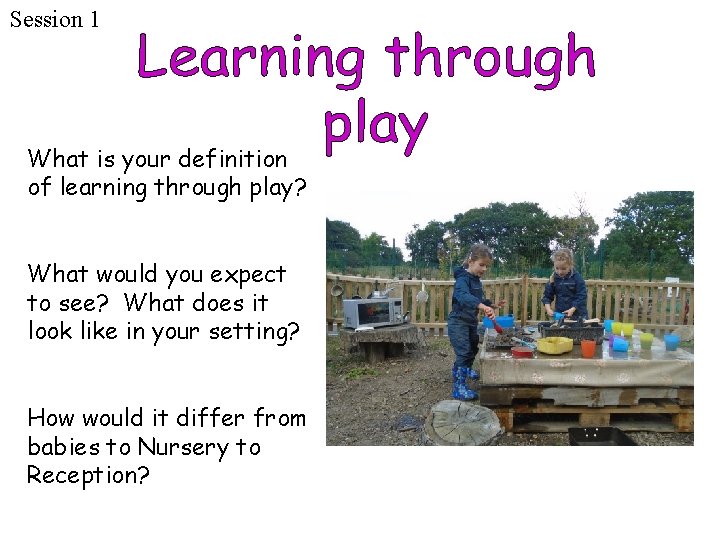
Session 1 What is your definition of learning through play? What would you expect to see? What does it look like in your setting? How would it differ from babies to Nursery to Reception?
Caine’s Arcade Key Points –
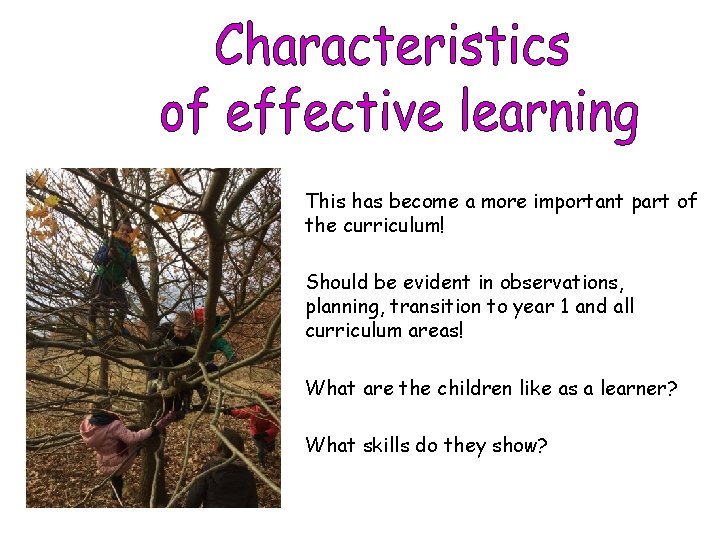
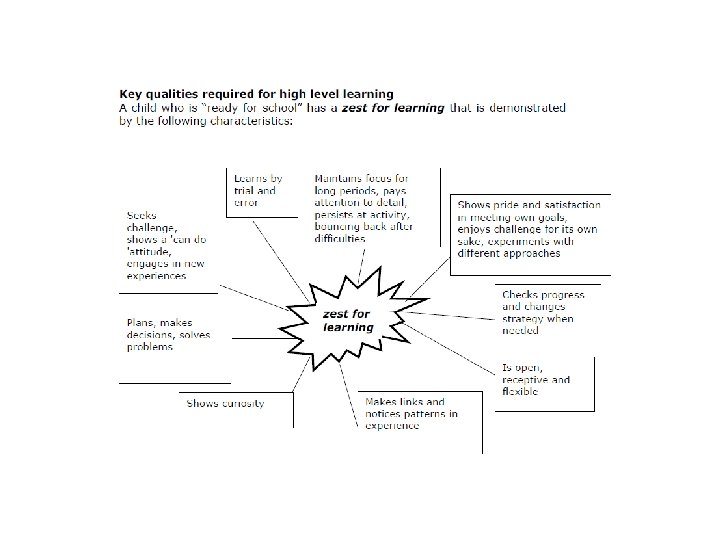
This has become a more important part of the curriculum! Should be evident in observations, planning, transition to year 1 and all curriculum areas! What are the children like as a learner? What skills do they show?
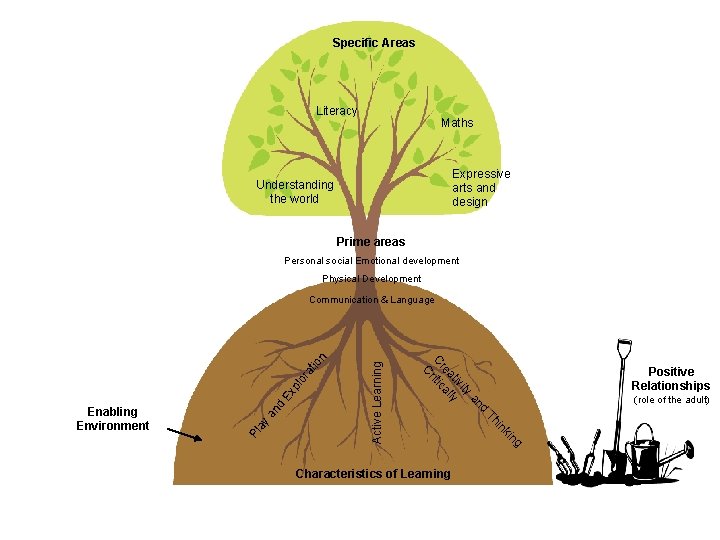
Specific Areas Literacy Maths Expressive arts and design Understanding the world Prime areas Personal social Emotional development Physical Development Active Learning at pl or Ex d an ay Pl (role of the adult) ng Characteristics of Learning Positive Relationships ki in Th Enabling Environment d an ity iv at lly re a C ritic C io n Communication & Language
The completed EYFS profile must include a short commentary i. e. 1 -2 paragraphs on each child’s skills and abilities in relation to the three key characteristics of effective learning. These descriptions must reflect ongoing observations of the child within formative assessment processes and should take account of all the relevant records held by the setting and include information from the child , their parents and other relevant adults 17
Planning for rhymes • 40 -50 before reception • Children who know a wide range have better auditory discrimination • Plan for rhymes across the setting and involve parents • Rhymes support physical development
Implementing rhyme • Use in regular routines • Say, sing and repeat until children join in, including opportunities for children to fill in the gaps • Use range of facial expressions and gestures • Link to transition e. g. s a t p i n before they go into reception
Rhyme categories • • • Finger Action Counting Traditional Modern (e. g. 5 little men in a flying saucer)
Using rhyme • Teaching phonics • Cross-curricular
Continuous provision • Where are the reading opportunities? • How are they audited? • For some children, this may be the only experience of books – do they have opportunities to access at least 4 or 5 each a day? • Research library – what could this look like?
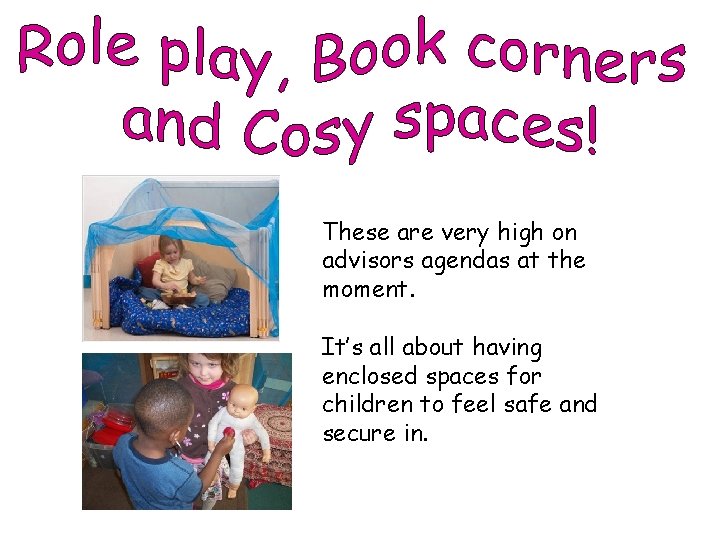
These are very high on advisors agendas at the moment. It’s all about having enclosed spaces for children to feel safe and secure in.
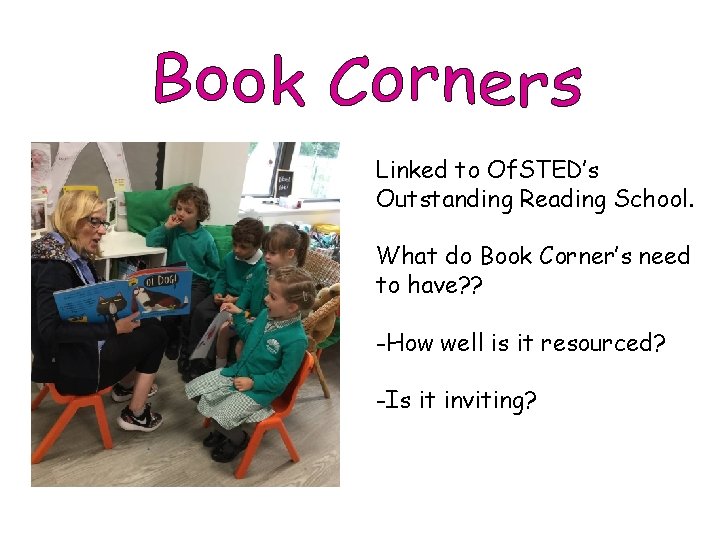
Linked to Of. STED’s Outstanding Reading School. What do Book Corner’s need to have? ? -How well is it resourced? -Is it inviting?
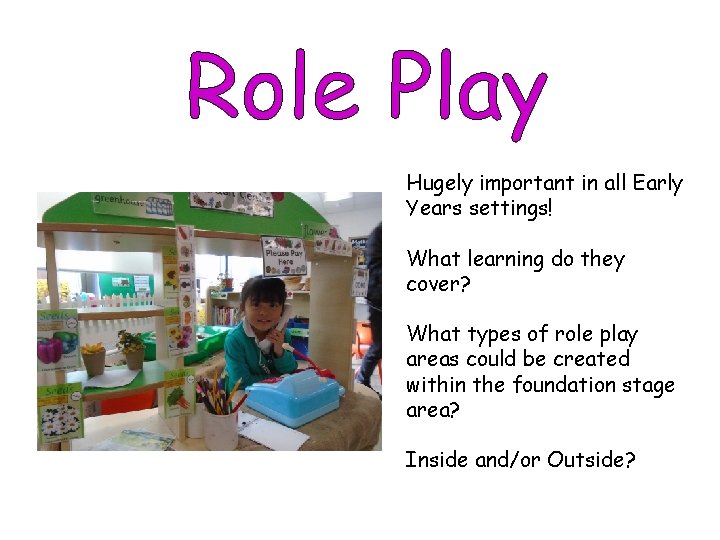
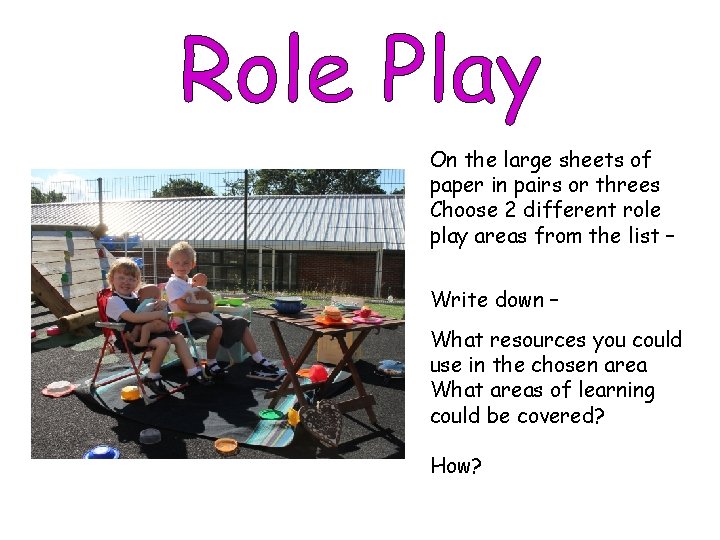
Hugely important in all Early Years settings! What learning do they cover? What types of role play areas could be created within the foundation stage area? Inside and/or Outside?
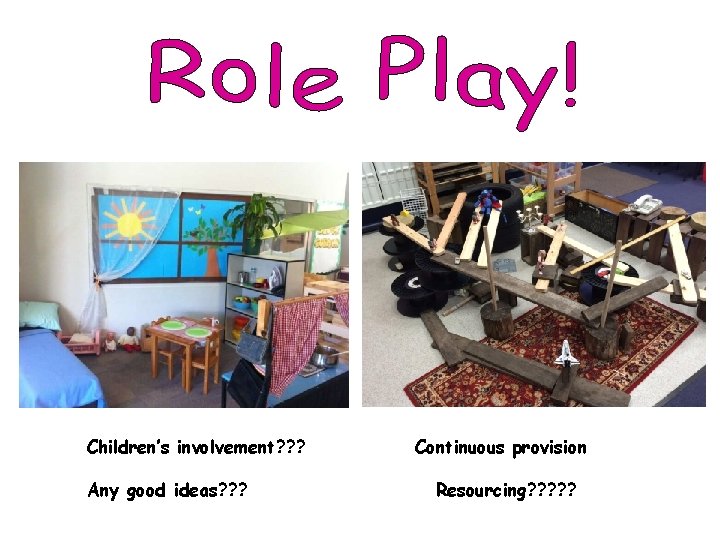
Children’s involvement? ? ? Any good ideas? ? ? Continuous provision Resourcing? ? ?
On the large sheets of paper in pairs or threes Choose 2 different role play areas from the list – Write down – What resources you could use in the chosen area What areas of learning could be covered? How?
Resources wish list What do you think you would need to create spaces like this? Have you seen anything to share?
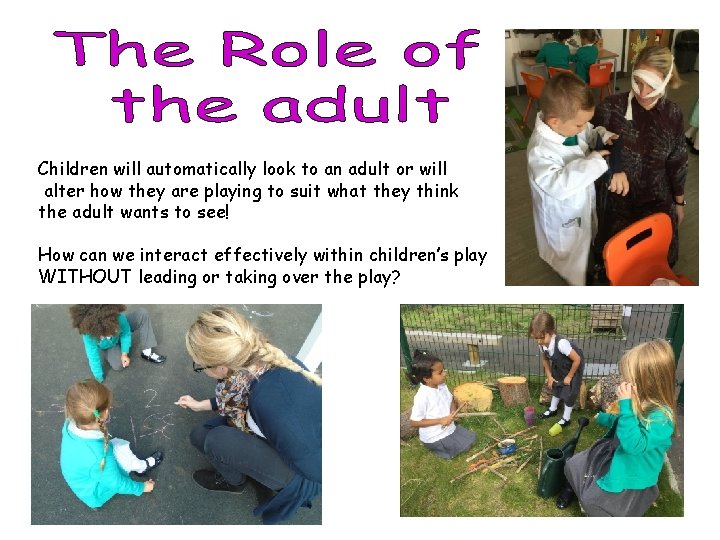
Children will automatically look to an adult or will alter how they are playing to suit what they think the adult wants to see! How can we interact effectively within children’s play WITHOUT leading or taking over the play? 29
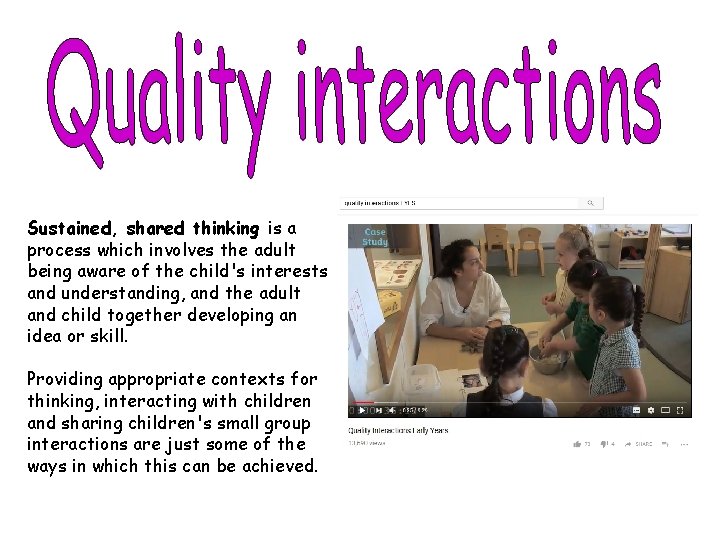
Sustained, shared thinking is a process which involves the adult being aware of the child's interests and understanding, and the adult and child together developing an idea or skill. Providing appropriate contexts for thinking, interacting with children and sharing children's small group interactions are just some of the ways in which this can be achieved.
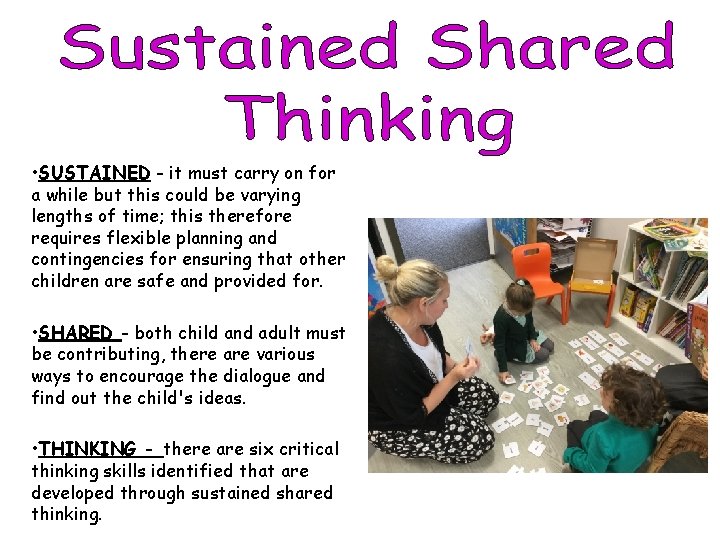
• SUSTAINED - it must carry on for a while but this could be varying lengths of time; this therefore requires flexible planning and contingencies for ensuring that other children are safe and provided for. • SHARED - both child and adult must be contributing, there are various ways to encourage the dialogue and find out the child's ideas. • THINKING - there are six critical thinking skills identified that are developed through sustained shared thinking.
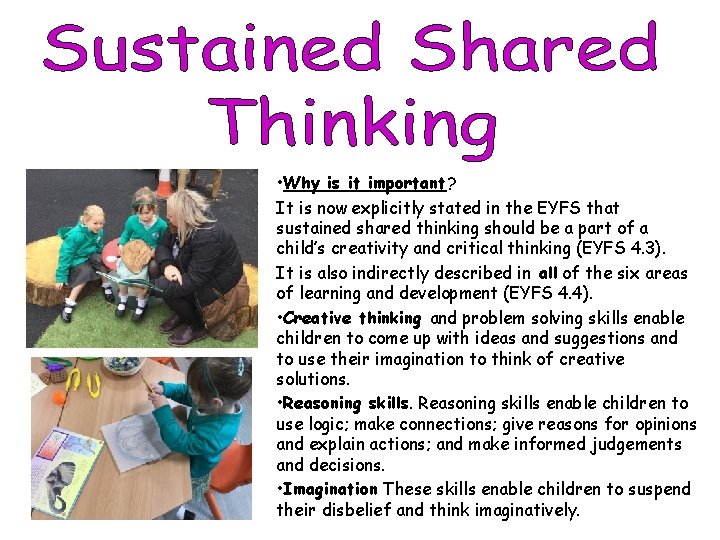
• Why is it important? It is now explicitly stated in the EYFS that sustained shared thinking should be a part of a child’s creativity and critical thinking (EYFS 4. 3). It is also indirectly described in all of the six areas of learning and development (EYFS 4. 4). • Creative thinking and problem solving skills enable children to come up with ideas and suggestions and to use their imagination to think of creative solutions. • Reasoning skills enable children to use logic; make connections; give reasons for opinions and explain actions; and make informed judgements and decisions. • Imagination These skills enable children to suspend their disbelief and think imaginatively.
Because there a lot of speech and language problems now and children have a smaller spoken vocabulary there a few projects been set up to support teachers and parents! ICAN – training, support and activities for practitioners and parents www. ican. org. uk ECAT – Every Child a Talker – Essex CC run program TLC – Talk Listen Cuddle – workshops and story mornings across the county! Search for them on Facebook! http: //www. essex. gov. uk/Education-Schools/Early-Years. Childcare/TLC/Pages/Default. aspx
“It may seem an obvious thing to say but one of the best things we can do with young children is to have interesting and enjoyable conversations with them. . . as we go about our activities, whether at home or at nursery, pre-schools, playgrounds, the child-minding situation, or out and about. We should make a special effort to answer children’s questions, point out things that interest us, involve children. . . ” Michael Rosen, author of We’re Going On A Bear Hunt.
Plays a vital role within the whole of the Foundation Stage (as well as the rest of the curriculum!) Children need to have a firm and clear grounding for speech and language as well as an increasing vocabulary which children are coming into school with less and less! It is easier to sit in front of the TV rather than talking to our children and prams don’t help either!!!!
Telling stories • Children enjoy adults telling a story • Story can be based on real experiences of the adult, child, what’s happening in the setting • Stories occur in patterns of 3: Ø Repeated 3 words: jump, jump Ø Repeated actions: he looked in the cupboard, it wasn’t there; he looked in the box, it wasn’t there, he looked under the bed, it wasn’t there Ø Beginning, middle, end
Story kebabs are a way of giving children some resources to use to create their own story from the props that are included! Need to be used with a story structure Katrice Horsely is the current story telling Laureate and has developed a story structure to help people to tell a story. Lets have a go!
These can be extended into story boxes with more resources given children a greater choice of objects and language to include in their stories! These are ours! Please feel free to have a look through!!
Story telling is becoming a dying art! Children are not coming into school with a knowledge of familiar stories and are not able to tell a story at all! Story telling needs to be included every day in the classroom! To build upon the familiar stories that we need to be telling children it is important to encourage and extend their own vocabulary and story telling ability!
Telling stories – your turn • In your group, use the story telling ribbon/story mountain
Helicopter stories • In its simplest form, Helicopter Stories lets children dictate their stories which are written down verbatim, exactly as they are told, by an EYFS or Key Stage 1 practitioner. The children then gather around a taped out stage and the stories are acted out. (www. makebelievearts. co. uk) • https: //youtu. be/t 6 t. E 90 -TOSk
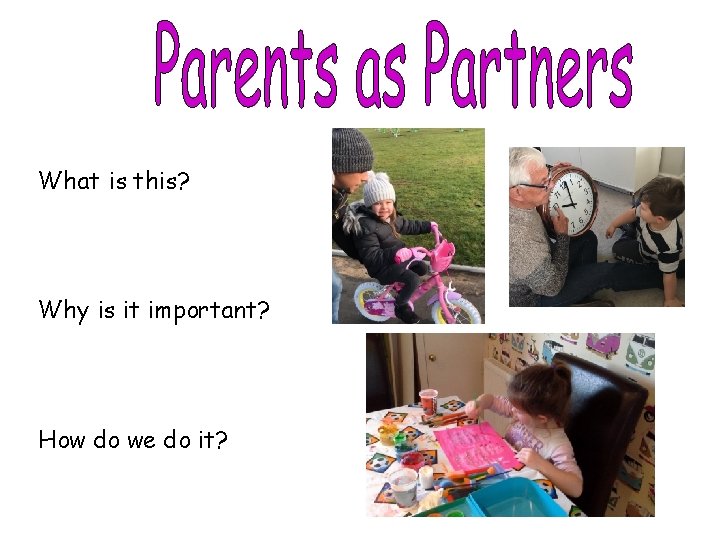
What is this? Why is it important? How do we do it?
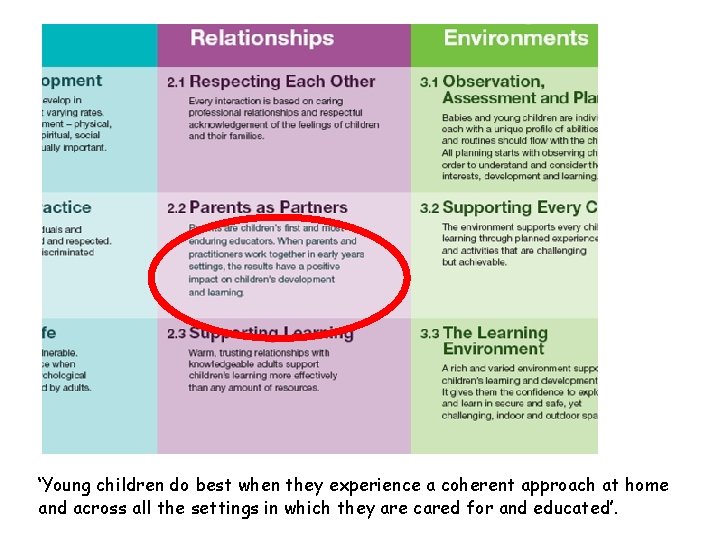
‘Young children do best when they experience a coherent approach at home and across all the settings in which they are cared for and educated’.
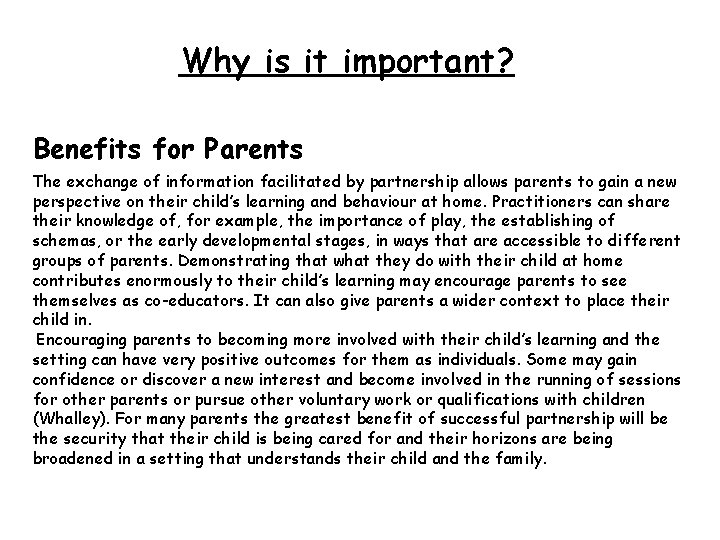
Why is it important? Benefits for Parents The exchange of information facilitated by partnership allows parents to gain a new perspective on their child’s learning and behaviour at home. Practitioners can share their knowledge of, for example, the importance of play, the establishing of schemas, or the early developmental stages, in ways that are accessible to different groups of parents. Demonstrating that what they do with their child at home contributes enormously to their child’s learning may encourage parents to see themselves as co-educators. It can also give parents a wider context to place their child in. Encouraging parents to becoming more involved with their child’s learning and the setting can have very positive outcomes for them as individuals. Some may gain confidence or discover a new interest and become involved in the running of sessions for other parents or pursue other voluntary work or qualifications with children (Whalley). For many parents the greatest benefit of successful partnership will be the security that their child is being cared for and their horizons are being broadened in a setting that understands their child and the family.
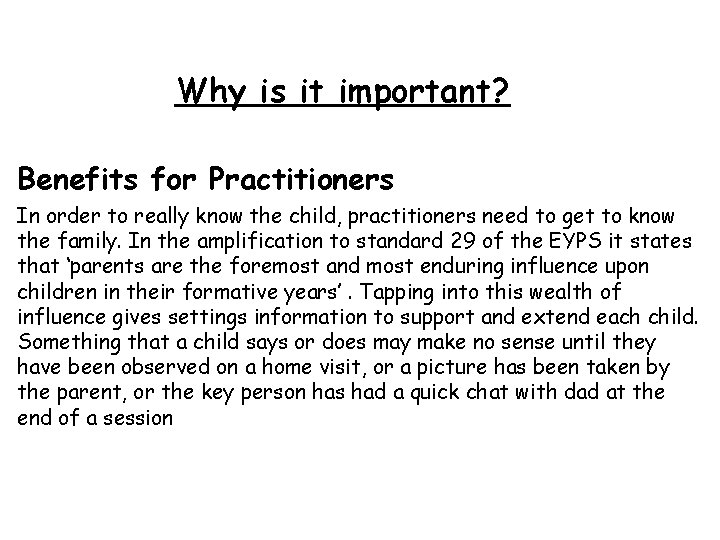
Why is it important? Benefits for Practitioners In order to really know the child, practitioners need to get to know the family. In the amplification to standard 29 of the EYPS it states that ‘parents are the foremost and most enduring influence upon children in their formative years’. Tapping into this wealth of influence gives settings information to support and extend each child. Something that a child says or does may make no sense until they have been observed on a home visit, or a picture has been taken by the parent, or the key person has had a quick chat with dad at the end of a session
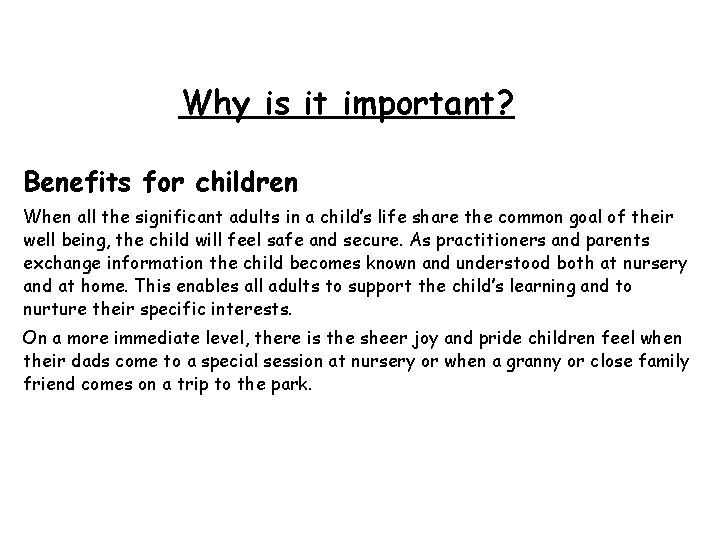
Why is it important? Benefits for children When all the significant adults in a child’s life share the common goal of their well being, the child will feel safe and secure. As practitioners and parents exchange information the child becomes known and understood both at nursery and at home. This enables all adults to support the child’s learning and to nurture their specific interests. On a more immediate level, there is the sheer joy and pride children feel when their dads come to a special session at nursery or when a granny or close family friend comes on a trip to the park.
How do we do it? Building partnership with parents has positive outcomes for all. Even the simple exchange of smiles and friendly conversation will create a relaxed and respectful atmosphere. But it takes time to establish real and equal partnership, and for this settings need to focus on diversity, inclusion and flexibility. After building initial ties between parents and practitioners, settings need to find ways of sustaining parental involvement in their child's learning and in the setting. Continuing to make time for parents is extremely important, including daily opportunities for a quick chat at the beginning and end of sessions. More formal meetings with parents should also be organised at regular intervals to review and plan a child's learning programme together.
What does this look like? What have you seen in your placement? What else could you do? Have a chat about it!!
What does this mean to you? Have a chat!! The revised EYFS refers to “school readiness” as supporting children to be ready for the opportunities available to them in Year 1. For practitioners in the Early Years Foundation Stage, including those in reception classes, it is important to consider the notion of children’s readiness for the next phase of their learning journey.
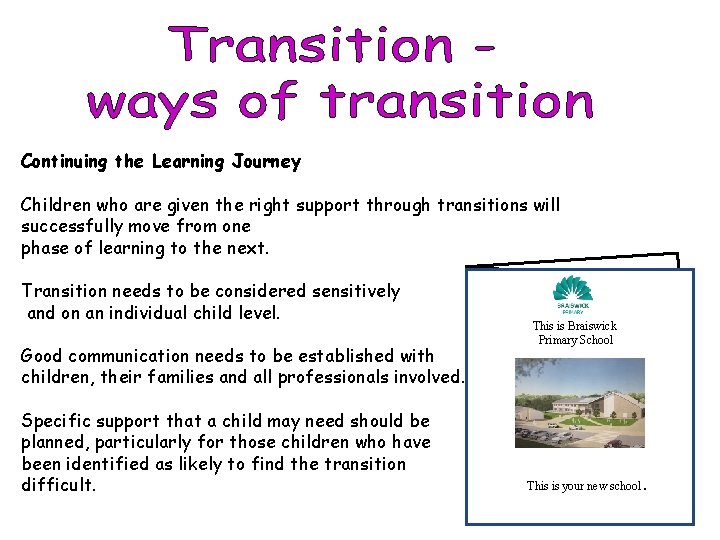
Continuing the Learning Journey Children who are given the right support through transitions will successfully move from one phase of learning to the next. Transition needs to be considered sensitively and on an individual child level. Good communication needs to be established with children, their families and all professionals involved. Specific support that a child may need should be planned, particularly for those children who have been identified as likely to find the transition difficult. This is Braiswick Primary School T new school This is your .
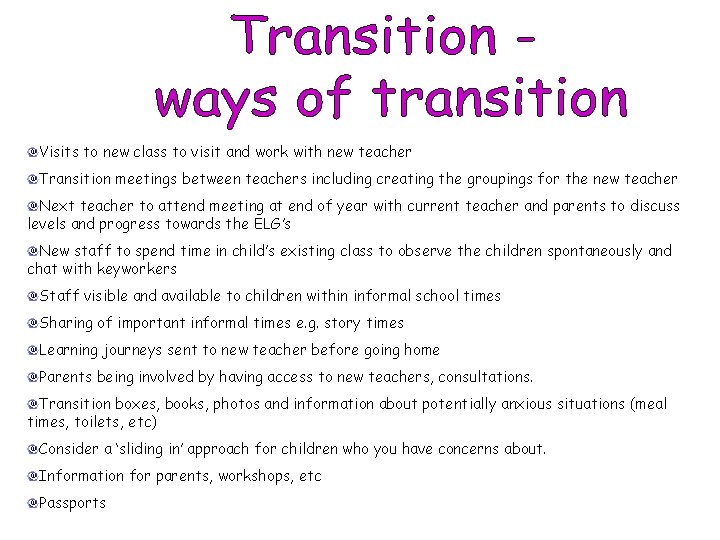
Visits to new class to visit and work with new teacher Transition meetings between teachers including creating the groupings for the new teacher Next teacher to attend meeting at end of year with current teacher and parents to discuss levels and progress towards the ELG’s New staff to spend time in child’s existing class to observe the children spontaneously and chat with keyworkers Staff visible and available to children within informal school times Sharing of important informal times e. g. story times Learning journeys sent to new teacher before going home Parents being involved by having access to new teachers, consultations. Transition boxes, books, photos and information about potentially anxious situations (meal times, toilets, etc) Consider a ‘sliding in’ approach for children who you have concerns about. Information for parents, workshops, etc Passports
Transition boxes Share your transition box with someone within the group. What did you learn about that person? What are the benefits? What are the pitfalls?
Cultural capital for young children • Ofsted’s definition (2019): Ø ‘It is essential knowledge that pupils need to be educated citizens, introducing them to the best that has been thought and said and helping to engender an appreciation of human creativity and achievement’
3 forms of capital • Economic + cultural (knowledge, skills, education = symbolic (aggregate culmination of resources that symbolise social status)
Origin of cultural capital • Sociologist Pierre Bourdieu: Ø (Habitus (dispositions) x Capital (something you can trade)) + Field = Practice Ø ‘Capital is something that is accumulated over time and can be exchanged in order to benefit your life in some way. The accumulation of capital begins as soon as child is born. The greater the investment a parent can make towards their child’s learning and development, then the more likely they are to be school ready’ Dr. Jo Basford (2019)
Funds of knowledge • Sociocultural perspective of learning • ‘Funds of knowledge are bodies of knowledge related to information, skills and strategies which underlie household functioning, development and well-being’ • How do you currently approach this? Dr. Jo Basford (2019)
Ofsted questions • What do settings do to ensure children experience the awe and wonder of the world in which they live through the seven areas of learning and development? • How do they decide what children in their setting need to learn?
References • Penny Tussoni, Reading and progression, Nurseryworld show 2020 • Dr. Jo Basford, Cultural capital: making it meaningful for young children, Nurseryworld show 2020 • Helicopter Stories www. makebelievearts. co. uk
Final Thought: • “Let children be children. A skilled five year old grows from a busy four year old, a curious three year old, a cuddled two year old, an adventurous one year old and a communicative baby. “ • Quote by Jennie Lindon.