InService Teacher Training Assessment in IGCSE English as
- Slides: 22
In-Service Teacher Training Assessment in IGCSE English as a Second Language 0510 Session 2: Question papers and mark schemes
www. cie. org. uk Welcome • Introductions • Background • Aim of training
www. cie. org. uk Session 2 looks at: Summative assessment • The construction of question papers and mark schemes • Analysis of question papers • Grade descriptions • Recent candidate scripts • Creating suitable summative exercises and mark schemes
www. cie. org. uk What is summative assessment? Summative assessment might be: • A means to place students in rank order • External to the teaching and learning situation • Regarded as an objective way of recording achievement • The pressure under which teachers work • Seen as the ‘end’ of a course of learning
www. cie. org. uk How question papers are set • • • Using Assessment Objectives Levels of difficulty Mark schemes
www. cie. org. uk Question papers (1): Reading - Locating specific information • • • Timetables and signs Newspaper advertisements Collecting and analysing brochures
www. cie. org. uk Question papers (2): Reading - Locating more detailed information • • • Factual/informative articles Newspaper and magazine articles Articles which include a visual display - e. g. graph, chart, diagram
www. cie. org. uk Question papers (3): Reading and writing as an integrated skill • • Filling out a form (Core level only) Making notes (Extended level only
www. cie. org. uk Question papers (4): Reading and writing – writing a summary • • • Analyse summaries to recognise similarities Convert a set of notes to a summary Practise the language of summaries Encourage use of own words Discourage the ‘note-taking’ approach
www. cie. org. uk Question papers (5): Extended writing Descriptive/personal writing • • • Writing letters Recording personal feelings, opinions Describing events, places, people Semi-formal style and register Audience is always given
www. cie. org. uk Question papers (6): Extended writing Using language for a specific purpose [Only required on Paper 2, for Extended candidates] • • Of a more formal style/register Often deals with an issue open to debate, e. g. to persuade, to comment upon, to state own point of view, to consider a variety of others’ views Higher level concepts are introduced Same mark scheme/criteria as first task(s)
www. cie. org. uk Question papers (7): Listening for specific information in short statements • • • Factual detail presented Often in the form of announcements, e. g. at railway stations, airports, etc. News reports, weather reports, travel reports Understanding directions Recognising numbers, amounts, currency
www. cie. org. uk Question papers (8): Listening to longer conversations/interviews • • • Semi-formal interviews are often used Most of the interviews have a topic or theme which is developed ‘Gist’ understanding is also tested - working out the attitudes, opinions and feelings of speakers Gap filling is required for some exercises Core candidates will use true or false tick boxes Extended candidates will answer using sentencelength responses
www. cie. org. uk Question papers (9): Speaking - the Oral Test • • • Topic-based conversation/discussion Includes a 2 -3 minute ‘Warm up’ - not assessed Conversation to last 6 -9 minutes - assessed Examined at the Centre, but moderated by CIE Graded separately - marks NOT part of final letter grade
www. cie. org. uk Question papers (10): Coursework • • • Conduct three different and separate activities throughout the course Try to include group work and pair work - not just individual work Assessed by the teacher/Examiner using the same criteria as for the Oral Test Same procedure applies for sending in samples The only Coursework option for the E 2 L IGCSE course
www. cie. org. uk The Oral Assessment criteria • • • Three criteria: Fluency, Vocabulary and Structure The full grid appears in the syllabus Applies to both the Oral Test and Coursework Teachers/Examiners, in applying the criteria, tend to be lenient more often than they are severe Grade 1 candidates are not expected to be ‘First Language’ users
www. cie. org. uk Grade descriptions (1): Why have grade descriptions? • • To make clear the level of performance required for different grades Help Examiners to set questions of the appropriate difficulty Help teachers assess the level of their students Form a basis for school-based assessment
www. cie. org. uk Grade descriptions (2): Extended Writing criteria – extracts of Grade A • • • Enjoyable to read Few mistakes in grammar, punctuation or spelling Confident use of language, idiom and tenses Sense of audience is well developed Response is entirely relevant The interest of the reader is aroused
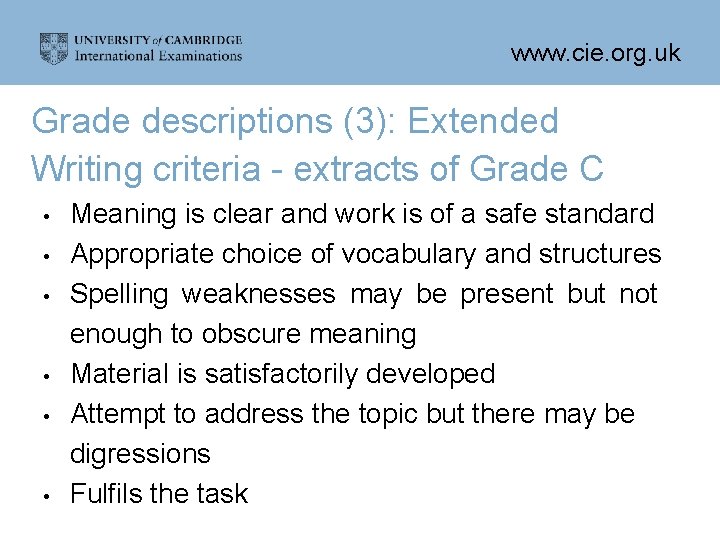
www. cie. org. uk Grade descriptions (3): Extended Writing criteria - extracts of Grade C • • • Meaning is clear and work is of a safe standard Appropriate choice of vocabulary and structures Spelling weaknesses may be present but not enough to obscure meaning Material is satisfactorily developed Attempt to address the topic but there may be digressions Fulfils the task
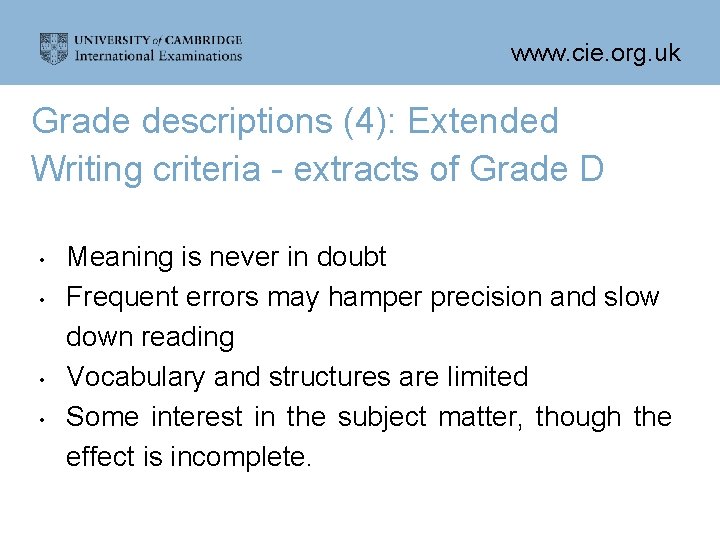
www. cie. org. uk Grade descriptions (4): Extended Writing criteria - extracts of Grade D • • Meaning is never in doubt Frequent errors may hamper precision and slow down reading Vocabulary and structures are limited Some interest in the subject matter, though the effect is incomplete.
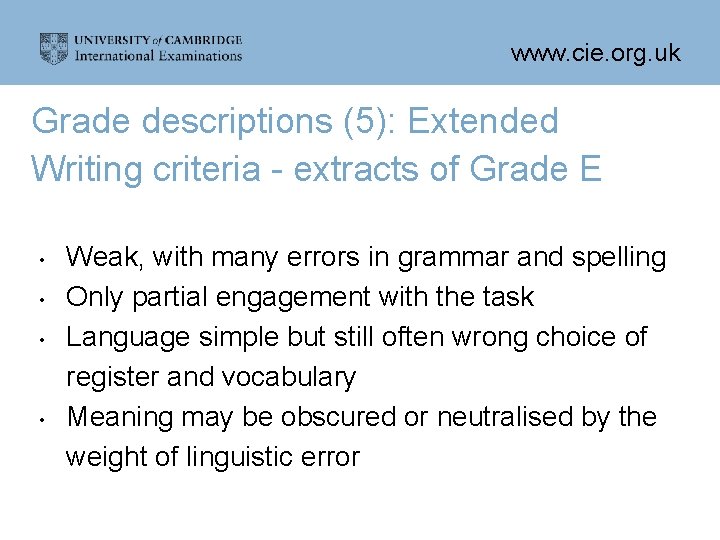
www. cie. org. uk Grade descriptions (5): Extended Writing criteria - extracts of Grade E • • Weak, with many errors in grammar and spelling Only partial engagement with the task Language simple but still often wrong choice of register and vocabulary Meaning may be obscured or neutralised by the weight of linguistic error
Closing comments