Executive WHAT Introduction to Executive Functioning and ASD


- Slides: 38
Executive WHAT? !? Introduction to Executive Functioning and ASD Presented by: Tara Maltby, M. Ed. Alaska Autism Resource Center/SESA
Quick Facts… What We Know…. .
Quick Fact # 1 Autism is a Neurological Disorder This means that the brain of a person with autism works differently than the brain of someone who does not have autism. ASD is present at a very young age. However, ASD is not always identified at a young age in students with High Functioning ASD.
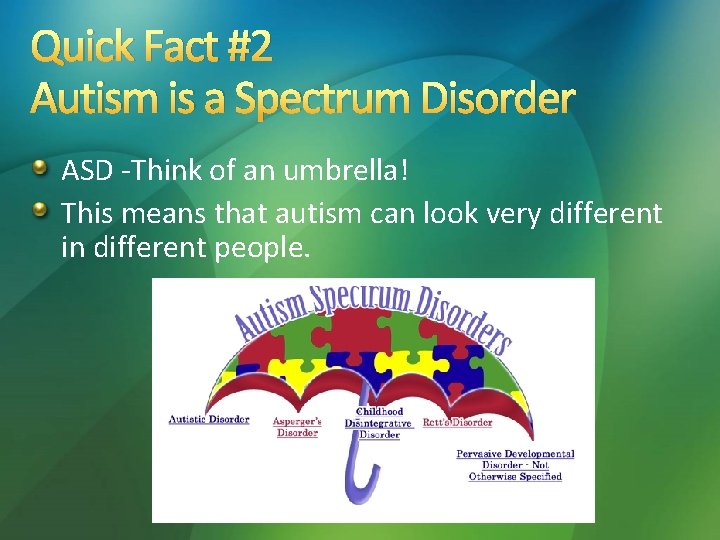
Quick Fact #2 Autism is a Spectrum Disorder ASD -Think of an umbrella! This means that autism can look very different in different people.
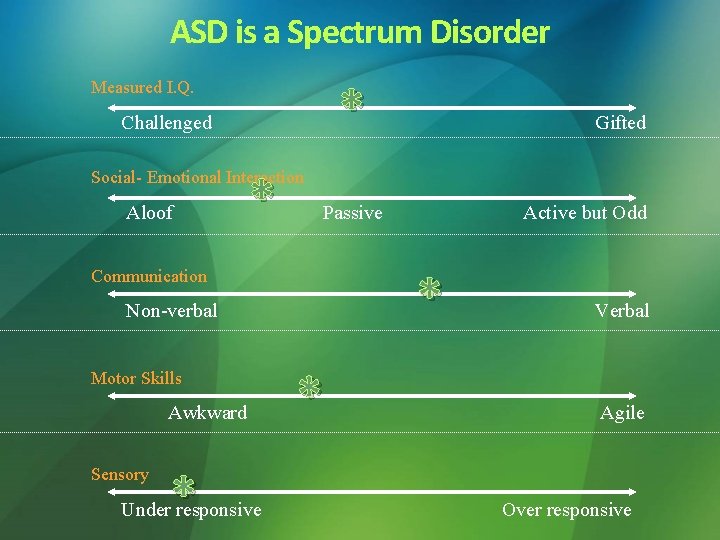
ASD is a Spectrum Disorder * Measured I. Q. Challenged * Gifted Social- Emotional Interaction Aloof Passive * Communication Non-verbal Motor Skills Awkward Sensory * Under responsive Active but Odd * Verbal Agile Over responsive
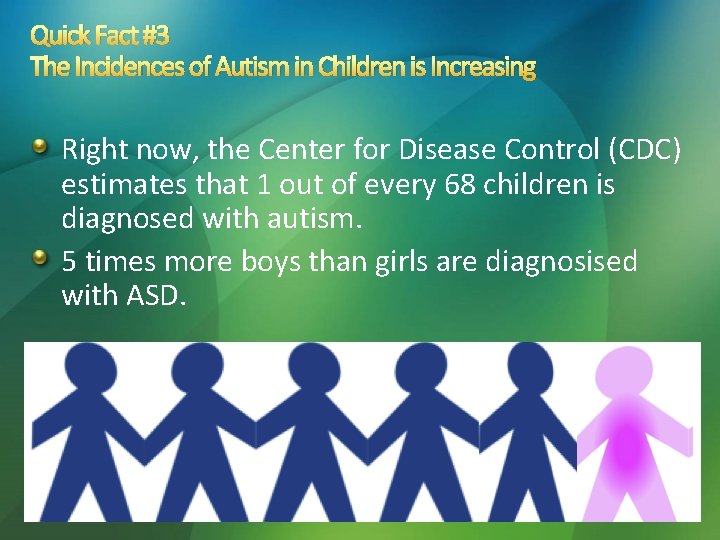
Quick Fact #3 The Incidences of Autism in Children is Increasing Right now, the Center for Disease Control (CDC) estimates that 1 out of every 68 children is diagnosed with autism. 5 times more boys than girls are diagnosised with ASD.
What We Know…Diagnosis There is no blood test, genetic test, or other physical test to identify children with ASD. Diagnosis is made by identifying a set of skills deficits and by observation of behaviors.
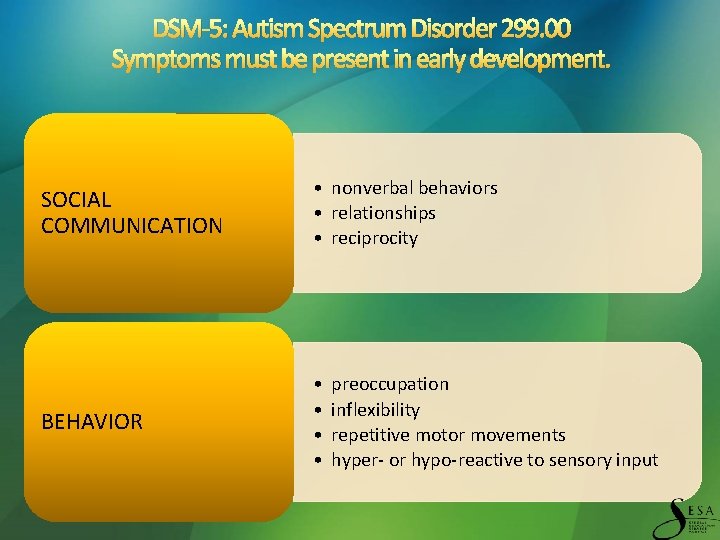
DSM-5: Autism Spectrum Disorder 299. 00 Symptoms must be present in early development. SOCIAL COMMUNICATION • nonverbal behaviors • relationships • reciprocity BEHAVIOR • • preoccupation inflexibility repetitive motor movements hyper- or hypo-reactive to sensory input
CORE Deficits of Autism Communication (Expressive and Receptive) Social Skills Special Interests Special Note: Sensory Issues
What We Know…Cure There is no cure for ASD, but there are things we can do that will help: Early intervention Consistent use of research based therapeutic interventions Specially designed supports in our homes and researchbased instruction in our classrooms
Characteristics of ASD you might see in your home or classroom. Difficulty with conversation and communication. Difficulty making friends and participating in social/group situations. Special Interests that may interfere with attendance to tasks and activities. Unusual behaviors (some maybe quite challenging) Difficulty with organization / Executive Functioning
Difficulty with Communication Vocabulary maybe quite elaborate. Expressive and/or receptive language maybe effected. Pragmatic language Conversation
Social Skills Deficits Difficulty making and keeping friends. Difficulty working in group situations. Perspective taking. Frustration with behavioral expectations.
Special Interests For children with ASD special interests are more than a hobby. Difficulty attending to task… distracted by his or her special interest. Frustration with non-preferred topics. Perspective taking.
Unusual Behaviors Sensory issues Communicative Intent Frustration Taking perspective / Social thinking. Some of these behaviors maybe quite challenging and disruptive to the classroom.
What is Executive Functioning? The executive functions are a set of processes that all have to do with managing oneself and one's resources in order to achieve a goal. It is an umbrella term for the neurologically-based skills involving mental control and selfregulation. ldonline. org
What is Effected By Executive Functioning? Inhibition Shift Emotional Control Initiation Working Memory Planning/Organization
Inhibition The ability to stop one’s own behavior at the appropriate time, including stopping actions and thoughts. The flip side of inhibition is impulsivity; if you have weak ability to stop yourself from acting on your impulses you are “impulsive. ”
Inhibition in the Home & Classroom Transition from a preferred activity to a nonpreferred activity. Making inappropriate comments, possibly at inappropriate times. Leaving an activity (running off) Controlling the impulse to seek sensory input.
Strategies for Inhibition Visual cues for transitions Social Stories
Shift The ability to move freely from one situation to another and to think flexibly in order to respond appropriately to the situation.
Strategies for Shift Visual/audio/gesture cues for transitions. Class schedule (individual or full class) Social stories
Shift In the Home & Classroom: Moving from one activity or one class to another. Change of topic within a class period. Moving attention from one speaker to another. Moving into group work
Emotional Control The ability to modulate emotional responses by bringing rational thought to bear on feelings.
Emotional Control In the Home & Classroom Over reacting or under reacting to situations. Social situations in unstructured settings: hallways, cafeteria, gymnasium, bus, after school, daycare Working in Groups
Strategies for Emotional Control Social Stories Preparation for difficult situations 5 point scale or other numerical plan for reactions and emotions (emotional thermometers or linear scales) Plan for safe places, take 5 spots and calm times to be in hall.
Initiation The ability to begin a task or activity and to independently generate ideas, responses, or problem solving strategies.
Initiation in the Home & Classroom Writing Homework Functional Routines Asking for help or clarification Don’t assume a student has internalized information.
Strategies for Initiation Graphic Organizers Dictate to scribe Planners Social Stories Visual Cue Cards or reminders on how to ask for clarification Task Analysis Visual Supports
Working Memory The capacity to hold information in mind for the purpose of completing a task.
Working Memory In the Home & Classroom: Multi step directions Remembering instructions from school to home. (Homework) Remembering instructions over several days.
Strategies for Working Memory Planners Schedules Hard copy of notes Self Monitor check lists
Planning/Organization The ability to manage current and future oriented tasks on demands.
Planning/Organization In the Home & classroom: Writing Long term assignments Turning in completed work Finding notes and work Working in groups Organizing Room/Personal space
Strategies for Planning and Organization Planners or calendars Hard copy of assignments and class notes Checklists Routines Environmental supports
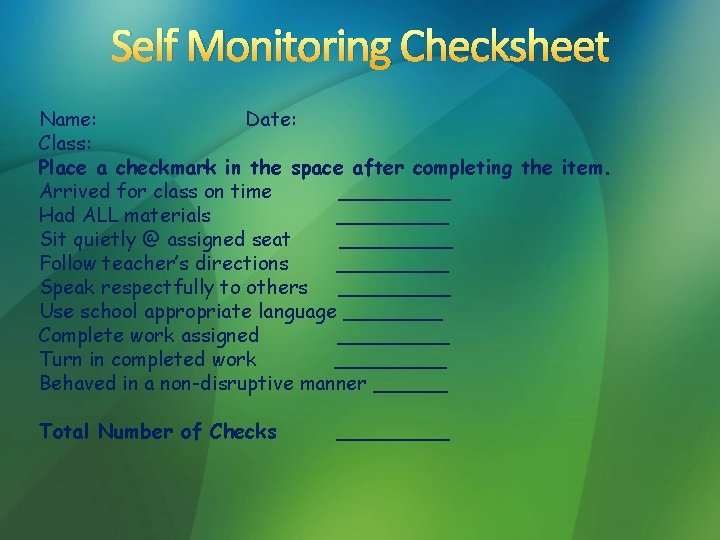
Self Monitoring Checksheet Name: Date: Class: Place a checkmark in the space after completing the item. Arrived for class on time _____ Had ALL materials _____ Sit quietly @ assigned seat _____ Follow teacher’s directions _____ Speak respectfully to others _____ Use school appropriate language ____ Complete work assigned _____ Turn in completed work _____ Behaved in a non-disruptive manner ______ Total Number of Checks _____
What Can Parents & Teachers Do? Recognize that the child has real developmental and learning specific needs. Provide strategies for organization and structure within your assignments… even if you are sure you have already done this. Communicate with eachother.
THANK YOU! Information is the first step towards providing effective instruction and interventions for students with ASD. Alaska Autism Resource Center www. Alaska. ARC. org 907 -334 -1331