EOG REVIEW MATERIAL EARTH HISTORY EVOLUTION ENERGY TRANSFER

- Slides: 51
EOG REVIEW MATERIAL EARTH HISTORY, EVOLUTION, ENERGY TRANSFER, CHEMISTRY, Eboni Newton Ridge Road Middle School eboni. townsend@cms. k 12. nc. us
TEST TAKING STRATEGIES The information that we will cover is all review. You have seen it before. Today we are working on answering higher level thinking questions from past material. Things you need to do. You should be able to answer the questions and provide a justification. Showing justification shows true mastery. 1. Read the question and determine what is it really asking you? Look for key vocabulary words and context clues for words you don’t know. 2. Anticipate an answer prior to reading your selections. 3. Process of elimination. You should be able to cross out of at least 1 This will increase your chances of selecting the correct response. 4. For the correct answer you should be able to justify your answer. 5. If you can’t answer the question skip it and move on to the next. 6. When you are done go back and answer the question you did
LAW OF SUPERPOSITION Law of superposition states that the older layer is on the bottom and the younger is on top. Unconformity- a layer of missing rock caused by erosion (if it takes place) or deposition (if it is not taking place). Deposition- addition/accumulation of new material Erosion – the wearing away of material
According to the Law of Superposition at which dept in a multi-layered rock formation will the oldest rock likely be found? A. 10 m B. 50 m C. 300 m D. 500 m
Which type of dating method can be used on rock layers by applying the law of superposition? A. Relative dating B. Absolute dating C. Radioactive dating D. Radiometic dating
WHICH OF THE FOLLOWING USES LAYERED SEDIMENTARY ROCK TO TELL WHICH EVENTS ON EARTH OCCURRED BEFORE OTHER EVENTS? A. Absolute Age B. Unconformity C. Relative Age D. Plate Tectonics
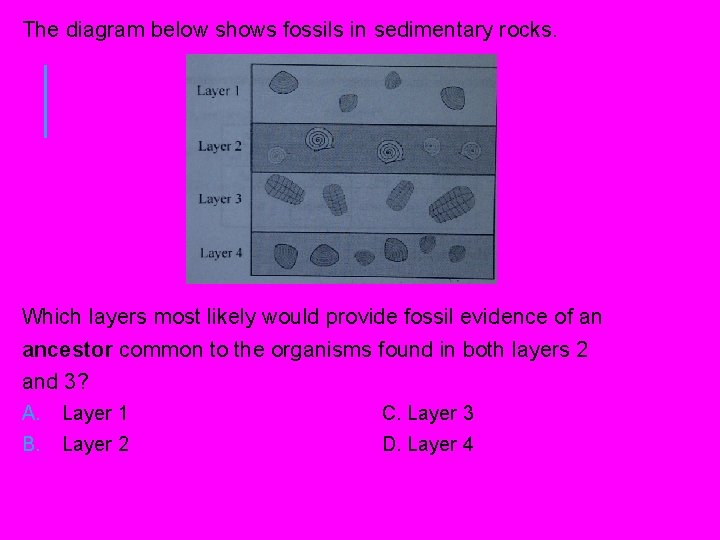
The diagram below shows fossils in sedimentary rocks. Which layers most likely would provide fossil evidence of an ancestor common to the organisms found in both layers 2 and 3? A. Layer 1 C. Layer 3 B. Layer 2 D. Layer 4
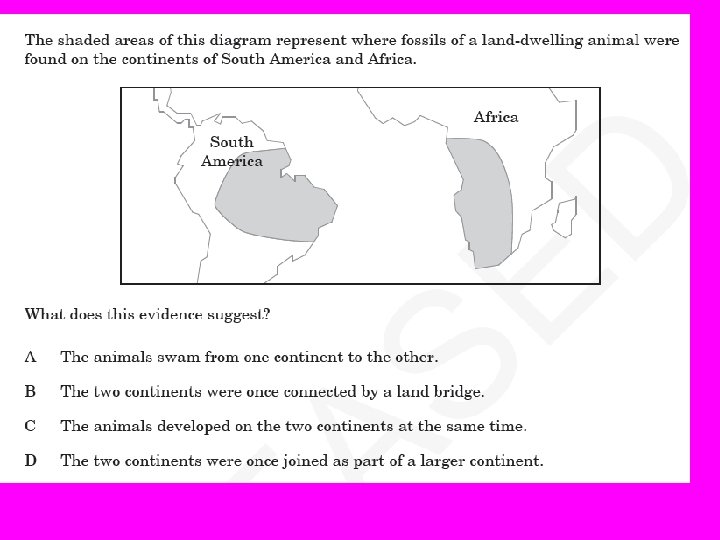
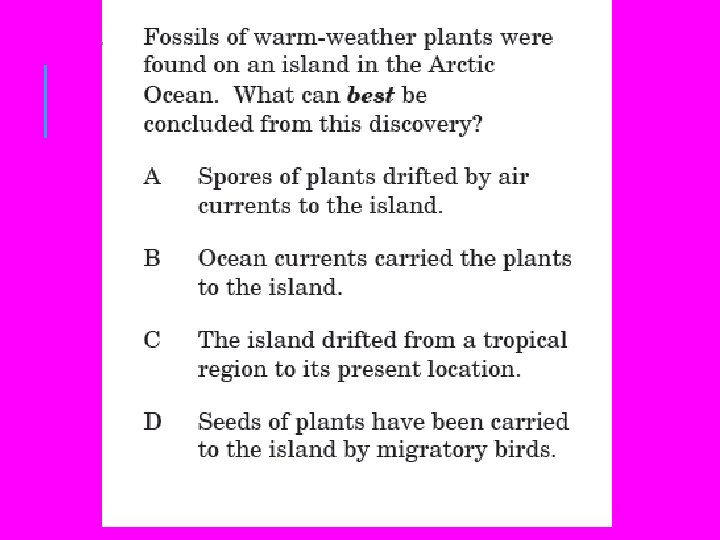
CONTINENTAL DRIFT Evidence : 1. Continents fit like puzzle pieces 2. Identical fossils found on different continents 3. Identical rock sequence (geology) 4. Ancient climate (example topical fossils found on Antarctica) Continents spread apart this theory didn’t explain the forces that moved it but Theory of Plate tectonics did!! Convention currents in the mantle.
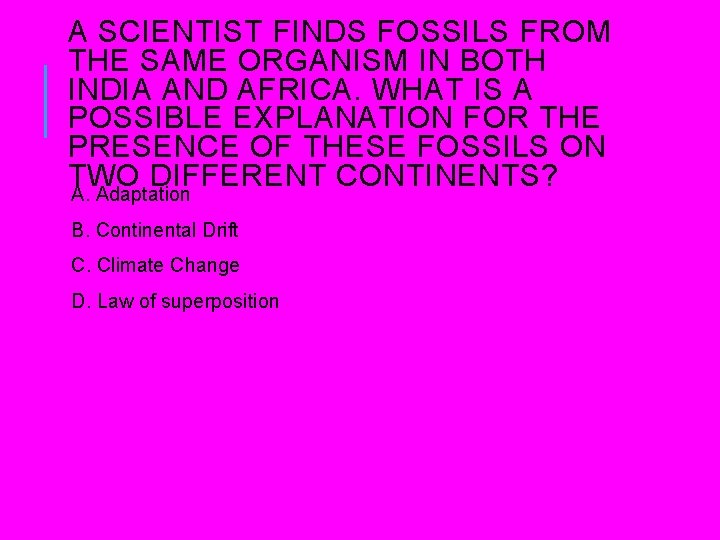
A SCIENTIST FINDS FOSSILS FROM THE SAME ORGANISM IN BOTH INDIA AND AFRICA. WHAT IS A POSSIBLE EXPLANATION FOR THE PRESENCE OF THESE FOSSILS ON TWO DIFFERENT CONTINENTS? A. Adaptation B. Continental Drift C. Climate Change D. Law of superposition
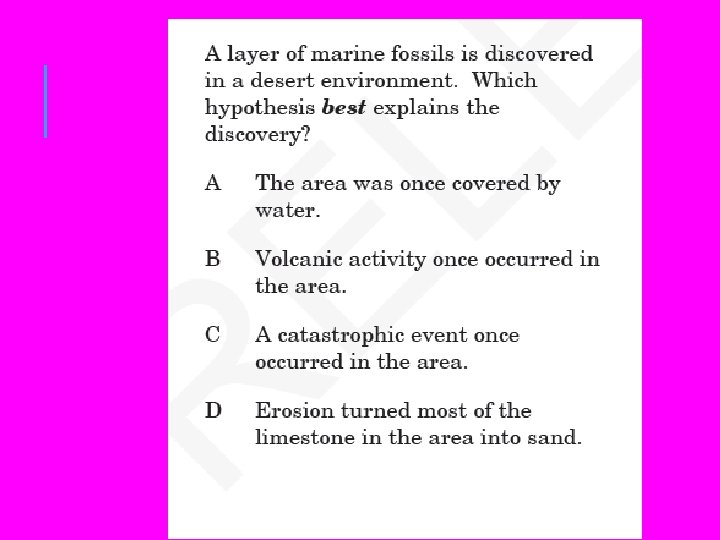
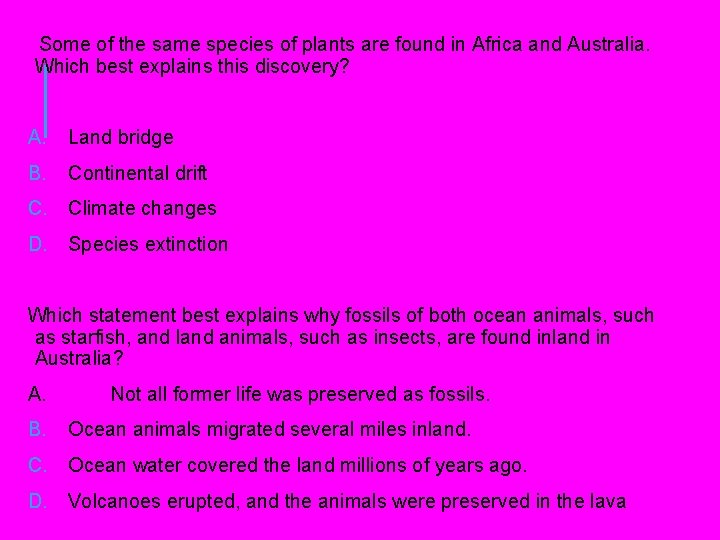
Some of the same species of plants are found in Africa and Australia. Which best explains this discovery? A. Land bridge B. Continental drift C. Climate changes D. Species extinction Which statement best explains why fossils of both ocean animals, such as starfish, and land animals, such as insects, are found inland in Australia? A. B. Not all former life was preserved as fossils. Ocean animals migrated several miles inland. C. Ocean water covered the land millions of years ago. D. Volcanoes erupted, and the animals were preserved in the lava
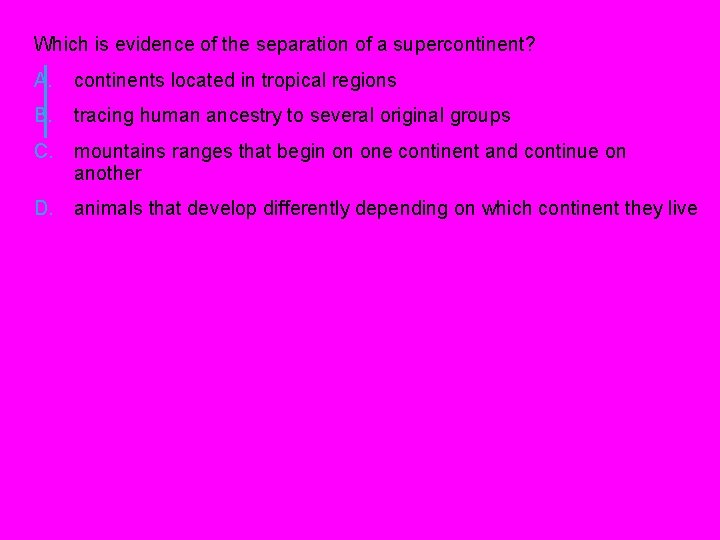
Which is evidence of the separation of a supercontinent? A. continents located in tropical regions B. tracing human ancestry to several original groups C. mountains ranges that begin on one continent and continue on another D. animals that develop differently depending on which continent they live
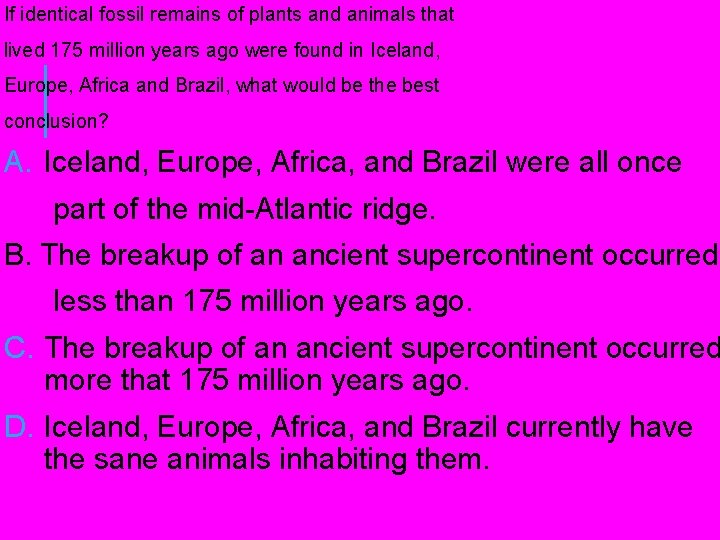
If identical fossil remains of plants and animals that lived 175 million years ago were found in Iceland, Europe, Africa and Brazil, what would be the best conclusion? A. Iceland, Europe, Africa, and Brazil were all once part of the mid-Atlantic ridge. B. The breakup of an ancient supercontinent occurred less than 175 million years ago. C. The breakup of an ancient supercontinent occurred more that 175 million years ago. D. Iceland, Europe, Africa, and Brazil currently have the sane animals inhabiting them.
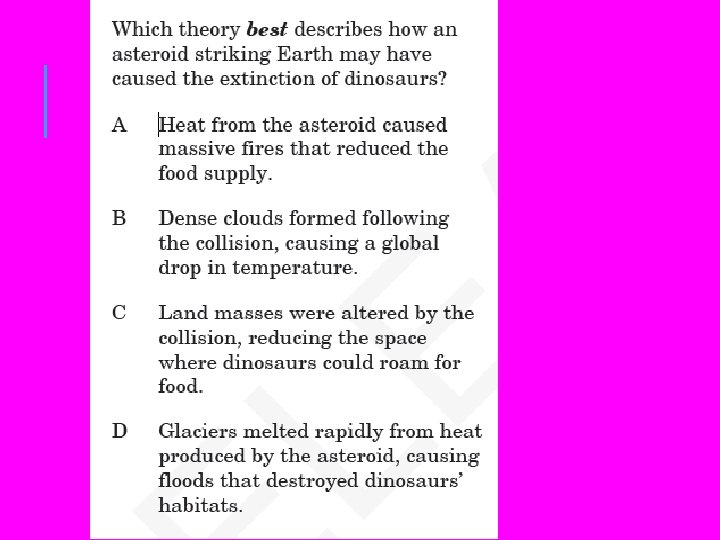
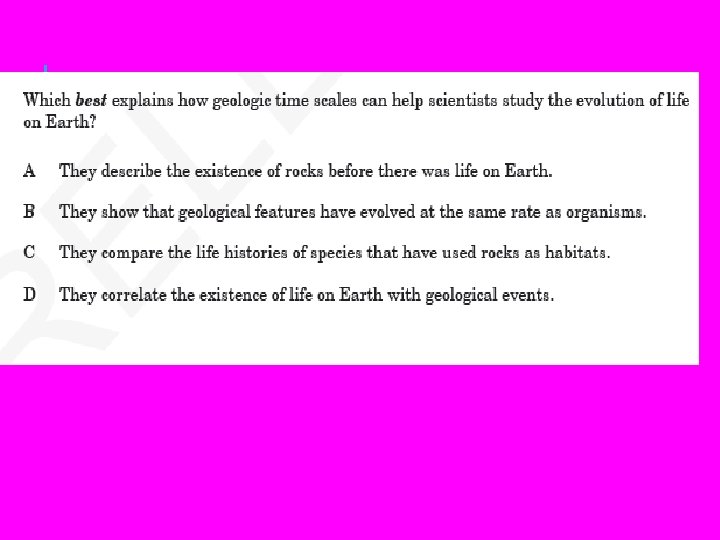
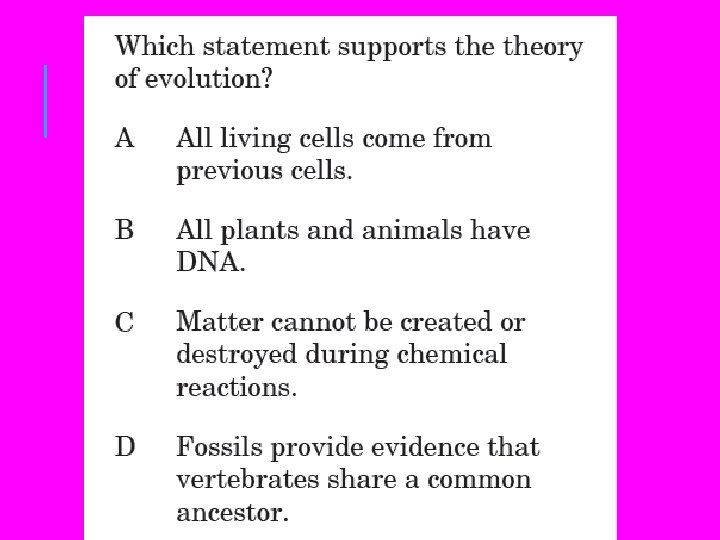
EVOLUTION (MEANS TO CHANGE) The geologic time scale is a record of earth’s history which is categorized by major events (example 1 st form of life). Mass extinction- large amount of organisms die example of events that can cause this are volcanoes and asteroids. Natural selection/adaptation- organism change in response to their environment. (Darwin’s finches their beaks matched what they ate) The greater the diversity the greater the chances are for that species to survive during environmental changes. Those traits that increase survival are passed on from generation to generation.
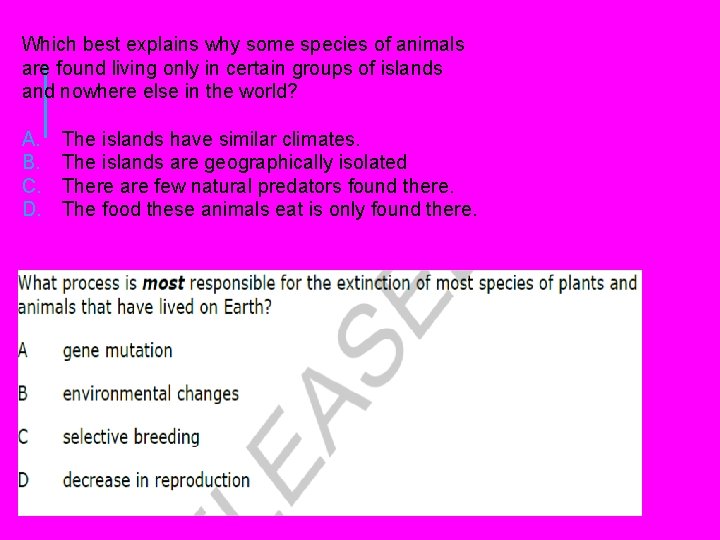
Which best explains why some species of animals are found living only in certain groups of islands and nowhere else in the world? A. B. C. D. The islands have similar climates. The islands are geographically isolated There are few natural predators found there. The food these animals eat is only found there.
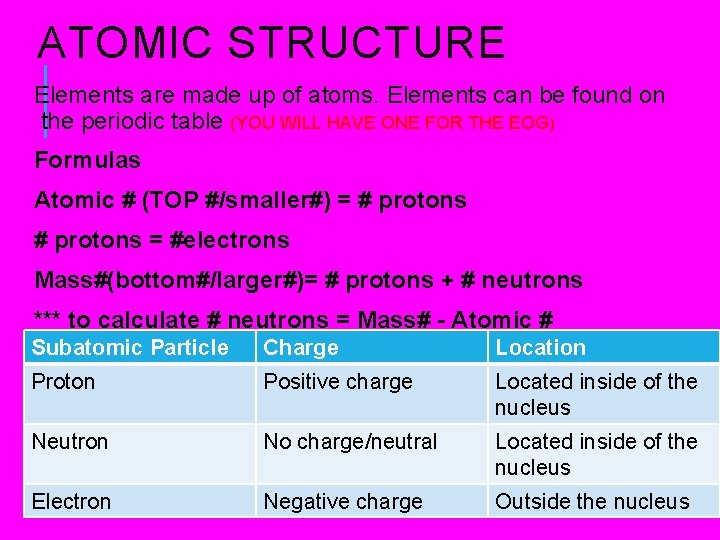
ATOMIC STRUCTURE Elements are made up of atoms. Elements can be found on the periodic table (YOU WILL HAVE ONE FOR THE EOG) Formulas Atomic # (TOP #/smaller#) = # protons = #electrons Mass#(bottom#/larger#)= # protons + # neutrons *** to calculate # neutrons = Mass# - Atomic # Subatomic Particle Charge Location Proton Positive charge Located inside of the nucleus Neutron No charge/neutral Located inside of the nucleus Electron Negative charge Outside the nucleus
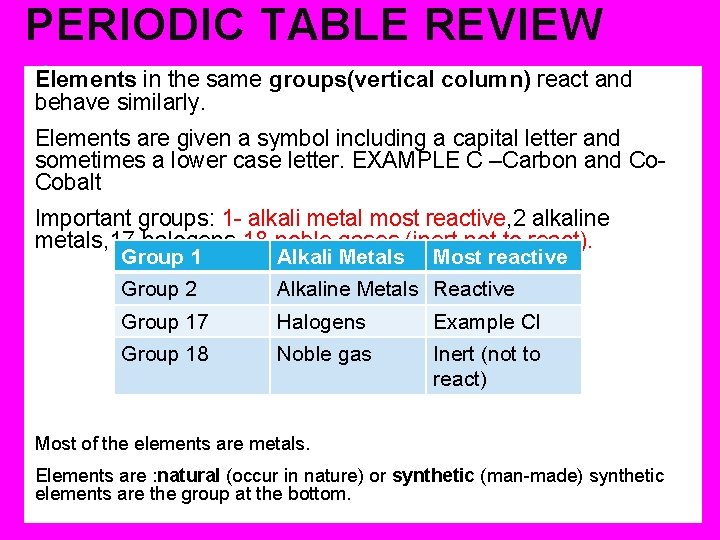
PERIODIC TABLE REVIEW Elements in the same groups(vertical column) react and behave similarly. Elements are given a symbol including a capital letter and sometimes a lower case letter. EXAMPLE C –Carbon and Co. Cobalt Important groups: 1 - alkali metal most reactive, 2 alkaline metals, 17 -halogens, 18 -noble gases (inert not to react). Group 1 Alkali Metals Most reactive Group 2 Alkaline Metals Reactive Group 17 Halogens Example Cl Group 18 Noble gas Inert (not to react) Most of the elements are metals. Elements are : natural (occur in nature) or synthetic (man-made) synthetic elements are the group at the bottom.
WHICH IS TRUE FOR ANY ELEMENT? A. Atomic number = number of protons + number of electrons B. Atomic number = number of protons C. Atomic number = number of protons + number of neutrons D. Atomic number = number of protons, electrons, and neutrons
WHICH IS TRUE OF ALL ELEMENTS? A. They have no physical properties. B. They are solids at room temperature. C. They break down during chemical reactions. D. They are each composed of only kind of atom.
WHAT ARE THE BASIC MATERIALS THAT FORM ALL LIVING AND NONLIVING SUBSTANCES THROUGH DIFFERENT COMBINATIONS? A. Chemicals B. Compounds C. Elements D. Gases
WHAT ARE ELECTRONS? a. positively charged particles b. negatively charged particles c. particles with no charge d. particles whose charge can change
What does the nucleus of an atom contain? A. protons, neutrons, and electrons B. only electrons C. protons and neutrons D. electrons and protons
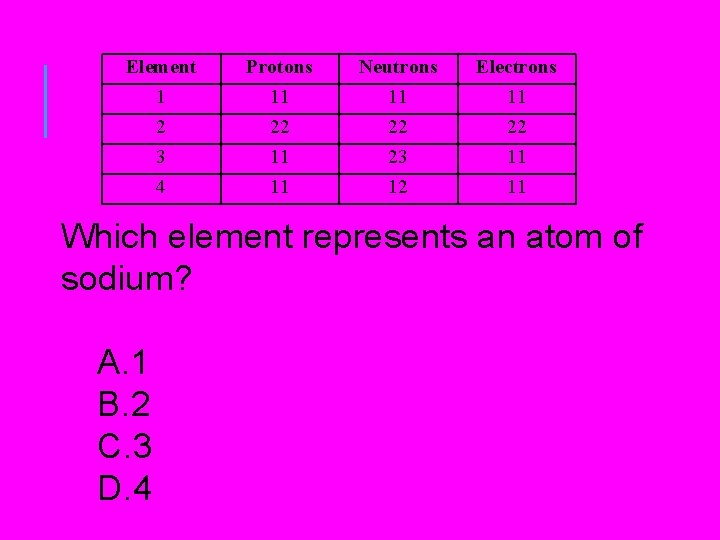
Element 1 2 3 4 Protons 11 22 11 11 Neutrons 11 22 23 12 Electrons 11 22 11 11 Which element represents an atom of sodium? A. 1 B. 2 C. 3 D. 4
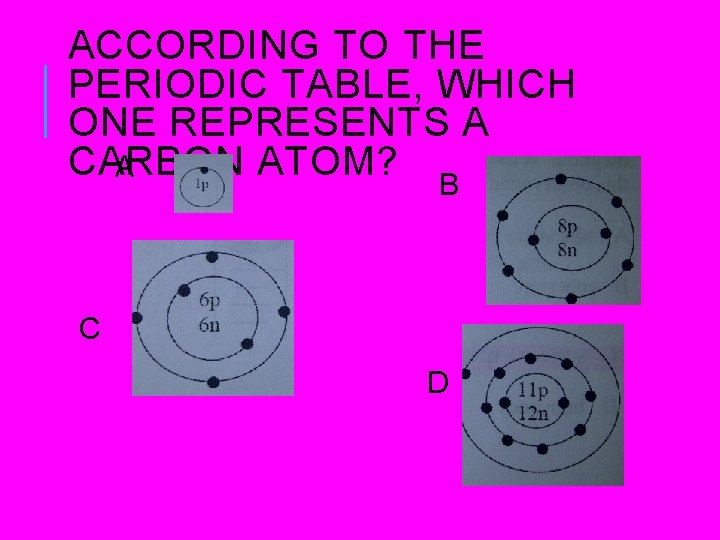
ACCORDING TO THE PERIODIC TABLE, WHICH ONE REPRESENTS A CARBON ATOM? A B C D
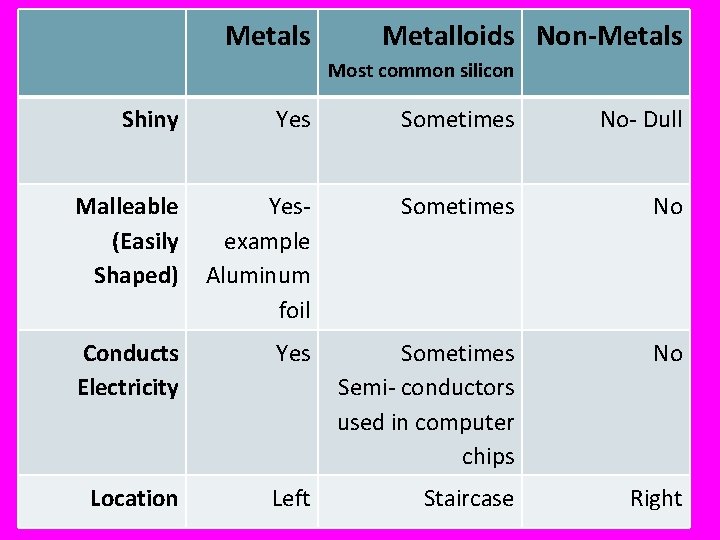
Metals Metalloids Non-Metals Most common silicon Shiny Yes Sometimes No- Dull Malleable (Easily Shaped) Yesexample Aluminum foil Sometimes No Conducts Electricity Yes Sometimes Semi- conductors used in computer chips No Location Left Staircase Right
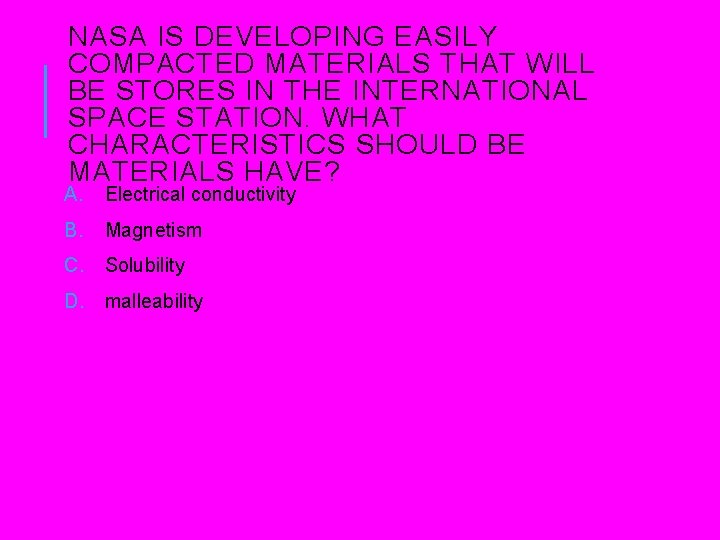
NASA IS DEVELOPING EASILY COMPACTED MATERIALS THAT WILL BE STORES IN THE INTERNATIONAL SPACE STATION. WHAT CHARACTERISTICS SHOULD BE MATERIALS HAVE? A. Electrical conductivity B. Magnetism C. Solubility D. malleability
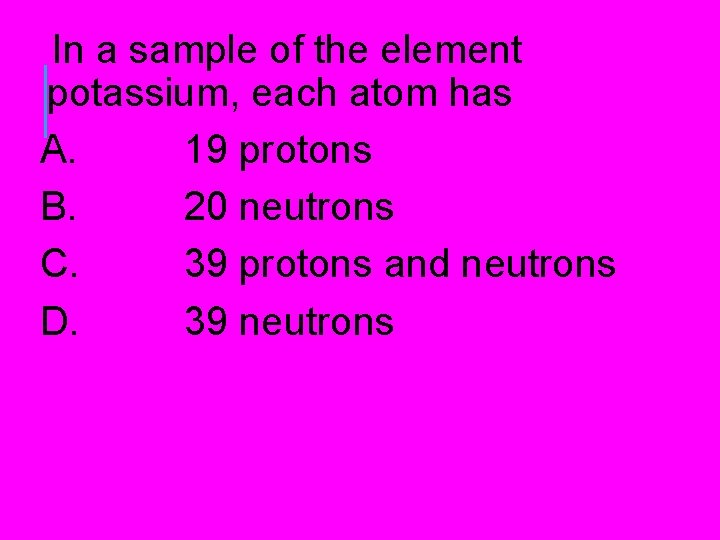
In a sample of the element potassium, each atom has A. 19 protons B. 20 neutrons C. 39 protons and neutrons D. 39 neutrons
ELEMENT, COMPOUND, MIXTURE
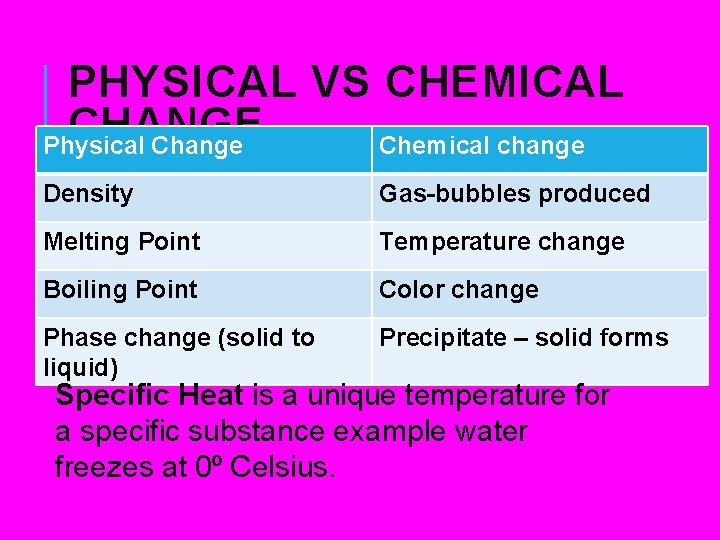
PHYSICAL VS CHEMICAL CHANGE Physical Change Chemical change Density Gas-bubbles produced Melting Point Temperature change Boiling Point Color change Phase change (solid to liquid) Precipitate – solid forms Specific Heat is a unique temperature for a specific substance example water freezes at 0⁰ Celsius.
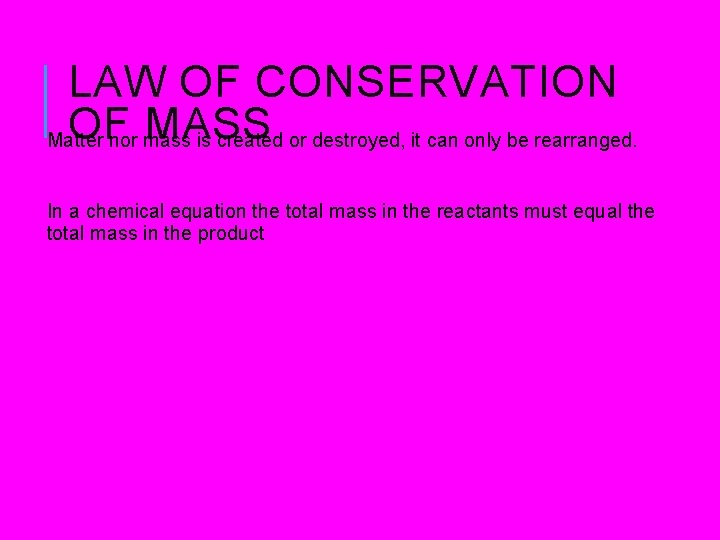
LAW OF CONSERVATION OF MASS Matter nor mass is created or destroyed, it can only be rearranged. In a chemical equation the total mass in the reactants must equal the total mass in the product
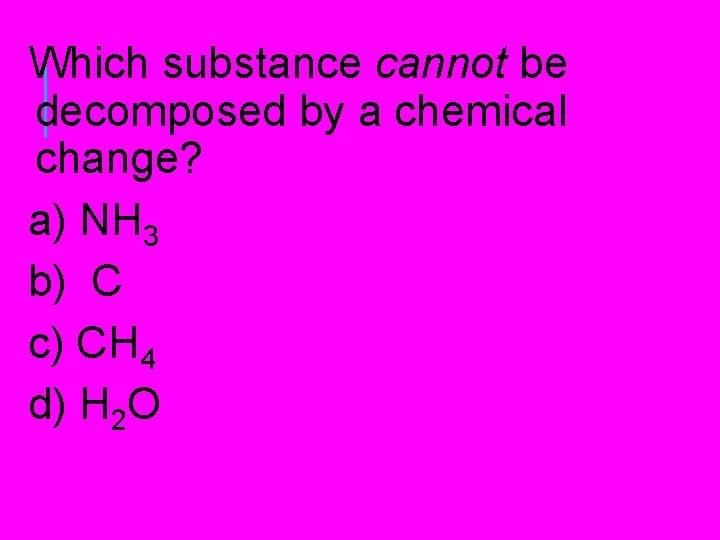
Which substance cannot be decomposed by a chemical change? a) NH 3 b) C c) CH 4 d) H 2 O
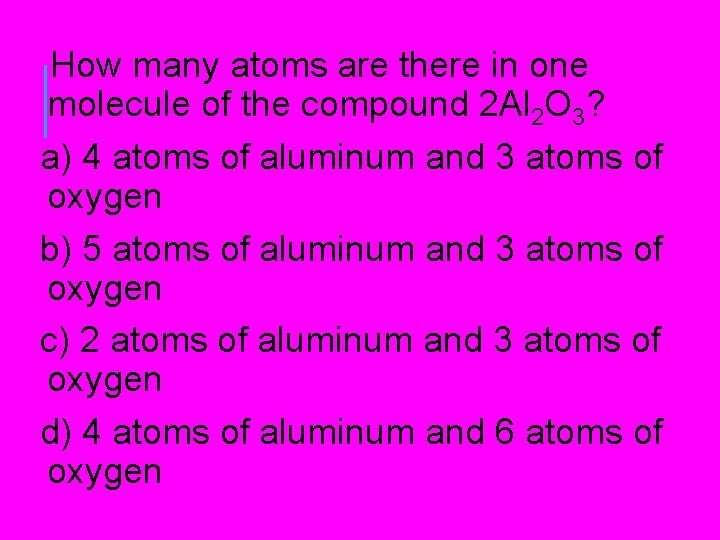
How many atoms are there in one molecule of the compound 2 Al 2 O 3? a) 4 atoms of aluminum and 3 atoms of oxygen b) 5 atoms of aluminum and 3 atoms of oxygen c) 2 atoms of aluminum and 3 atoms of oxygen d) 4 atoms of aluminum and 6 atoms of oxygen
ENERGY TRANSFER All organisms require energy for growth, maintenance, reproduction, locomotion, etc. . The SUN is the ultimate source of energy without it, the most basic forms of life would not exist Food(nutrients-proteins, carbohydrates, fats, lipids) provides molecules that serve as fuel and building material for all organisms Carbohydrates – provides energy for cells Proteins – helps build and repair muscle Fats – acts as he body's insulator protecting organs and absorbing shocks, helps process vitamins and minerals, and provides energy
ENERGY TRANSFER Mitosis/Meiosis- are the processes of growing and dividing to produce new cells Photosynthesis- Chemical reaction where green plants use water & carbon dioxide to store the sun’s energy in glucose Cellular Respiration- is the chemical reaction that releases the energy stored in the chemical bonds of glucose
Where do plants get most of the energy they need to live and grow? A water B soil C air D sunlight Which food provides the most energy for the body in the shortest amount of time? A potato B meat C milk D fruit Why is protein an important part of a healthy diet? A It is needed to change glucose to energy. B It is needed to store nutrients. C It is needed to repair tissue. D It is needed to produce water.
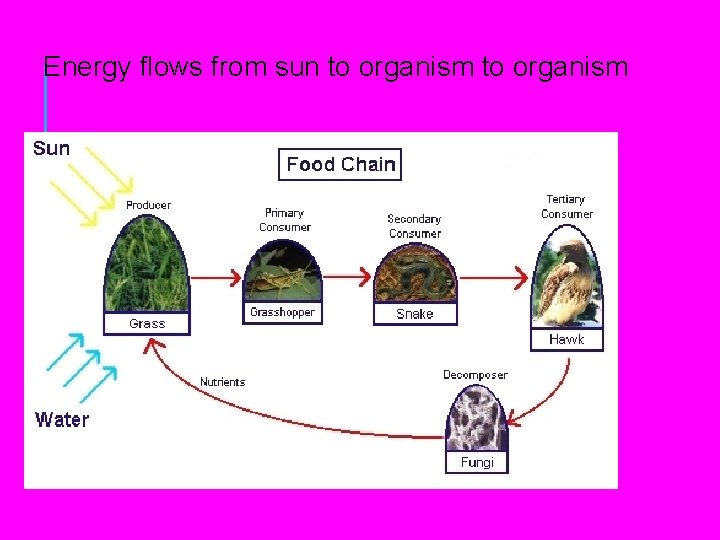
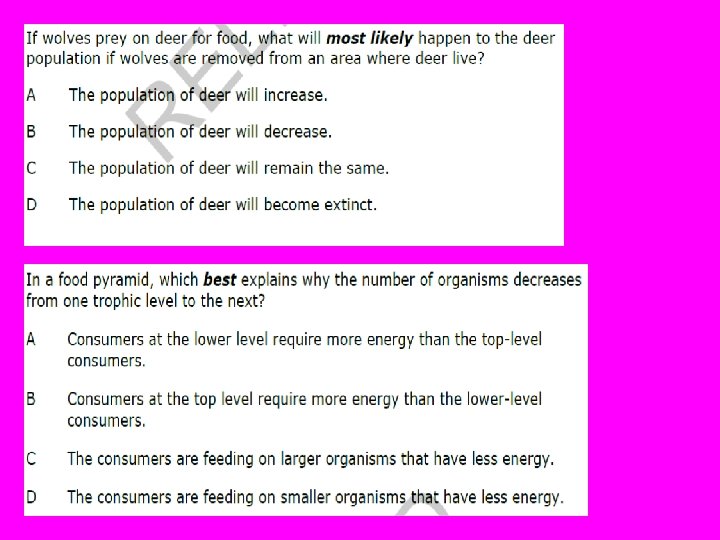
Ecosystem- all biotic (living) factors & abiotic (non-living) factors that interact in an environment Producers- Organism that make their own food by capturing energy from the sun Consumers- are organisms that feed on other organisms.
Energy flows from sun to organism
The energy flow from one trophic level to the other is called a food chain A food chain is simple and direct It involves one organism at each trophic level -Primary Consumers – eat producers -Secondary Consumers – eat the primary consumers -Tertiary Consumer-eat the secondary consumer -Decomposers – bacteria and fungi that break down dead organisms and recycle
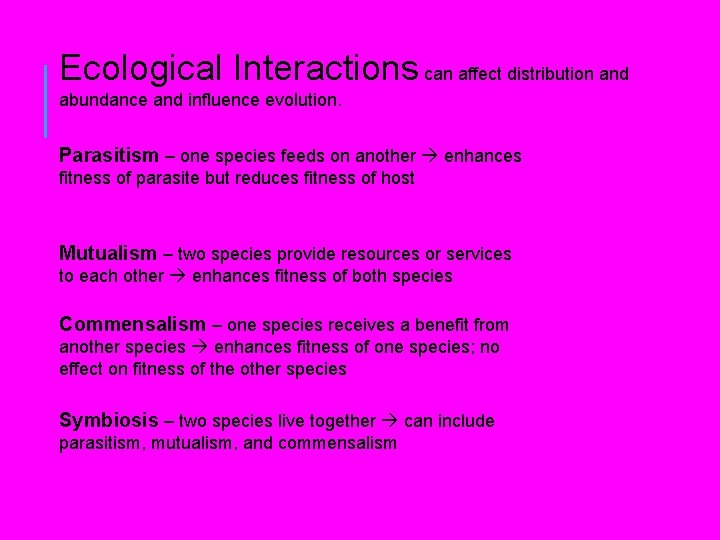
Ecological Interactions can affect distribution and abundance and influence evolution. Parasitism – one species feeds on another enhances fitness of parasite but reduces fitness of host Mutualism – two species provide resources or services to each other enhances fitness of both species Commensalism – one species receives a benefit from another species enhances fitness of one species; no effect on fitness of the other species Symbiosis – two species live together can include parasitism, mutualism, and commensalism