Environmental Engineering Odor Competency Center Presents Odo Watch

- Slides: 37
Environmental Engineering Odor Competency Center Presents Odo. Watch™ MWEA Bio. Solids Conference 2/21/08 10/29/2020
Veolia Water Solutions & Technologies North America (VWSNA) Blank Blank Blank 10/29/2020
Table of Contents u u u 10/29/2020 What is Odo. Watch? Phases of an Odo. Watch Project Examples Frequently Asked Questions Getting Started Contact Information
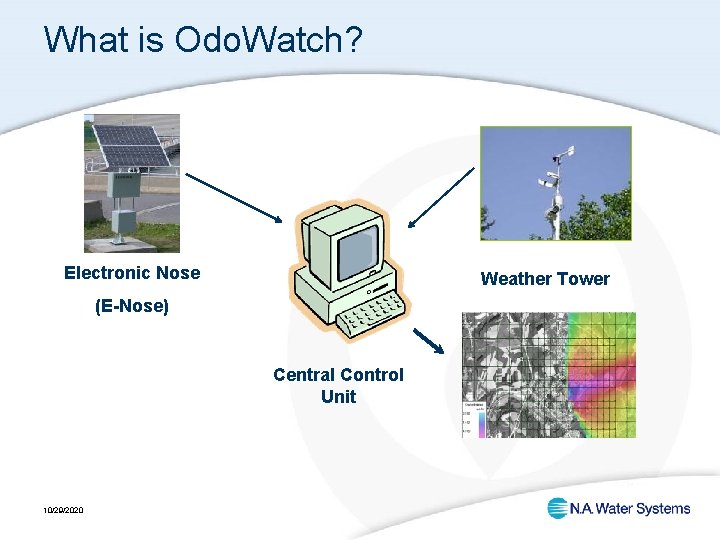
What is Odo. Watch? Electronic Nose Weather Tower (E-Nose) Central Control Unit 10/29/2020
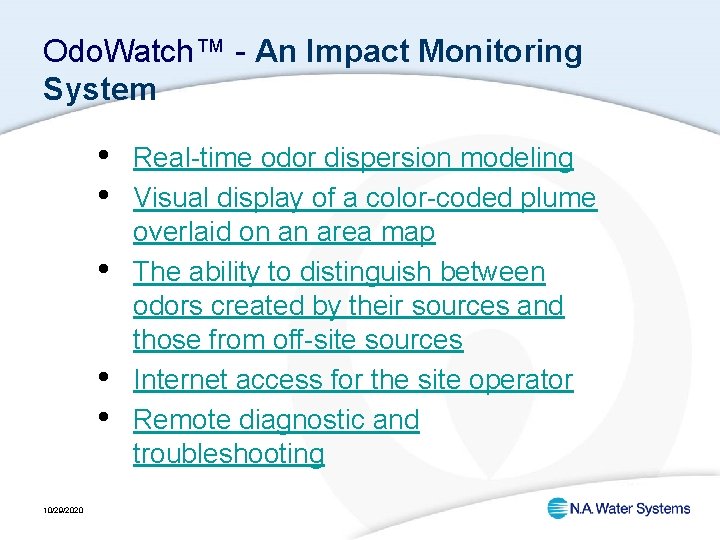
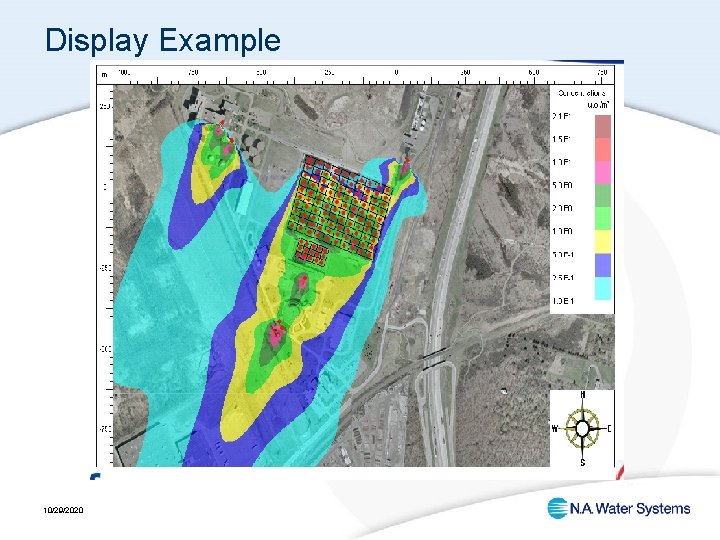
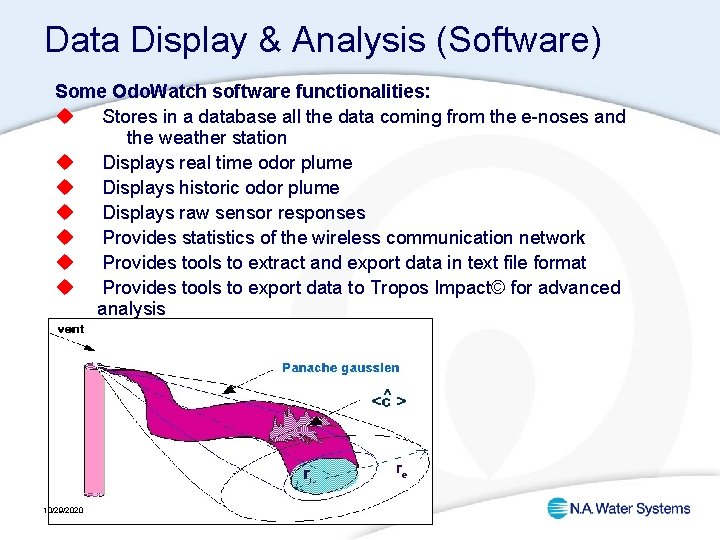
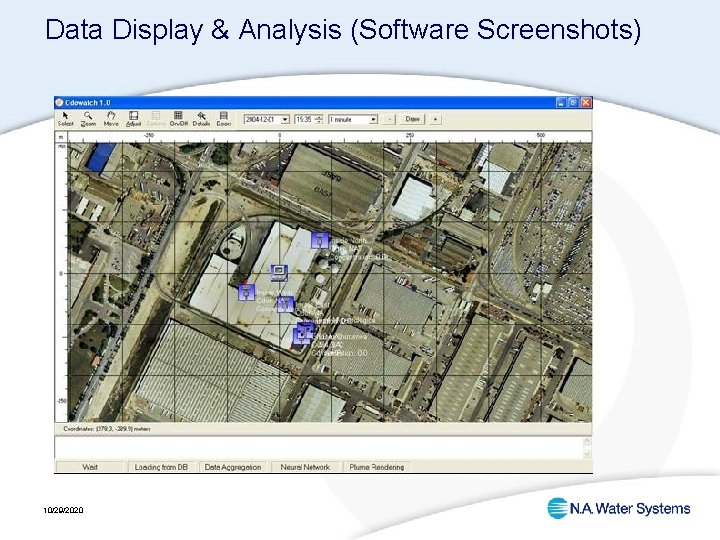
Odo. Watch™ - An Impact Monitoring System • • • 10/29/2020 Real-time odor dispersion modeling Visual display of a color-coded plume overlaid on an area map The ability to distinguish between odors created by their sources and those from off-site sources Internet access for the site operator Remote diagnostic and troubleshooting
Display Example 10/29/2020
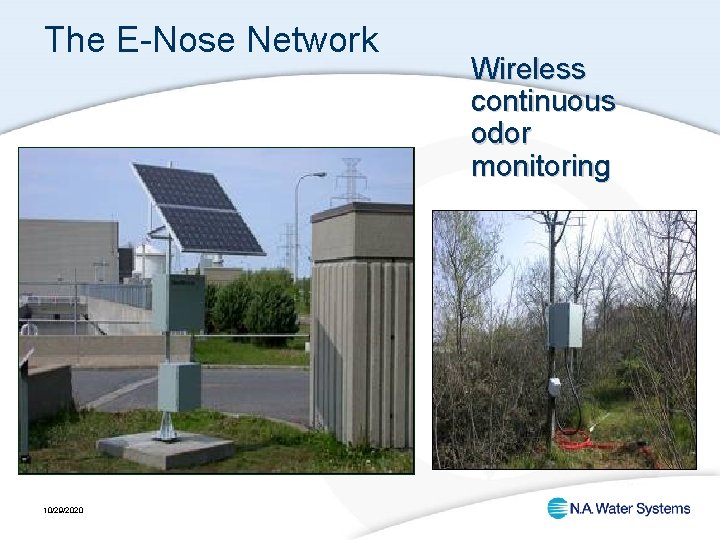
The E-Nose Network 10/29/2020 Wireless continuous odor monitoring
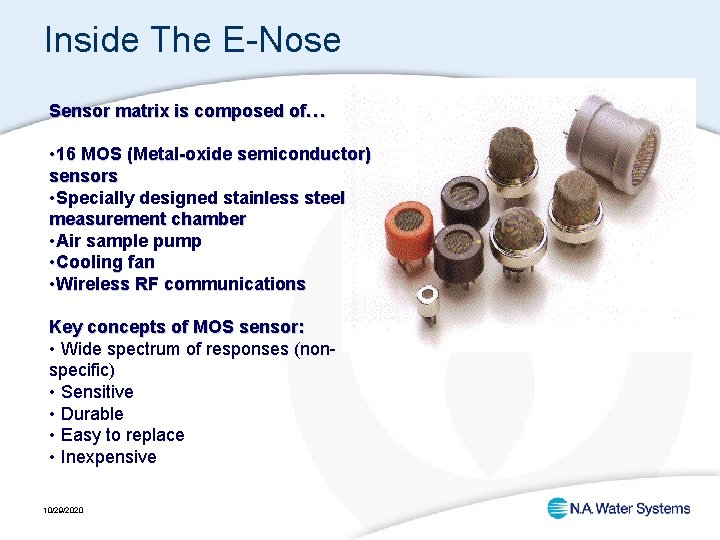
Inside The E-Nose Sensor matrix is composed of… • 16 MOS (Metal-oxide semiconductor) sensors • Specially designed stainless steel measurement chamber • Air sample pump • Cooling fan • Wireless RF communications Key concepts of MOS sensor: • Wide spectrum of responses (non- specific) • Sensitive • Durable • Easy to replace • Inexpensive 10/29/2020
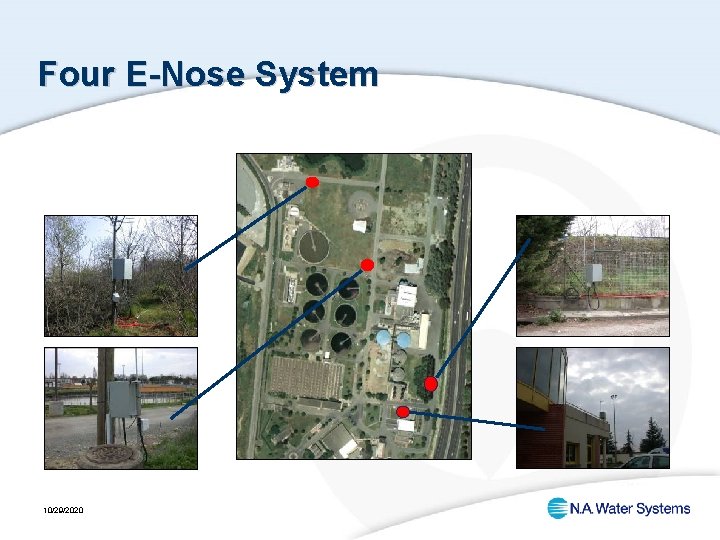
Four E-Nose System 10/29/2020
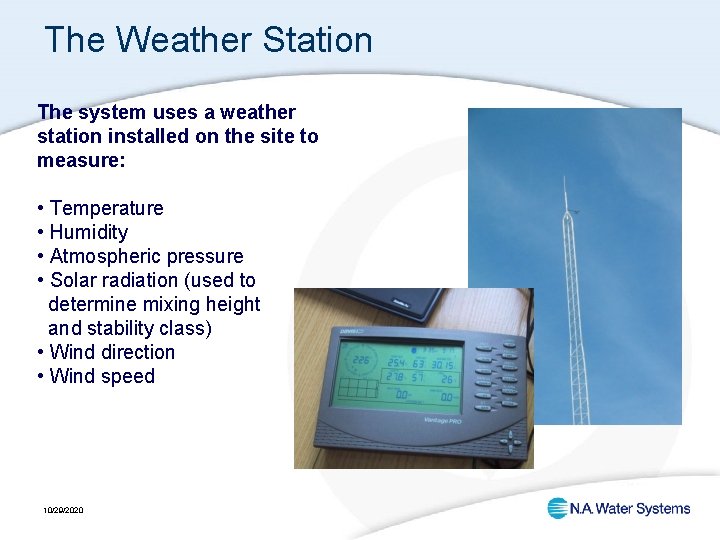
The Weather Station The system uses a weather station installed on the site to measure: • Temperature • Humidity • Atmospheric pressure • Solar radiation (used to determine mixing height and stability class) • Wind direction • Wind speed 10/29/2020
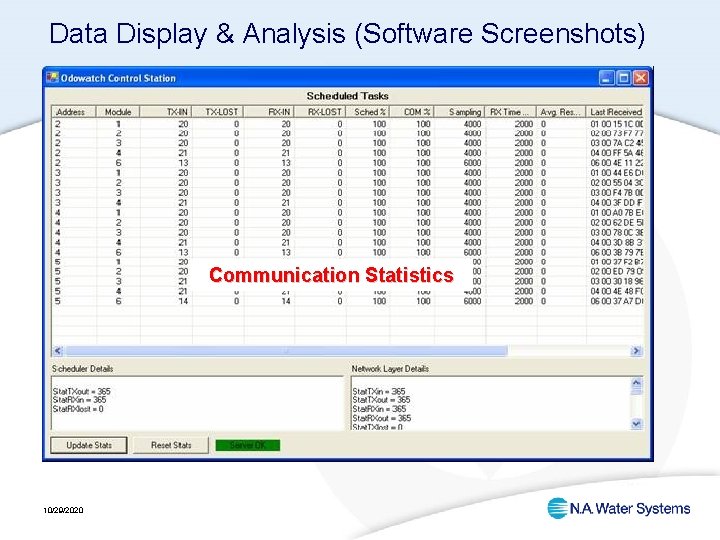
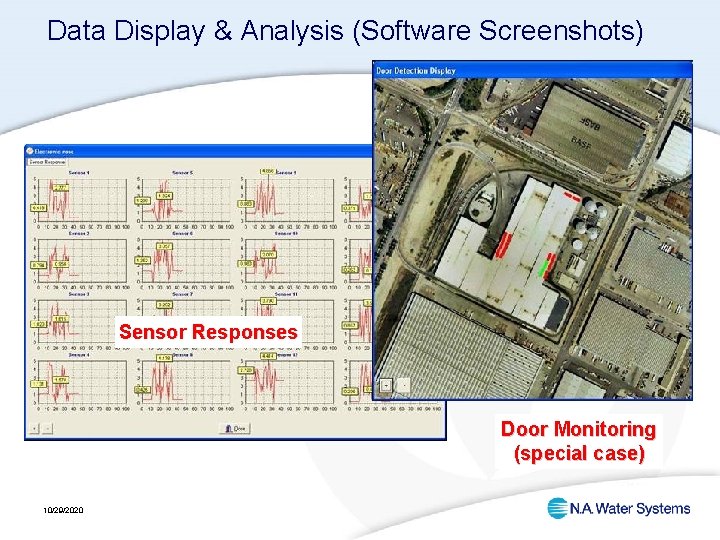
Data Display & Analysis (Software) Some Odo. Watch software functionalities: u Stores in a database all the data coming from the e-noses and the weather station u Displays real time odor plume u Displays historic odor plume u Displays raw sensor responses u Provides statistics of the wireless communication network u Provides tools to extract and export data in text file format u Provides tools to export data to Tropos Impact© for advanced analysis 10/29/2020
Data Display & Analysis (Software Screenshots) 10/29/2020
Data Display & Analysis (Software Screenshots) Communication Statistics 10/29/2020
Data Display & Analysis (Software Screenshots) Sensor Responses Door Monitoring (special case) 10/29/2020
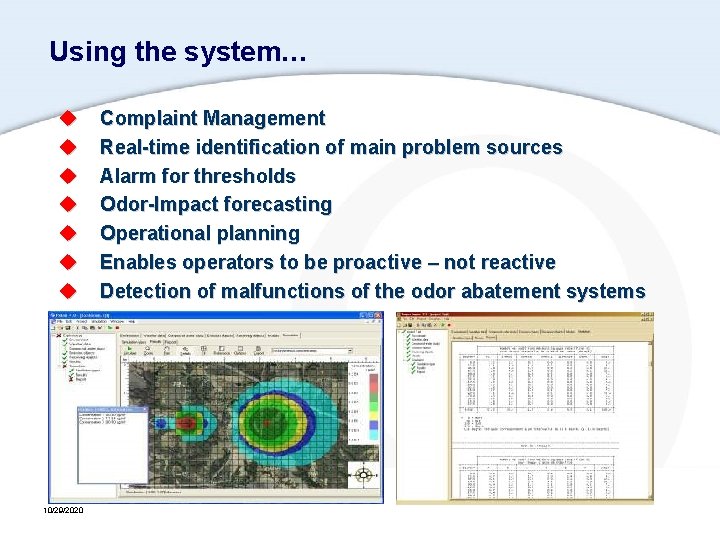
Using the system… u u u u 10/29/2020 Complaint Management Real-time identification of main problem sources Alarm for thresholds Odor-Impact forecasting Operational planning Enables operators to be proactive – not reactive Detection of malfunctions of the odor abatement systems
An Odo. Watch Project § Study § Installation § Support 10/29/2020
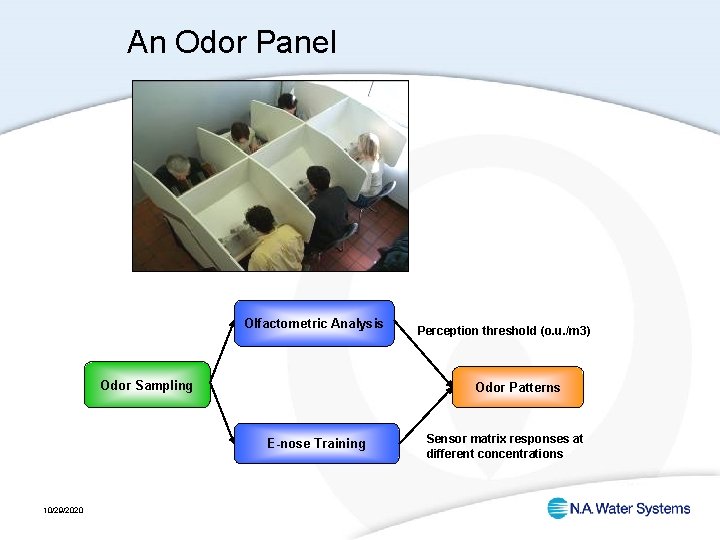
An Odor Panel Olfactometric Analysis Odor Sampling Odor Patterns E-nose Training 10/29/2020 Perception threshold (o. u. /m 3) Sensor matrix responses at different concentrations
Example Project City of Montreal Wastewater Treatment Plant 10/29/2020
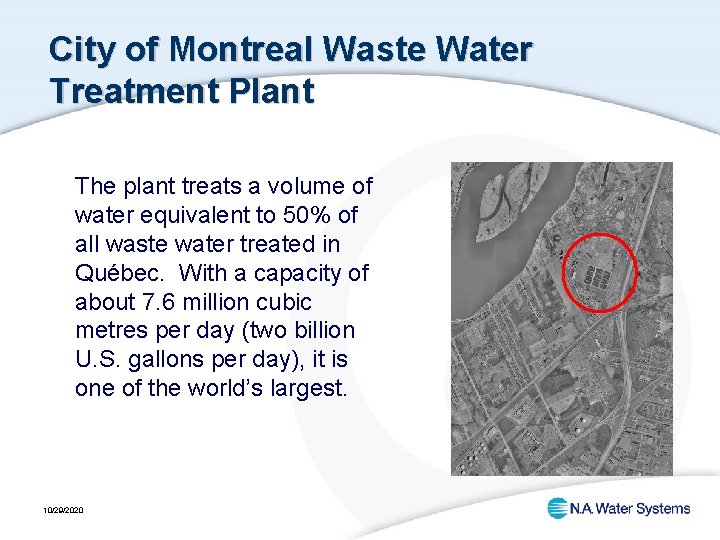
City of Montreal Waste Water Treatment Plant The plant treats a volume of water equivalent to 50% of all waste water treated in Québec. With a capacity of about 7. 6 million cubic metres per day (two billion U. S. gallons per day), it is one of the world’s largest. 10/29/2020
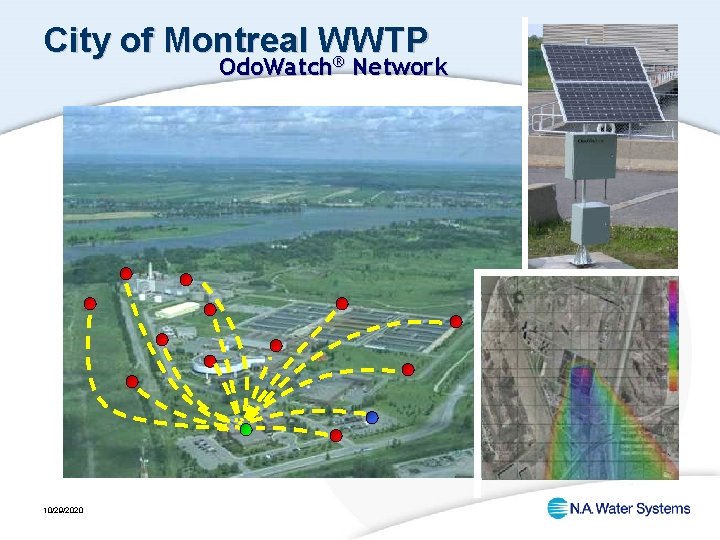
City of Montreal WWTP ® Odo. Watch Network 10/29/2020
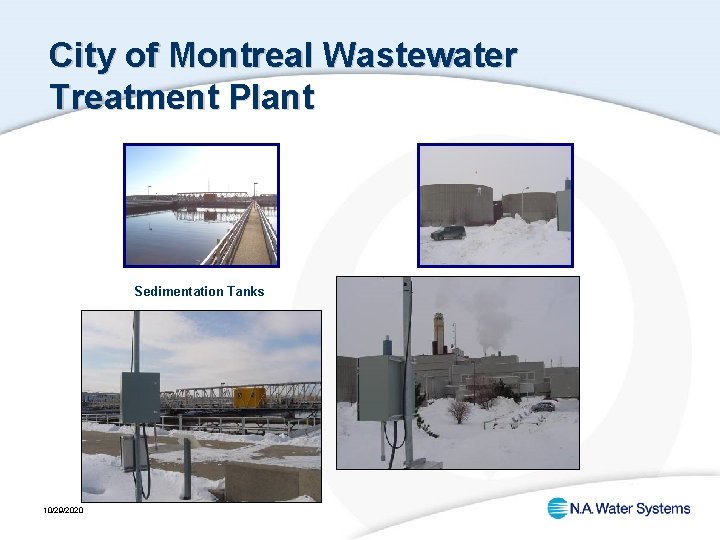
City of Montreal Wastewater Treatment Plant Sedimentation Tanks 10/29/2020 odor Treatment Units
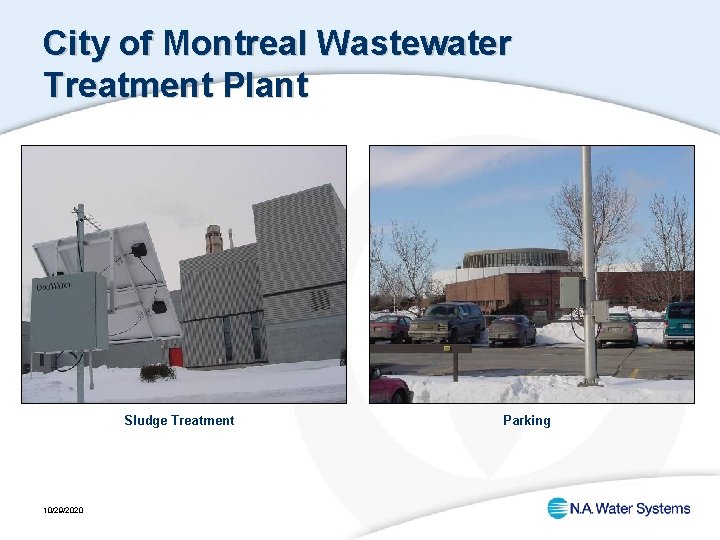
City of Montreal Wastewater Treatment Plant Sludge Treatment 10/29/2020 Parking
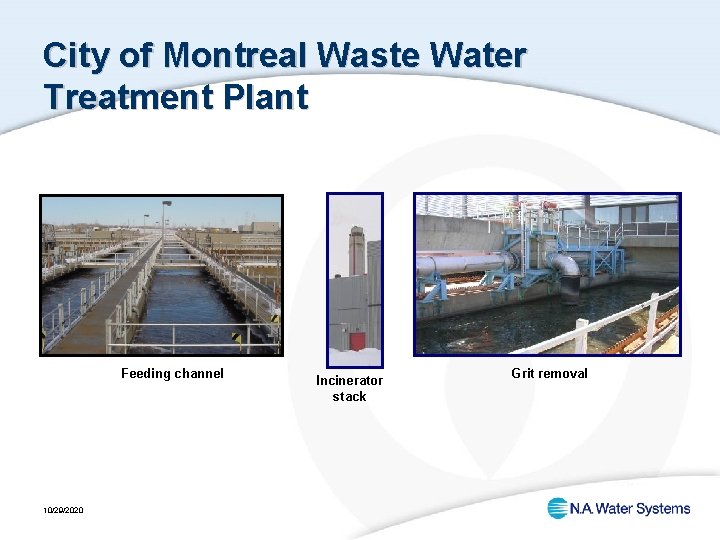
City of Montreal Waste Water Treatment Plant Feeding channel 10/29/2020 Incinerator stack Grit removal
Some Odo. Watch™ system installations u u u 10/29/2020 Canada Landfill Site of BFI Usine de Triage Lachenaie Wastewater Treatment Plant of City of Montreal France Landfill Site of Claye-Souilly (Paris) Wastewater Treatment Plant of Ginestous (Toulouse) Rendering plant (Agen) Spain Composting Site Eco. Parc I in Barcelona USA Cranston, R. I. Waste. Water Treatment Plant 2008 – Hyperion WWTP, Los Angeles
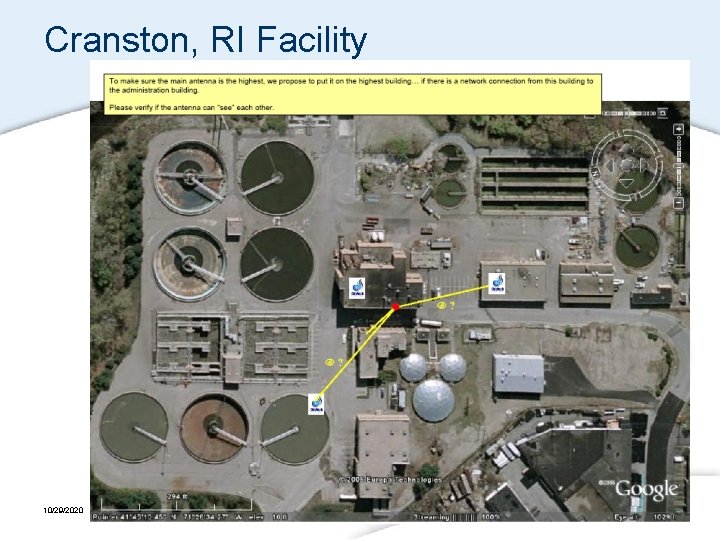
Cranston, RI Facility 10/29/2020
View the Cranston Data u Actual odor plumes at Cranston, RI 10/29/2020
Potential Benefits of Odo. Watch® u Self-defense: distinguishes between odors caused on-site vs. odors caused nearby u Right-sizing plant and equipment u Prioritizing/ranking biggest contributors to odor u Using optimal quantity of chemicals to neutralize odor u Saving time and money on investigations 10/29/2020
Potential Benefits of Odo. Watch® (cont. ) u Facilitating communication with local population to avoid costly disputes u Providing a history of technical data u Demonstrating effectiveness of actions taken u Facilitating required odor impact studies 10/29/2020
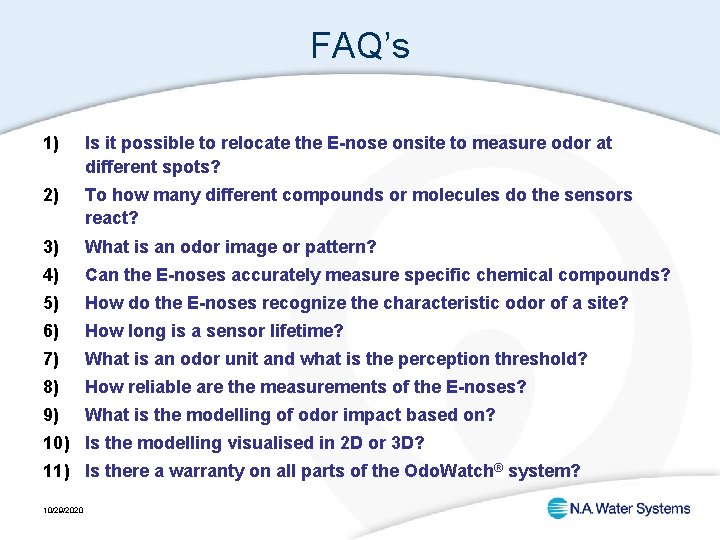
FAQ’s 1) Is it possible to relocate the E-nose onsite to measure odor at different spots? 2) To how many different compounds or molecules do the sensors react? 3) What is an odor image or pattern? 4) Can the E-noses accurately measure specific chemical compounds? 5) How do the E-noses recognize the characteristic odor of a site? 6) How long is a sensor lifetime? 7) What is an odor unit and what is the perception threshold? 8) How reliable are the measurements of the E-noses? 9) What is the modelling of odor impact based on? 10) Is the modelling visualised in 2 D or 3 D? 11) Is there a warranty on all parts of the Odo. Watch® system? 10/29/2020
1) Is it possible to relocate the E-nose onsite to measure odor at different spots? For technical reasons, it is impossible to manufacture a truly mobile E-Nose. Clients often ask whether they can take an E-Nose at the time of a complaint and go with it on the location of the complaint to check the odors by means of the E-Nose. This is impossible for three reasons: § § § Far from the odor source, and thus from the site, the odor has become dispersed. It is very weak, being at or below the sensitivity threshold of the Enose. The ambient air usually carries so-called “background” olfactory pollution. Far from the source, that background disturbance may mask the odor sought, since the latter has become very dispersed. Moreover, E-noses only recognize the site odors for which they were calibrated. Far from the site, there are other odors (from other origins) that the E-nose will not be able to recognize. That is why the E-noses of the Odo. Watch® system are always positioned near the odor sources. 2) To how many different compounds or molecules do the sensors react? The Odo. Watch® sensors are non-specific Metal Oxide Sensors. This means that each sensor reacts to several compounds or molecules rather than to just one. The objective is to have in each E-nose 16 different sensors, each reacting in its own way to the gases 10/29/2020 present. It is the totality of the 16 responses that enables us to identify the odor image or pattern.
FAQ’s Continued 3) What is an odor image or pattern? The odor image corresponds to the interpretation of an odor by the human brain, with all its associations. For instance, at the age of 2, sitting in the family car while stopped at a gas station, you had noticed a very strong, penetrating, aggressive odor, but you were unable to identify it. Later, you came to associate the odor of gasoline with the idea of car, transportation, gas pump, etc. Today, as soon as you detect a light puff of gasoline odor, all these connotations come to your mind. That is what the odor image is. The human brain contains hundreds of thousands of odor images. 4) Can the E-noses accurately chemical compounds? measure specific Not for the time being, because this requires specific sensors that do not help odor identification in any way. On the other hand, ODOTECH is planning to include some highly accurate specific sensors to indicate in ppb or ppm the chemical composition of the air, in addition to its odor. Traditionally, air quality experts used chemical analysis of the compounds carried by the air. This gave them the chemical composition of the air but no odor, because there is no correlation between the two, once the number of compounds exceed 2 or 3. Today, Odo. Watch® can identify and quantify the odor. But some experts are still having trouble absorbing this new type of measurement. That is why those unfamiliar with the field of odors will always ask you: “is the odor measurement based on chemical composition? ”. No, it is not, because there is no correlation in most instances. 10/29/2020
FAQ’s Continued 5) How do the E-noses recognize the characteristic odor of a site? E-noses must be trained (or calibrated) in order to be able to recognize the characteristic odors of a site, and to quantify them. This training occurs in three stages: • Odor samples are collected on site, • The samples are subjected to olfactometric analysis (human panel), • The E-noses are exposed to the samples and their responses are compared with the results of the analysis. The correlation is then established between the two via a statistical neural calculation. This enables the E-nose to perceive odor the way the human nose does. 6) How long is a sensor’s lifetime? The 16 sensors of each E-nose have a life of 1 to 2 years. It may however happen that sensors exposed to extremely severe operating conditions degrade more quickly or stop operating. At the Montreal Waste Water Treatment Plant, the 64 sensors of the 4 E-noses of the system have been in operation without a problem for 2 years. At the composting site in Barcelona, 1 of the 6 sensors of the E-nose exposed to the worst heat, 10/29/2020 dust and humidity conditions had to be replaced after 3 months. Since every Odo. Watch® system is connected to the Internet, ODOTECH
FAQ’s Continued 7) What is an odor unit and what is the perception threshold? When measuring odor with an olfactometer, 6 human panellists are exposed to the odor sample via the dilution unit of the olfactometer. Initially, the odor being strong, all 6 indicate that they can smell it. The operator then dilutes the sample with pure air in a given, accurate ratio, and the 6 panellists respond. The operator keeps diluting the odor sample until 3 of the six panellists indicate that they can no longer smell the odor, but the other 3 can still smell it. By definition, the point at which 50% of the panellists can no longer smell the odor but 50% still can, is called the PERCEPTION THRESHOLD and is equal to 1 odor unit per cubic meter. To find out how many odor units the sample had in the first place, the operator – once the perception threshold has been reached – adds up all the dilutions that were required to reach that threshold; if the sample was diluted, say, 536 times, in order to reach 1 odor unit, then the sample odor concentration was 536 odor units initially. 8) How reliable are the measurements of the E-noses? The reliability of the E-noses corresponds to that of the human nose, with a relative error of about 20%. Moreover, odor sampling induces 5 to 10 % 10/29/2020 error. This is tantamount to saying that a perfect E-nose has a 25 %
FAQ’s Continued 9) What is the modelling of odor impact based on? The model used by Odo. Watch® consists of two sub-models: the Gaussian identical to the ISC of the US EPA, and the Gifford model optimised for shorter dispersion distances. While the Gaussian model is the one the most widely used throughout the world for dispersion studies, the addition of the Gifford model by ODOTECH improves its performance by taking into account the eddies at the outlet of the odor point sources. Validation of the model used by Odo. Watch® was effected by comparing its predictions to the actual data measured in the field. A technical validation document (100 pages) is available on request. The ISC model is being replaced by an AERMOD model in line with US EPA directives. 10) Is the modelling visualised in 2 D or 3 D? There is no 3 D model specifically for odors. 3 D models require a very large amount of data, and the computations require great computing power: since this requires long computation times, it is impossible to show a plume in real time. 3 D weather data are very difficult to find, and costly. While they are not three-dimensional, 2 D models take into account the height of 10/29/2020 point sources (stacks).
FAQ’s Continued 11) Is there a warranty on all parts of the Odo. Watch® system? The Odo. Watch® system is covered by a manufacturer's warranty of 1 year on all the parts and labor required for replacing those parts. During the warranty period, the free after-sales service provided by ODOTECH comprises: free technical support for use of the system (20 technician hours), call-back within 24 hours (outside holidays) upon receipt of a troubleshooting request, action (by telephone, modem, Internet, or on site, as required) by an authorized ODOTECH representative in the case of a defect covered by the warranty. 10/29/2020
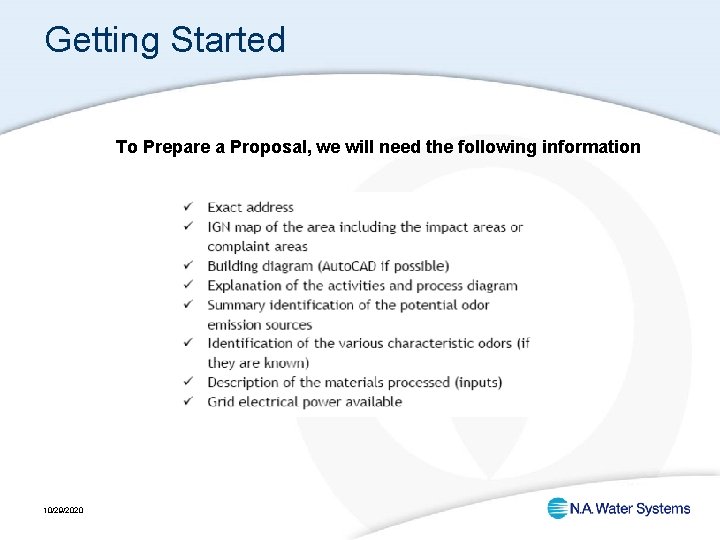
Getting Started To Prepare a Proposal, we will need the following information 10/29/2020
N. A. Water Systems Contacts Product Manager: Sharon Paterson (734)973 -0700 ext. 1126 Email: Sharon. Paterson@veoliawater. com Odor Specialist Monty Saron (412)809 -6730 Email: Maninder. Saron@veoliawater. com 10/29/2020