
Gas and Odor Emissions In Poultry Farms By
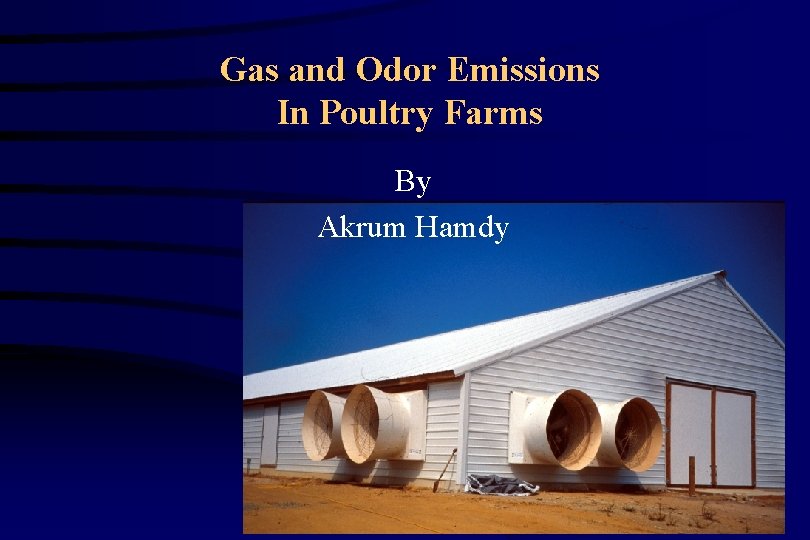
Gas and Odor Emissions In Poultry Farms By Akrum Hamdy
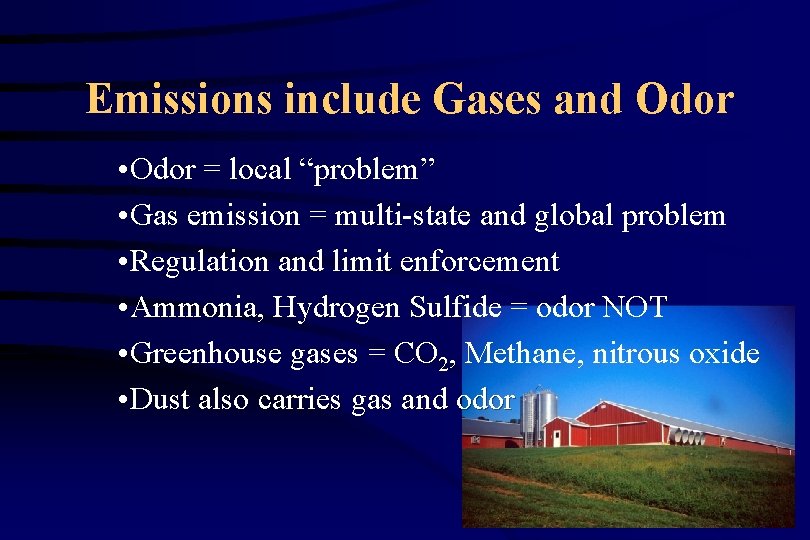
Emissions include Gases and Odor • Odor = local “problem” • Gas emission = multi-state and global problem • Regulation and limit enforcement • Ammonia, Hydrogen Sulfide = odor NOT • Greenhouse gases = CO 2, Methane, nitrous oxide • Dust also carries gas and odor
Strategies to Reduce Gas and Odor Emissions 1. Reduce generation at source 2. Reduce release from farm site 3. Enhance dispersion = dilution
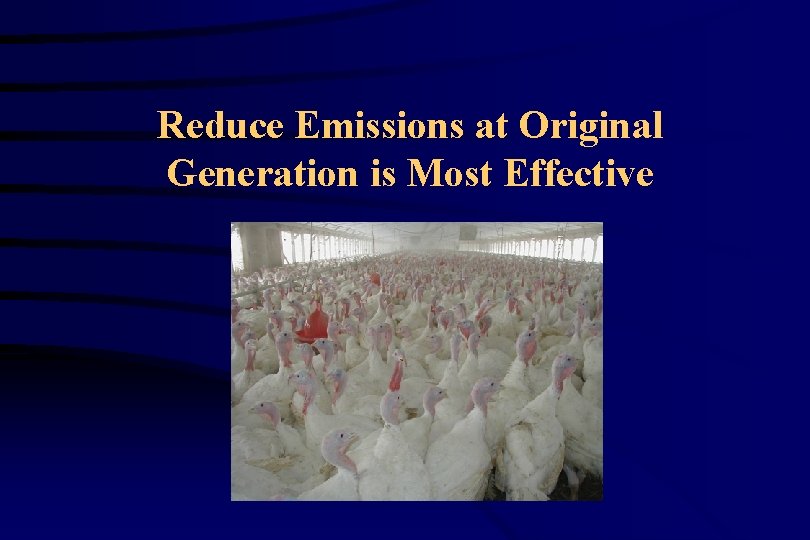
Reduce Emissions at Original Generation is Most Effective
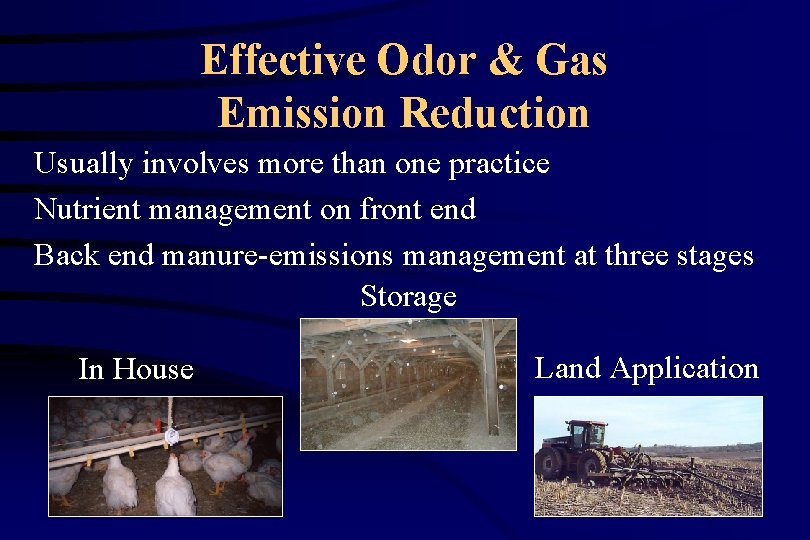
Effective Odor & Gas Emission Reduction Usually involves more than one practice Nutrient management on front end Back end manure-emissions management at three stages Storage In House Land Application
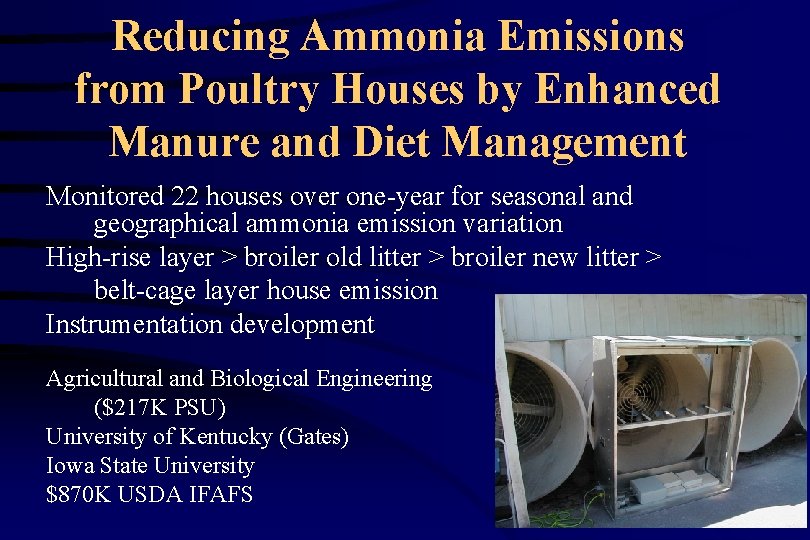
Reducing Ammonia Emissions from Poultry Houses by Enhanced Manure and Diet Management Monitored 22 houses over one-year for seasonal and geographical ammonia emission variation High-rise layer > broiler old litter > broiler new litter > belt-cage layer house emission Instrumentation development Agricultural and Biological Engineering ($217 K PSU) University of Kentucky (Gates) Iowa State University $870 K USDA IFAFS
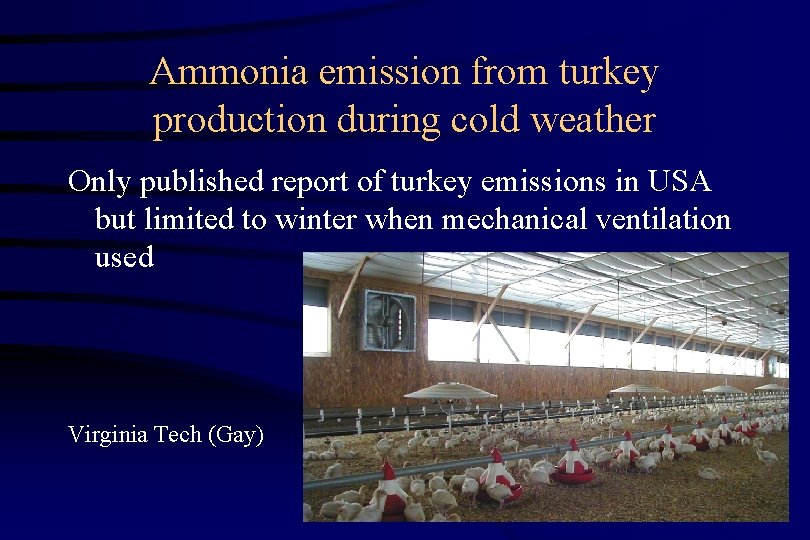
Ammonia emission from turkey production during cold weather Only published report of turkey emissions in USA but limited to winter when mechanical ventilation used Virginia Tech (Gay)
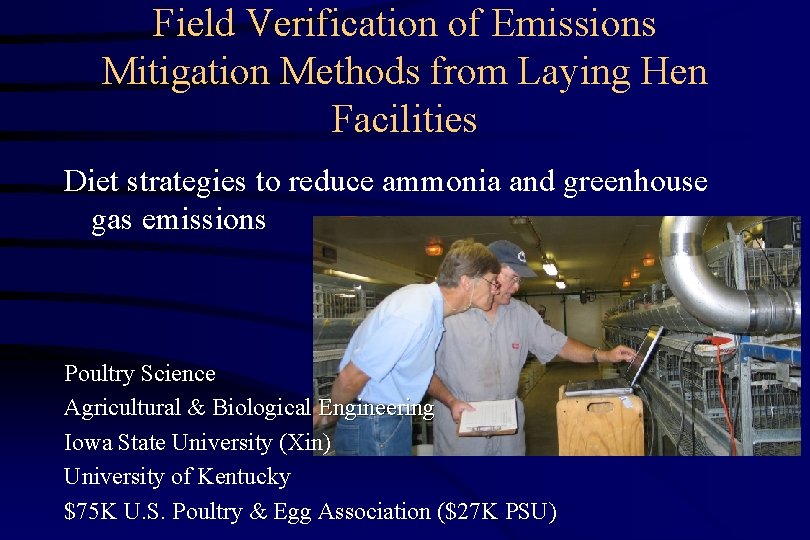
Field Verification of Emissions Mitigation Methods from Laying Hen Facilities Diet strategies to reduce ammonia and greenhouse gas emissions Poultry Science Agricultural & Biological Engineering Iowa State University (Xin) University of Kentucky $75 K U. S. Poultry & Egg Association ($27 K PSU)
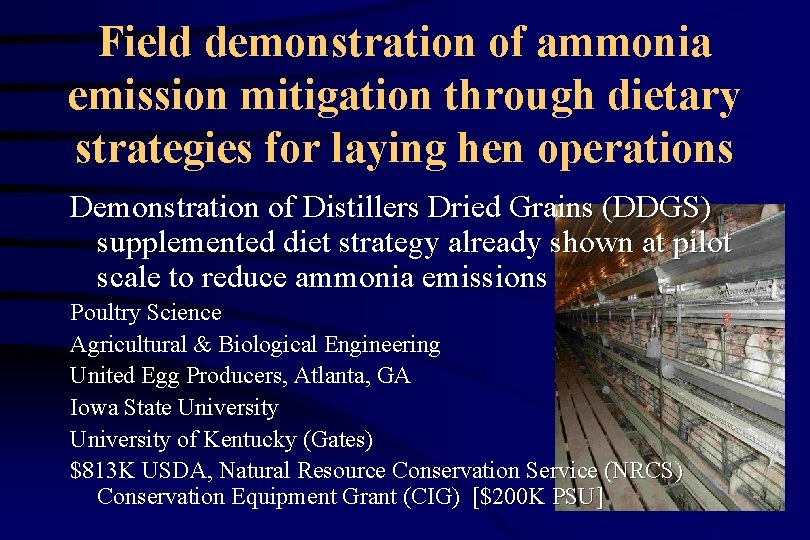
Field demonstration of ammonia emission mitigation through dietary strategies for laying hen operations Demonstration of Distillers Dried Grains (DDGS) supplemented diet strategy already shown at pilot scale to reduce ammonia emissions Poultry Science Agricultural & Biological Engineering United Egg Producers, Atlanta, GA Iowa State University of Kentucky (Gates) $813 K USDA, Natural Resource Conservation Service (NRCS) Conservation Equipment Grant (CIG) [$200 K PSU]
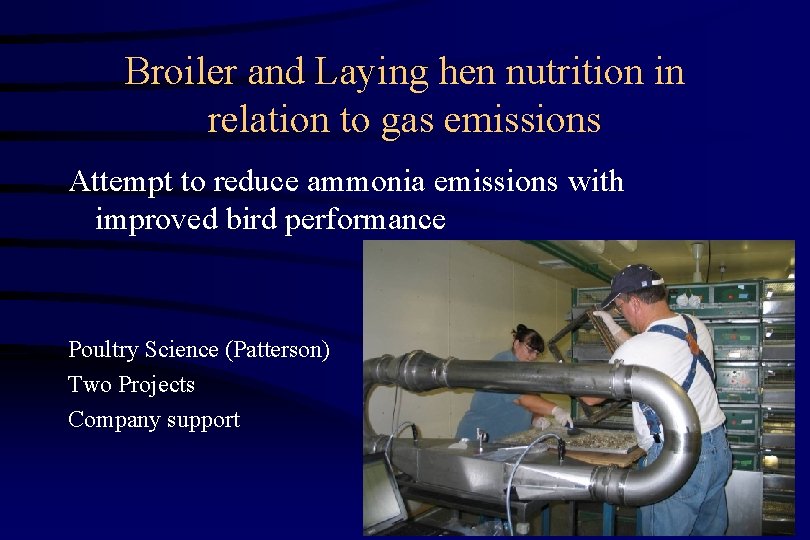
Broiler and Laying hen nutrition in relation to gas emissions Attempt to reduce ammonia emissions with improved bird performance Poultry Science (Patterson) Two Projects Company support
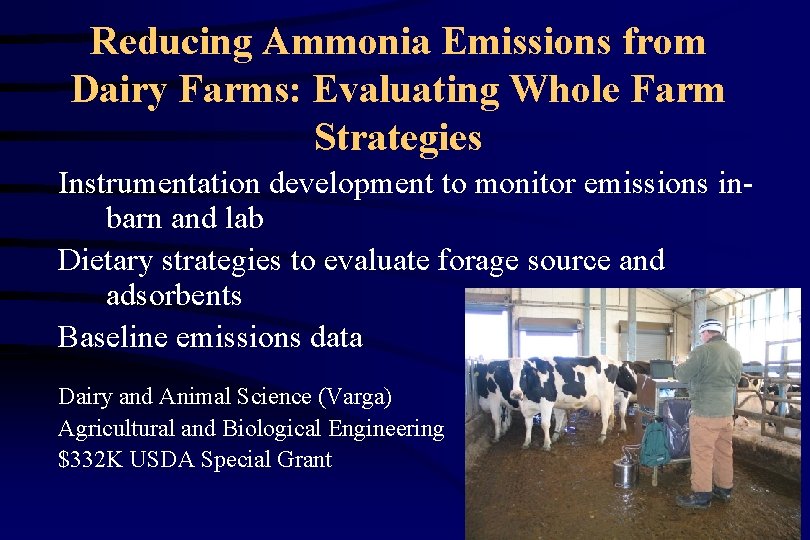
Reducing Ammonia Emissions from Dairy Farms: Evaluating Whole Farm Strategies Instrumentation development to monitor emissions inbarn and lab Dietary strategies to evaluate forage source and adsorbents Baseline emissions data Dairy and Animal Science (Varga) Agricultural and Biological Engineering $332 K USDA Special Grant
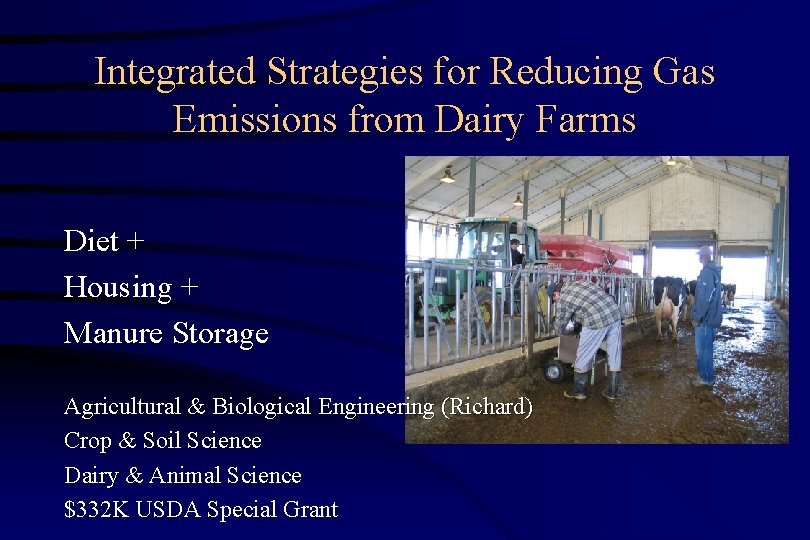
Integrated Strategies for Reducing Gas Emissions from Dairy Farms Diet + Housing + Manure Storage Agricultural & Biological Engineering (Richard) Crop & Soil Science Dairy & Animal Science $332 K USDA Special Grant
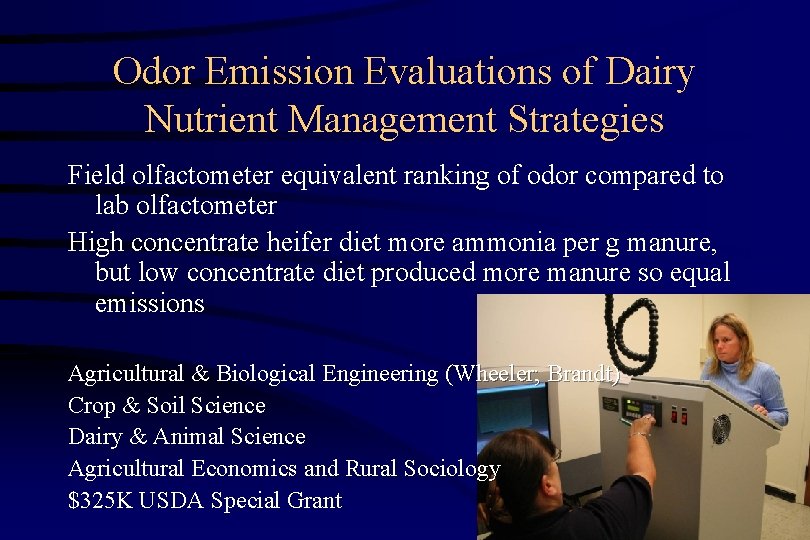
Odor Emission Evaluations of Dairy Nutrient Management Strategies Field olfactometer equivalent ranking of odor compared to lab olfactometer High concentrate heifer diet more ammonia per g manure, but low concentrate diet produced more manure so equal emissions Agricultural & Biological Engineering (Wheeler; Brandt) Crop & Soil Science Dairy & Animal Science Agricultural Economics and Rural Sociology $325 K USDA Special Grant
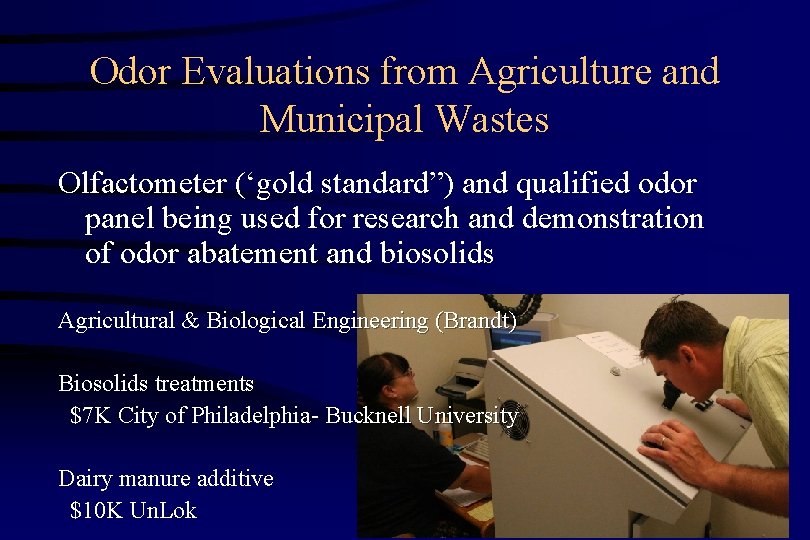
Odor Evaluations from Agriculture and Municipal Wastes Olfactometer (‘gold standard”) and qualified odor panel being used for research and demonstration of odor abatement and biosolids Agricultural & Biological Engineering (Brandt) Biosolids treatments $7 K City of Philadelphia- Bucknell University Dairy manure additive $10 K Un. Lok
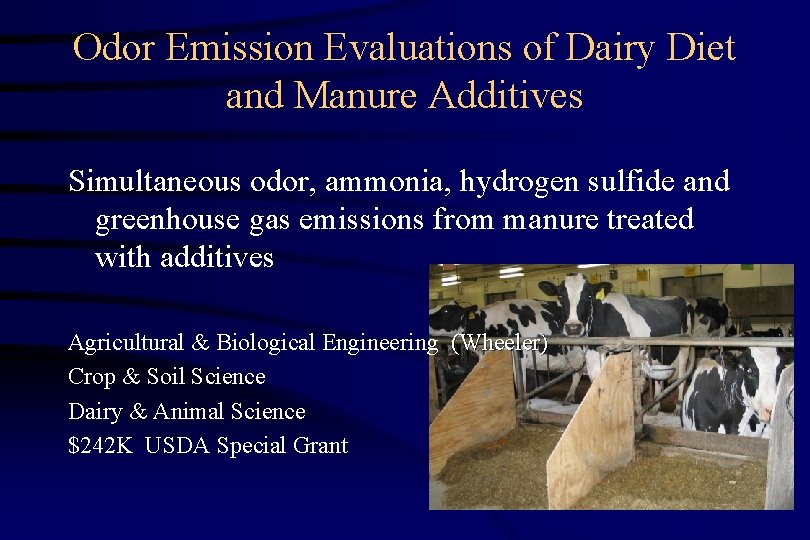
Odor Emission Evaluations of Dairy Diet and Manure Additives Simultaneous odor, ammonia, hydrogen sulfide and greenhouse gas emissions from manure treated with additives Agricultural & Biological Engineering (Wheeler) Crop & Soil Science Dairy & Animal Science $242 K USDA Special Grant
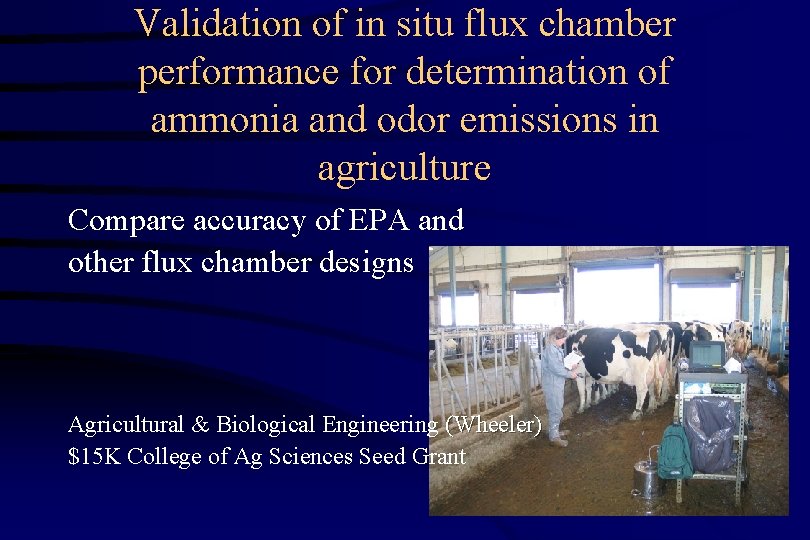
Validation of in situ flux chamber performance for determination of ammonia and odor emissions in agriculture Compare accuracy of EPA and other flux chamber designs Agricultural & Biological Engineering (Wheeler) $15 K College of Ag Sciences Seed Grant
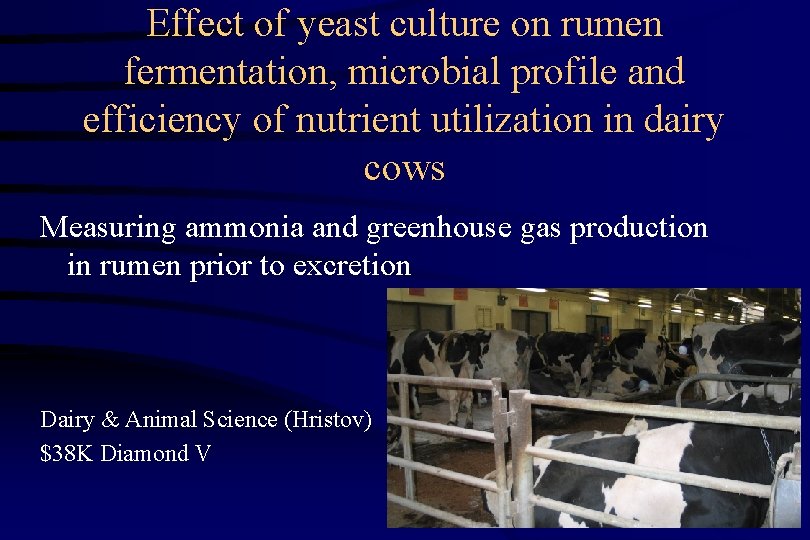
Effect of yeast culture on rumen fermentation, microbial profile and efficiency of nutrient utilization in dairy cows Measuring ammonia and greenhouse gas production in rumen prior to excretion Dairy & Animal Science (Hristov) $38 K Diamond V
Air Quality Extension and Education: Addressing Issues in Animal Agriculture Curriculum development for classroom and Extension use with audience of engineers and non-engineers Agricultural & Biological Engr. University of Nebraska (Stowell) University of Minnesota University of Idaho $500 K USDA NRI Air Quality
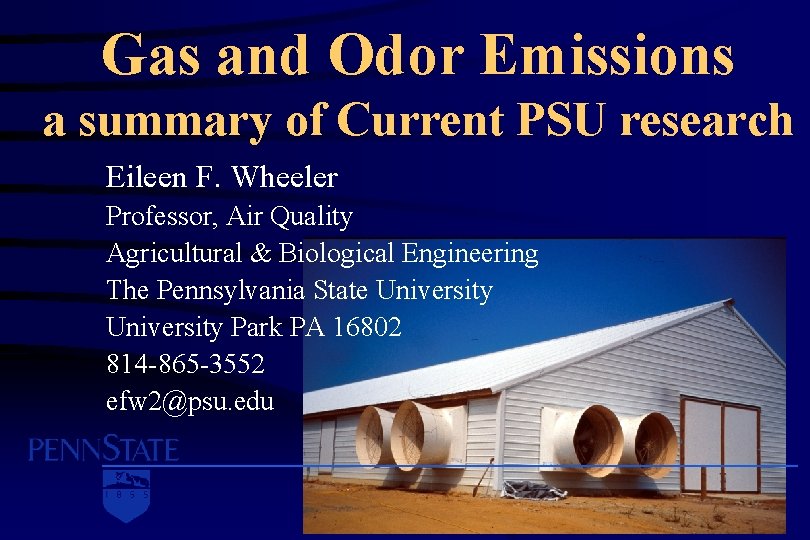
Gas and Odor Emissions a summary of Current PSU research Eileen F. Wheeler Professor, Air Quality Agricultural & Biological Engineering The Pennsylvania State University Park PA 16802 814 -865 -3552 efw 2@psu. edu
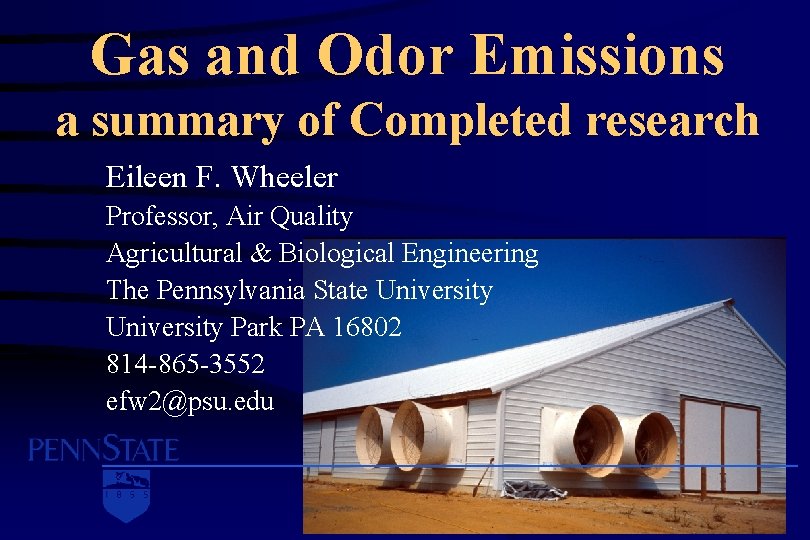
Gas and Odor Emissions a summary of Completed research Eileen F. Wheeler Professor, Air Quality Agricultural & Biological Engineering The Pennsylvania State University Park PA 16802 814 -865 -3552 efw 2@psu. edu
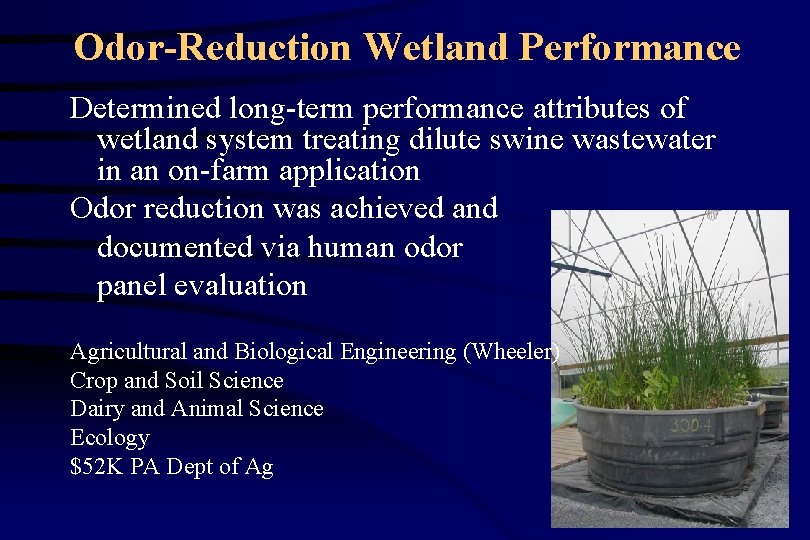
Odor-Reduction Wetland Performance Determined long-term performance attributes of wetland system treating dilute swine wastewater in an on-farm application Odor reduction was achieved and documented via human odor panel evaluation Agricultural and Biological Engineering (Wheeler) Crop and Soil Science Dairy and Animal Science Ecology $52 K PA Dept of Ag
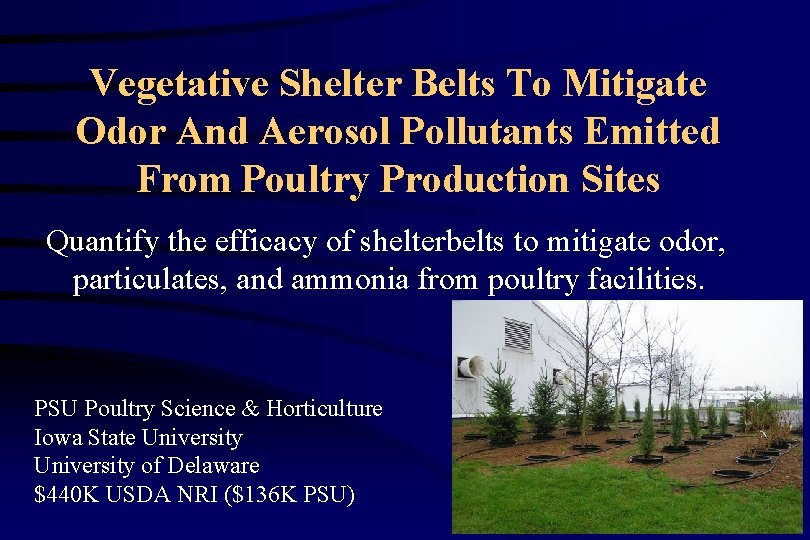
Vegetative Shelter Belts To Mitigate Odor And Aerosol Pollutants Emitted From Poultry Production Sites Quantify the efficacy of shelterbelts to mitigate odor, particulates, and ammonia from poultry facilities. PSU Poultry Science & Horticulture Iowa State University of Delaware $440 K USDA NRI ($136 K PSU)
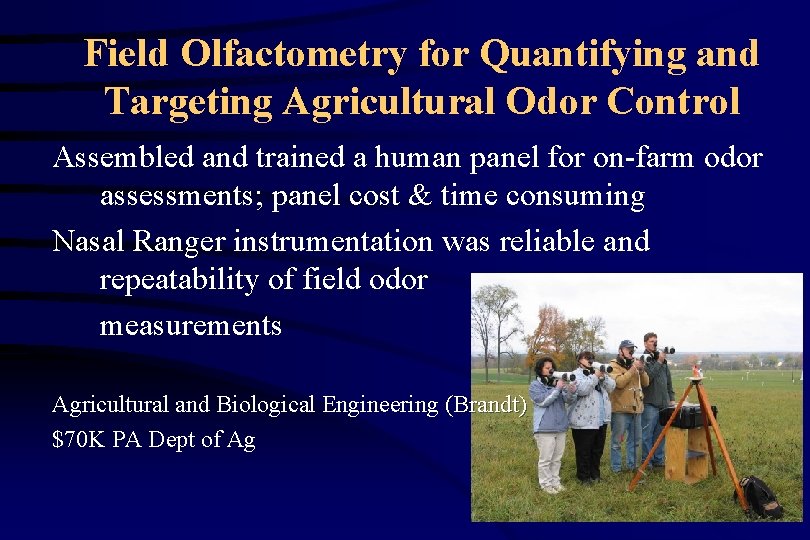
Field Olfactometry for Quantifying and Targeting Agricultural Odor Control Assembled and trained a human panel for on-farm odor assessments; panel cost & time consuming Nasal Ranger instrumentation was reliable and repeatability of field odor measurements Agricultural and Biological Engineering (Brandt) $70 K PA Dept of Ag
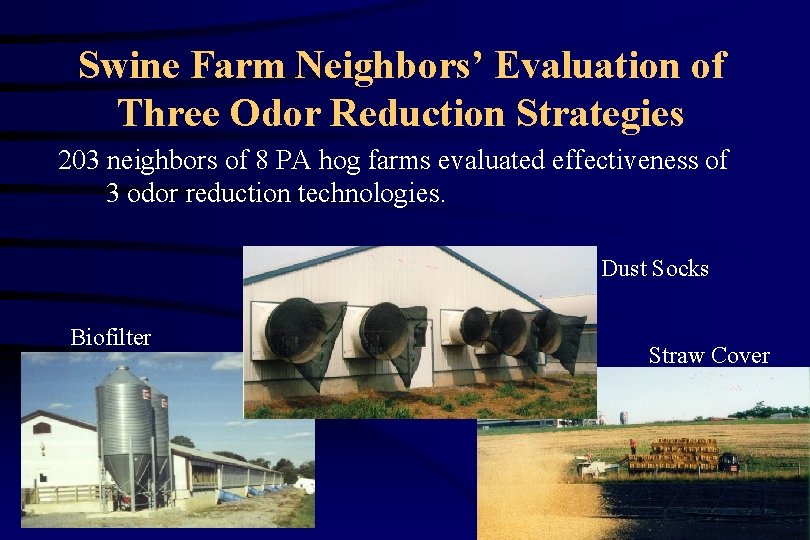
Swine Farm Neighbors’ Evaluation of Three Odor Reduction Strategies 203 neighbors of 8 PA hog farms evaluated effectiveness of 3 odor reduction technologies. Dust Socks Biofilter Straw Cover
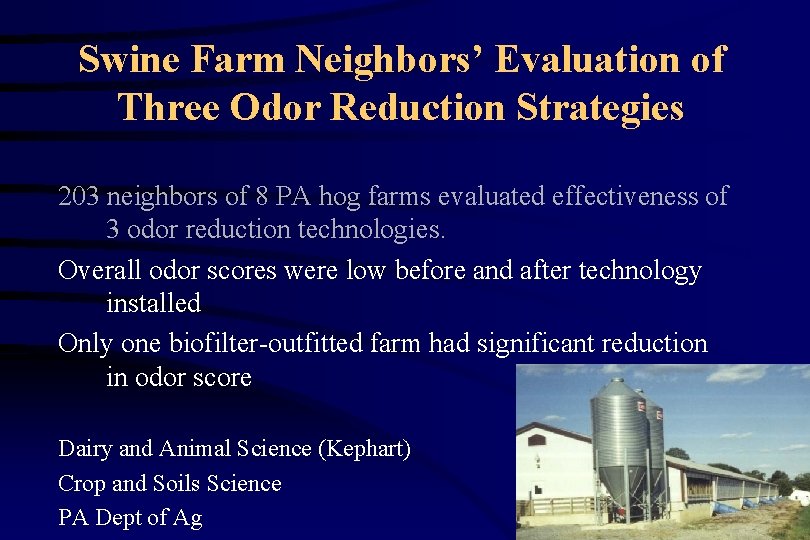
Swine Farm Neighbors’ Evaluation of Three Odor Reduction Strategies 203 neighbors of 8 PA hog farms evaluated effectiveness of 3 odor reduction technologies. Overall odor scores were low before and after technology installed Only one biofilter-outfitted farm had significant reduction in odor score Dairy and Animal Science (Kephart) Crop and Soils Science PA Dept of Ag
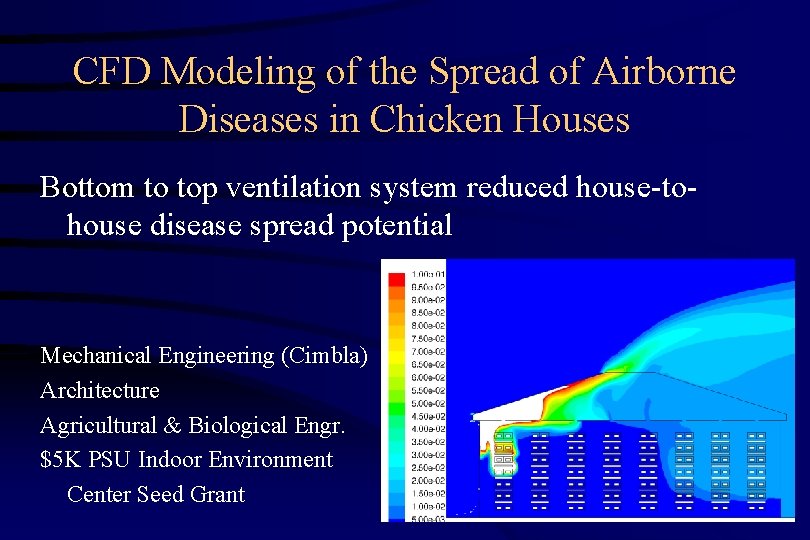
CFD Modeling of the Spread of Airborne Diseases in Chicken Houses Bottom to top ventilation system reduced house-tohouse disease spread potential Mechanical Engineering (Cimbla) Architecture Agricultural & Biological Engr. $5 K PSU Indoor Environment Center Seed Grant
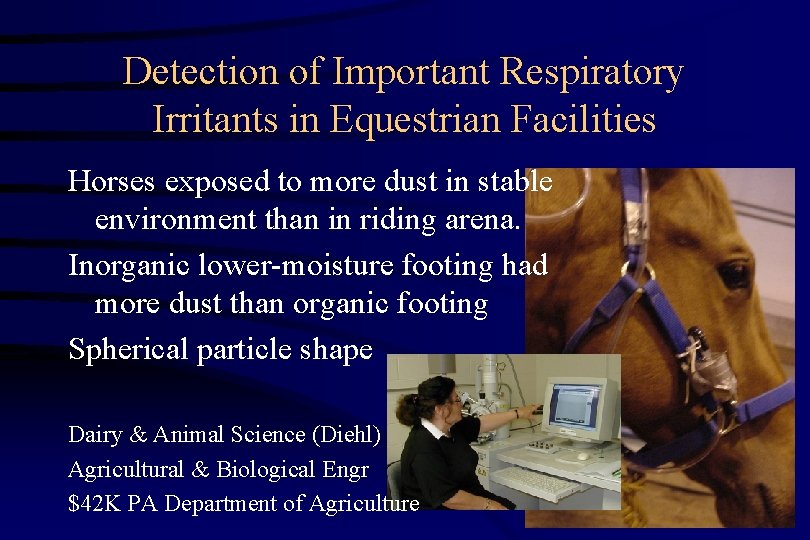
Detection of Important Respiratory Irritants in Equestrian Facilities Horses exposed to more dust in stable environment than in riding arena. Inorganic lower-moisture footing had more dust than organic footing Spherical particle shape Dairy & Animal Science (Diehl) Agricultural & Biological Engr $42 K PA Department of Agriculture
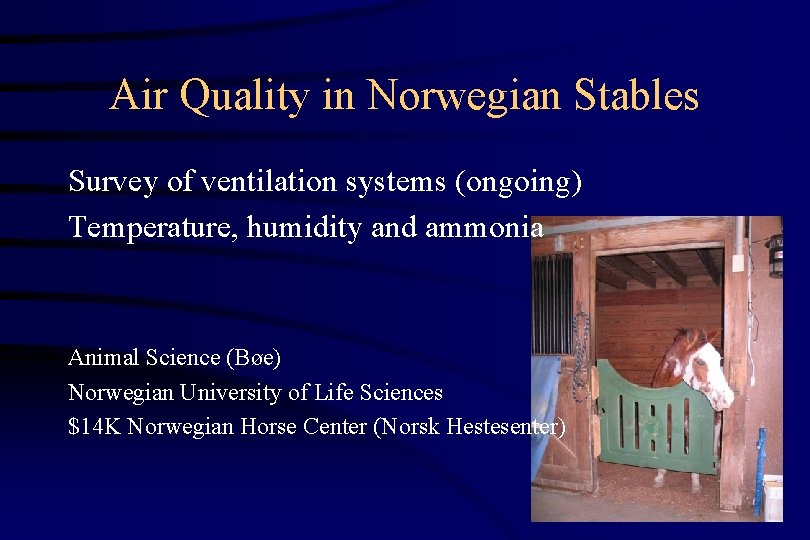
Air Quality in Norwegian Stables Survey of ventilation systems (ongoing) Temperature, humidity and ammonia Animal Science (Bøe) Norwegian University of Life Sciences $14 K Norwegian Horse Center (Norsk Hestesenter)
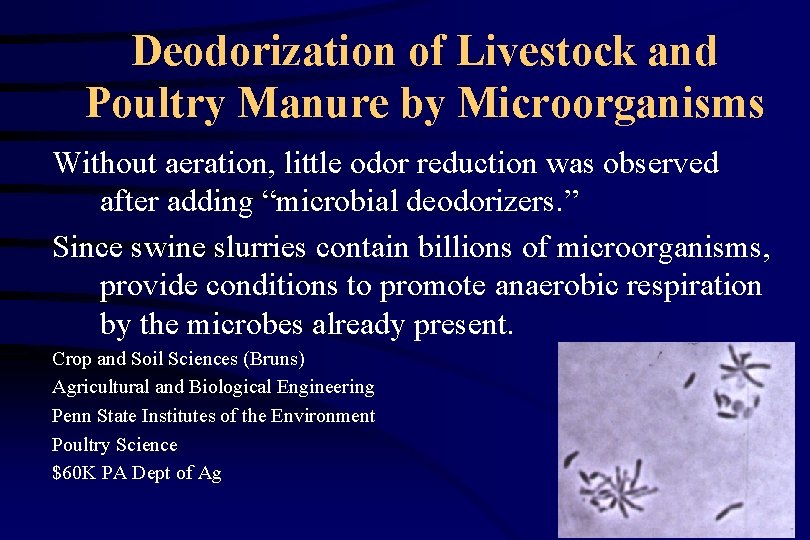
Deodorization of Livestock and Poultry Manure by Microorganisms Without aeration, little odor reduction was observed after adding “microbial deodorizers. ” Since swine slurries contain billions of microorganisms, provide conditions to promote anaerobic respiration by the microbes already present. Crop and Soil Sciences (Bruns) Agricultural and Biological Engineering Penn State Institutes of the Environment Poultry Science $60 K PA Dept of Ag
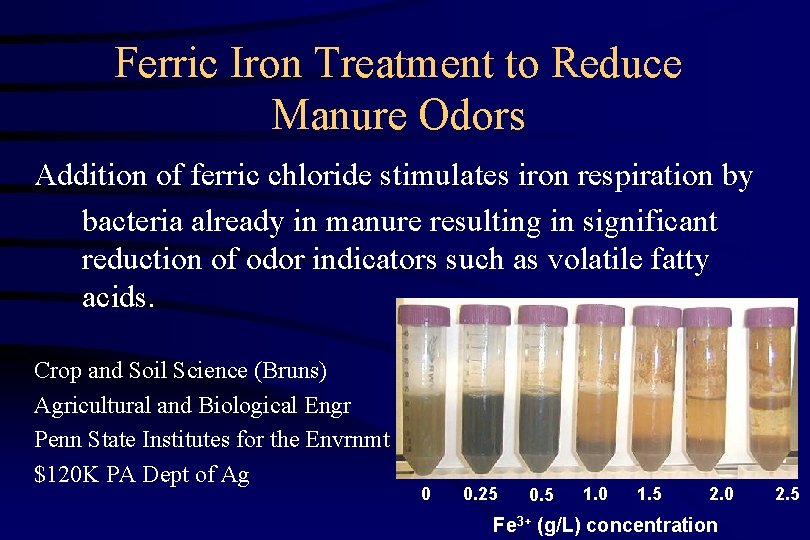
Ferric Iron Treatment to Reduce Manure Odors Addition of ferric chloride stimulates iron respiration by bacteria already in manure resulting in significant reduction of odor indicators such as volatile fatty acids. Crop and Soil Science (Bruns) Agricultural and Biological Engr Penn State Institutes for the Envrnmt $120 K PA Dept of Ag 0 0. 25 0. 5 1. 0 1. 5 2. 0 Fe 3+ (g/L) concentration 2. 5
Enzymatic Deodorization of Swine Manure Oxidation of odorants via horseradish peroxidase (present in plant tissue) and peroxide. Malodor reduced 50% according to human odor panel evaluation Gas chromatography demonstrated 100% removal of all phenolic odorants without reoccurrence for at least 72 hours. Penn State Institutes of the Environment (Dec) Agricultural and Biological Engineering Diary and Animal Science $119 K PA Dept of Ag
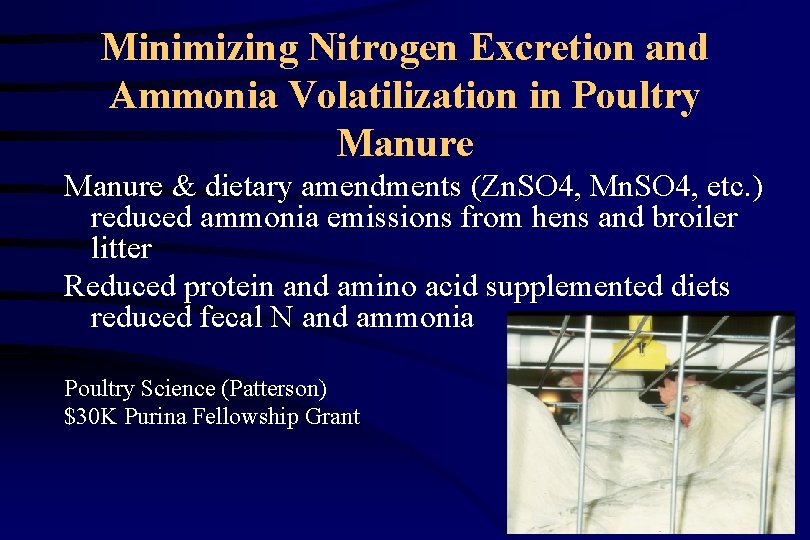
Minimizing Nitrogen Excretion and Ammonia Volatilization in Poultry Manure & dietary amendments (Zn. SO 4, Mn. SO 4, etc. ) reduced ammonia emissions from hens and broiler litter Reduced protein and amino acid supplemented diets reduced fecal N and ammonia Poultry Science (Patterson) $30 K Purina Fellowship Grant
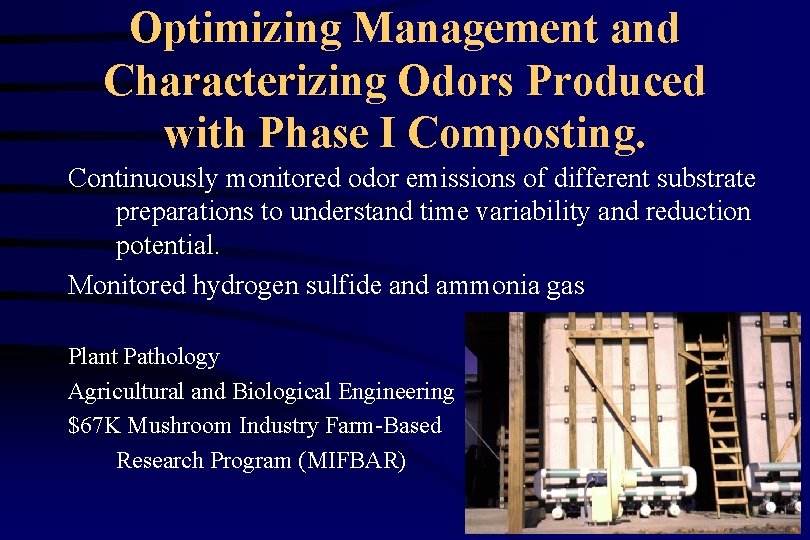
Optimizing Management and Characterizing Odors Produced with Phase I Composting. Continuously monitored odor emissions of different substrate preparations to understand time variability and reduction potential. Monitored hydrogen sulfide and ammonia gas Plant Pathology Agricultural and Biological Engineering $67 K Mushroom Industry Farm-Based Research Program (MIFBAR)
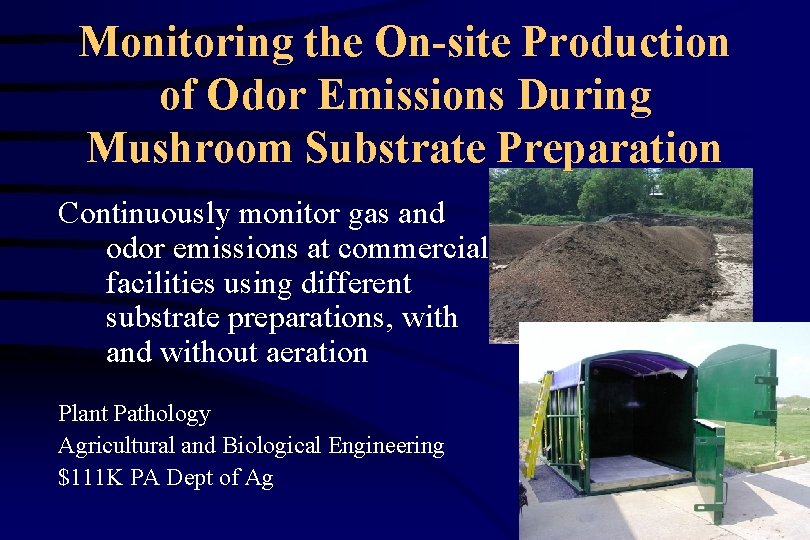
Monitoring the On-site Production of Odor Emissions During Mushroom Substrate Preparation Continuously monitor gas and odor emissions at commercial facilities using different substrate preparations, with and without aeration Plant Pathology Agricultural and Biological Engineering $111 K PA Dept of Ag
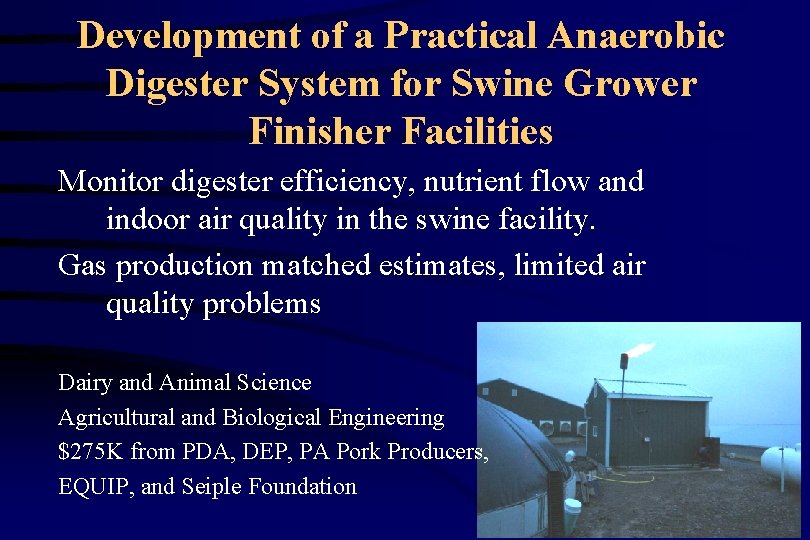
Development of a Practical Anaerobic Digester System for Swine Grower Finisher Facilities Monitor digester efficiency, nutrient flow and indoor air quality in the swine facility. Gas production matched estimates, limited air quality problems Dairy and Animal Science Agricultural and Biological Engineering $275 K from PDA, DEP, PA Pork Producers, EQUIP, and Seiple Foundation
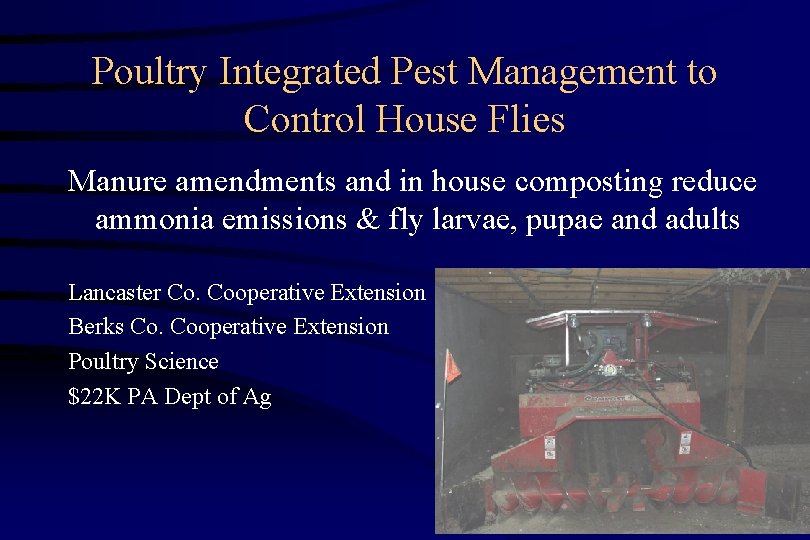
Poultry Integrated Pest Management to Control House Flies Manure amendments and in house composting reduce ammonia emissions & fly larvae, pupae and adults Lancaster Co. Cooperative Extension Berks Co. Cooperative Extension Poultry Science $22 K PA Dept of Ag
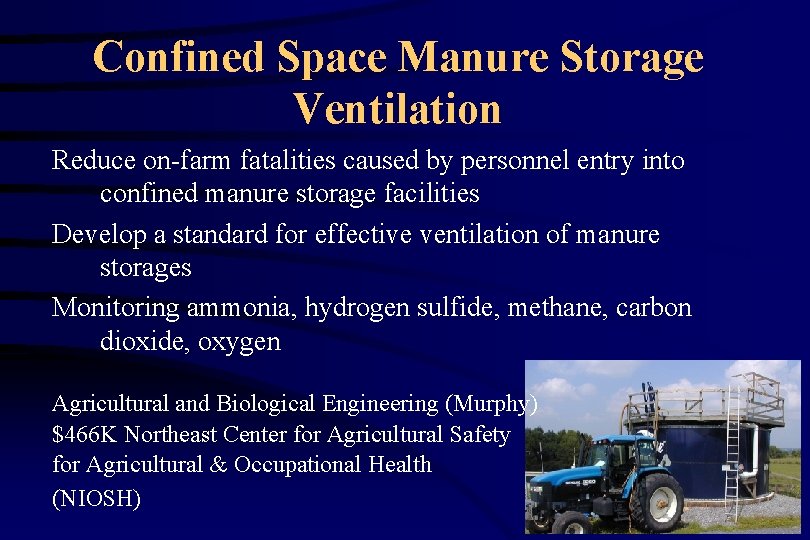
Confined Space Manure Storage Ventilation Reduce on-farm fatalities caused by personnel entry into confined manure storage facilities Develop a standard for effective ventilation of manure storages Monitoring ammonia, hydrogen sulfide, methane, carbon dioxide, oxygen Agricultural and Biological Engineering (Murphy) $466 K Northeast Center for Agricultural Safety for Agricultural & Occupational Health (NIOSH)
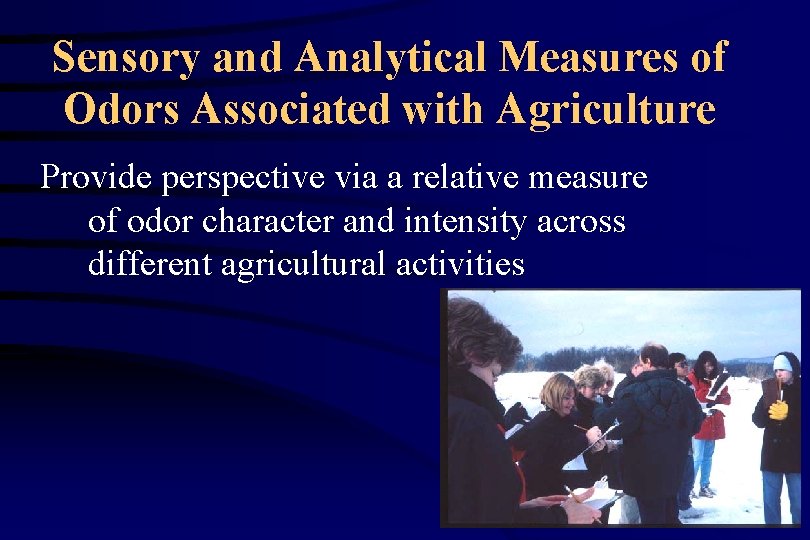
Sensory and Analytical Measures of Odors Associated with Agriculture Provide perspective via a relative measure of odor character and intensity across different agricultural activities
- Slides: 38