
PRESENTS FROM MY AUNTS IN By Moniza Alvi
PRESENTS FROM MY AUNTS IN By Moniza Alvi
THE BIG PICTURE During this unit we will: Read the poem Presents from My Aunts in Pakistan by Moniza Alvi Understand what is meant by the terms: word choice, simile, assonance, form and structure Discuss themes and meanings of the poem Write a critical essay about the poem
POETRY – TECHNIQUES AND TERMS Metaphor Simile Personification Alliteration Assonance Enjambment Stanza Setting Contrast
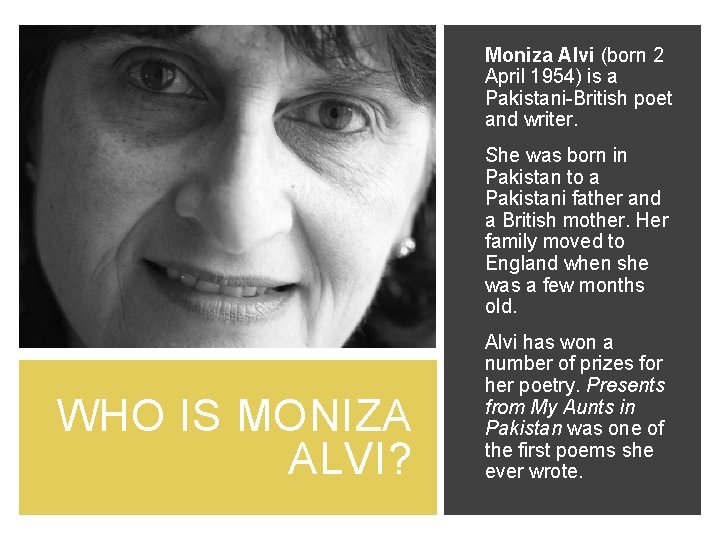
Moniza Alvi (born 2 April 1954) is a Pakistani-British poet and writer. She was born in Pakistan to a Pakistani father and a British mother. Her family moved to England when she was a few months old. WHO IS MONIZA ALVI? Alvi has won a number of prizes for her poetry. Presents from My Aunts in Pakistan was one of the first poems she ever wrote.
WE ARE NOW GOING TO READ THE POEM.
PRESENTS FROM MY AUNTS IN PAKISTAN They sent me a salwar kameez peacock-blue, and another glistening like an orange split open, embossed slippers, gold and black points curling. Candy-striped glass bangles snapped, drew blood. Like at school, fashions changed in Pakistan the salwar bottoms were broad and stiff, then narrow. My aunts chose an apple-green sari, silver-bordered for my teens.
PRESENTS FROM MY AUNTS IN PAKISTAN I tried each satin-silken top was alien in the sitting-room. I could never be as lovely as those clothes I longed for denim and corduroy. My costume clung to me and I was aflame, I couldn't rise up out of its fire, half-English, unlike Aunt Jamila.
PRESENTS FROM MY AUNTS IN PAKISTAN I wanted my parents' camel-skin lamp switching it on in my bedroom, to consider the cruelty and the transformation from camel to shade, marvel at the colours like stained glass.
PRESENTS FROM MY AUNTS IN PAKISTAN My mother cherished her jewellery Indian gold, dangling, filigree. But it was stolen from our car. The presents were radiant in my wardrobe. My aunts requested cardigans from Marks and Spencers.
PRESENTS FROM MY AUNTS IN PAKISTAN My salwar kameez didn't impress the schoolfriend who sat on my bed, asked to see my weekend clothes. But often I admired the mirror-work, tried to glimpse myself in the miniature glass circles, recall the story how the three of us sailed to England. Prickly heat had me screaming on the way. I ended up in a cot in my English grandmother's dining-room, found myself alone, playing with a tin boat.
PRESENTS FROM MY AUNTS IN PAKISTAN I pictured my birthplace from fifties' photographs. When I was older there was conflict, a fractured land throbbing through newsprint. Sometimes I saw Lahore my aunts in shaded rooms, screened from male visitors, sorting presents, wrapping them in tissue.
PRESENTS FROM MY AUNTS IN PAKISTAN Or there were beggars, sweeper-girls and I was there of no fixed nationality, staring through fretwork at the Shalimar Gardens.
WHAT IS PRESE NTS FROM MY AUNTS IN PAKIST AN ABOUT? This poem is about having a mixed cultural background, being half-English and half. Pakistani. The poem is about how confusing this was when Moniza Alvi was a young girl.
WHAT IS THE POEM ABOUT? Presents From My Aunts in Pakistan focuses on the feelings of a teenage girl who is caught between cultures, having a father from Pakistan and an English mother. It is set in the past, the speaker recalling the time she received the gifts. The poem is an exploration of cultural identity. The gifts she receives, vividly coloured traditional Pakistani clothes, bangles and shoes, both delight and confuse her. They set off a train of thoughts, feelings and memories that take the speaker all the way from England to Pakistan and back.
CULTURAL IDENTITY When we talk about cultural identity, we are talking about how we feel and identify within ourselves as part of the world around us. This could mean our nationality, our religion, our sexuality, our skin colour, and many other things. How would you describe your cultural identity?
WHAT IS THE POEM ABOUT? Above all, it is a person-centred poem, autobiographical. As the poet herself says: 'The girl in the poem would be me at about thirteen. The clothes seem to stick to her in an uncomfortable way, a bit like a kind of false skin, and she thinks things aren't straightforward for her. ’ She feels part of two different cultures, but also feels separate from them.
WHAT IS THE POEM ABOUT? The speaker of the poem is uncertain about herself and where she comes from, and how she fits in as a British. Pakistani person. There are some feelings of guilt about this uncertain attitude. There is a general sense of a young person trying to work who they are. The Pakistani clothes she is sent are made to sound vibrant and attractive, but this contrasts with the final stanzas, where we hear more negative things about the poet's 'home' country: For example, 'conflict' and 'beggars'. We also see a contrast between the British clothes she ‘longs’ for and the more negative aspects of British culture, like thieves stealing her mother’s jewellery from their car.
STRUCTURE Presents From My Aunts in Pakistan is a free verse poem of seven stanzas with a total of 68 lines. There is no set rhyme scheme. It is poem that appears restless on the page, moving from right to left as the lines become indented, shorter, staggered and longer. The form of the poem is irregular, with lines starting at different places, and being of different lengths. This creates a slightly unsettled, fluid feel to the poem, reflecting the poet's feelings about her identity.
WHAT IS THE MAIN THEME OF THIS POEM? Identity MID-TERM BREAK BY SEAMUS HEANEY
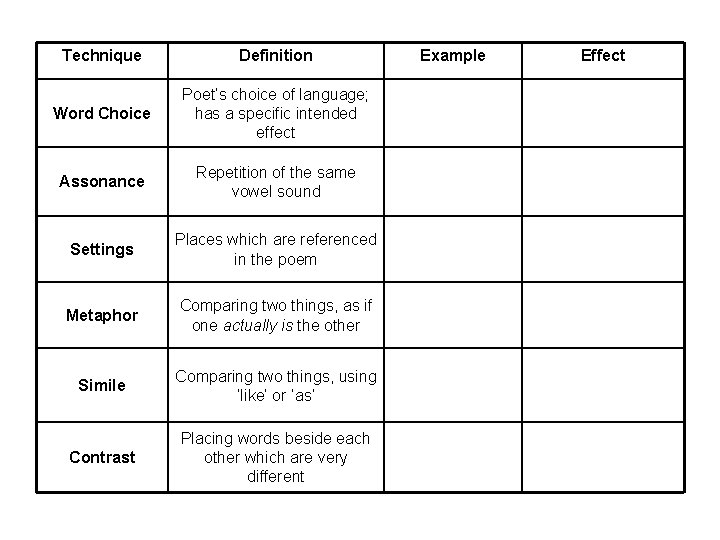
Technique Definition Word Choice Poet’s choice of language; has a specific intended effect Assonance Repetition of the same vowel sound Settings Places which are referenced in the poem Metaphor Comparing two things, as if one actually is the other Simile Comparing two things, using ‘like’ or ‘as’ Contrast Placing words beside each other which are very different Example Effect
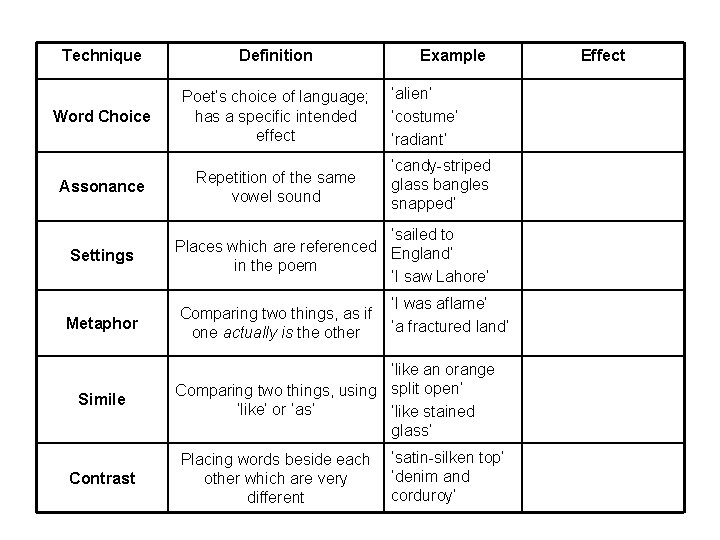
Technique Definition Word Choice Poet’s choice of language; has a specific intended effect Assonance Repetition of the same vowel sound Example ‘alien’ ‘costume’ ‘radiant’ ‘candy-striped glass bangles snapped’ Settings ‘sailed to Places which are referenced England’ in the poem ‘I saw Lahore’ Metaphor Comparing two things, as if one actually is the other Simile Contrast ‘I was aflame’ ‘a fractured land’ ‘like an orange Comparing two things, using split open’ ‘like’ or ‘as’ ‘like stained glass’ Placing words beside each other which are very different ‘satin-silken top’ ‘denim and corduroy’ Effect
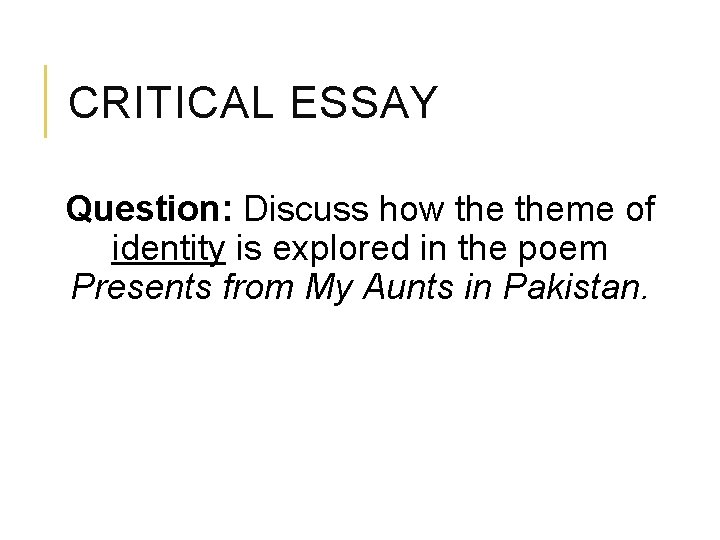
CRITICAL ESSAY Question: Discuss how theme of identity is explored in the poem Presents from My Aunts in Pakistan.
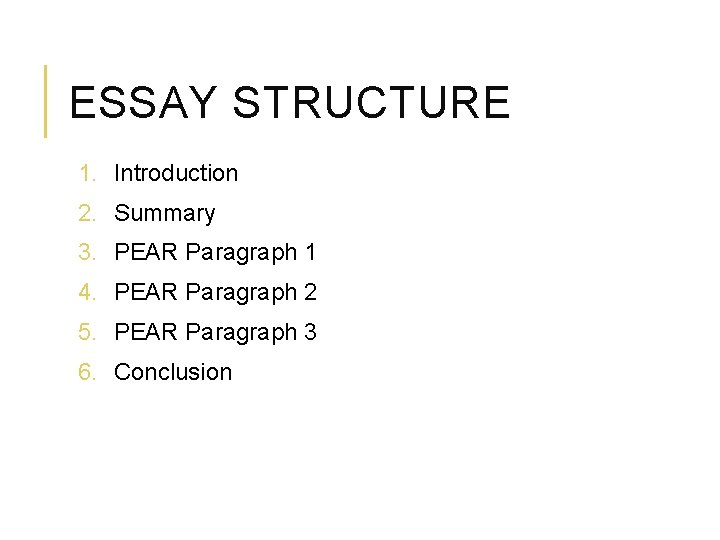
ESSAY STRUCTURE 1. Introduction 2. Summary 3. PEAR Paragraph 1 4. PEAR Paragraph 2 5. PEAR Paragraph 3 6. Conclusion
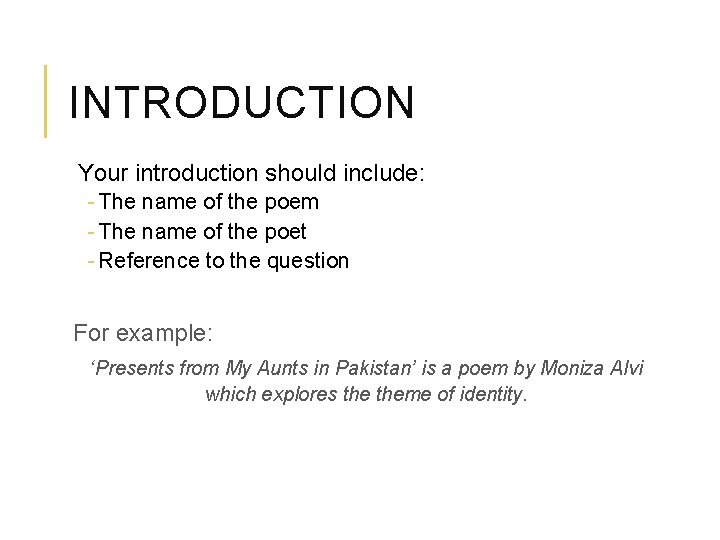
INTRODUCTION Your introduction should include: - The name of the poem - The name of the poet - Reference to the question For example: ‘Presents from My Aunts in Pakistan’ is a poem by Moniza Alvi which explores theme of identity.
SUMMARY Briefly summarise what the poem is about. For example: The poem is about a girl who is half-British and half. Pakistani, and explores the conflict and confusion within her about her cultural identity when her aunts send her clothes from Pakistan.
HOW IS THEME OF IDENTITY EXPLORED IN PRESENTS FROM MY AUNTS IN PAKISTAN? 1. Through metaphor 2. Through simile 3. Through word choice 4. Through contrast 5. Through setting
PEAR PARAGRAPHS We will be using PEAR paragraphs to structure the main body of our essays. PEAR stands for: Point Evidence Analysis Response
PEAR PARAGRAPHS Point – State what you will be discussing in the paragraph. For example: One way Alvi explores theme of identity is through word choice. Evidence – Give a quote from the poem. ‘My costume clung to me’.
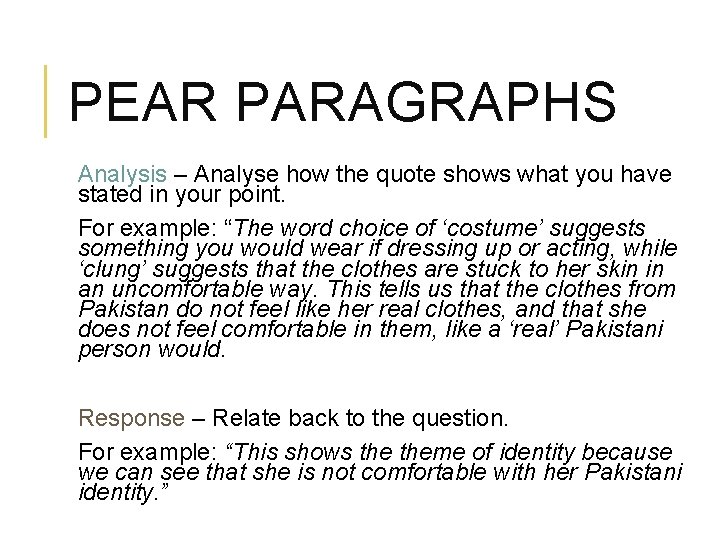
PEAR PARAGRAPHS Analysis – Analyse how the quote shows what you have stated in your point. For example: “The word choice of ‘costume’ suggests something you would wear if dressing up or acting, while ‘clung’ suggests that the clothes are stuck to her skin in an uncomfortable way. This tells us that the clothes from Pakistan do not feel like her real clothes, and that she does not feel comfortable in them, like a ‘real’ Pakistani person would. Response – Relate back to the question. For example: “This shows theme of identity because we can see that she is not comfortable with her Pakistani identity. ”
EXAMPLE PEAR PARAGRAPH One way Alvi explores theme of identity is through word choice.
EXAMPLE PEAR PARAGRAPH One way Alvi explores theme of identity is through word choice. ‘My costume clung to me’.
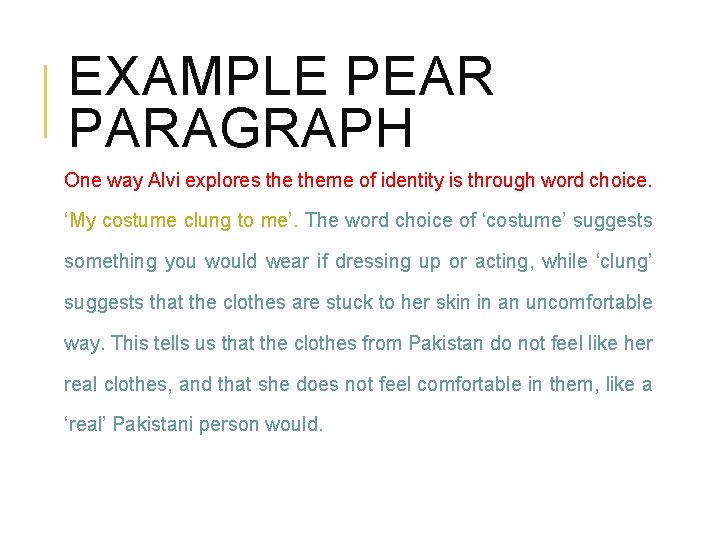
EXAMPLE PEAR PARAGRAPH One way Alvi explores theme of identity is through word choice. ‘My costume clung to me’. The word choice of ‘costume’ suggests something you would wear if dressing up or acting, while ‘clung’ suggests that the clothes are stuck to her skin in an uncomfortable way. This tells us that the clothes from Pakistan do not feel like her real clothes, and that she does not feel comfortable in them, like a ‘real’ Pakistani person would.
EXAMPLE PEAR PARAGRAPH One way Alvi explores theme of identity is through word choice. ‘My costume clung to me’. The word choice of ‘costume’ suggests something you would wear if dressing up or acting, while ‘clung’ suggests that the clothes are stuck to her skin in an uncomfortable way. This tells us that the clothes from Pakistan do not feel like her real clothes, and that she does not feel comfortable in them, like a ‘real’ Pakistani person would. This shows theme of identity because we can see that she is not comfortable with her Pakistani identity.
CONCLUSION Your conclusion should restate the name of the poem, the poet, and reference the question you have answered. You should then give your opinion of the poem – be detailed and insightful. For example: In conclusion, ‘Presents from My Aunts in Pakistan’ by Moniza Alvi is a poem which explores theme of identity. By using a range of techniques like _____, Alvi explores the experience of a girl who feels trapped between two cultures. In my opinion, this poem is…
ESSAY STRUCTURE 1. Introduction 2. Summary 3. PEAR Paragraph 1 4. PEAR Paragraph 2 5. PEAR Paragraph 3 6. Conclusion
- Slides: 35