Enterprise Resource Planning ERP Models Dr Merle Martin
- Slides: 47
Enterprise Resource Planning (ERP) Models Dr. Merle Martin Dr. Yan Xiong College of Business CSU Sacramento 10/06/03
Agenda What is ERP? t ERP Advantages and Disadvantages t Application Service Providers (ASP) t FHC – a Case Study t
What is an ERP System? “Packaged software designed to process an organization’s transactions and facilitate integrated and real-time planning, production and consumer response. ” Daniel O’Leary
ERP Definition t “ It attempts to integrate all departments and functions across a company onto a single computer system that can serve all those different departments’ particular needs” Koch, C 2002
ERP Suppliers In order of $ sales t SAP t People Soft t Oracle t Baan t J. D. Edwards t
ERP Market Info-Tech Consulting Group t 70% of Fortune 500 firms t 37% growth over next 5 years t Global market projected to $15 billion in 5 years t
Functions Integrated suite of software application models t Real-time database update t Supports organizations with multiple companies in multiple locations t Supports any number of currencies t
Functions (Cont. ) Supports multiple languages t Suitable to wide range of industries and organizations t Industry specific templates t
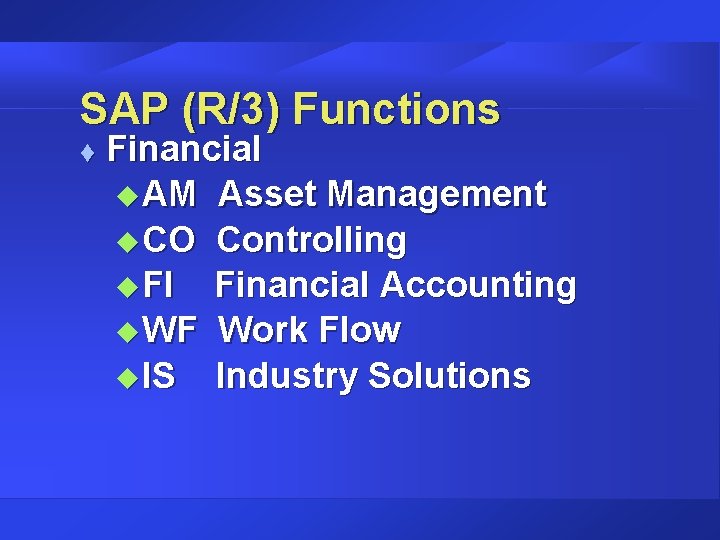
SAP (R/3) Functions t Financial u AM Asset Management u CO Controlling u FI Financial Accounting u WF Work Flow u IS Industry Solutions
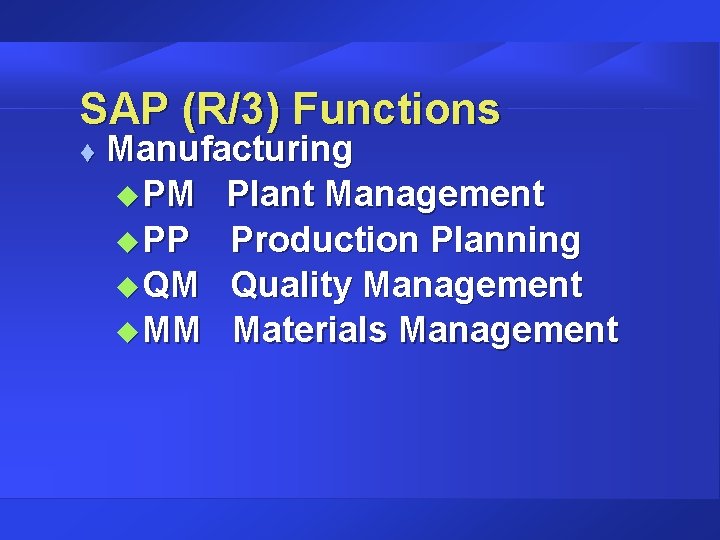
SAP (R/3) Functions t Manufacturing u PM Plant Management u PP Production Planning u QM Quality Management u MM Materials Management
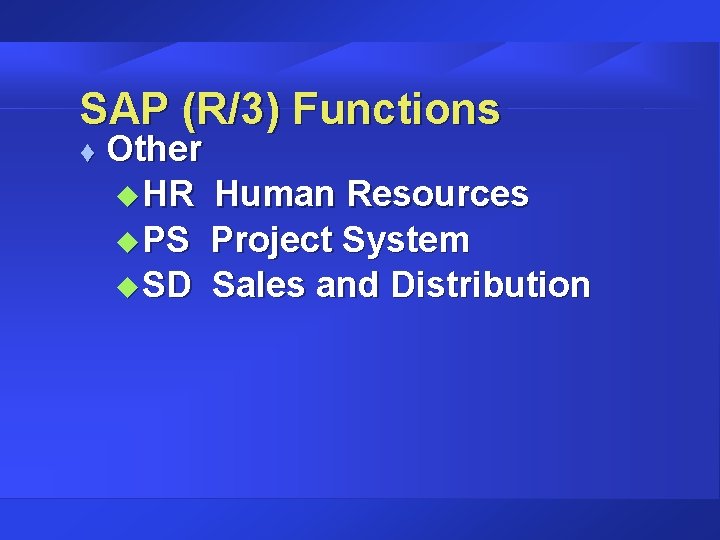
SAP (R/3) Functions t Other u HR Human Resources u PS Project System u SD Sales and Distribution
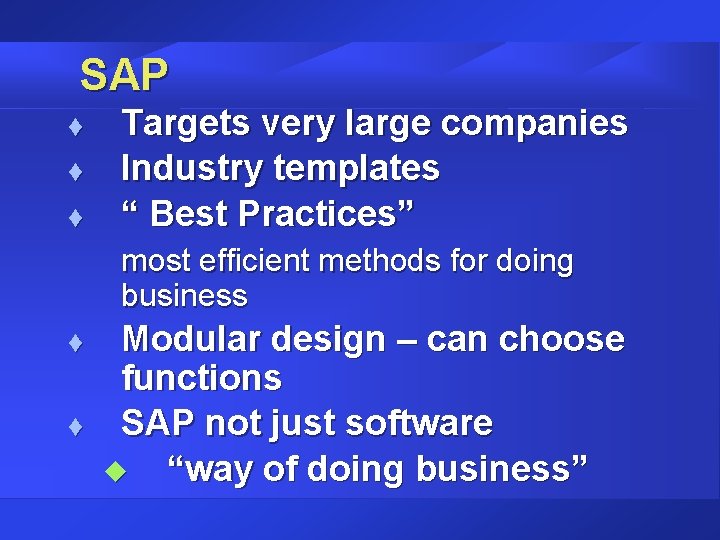
SAP t t t Targets very large companies Industry templates “ Best Practices” most efficient methods for doing business t t Modular design – can choose functions SAP not just software u “way of doing business”
People Soft Pure Internet environment t Entire CSU system converting over next few years. t Ease if use t
Oracle Has leveraged database dominance t Emphasis on security t Integration: linking applications, data. Web services, users and partners t
BAAN t Unique vertical market capabilities Chemicals Food& Beverage Pharmaceuticals Cable & Wire Pulp & Paper Primary Metals
JD Edwards Focus on mid-sized companies t Easy integration with current systems t Open, scalable, and flexible t
Agenda What is ERP? t ERP Disadvantage and Disadvantage t Application Service Providers (ASP) t FHC – a Case Study t
Why ERP? Highly competitive markets t Continually changing business environment t Need for integration u Within company u Between dispersed operations u Between alliance partners t
Why ERP? Reduce operating costs t Integrate operations (more control) t Increase organization’s time efficiency t Encompass different types of software t
ERP Advantages Integrates firm’s activities t Uses “ Best Practices” t Enables organizational standardization t Eliminates information asymmetries t Provides on-line/real-time information t
ERP Advantages Allows simultaneous access to information for planning and control t Facilities intra-organization collaboration t
ERP Advantages Eliminates redundant efforts and duplicated data u 33% of companies had sales order cost savings u 34% significantly reduced personnel needs t Faster movement of goods, services u more sales generated per month t
ERP Intangible t Keeping up with competitors Advantages Save vendor, customer frustration t Savings occur over several years t Implementation takes years t Some companies don’t make ROI calculations u too many intangibles t
ERP Disadvantages High cost (particularly for small business) t Privacy and security t Long implementation time t Displaces clerical employees t May have to change business to fit software t
ERP Costs t Total Costs: u License u Training u Implementation u Maintenance u Customization u Hardware required
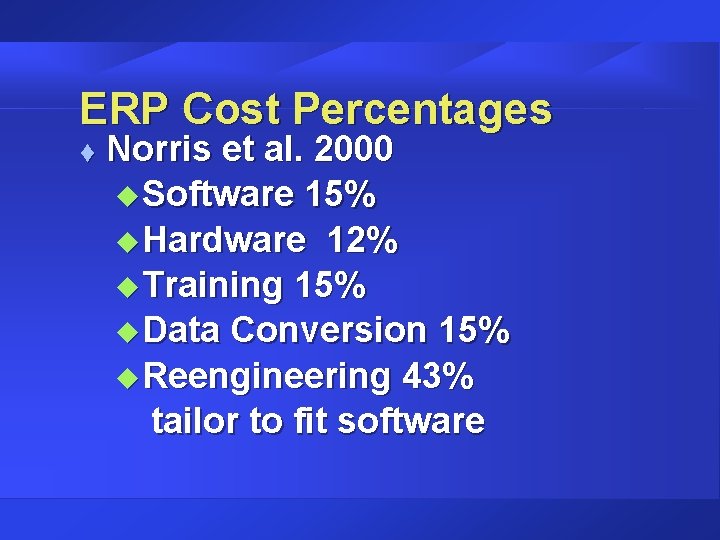
ERP Cost Percentages t Norris et al. 2000 u Software 15% u Hardware 12% u Training 15% u Data Conversion 15% u Reengineering 43% tailor to fit software
ERP Critical Success Factors Top management commitment t Management of change t Resistance to “overcustomization” u Heavy infrastructure difficult to change u Similar to battleship changing course t
Evaluating ERP Software Functional fit into company’s business t Flexibility and scalability t Complexity (Usability) t Shortened ROI periods t Ability to support multi-site planning and control t
Evaluating ERP Software Technology: u Client / server capabilities u Database independence t Availability of regular upgrades t Local support infrastructure t Availability of reference site t
Agenda What is ERP? t ERP Advantages and Disadvantages t Application Service Providers (ASP) t FHC – a Case Study t
Outsourcing ERP High costs ERP maintenance t ERP outsourcing? u install upgrades u maintain modules u trouble-shoot problems u police platforms t
Why Outsource ERP? Lack of specialized ERP staff skills t ERP specialists expensive u cheaper to use ERP outsourcer if don’t use skills on full-time basis t ERP upgrade releases very frequent t Firms want IT to focus on activities that “add value to t
Application Service t ASP Providers Lease expensive software packages such as SAP t Allow multiple users over internet t Charge users by the transaction t Provide startup services u tailoring and training t
Applications Deloitte & Touche t SAP t “Hyper Deploy” over Web t One change rather than many t Prospective customers can “play” with application t
ASP Problem t Confusing array of emerging ASPs: u “Pure Play”: founded explicitly for new ASP market u Application Vendor (e. g. , SAP) u Telecommunications Carriers and ISPs; v add ASPs to existing networks
ASP Problem Info-Tech Research predicts that, by year-end 2001, 60% of today’s ASPs will fail due to: u poor business models u choice of partners u failure to execute / consolidate their offerings t KEY DECISION: Gamble early or wait for market to “shake out”? t
Agenda What is ERP? t ERP Downsides t Application Service Providers t FHC – a Case Study t
FHS Foundation Health Systems t Fortune 500 firm t Was FHC (Corporation) before merger with Health Net t Created by merger of diverse heath provider companies throughout country t
FHS Needed to standardize language, culture, and “business rules” t IT Department proposed complete centralization of IT operations t IT centralization attempted, but met with severe resistance from local units t Abandoned shortly after t
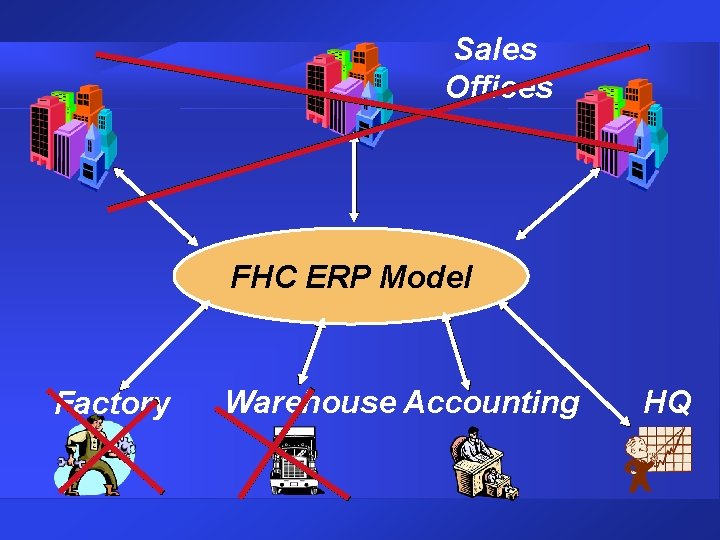
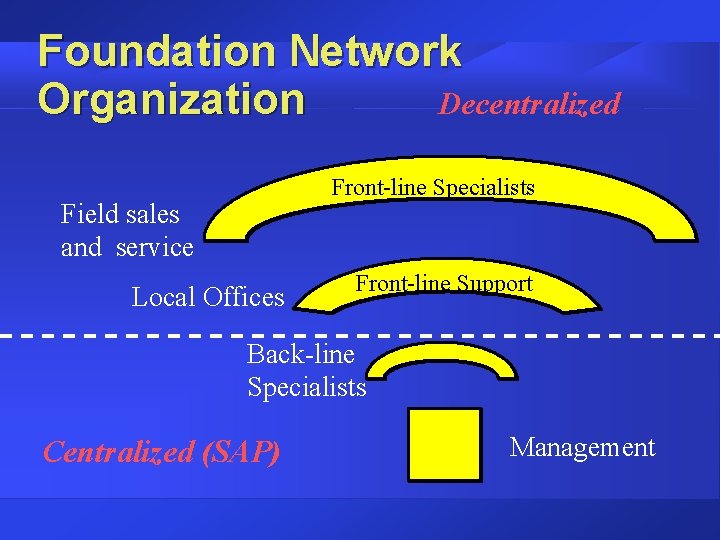
FHC ERP Goals Main objective: to standardize “back office” business rules t Wanted to change organization culture by means of software t Back-end centralized using SAP t Front-end decentralized by business unit u e. g. , Dental Care in Texas t
Sales Offices FHC ERP Model Factory Warehouse Accounting HQ
Foundation Network Organization Decentralized Front-line Specialists Field sales and service Local Offices Front-line Support Back-line Specialists Centralized (SAP) Management
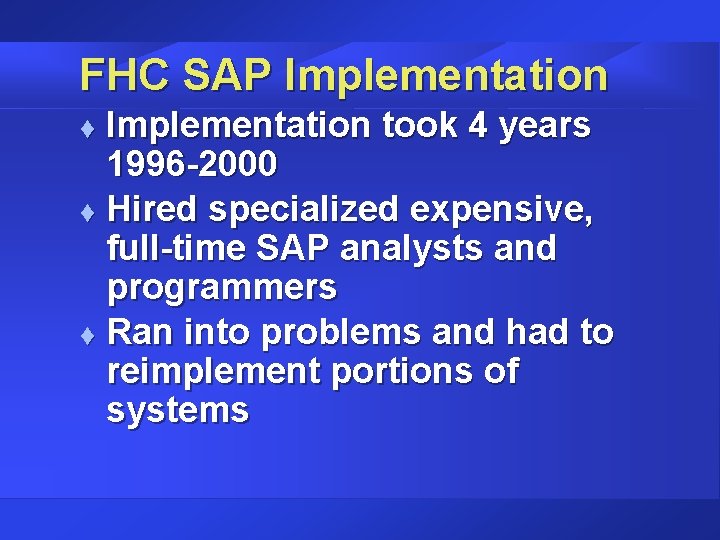
FHC SAP Implementation took 4 years 1996 -2000 t Hired specialized expensive, full-time SAP analysts and programmers t Ran into problems and had to reimplement portions of systems t
FHC ERP Problems integrating with existing legacy applications t Extensive upgrades t
FHC ERP Issues Why did they choose “ best practice” approach? t When didn’t they outsource ERP or ASP? t Why did they hire expensive SAP specialists who would not be needed in future? t Should ERP be used for organizational redesign? t
Issue Compare what is happening in the E-Business arena and the features of ERP. Is ERP compatible with the future of business? Why or why not?
Topics Discussed What is ERP? t ERP Advantages and Disadvantages t Application Service Providers t FHC – a Case Study t