Enterprise Resource Planning ERP Systems What is ERP


- Slides: 18
Enterprise Resource Planning (ERP) Systems
What is ERP? l An ERP system is an attempt to integrate all functions across a company to a single computer system that can serve all those functions’ specific needs. l “Integration” is the key word for ERP implementation.
What is ERP? l It may also integrate key customers and suppliers as part of the enterprise’s operation. l It provides integrated database and customdesigned report systems. l It adopts a set of “best practices” for carrying out all business processes.
Major Reasons for Adopting ERP l Integrate financial information l Integrate customer order information l Standardize and speed up operations processes l Reduce inventory l Standardize Human Resources information
Potential Benefits of ERP l Internal Benefits • Integration of a single source of data • Common data definition • A real-time system • Increased productivity • Reduced operating costs • Improved internal communication • Foundation for future improvement
Potential Benefits of ERP l External Benefits • Improved customer service and order fulfillment • Improved communication with suppliers and customers • Enhanced competitive position • Increased sales and profits
ERP Implementation Approaches l l l The big bang – install a single ERP system across the entire organization Franchising – Independent ERP systems are installed in different units linked by common processes, e. g. , bookkeeping. Slam dunk – install one or several ERP modules for phased implementation of key business processes.
Major Phases of ERP Implementation (Kent Sandoe, Enterprise Integration) l l l Initiation – develop business case, project scope, and implementation strategy Planning – establish implementation team, determine goals and objectives, establish metrics Analysis and process design – analyze and improve existing processes, map new processes to be adopted by the system
Major Phases of ERP Implementation (Kent Sandoe, Enterprise Integration) l l l Realization – install a base system, customization, and test the system Transition – replace the formal system with the new system, data conversion Operation – monitor and improve system performance, provide continued training and technical support
Major Challenges to ERP Implementation l Limitations of ERP technical capabilities l Inconsistency with existing business processes Costs - implementation (hardware, software, training, consulting) and maintenance Impact on organizational structure (front office vs. back office, product lines, etc. ) Changes in employee responsibilities l l l
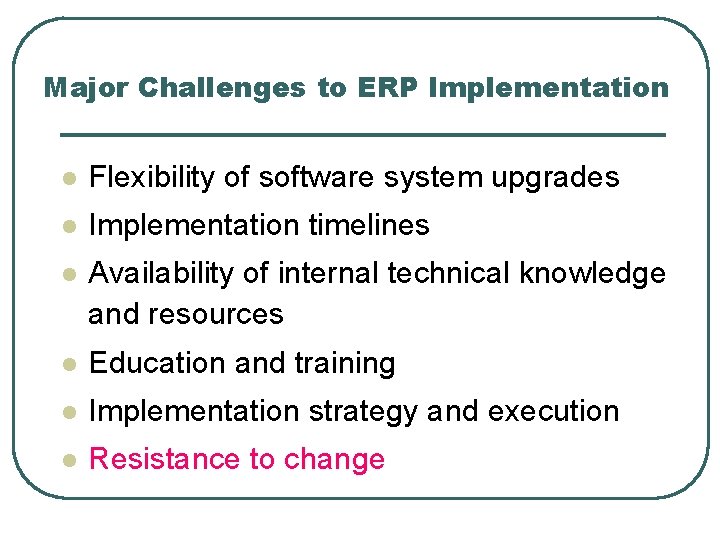
Major Challenges to ERP Implementation l Flexibility of software system upgrades l Implementation timelines l Availability of internal technical knowledge and resources l Education and training l Implementation strategy and execution l Resistance to change
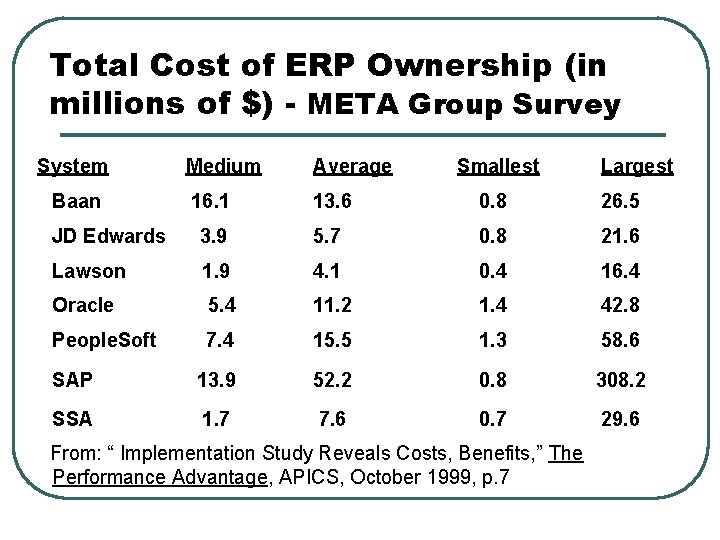
Total Cost of ERP Ownership (in millions of $) - META Group Survey System Medium Average 16. 1 13. 6 0. 8 26. 5 JD Edwards 3. 9 5. 7 0. 8 21. 6 Lawson 1. 9 4. 1 0. 4 16. 4 Oracle 5. 4 11. 2 1. 4 42. 8 People. Soft 7. 4 15. 5 1. 3 58. 6 SAP 13. 9 52. 2 0. 8 308. 2 SSA 1. 7 7. 6 0. 7 29. 6 Baan Smallest From: “ Implementation Study Reveals Costs, Benefits, ” The Performance Advantage, APICS, October 1999, p. 7 Largest
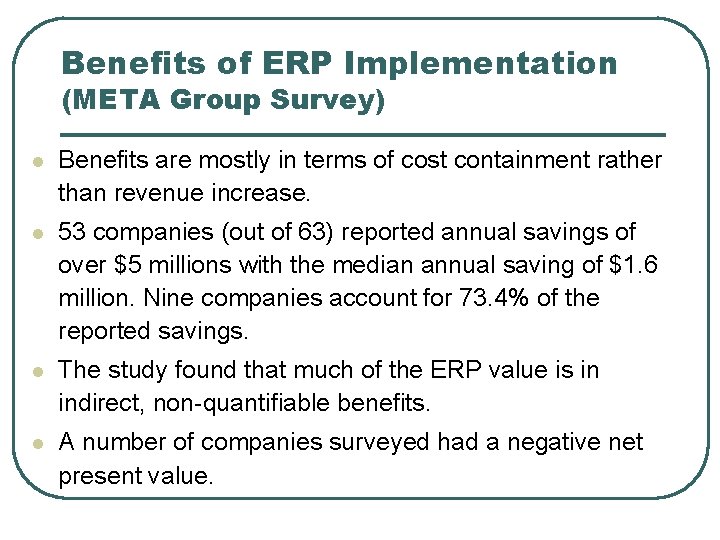
Benefits of ERP Implementation (META Group Survey) l Benefits are mostly in terms of cost containment rather than revenue increase. l 53 companies (out of 63) reported annual savings of over $5 millions with the median annual saving of $1. 6 million. Nine companies account for 73. 4% of the reported savings. l The study found that much of the ERP value is in indirect, non-quantifiable benefits. l A number of companies surveyed had a negative net present value.
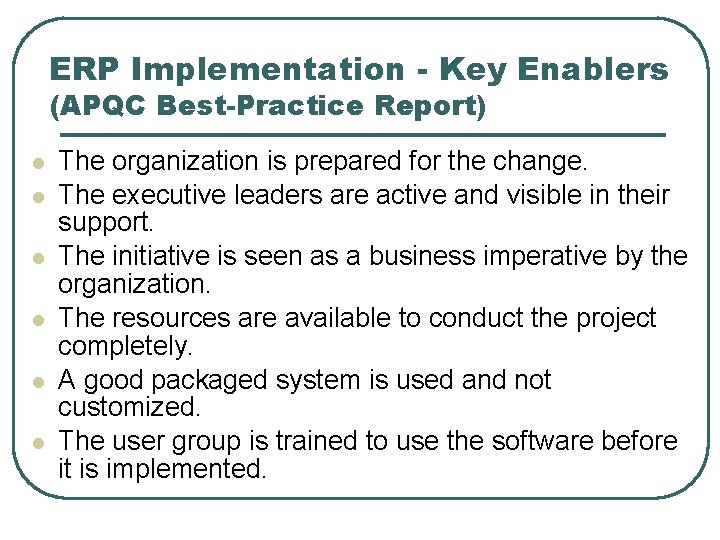
ERP Implementation - Key Enablers (APQC Best-Practice Report) l l l The organization is prepared for the change. The executive leaders are active and visible in their support. The initiative is seen as a business imperative by the organization. The resources are available to conduct the project completely. A good packaged system is used and not customized. The user group is trained to use the software before it is implemented.
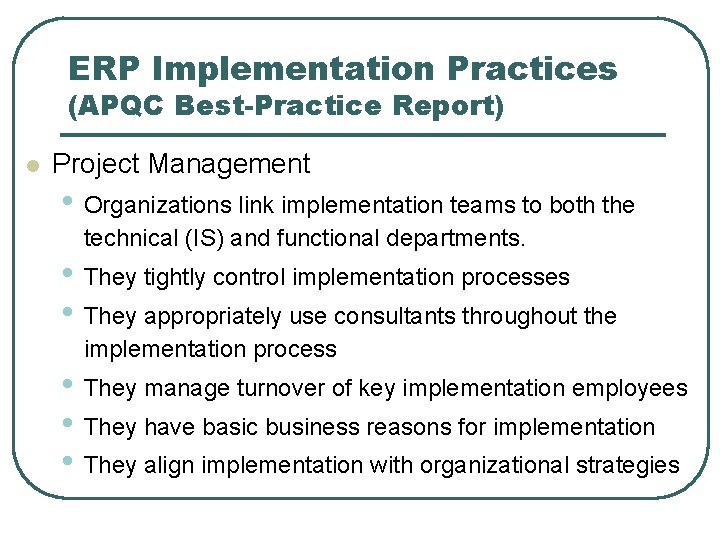
ERP Implementation Practices (APQC Best-Practice Report) l Project Management • Organizations link implementation teams to both the technical (IS) and functional departments. • They tightly control implementation processes • They appropriately use consultants throughout the implementation process • They manage turnover of key implementation employees • They have basic business reasons for implementation • They align implementation with organizational strategies
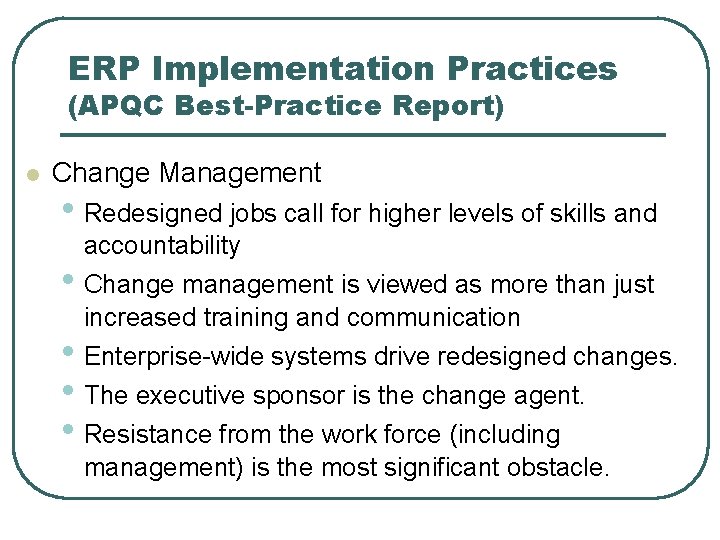
ERP Implementation Practices (APQC Best-Practice Report) l Change Management • Redesigned jobs call for higher levels of skills and accountability • Change management is viewed as more than just increased training and communication • Enterprise-wide systems drive redesigned changes. • The executive sponsor is the change agent. • Resistance from the work force (including management) is the most significant obstacle.
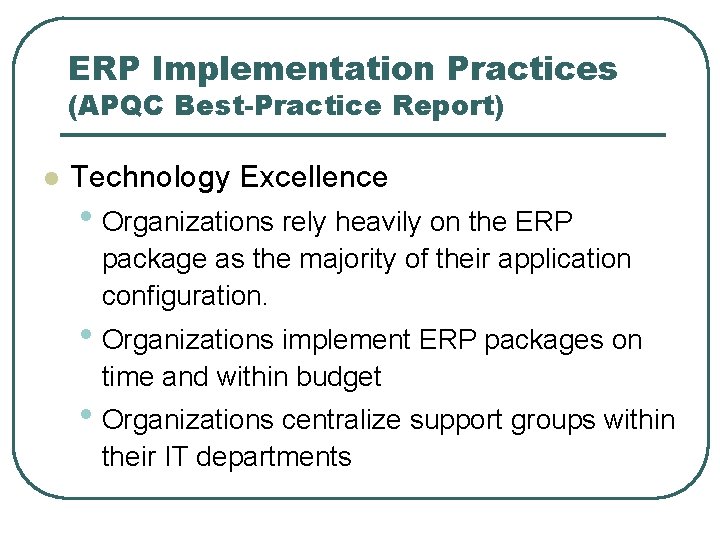
ERP Implementation Practices (APQC Best-Practice Report) l Technology Excellence • Organizations rely heavily on the ERP package as the majority of their application configuration. • Organizations implement ERP packages on time and within budget • Organizations centralize support groups within their IT departments
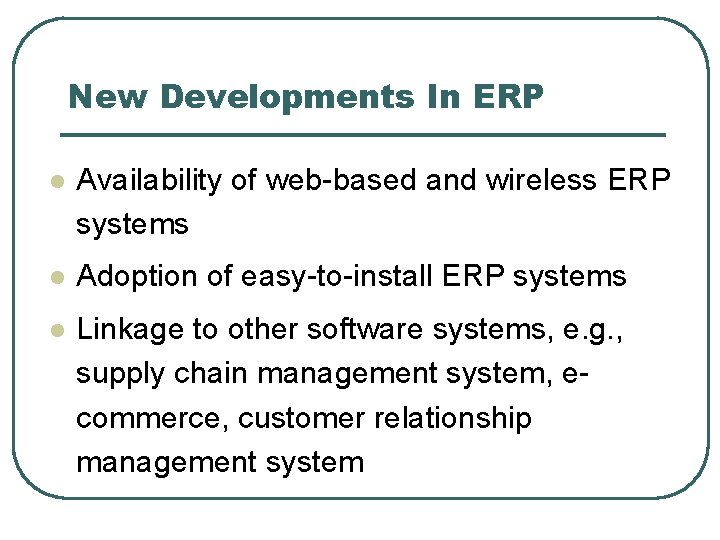
New Developments In ERP l Availability of web-based and wireless ERP systems l Adoption of easy-to-install ERP systems l Linkage to other software systems, e. g. , supply chain management system, ecommerce, customer relationship management system