EGR 2201 Unit 13 AC Power Analysis Read
- Slides: 43
EGR 2201 Unit 13 AC Power Analysis Read Alexander & Sadiku, Chapter 11. ¡ Homework #13 and Lab #13 due next week. ¡ Final Exam and Lab Exam next week. ¡
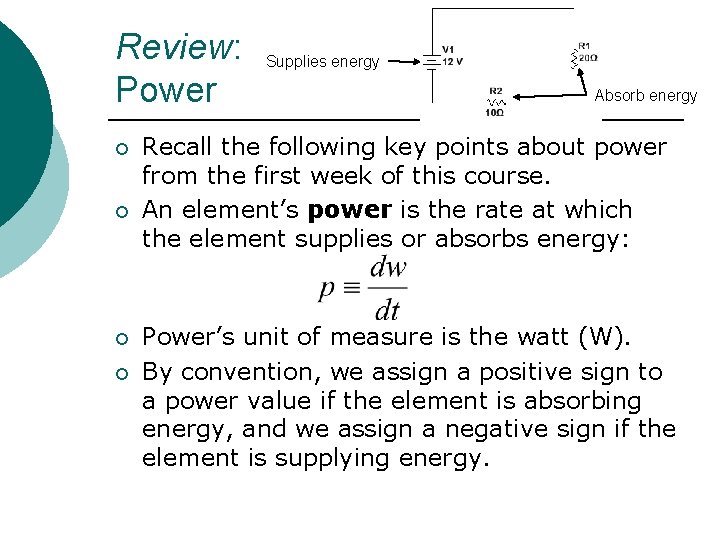
Review: Power ¡ ¡ Supplies energy Absorb energy Recall the following key points about power from the first week of this course. An element’s power is the rate at which the element supplies or absorbs energy: Power’s unit of measure is the watt (W). By convention, we assign a positive sign to a power value if the element is absorbing energy, and we assign a negative sign if the element is supplying energy.
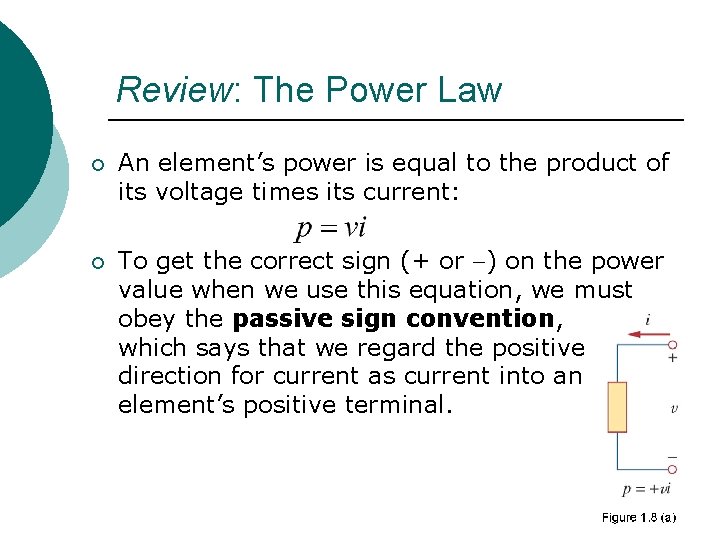
Review: The Power Law ¡ An element’s power is equal to the product of its voltage times its current: ¡ To get the correct sign (+ or ) on the power value when we use this equation, we must obey the passive sign convention, which says that we regard the positive direction for current as current into an element’s positive terminal.
Review: Dissipation versus Storage ¡ Recall also that resistors always absorb energy. They never supply energy. l l ¡ So a resistor’s power is always positive. The energy a resistor absorbs is lost (or “dissipated”) as heat. In contrast, inductors and capacitors are energy-storage elements. At times they may absorb energy, but at other times they may supply this energy back to the circuit. l So an inductor’s or capacitor’s power may be positive at one time but negative at another time.
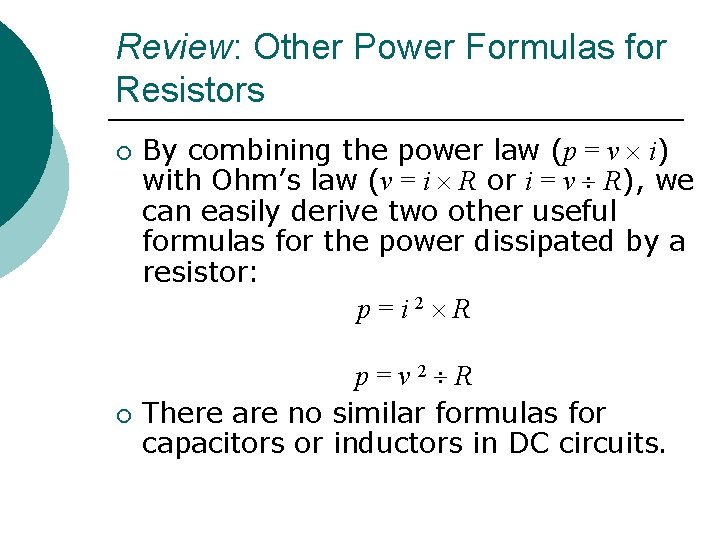
Review: Other Power Formulas for Resistors ¡ ¡ By combining the power law (p = v i) with Ohm’s law (v = i R or i = v R), we can easily derive two other useful formulas for the power dissipated by a resistor: p = i 2 R p = v 2 R There are no similar formulas for capacitors or inductors in DC circuits.
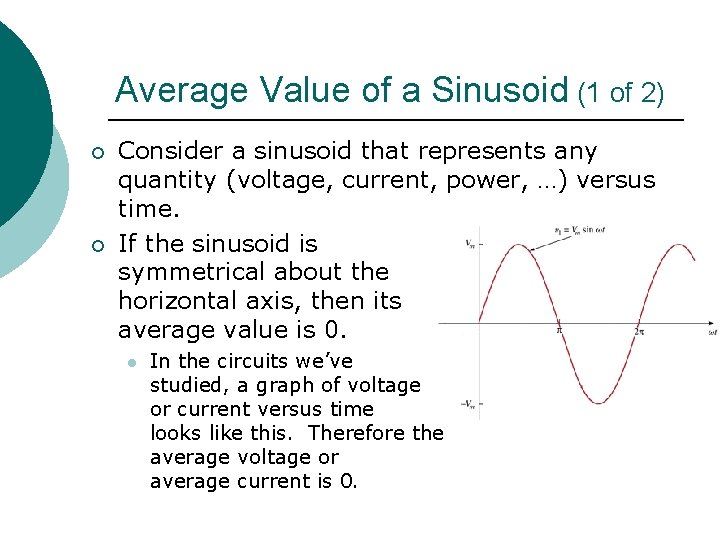
Average Value of a Sinusoid (1 of 2) ¡ ¡ Consider a sinusoid that represents any quantity (voltage, current, power, …) versus time. If the sinusoid is symmetrical about the horizontal axis, then its average value is 0. l In the circuits we’ve studied, a graph of voltage or current versus time looks like this. Therefore the average voltage or average current is 0.
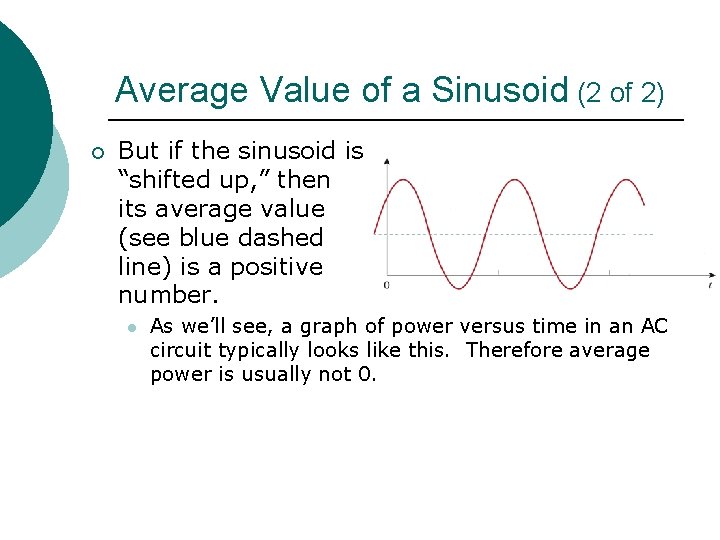
Average Value of a Sinusoid (2 of 2) ¡ But if the sinusoid is “shifted up, ” then its average value (see blue dashed line) is a positive number. l As we’ll see, a graph of power versus time in an AC circuit typically looks like this. Therefore average power is usually not 0.
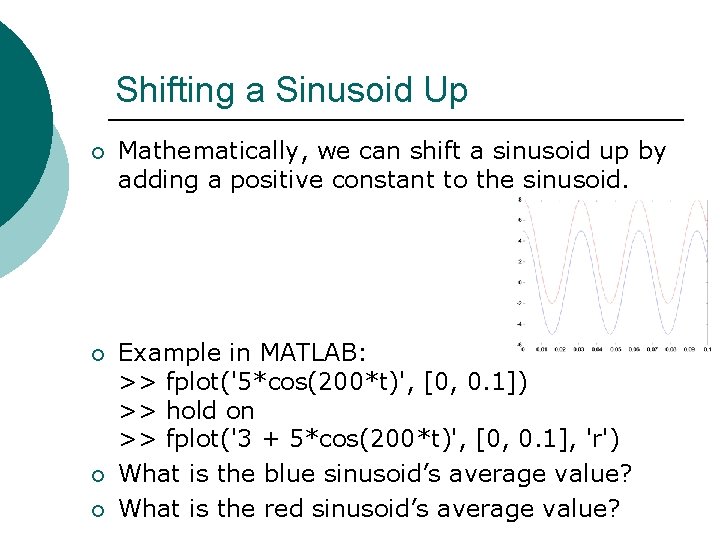
Shifting a Sinusoid Up ¡ Mathematically, we can shift a sinusoid up by adding a positive constant to the sinusoid. ¡ Example in MATLAB: >> fplot('5*cos(200*t)', [0, 0. 1]) >> hold on >> fplot('3 + 5*cos(200*t)', [0, 0. 1], 'r') What is the blue sinusoid’s average value? What is the red sinusoid’s average value? ¡ ¡
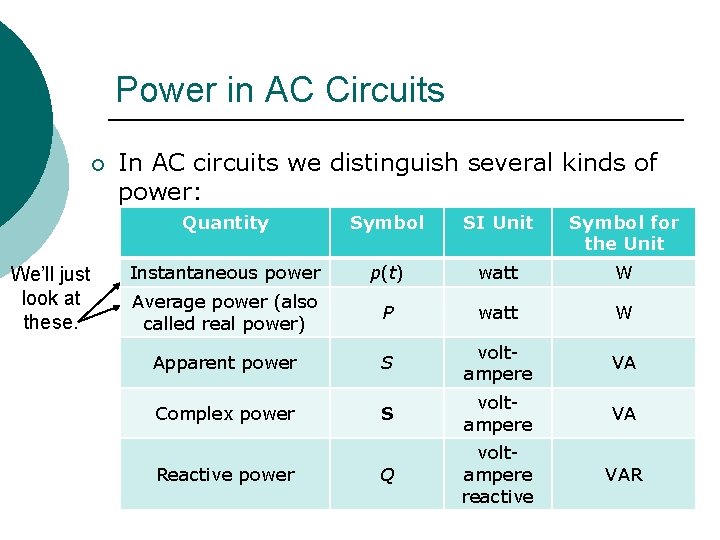
Power in AC Circuits ¡ We’ll just look at these. In AC circuits we distinguish several kinds of power: Quantity Symbol SI Unit Symbol for the Unit Instantaneous power p(t) watt W Average power (also called real power) P watt W Apparent power S voltampere VA Complex power S voltampere VA Q voltampere reactive VAR Reactive power
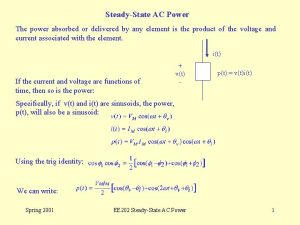
Instantaneous Power ¡ ¡ ¡ To find an element’s or network’s instantaneous power, use the same power formula as for DC circuits: The t reminds us that in AC circuits, voltage and current change with time. So instantaneous power also changes with time. This equation holds whether the source is sinusoidal, triangle, square, etc. But we’ll focus on the sinusoidal case.
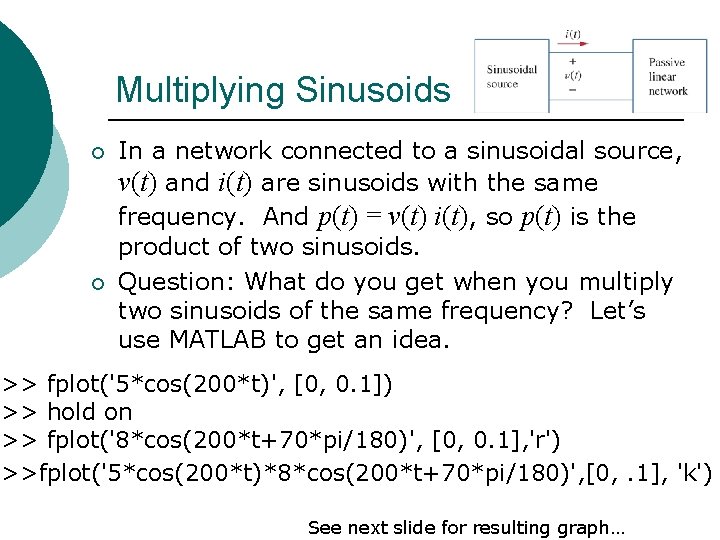
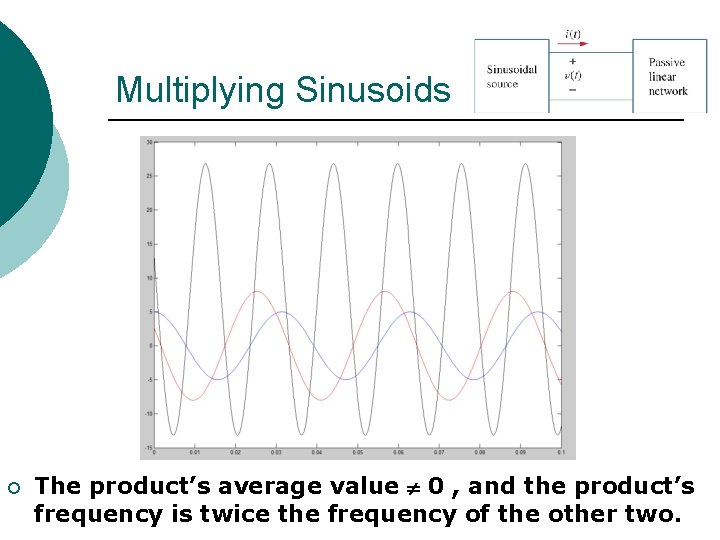
Multiplying Sinusoids ¡ ¡ In a network connected to a sinusoidal source, v(t) and i(t) are sinusoids with the same frequency. And p(t) = v(t) i(t), so p(t) is the product of two sinusoids. Question: What do you get when you multiply two sinusoids of the same frequency? Let’s use MATLAB to get an idea. >> fplot('5*cos(200*t)', [0, 0. 1]) >> hold on >> fplot('8*cos(200*t+70*pi/180)', [0, 0. 1], 'r') >>fplot('5*cos(200*t)*8*cos(200*t+70*pi/180)', [0, . 1], 'k') See next slide for resulting graph…
Multiplying Sinusoids ¡ The product’s average value 0 , and the product’s frequency is twice the frequency of the other two.
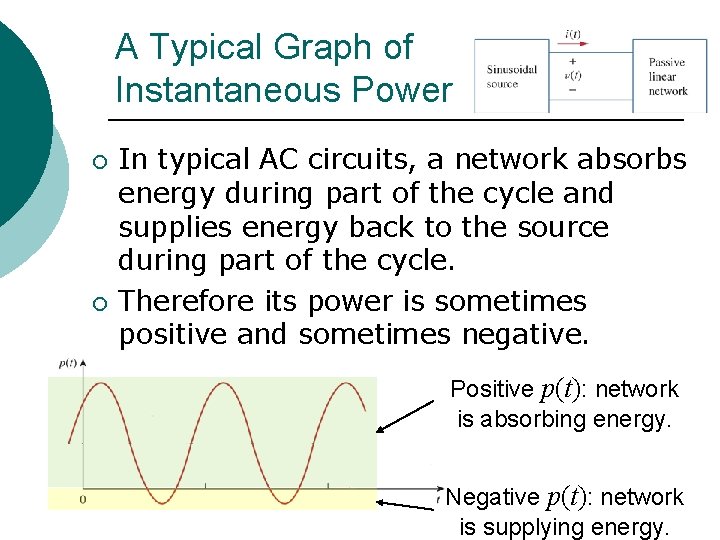
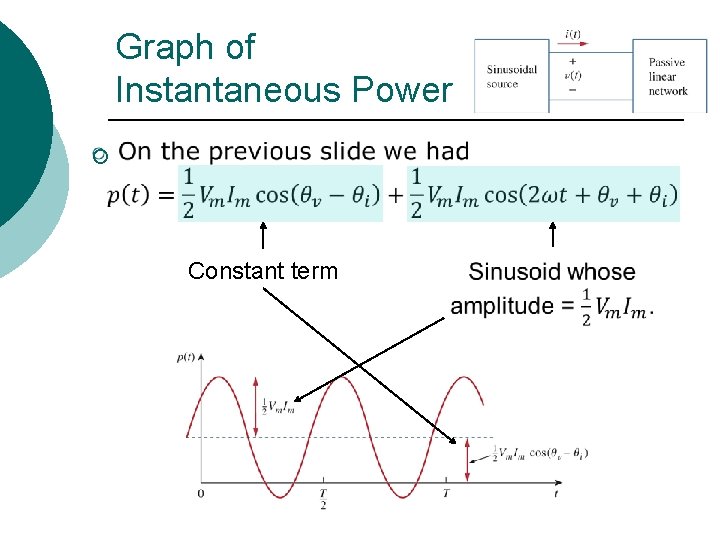
A Typical Graph of Instantaneous Power ¡ ¡ In typical AC circuits, a network absorbs energy during part of the cycle and supplies energy back to the source during part of the cycle. Therefore its power is sometimes positive and sometimes negative. Positive p(t): network is absorbing energy. Negative p(t): network is supplying energy.
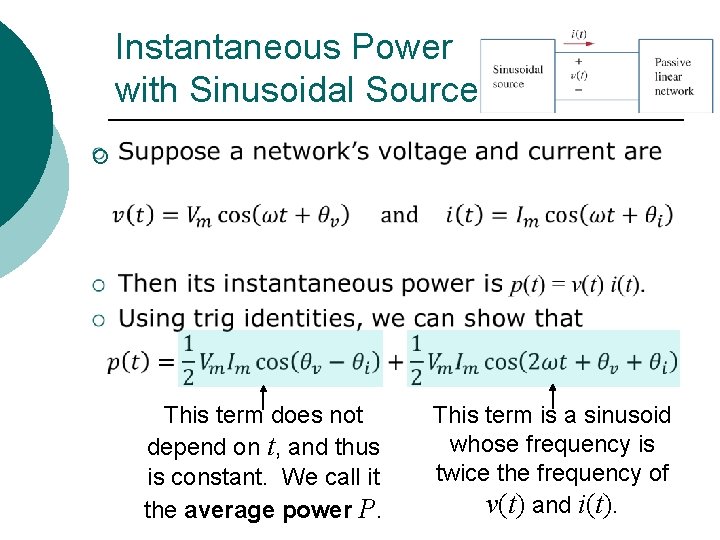
Instantaneous Power with Sinusoidal Source ¡ This term does not depend on t, and thus is constant. We call it the average power P. This term is a sinusoid whose frequency is twice the frequency of v(t) and i(t).
Graph of Instantaneous Power ¡ Constant term
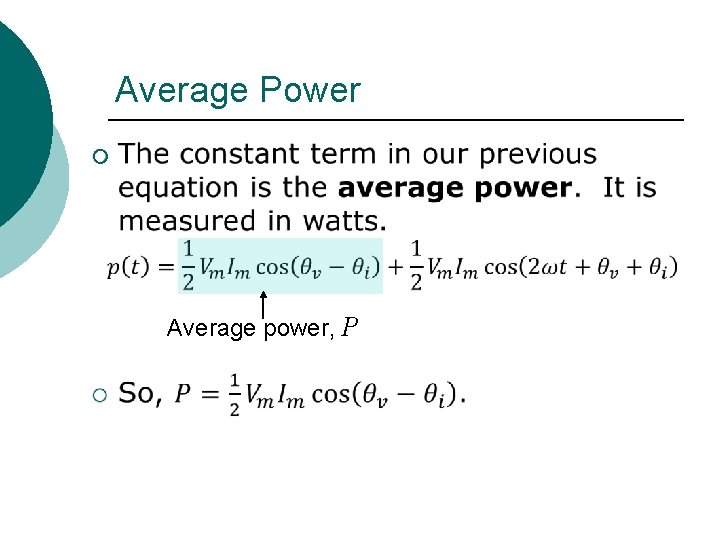
Average Power ¡ Average power, P
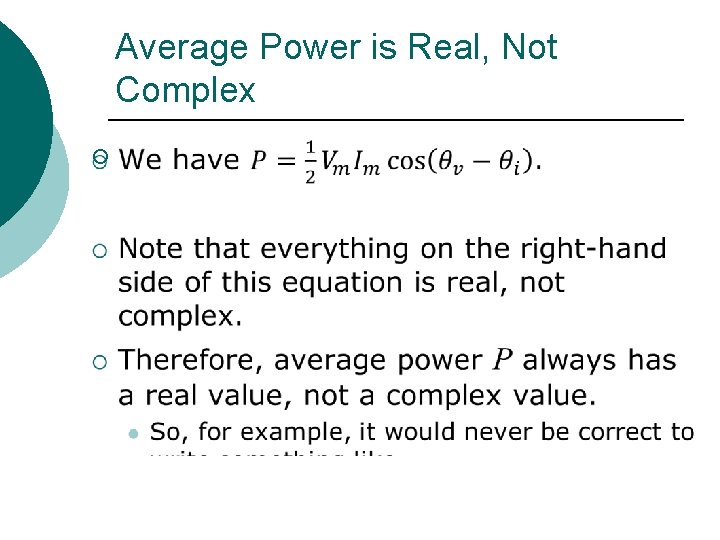
Average Power is Real, Not Complex ¡
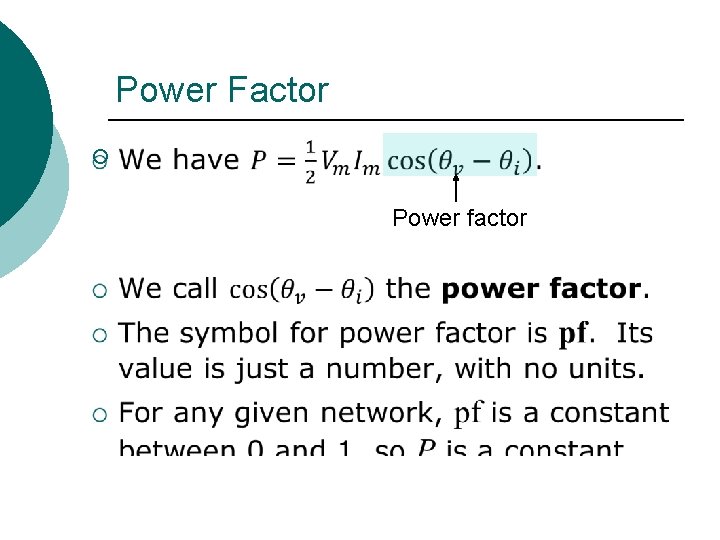
Power Factor ¡ Power factor
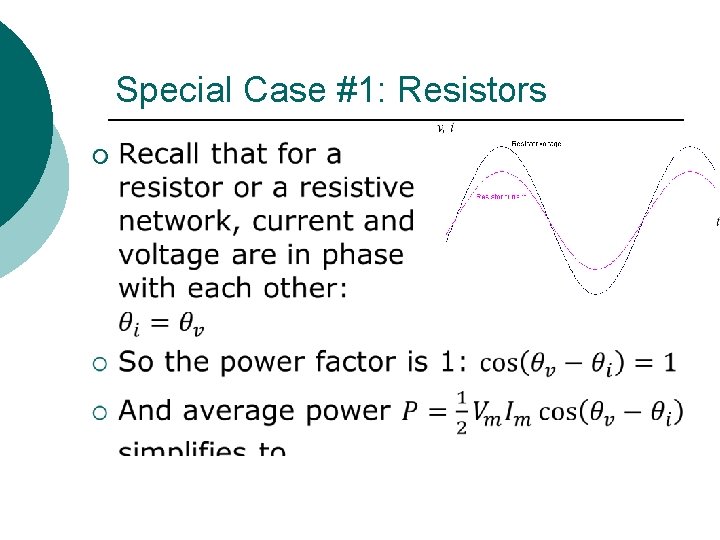
Special Case #1: Resistors ¡
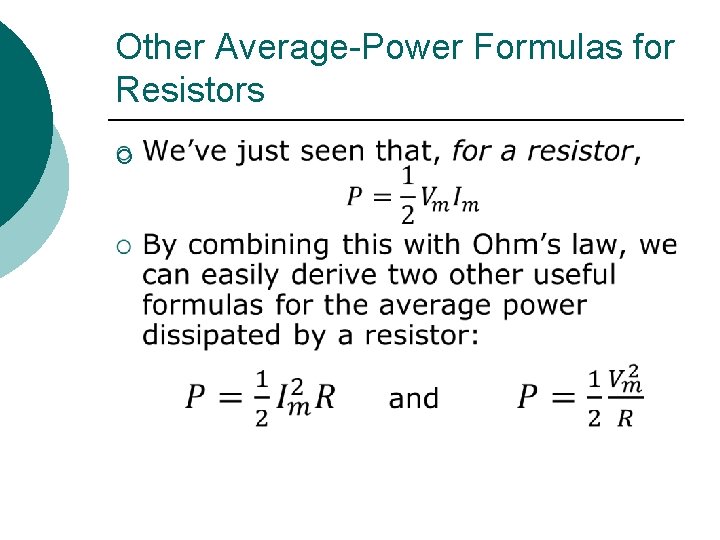
Other Average-Power Formulas for Resistors ¡
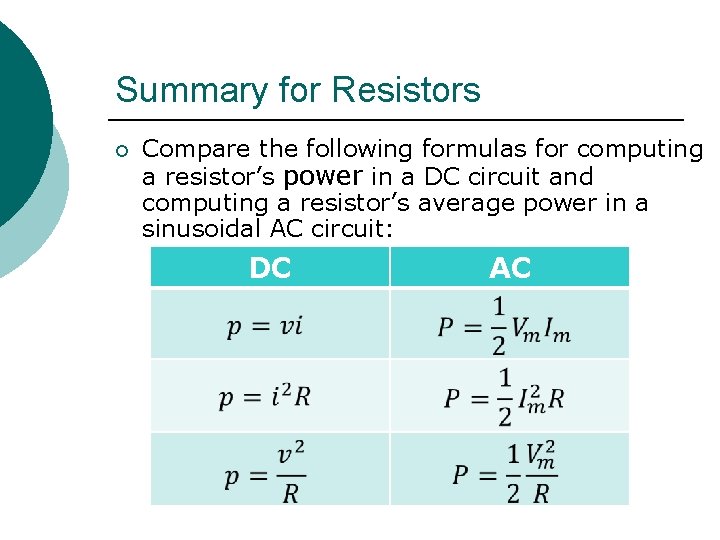
Summary for Resistors ¡ Compare the following formulas for computing a resistor’s power in a DC circuit and computing a resistor’s average power in a sinusoidal AC circuit: DC AC
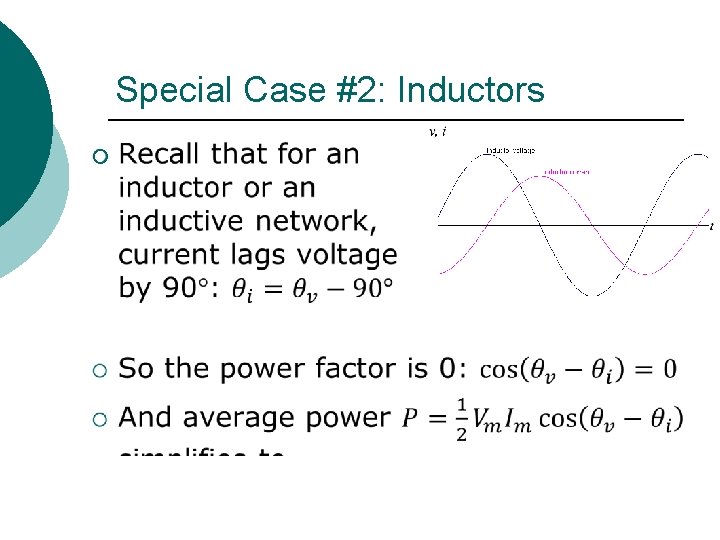
Special Case #2: Inductors ¡
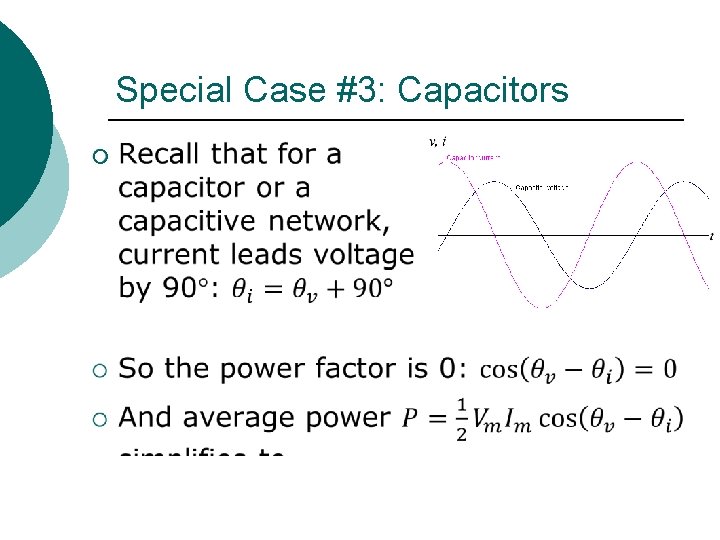
Special Case #3: Capacitors ¡
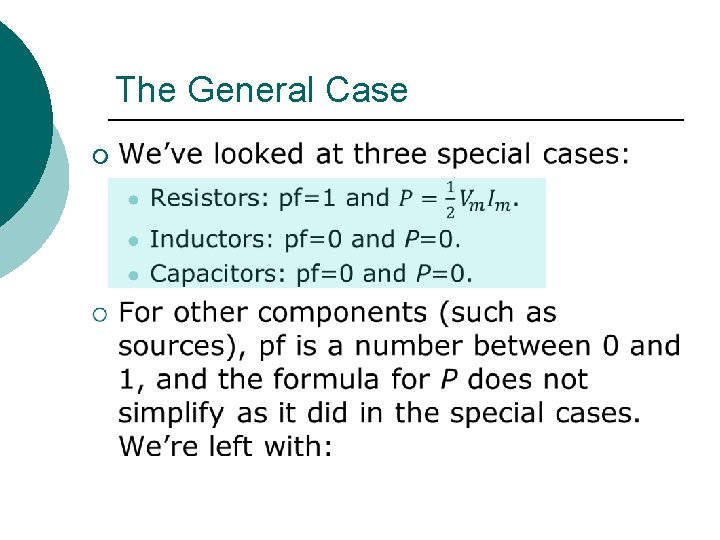
The General Case ¡
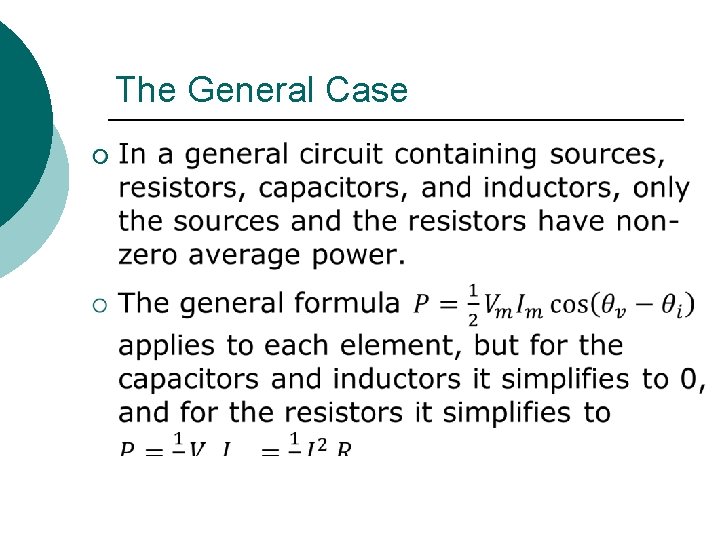
The General Case ¡
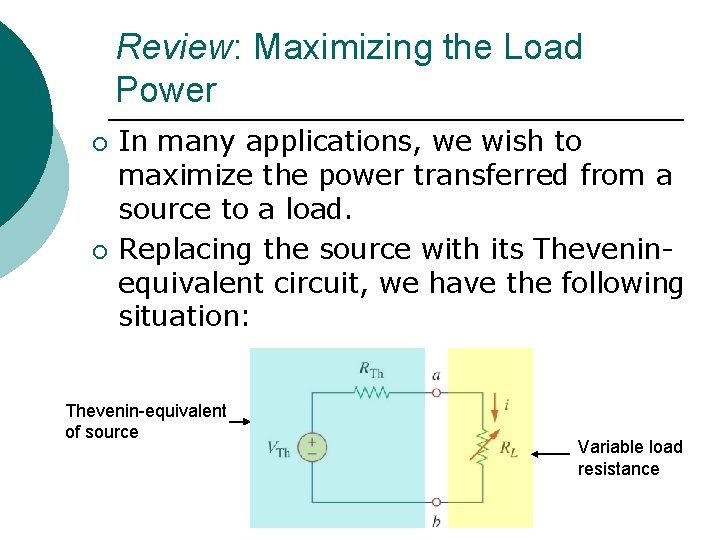
Review: Maximizing the Load Power ¡ ¡ In many applications, we wish to maximize the power transferred from a source to a load. Replacing the source with its Theveninequivalent circuit, we have the following situation: Thevenin-equivalent of source Variable load resistance
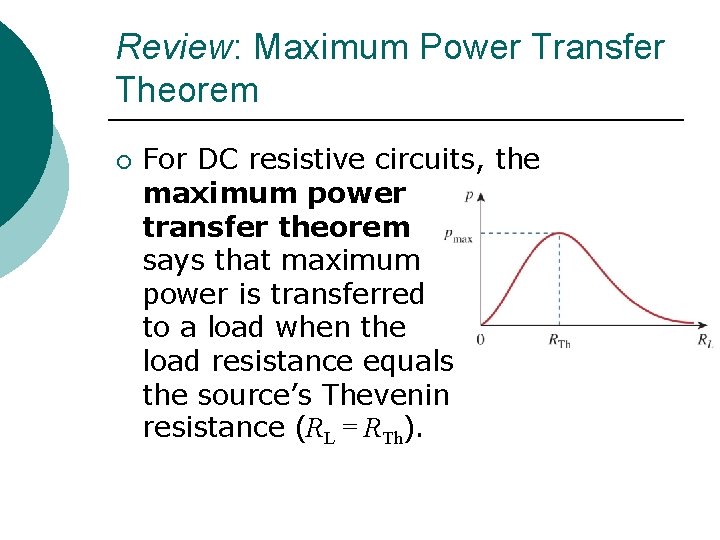
Review: Maximum Power Transfer Theorem ¡ For DC resistive circuits, the maximum power transfer theorem says that maximum power is transferred to a load when the load resistance equals the source’s Thevenin resistance (RL = RTh).
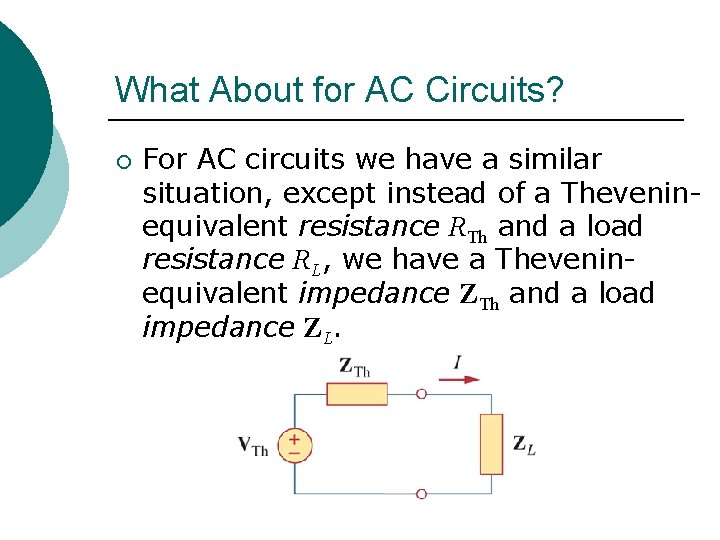
What About for AC Circuits? ¡ For AC circuits we have a similar situation, except instead of a Theveninequivalent resistance RTh and a load resistance RL, we have a Theveninequivalent impedance ZTh and a load impedance ZL.
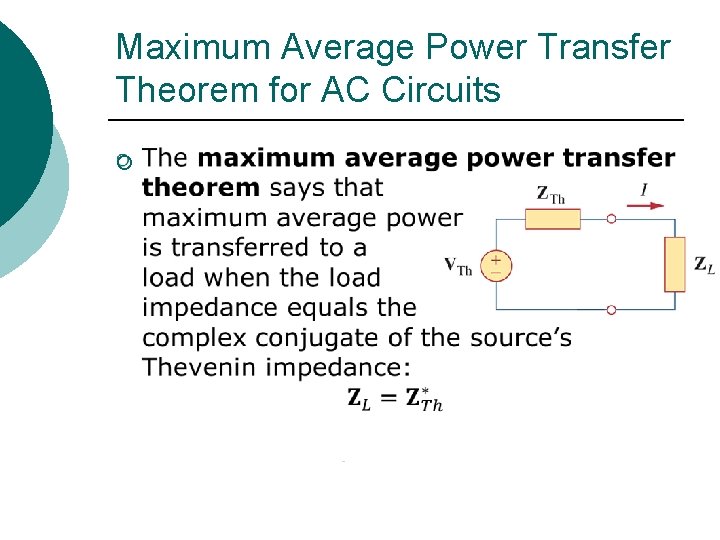
Maximum Average Power Transfer Theorem for AC Circuits ¡
Different Ways to Give AC Values ¡ We’ve seen two ways to specify the size of an AC current or voltage: l l ¡ ¡ Peak-to-peak value. Peak (or maximum) value, also called the amplitude. A third common way is called the effective value (or rms value). To understand this third way, we have to think about how to compare AC and DC.
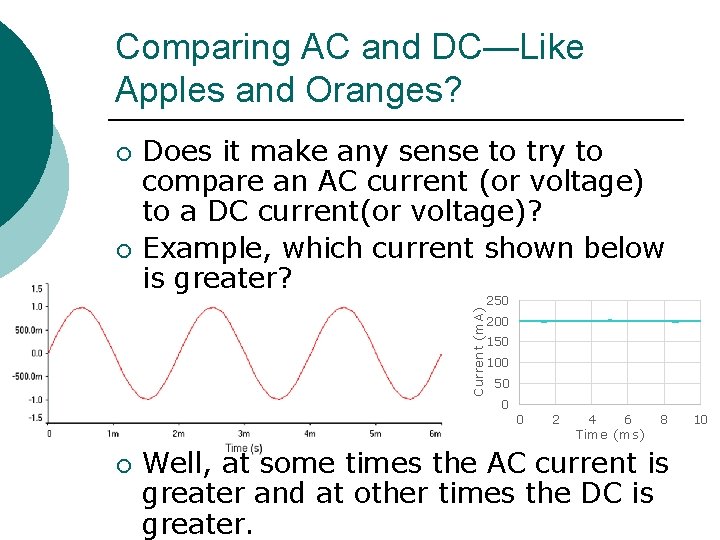
Comparing AC and DC—Like Apples and Oranges? ¡ ¡ Does it make any sense to try to compare an AC current (or voltage) to a DC current(or voltage)? Example, which current shown below is greater? Current (m. A) 250 200 150 100 50 0 0 ¡ 2 4 6 Time (ms) 8 Well, at some times the AC current is greater and at other times the DC is greater. 10
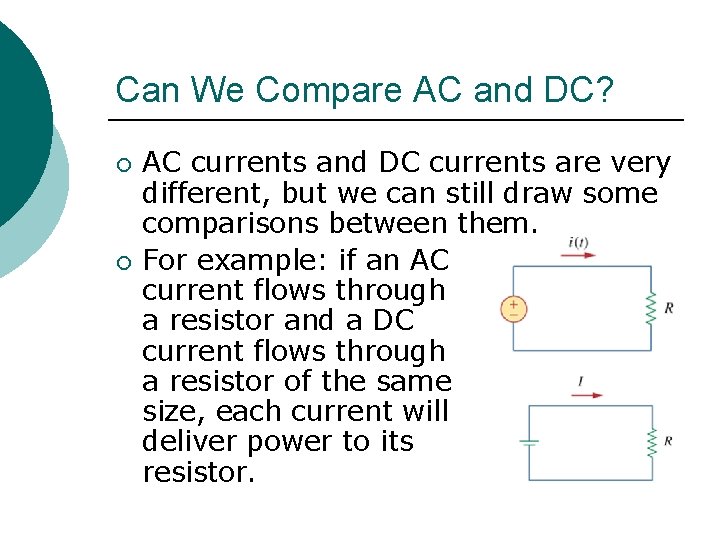
Can We Compare AC and DC? ¡ ¡ AC currents and DC currents are very different, but we can still draw some comparisons between them. For example: if an AC current flows through a resistor and a DC current flows through a resistor of the same size, each current will deliver power to its resistor.
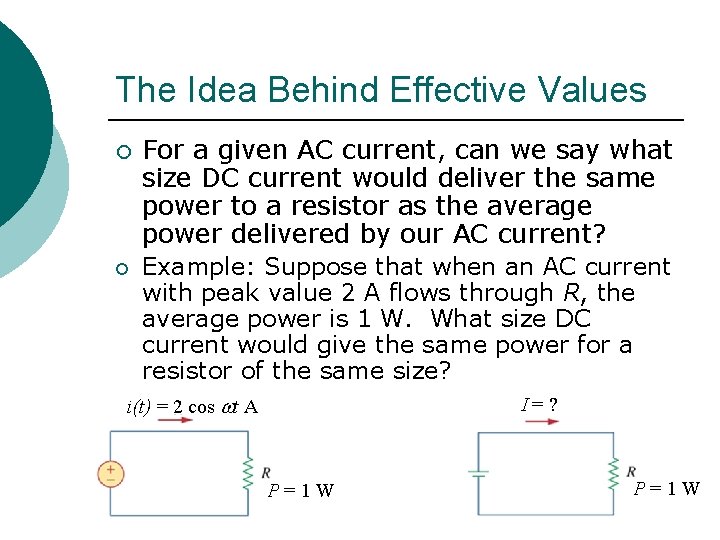
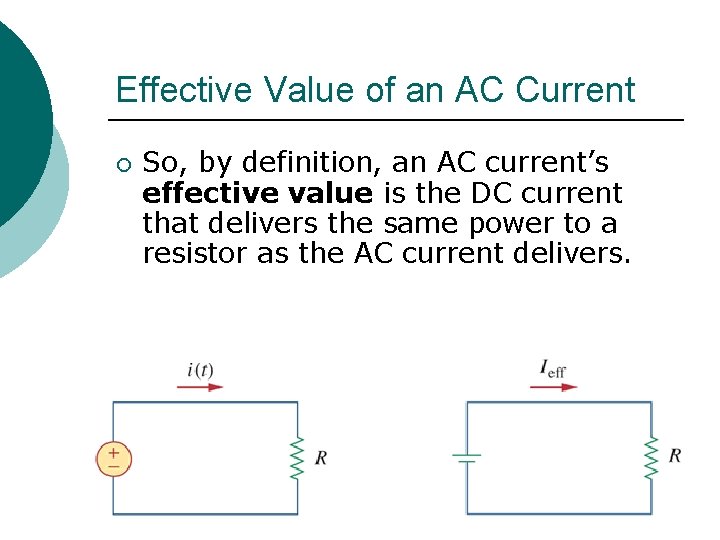
The Idea Behind Effective Values ¡ ¡ For a given AC current, can we say what size DC current would deliver the same power to a resistor as the average power delivered by our AC current? Example: Suppose that when an AC current with peak value 2 A flows through R, the average power is 1 W. What size DC current would give the same power for a resistor of the same size? i(t) = 2 cos t A I = ? P = 1 W
Effective Value of an AC Current ¡ So, by definition, an AC current’s effective value is the DC current that delivers the same power to a resistor as the AC current delivers.
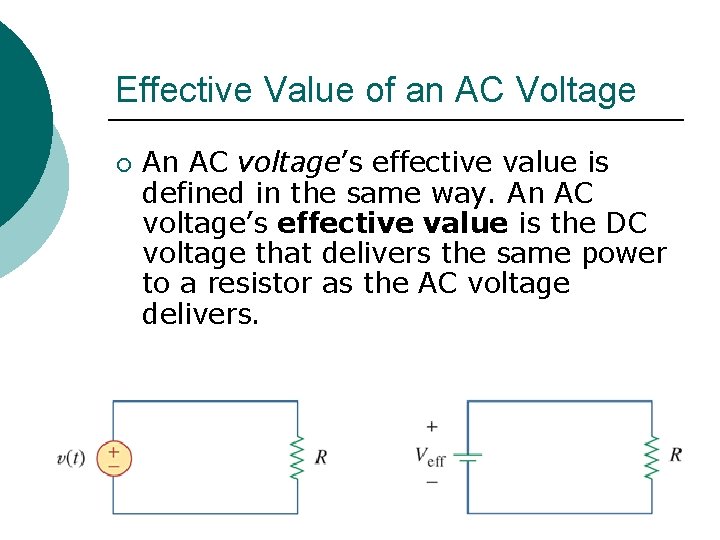
Effective Value of an AC Voltage ¡ An AC voltage’s effective value is defined in the same way. An AC voltage’s effective value is the DC voltage that delivers the same power to a resistor as the AC voltage delivers.
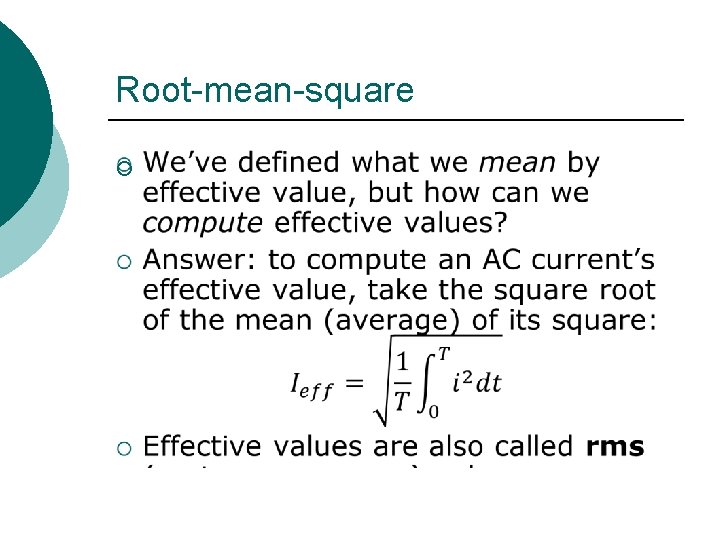
Root-mean-square ¡
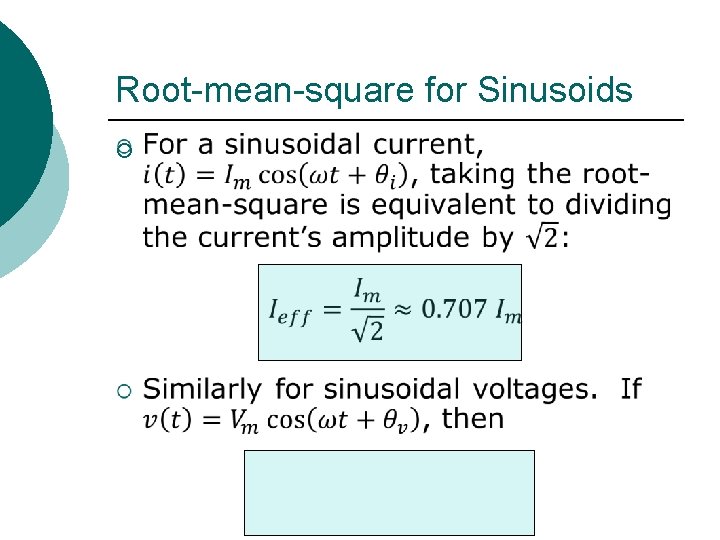
Root-mean-square for Sinusoids ¡
Outlet Voltage in the USA ¡ The voltage at wall outlets in the USA is a sinusoid, with a frequency of 60 Hz and a voltage of 120 V rms.
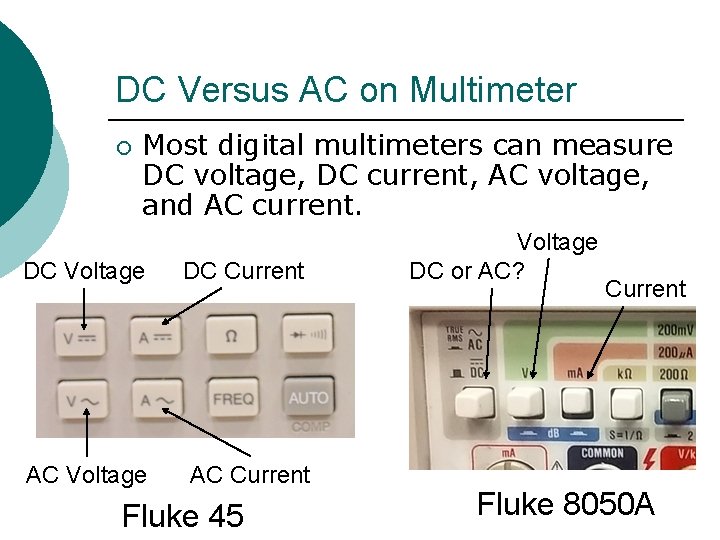
DC Versus AC on Multimeter ¡ Most digital multimeters can measure DC voltage, DC current, AC voltage, and AC current. DC Voltage DC Current AC Voltage AC Current Fluke 45 Voltage DC or AC? Current Fluke 8050 A
DC or AC? ¡ ¡ When a multimeter is set to measure DC voltage or current, it actually displays the average value of the voltage or current. When a multimeter is set to measure AC voltage or current, it actually displays the rms (or effective) value of the voltage or current.
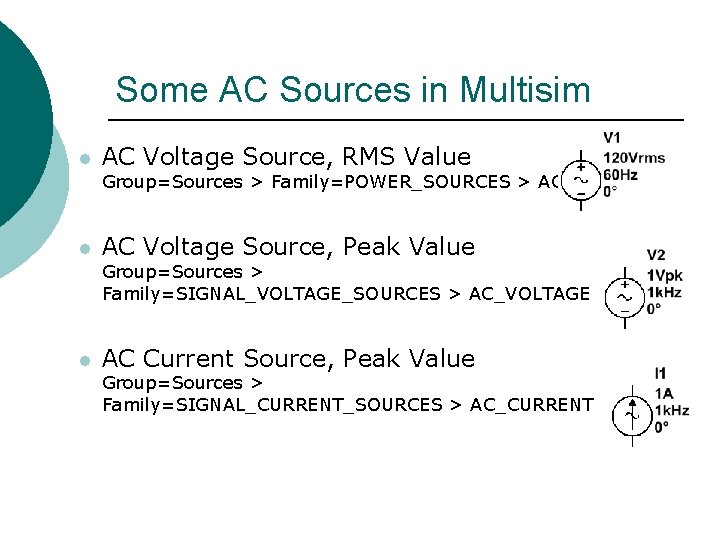
Some AC Sources in Multisim l AC Voltage Source, RMS Value Group=Sources > Family=POWER_SOURCES > AC_POWER l AC Voltage Source, Peak Value Group=Sources > Family=SIGNAL_VOLTAGE_SOURCES > AC_VOLTAGE l AC Current Source, Peak Value Group=Sources > Family=SIGNAL_CURRENT_SOURCES > AC_CURRENT
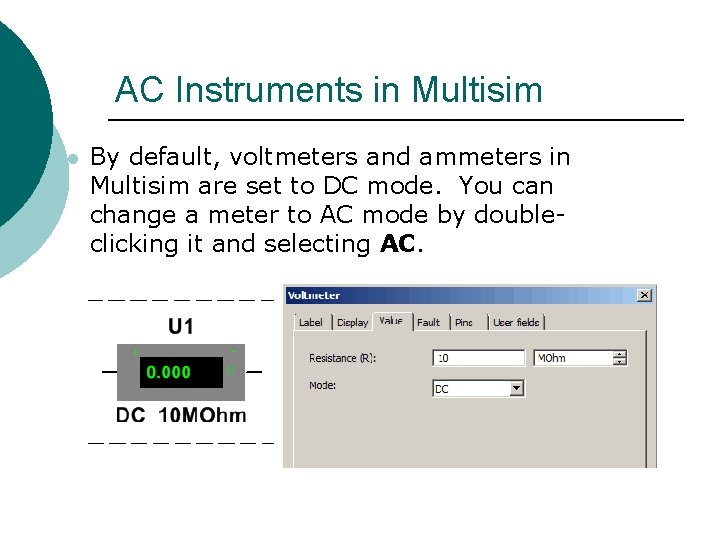
AC Instruments in Multisim l By default, voltmeters and ammeters in Multisim are set to DC mode. You can change a meter to AC mode by doubleclicking it and selecting AC.
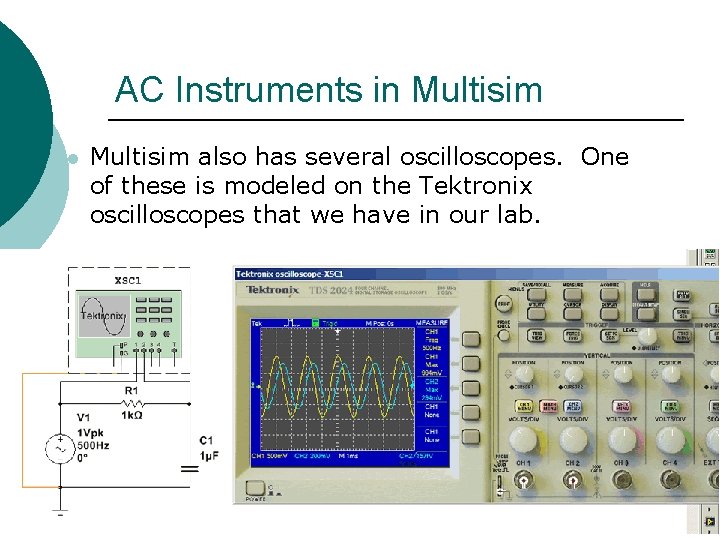
AC Instruments in Multisim l Multisim also has several oscilloscopes. One of these is modeled on the Tektronix oscilloscopes that we have in our lab.