EE 562 ARTIFICIAL INTELLIGENCE FOR ENGINEERS Lecture 10


- Slides: 78
EE 562 ARTIFICIAL INTELLIGENCE FOR ENGINEERS Lecture 10, 5/9/2005 University of Washington, Department of Electrical Engineering Spring 2005 Instructor: Professor Jeff A. Bilmes 5/9/2005 EE 562
Logical Agents Chapter 7 5/9/2005 EE 562
Outline • • • Knowledge-based agents Wumpus world Logic in general - models and entailment Propositional (Boolean) logic Equivalence, validity, satisfiability Inference rules and theorem proving – forward chaining – backward chaining – resolution 5/9/2005 EE 562
Homework • Due: Monday, May 23 rd, in class. • Chapter 6: – 6. 1, 6. 3, 6. 4 • Chapter 7: – 7. 3, 7. 4, 7. 6, 7. 12 • Chapter 8: – 8. 3, 8. 6, 8. 13 5/9/2005 EE 562
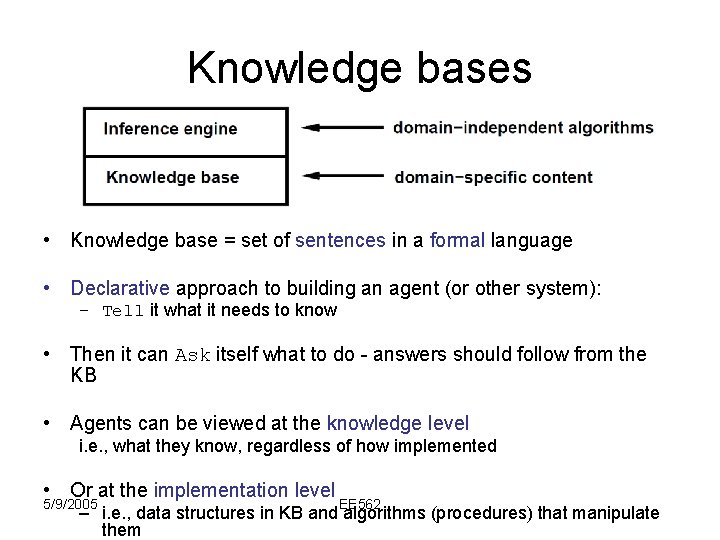
Knowledge bases • Knowledge base = set of sentences in a formal language • Declarative approach to building an agent (or other system): – Tell it what it needs to know • Then it can Ask itself what to do - answers should follow from the KB • Agents can be viewed at the knowledge level i. e. , what they know, regardless of how implemented • Or at the implementation level 5/9/2005 EE 562 – i. e. , data structures in KB and algorithms (procedures) that manipulate them
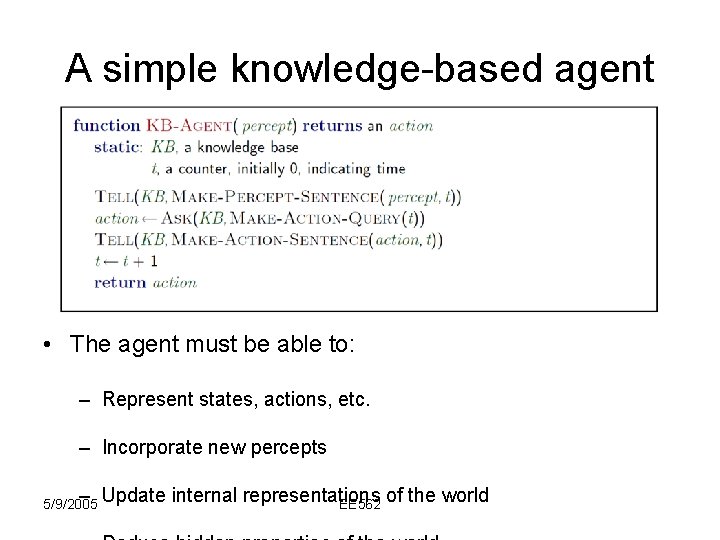
A simple knowledge-based agent • The agent must be able to: – Represent states, actions, etc. – Incorporate new percepts – Update internal representations of the world EE 562 5/9/2005
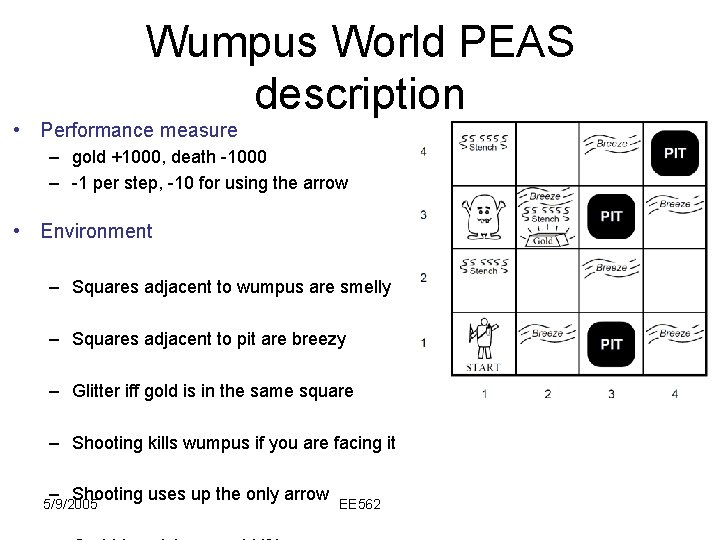
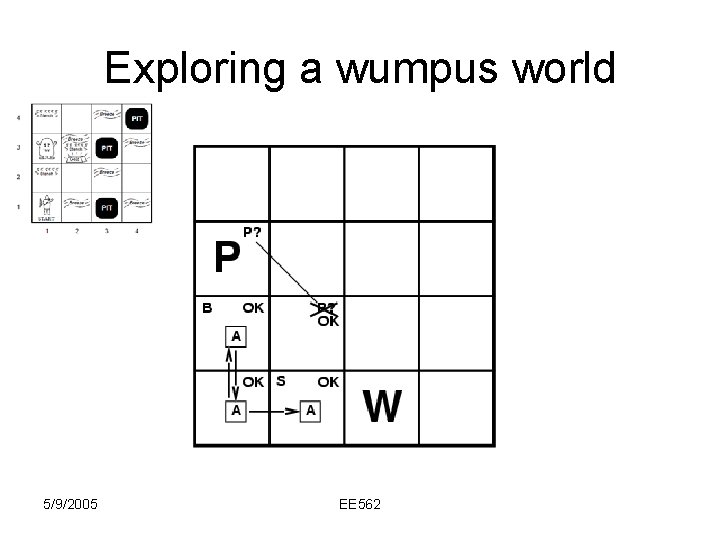
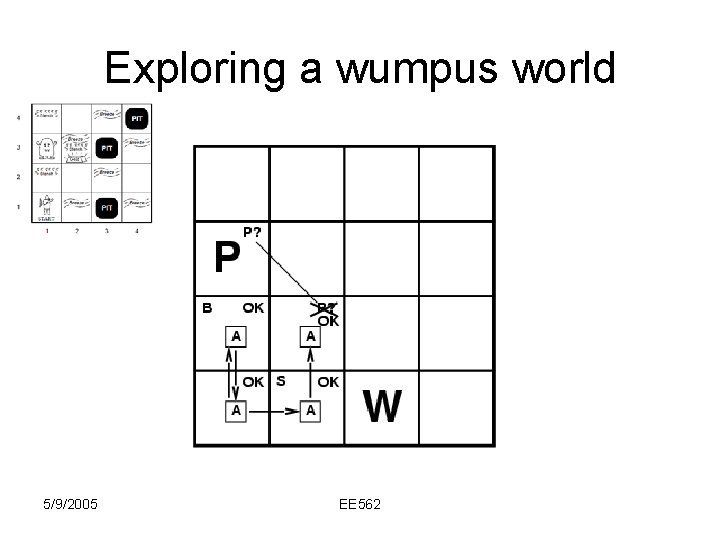
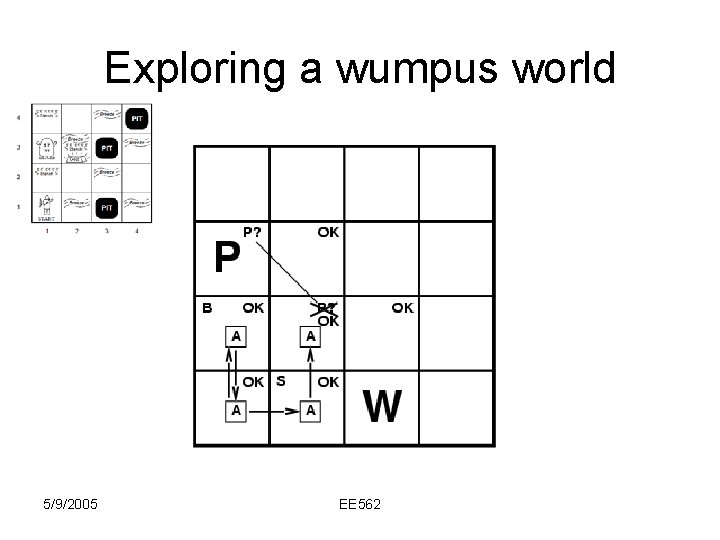
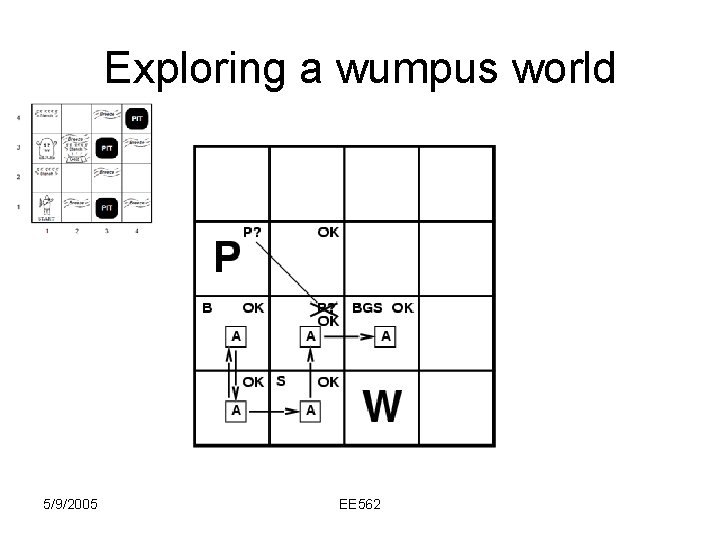
Wumpus World PEAS description • Performance measure – gold +1000, death -1000 – -1 per step, -10 for using the arrow • Environment – Squares adjacent to wumpus are smelly – Squares adjacent to pit are breezy – Glitter iff gold is in the same square – Shooting kills wumpus if you are facing it – Shooting uses up the only arrow 5/9/2005 EE 562
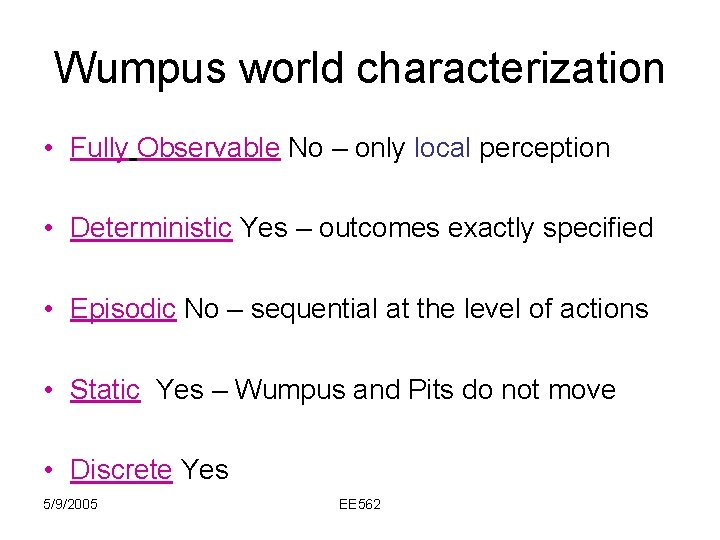
Wumpus world characterization • Fully Observable No – only local perception • Deterministic Yes – outcomes exactly specified • Episodic No – sequential at the level of actions • Static Yes – Wumpus and Pits do not move • Discrete Yes 5/9/2005 EE 562
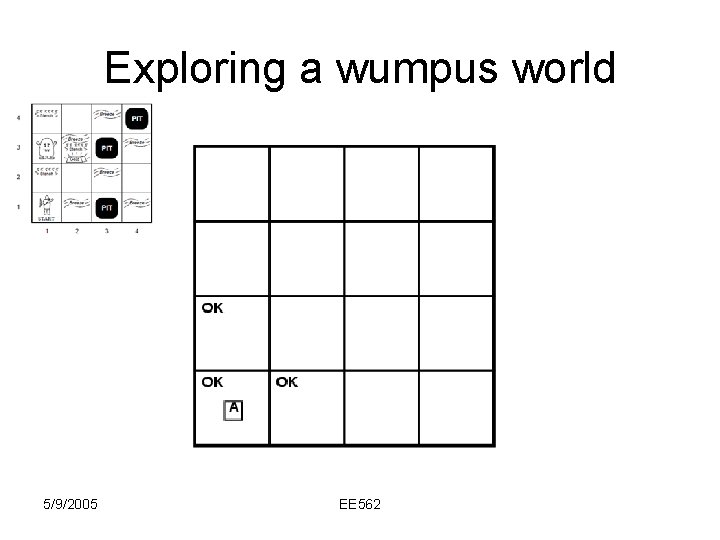
Exploring a wumpus world 5/9/2005 EE 562
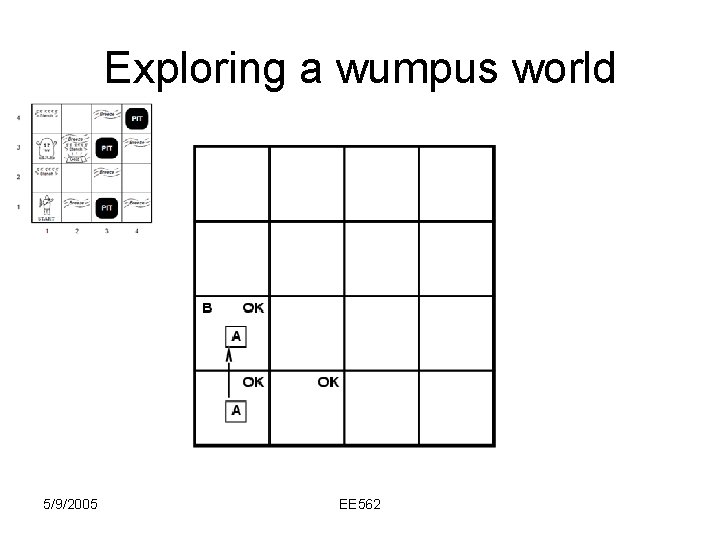
Exploring a wumpus world 5/9/2005 EE 562
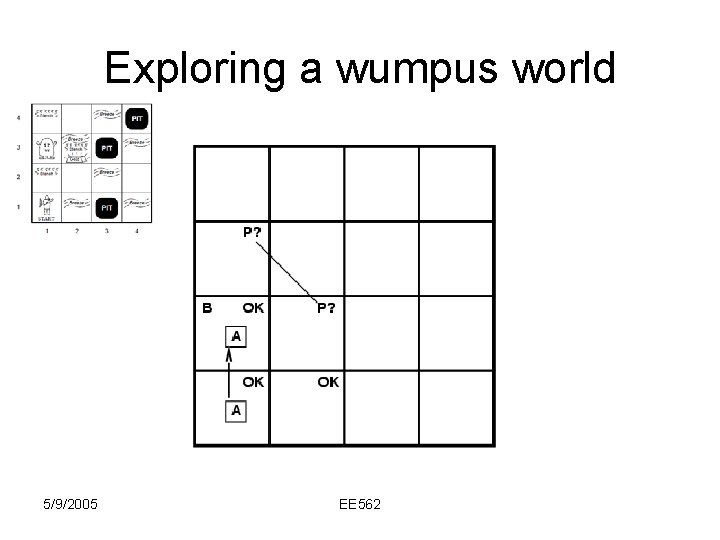
Exploring a wumpus world 5/9/2005 EE 562
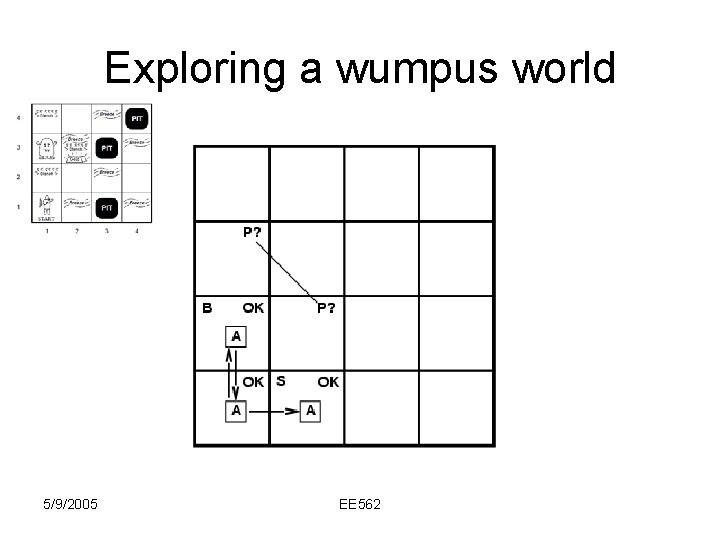
Exploring a wumpus world 5/9/2005 EE 562
Exploring a wumpus world 5/9/2005 EE 562
Exploring a wumpus world 5/9/2005 EE 562
Exploring a wumpus world 5/9/2005 EE 562
Exploring a wumpus world 5/9/2005 EE 562
Logic in general • Logics are formal languages for representing information such that conclusions can be drawn • Syntax defines the sentences in the language • Semantics define the "meaning" of sentences; – i. e. , define truth of a sentence in a world • E. g. , the language of arithmetic – x+2 5/9/2005 ≥ y is a sentence; x 2+y. EE 562 > {} is not a sentence
Entailment • Entailment means that one thing follows from another: KB ╞ α • Knowledge base KB entails sentence α if and only if α is true in all worlds where KB is true – E. g. , the KB containing “the Giants won” and “the Reds won” entails “Either the Giants won or the Reds won” (A, B entails A | B) – E. g. , x+y = 4 entails 4 = x+y 5/9/2005 EE 562 – Entailment is a relationship between sentences (i. e. ,
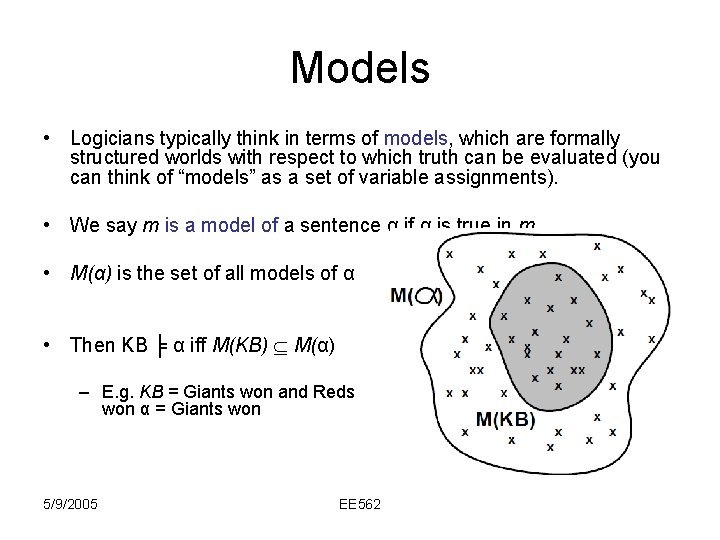
Models • Logicians typically think in terms of models, which are formally structured worlds with respect to which truth can be evaluated (you can think of “models” as a set of variable assignments). • We say m is a model of a sentence α if α is true in m • M(α) is the set of all models of α • Then KB ╞ α iff M(KB) M(α) – E. g. KB = Giants won and Reds won α = Giants won 5/9/2005 EE 562
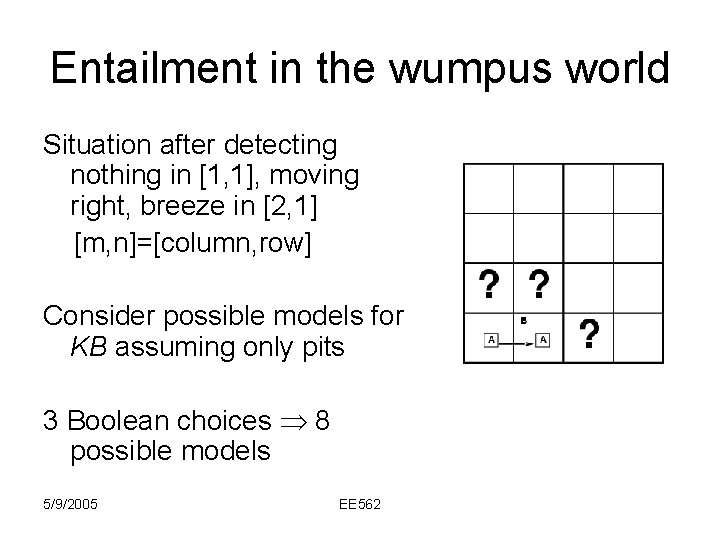
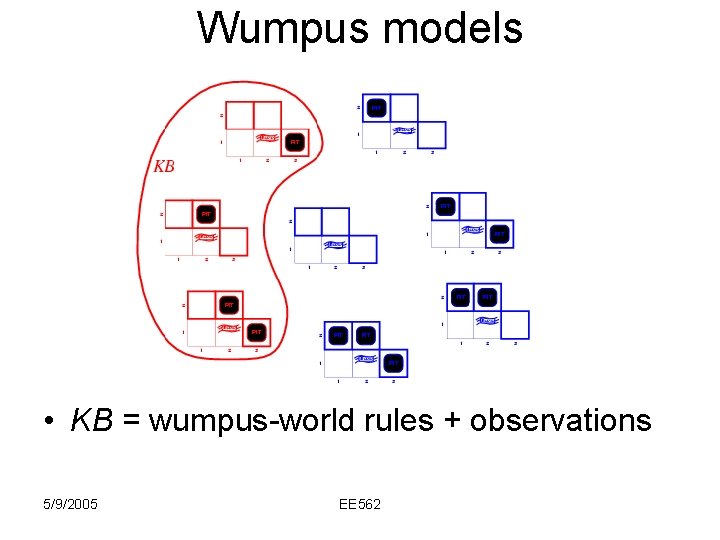
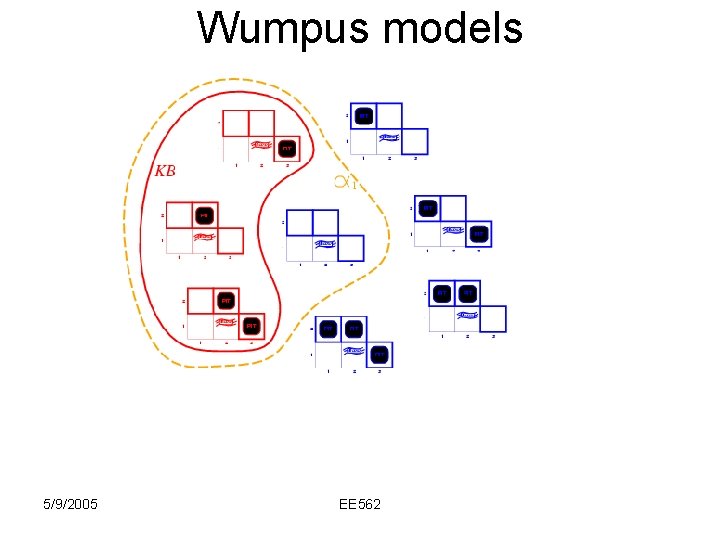
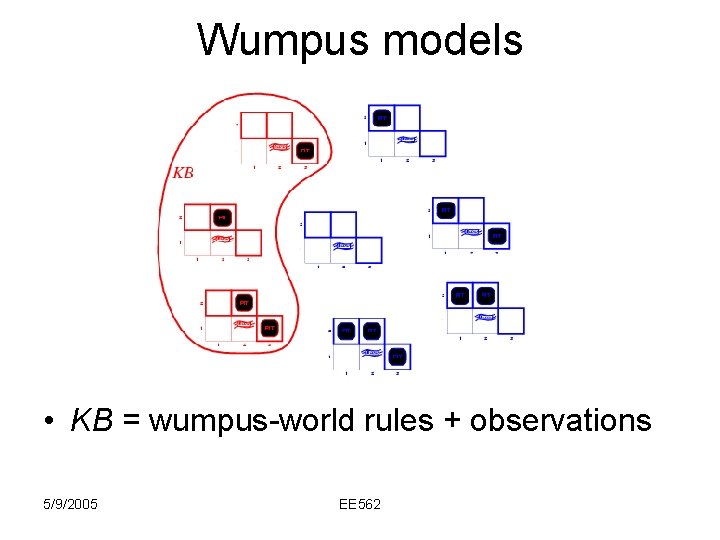
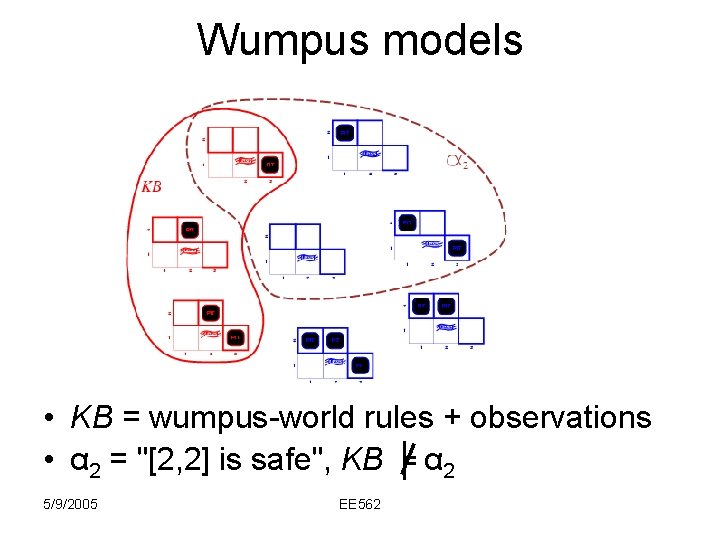
Entailment in the wumpus world Situation after detecting nothing in [1, 1], moving right, breeze in [2, 1] [m, n]=[column, row] Consider possible models for KB assuming only pits 3 Boolean choices 8 possible models 5/9/2005 EE 562
Wumpus models 5/9/2005 EE 562
Wumpus models • KB = wumpus-world rules + observations 5/9/2005 EE 562
Wumpus models 5/9/2005 EE 562
Wumpus models • KB = wumpus-world rules + observations 5/9/2005 EE 562
Wumpus models • KB = wumpus-world rules + observations • α 2 = "[2, 2] is safe", KB ╞ α 2 5/9/2005 EE 562
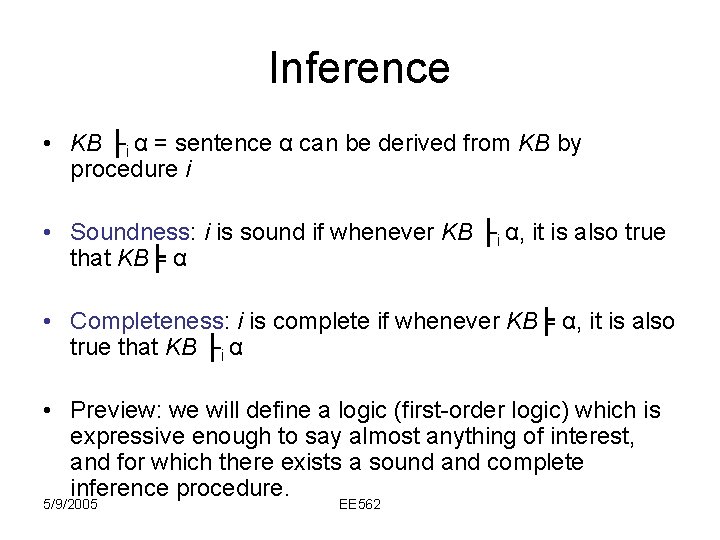
Inference • KB ├i α = sentence α can be derived from KB by procedure i • Soundness: i is sound if whenever KB ├i α, it is also true that KB╞ α • Completeness: i is complete if whenever KB╞ α, it is also true that KB ├i α • Preview: we will define a logic (first-order logic) which is expressive enough to say almost anything of interest, and for which there exists a sound and complete inference procedure. 5/9/2005 EE 562
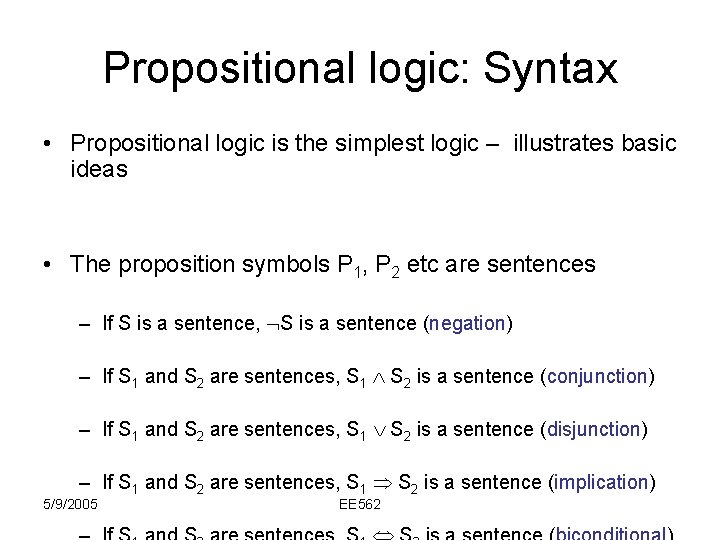
Propositional logic: Syntax • Propositional logic is the simplest logic – illustrates basic ideas • The proposition symbols P 1, P 2 etc are sentences – If S is a sentence, S is a sentence (negation) – If S 1 and S 2 are sentences, S 1 S 2 is a sentence (conjunction) – If S 1 and S 2 are sentences, S 1 S 2 is a sentence (disjunction) – If S 1 and S 2 are sentences, S 1 S 2 is a sentence (implication) 5/9/2005 EE 562
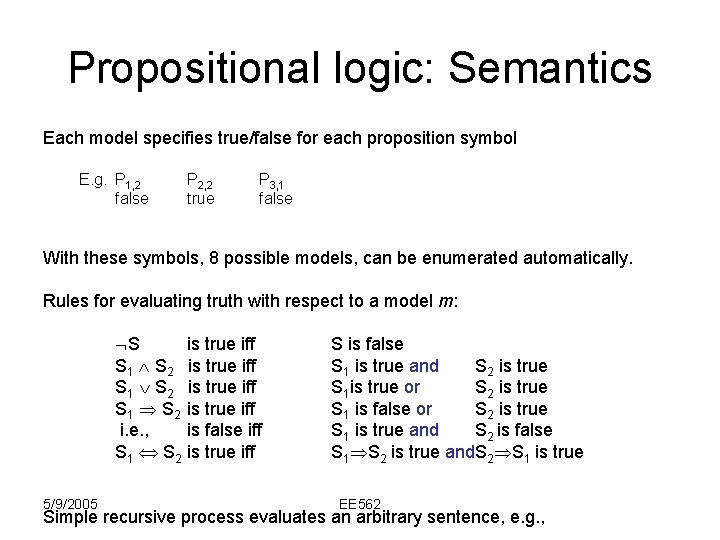
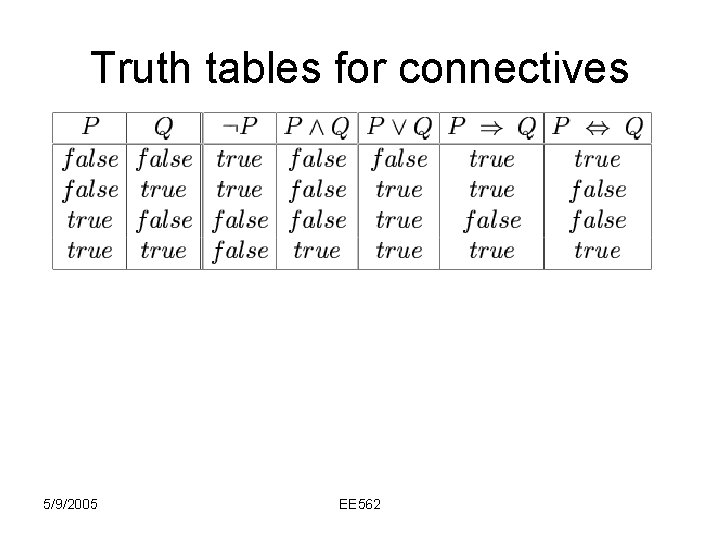
Propositional logic: Semantics Each model specifies true/false for each proposition symbol E. g. P 1, 2 false P 2, 2 true P 3, 1 false With these symbols, 8 possible models, can be enumerated automatically. Rules for evaluating truth with respect to a model m: S S 1 S 2 i. e. , S 1 S 2 5/9/2005 is true iff is false iff is true iff S is false S 1 is true and S 2 is true S 1 is true or S 2 is true S 1 is false or S 2 is true S 1 is true and S 2 is false S 1 S 2 is true and. S 2 S 1 is true EE 562 Simple recursive process evaluates an arbitrary sentence, e. g. ,
Truth tables for connectives 5/9/2005 EE 562
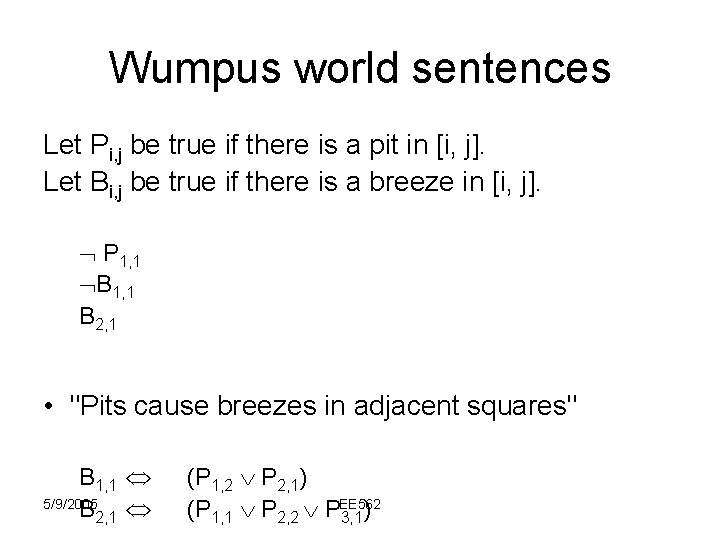
Wumpus world sentences Let Pi, j be true if there is a pit in [i, j]. Let Bi, j be true if there is a breeze in [i, j]. P 1, 1 B 2, 1 • "Pits cause breezes in adjacent squares" B 1, 1 5/9/2005 B 2, 1 (P 1, 2 P 2, 1) (P 1, 1 P 2, 2 PEE 562 3, 1)
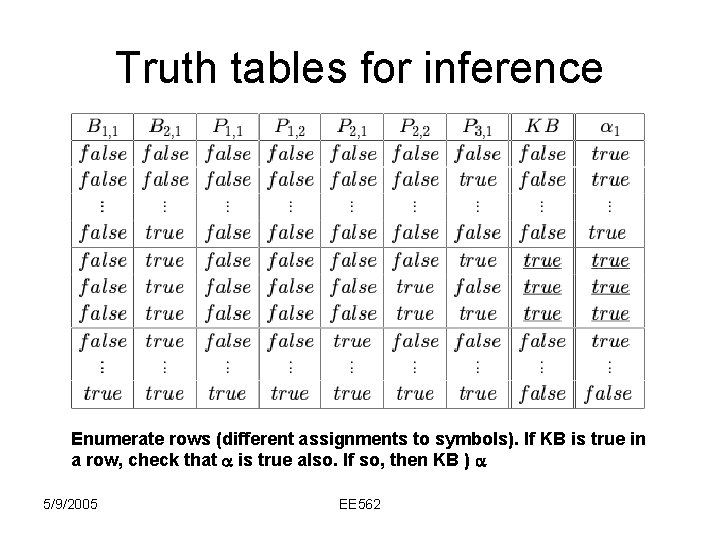
Truth tables for inference Enumerate rows (different assignments to symbols). If KB is true in a row, check that is true also. If so, then KB ) 5/9/2005 EE 562
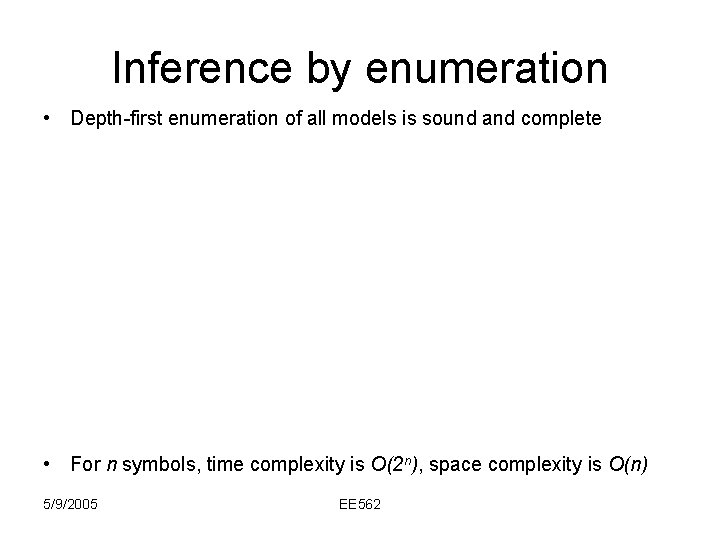
Inference by enumeration • Depth-first enumeration of all models is sound and complete • For n symbols, time complexity is O(2 n), space complexity is O(n) 5/9/2005 EE 562
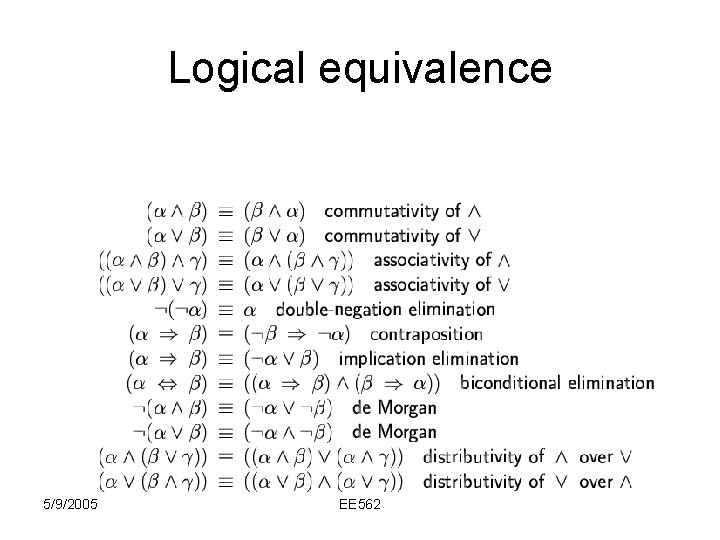
Logical equivalence 5/9/2005 EE 562
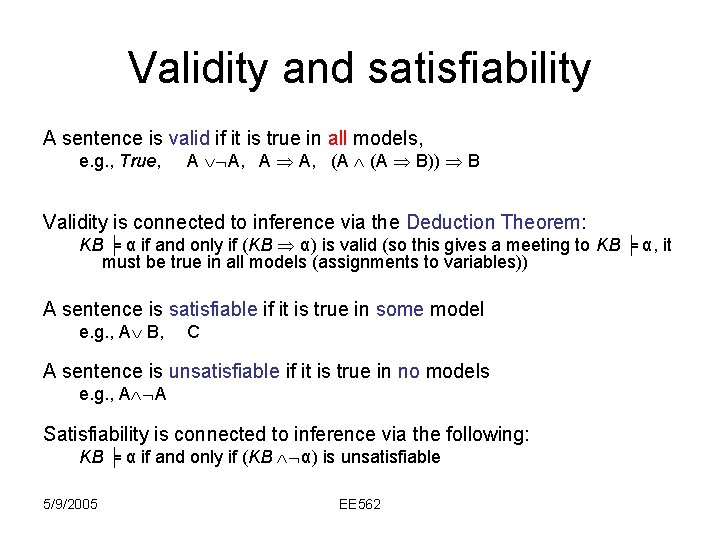
Validity and satisfiability A sentence is valid if it is true in all models, e. g. , True, A A, (A B)) B Validity is connected to inference via the Deduction Theorem: KB ╞ α if and only if (KB α) is valid (so this gives a meeting to KB ╞ α, it must be true in all models (assignments to variables)) A sentence is satisfiable if it is true in some model e. g. , A B, C A sentence is unsatisfiable if it is true in no models e. g. , A A Satisfiability is connected to inference via the following: KB ╞ α if and only if (KB α) is unsatisfiable 5/9/2005 EE 562
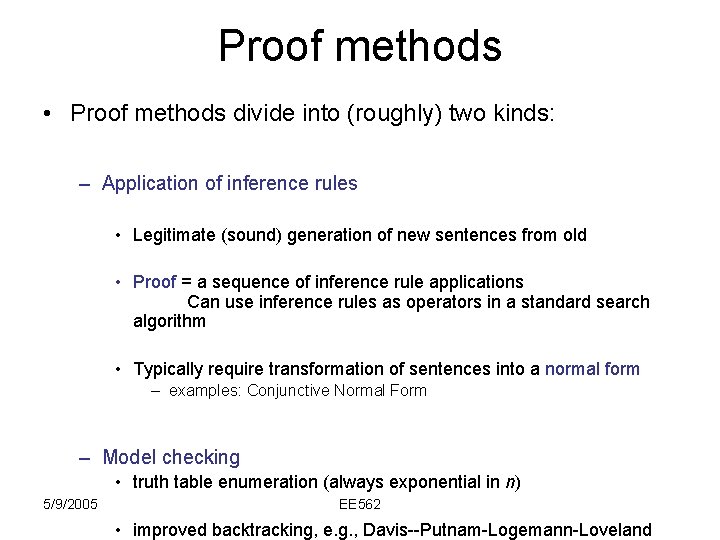
Proof methods • Proof methods divide into (roughly) two kinds: – Application of inference rules • Legitimate (sound) generation of new sentences from old • Proof = a sequence of inference rule applications Can use inference rules as operators in a standard search algorithm • Typically require transformation of sentences into a normal form – examples: Conjunctive Normal Form – Model checking • truth table enumeration (always exponential in n) 5/9/2005 EE 562 • improved backtracking, e. g. , Davis--Putnam-Logemann-Loveland
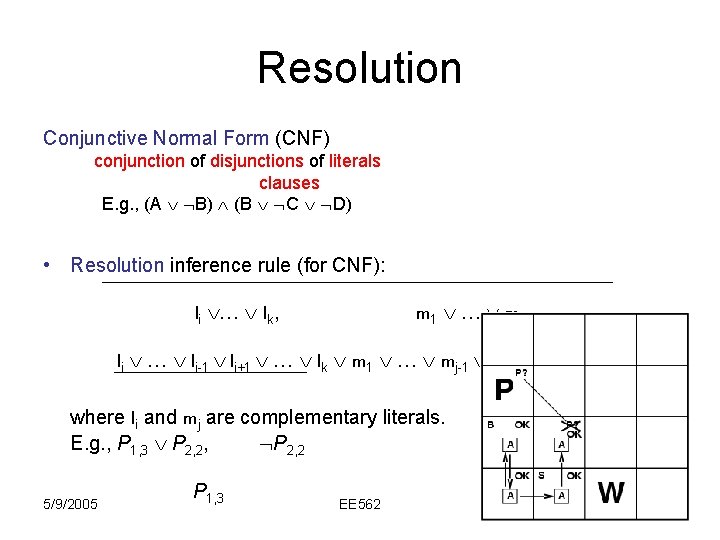
Resolution Conjunctive Normal Form (CNF) conjunction of disjunctions of literals clauses E. g. , (A B) (B C D) • Resolution inference rule (for CNF): li … lk, m 1 … mn li … li-1 li+1 … lk m 1 … mj-1 mj+1 . . . mn where li and mj are complementary literals. E. g. , P 1, 3 P 2, 2, P 2, 2 5/9/2005 P 1, 3 EE 562
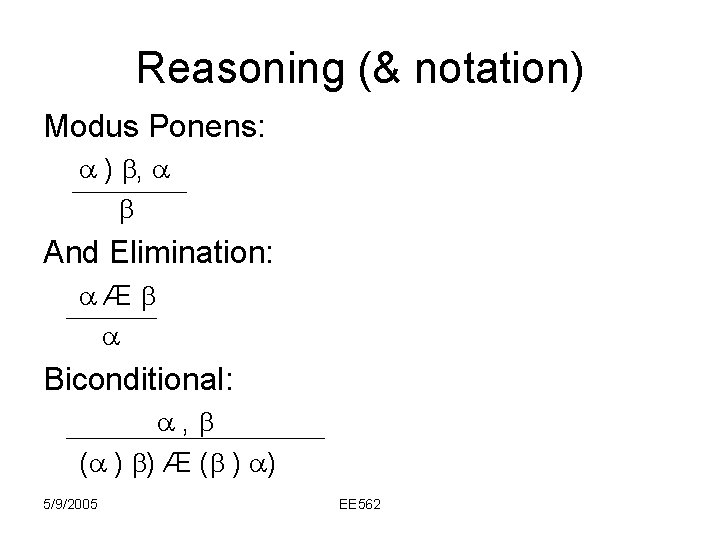
Reasoning (& notation) Modus Ponens: ) , And Elimination: Æ Biconditional: , ( ) ) Æ ( ) ) 5/9/2005 EE 562
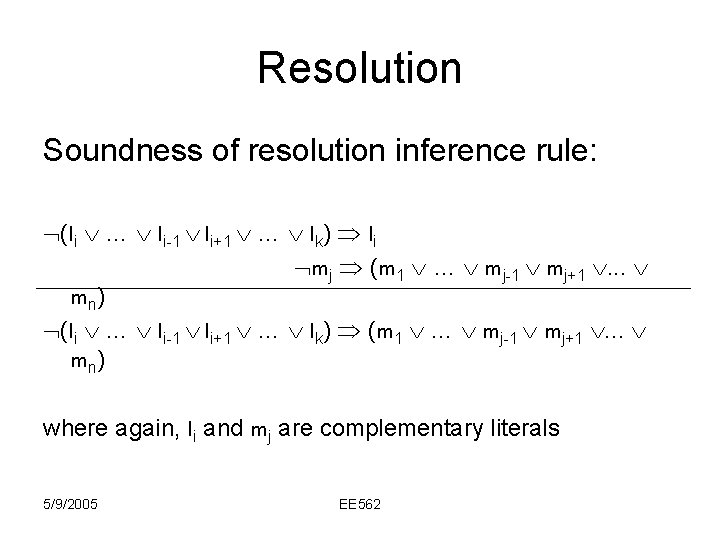
Resolution Soundness of resolution inference rule: (li … li-1 li+1 … lk) li mj (m 1 … mj-1 mj+1 . . . m n) (li … li-1 li+1 … lk) (m 1 … mj-1 mj+1 . . . m n) where again, li and mj are complementary literals 5/9/2005 EE 562
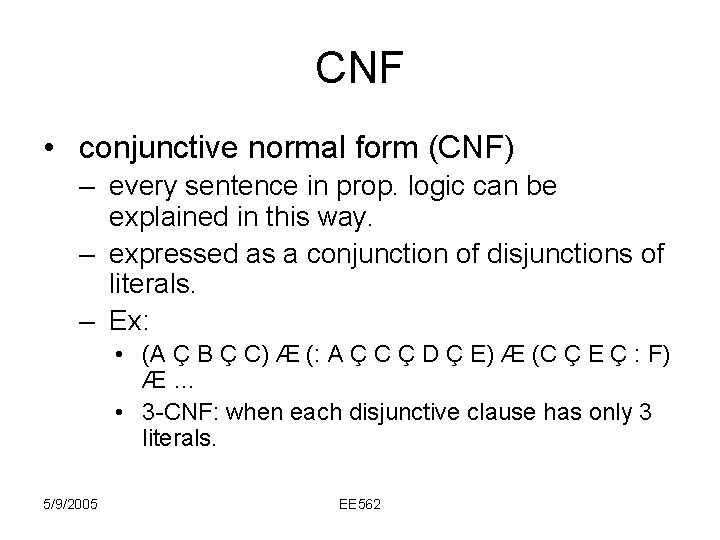
CNF • conjunctive normal form (CNF) – every sentence in prop. logic can be explained in this way. – expressed as a conjunction of disjunctions of literals. – Ex: • (A Ç B Ç C) Æ (: A Ç C Ç D Ç E) Æ (C Ç E Ç : F) Æ… • 3 -CNF: when each disjunctive clause has only 3 literals. 5/9/2005 EE 562
Conversion to CNF B 1, 1 (P 1, 2 P 2, 1) 1. Eliminate , replacing α β with (α β) (β α). (B 1, 1 (P 1, 2 P 2, 1)) ((P 1, 2 P 2, 1) B 1, 1) 2. Eliminate , replacing α β with α β. ( B 1, 1 P 1, 2 P 2, 1) ( (P 1, 2 P 2, 1) B 1, 1) 3. Move inwards using de Morgan's rules and doublenegation: 5/9/2005 EE 562
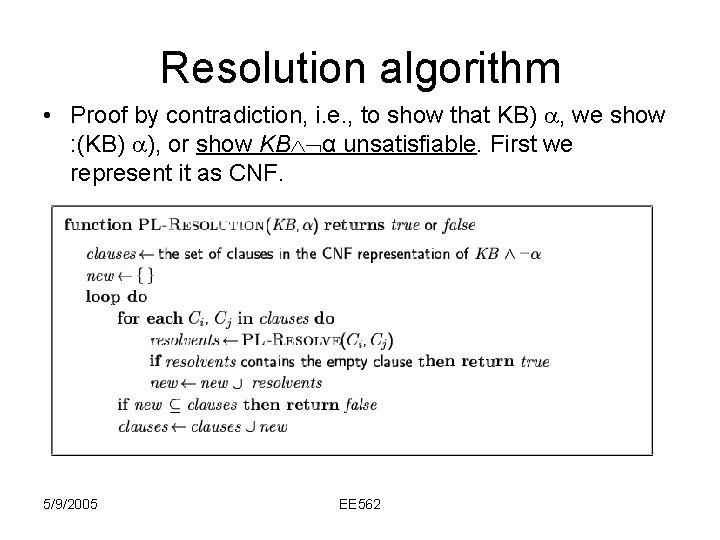
Resolution algorithm • Proof by contradiction, i. e. , to show that KB) , we show : (KB) ), or show KB α unsatisfiable. First we represent it as CNF. 5/9/2005 EE 562
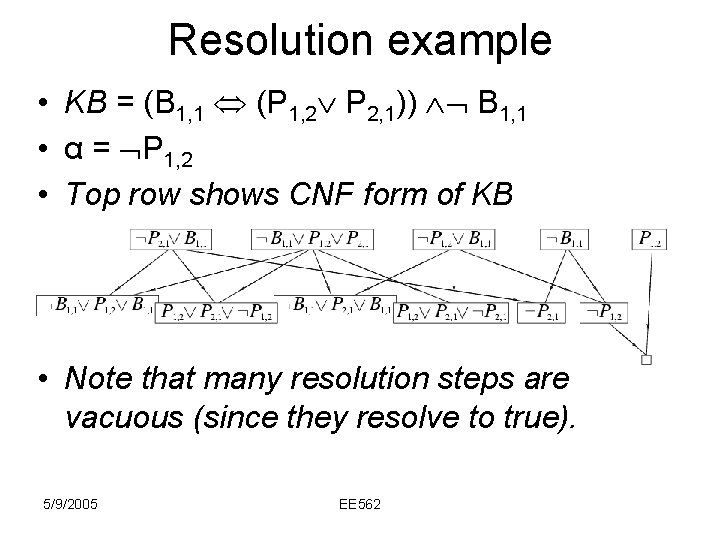
Resolution example • KB = (B 1, 1 (P 1, 2 P 2, 1)) B 1, 1 • α = P 1, 2 • Top row shows CNF form of KB • Note that many resolution steps are vacuous (since they resolve to true). 5/9/2005 EE 562
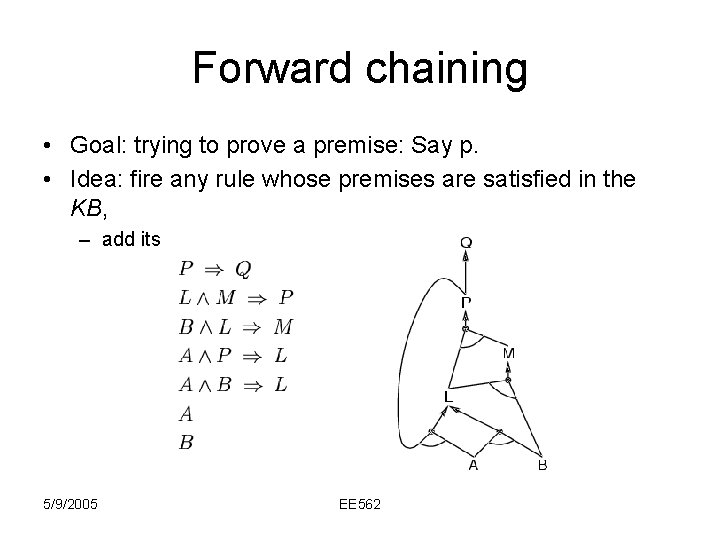
Forward and backward chaining • Horn Form (restricted) KB = conjunction of Horn clauses – Horn clause = • • proposition symbol; or (conjunction of symbols) symbol disjunction of literals at which at most one is positive. Can be written as an implication where: – premise is conjunction of positive literals – conclusion is a single positive literal. – E. g. , (L 1, 1 Æ Breeze) ) B 1, 1 • Modus Ponens (for Horn Form): complete for Horn KBs α 1, … , αn, α 1 … αn β β • Integrity constraint: (: W 1, 1 Ç : W 5/9/2005 EE 562 1, 2) === W 1, 1 Æ W 1, 2 ) false • Can be used with forward chaining or backward chaining.
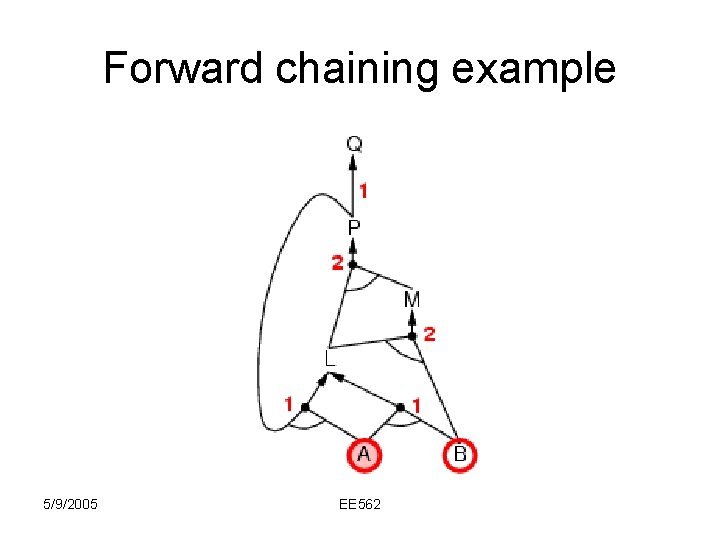
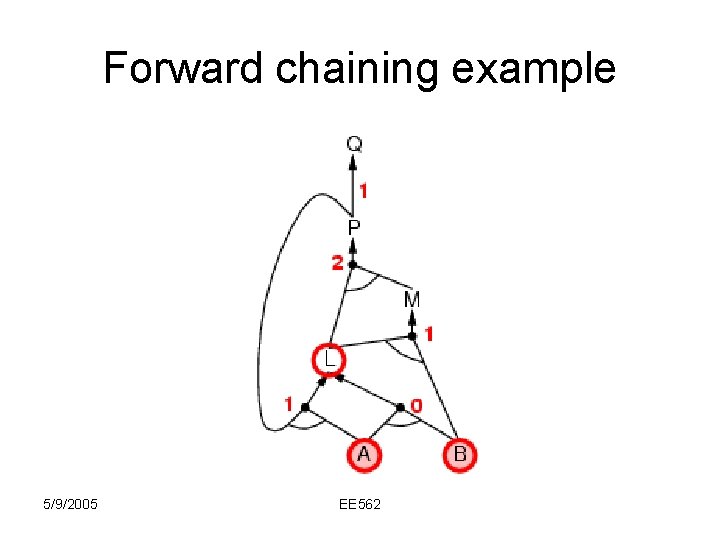
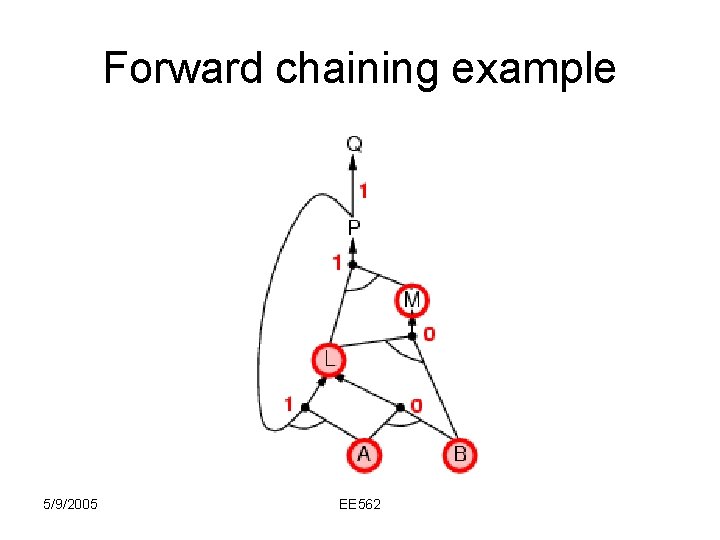
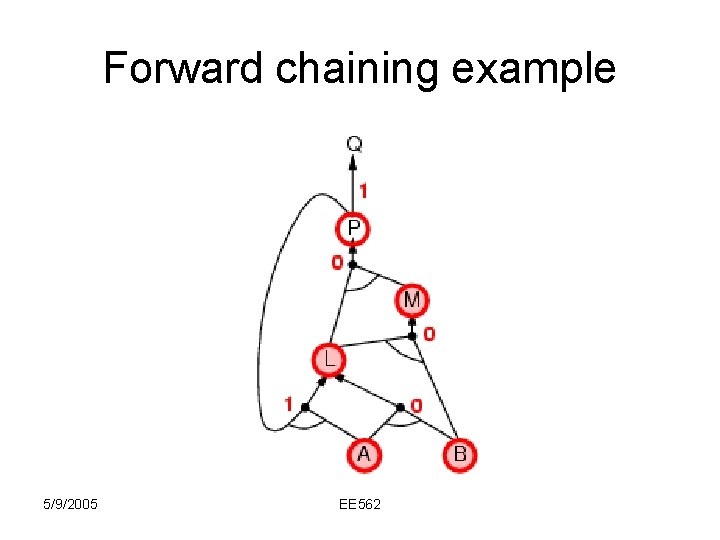
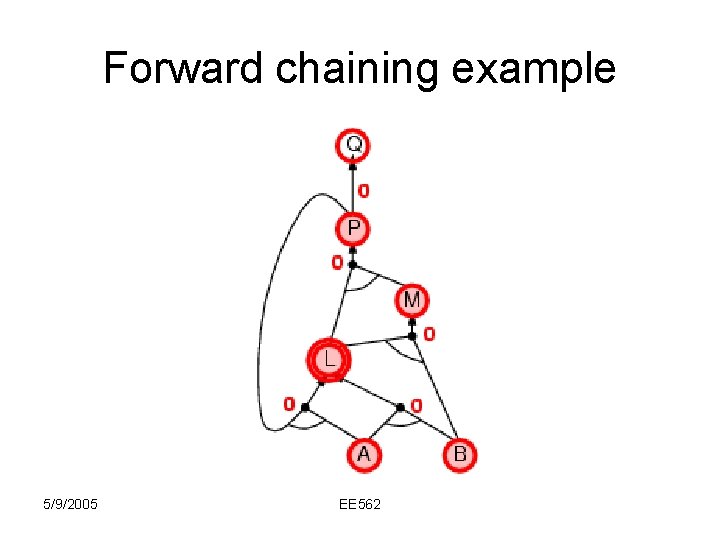
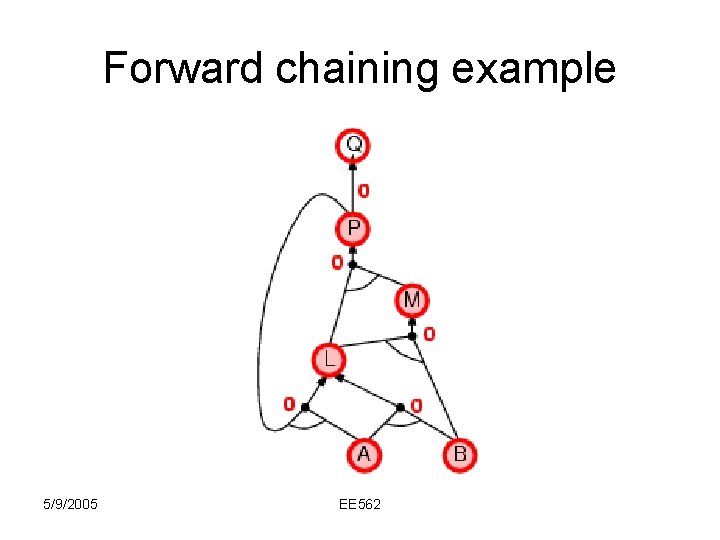
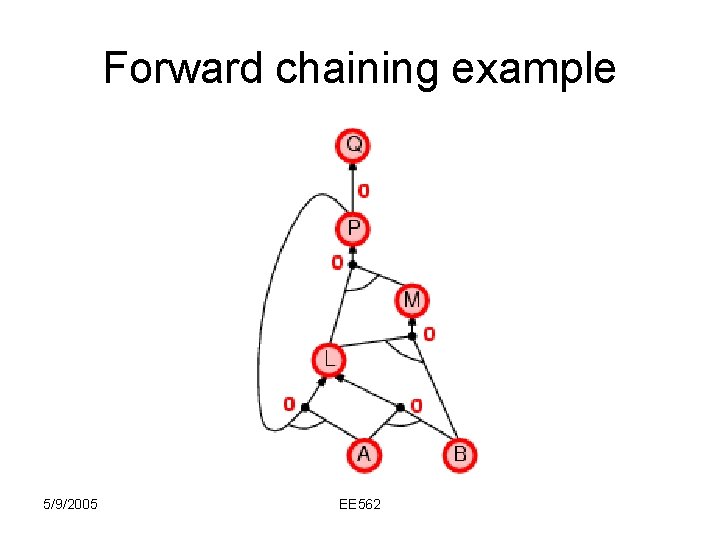
Forward chaining • Goal: trying to prove a premise: Say p. • Idea: fire any rule whose premises are satisfied in the KB, – add its conclusion to the KB, until query is found 5/9/2005 EE 562
Forward chaining algorithm • Forward chaining is sound and complete for Horn KB 5/9/2005 EE 562
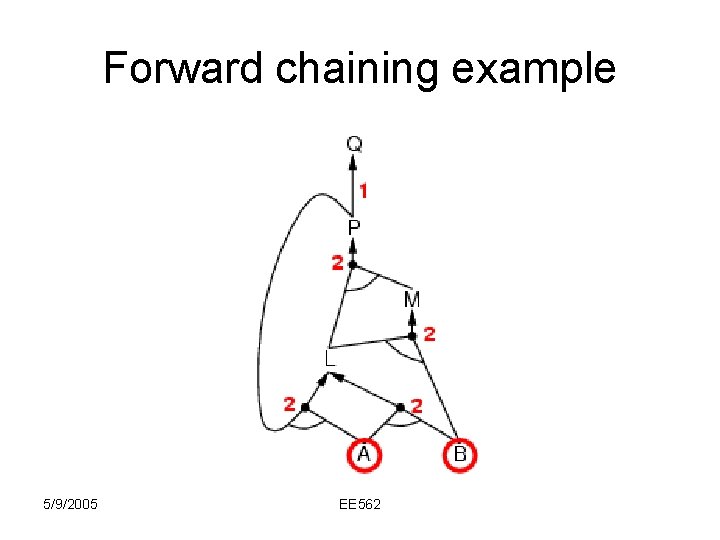
Forward chaining example 5/9/2005 EE 562
Forward chaining example 5/9/2005 EE 562
Forward chaining example 5/9/2005 EE 562
Forward chaining example 5/9/2005 EE 562
Forward chaining example 5/9/2005 EE 562
Forward chaining example 5/9/2005 EE 562
Forward chaining example 5/9/2005 EE 562
Forward chaining example 5/9/2005 EE 562
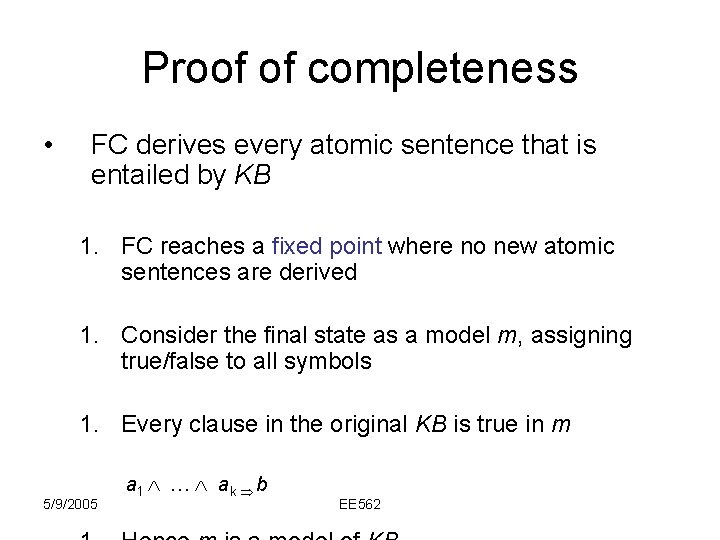
Proof of completeness • FC derives every atomic sentence that is entailed by KB 1. FC reaches a fixed point where no new atomic sentences are derived 1. Consider the final state as a model m, assigning true/false to all symbols 1. Every clause in the original KB is true in m 5/9/2005 a 1 … ak b EE 562
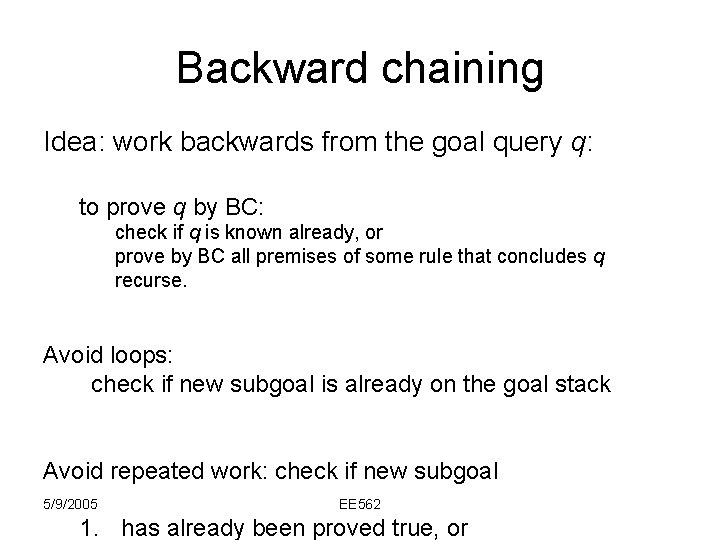
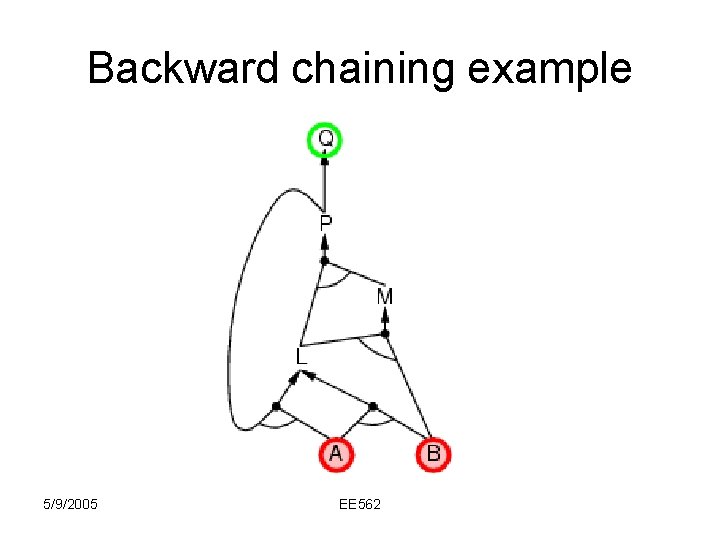
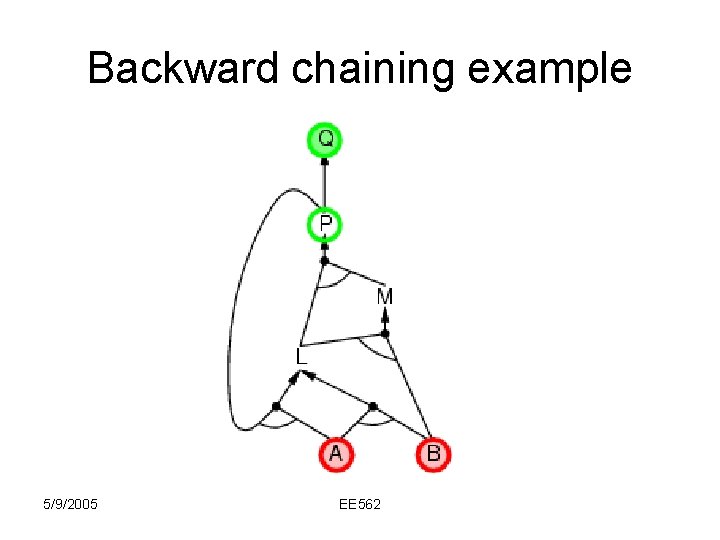
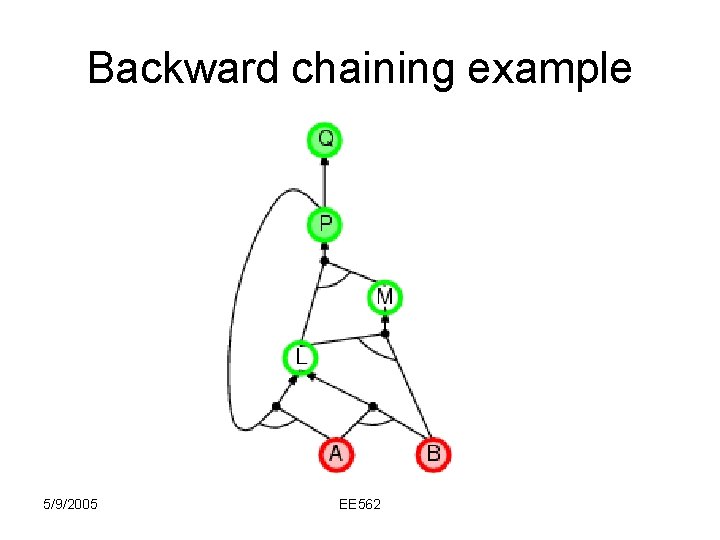
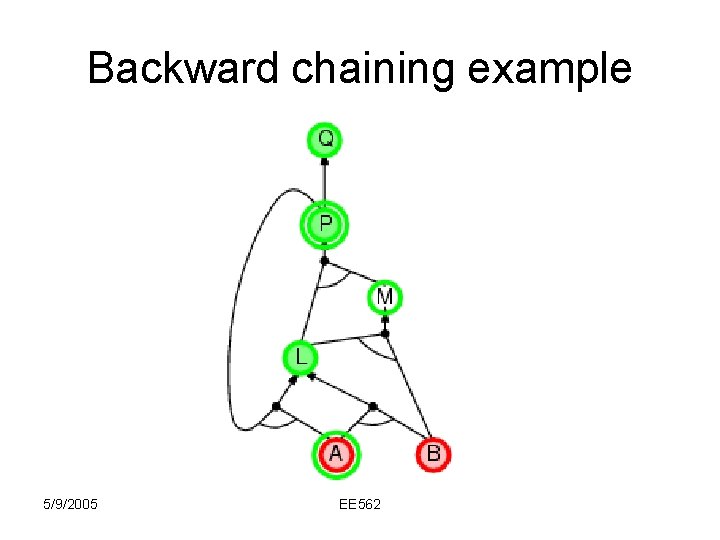
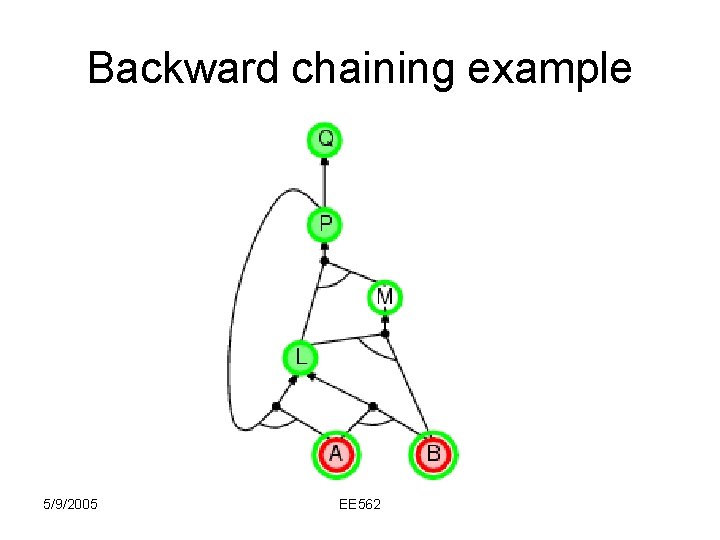
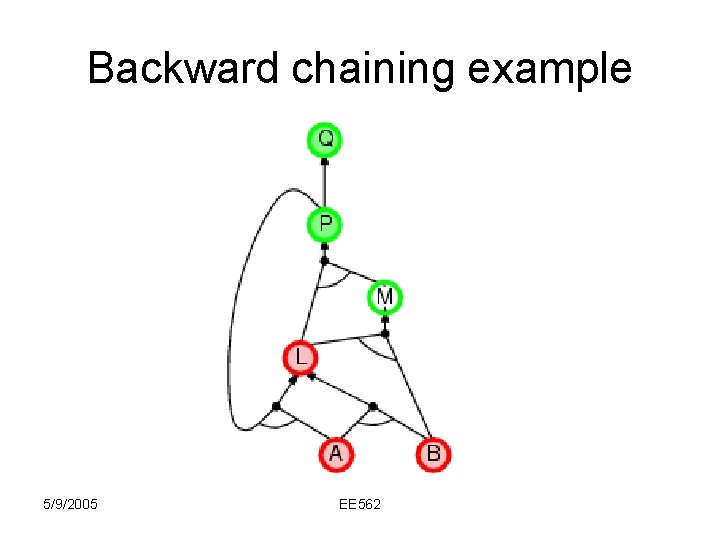
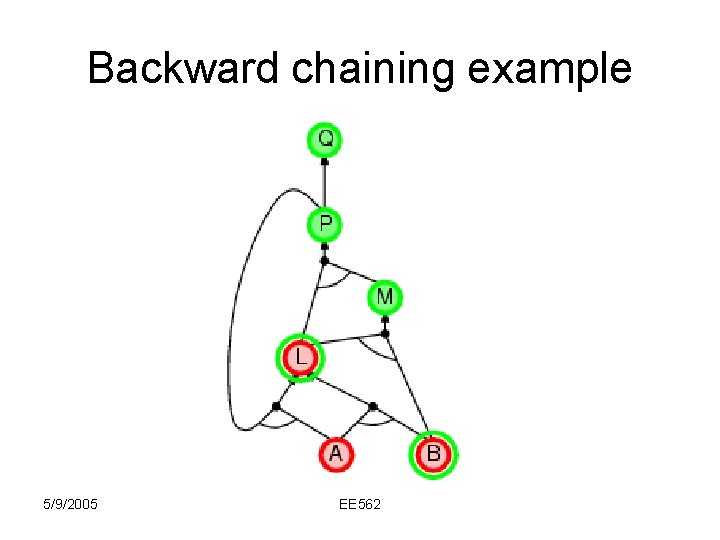
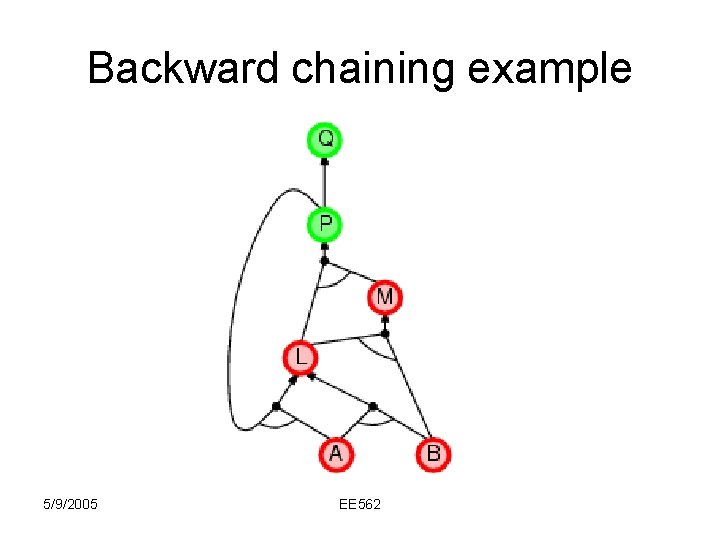
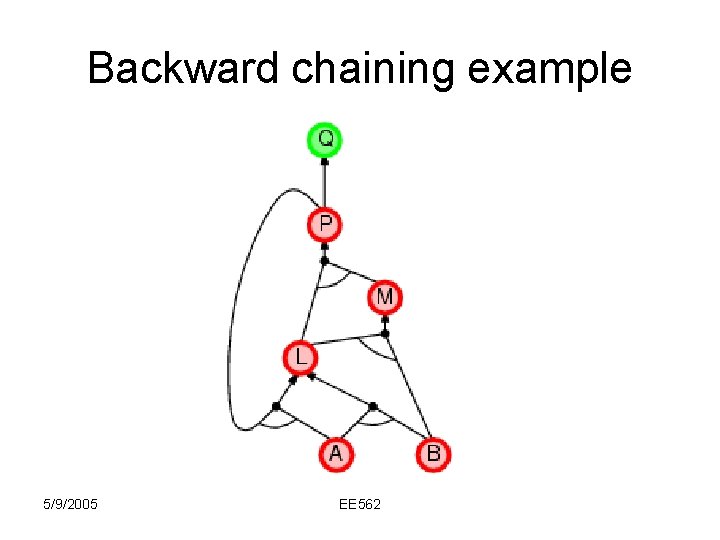
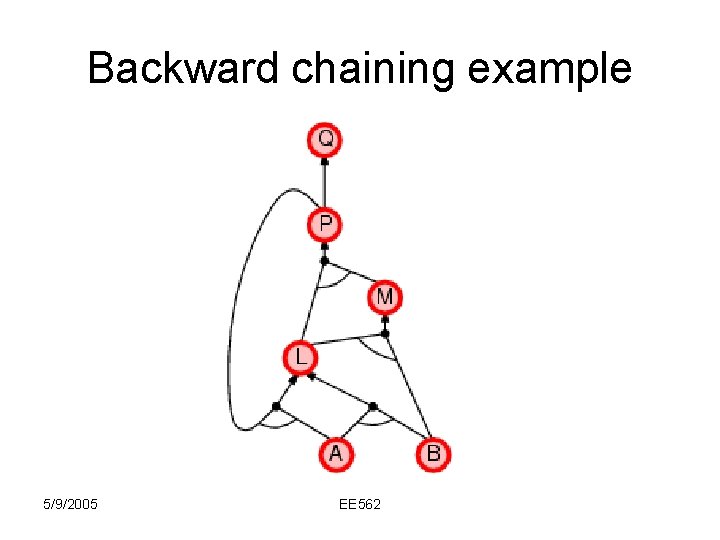
Backward chaining Idea: work backwards from the goal query q: to prove q by BC: check if q is known already, or prove by BC all premises of some rule that concludes q recurse. Avoid loops: check if new subgoal is already on the goal stack Avoid repeated work: check if new subgoal 5/9/2005 EE 562 1. has already been proved true, or
Backward chaining example 5/9/2005 EE 562
Backward chaining example 5/9/2005 EE 562
Backward chaining example 5/9/2005 EE 562
Backward chaining example 5/9/2005 EE 562
Backward chaining example 5/9/2005 EE 562
Backward chaining example 5/9/2005 EE 562
Backward chaining example 5/9/2005 EE 562
Backward chaining example 5/9/2005 EE 562
Backward chaining example 5/9/2005 EE 562
Backward chaining example 5/9/2005 EE 562
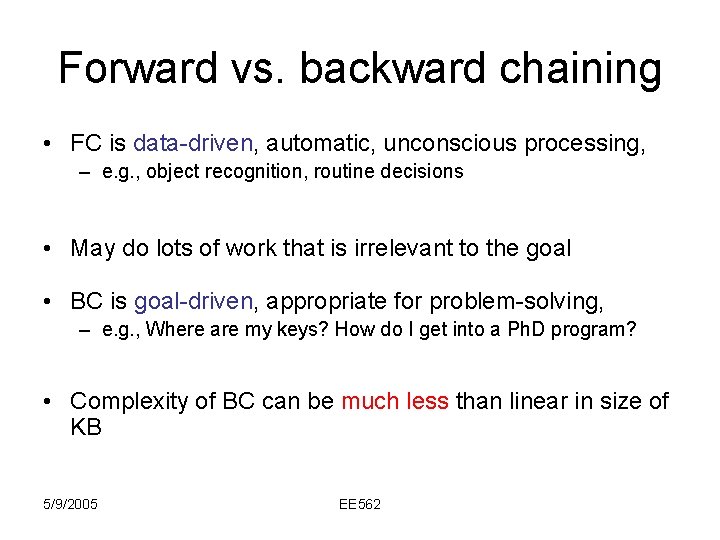
Forward vs. backward chaining • FC is data-driven, automatic, unconscious processing, – e. g. , object recognition, routine decisions • May do lots of work that is irrelevant to the goal • BC is goal-driven, appropriate for problem-solving, – e. g. , Where are my keys? How do I get into a Ph. D program? • Complexity of BC can be much less than linear in size of KB 5/9/2005 EE 562
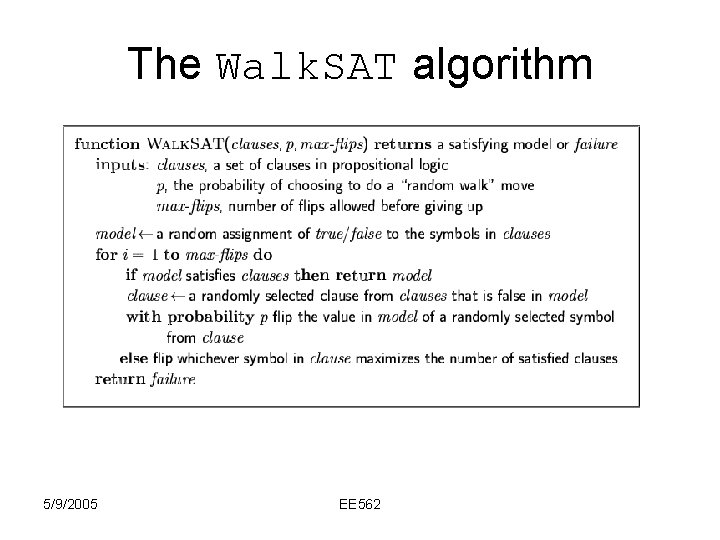
Efficient propositional inference Two families of efficient algorithms for propositional inference: Complete backtracking search algorithms • DPLL algorithm (Davis, Putnam, Logemann, Loveland) • Incomplete local search algorithms – Walk. SAT algorithm 5/9/2005 EE 562
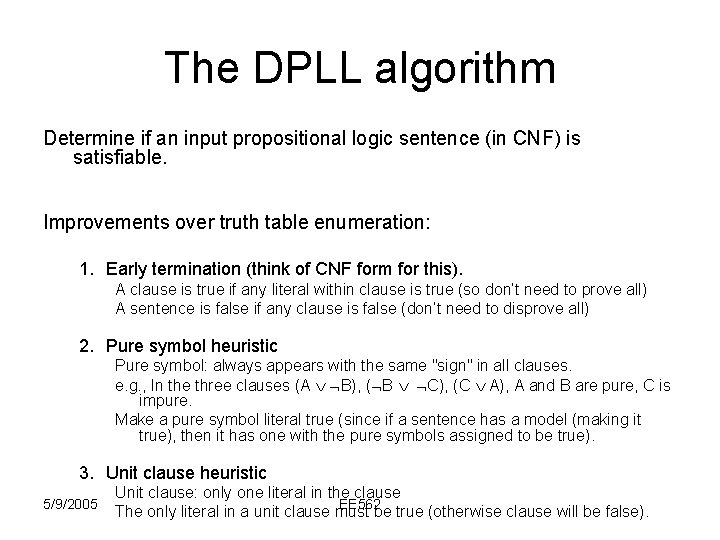
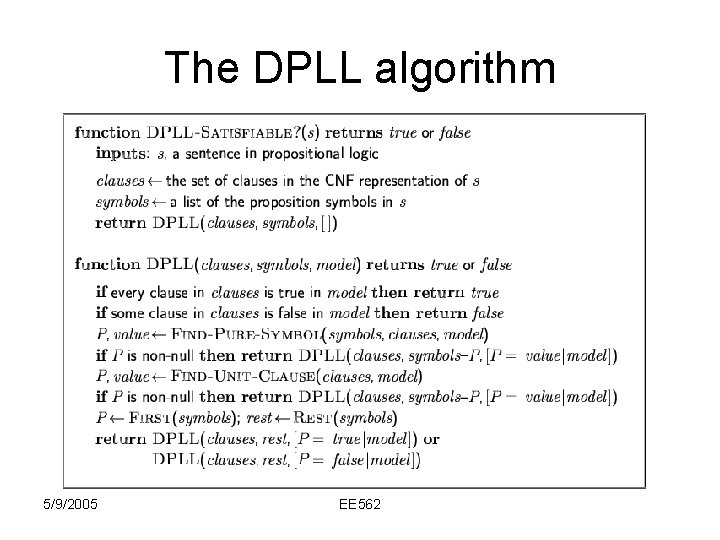
The DPLL algorithm Determine if an input propositional logic sentence (in CNF) is satisfiable. Improvements over truth table enumeration: 1. Early termination (think of CNF form for this). A clause is true if any literal within clause is true (so don’t need to prove all) A sentence is false if any clause is false (don’t need to disprove all) 2. Pure symbol heuristic Pure symbol: always appears with the same "sign" in all clauses. e. g. , In the three clauses (A B), ( B C), (C A), A and B are pure, C is impure. Make a pure symbol literal true (since if a sentence has a model (making it true), then it has one with the pure symbols assigned to be true). 3. Unit clause heuristic 5/9/2005 Unit clause: only one literal in the clause EE 562 The only literal in a unit clause must be true (otherwise clause will be false).
The DPLL algorithm 5/9/2005 EE 562
The Walk. SAT algorithm • Incomplete, local search algorithm • Evaluation function: The min-conflict heuristic of minimizing the number of unsatisfied clauses • Balance between greediness and randomness 5/9/2005 EE 562
The Walk. SAT algorithm 5/9/2005 EE 562
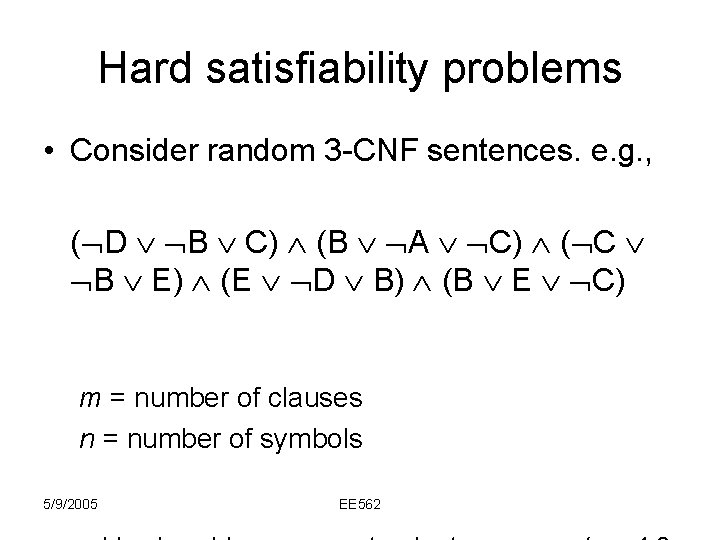
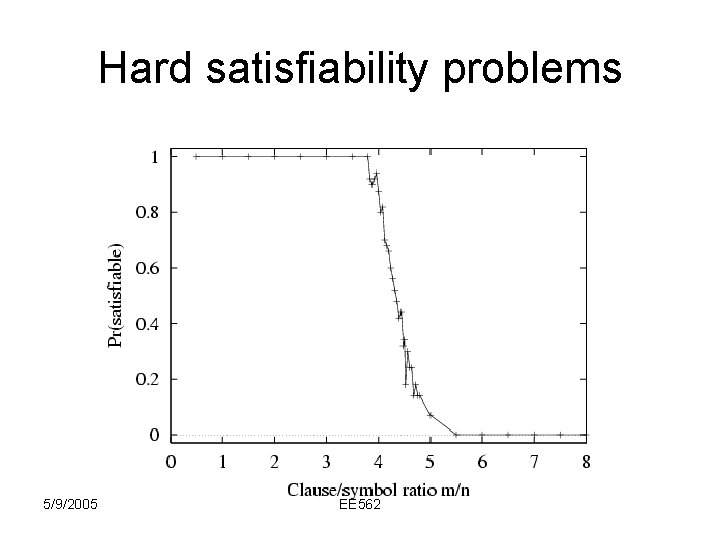
Hard satisfiability problems • Consider random 3 -CNF sentences. e. g. , ( D B C) (B A C) ( C B E) (E D B) (B E C) m = number of clauses n = number of symbols 5/9/2005 EE 562
Hard satisfiability problems 5/9/2005 EE 562
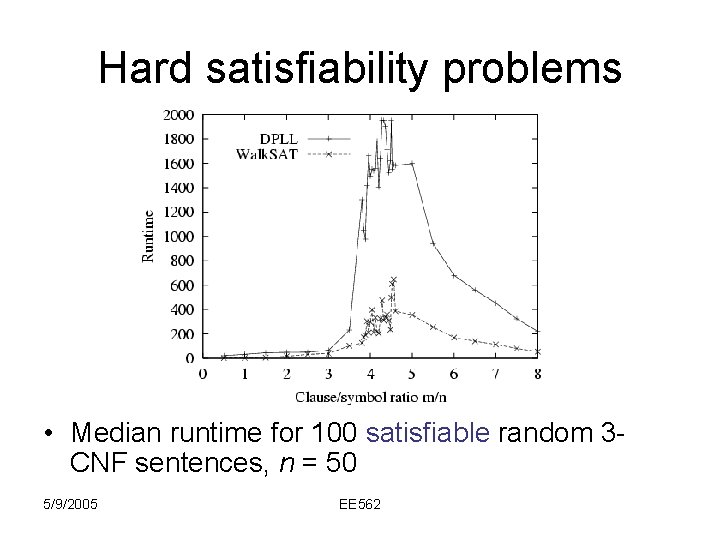
Hard satisfiability problems • Median runtime for 100 satisfiable random 3 CNF sentences, n = 50 5/9/2005 EE 562
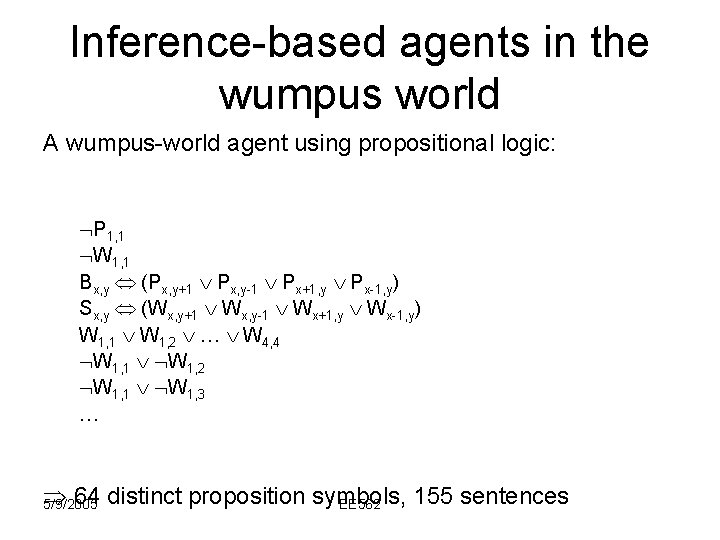
Inference-based agents in the wumpus world A wumpus-world agent using propositional logic: P 1, 1 W 1, 1 Bx, y (Px, y+1 Px, y-1 Px+1, y Px-1, y) Sx, y (Wx, y+1 Wx, y-1 Wx+1, y Wx-1, y) W 1, 1 W 1, 2 … W 4, 4 W 1, 1 W 1, 2 W 1, 1 W 1, 3 … 64 distinct proposition symbols, 155 sentences EE 562 5/9/2005
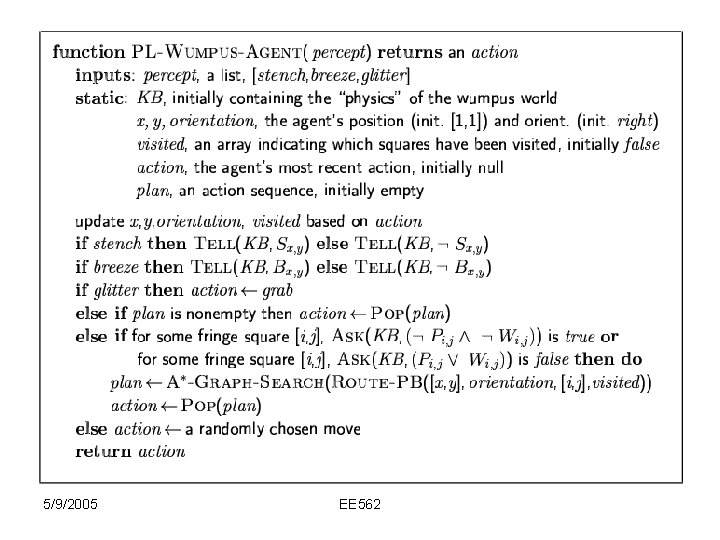
5/9/2005 EE 562
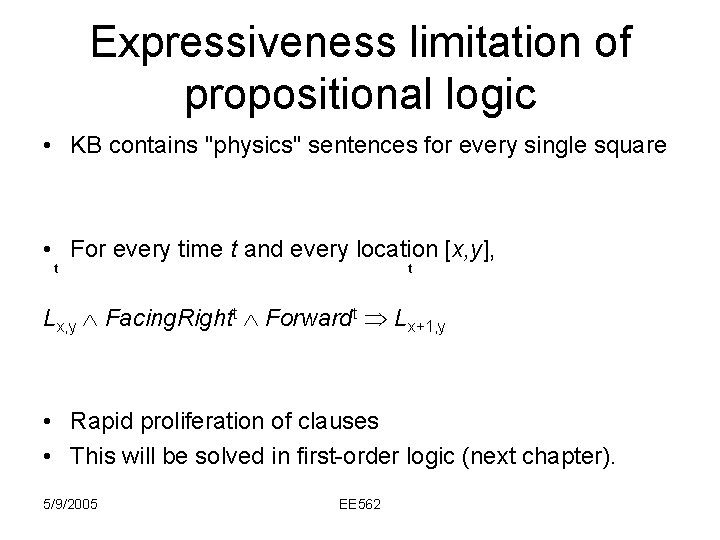
Expressiveness limitation of propositional logic • KB contains "physics" sentences for every single square • For every time t and every location [x, y], t t Lx, y Facing. Rightt Forwardt Lx+1, y • Rapid proliferation of clauses • This will be solved in first-order logic (next chapter). 5/9/2005 EE 562
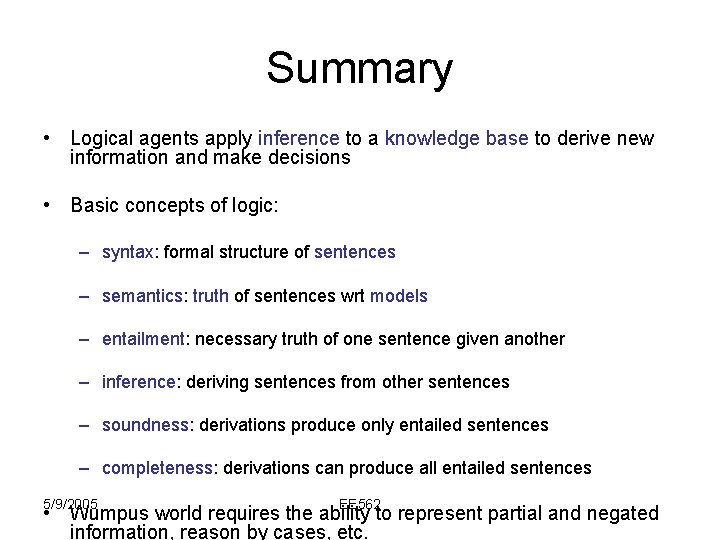
Summary • Logical agents apply inference to a knowledge base to derive new information and make decisions • Basic concepts of logic: – syntax: formal structure of sentences – semantics: truth of sentences wrt models – entailment: necessary truth of one sentence given another – inference: deriving sentences from other sentences – soundness: derivations produce only entailed sentences – completeness: derivations can produce all entailed sentences 5/9/2005 EE 562 • Wumpus world requires the ability to represent partial and negated information, reason by cases, etc.