Econ 522 Economics of Law Dan Quint Fall
- Slides: 47
Econ 522 Economics of Law Dan Quint Fall 2015 Lecture 4
Reminder w HW 1 due midnight Thursday via Learn@UW w If you want to read ahead for next week: w Harold Demsetz, “Toward a Theory of Property Rights” 1
So far, we have… w Defined efficiency Maximizing total surplus achieved by everyone in society… w …with value measured by willingness-to-pay w w Asked whether efficiency is a good normative goal for a legal system Posner: yes, because ex ante (before we knew which part we would play), we’d all agree to efficient rules w Cooter and Ulen: yes, because even if society has other goals in mind, such as redistribution, it’s better to make the law efficient and achieve redistribution through taxes w w Reviewed some basic game theory w Static games, and Nash equilibrium 2
Before we move on, an open discussion question w We asked whether efficiency is a good normative goal for a legal system w What are other plausible normative goals for a legal system? w When would you expect them to agree with, or conflict with, efficiency? 3
Property Law 4
Why do we need property law in the first place? w Monday, we introduced a game between two neighboring farmers w Each has two choices: farm his own land, or steal crops from his neighbor w Stealing is less efficient than planting my own crops w Have to carry the crops from your land to mine Might drop some along the way Have to steal at night move slower If I steal your crops, I avoid the effort of planting and watering 5
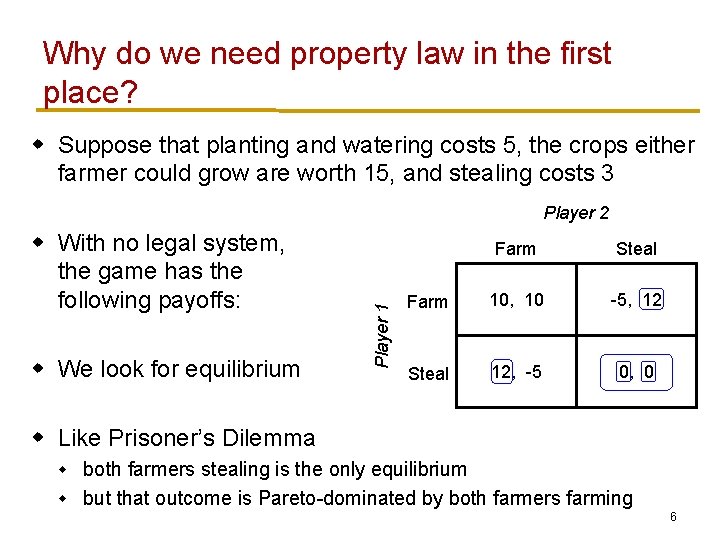
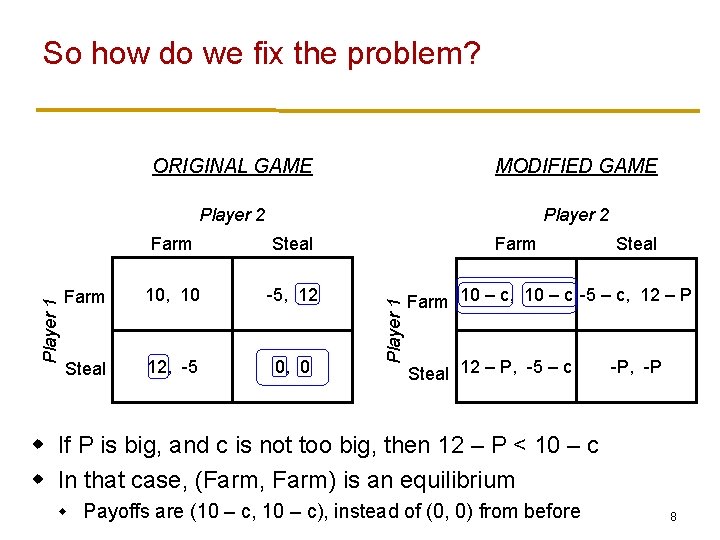
Why do we need property law in the first place? w Suppose that planting and watering costs 5, the crops either farmer could grow are worth 15, and stealing costs 3 w With no legal system, the game has the following payoffs: w We look for equilibrium Player 1 Player 2 Farm Steal Farm 10, 10 -5, 12 Steal 12, -5 0, 0 w Like Prisoner’s Dilemma both farmers stealing is the only equilibrium w but that outcome is Pareto-dominated by both farmers farming w 6
So how do we fix the problem? w Suppose there were lots of farmers facing this same problem w They come up with an idea: Institute some property rights w And some type of government that would punish people who steal w w Setting up the system would cost something w Suppose it imposes a cost c on everyone who plays by the rules 7
ORIGINAL GAME MODIFIED GAME Player 2 Farm Steal Farm 10, 10 -5, 12 Steal 12, -5 0, 0 Farm Player 1 So how do we fix the problem? Steal Farm 10 – c, 10 – c -5 – c, 12 – P Steal 12 – P, -5 – c -P, -P w If P is big, and c is not too big, then 12 – P < 10 – c w In that case, (Farm, Farm) is an equilibrium w Payoffs are (10 – c, 10 – c), instead of (0, 0) from before 8
So the idea here… w Anarchy is inefficient I spend time and effort stealing from you w You spend time and effort defending your property from thieves w Instead of doing productive work w w Establishing property rights, and a legal process for when they’re violated, is one way around the problem 9
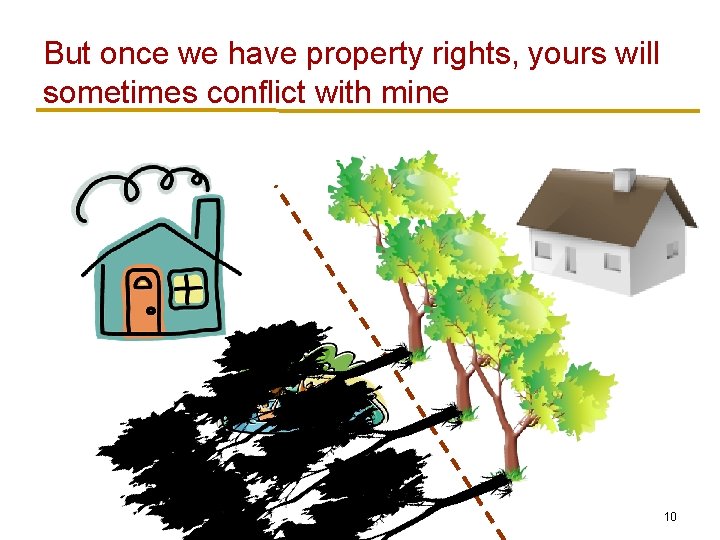
But once we have property rights, yours will sometimes conflict with mine 10
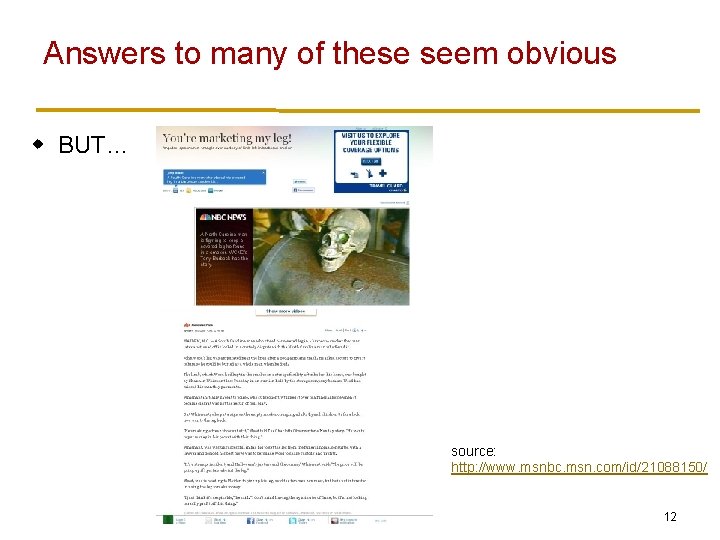
Overview of Property Law w Cooter and Ulen: property is “A bundle of legal rights over resources that the owner is free to exercise and whose exercise is protected from interference by others” w Property rights are not absolute w Appendix to ch. 4 discusses different conceptions of property rights w Any system has to answer four fundamental questions: What things can be privately owned? w What can (and can’t) an owner do with his property? w How are property rights established? w What remedies are given when property rights are violated? w 11
Answers to many of these seem obvious w BUT… source: http: //www. msnbc. msn. com/id/21088150/ 12
How do we design property law to achieve efficient outcomes? 13
Foxes 14
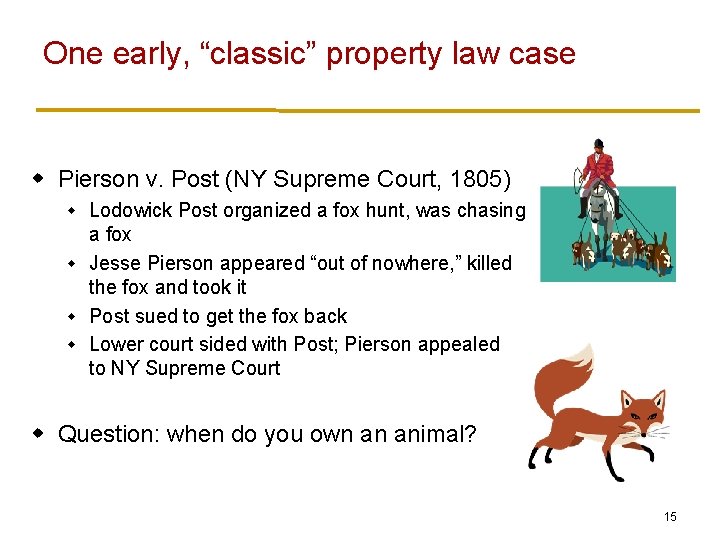
One early, “classic” property law case w Pierson v. Post (NY Supreme Court, 1805) Lodowick Post organized a fox hunt, was chasing a fox w Jesse Pierson appeared “out of nowhere, ” killed the fox and took it w Post sued to get the fox back w Lower court sided with Post; Pierson appealed to NY Supreme Court w w Question: when do you own an animal? 15
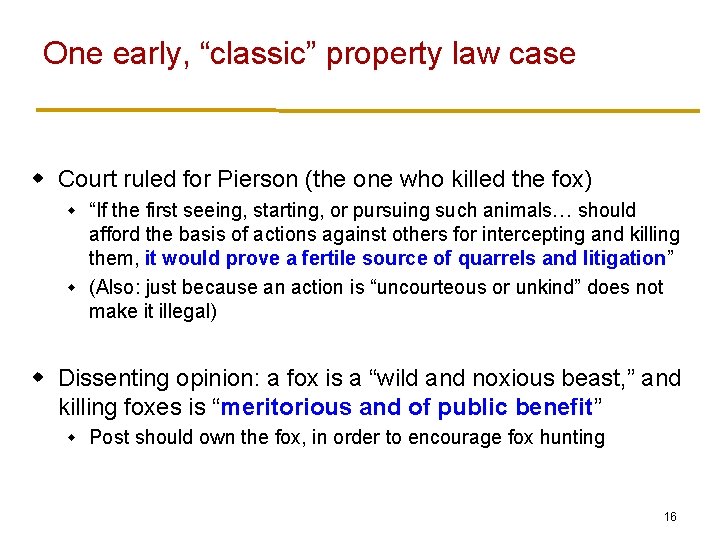
One early, “classic” property law case w Court ruled for Pierson (the one who killed the fox) “If the first seeing, starting, or pursuing such animals… should afford the basis of actions against others for intercepting and killing them, it would prove a fertile source of quarrels and litigation” w (Also: just because an action is “uncourteous or unkind” does not make it illegal) w w Dissenting opinion: a fox is a “wild and noxious beast, ” and killing foxes is “meritorious and of public benefit” w Post should own the fox, in order to encourage fox hunting 16
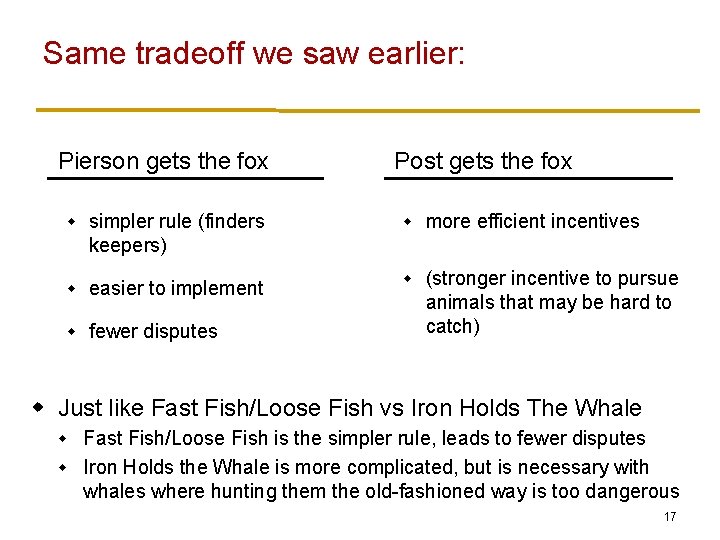
Same tradeoff we saw earlier: Pierson gets the fox Post gets the fox w simpler rule (finders keepers) w more efficient incentives w easier to implement w w fewer disputes (stronger incentive to pursue animals that may be hard to catch) w Just like Fast Fish/Loose Fish vs Iron Holds The Whale Fast Fish/Loose Fish is the simpler rule, leads to fewer disputes w Iron Holds the Whale is more complicated, but is necessary with whales where hunting them the old-fashioned way is too dangerous w 17
This suggests it matters quite a bit who we award the fox to w Not just to Pierson and Post, who both want it… w …but for efficiency w And this brings us to… 18
Coase 19
How should property rights be allocated to achieve efficiency? w Coase’s surprising answer: it doesn’t matter w (Under certain conditions) 20
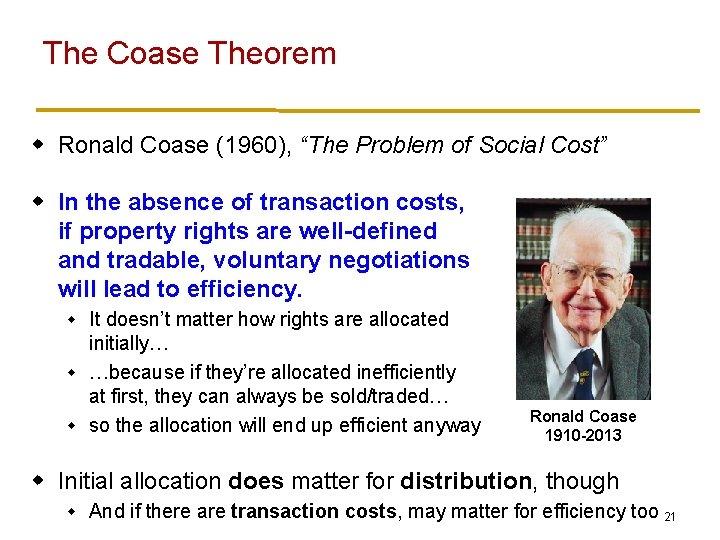
The Coase Theorem w Ronald Coase (1960), “The Problem of Social Cost” w In the absence of transaction costs, if property rights are well-defined and tradable, voluntary negotiations will lead to efficiency. It doesn’t matter how rights are allocated initially… w …because if they’re allocated inefficiently at first, they can always be sold/traded… w so the allocation will end up efficient anyway w Ronald Coase 1910 -2013 w Initial allocation does matter for distribution, though w And if there are transaction costs, may matter for efficiency too 21
Example of Coase: you have a car worth $3, 000 to you, $4, 000 to me w Obviously, efficient for me to own it… w …but we don’t need the law to give me the car If I start out owning the car: no reason for you to buy it, I end up with it efficient w If you start out owning the car: clear incentive for me to buy it, I end up with it efficient w Regardless of who owns the car at first, we get to the efficient outcome w I’d rather start out with the car – so I don’t have to pay you for it You’d rather start out with it – so you end up with more money Efficiency doesn’t care about distribution – how much money we each end up with – just who ends up with the car at the end. And that doesn’t depend on who starts with it. w The key: lack of transaction costs 22
Another example: you want to have a party in the house next door to mine w If it’s efficient for you to have the party… Your benefit from having the party is greater than my benefit from a good night’s sleep w If you start out with the right to have the party, no problem w If I start out with the right to quiet, you can pay me for the right to have the party w w If it’s efficient for you not to have the party… Good night sleep is worth more to me w If I have right to silence, no problem w If you have right to party, I can pay you not to have it w w The point: either way, we achieve efficiency If it’s efficient to have the party, you have the party w If it’s efficient not to, you don’t w Regardless of who started off with the right w 23
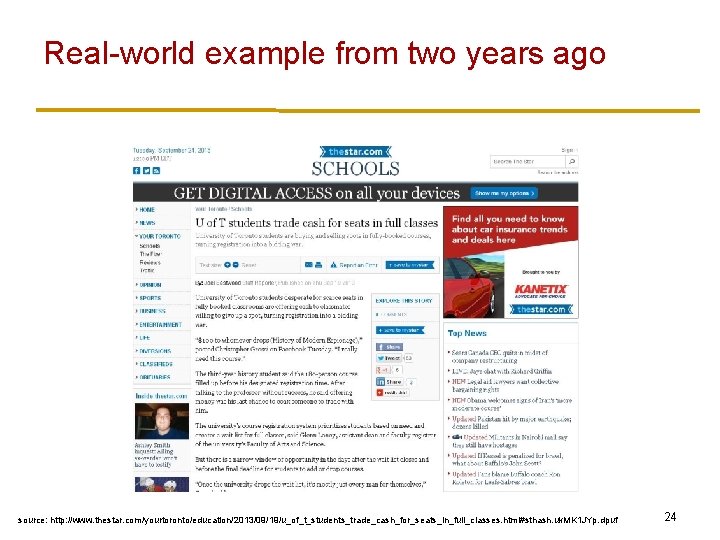
Real-world example from two years ago source: http: //www. thestar. com/yourtoronto/education/2013/09/19/u_of_t_students_trade_cash_for_seats_in_full_classes. html#sthash. uk. MK 1 JYp. dpuf 24
The conditions for this to hold w Property rights have to be well-defined… w It must be clear on who has what rights to start with, so we know the starting point for negotiations w …and tradable… w We need to be allowed to sell/transfer/reallocate rights if we want w …and there can’t be transaction costs w It can’t be difficult or costly for us to buy/sell the right w So, the Coase Theorem: In the absence of transaction costs, if property rights are well-defined and tradable, voluntary negotiations will lead to efficiency. 25
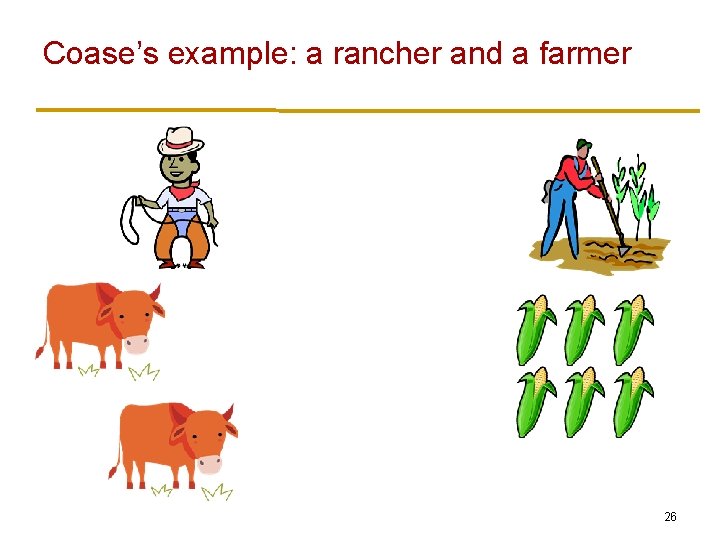
Coase’s example: a rancher and a farmer 26
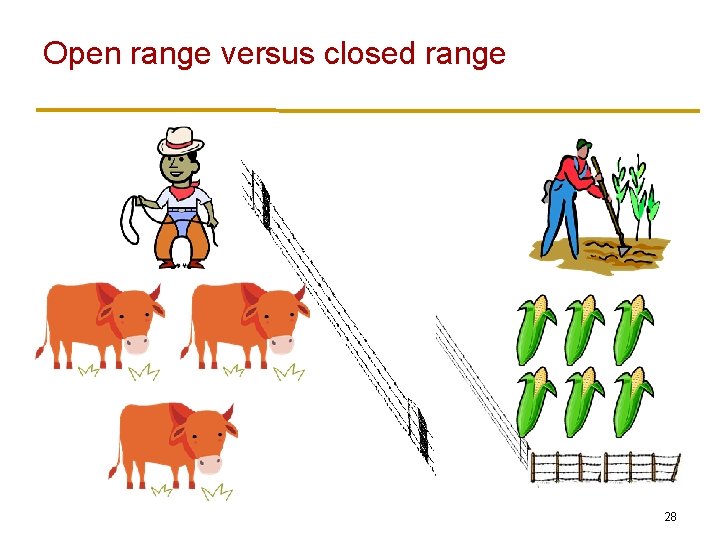
Rancher’s versus farmer’s rights w English common law: “closed range” or “fencing-in” (or “farmer’s rights”) Ranchers have responsibility to control their cattle w Rancher must pay for any damage done by his herd w w Much of the U. S. at various times: “open range” or “fencing-out” (or “rancher’s rights”) Rancher can let his cattle roam free w Not liable for damage they do to farmer’s crops (unless farmer had a good fence and they broke through anyway) w w Which rule is more efficient? 27
Open range versus closed range 28
Coase: either law will lead to efficiency w If it’s cheaper for the farmer to protect his crops than for the rancher to control his herd… Under open range law, that’s what he’ll do w Under closed range law, rancher can pay farmer to build fence w w If smaller herd is more efficient, farmer can pay rancher to keep fewer cattle w Coase: Whatever is the efficient combination of cattle, crops, fences, etc. … w …the rancher and farmer will negotiate to that efficient outcome, regardless of which law is in place… w …as long as the rights are well-defined and tradable and there are no transaction costs 29 w
Note that there’s no sense of “blame” here w Pigovian tax (Arthur Pigou) Penalize firms for causing negative externalities w Requires us to “blame” one party w w Coase: doesn’t matter who is “causing” the harm w “It is true that there would be no crop damage without the cattle. It is equally true that there would be no crop damage without the crops. ” w Coase isn’t worried about “justice”, just efficiency Doesn’t matter if a polluter is actually charged for polluting… w …or is allowed to pollute, but could be bribed to not pollute w Either way, without transaction costs, we’ll end up getting the efficient amount of pollution! w 30
Rancher and farmer: numerical example w Three possibilities: Rancher builds fence around herd… costs $400 w Farmer builds fence around crops… costs $200 w Do nothing, live with damage… costs nothing w w If expected crop damage = $100 Open range: farmer lives with damage rather than building fence w Closed range: rancher pays for damage rather than fence w w If expected crop damage = $500 Open range: farmer builds fence – efficient w Coase: closed range: rancher pays farmer to build fence w So efficient outcome under either rule w 31
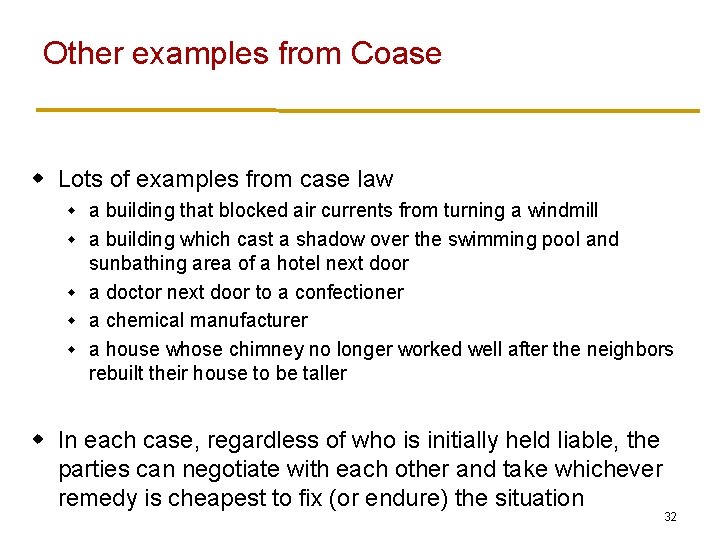
Other examples from Coase w Lots of examples from case law w w a building that blocked air currents from turning a windmill a building which cast a shadow over the swimming pool and sunbathing area of a hotel next door a doctor next door to a confectioner a chemical manufacturer a house whose chimney no longer worked well after the neighbors rebuilt their house to be taller w In each case, regardless of who is initially held liable, the parties can negotiate with each other and take whichever remedy is cheapest to fix (or endure) the situation 32
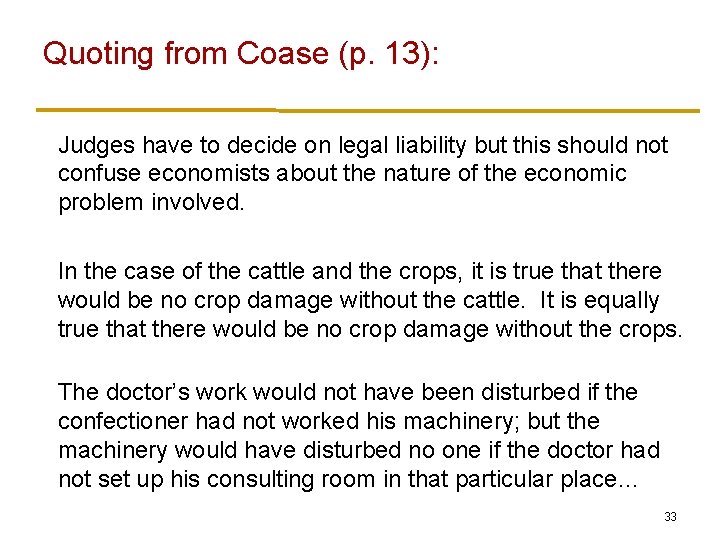
Quoting from Coase (p. 13): Judges have to decide on legal liability but this should not confuse economists about the nature of the economic problem involved. In the case of the cattle and the crops, it is true that there would be no crop damage without the cattle. It is equally true that there would be no crop damage without the crops. The doctor’s work would not have been disturbed if the confectioner had not worked his machinery; but the machinery would have disturbed no one if the doctor had not set up his consulting room in that particular place… 33
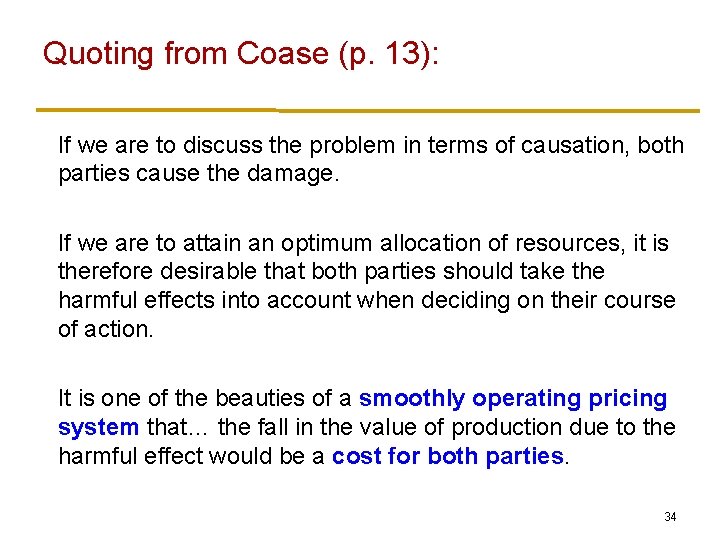
Quoting from Coase (p. 13): If we are to discuss the problem in terms of causation, both parties cause the damage. If we are to attain an optimum allocation of resources, it is therefore desirable that both parties should take the harmful effects into account when deciding on their course of action. It is one of the beauties of a smoothly operating pricing system that… the fall in the value of production due to the harmful effect would be a cost for both parties. 34
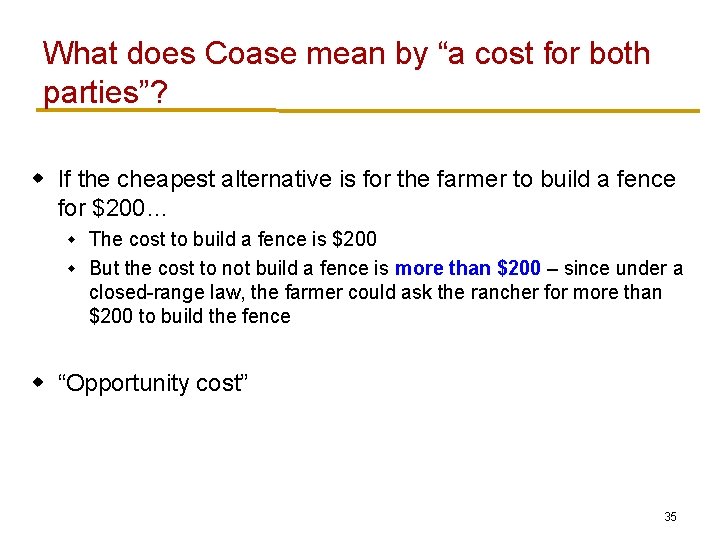
What does Coase mean by “a cost for both parties”? w If the cheapest alternative is for the farmer to build a fence for $200… The cost to build a fence is $200 w But the cost to not build a fence is more than $200 – since under a closed-range law, the farmer could ask the rancher for more than $200 to build the fence w w “Opportunity cost” 35
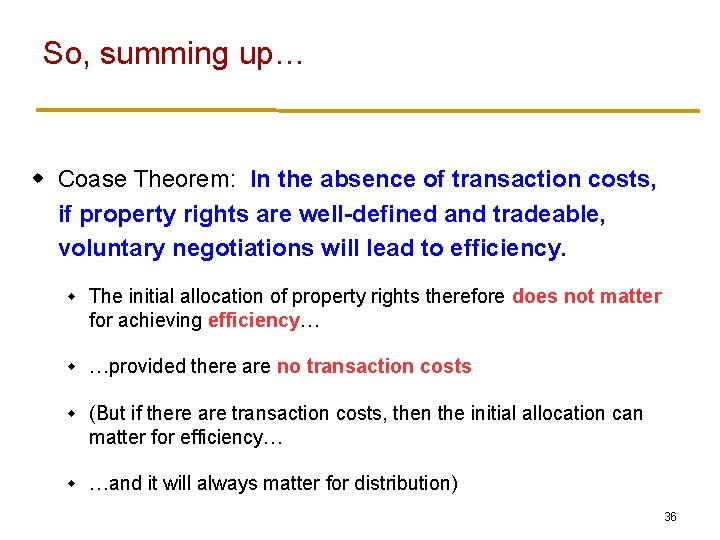
So, summing up… w Coase Theorem: In the absence of transaction costs, if property rights are well-defined and tradeable, voluntary negotiations will lead to efficiency. w The initial allocation of property rights therefore does not matter for achieving efficiency… w …provided there are no transaction costs w (But if there are transaction costs, then the initial allocation can matter for efficiency… w …and it will always matter for distribution) 36
Back to Foxes 37
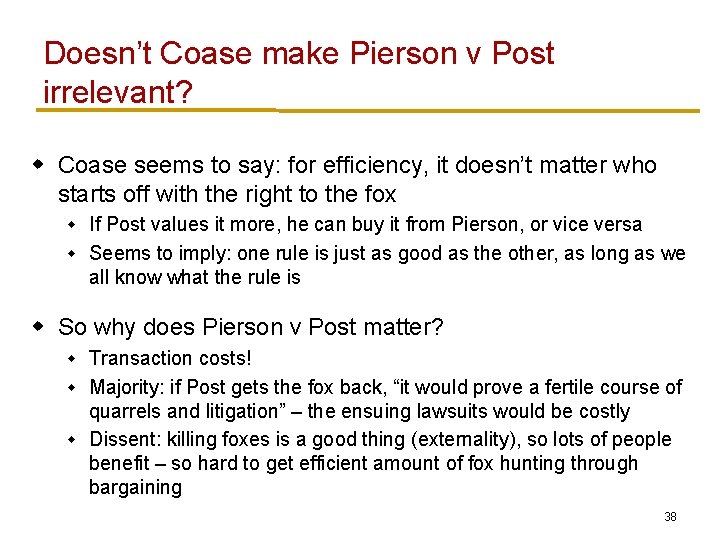
Doesn’t Coase make Pierson v Post irrelevant? w Coase seems to say: for efficiency, it doesn’t matter who starts off with the right to the fox If Post values it more, he can buy it from Pierson, or vice versa w Seems to imply: one rule is just as good as the other, as long as we all know what the rule is w w So why does Pierson v Post matter? Transaction costs! w Majority: if Post gets the fox back, “it would prove a fertile course of quarrels and litigation” – the ensuing lawsuits would be costly w Dissent: killing foxes is a good thing (externality), so lots of people benefit – so hard to get efficient amount of fox hunting through bargaining w 38
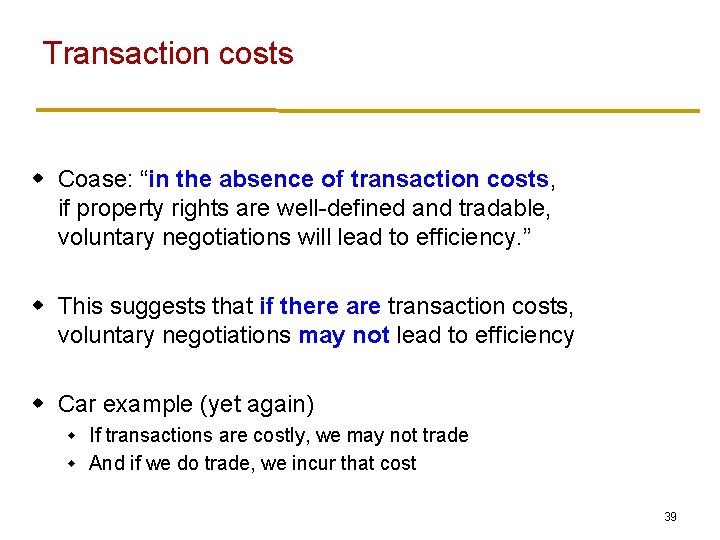
Transaction costs w Coase: “in the absence of transaction costs, if property rights are well-defined and tradable, voluntary negotiations will lead to efficiency. ” w This suggests that if there are transaction costs, voluntary negotiations may not lead to efficiency w Car example (yet again) If transactions are costly, we may not trade w And if we do trade, we incur that cost w 39
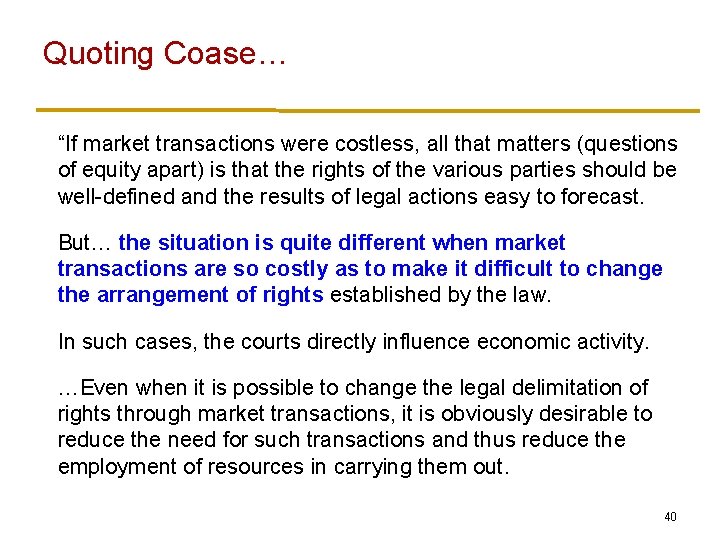
Quoting Coase… “If market transactions were costless, all that matters (questions of equity apart) is that the rights of the various parties should be well-defined and the results of legal actions easy to forecast. But… the situation is quite different when market transactions are so costly as to make it difficult to change the arrangement of rights established by the law. In such cases, the courts directly influence economic activity. …Even when it is possible to change the legal delimitation of rights through market transactions, it is obviously desirable to reduce the need for such transactions and thus reduce the employment of resources in carrying them out. 40
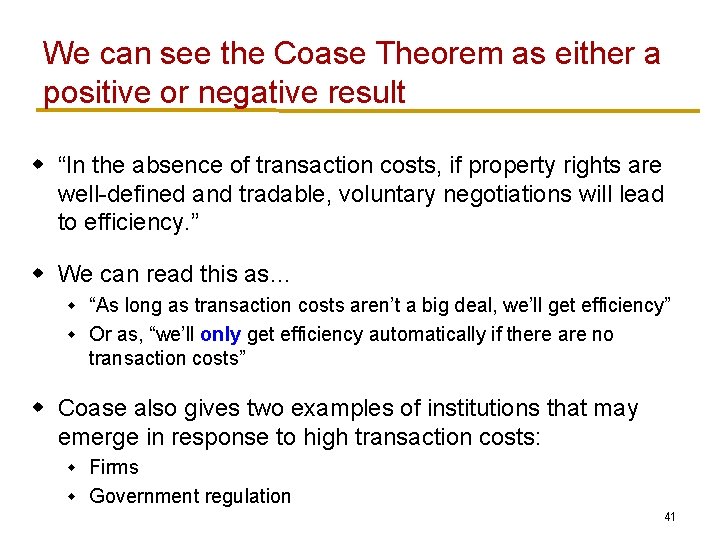
We can see the Coase Theorem as either a positive or negative result w “In the absence of transaction costs, if property rights are well-defined and tradable, voluntary negotiations will lead to efficiency. ” w We can read this as… “As long as transaction costs aren’t a big deal, we’ll get efficiency” w Or as, “we’ll only get efficiency automatically if there are no transaction costs” w w Coase also gives two examples of institutions that may emerge in response to high transaction costs: Firms w Government regulation w 41
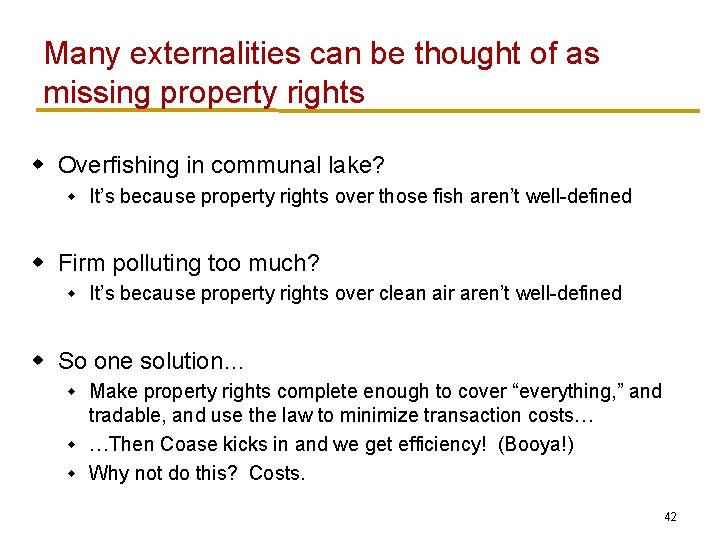
Many externalities can be thought of as missing property rights w Overfishing in communal lake? w It’s because property rights over those fish aren’t well-defined w Firm polluting too much? w It’s because property rights over clean air aren’t well-defined w So one solution… Make property rights complete enough to cover “everything, ” and tradable, and use the law to minimize transaction costs… w …Then Coase kicks in and we get efficiency! (Booya!) w Why not do this? Costs. w 42
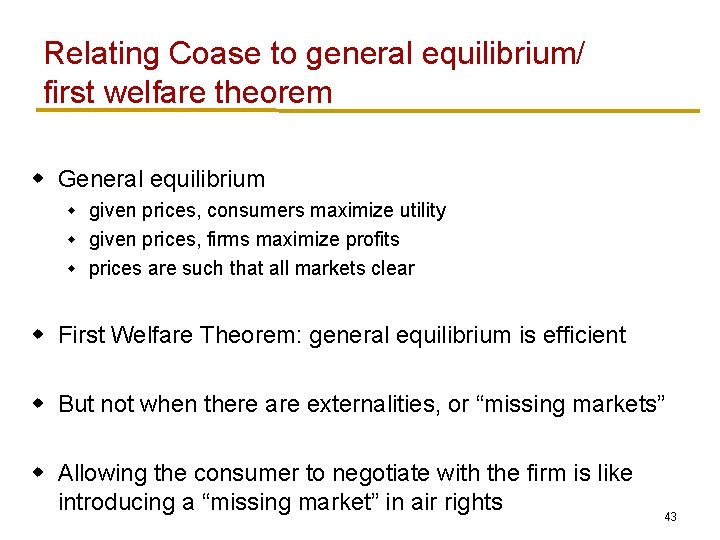
Relating Coase to general equilibrium/ first welfare theorem w General equilibrium given prices, consumers maximize utility w given prices, firms maximize profits w prices are such that all markets clear w w First Welfare Theorem: general equilibrium is efficient w But not when there are externalities, or “missing markets” w Allowing the consumer to negotiate with the firm is like introducing a “missing market” in air rights 43
Relating Coase to general equilibrium/ first welfare theorem w General equilibrium given prices, consumers maximize utility w given prices, firms maximize profits w prices are such that all markets clear w w First Welfare Theorem: general equilibrium is efficient w But not when there are externalities, or “missing markets” w Allowing the consumer to negotiate with the firm is like introducing a “missing market” in air rights 44
That’s it for today w HW 1 due (online submission) midnight Thursday w For next week w Demsetz, “Toward a Theory of Property Rights” 45
(blank slide) w … 46