
CS 522 Advanced Database Systems Data Cube Computation
CS 522 Advanced Database Systems Data Cube Computation Chengyu Sun California State University, Los Angeles
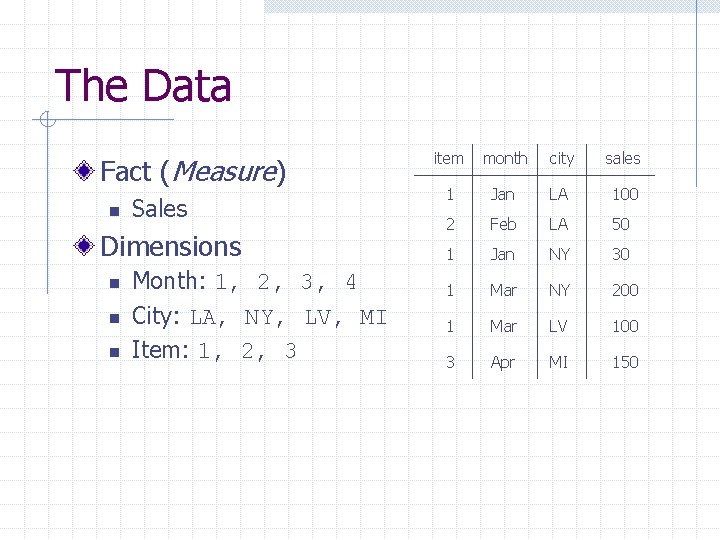
The Data Fact (Measure) n Sales Dimensions n n n Month: 1, 2, 3, 4 City: LA, NY, LV, MI Item: 1, 2, 3 item month city sales 1 Jan LA 100 2 Feb LA 50 1 Jan NY 30 1 Mar NY 200 1 Mar LV 100 3 Apr MI 150
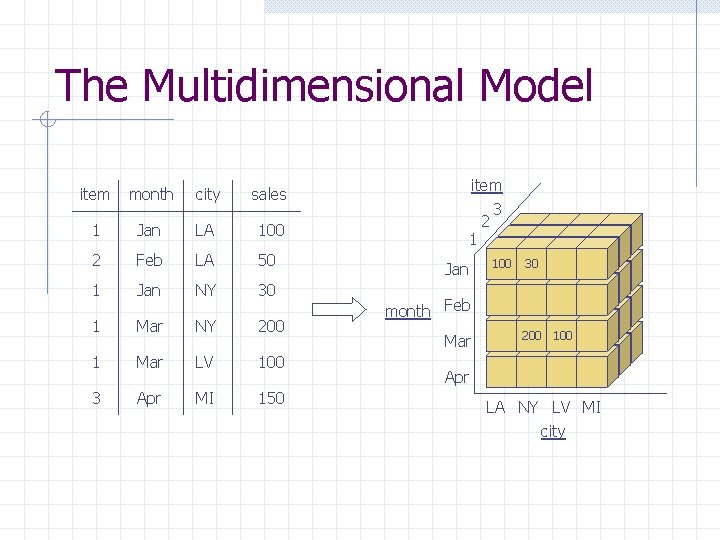
The Multidimensional Model item month city sales 1 Jan LA 100 2 Feb LA 50 1 Jan NY 30 1 Mar NY 200 1 Mar LV 100 3 Apr MI 150 item 3 2 1 Jan 100 30 month Feb Mar 200 100 Apr LA NY LV MI city
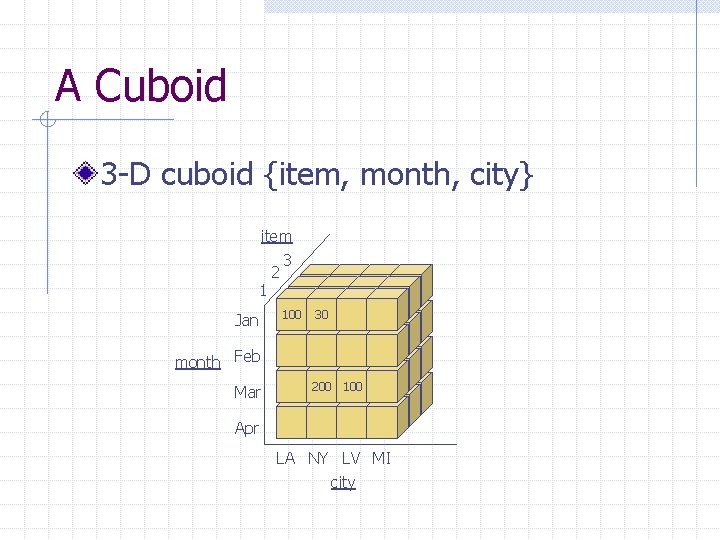
A Cuboid 3 -D cuboid {item, month, city} item 3 2 1 Jan 100 30 month Feb Mar 200 100 Apr LA NY LV MI city
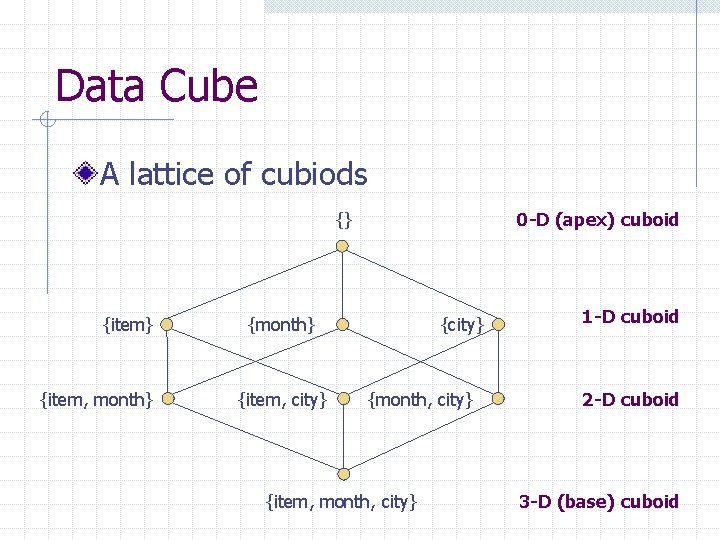
Data Cube A lattice of cubiods {} {item, month} 0 -D (apex) cuboid {month} {item, city} {month, city} {item, month, city} 1 -D cuboid 2 -D cuboid 3 -D (base) cuboid
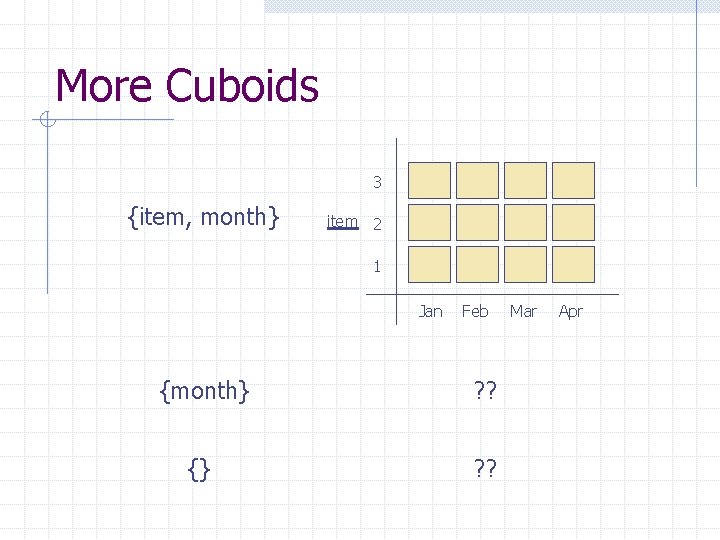
More Cuboids 3 {item, month} item 2 1 Jan Feb {month} ? ? {} ? ? Mar Apr
About the Data Cube # of cuboids? ? # of cells in each cuboid? ? How do a few records turn into so much data? ?
Observations and Solutions Observations n Curse of Dimensionality Sparsity n Closed coverage n Solutions n Partial computation of data cube w Iceberg Cube w Shell Cube n Cube compression w Closed Cube
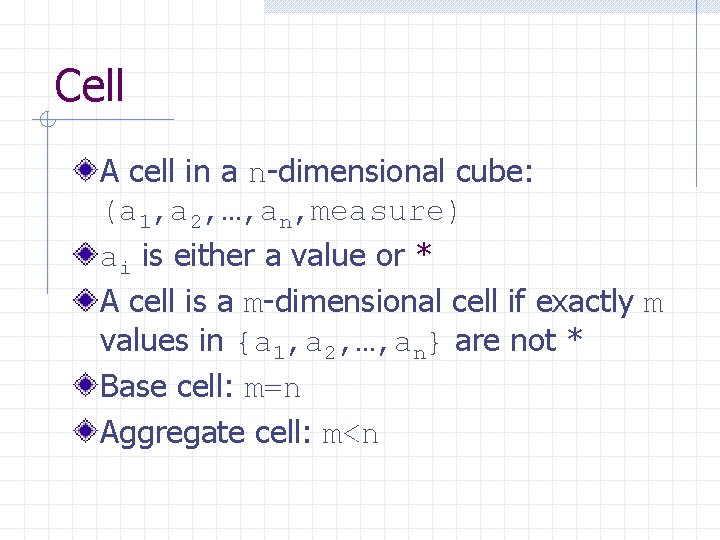
Cell A cell in a n-dimensional cube: (a 1, a 2, …, an, measure) ai is either a value or * A cell is a m-dimensional cell if exactly m values in {a 1, a 2, …, an} are not * Base cell: m=n Aggregate cell: m<n
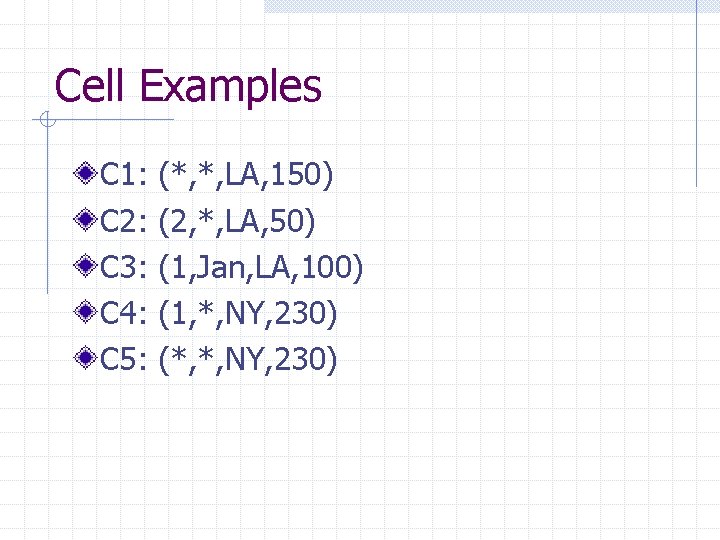
Cell Examples C 1: C 2: C 3: C 4: C 5: (*, *, LA, 150) (2, *, LA, 50) (1, Jan, LA, 100) (1, *, NY, 230) (*, *, NY, 230)
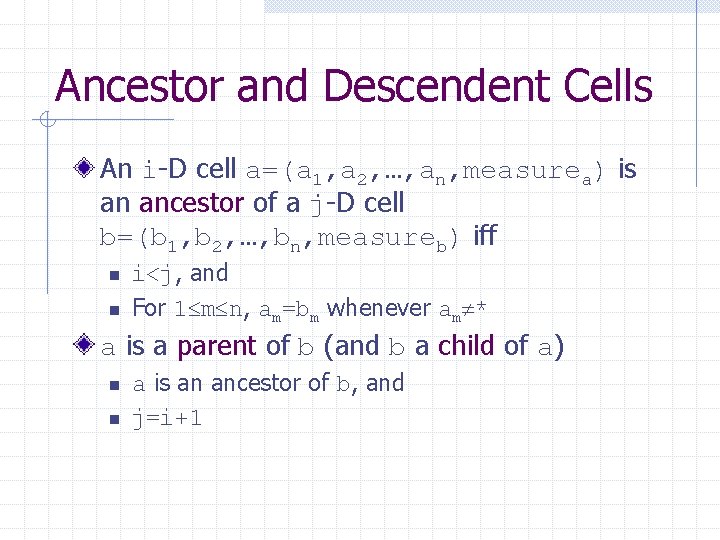
Ancestor and Descendent Cells An i-D cell a=(a 1, a 2, …, an, measurea) is an ancestor of a j-D cell b=(b 1, b 2, …, bn, measureb) iff n n i<j, and For 1 m n, am=bm whenever am * a is a parent of b (and b a child of a) n n a is an ancestor of b, and j=i+1
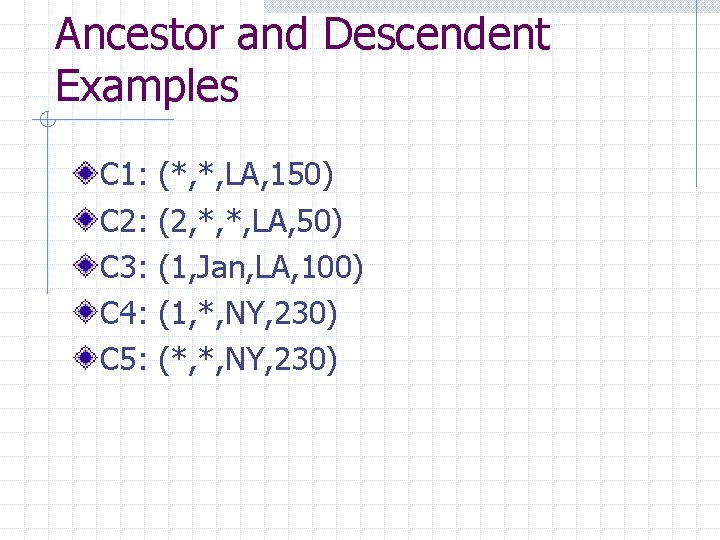
Ancestor and Descendent Examples C 1: C 2: C 3: C 4: C 5: (*, *, LA, 150) (2, *, *, LA, 50) (1, Jan, LA, 100) (1, *, NY, 230) (*, *, NY, 230)
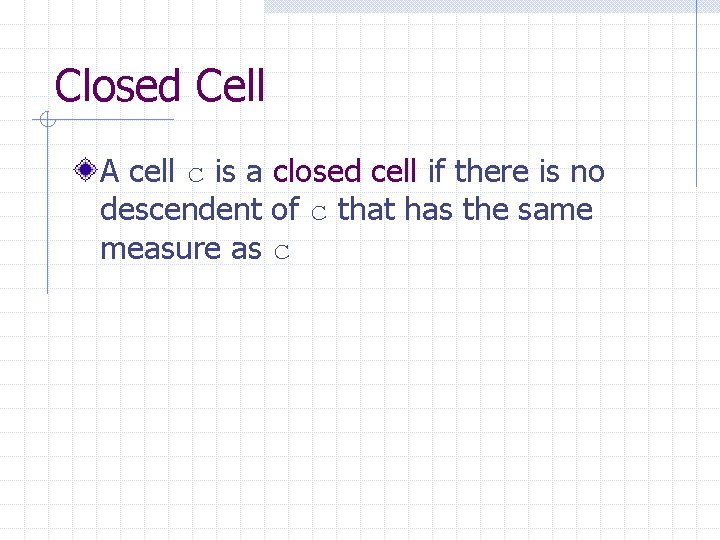
Closed Cell A cell c is a closed cell if there is no descendent of c that has the same measure as c
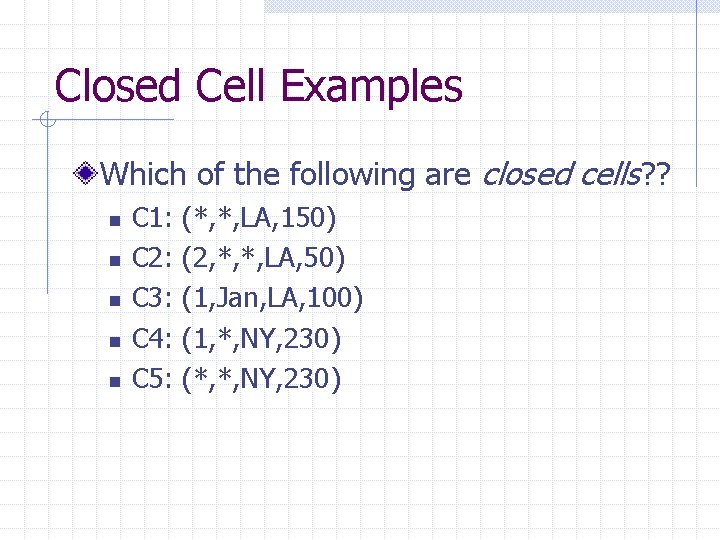
Closed Cell Examples Which of the following are closed cells? ? n n n C 1: C 2: C 3: C 4: C 5: (*, *, LA, 150) (2, *, *, LA, 50) (1, Jan, LA, 100) (1, *, NY, 230) (*, *, NY, 230)
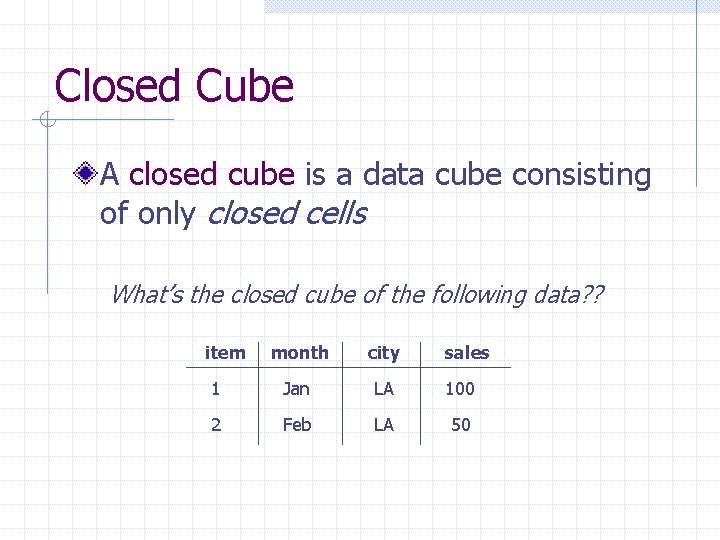
Closed Cube A closed cube is a data cube consisting of only closed cells What’s the closed cube of the following data? ? item month city sales 1 Jan LA 100 2 Feb LA 50
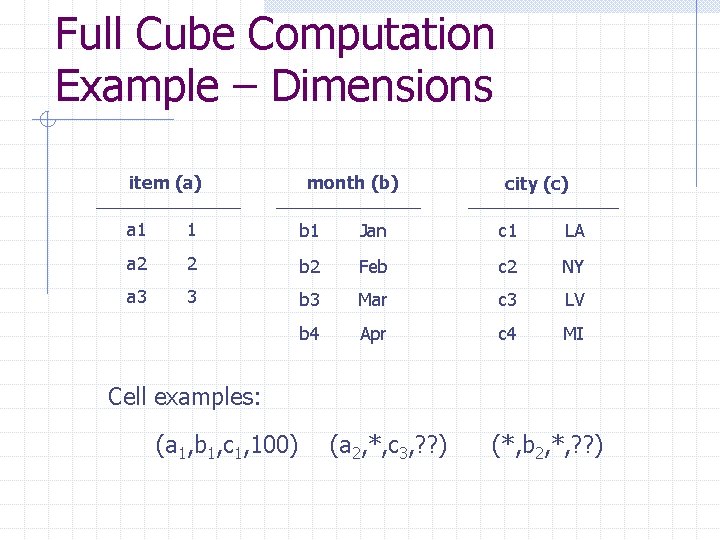
Full Cube Computation Example – Dimensions item (a) month (b) city (c) a 1 1 b 1 Jan c 1 LA a 2 2 b 2 Feb c 2 NY a 3 3 b 3 Mar c 3 LV b 4 Apr c 4 MI Cell examples: (a 1, b 1, c 1, 100) (a 2, *, c 3, ? ? ) (*, b 2, *, ? ? )
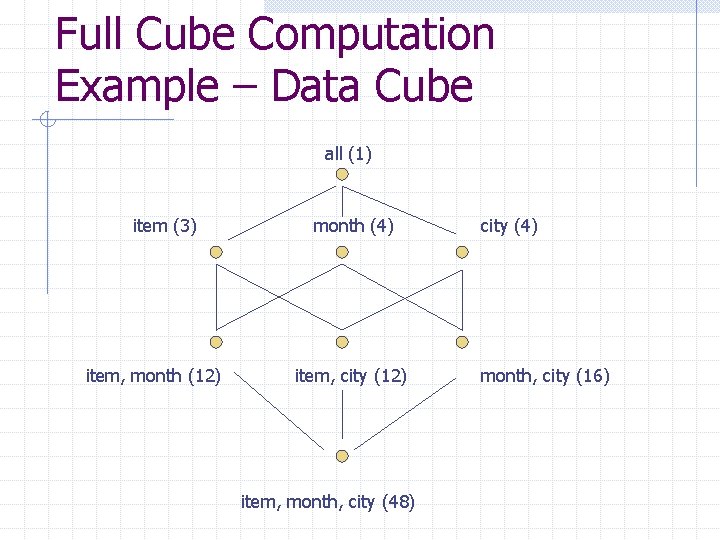
Full Cube Computation Example – Data Cube all (1) item (3) item, month (12) month (4) item, city (12) item, month, city (48) city (4) month, city (16)
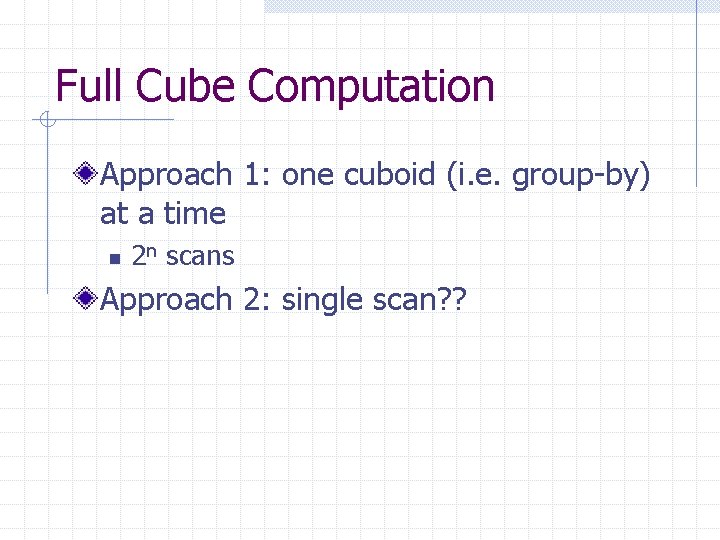
Full Cube Computation Approach 1: one cuboid (i. e. group-by) at a time n 2 n scans Approach 2: single scan? ?
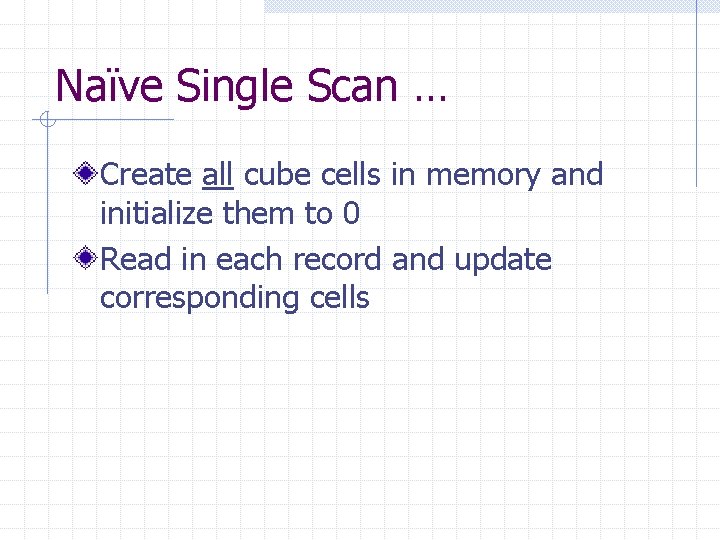
Naïve Single Scan … Create all cube cells in memory and initialize them to 0 Read in each record and update corresponding cells
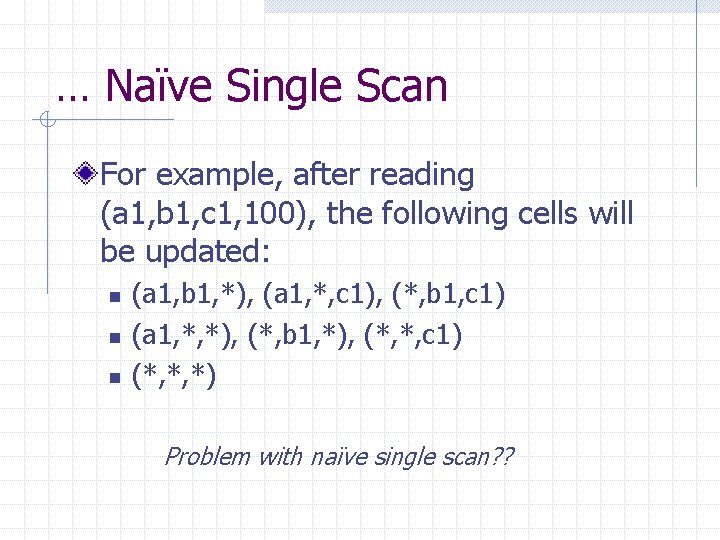
… Naïve Single Scan For example, after reading (a 1, b 1, c 1, 100), the following cells will be updated: n n n (a 1, b 1, *), (a 1, *, c 1), (*, b 1, c 1) (a 1, *, *), (*, b 1, *), (*, *, c 1) (*, *, *) Problem with naïve single scan? ?
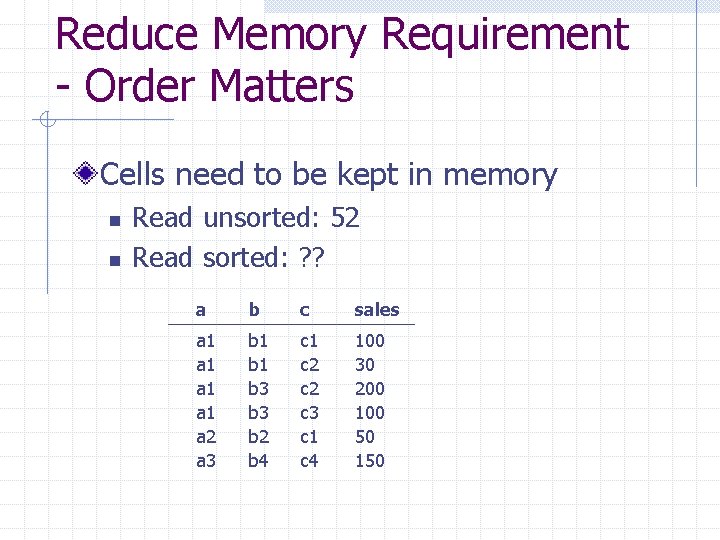
Reduce Memory Requirement - Order Matters Cells need to be kept in memory n n Read unsorted: 52 Read sorted: ? ? a b c sales a 1 a 1 a 2 a 3 b 1 b 3 b 2 b 4 c 1 c 2 c 3 c 1 c 4 100 30 200 100 50 150
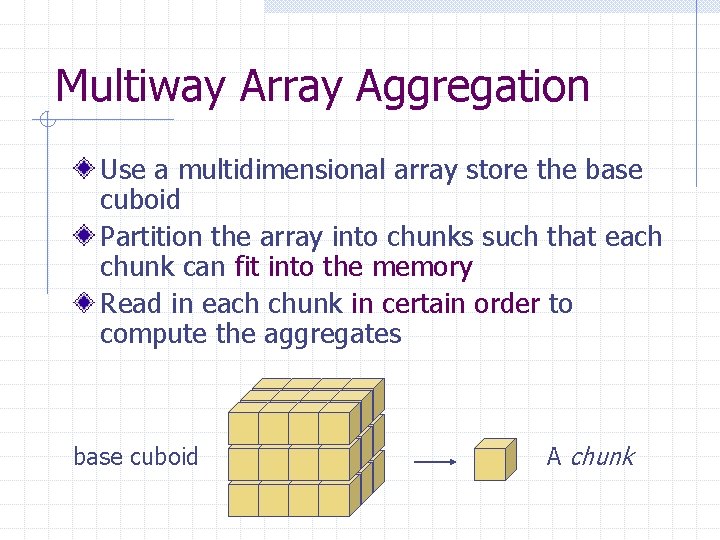
Multiway Array Aggregation Use a multidimensional array store the base cuboid Partition the array into chunks such that each chunk can fit into the memory Read in each chunk in certain order to compute the aggregates base cuboid A chunk
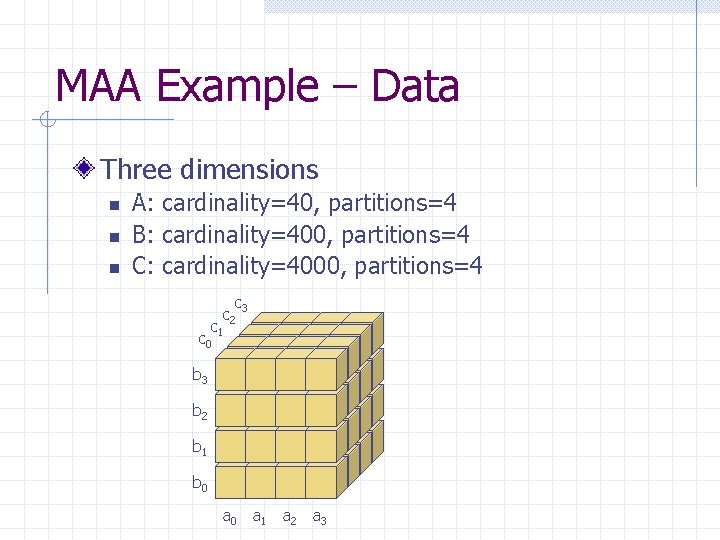
MAA Example – Data Three dimensions n n n A: cardinality=40, partitions=4 B: cardinality=400, partitions=4 C: cardinality=4000, partitions=4 c c 2 3 c c 0 1 b 3 b 2 b 1 b 0 a 1 a 2 a 3
MAA Example – 3 D to 2 D To compute all the 2 D cells, which of the ordering of the chunks is the best? n n n Sort by a, b, c Sort by b, a, c Sort by c, b, a
Iceberg Cubes Data cubes that contain only cells with aggregates greater than a minimum threshold (minimum threshold support, or minimum support)
The Apriori Property If a cell does not satisfy minimum support, then no descendant of the cell can satisfy the minimum support Antimonotonic aggregation functions n E. g. count, sum Non-antimonotonic aggregation functions n E. g. avg
BUC Bottom-Up Construction An algorithm to compute iceberg cubes with antimonotonic measures It’s actually top-down in our view of the lattice of cuboids
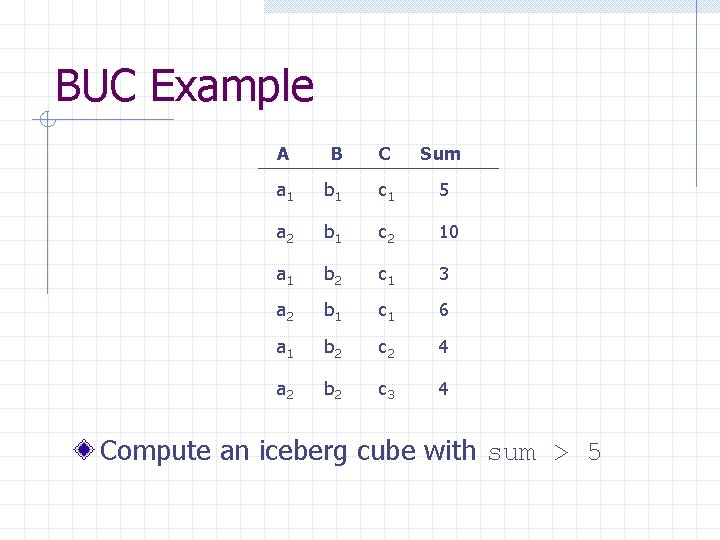
BUC Example A B C Sum a 1 b 1 c 1 5 a 2 b 1 c 2 10 a 1 b 2 c 1 3 a 2 b 1 c 1 6 a 1 b 2 c 2 4 a 2 b 2 c 3 4 Compute an iceberg cube with sum > 5
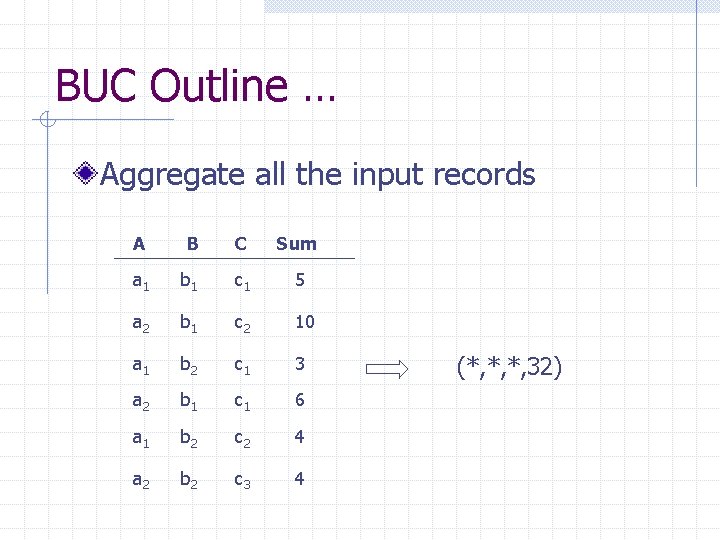
BUC Outline … Aggregate all the input records A B C Sum a 1 b 1 c 1 5 a 2 b 1 c 2 10 a 1 b 2 c 1 3 a 2 b 1 c 1 6 a 1 b 2 c 2 4 a 2 b 2 c 3 4 (*, *, *, 32)
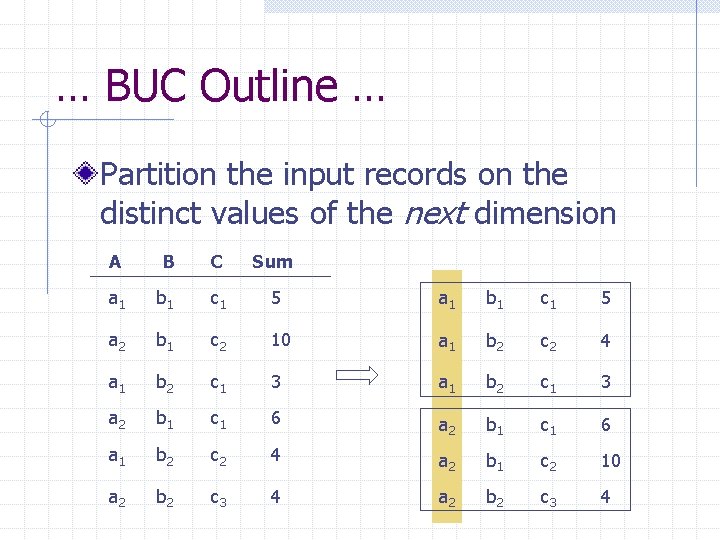
… BUC Outline … Partition the input records on the distinct values of the next dimension A B C Sum a 1 b 1 c 1 5 a 2 b 1 c 2 10 a 1 b 2 c 2 4 a 1 b 2 c 1 3 a 2 b 1 c 1 6 a 1 b 2 c 2 4 a 2 b 1 c 2 10 a 2 b 2 c 3 4
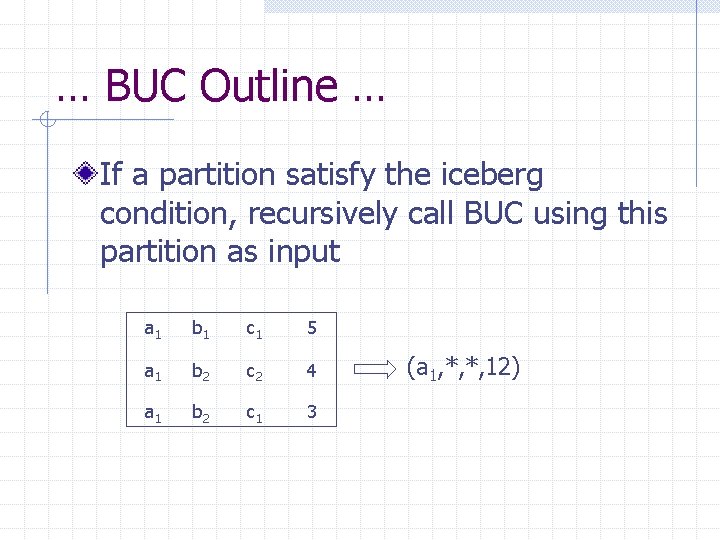
… BUC Outline … If a partition satisfy the iceberg condition, recursively call BUC using this partition as input a 1 b 1 c 1 5 a 1 b 2 c 2 4 a 1 b 2 c 1 3 (a 1, *, *, 12)
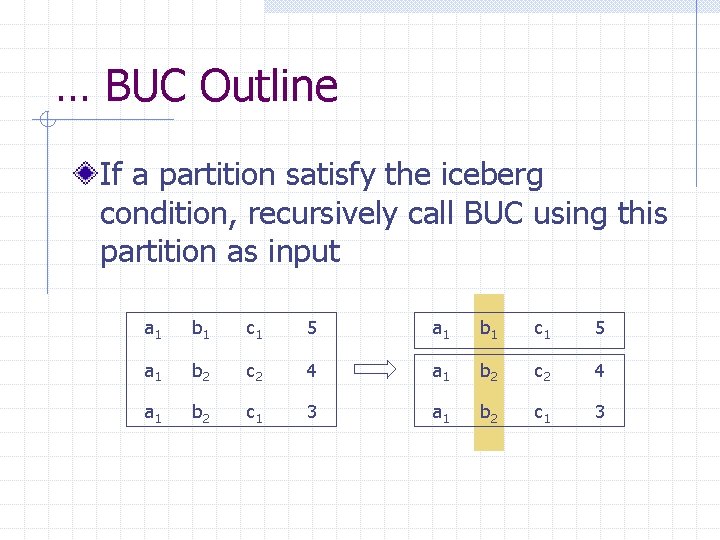
… BUC Outline If a partition satisfy the iceberg condition, recursively call BUC using this partition as input a 1 b 1 c 1 5 a 1 b 2 c 2 4 a 1 b 2 c 1 3
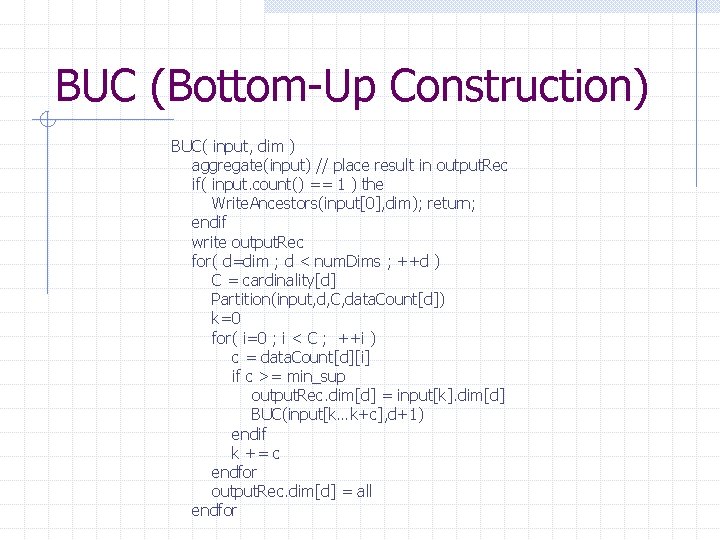
BUC (Bottom-Up Construction) BUC( input, dim ) aggregate(input) // place result in output. Rec if( input. count() == 1 ) the Write. Ancestors(input[0], dim); return; endif write output. Rec for( d=dim ; d < num. Dims ; ++d ) C = cardinality[d] Partition(input, d, C, data. Count[d]) k=0 for( i=0 ; i < C ; ++i ) c = data. Count[d][i] if c >= min_sup output. Rec. dim[d] = input[k]. dim[d] BUC(input[k…k+c], d+1) endif k += c endfor output. Rec. dim[d] = all endfor
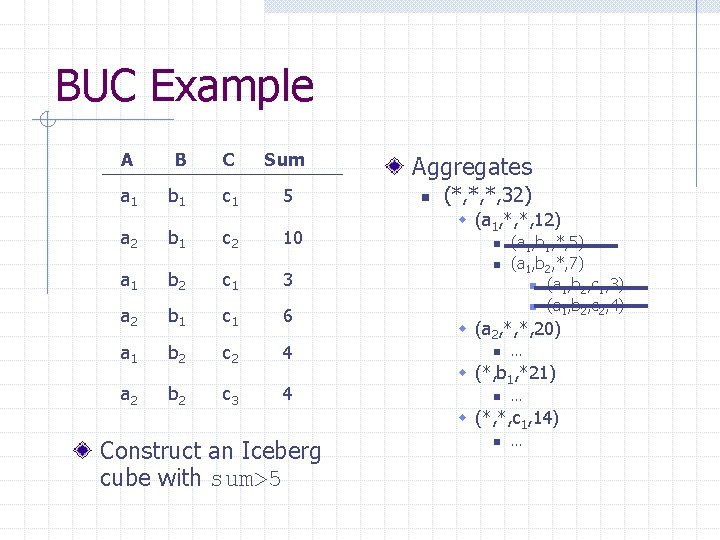
BUC Example A B C Sum a 1 b 1 c 1 5 a 2 b 1 c 2 10 a 1 b 2 c 1 3 a 2 b 1 c 1 6 a 1 b 2 c 2 4 a 2 b 2 c 3 4 Construct an Iceberg cube with sum>5 Aggregates n (*, *, *, 32) w (a 1, *, *, 12) n n (a 1, b 1, *, 5) (a 1, b 2, *, 7) n (a 1, b 2, c 1, 3) n (a 1, b 2, c 2, 4) w (a 2, *, *, 20) n … w (*, b 1, *21) n … w (*, *, c 1, 14) n …
A Few Optimizations in BUC Apriori pruning Dimension ordering Single record partition
Problems of Iceberg Cubes May still be too large Minimum support is hard to determine Incremental updates require recomputation of the whole cube
Cube Shells Observation: most OLAP operations are performed on a small number of dimensions at a time A cube shell of a data cube consists of the cuboids up to a certain dimension n E. g. all cuboids with 3 dimensions or less in a 60 -dimension data cube
Problems with Cube Shells They may still be too large n E. g. how many cuboids in a 3 -D shell of a 60 -D data cube? ? They can’t be used to answer queries like (location, product_type, suppli er, 2004, ? )
Shell Fragments Compute only parts of a cube shell – shell fragments Answer queries using pre-computed or dynamically computed data
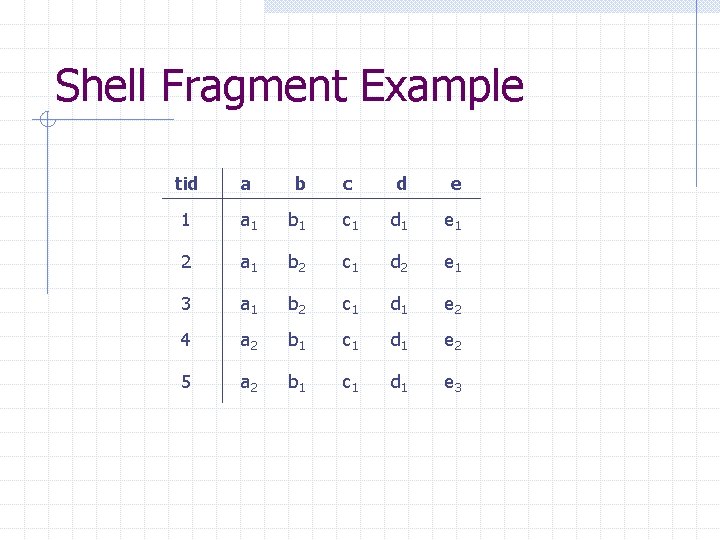
Shell Fragment Example tid a b c d e 1 a 1 b 1 c 1 d 1 e 1 2 a 1 b 2 c 1 d 2 e 1 3 a 1 b 2 c 1 d 1 e 2 4 a 2 b 1 c 1 d 1 e 2 5 a 2 b 1 c 1 d 1 e 3
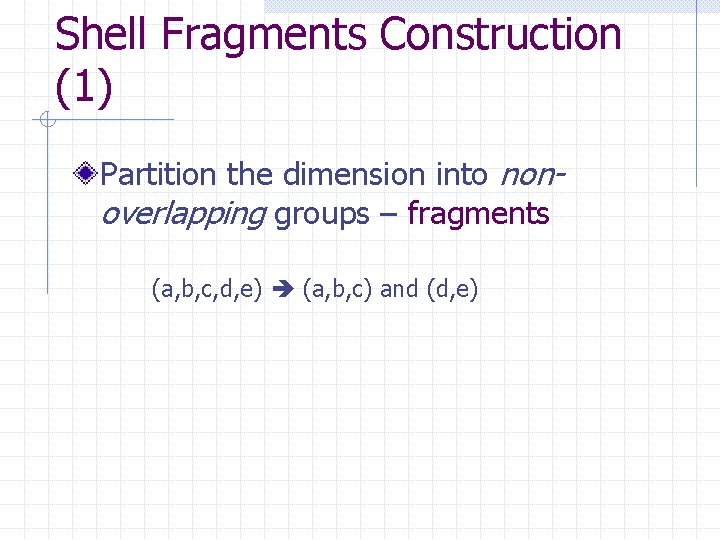
Shell Fragments Construction (1) Partition the dimension into nonoverlapping groups – fragments (a, b, c, d, e) (a, b, c) and (d, e)
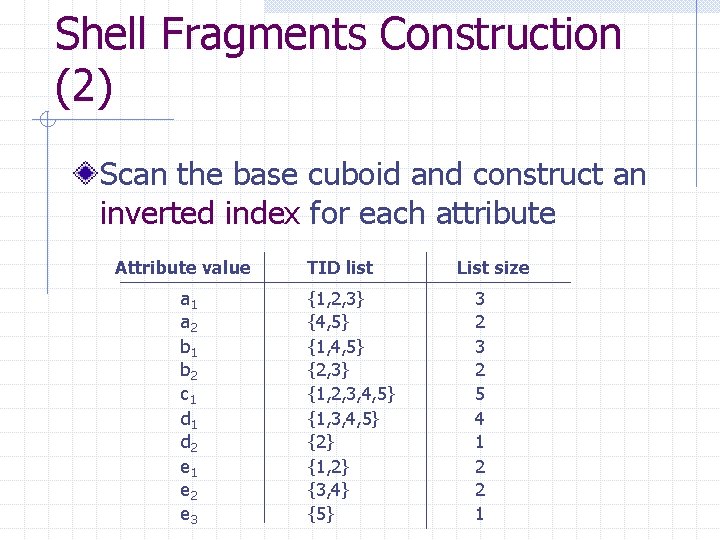
Shell Fragments Construction (2) Scan the base cuboid and construct an inverted index for each attribute Attribute value a 1 a 2 b 1 b 2 c 1 d 2 e 1 e 2 e 3 TID list {1, 2, 3} {4, 5} {1, 4, 5} {2, 3} {1, 2, 3, 4, 5} {1, 3, 4, 5} {2} {1, 2} {3, 4} {5} List size 3 2 5 4 1 2 2 1
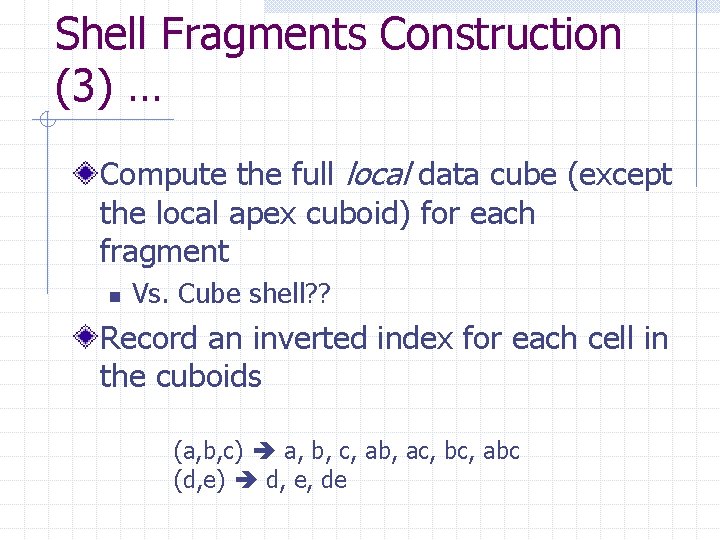
Shell Fragments Construction (3) … Compute the full local data cube (except the local apex cuboid) for each fragment n Vs. Cube shell? ? Record an inverted index for each cell in the cuboids (a, b, c) a, b, c, ab, ac, bc, abc (d, e) d, e, de
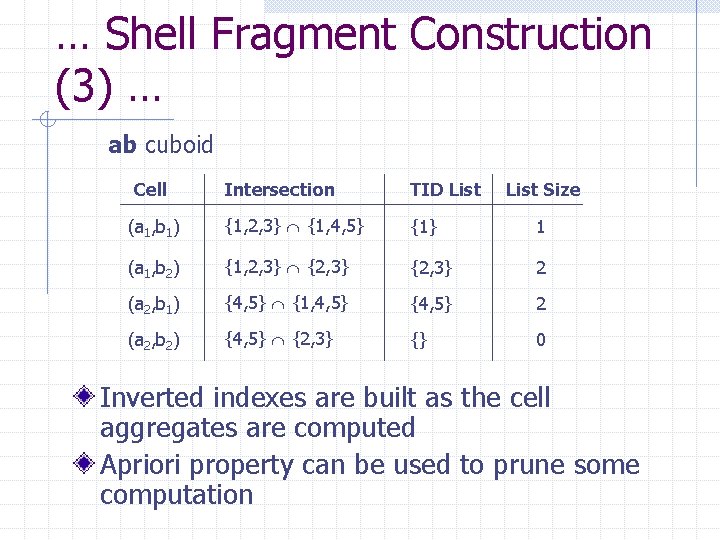
… Shell Fragment Construction (3) … ab cuboid Cell Intersection TID List Size (a 1, b 1) {1, 2, 3} {1, 4, 5} {1} 1 (a 1, b 2) {1, 2, 3} {2, 3} 2 (a 2, b 1) {4, 5} {1, 4, 5} {4, 5} 2 (a 2, b 2) {4, 5} {2, 3} {} 0 Inverted indexes are built as the cell aggregates are computed Apriori property can be used to prune some computation
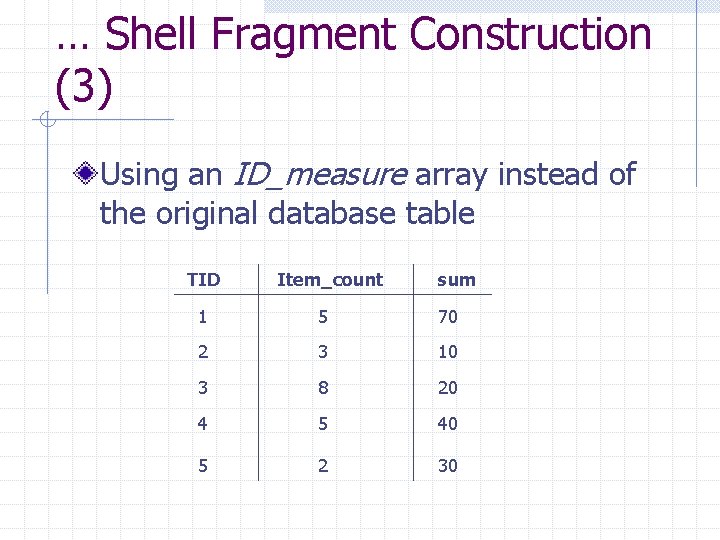
… Shell Fragment Construction (3) Using an ID_measure array instead of the original database table TID Item_count sum 1 5 70 2 3 10 3 8 20 4 5 40 5 2 30
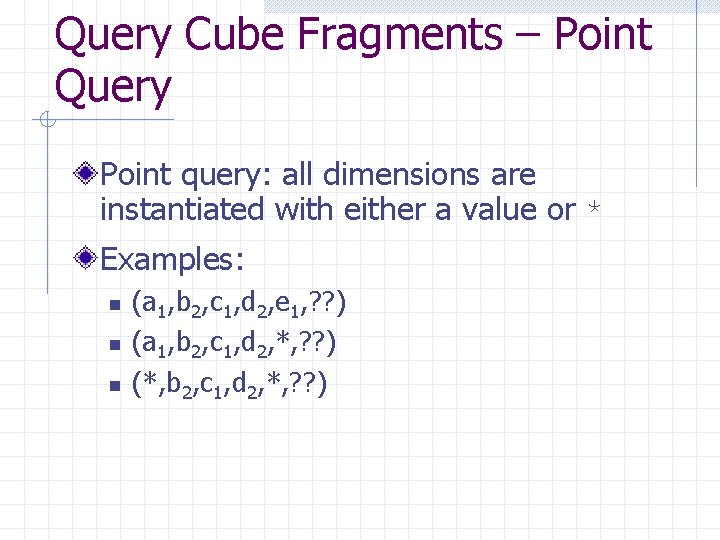
Query Cube Fragments – Point Query Point query: all dimensions are instantiated with either a value or * Examples: n n n (a 1, b 2, c 1, d 2, e 1, ? ? ) (a 1, b 2, c 1, d 2, *, ? ? ) (*, b 2, c 1, d 2, *, ? ? )
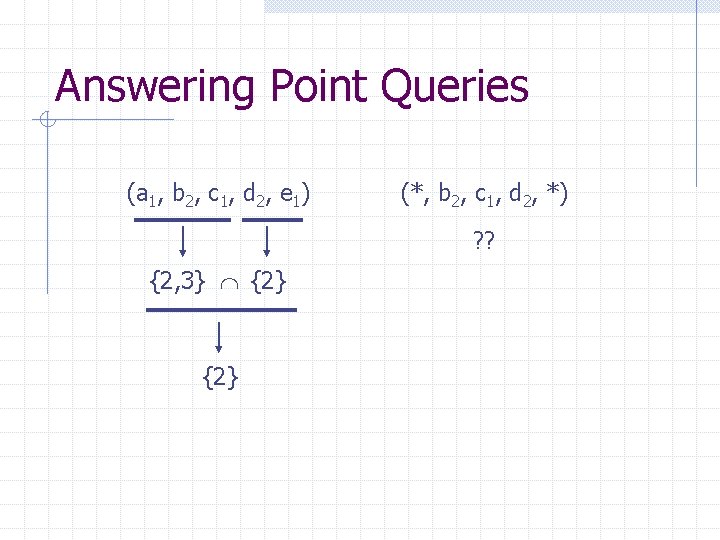
Answering Point Queries (a 1, b 2, c 1, d 2, e 1) (*, b 2, c 1, d 2, *) ? ? {2, 3} {2}
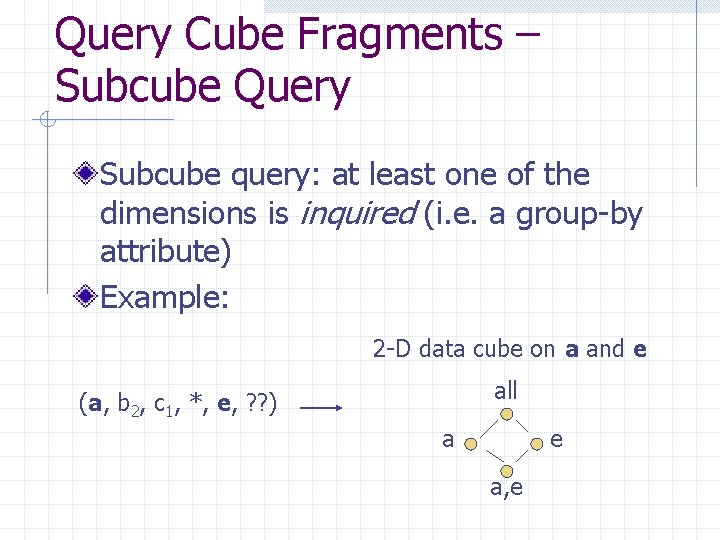
Query Cube Fragments – Subcube Query Subcube query: at least one of the dimensions is inquired (i. e. a group-by attribute) Example: 2 -D data cube on a and e all (a, b 2, c 1, *, e, ? ? ) a e a, e
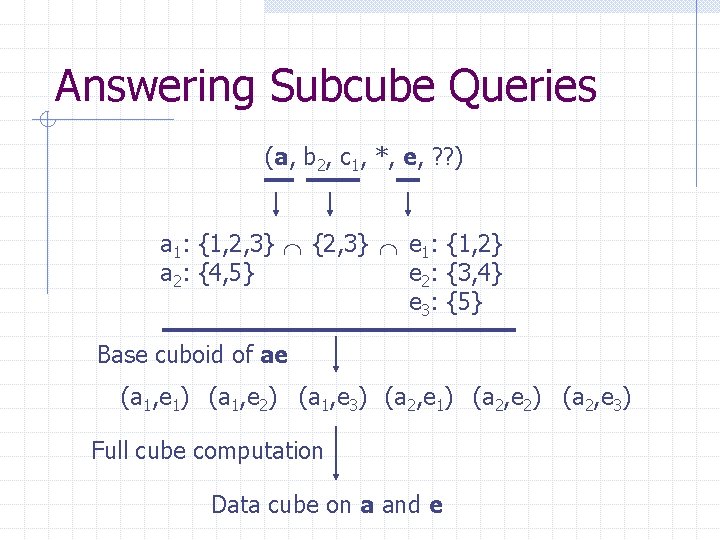
Answering Subcube Queries (a, b 2, c 1, *, e, ? ? ) a 1: {1, 2, 3} {2, 3} e 1: {1, 2} a 2: {4, 5} e 2: {3, 4} e 3: {5} Base cuboid of ae (a 1, e 1) (a 1, e 2) (a 1, e 3) (a 2, e 1) (a 2, e 2) (a 2, e 3) Full cube computation Data cube on a and e
OLAP Storage Types Relational OLAP (ROLAP) Multidimensional OLAP (MOLAP) Hybrid OLAP (HOLAP)
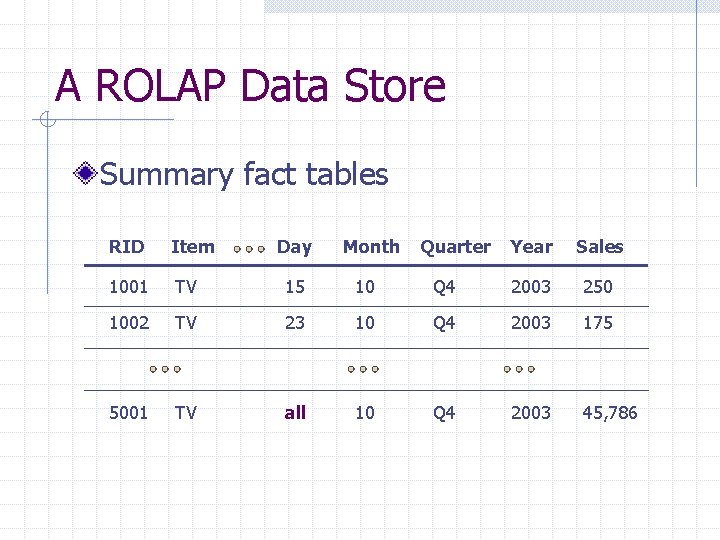
A ROLAP Data Store Summary fact tables RID Item Day Month 1001 TV 15 10 1002 TV 23 5001 TV all Quarter Year Sales Q 4 2003 250 10 Q 4 2003 175 10 Q 4 2003 45, 786
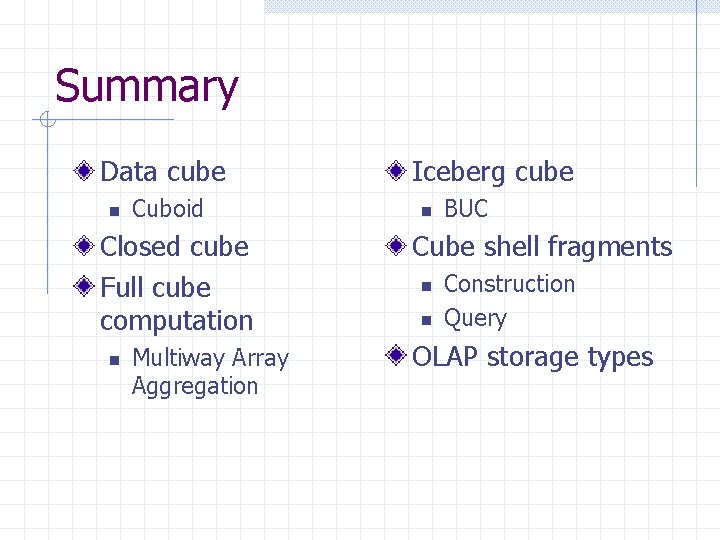
Summary Data cube n Cuboid Closed cube Full cube computation n Multiway Array Aggregation Iceberg cube n BUC Cube shell fragments n n Construction Query OLAP storage types
Readings Textbook Chapter 4. 1 except 4. 1. 4
- Slides: 54