
Econ 805 Advanced Micro Theory 1 Dan Quint



- Slides: 11
Econ 805 Advanced Micro Theory 1 Dan Quint Fall 2008 Lecture 1 – Sept 2, 2007 A Quick Review of Game Theory and, in particular, Bayesian Games
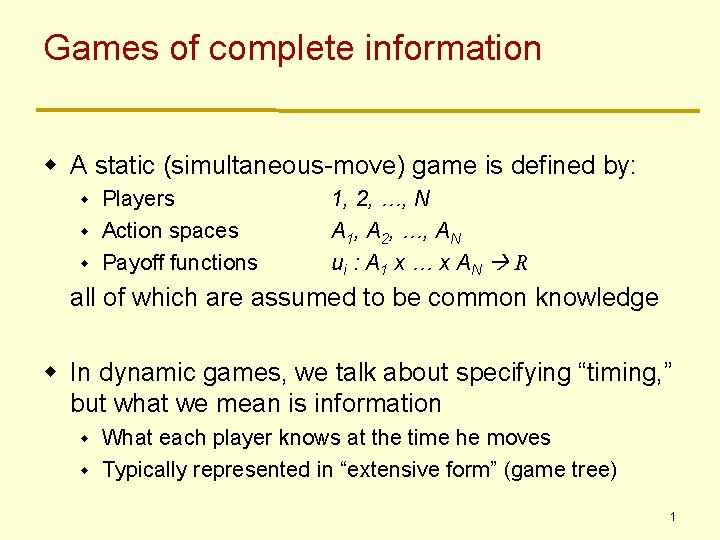
Games of complete information w A static (simultaneous-move) game is defined by: Players w Action spaces w Payoff functions w 1, 2, …, N A 1, A 2, …, AN ui : A 1 x … x A N R all of which are assumed to be common knowledge w In dynamic games, we talk about specifying “timing, ” but what we mean is information What each player knows at the time he moves w Typically represented in “extensive form” (game tree) w 1
Solution concepts for games of complete information w Pure-strategy Nash equilibrium: s Î A 1 x … x AN s. t. ui(si, s-i) ³ ui(s’i, s-i) for all s’i Î Ai for all i Î {1, 2, …, N} w In dynamic games, we typically focus on Subgame Perfect equilibria Profiles where Nash equilibria are also played within each branch of the game tree w Often solvable by backward induction w 2
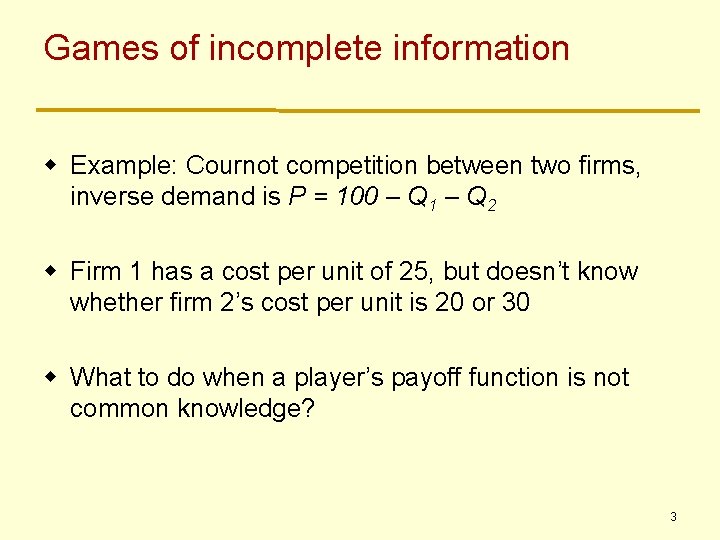
Games of incomplete information w Example: Cournot competition between two firms, inverse demand is P = 100 – Q 1 – Q 2 w Firm 1 has a cost per unit of 25, but doesn’t know whether firm 2’s cost per unit is 20 or 30 w What to do when a player’s payoff function is not common knowledge? 3
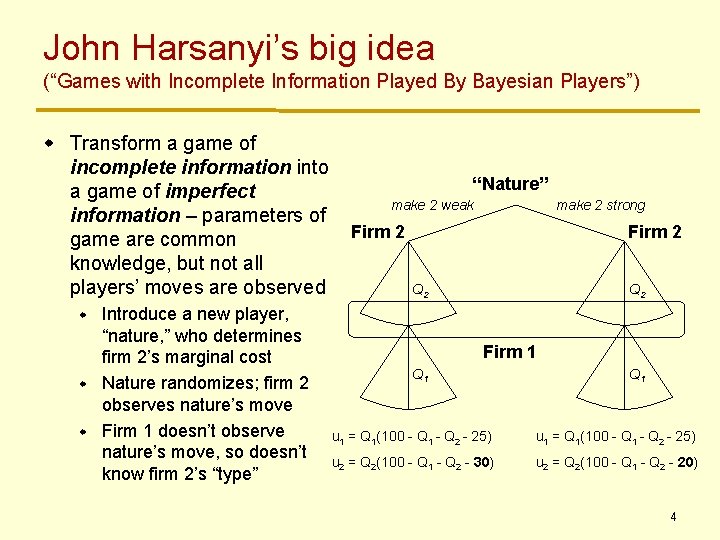
John Harsanyi’s big idea (“Games with Incomplete Information Played By Bayesian Players”) w Transform a game of incomplete information into a game of imperfect information – parameters of game are common knowledge, but not all players’ moves are observed Introduce a new player, “nature, ” who determines firm 2’s marginal cost w Nature randomizes; firm 2 observes nature’s move w Firm 1 doesn’t observe nature’s move, so doesn’t know firm 2’s “type” “Nature” make 2 weak make 2 strong Firm 2 Q 2 w Firm 1 Q 1 u 1 = Q 1(100 - Q 1 - Q 2 - 25) u 2 = Q 2(100 - Q 1 - Q 2 - 30) u 2 = Q 2(100 - Q 1 - Q 2 - 20) 4
Bayesian Nash Equilibrium w Assign probabilities to nature’s moves (common knowledge) w Firm 2’s pure strategies are maps from his “type space” {Weak, Strong} to A 2 = R+ w Firm 1 maximizes expected payoff in expectation over firm 2’s types w given firm 2’s equilibrium strategy “Nature” make 2 weak Firm 2 make 2 strong p=½ Q 2 W Firm 2 Q 2 S Firm 1 Q 1 w u 1 = Q 1(100 - Q 1 - Q 2 - 25) u 2 = Q 2(100 - Q 1 - Q 2 - 30) u 2 = Q 2(100 - Q 1 - Q 2 - 20) 5
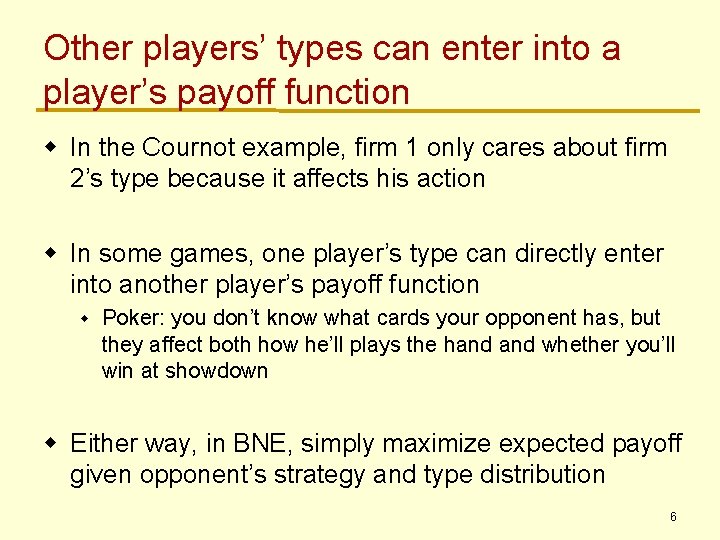
Other players’ types can enter into a player’s payoff function w In the Cournot example, firm 1 only cares about firm 2’s type because it affects his action w In some games, one player’s type can directly enter into another player’s payoff function w Poker: you don’t know what cards your opponent has, but they affect both how he’ll plays the hand whether you’ll win at showdown w Either way, in BNE, simply maximize expected payoff given opponent’s strategy and type distribution 6
Solving the Cournot example, with p = ½ that firm 2 is strong… w Strong firm 2 best-responds by choosing Q 2 S = arg maxq q(100 -Q 1 -q-20) Maximization gives Q 2 S = (80 -Q 1)/2 w Weak firm 2 sets Q 2 W = arg maxq q(100 -Q 1 -q-30) giving Q 2 W = (70 -Q 1)/2 w Firm 1 maximizes expected profits: Q 1 = arg maxq ½q(100 -q-Q 2 S-25) + ½q(100 -q-Q 2 W-25) giving Q 1 = (75 – Q 2 W/2 – Q 2 S/2)/2 w Solving these simultaneously gives equilibrium strategies: Q 1 = 25, (Q 2 W, Q 2 S) = (22½ , 27½) 7
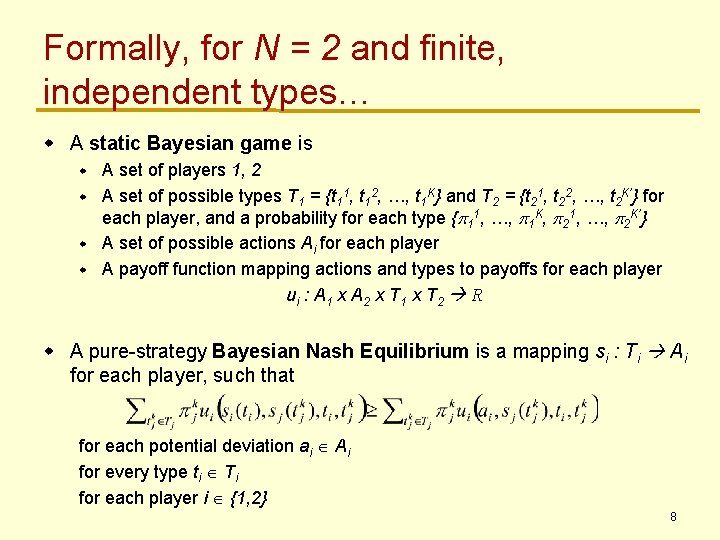
Formally, for N = 2 and finite, independent types… w A static Bayesian game is A set of players 1, 2 w A set of possible types T 1 = {t 11, t 12, …, t 1 K} and T 2 = {t 21, t 22, …, t 2 K’} for each player, and a probability for each type {p 11, …, p 1 K, p 21, …, p 2 K’} w A set of possible actions Ai for each player w A payoff function mapping actions and types to payoffs for each player ui : A 1 x A 2 x T 1 x T 2 R w w A pure-strategy Bayesian Nash Equilibrium is a mapping si : Ti Ai for each player, such that for each potential deviation ai Î Ai for every type ti Î Ti for each player i Î {1, 2} 8
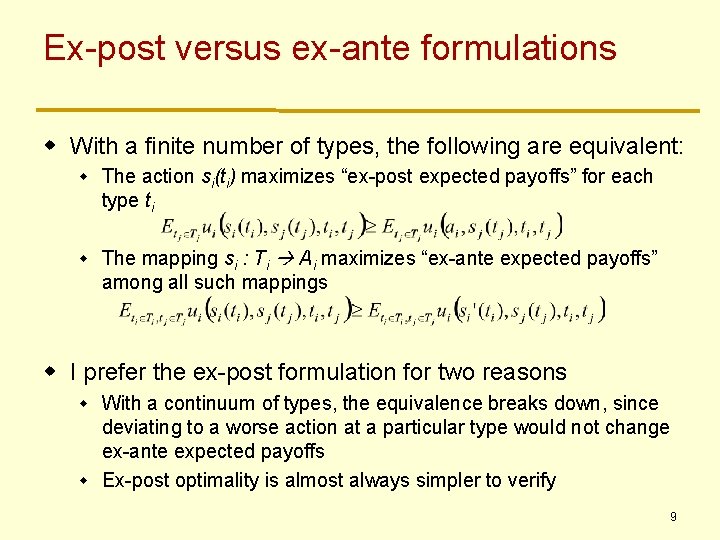
Ex-post versus ex-ante formulations w With a finite number of types, the following are equivalent: w The action si(ti) maximizes “ex-post expected payoffs” for each type ti w The mapping si : Ti Ai maximizes “ex-ante expected payoffs” among all such mappings w I prefer the ex-post formulation for two reasons With a continuum of types, the equivalence breaks down, since deviating to a worse action at a particular type would not change ex-ante expected payoffs w Ex-post optimality is almost always simpler to verify w 9
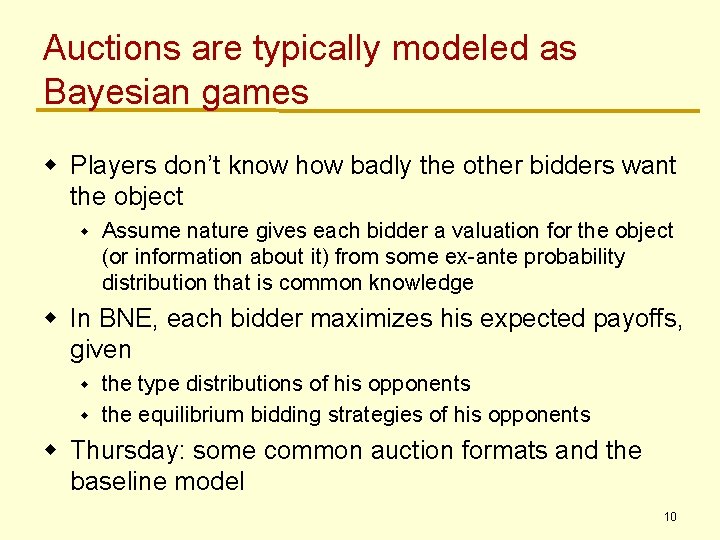
Auctions are typically modeled as Bayesian games w Players don’t know how badly the other bidders want the object w Assume nature gives each bidder a valuation for the object (or information about it) from some ex-ante probability distribution that is common knowledge w In BNE, each bidder maximizes his expected payoffs, given the type distributions of his opponents w the equilibrium bidding strategies of his opponents w w Thursday: some common auction formats and the baseline model 10