
ECE 313 Computer Organization Lecture 14 MultiCycle Processor
![Multicycle Execution Step (1) Instruction Fetch IR = Memory[PC]; PC = PC + 4;](https://slidetodoc.com/presentation_image_h/0c059515a7f232e0062558a4122143db/image-4.jpg "Multicycle Execution Step (1) Instruction Fetch IR = Memory[PC]; PC = PC + 4;")
![Multicycle Execution Step (2) Instruction Decode and Register Fetch A = Reg[IR[25 -21]]; (A](https://slidetodoc.com/presentation_image_h/0c059515a7f232e0062558a4122143db/image-5.jpg "Multicycle Execution Step (2) Instruction Decode and Register Fetch A = Reg[IR[25 -21]]; (A")
![Multicycle Execution Steps (3) Memory Reference Instructions ALUOut = A + sign-extend(IR[15 -0]); Reg[rs]](https://slidetodoc.com/presentation_image_h/0c059515a7f232e0062558a4122143db/image-6.jpg "Multicycle Execution Steps (3) Memory Reference Instructions ALUOut = A + sign-extend(IR[15 -0]); Reg[rs]")
![Multicycle Execution Steps (3) ALU Instruction (R-Type) ALUOut = A op B Reg[rs] R-Type](https://slidetodoc.com/presentation_image_h/0c059515a7f232e0062558a4122143db/image-7.jpg "Multicycle Execution Steps (3) ALU Instruction (R-Type) ALUOut = A op B Reg[rs] R-Type")
![Multicycle Execution Steps (3) Branch Instructions if (A == B) PC = ALUOut; Reg[rs]](https://slidetodoc.com/presentation_image_h/0c059515a7f232e0062558a4122143db/image-8.jpg "Multicycle Execution Steps (3) Branch Instructions if (A == B) PC = ALUOut; Reg[rs]")
![Multicycle Execution Step (3) Jump Instruction PC = PC[31 -28] concat (IR[25 -0] <<](https://slidetodoc.com/presentation_image_h/0c059515a7f232e0062558a4122143db/image-9.jpg "Multicycle Execution Step (3) Jump Instruction PC = PC[31 -28] concat (IR[25 -0] <<")
![Multicycle Execution Steps (4) Memory Access - Read (lw) MDR = Memory[ALUOut]; Reg[rs] Mem.](https://slidetodoc.com/presentation_image_h/0c059515a7f232e0062558a4122143db/image-10.jpg "Multicycle Execution Steps (4) Memory Access - Read (lw) MDR = Memory[ALUOut]; Reg[rs] Mem.")
![Multicycle Execution Steps (4) Memory Access - Write (sw) Memory[ALUOut] = B; Reg[rs] PC](https://slidetodoc.com/presentation_image_h/0c059515a7f232e0062558a4122143db/image-11.jpg "Multicycle Execution Steps (4) Memory Access - Write (sw) Memory[ALUOut] = B; Reg[rs] PC")
![Multicycle Execution Steps (4) ALU Instruction (R-Type) Reg[IR[15: 11]] = ALUOUT Reg[rs] R-Type Result](https://slidetodoc.com/presentation_image_h/0c059515a7f232e0062558a4122143db/image-12.jpg "Multicycle Execution Steps (4) ALU Instruction (R-Type) Reg[IR[15: 11]] = ALUOUT Reg[rs] R-Type Result")
![Multicycle Execution Steps (5) Memory Read Completion (lw) Reg[IR[20 -16]] = MDR; Reg[rs] Mem.](https://slidetodoc.com/presentation_image_h/0c059515a7f232e0062558a4122143db/image-13.jpg "Multicycle Execution Steps (5) Memory Read Completion (lw) Reg[IR[20 -16]] = MDR; Reg[rs] Mem.")
- Slides: 19
ECE 313 - Computer Organization Lecture 14 - Multi-Cycle Processor Design 1 Fall 2004 Reading: 5. 5 Prof. John Nestor ECE Department Lafayette College Easton, Pennsylvania 18042 nestorj@lafayette. edu Portions of these slides are derived from: Textbook figures © 1998 Morgan Kaufmann Publishers all rights reserved Tod Amon's COD 2 e Slides © 1998 Morgan Kaufmann Publishers all rights reserved Dave Patterson’s CS 152 Slides - Fall 1997 © UCB Rob Rutenbar’s 18 -347 Slides - Fall 1999 CMU ECE 313 Fall 2004 Lecture 14 - Multicycle Design other sources as noted 1 1
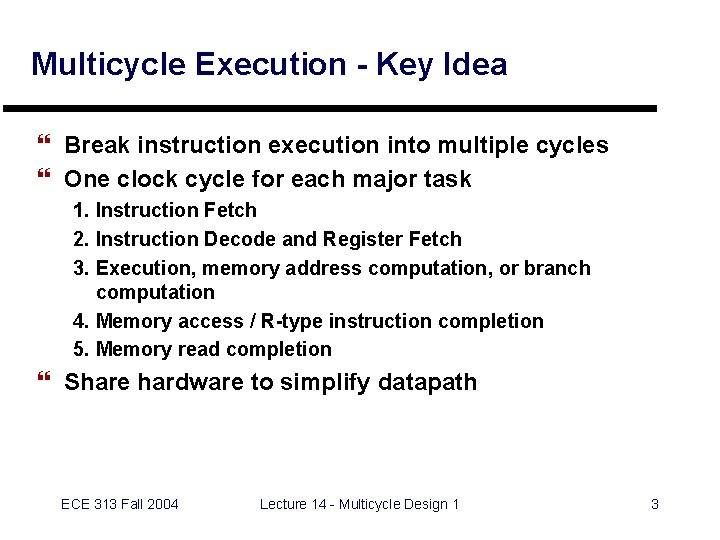
Multicycle Execution - Key Idea } Break instruction execution into multiple cycles } One clock cycle for each major task 1. Instruction Fetch 2. Instruction Decode and Register Fetch 3. Execution, memory address computation, or branch computation 4. Memory access / R-type instruction completion 5. Memory read completion } Share hardware to simplify datapath ECE 313 Fall 2004 Lecture 14 - Multicycle Design 1 3
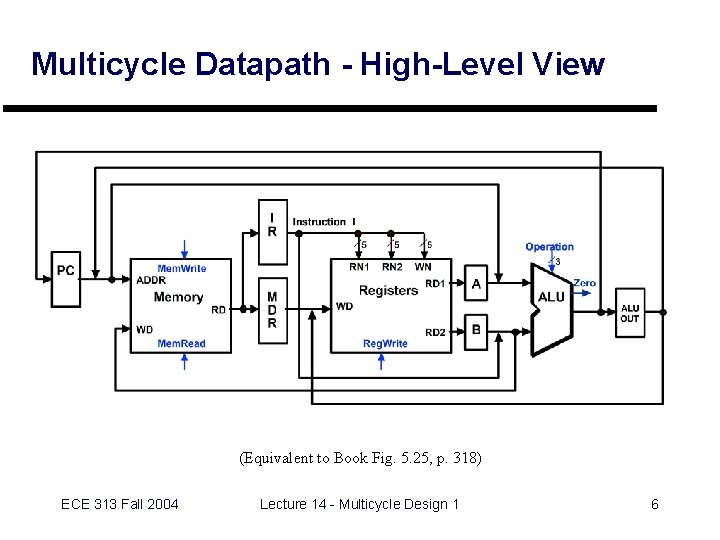
Multicycle Datapath - High-Level View (Equivalent to Book Fig. 5. 25, p. 318) ECE 313 Fall 2004 Lecture 14 - Multicycle Design 1 6
Multicycle Execution Step (1) Instruction Fetch IR = Memory[PC]; PC = PC + 4; 4 PC + 4 ECE 313 Fall 2004 Lecture 14 - Multicycle Design 1 11
Multicycle Execution Step (2) Instruction Decode and Register Fetch A = Reg[IR[25 -21]]; (A = Reg[rs]) B = Reg[IR[20 -15]]; (B = Reg[rt]) ALUOut = (PC + sign-extend(IR[15 -0]) << 2) Reg[rs] Branch Target Address PC + 4 Reg[rt] ECE 313 Fall 2004 Lecture 14 - Multicycle Design 1 12
Multicycle Execution Steps (3) Memory Reference Instructions ALUOut = A + sign-extend(IR[15 -0]); Reg[rs] Mem. Address PC + 4 Reg[rt] ECE 313 Fall 2004 Lecture 14 - Multicycle Design 1 13
Multicycle Execution Steps (3) ALU Instruction (R-Type) ALUOut = A op B Reg[rs] R-Type Result PC + 4 Reg[rt] ECE 313 Fall 2004 Lecture 14 - Multicycle Design 1 14
Multicycle Execution Steps (3) Branch Instructions if (A == B) PC = ALUOut; Reg[rs] Branch Target Address ECE 313 Fall 2004 Branch Target Address Reg[rt] Lecture 14 - Multicycle Design 1 15
Multicycle Execution Step (3) Jump Instruction PC = PC[31 -28] concat (IR[25 -0] << 2) Reg[rs] Branch Target Address Jump Address Reg[rt] ECE 313 Fall 2004 Lecture 14 - Multicycle Design 1 16
Multicycle Execution Steps (4) Memory Access - Read (lw) MDR = Memory[ALUOut]; Reg[rs] Mem. Address PC + 4 Mem. Data ECE 313 Fall 2004 Reg[rt] Lecture 14 - Multicycle Design 1 17
Multicycle Execution Steps (4) Memory Access - Write (sw) Memory[ALUOut] = B; Reg[rs] PC + 4 Reg[rt] ECE 313 Fall 2004 Lecture 14 - Multicycle Design 1 18
Multicycle Execution Steps (4) ALU Instruction (R-Type) Reg[IR[15: 11]] = ALUOUT Reg[rs] R-Type Result PC + 4 Reg[rt] ECE 313 Fall 2004 Lecture 14 - Multicycle Design 1 19
Multicycle Execution Steps (5) Memory Read Completion (lw) Reg[IR[20 -16]] = MDR; Reg[rs] Mem. Address PC + 4 Mem. Data ECE 313 Fall 2004 Reg[rt] Lecture 14 - Multicycle Design 1 20
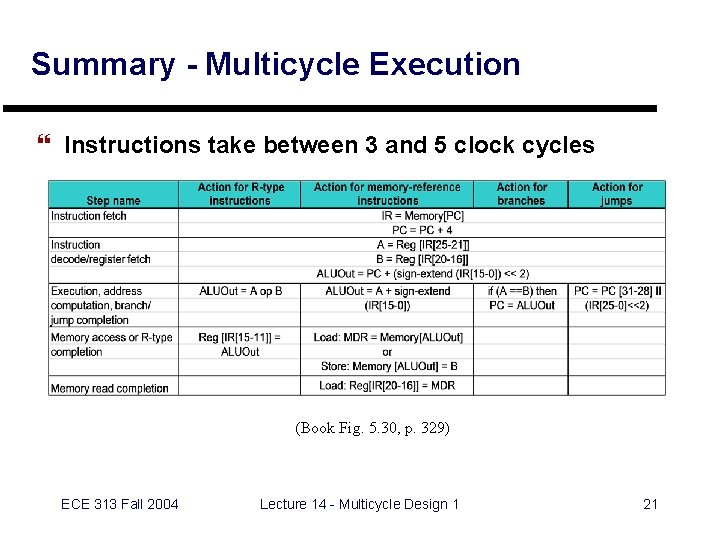
Summary - Multicycle Execution } Instructions take between 3 and 5 clock cycles (Book Fig. 5. 30, p. 329) ECE 313 Fall 2004 Lecture 14 - Multicycle Design 1 21
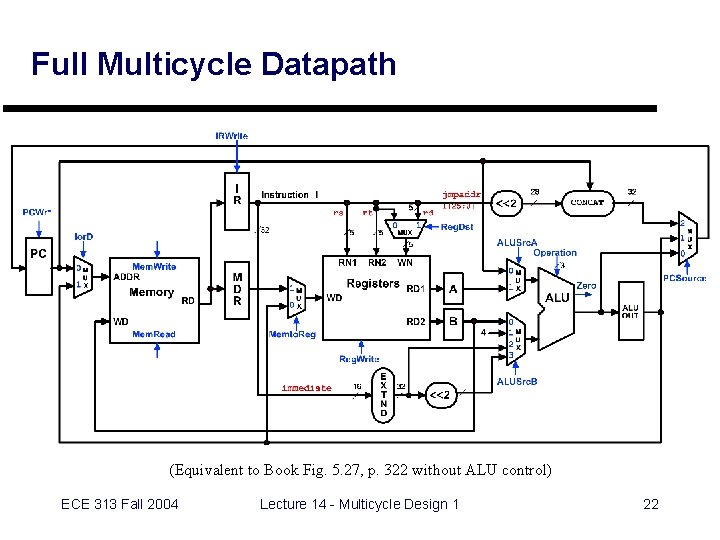
Full Multicycle Datapath (Equivalent to Book Fig. 5. 27, p. 322 without ALU control) ECE 313 Fall 2004 Lecture 14 - Multicycle Design 1 22
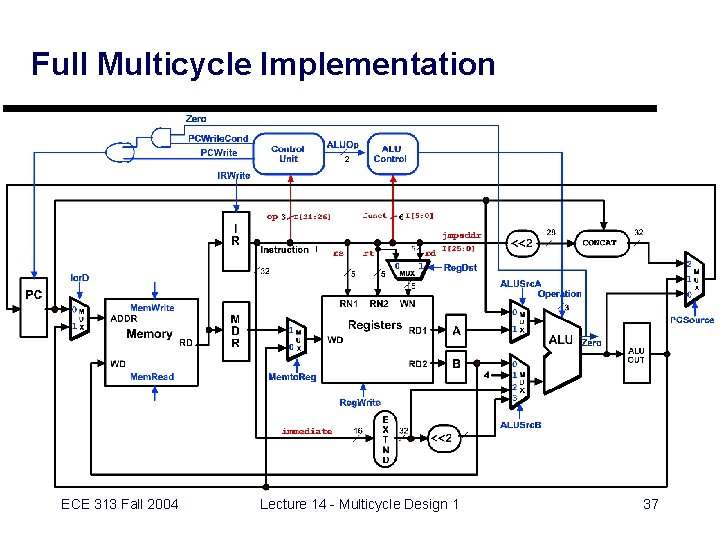
Full Multicycle Implementation ECE 313 Fall 2004 Lecture 14 - Multicycle Design 1 37
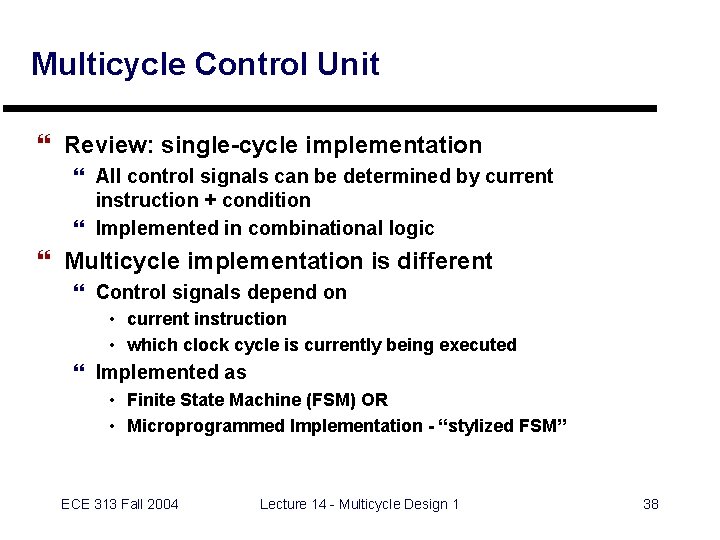
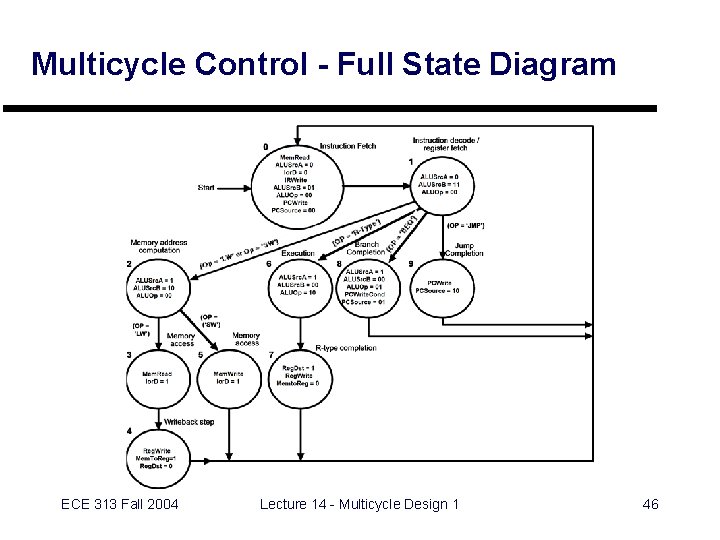
Multicycle Control Unit } Review: single-cycle implementation } All control signals can be determined by current instruction + condition } Implemented in combinational logic } Multicycle implementation is different } Control signals depend on • current instruction • which clock cycle is currently being executed } Implemented as • Finite State Machine (FSM) OR • Microprogrammed Implementation - “stylized FSM” ECE 313 Fall 2004 Lecture 14 - Multicycle Design 1 38
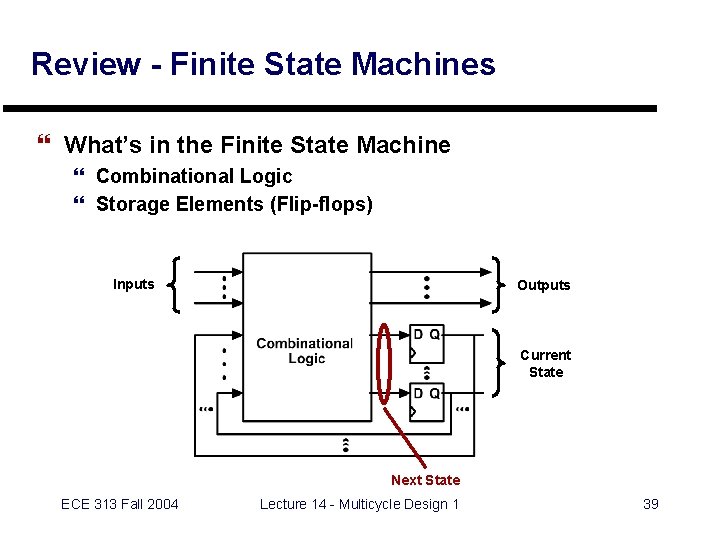
Review - Finite State Machines } What’s in the Finite State Machine } Combinational Logic } Storage Elements (Flip-flops) Inputs Outputs Current State Next State ECE 313 Fall 2004 Lecture 14 - Multicycle Design 1 39
Multicycle Control - Full State Diagram ECE 313 Fall 2004 Lecture 14 - Multicycle Design 1 46