Domain 2 The Classroom Environment 2 a Creating
- Slides: 27
Domain 2: The Classroom Environment 2 a: Creating an Environment of Respect and Rapport The Framework for Teaching Charlotte Danielson 1
Objectives 2 a: Creating an Environment of Respect and Rapport � Understand the elements of 2 a � Distinguish the difference in levels of performance � Review examples of 2 a behavior � Identify individual levels of performance on 2 a � Incorporate strategies to improve individual levels of performance in 2 a 2
Why Is Classroom Environment an Important Component of Effective Teaching? � Teaching depends on the quality of relationships among individuals. � Teachers manage relationships with students and must ensure that relationships among students are positive and supportive. � Verbal and non-verbal behavior and patterns of interactions contribute to the overall tone of class. � In a respectful environment, all students feel valued and safe, encouraging them to take intellectual risks. 3
Sharing Teaching Knowledge If you were to observe an excellent teacher, either in the classroom or another professional setting, what might you see or hear that would tell you that you were in the presence of an expert? Write each idea on a Post-it note—one idea per note. 4
“People will forget what you said. People will forget what you did. But they will never forget how you made them feel. ” Anna Quindlin, Commencement Address, 2002 5
The Elements This component may be broken down into two distinct and important elements. Teacher interactions with students, including both words and actions … § set the tone for the classroom. § convey that they care about their students. 6
The Elements Student interactions with other students, including both words and actions … § are as important as how teachers treat students § are mutually supportive and create an emotionally healthy school environment when they are positive § result in bullying, which can poison the environment of the entire school when interactions are at their worst 7
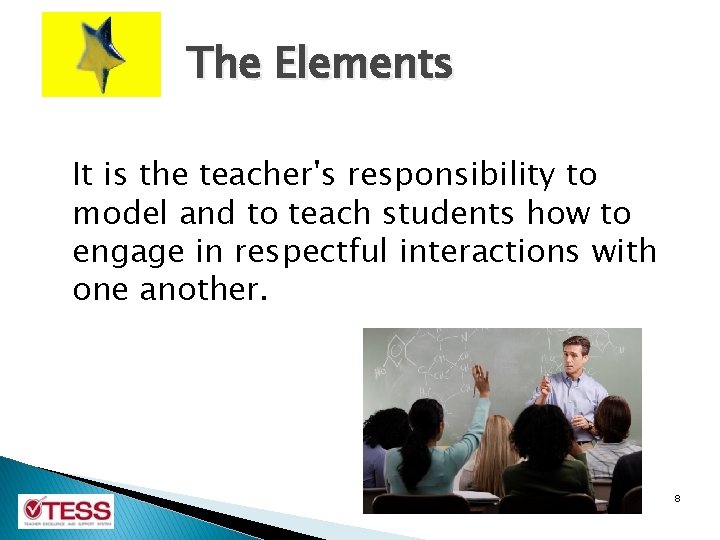
The Elements It is the teacher's responsibility to model and to teach students how to engage in respectful interactions with one another. 8
Performance Grounded in Evidence �Respectful talk and turn-taking �Attention to students’ backgrounds and lives outside the classroom �Teacher and student body language �Physical proximity 9
Performance Grounded in Evidence (continued) �Warmth and caring �Politeness and dignity �Encouragement �Active listening �Fairness 10
Relevant because… � Students roll their eyes at a classmate’s idea; the teacher does not respond. This observation demonstrates the quality of students’ interactions with each other and also how a teacher responds to disrespectful student interactions. � The teacher greets students by name as they enter the class or during the lesson. This observation serves as evidence for the quality of interaction between teacher and students. It indicates that the teacher knows the students as individuals. � The teacher says, “Don’t talk that way to your classmates, ” but the student shrugs his shoulders. This observation serves as evidence of how effectively a teacher tries to encourage respectful interactions among students. 11
Performance Levels � You will read four classroom observation descriptions. � After each of the four descriptions, write down on a Post-it what performance level you would assign it and why. � Then compare your responses with your table and discuss specific reasons for your rating. 12
What Is the Level? A. Patterns of classroom interactions, both between the teacher and students and among students, are generally appropriate. Interactions may reflect occasional inconsistencies, favoritism, and disregard for students’ ages, cultures, and developmental levels. Students rarely demonstrate disrespect for one another. The teacher attempts to respond to disrespectful behavior with inconsistent results. The net result of the interactions is neutral; conveying neither warmth nor conflict. Teachers Read Scenarios at Tables 13
What Is the Level? B. Classroom interactions among the teacher and individual students are highly respectful, reflecting genuine warmth and caring and sensitivity to students as individuals. Students exhibit respect for the teacher and contribute to high levels of civility among all members of the class. The net result of interactions is that of connecting with students as individuals. 14
What Is the Level? C. Teacher-student interactions are friendly and demonstrate general caring and respect. Such interactions are appropriate to the ages of the students. Students exhibit respect for the teacher. Interactions among students are generally polite and respectful. The teacher responds successfully to disrespectful behavior among students. The net result of the interactions is polite and respectful, but business-like. 15
What Is the Level? D. Patterns of classroom interactions, both between the teacher and students and among students, are mostly negative, inappropriate, or insensitive to students' ages, cultural backgrounds, and developmental levels. Interactions are characterized by sarcasm, put-downs, or conflict. The teacher does not deal with disrespectful behavior. 16
Level of Performance Answers �A. Basic (Level 2) �B. Distinguished (Level 4) �C. Proficient (Level 3) �D. Unsatisfactory (Level 1) Any surprises? 17
Level 3: Proficient Critical Attributes �Discussion between teacher and students and among students is uniformly respectful. �The teacher makes general connections with individual students. �Students exhibit respect for the teacher. �Teacher responds to disrespectful behavior among students. 18
Level 2: Basic Critical Attributes � The quality of interactions between teacher and students is uneven with occasional disrespect. � Teacher attempts to respond to disrespectful behavior among students with uneven results. � Teacher attempts to make connections with individual students, but student reactions indicate that efforts are not completely successful or are unusual. 19
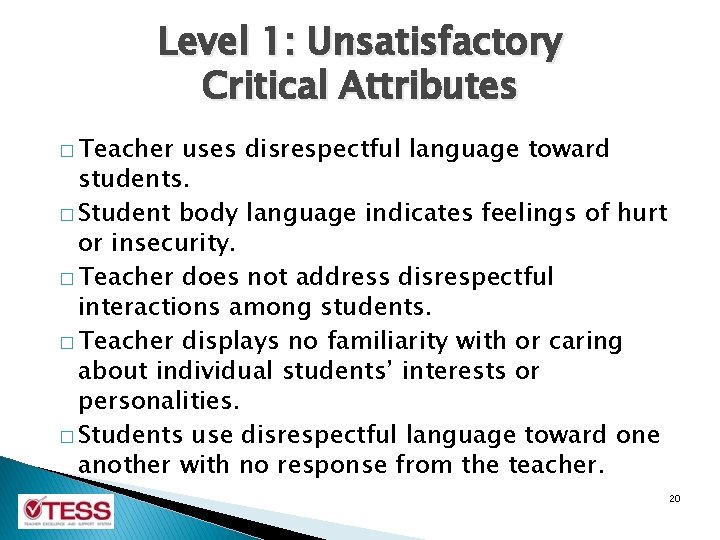
Level 1: Unsatisfactory Critical Attributes � Teacher uses disrespectful language toward students. � Student body language indicates feelings of hurt or insecurity. � Teacher does not address disrespectful interactions among students. � Teacher displays no familiarity with or caring about individual students’ interests or personalities. � Students use disrespectful language toward one another with no response from the teacher. 20
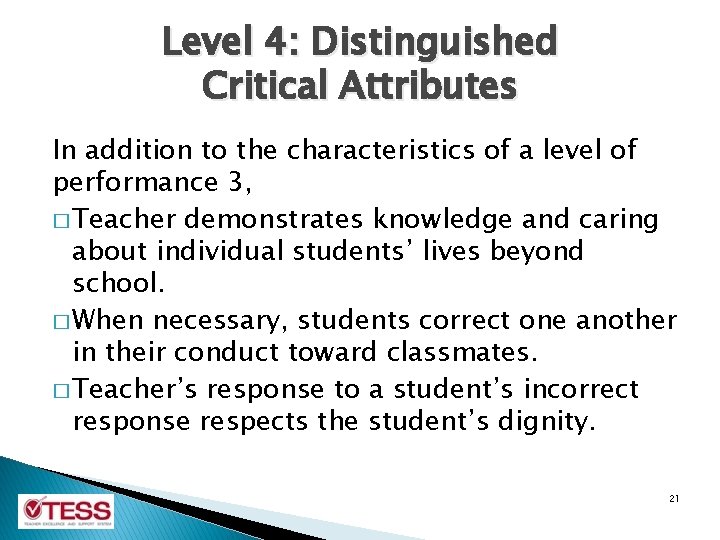
Level 4: Distinguished Critical Attributes In addition to the characteristics of a level of performance 3, � Teacher demonstrates knowledge and caring about individual students’ lives beyond school. � When necessary, students correct one another in their conduct toward classmates. � Teacher’s response to a student’s incorrect response respects the student’s dignity. 21
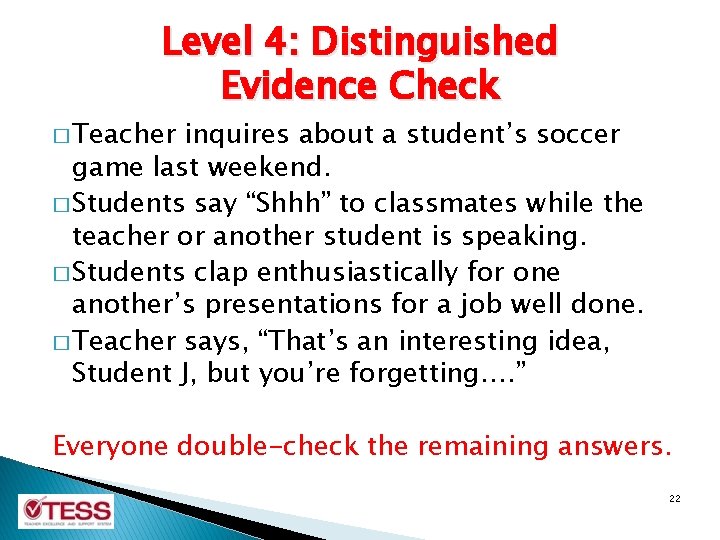
Level 4: Distinguished Evidence Check � Teacher inquires about a student’s soccer game last weekend. � Students say “Shhh” to classmates while the teacher or another student is speaking. � Students clap enthusiastically for one another’s presentations for a job well done. � Teacher says, “That’s an interesting idea, Student J, but you’re forgetting…. ” Everyone double-check the remaining answers. 22
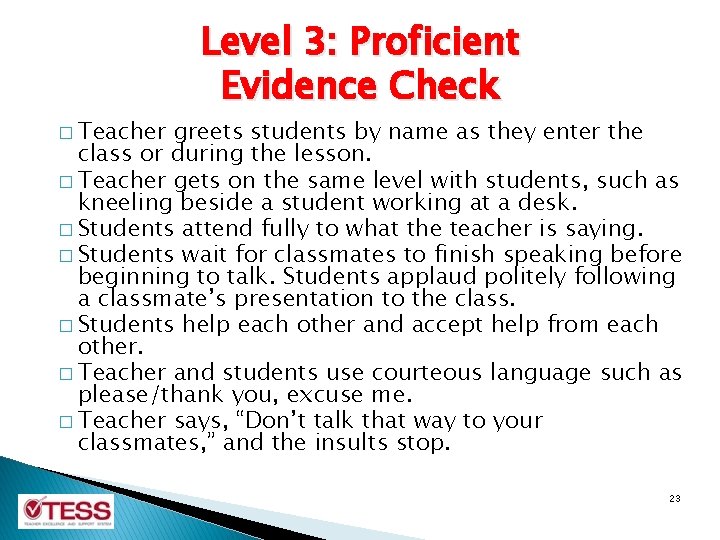
� Teacher Level 3: Proficient Evidence Check greets students by name as they enter the class or during the lesson. � Teacher gets on the same level with students, such as kneeling beside a student working at a desk. � Students attend fully to what the teacher is saying. � Students wait for classmates to finish speaking before beginning to talk. Students applaud politely following a classmate’s presentation to the class. � Students help each other and accept help from each other. � Teacher and students use courteous language such as please/thank you, excuse me. � Teacher says, “Don’t talk that way to your classmates, ” and the insults stop. 23
Level 2: Basic Evidence Check � Students attend passively to the teacher, but tend to talk, pass notes, etc. when other students are talking. � A few students do not engage with other students in the classroom even when put together in small groups. � Students applaud half-heartedly following a classmate’s presentation to the class. � Teacher says, “Don’t talk that way to your classmates, ” but student shrugs his/her shoulders. 24
�A Level 1: Unsatisfactory Evidence Examples Check student slumps in his/her chair following a comment by the teacher. � Students roll their eyes at a classmate’s idea. Teacher does not respond. � Many students talk when the teacher and other students are talking. The teacher does not ask them to stop. � Teacher does not call students by their names. � Some students refuse to work with other students. 25
Remember Our performance goal is to LIVE in 3… And vacation in 4. 26
Discussion � After reviewing the Performance Levels for Domain 2 a: Creating an Environment of Respect and Rapport, explain some methods of distinguishing between them? 27