Dialogue and Conversational Agents Part II Chapter 19
- Slides: 66
Dialogue and Conversational Agents (Part II) Chapter 19: Draft of May 18, 2005 Speech and Language Processing: An Introduction to Natural Language Processing, Computational Linguistics, and Speech Recognition Daniel Jurafsky and James H. Martin Spoken Dialogue Systems 1
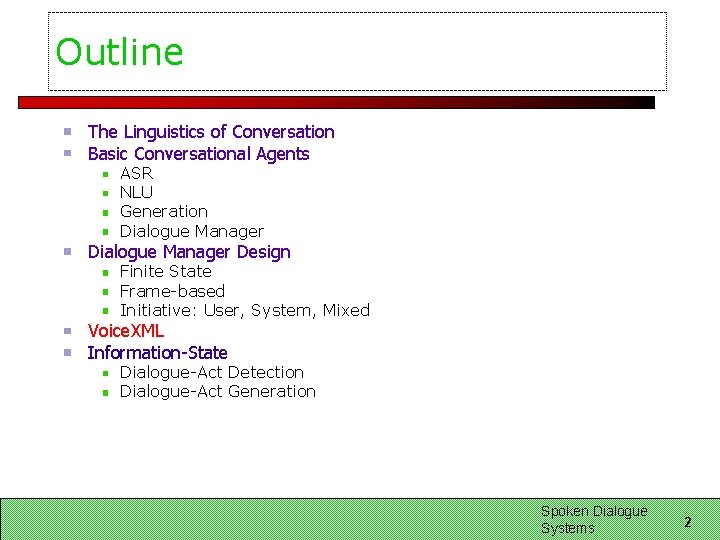
Outline The Linguistics of Conversation Basic Conversational Agents ASR NLU Generation Dialogue Manager Design Finite State Frame-based Initiative: User, System, Mixed Voice. XML Information-State Dialogue-Act Detection Dialogue-Act Generation Spoken Dialogue Systems 2
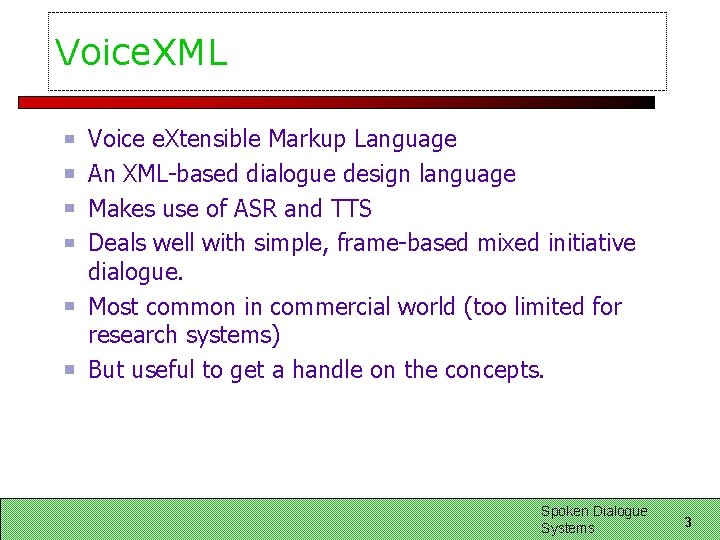
Voice. XML Voice e. Xtensible Markup Language An XML-based dialogue design language Makes use of ASR and TTS Deals well with simple, frame-based mixed initiative dialogue. Most common in commercial world (too limited for research systems) But useful to get a handle on the concepts. Spoken Dialogue Systems 3
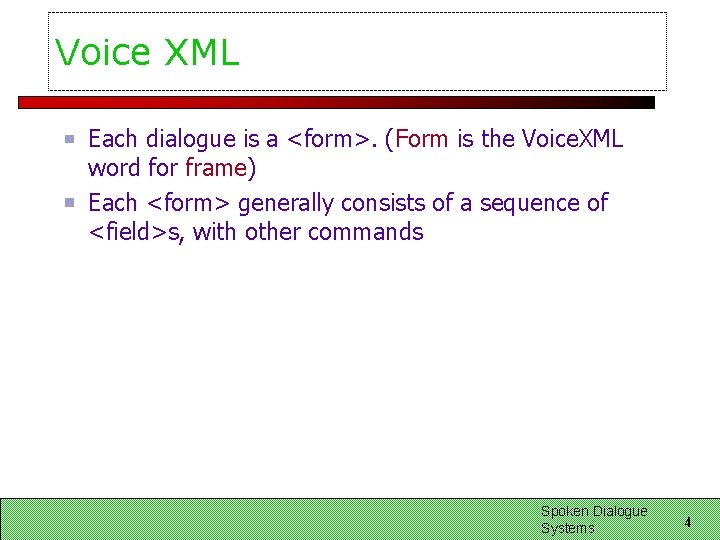
Voice XML Each dialogue is a <form>. (Form is the Voice. XML word for frame) Each <form> generally consists of a sequence of <field>s, with other commands Spoken Dialogue Systems 4
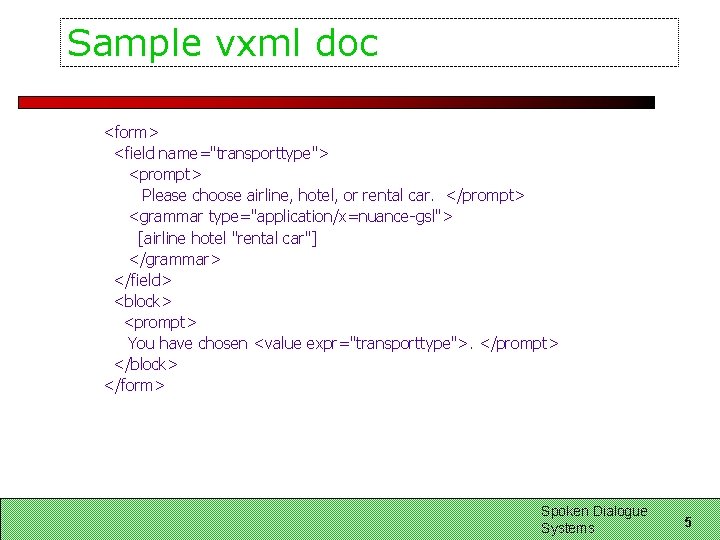
Sample vxml doc <form> <field name="transporttype"> <prompt> Please choose airline, hotel, or rental car. </prompt> <grammar type="application/x=nuance-gsl"> [airline hotel "rental car"] </grammar> </field> <block> <prompt> You have chosen <value expr="transporttype">. </prompt> </block> </form> Spoken Dialogue Systems 5
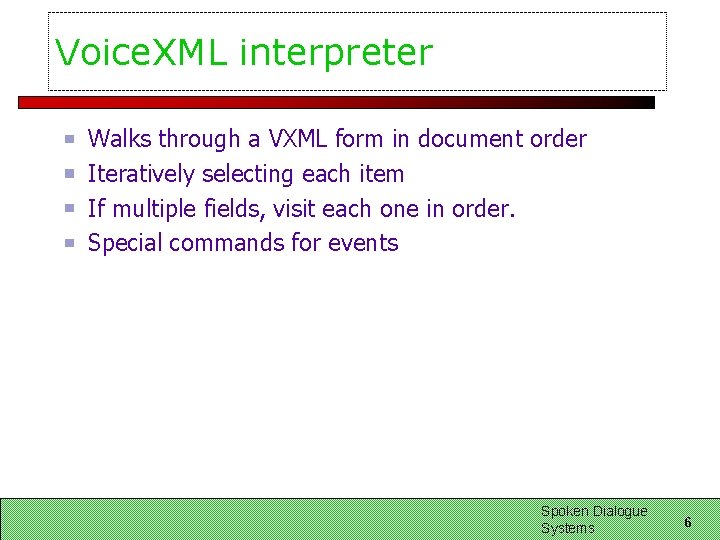
Voice. XML interpreter Walks through a VXML form in document order Iteratively selecting each item If multiple fields, visit each one in order. Special commands for events Spoken Dialogue Systems 6
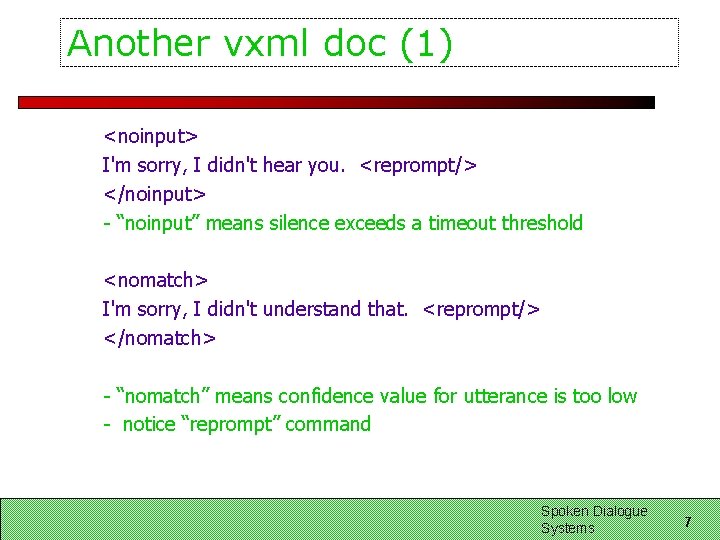
Another vxml doc (1) <noinput> I'm sorry, I didn't hear you. <reprompt/> </noinput> - “noinput” means silence exceeds a timeout threshold <nomatch> I'm sorry, I didn't understand that. <reprompt/> </nomatch> - “nomatch” means confidence value for utterance is too low - notice “reprompt” command Spoken Dialogue Systems 7
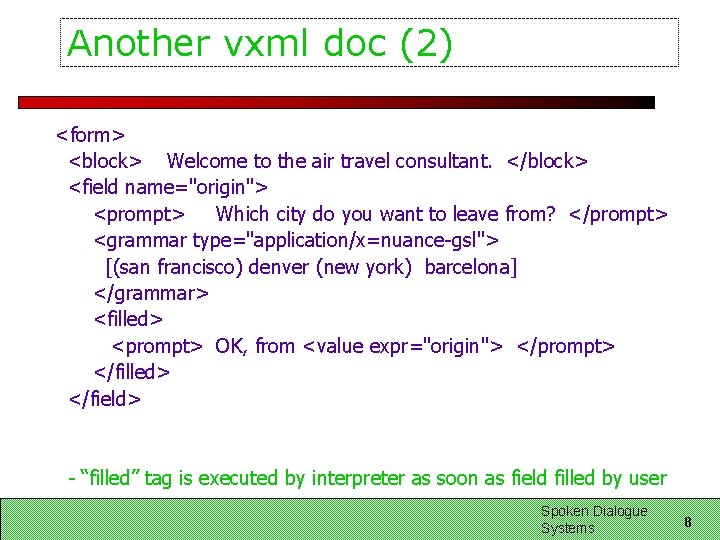
Another vxml doc (2) <form> <block> Welcome to the air travel consultant. </block> <field name="origin"> <prompt> Which city do you want to leave from? </prompt> <grammar type="application/x=nuance-gsl"> [(san francisco) denver (new york) barcelona] </grammar> <filled> <prompt> OK, from <value expr="origin"> </prompt> </filled> </field> - “filled” tag is executed by interpreter as soon as field filled by user Spoken Dialogue Systems 8
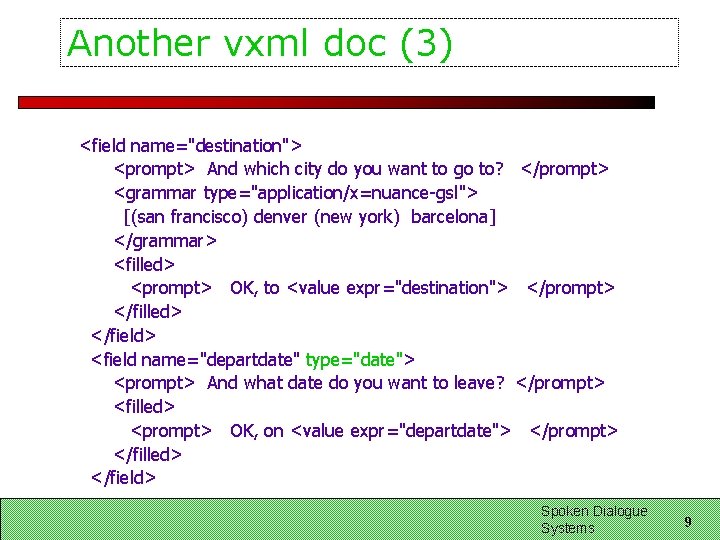
Another vxml doc (3) <field name="destination"> <prompt> And which city do you want to go to? </prompt> <grammar type="application/x=nuance-gsl"> [(san francisco) denver (new york) barcelona] </grammar> <filled> <prompt> OK, to <value expr="destination"> </prompt> </filled> </field> <field name="departdate" type="date"> <prompt> And what date do you want to leave? </prompt> <filled> <prompt> OK, on <value expr="departdate"> </prompt> </filled> </field> Spoken Dialogue Systems 9
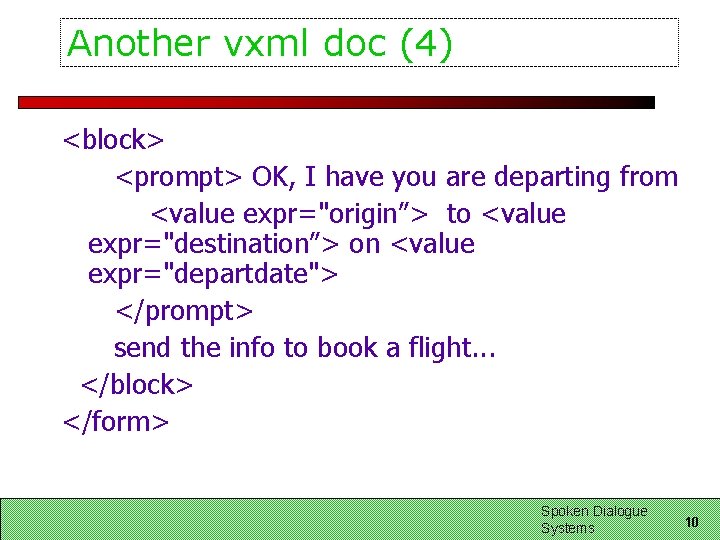
Another vxml doc (4) <block> <prompt> OK, I have you are departing from <value expr="origin”> to <value expr="destination”> on <value expr="departdate"> </prompt> send the info to book a flight. . . </block> </form> Spoken Dialogue Systems 10
Summary: Voice. XML Voice e. Xtensible Markup Language An XML-based dialogue design language Makes use of ASR and TTS Deals well with simple, frame-based mixed initiative dialogue. Most common in commercial world (too limited for research systems) But useful to get a handle on the concepts. Spoken Dialogue Systems 11
Outline The Linguistics of Conversation Basic Conversational Agents ASR NLU Generation Dialogue Manager Design Finite State Frame-based Initiative: User, System, Mixed Voice. XML Information-State Dialogue-Act Detection Dialogue-Act Generation Spoken Dialogue Systems 12
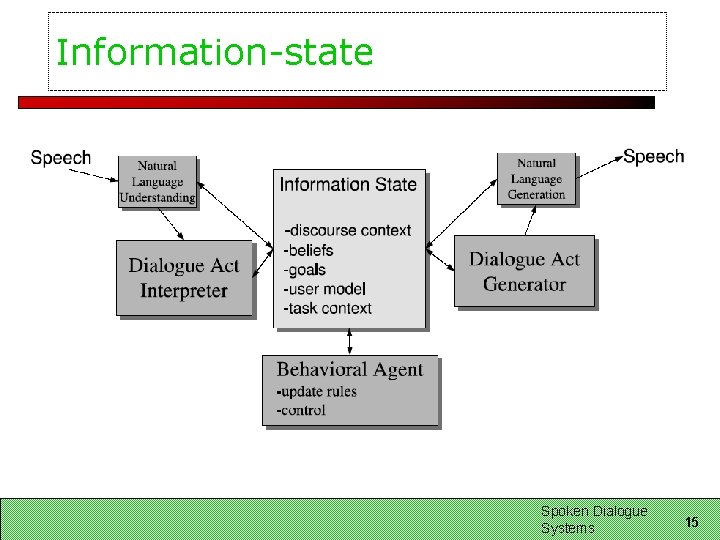
Information-State and Dialogue Acts If we want a dialogue system to be more than just form-filling Needs to: Decide when the user has asked a question, made a proposal, rejected a suggestion Ground a user’s utterance, ask clarification questions, suggestion plans Suggests: Conversational agent needs sophisticated models of interpretation and generation – In terms of speech acts and grounding – Needs more sophisticated representation of dialogue context than just a list of slots Spoken Dialogue Systems 13
Information-state architecture Information state Dialogue act interpreter Dialogue act generator Set of update rules Update dialogue state as acts are interpreted Generate dialogue acts Control structure to select which update rules to apply Spoken Dialogue Systems 14
Information-state Spoken Dialogue Systems 15
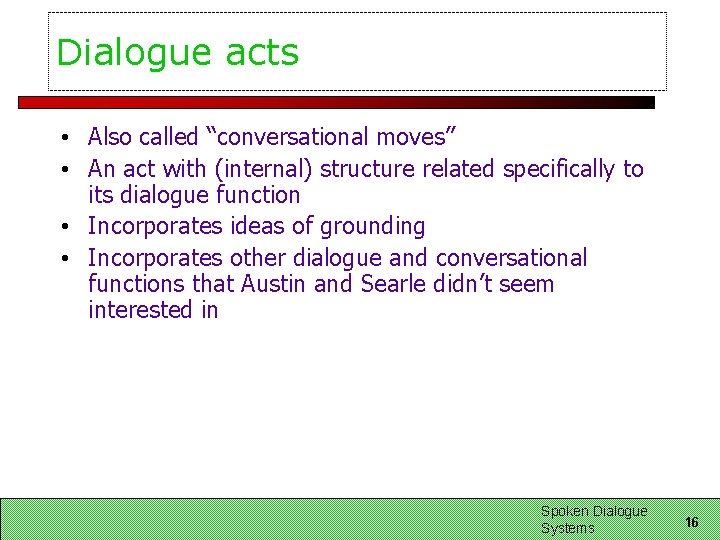
Dialogue acts • Also called “conversational moves” • An act with (internal) structure related specifically to its dialogue function • Incorporates ideas of grounding • Incorporates other dialogue and conversational functions that Austin and Searle didn’t seem interested in Spoken Dialogue Systems 16
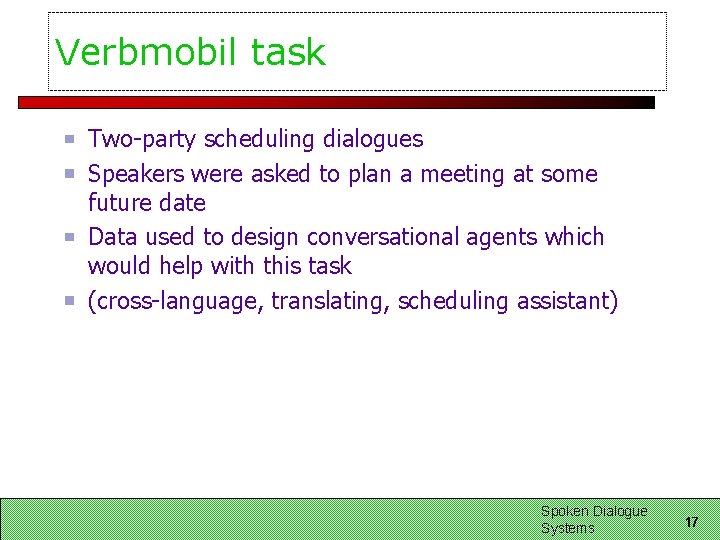
Verbmobil task Two-party scheduling dialogues Speakers were asked to plan a meeting at some future date Data used to design conversational agents which would help with this task (cross-language, translating, scheduling assistant) Spoken Dialogue Systems 17
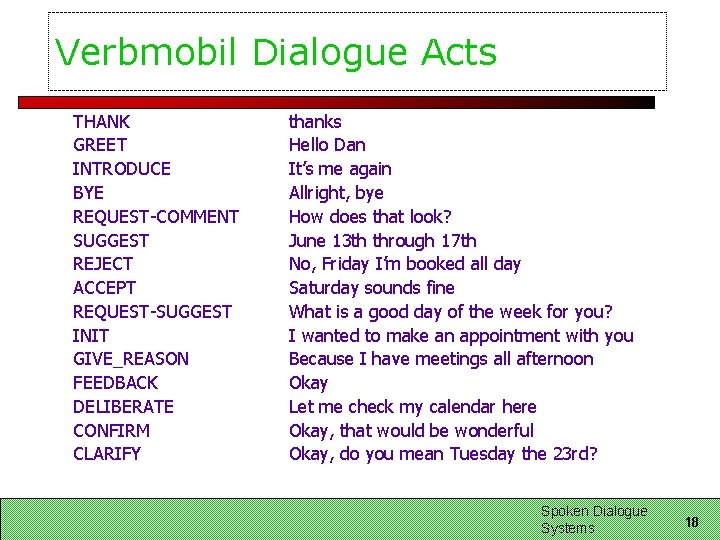
Verbmobil Dialogue Acts THANK GREET INTRODUCE BYE REQUEST-COMMENT SUGGEST REJECT ACCEPT REQUEST-SUGGEST INIT GIVE_REASON FEEDBACK DELIBERATE CONFIRM CLARIFY thanks Hello Dan It’s me again Allright, bye How does that look? June 13 th through 17 th No, Friday I’m booked all day Saturday sounds fine What is a good day of the week for you? I wanted to make an appointment with you Because I have meetings all afternoon Okay Let me check my calendar here Okay, that would be wonderful Okay, do you mean Tuesday the 23 rd? Spoken Dialogue Systems 18
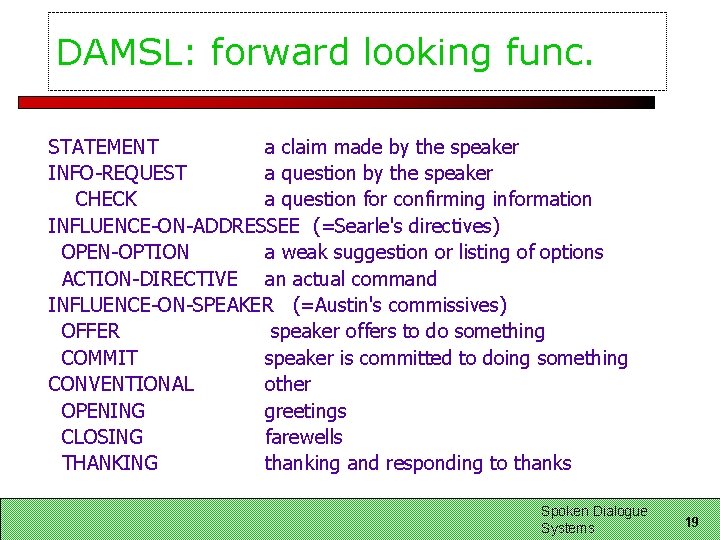
DAMSL: forward looking func. STATEMENT a claim made by the speaker INFO-REQUEST a question by the speaker CHECK a question for confirming information INFLUENCE-ON-ADDRESSEE (=Searle's directives) OPEN-OPTION a weak suggestion or listing of options ACTION-DIRECTIVE an actual command INFLUENCE-ON-SPEAKER (=Austin's commissives) OFFER speaker offers to do something COMMIT speaker is committed to doing something CONVENTIONAL other OPENING greetings CLOSING farewells THANKING thanking and responding to thanks Spoken Dialogue Systems 19
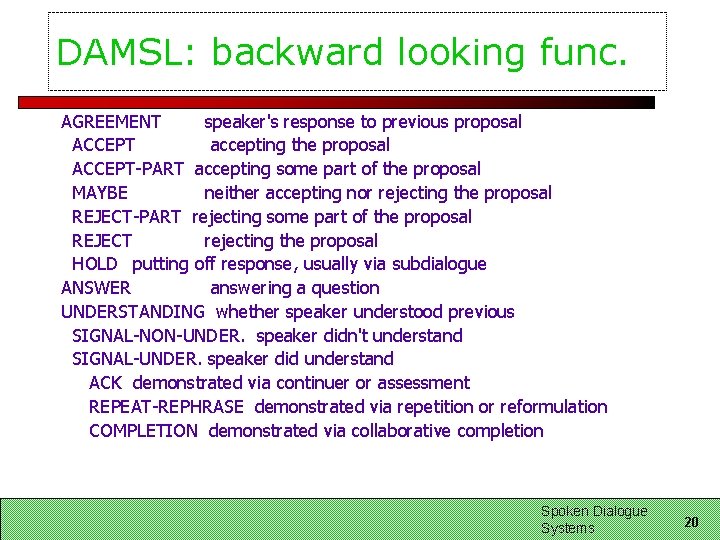
DAMSL: backward looking func. AGREEMENT speaker's response to previous proposal ACCEPT accepting the proposal ACCEPT-PART accepting some part of the proposal MAYBE neither accepting nor rejecting the proposal REJECT-PART rejecting some part of the proposal REJECT rejecting the proposal HOLD putting off response, usually via subdialogue ANSWER answering a question UNDERSTANDING whether speaker understood previous SIGNAL-NON-UNDER. speaker didn't understand SIGNAL-UNDER. speaker did understand ACK demonstrated via continuer or assessment REPEAT-REPHRASE demonstrated via repetition or reformulation COMPLETION demonstrated via collaborative completion Spoken Dialogue Systems 20
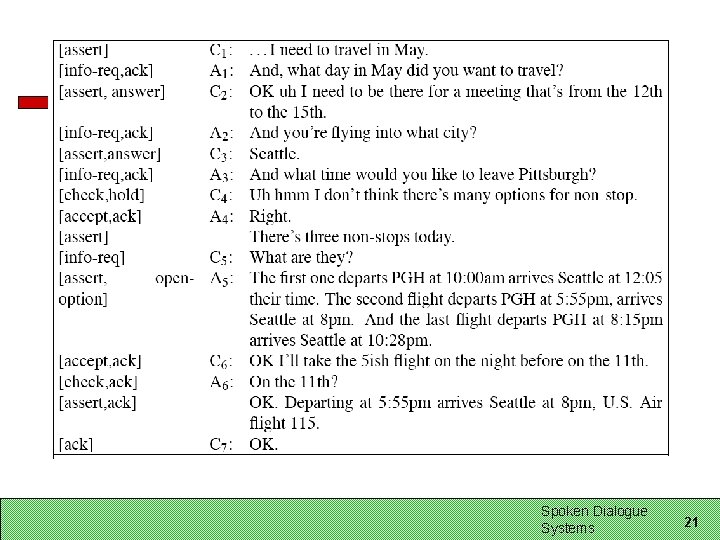
Spoken Dialogue Systems 21
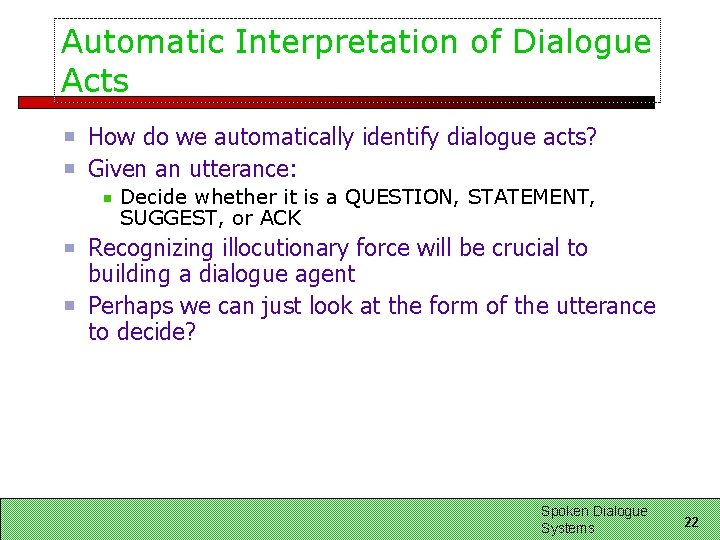
Automatic Interpretation of Dialogue Acts How do we automatically identify dialogue acts? Given an utterance: Decide whether it is a QUESTION, STATEMENT, SUGGEST, or ACK Recognizing illocutionary force will be crucial to building a dialogue agent Perhaps we can just look at the form of the utterance to decide? Spoken Dialogue Systems 22
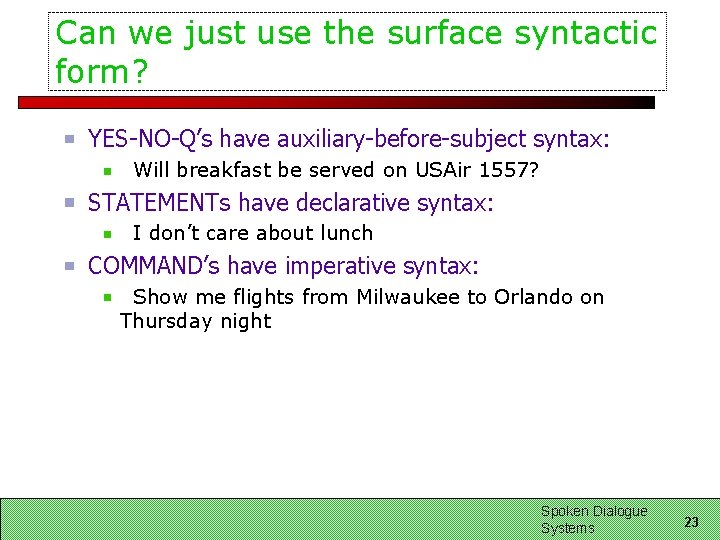
Can we just use the surface syntactic form? YES-NO-Q’s have auxiliary-before-subject syntax: Will breakfast be served on USAir 1557? STATEMENTs have declarative syntax: I don’t care about lunch COMMAND’s have imperative syntax: Show me flights from Milwaukee to Orlando on Thursday night Spoken Dialogue Systems 23
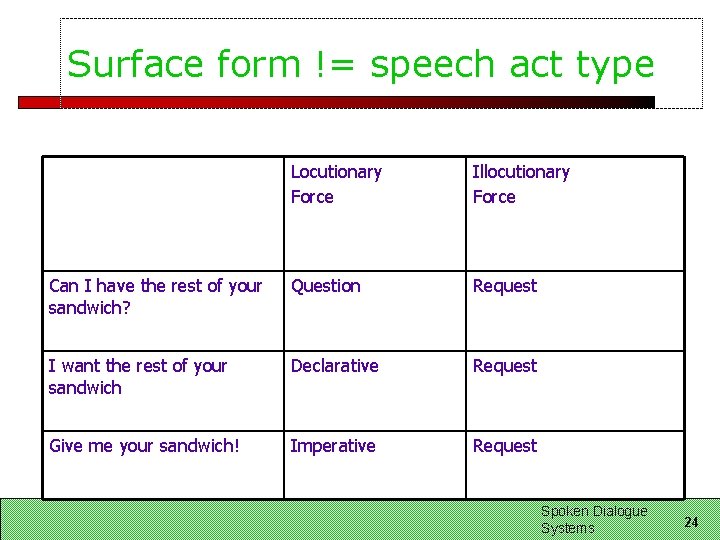
Surface form != speech act type Locutionary Force Illocutionary Force Can I have the rest of your sandwich? Question Request I want the rest of your sandwich Declarative Request Give me your sandwich! Imperative Request Spoken Dialogue Systems 24
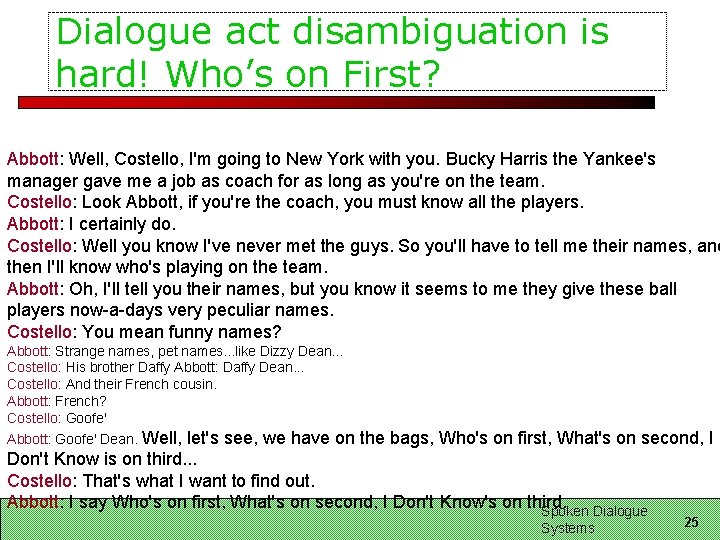
Dialogue act disambiguation is hard! Who’s on First? Abbott: Well, Costello, I'm going to New York with you. Bucky Harris the Yankee's manager gave me a job as coach for as long as you're on the team. Costello: Look Abbott, if you're the coach, you must know all the players. Abbott: I certainly do. Costello: Well you know I've never met the guys. So you'll have to tell me their names, and then I'll know who's playing on the team. Abbott: Oh, I'll tell you their names, but you know it seems to me they give these ball players now-a-days very peculiar names. Costello: You mean funny names? Abbott: Strange names, pet names. . . like Dizzy Dean. . . Costello: His brother Daffy Abbott: Daffy Dean. . . Costello: And their French cousin. Abbott: French? Costello: Goofe' Abbott: Goofe' Dean. Well, let's see, we have on the bags, Who's on first, What's on second, I Don't Know is on third. . . Costello: That's what I want to find out. Abbott: I say Who's on first, What's on second, I Don't Know's on third. Spoken Dialogue Systems 25
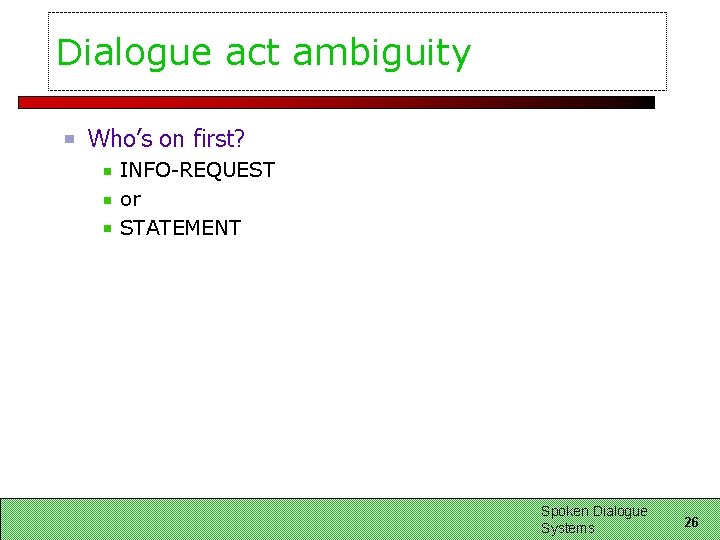
Dialogue act ambiguity Who’s on first? INFO-REQUEST or STATEMENT Spoken Dialogue Systems 26
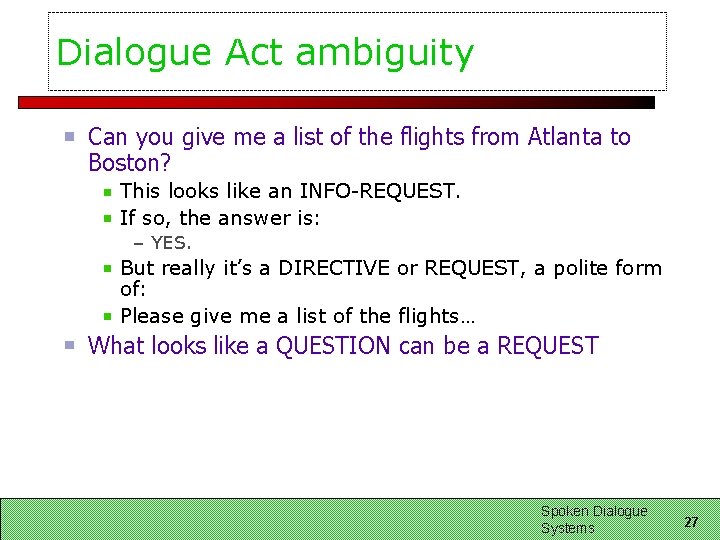
Dialogue Act ambiguity Can you give me a list of the flights from Atlanta to Boston? This looks like an INFO-REQUEST. If so, the answer is: – YES. But really it’s a DIRECTIVE or REQUEST, a polite form of: Please give me a list of the flights… What looks like a QUESTION can be a REQUEST Spoken Dialogue Systems 27
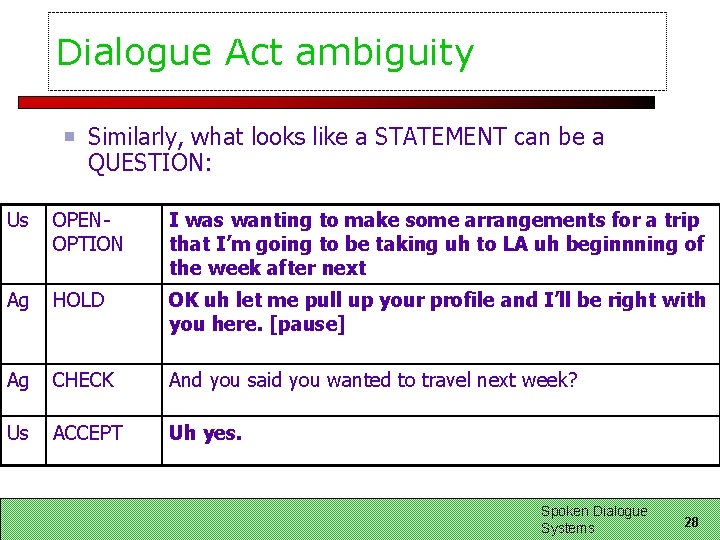
Dialogue Act ambiguity Similarly, what looks like a STATEMENT can be a QUESTION: Us OPENOPTION I was wanting to make some arrangements for a trip that I’m going to be taking uh to LA uh beginnning of the week after next Ag HOLD OK uh let me pull up your profile and I’ll be right with you here. [pause] Ag CHECK And you said you wanted to travel next week? Us ACCEPT Uh yes. Spoken Dialogue Systems 28
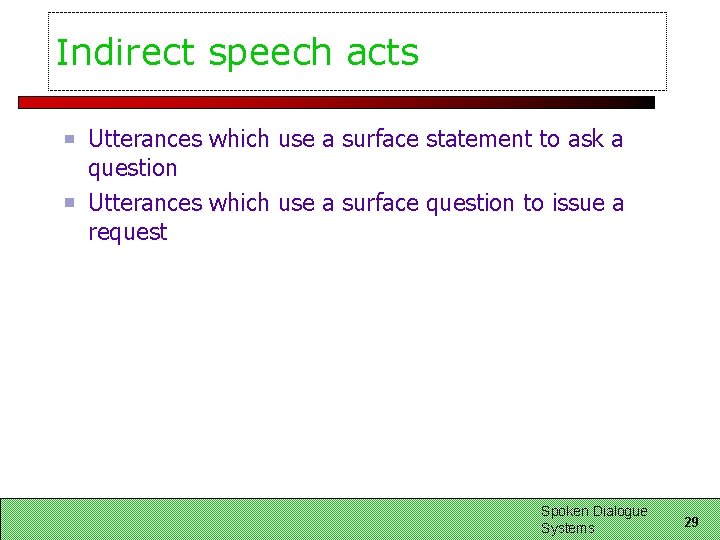
Indirect speech acts Utterances which use a surface statement to ask a question Utterances which use a surface question to issue a request Spoken Dialogue Systems 29
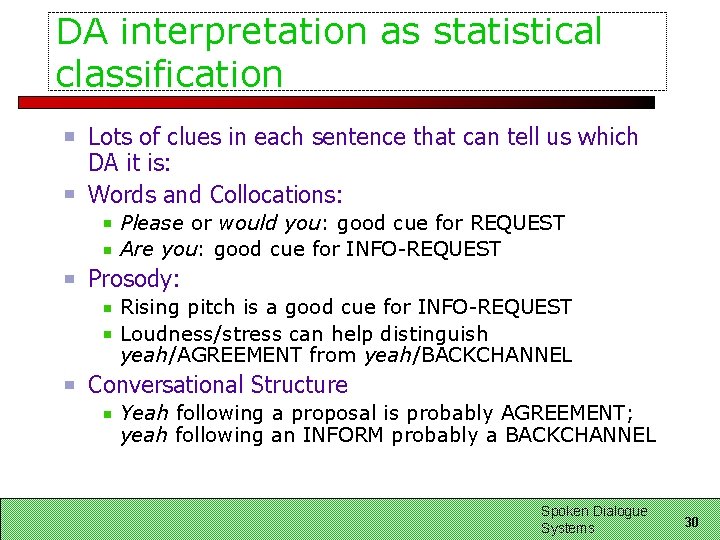
DA interpretation as statistical classification Lots of clues in each sentence that can tell us which DA it is: Words and Collocations: Please or would you: good cue for REQUEST Are you: good cue for INFO-REQUEST Prosody: Rising pitch is a good cue for INFO-REQUEST Loudness/stress can help distinguish yeah/AGREEMENT from yeah/BACKCHANNEL Conversational Structure Yeah following a proposal is probably AGREEMENT; yeah following an INFORM probably a BACKCHANNEL Spoken Dialogue Systems 30
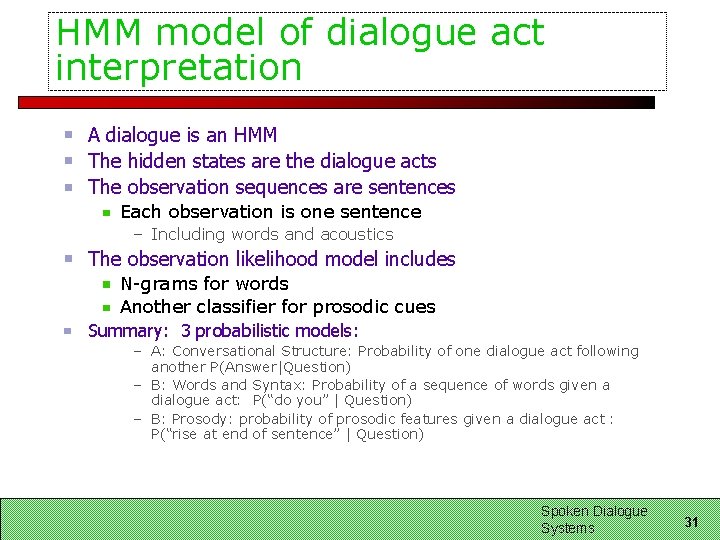
HMM model of dialogue act interpretation A dialogue is an HMM The hidden states are the dialogue acts The observation sequences are sentences Each observation is one sentence – Including words and acoustics The observation likelihood model includes N-grams for words Another classifier for prosodic cues Summary: 3 probabilistic models: – A: Conversational Structure: Probability of one dialogue act following another P(Answer|Question) – B: Words and Syntax: Probability of a sequence of words given a dialogue act: P(“do you” | Question) – B: Prosody: probability of prosodic features given a dialogue act : P(“rise at end of sentence” | Question) Spoken Dialogue Systems 31
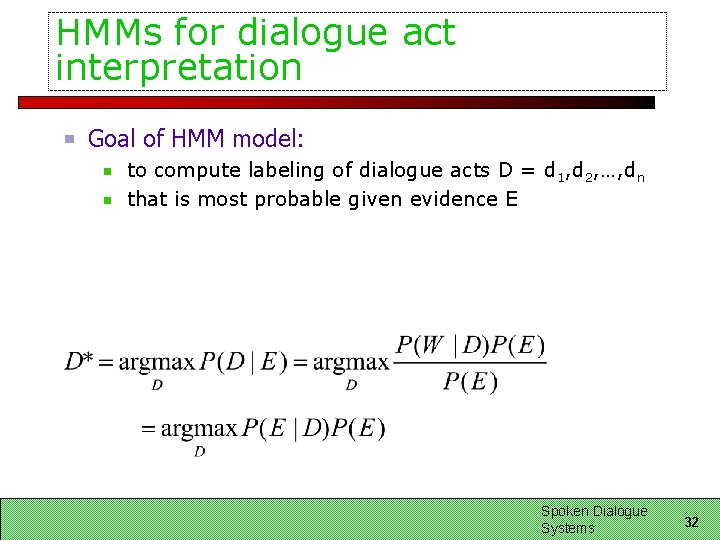
HMMs for dialogue act interpretation Goal of HMM model: to compute labeling of dialogue acts D = d 1, d 2, …, dn that is most probable given evidence E Spoken Dialogue Systems 32
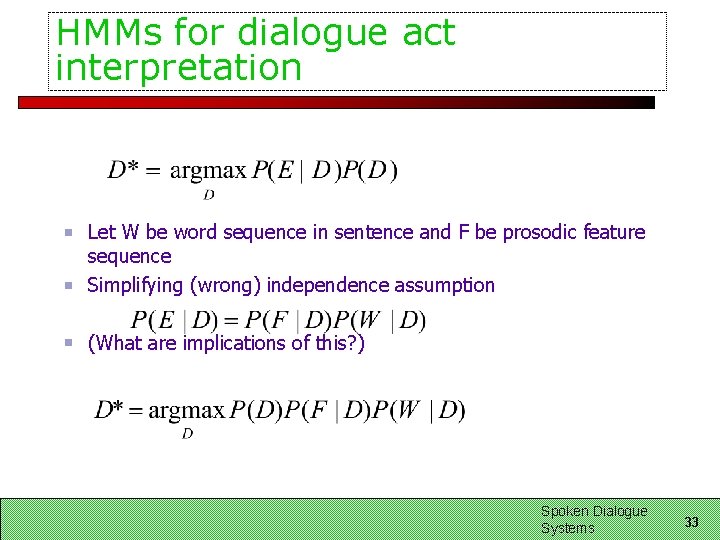
HMMs for dialogue act interpretation Let W be word sequence in sentence and F be prosodic feature sequence Simplifying (wrong) independence assumption (What are implications of this? ) Spoken Dialogue Systems 33
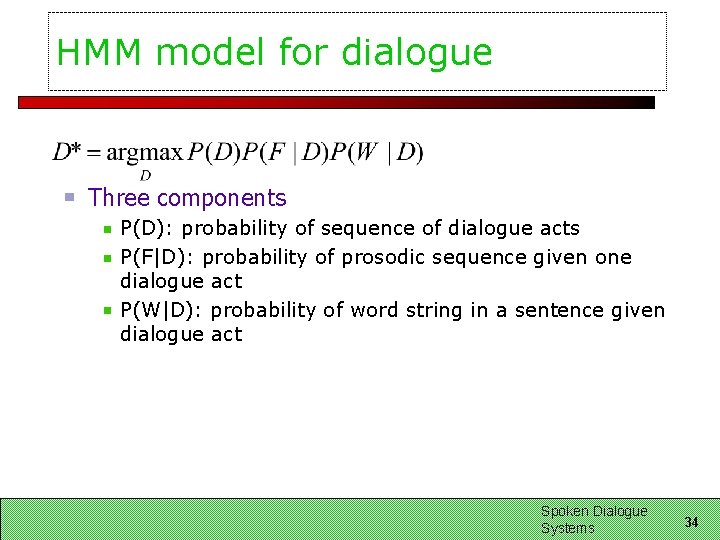
HMM model for dialogue Three components P(D): probability of sequence of dialogue acts P(F|D): probability of prosodic sequence given one dialogue act P(W|D): probability of word string in a sentence given dialogue act Spoken Dialogue Systems 34
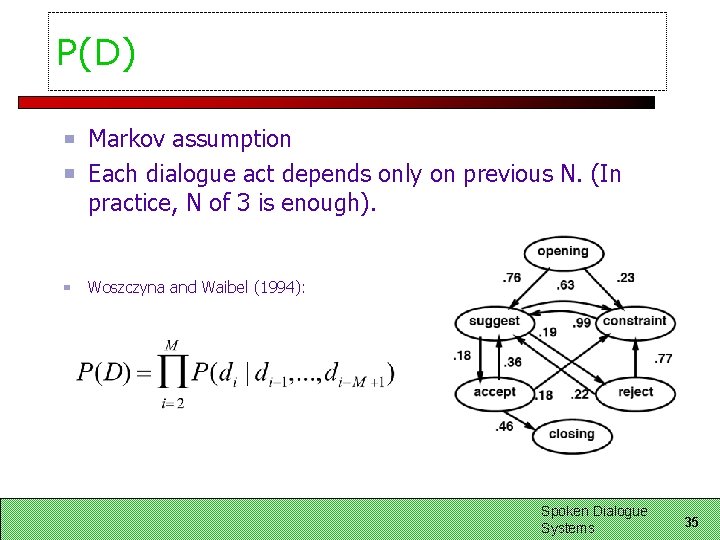
P(D) Markov assumption Each dialogue act depends only on previous N. (In practice, N of 3 is enough). Woszczyna and Waibel (1994): Spoken Dialogue Systems 35
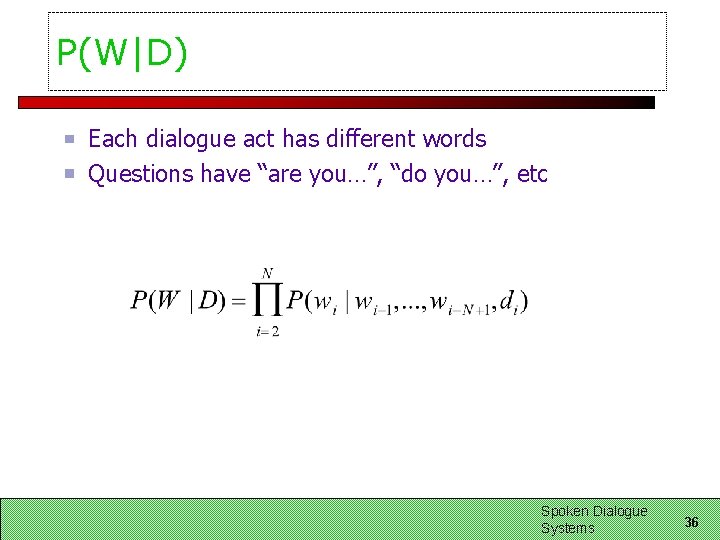
P(W|D) Each dialogue act has different words Questions have “are you…”, “do you…”, etc Spoken Dialogue Systems 36
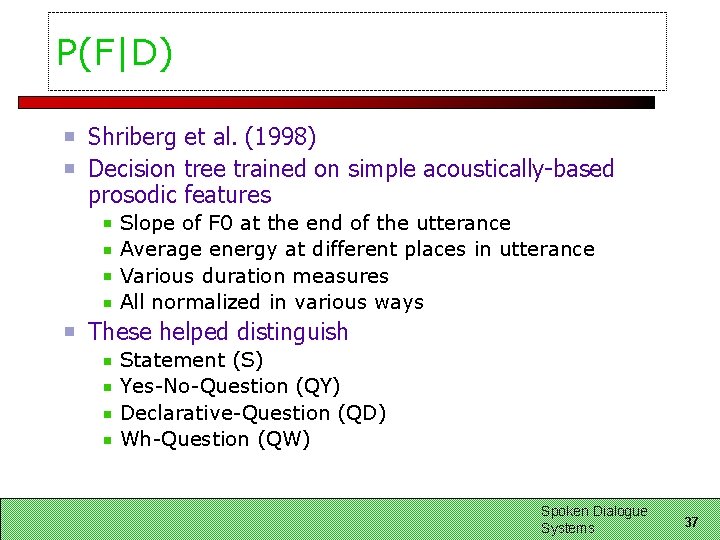
P(F|D) Shriberg et al. (1998) Decision tree trained on simple acoustically-based prosodic features Slope of F 0 at the end of the utterance Average energy at different places in utterance Various duration measures All normalized in various ways These helped distinguish Statement (S) Yes-No-Question (QY) Declarative-Question (QD) Wh-Question (QW) Spoken Dialogue Systems 37
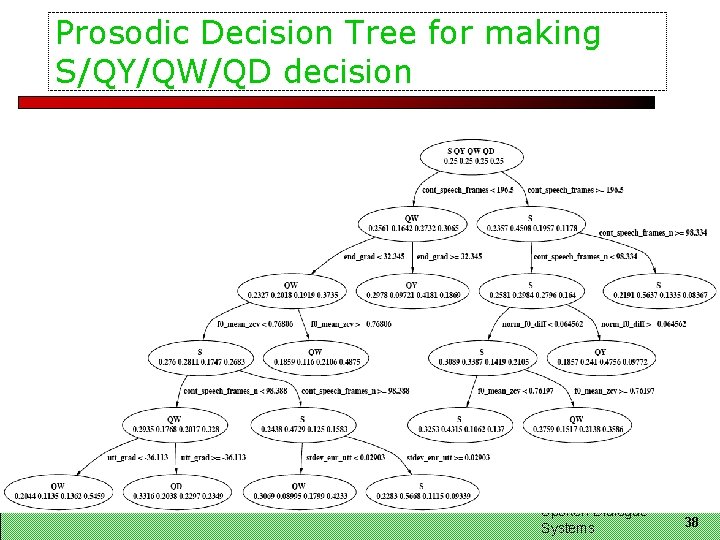
Prosodic Decision Tree for making S/QY/QW/QD decision Spoken Dialogue Systems 38
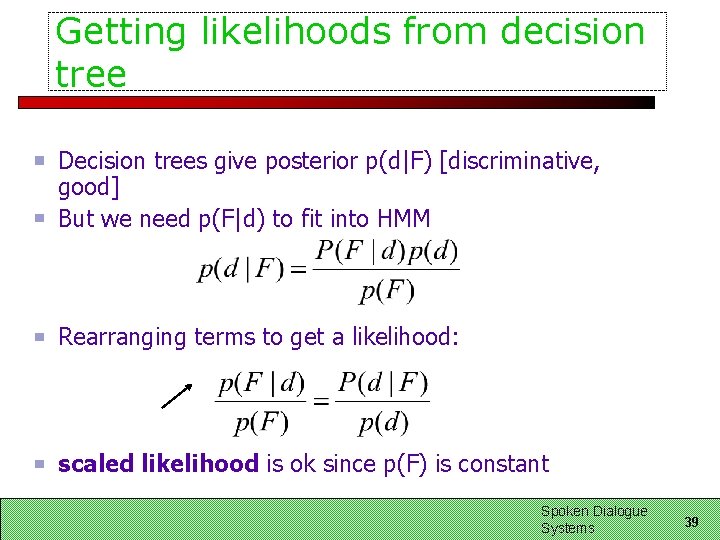
Getting likelihoods from decision tree Decision trees give posterior p(d|F) [discriminative, good] But we need p(F|d) to fit into HMM Rearranging terms to get a likelihood: scaled likelihood is ok since p(F) is constant Spoken Dialogue Systems 39
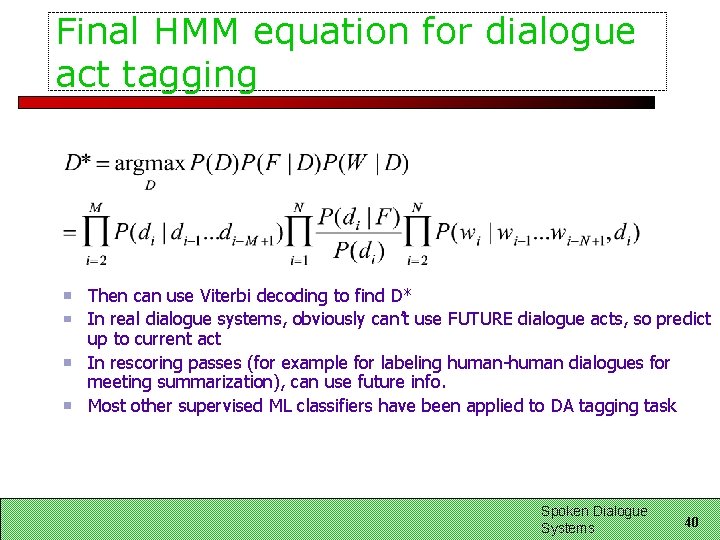
Final HMM equation for dialogue act tagging Then can use Viterbi decoding to find D* In real dialogue systems, obviously can’t use FUTURE dialogue acts, so predict up to current act In rescoring passes (for example for labeling human-human dialogues for meeting summarization), can use future info. Most other supervised ML classifiers have been applied to DA tagging task Spoken Dialogue Systems 40
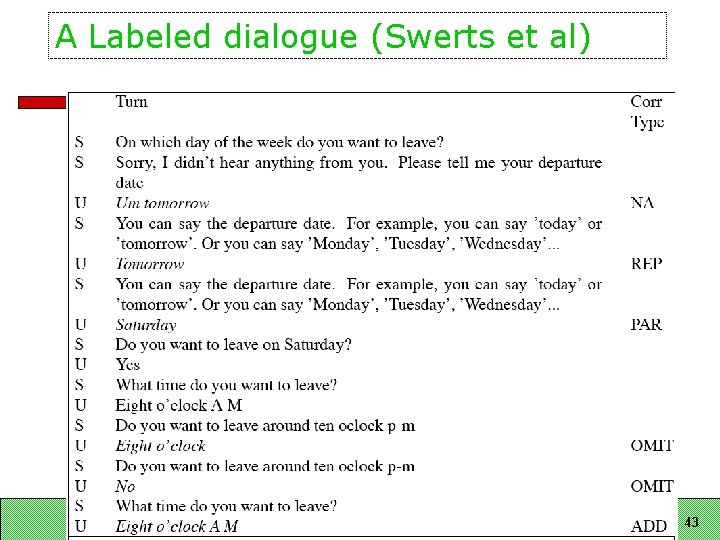
An example of dialogue act detection: Correction Detection Despite all these clever confirmation/rejection strategies, dialogue systems still make mistakes (Surprise!) If system misrecognizes an utterance, and either Rejects Via confirmation, displays its misunderstanding Then user has a chance to make a correction Repeat themselves Rephrasing Saying “no” to the confirmation question. Spoken Dialogue Systems 41
Corrections Unfortunately, corrections are harder to recognize than normal sentences! Swerts et al (2000): corrections misrecognized twice as often (in terms of WER) as non-corrections!!! Why? – Prosody seems to be largest factor: hyperarticulation – English Example from Liz Shriberg § “NO, I am DE-PAR-TING from Jacksonville) Spoken Dialogue Systems 42
A Labeled dialogue (Swerts et al) Spoken Dialogue Systems 43
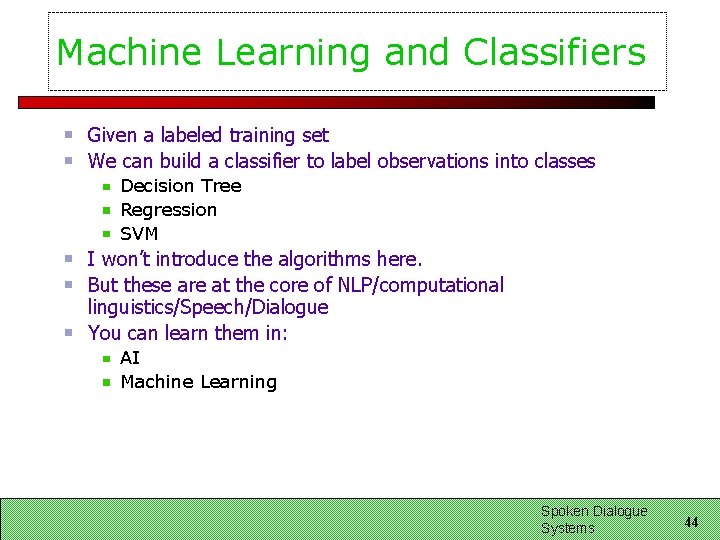
Machine Learning and Classifiers Given a labeled training set We can build a classifier to label observations into classes Decision Tree Regression SVM I won’t introduce the algorithms here. But these are at the core of NLP/computational linguistics/Speech/Dialogue You can learn them in: AI Machine Learning Spoken Dialogue Systems 44
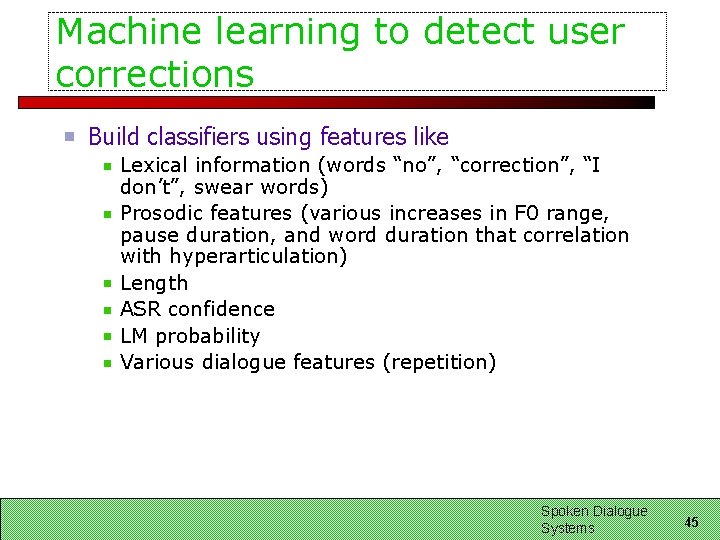
Machine learning to detect user corrections Build classifiers using features like Lexical information (words “no”, “correction”, “I don’t”, swear words) Prosodic features (various increases in F 0 range, pause duration, and word duration that correlation with hyperarticulation) Length ASR confidence LM probability Various dialogue features (repetition) Spoken Dialogue Systems 45
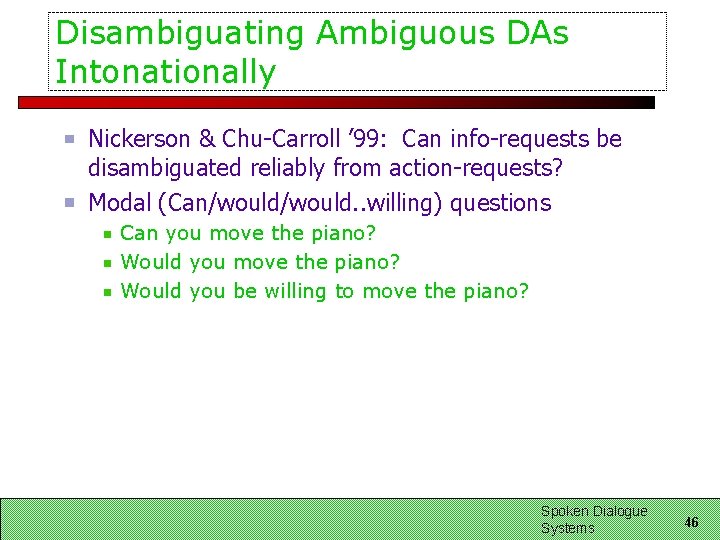
Disambiguating Ambiguous DAs Intonationally Nickerson & Chu-Carroll ’ 99: Can info-requests be disambiguated reliably from action-requests? Modal (Can/would. . willing) questions Can you move the piano? Would you be willing to move the piano? Spoken Dialogue Systems 46
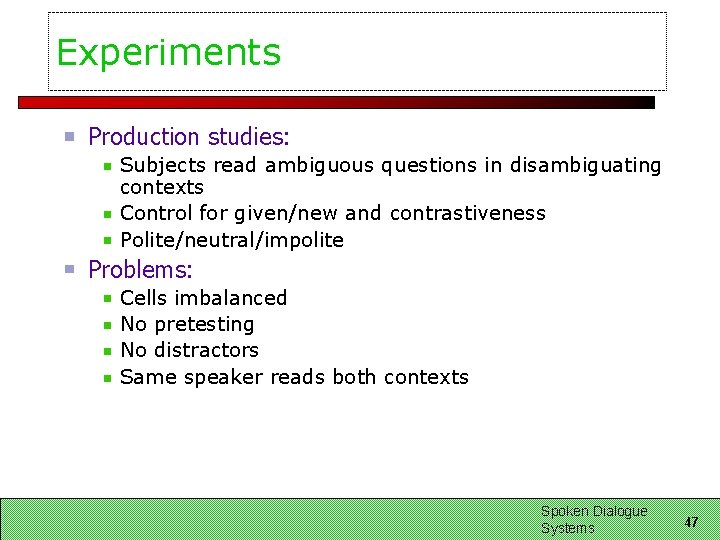
Experiments Production studies: Subjects read ambiguous questions in disambiguating contexts Control for given/new and contrastiveness Polite/neutral/impolite Problems: Cells imbalanced No pretesting No distractors Same speaker reads both contexts Spoken Dialogue Systems 47
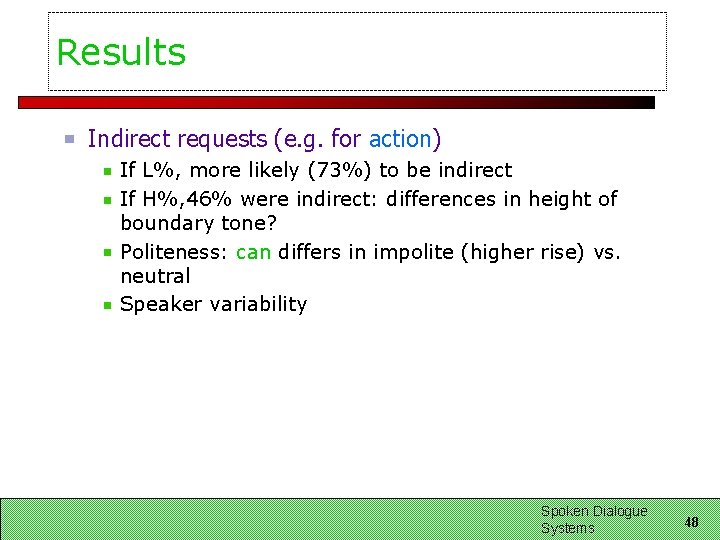
Results Indirect requests (e. g. for action) If L%, more likely (73%) to be indirect If H%, 46% were indirect: differences in height of boundary tone? Politeness: can differs in impolite (higher rise) vs. neutral Speaker variability Spoken Dialogue Systems 48
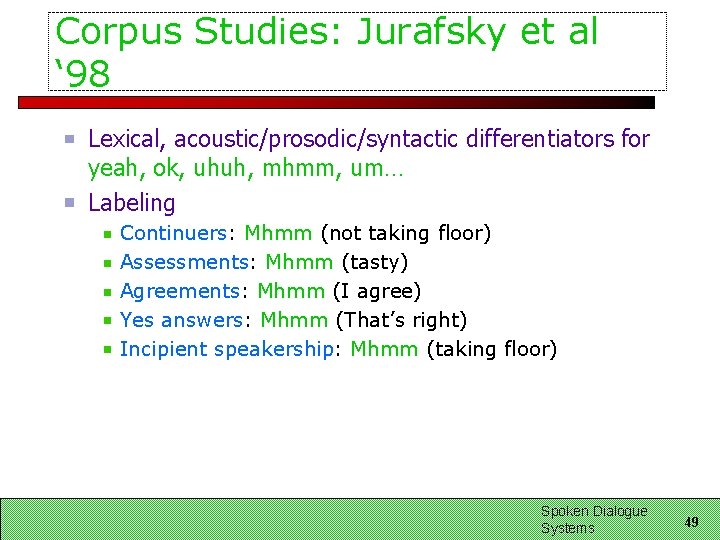
Corpus Studies: Jurafsky et al ‘ 98 Lexical, acoustic/prosodic/syntactic differentiators for yeah, ok, uhuh, mhmm, um… Labeling Continuers: Mhmm (not taking floor) Assessments: Mhmm (tasty) Agreements: Mhmm (I agree) Yes answers: Mhmm (That’s right) Incipient speakership: Mhmm (taking floor) Spoken Dialogue Systems 49
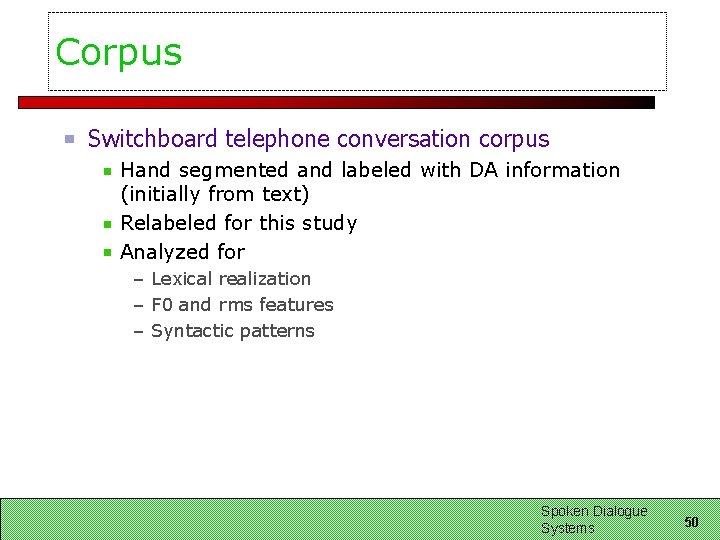
Corpus Switchboard telephone conversation corpus Hand segmented and labeled with DA information (initially from text) Relabeled for this study Analyzed for – Lexical realization – F 0 and rms features – Syntactic patterns Spoken Dialogue Systems 50
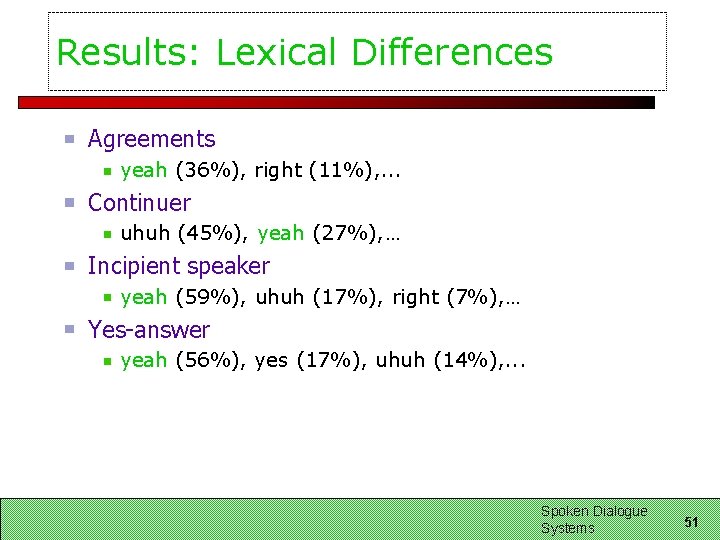
Results: Lexical Differences Agreements yeah (36%), right (11%), . . . Continuer uhuh (45%), yeah (27%), … Incipient speaker yeah (59%), uhuh (17%), right (7%), … Yes-answer yeah (56%), yes (17%), uhuh (14%), . . . Spoken Dialogue Systems 51
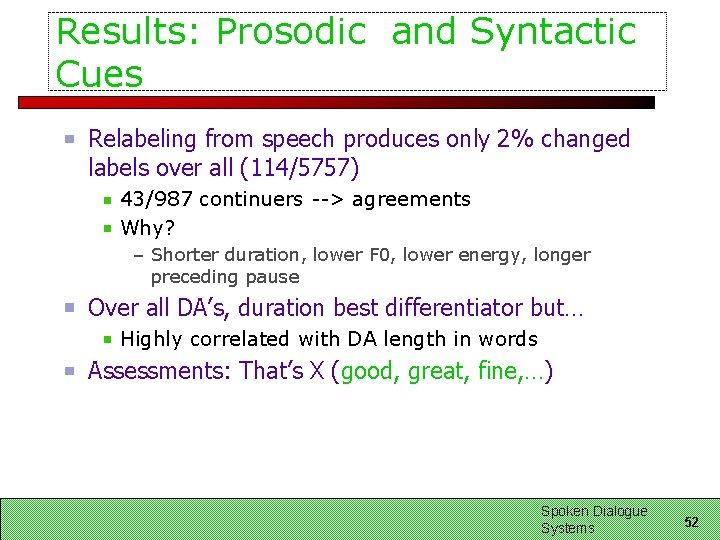
Results: Prosodic and Syntactic Cues Relabeling from speech produces only 2% changed labels over all (114/5757) 43/987 continuers --> agreements Why? – Shorter duration, lower F 0, lower energy, longer preceding pause Over all DA’s, duration best differentiator but… Highly correlated with DA length in words Assessments: That’s X (good, great, fine, …) Spoken Dialogue Systems 52
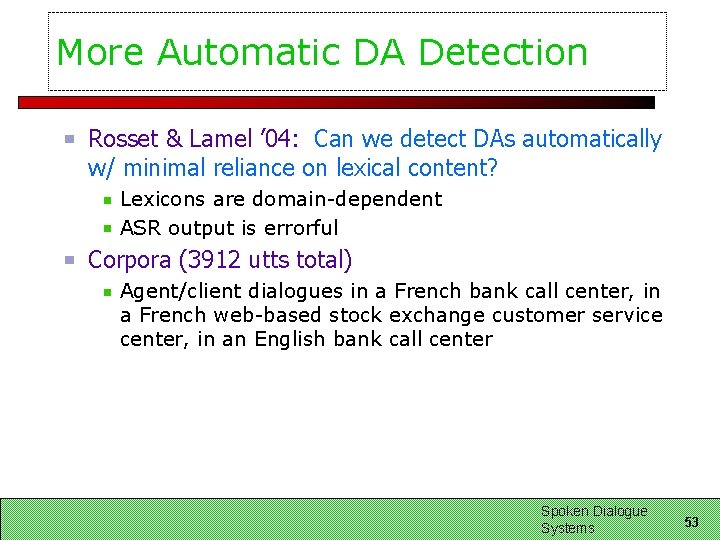
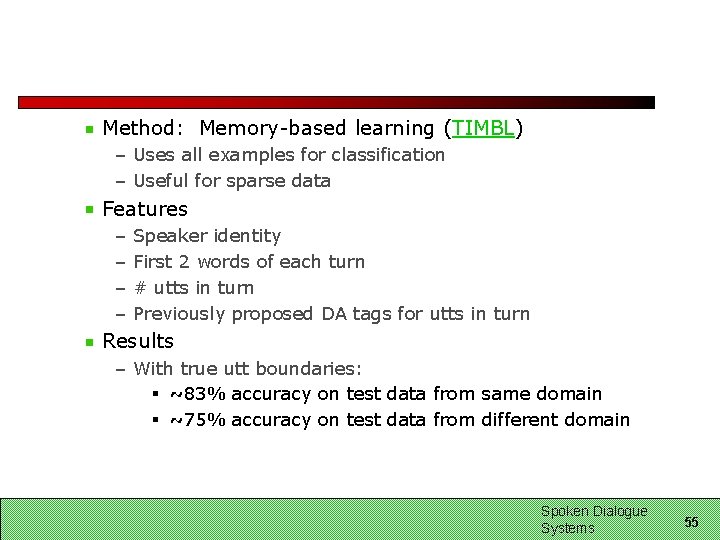
More Automatic DA Detection Rosset & Lamel ’ 04: Can we detect DAs automatically w/ minimal reliance on lexical content? Lexicons are domain-dependent ASR output is errorful Corpora (3912 utts total) Agent/client dialogues in a French bank call center, in a French web-based stock exchange customer service center, in an English bank call center Spoken Dialogue Systems 53
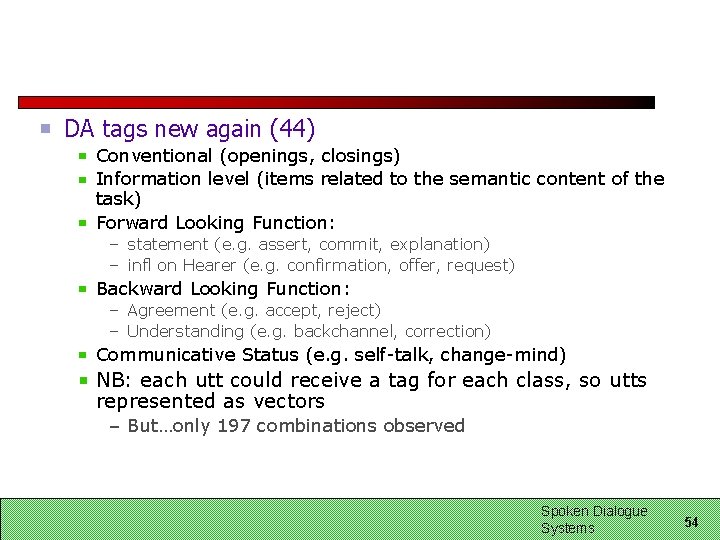
DA tags new again (44) Conventional (openings, closings) Information level (items related to the semantic content of the task) Forward Looking Function: – statement (e. g. assert, commit, explanation) – infl on Hearer (e. g. confirmation, offer, request) Backward Looking Function: – Agreement (e. g. accept, reject) – Understanding (e. g. backchannel, correction) Communicative Status (e. g. self-talk, change-mind) NB: each utt could receive a tag for each class, so utts represented as vectors – But…only 197 combinations observed Spoken Dialogue Systems 54
Method: Memory-based learning (TIMBL) – Uses all examples for classification – Useful for sparse data Features – – Speaker identity First 2 words of each turn # utts in turn Previously proposed DA tags for utts in turn Results – With true utt boundaries: § ~83% accuracy on test data from same domain § ~75% accuracy on test data from different domain Spoken Dialogue Systems 55
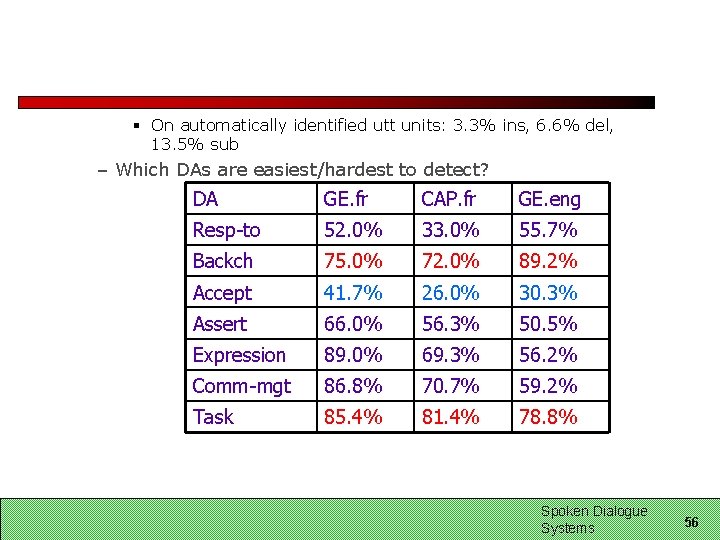
§ On automatically identified utt units: 3. 3% ins, 6. 6% del, 13. 5% sub – Which DAs are easiest/hardest to detect? DA GE. fr CAP. fr GE. eng Resp-to 52. 0% 33. 0% 55. 7% Backch 75. 0% 72. 0% 89. 2% Accept 41. 7% 26. 0% 30. 3% Assert 66. 0% 56. 3% 50. 5% Expression 89. 0% 69. 3% 56. 2% Comm-mgt 86. 8% 70. 7% 59. 2% Task 85. 4% 81. 4% 78. 8% Spoken Dialogue Systems 56
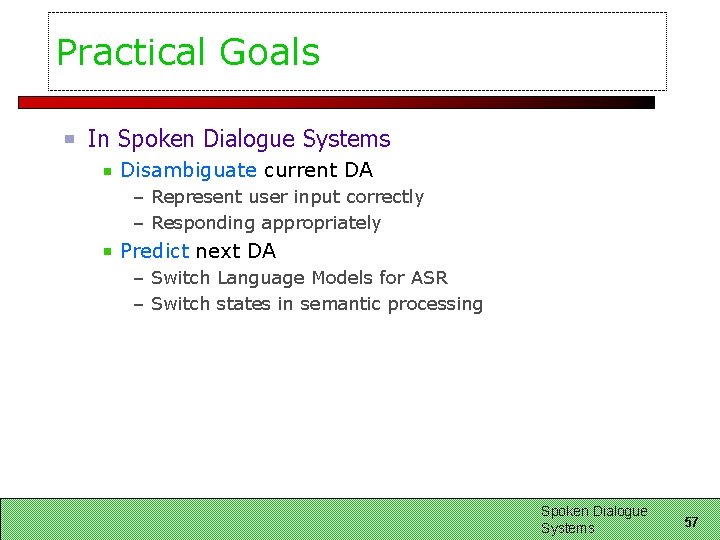
Practical Goals In Spoken Dialogue Systems Disambiguate current DA – Represent user input correctly – Responding appropriately Predict next DA – Switch Language Models for ASR – Switch states in semantic processing Spoken Dialogue Systems 57
Generating Dialogue Acts Confirmation Rejection Spoken Dialogue Systems 58
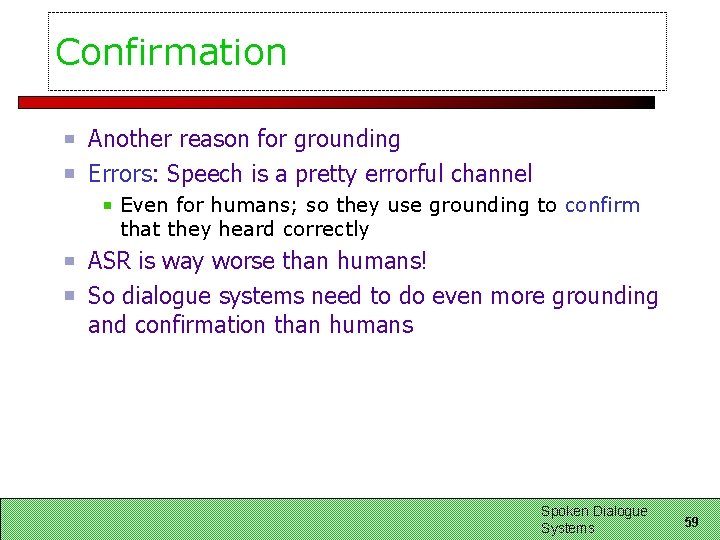
Confirmation Another reason for grounding Errors: Speech is a pretty errorful channel Even for humans; so they use grounding to confirm that they heard correctly ASR is way worse than humans! So dialogue systems need to do even more grounding and confirmation than humans Spoken Dialogue Systems 59
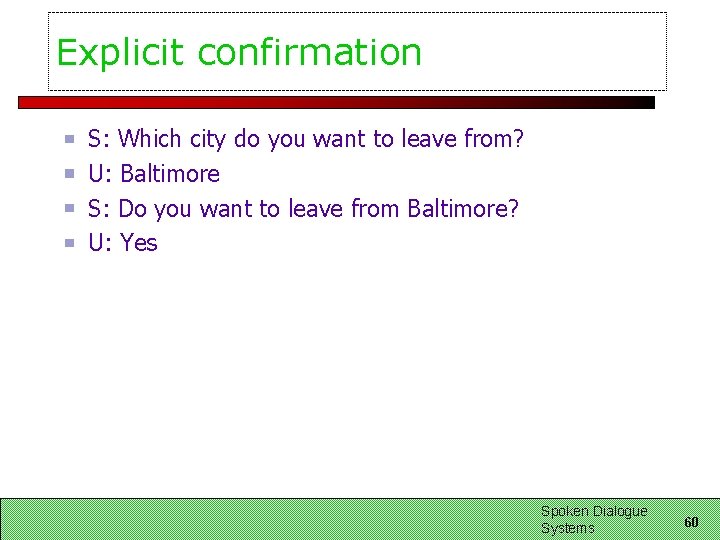
Explicit confirmation S: Which city do you want to leave from? U: Baltimore S: Do you want to leave from Baltimore? U: Yes Spoken Dialogue Systems 60
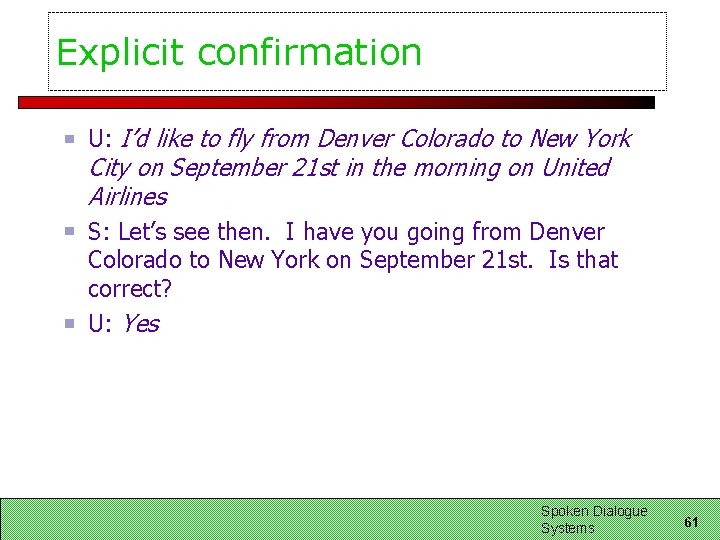
Explicit confirmation U: I’d like to fly from Denver Colorado to New York City on September 21 st in the morning on United Airlines S: Let’s see then. I have you going from Denver Colorado to New York on September 21 st. Is that correct? U: Yes Spoken Dialogue Systems 61
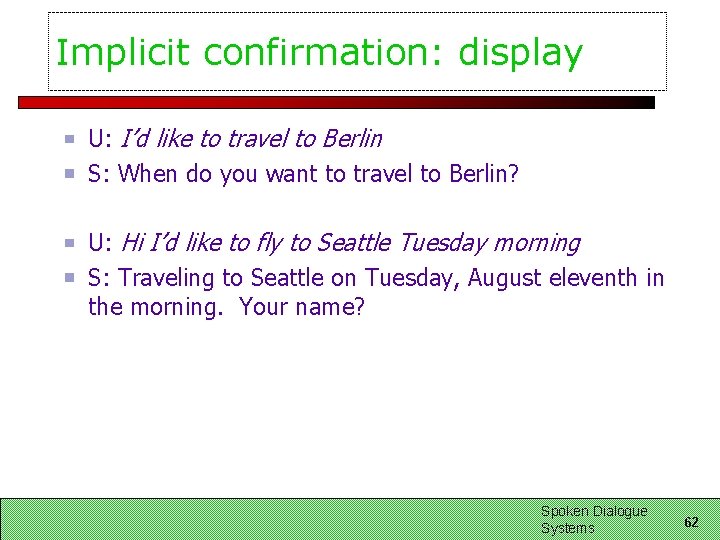
Implicit confirmation: display U: I’d like to travel to Berlin S: When do you want to travel to Berlin? U: Hi I’d like to fly to Seattle Tuesday morning S: Traveling to Seattle on Tuesday, August eleventh in the morning. Your name? Spoken Dialogue Systems 62
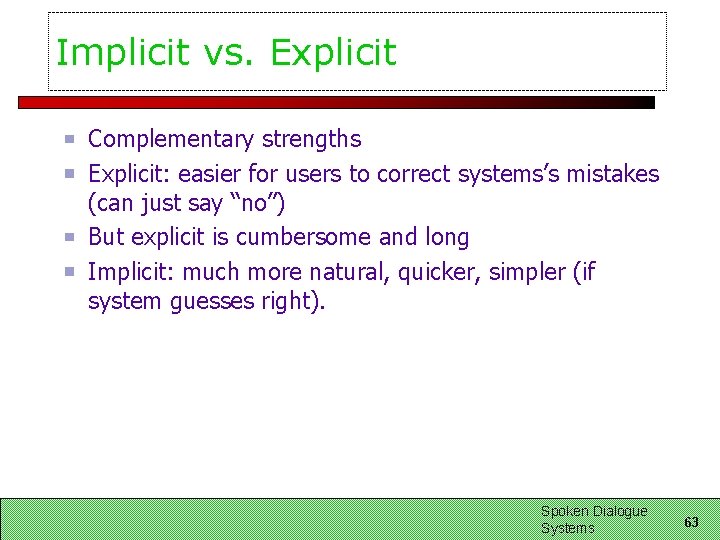
Implicit vs. Explicit Complementary strengths Explicit: easier for users to correct systems’s mistakes (can just say “no”) But explicit is cumbersome and long Implicit: much more natural, quicker, simpler (if system guesses right). Spoken Dialogue Systems 63
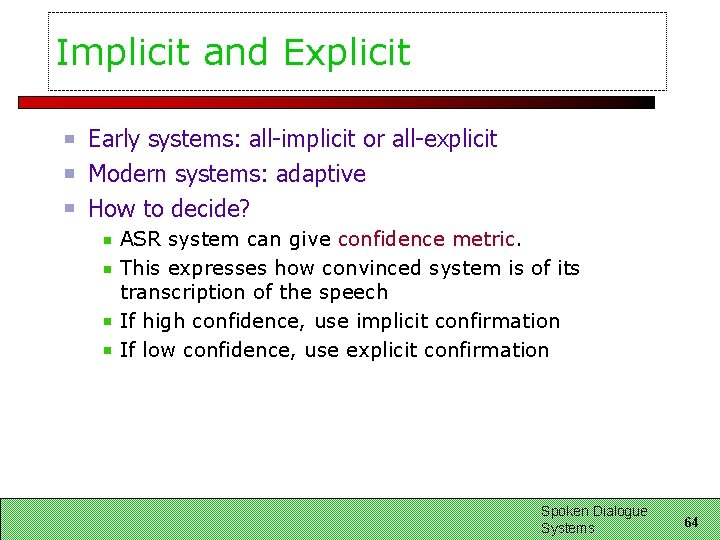
Implicit and Explicit Early systems: all-implicit or all-explicit Modern systems: adaptive How to decide? ASR system can give confidence metric. This expresses how convinced system is of its transcription of the speech If high confidence, use implicit confirmation If low confidence, use explicit confirmation Spoken Dialogue Systems 64
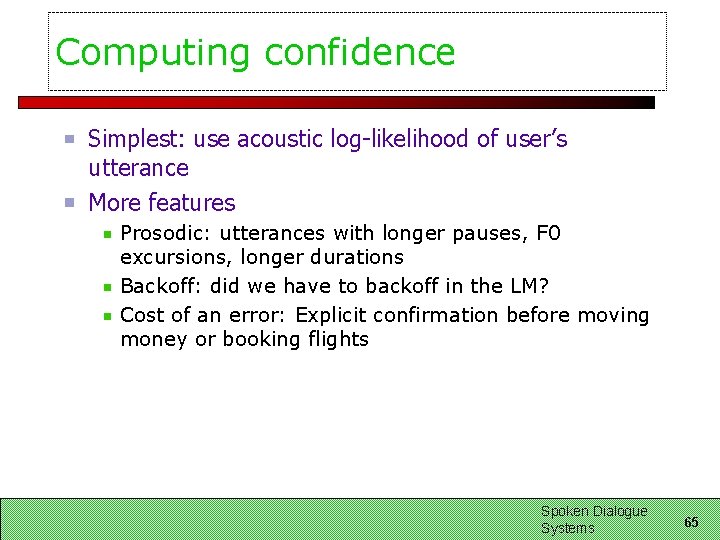
Computing confidence Simplest: use acoustic log-likelihood of user’s utterance More features Prosodic: utterances with longer pauses, F 0 excursions, longer durations Backoff: did we have to backoff in the LM? Cost of an error: Explicit confirmation before moving money or booking flights Spoken Dialogue Systems 65
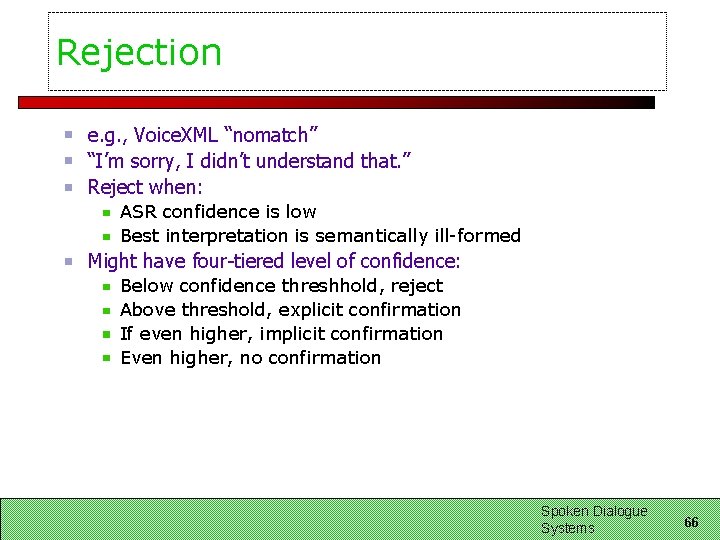
Rejection e. g. , Voice. XML “nomatch” “I’m sorry, I didn’t understand that. ” Reject when: ASR confidence is low Best interpretation is semantically ill-formed Might have four-tiered level of confidence: Below confidence threshhold, reject Above threshold, explicit confirmation If even higher, implicit confirmation Even higher, no confirmation Spoken Dialogue Systems 66