
Structure activity relationship SARof sympathomimetic amines Adrenergic antagonist



![Non-selective adrenergic receptor antagonists -Haloalkylamines ] Non-selective a receptor antagonist ] Also blocks acetylcholine,](https://slidetodoc.com/presentation_image_h/7dae24e05816f1b8b7d8afe674cc9494/image-19.jpg "Non-selective adrenergic receptor antagonists -Haloalkylamines ] Non-selective a receptor antagonist ] Also blocks acetylcholine,")
![Non-selective adrenergic receptor antagonists Imidazolines Phentolamine (Regitine) ] Non-selective a receptor antagonist ] Competitive](https://slidetodoc.com/presentation_image_h/7dae24e05816f1b8b7d8afe674cc9494/image-21.jpg "Non-selective adrenergic receptor antagonists Imidazolines Phentolamine (Regitine) ] Non-selective a receptor antagonist ] Competitive")



![Mixed adrenergic receptor antagonists Labetalol (Normodyne, Trandate) ] Non-selective receptor antagonist ] a 1](https://slidetodoc.com/presentation_image_h/7dae24e05816f1b8b7d8afe674cc9494/image-39.jpg "Mixed adrenergic receptor antagonists Labetalol (Normodyne, Trandate) ] Non-selective receptor antagonist ] a 1")
![Mixed adrenergic receptor antagonists Carvedilol (Coreg) ] Non-selective receptor antagonist ] a 1 receptor](https://slidetodoc.com/presentation_image_h/7dae24e05816f1b8b7d8afe674cc9494/image-40.jpg "Mixed adrenergic receptor antagonists Carvedilol (Coreg) ] Non-selective receptor antagonist ] a 1 receptor")


- Slides: 48
Structure activity relationship (SAR)of sympathomimetic amines, Adrenergic antagonist and Neurone blockers DR. ISHOLA I. O. PHARMACOLOGY, THERAPEUTICS AND TOXICOLOGY CMUL
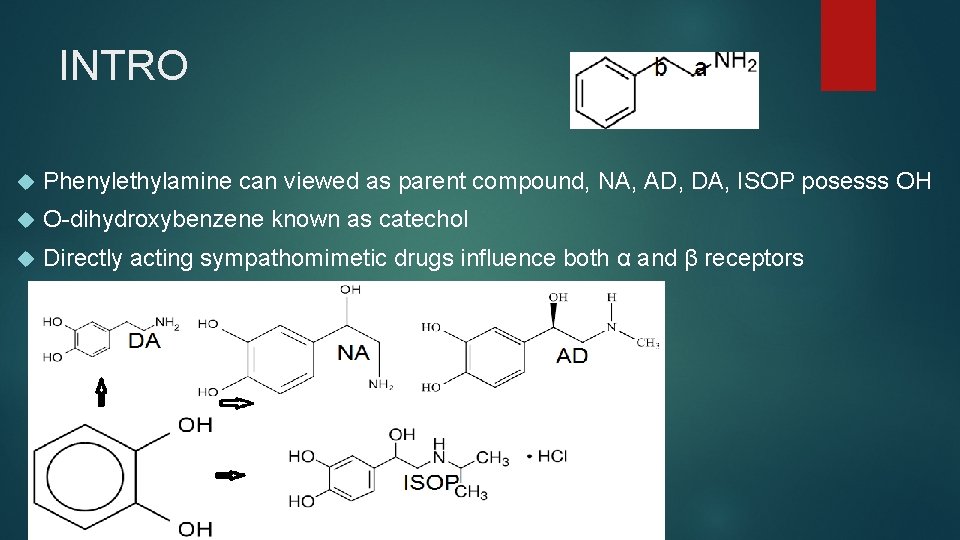
INTRO Phenylethylamine can viewed as parent compound, NA, AD, DA, ISOP posesss OH O-dihydroxybenzene known as catechol Directly acting sympathomimetic drugs influence both α and β receptors
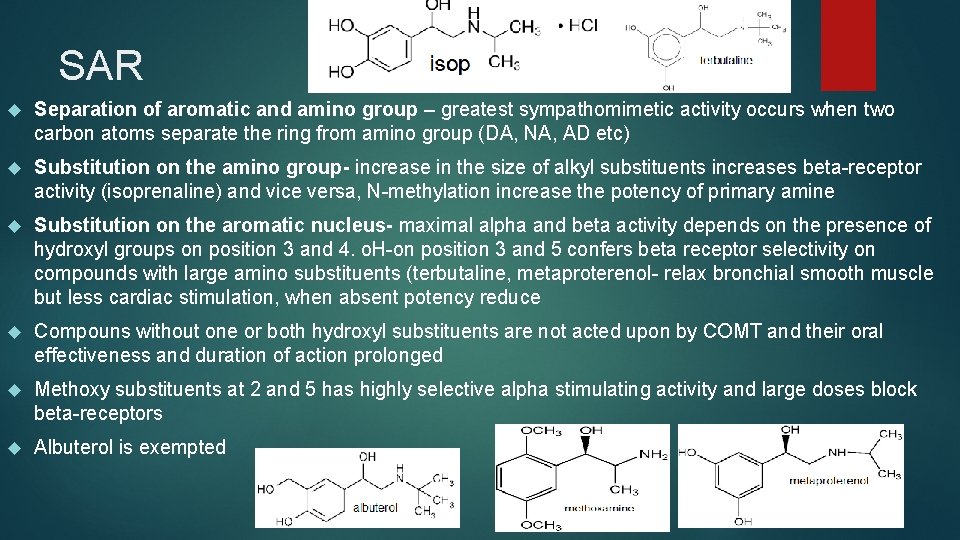
SAR Separation of aromatic and amino group – greatest sympathomimetic activity occurs when two carbon atoms separate the ring from amino group (DA, NA, AD etc) Substitution on the amino group- increase in the size of alkyl substituents increases beta-receptor activity (isoprenaline) and vice versa, N-methylation increase the potency of primary amine Substitution on the aromatic nucleus- maximal alpha and beta activity depends on the presence of hydroxyl groups on position 3 and 4. o. H-on position 3 and 5 confers beta receptor selectivity on compounds with large amino substituents (terbutaline, metaproterenol- relax bronchial smooth muscle but less cardiac stimulation, when absent potency reduce Compouns without one or both hydroxyl substituents are not acted upon by COMT and their oral effectiveness and duration of action prolonged Methoxy substituents at 2 and 5 has highly selective alpha stimulating activity and large doses block beta-receptors Albuterol is exempted
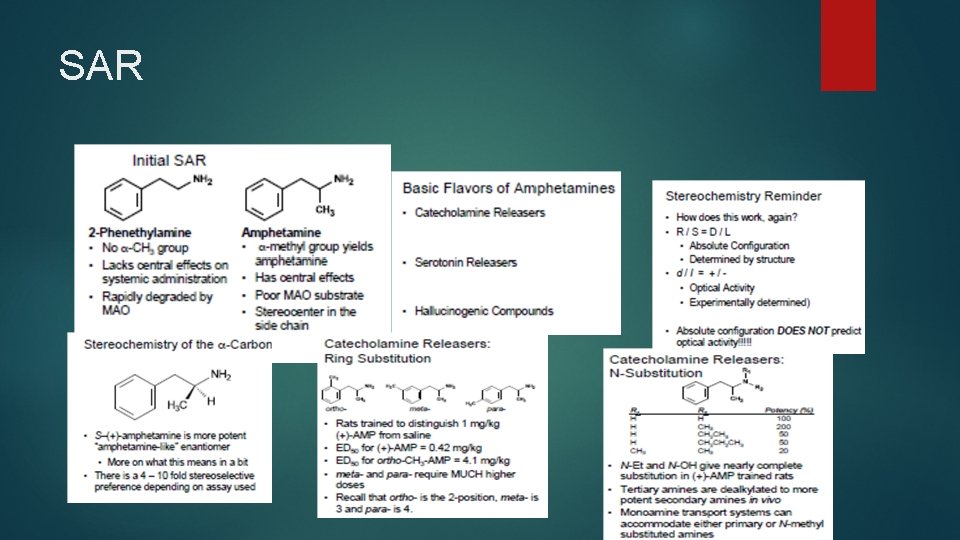
SAR Substitution on the alpha-carbon atom- this substitution block oxidation by MAO (EPHEDRINE OR AMPHETAMINE), thus prolonging the duration of action Substitution on the beta-carbon atom- Substitution of a hydroxyl group on the beta carbon generally decreases action within the CNS largely because it lowers lipid solubility but enhances agonist activity at both alpha and beta adrenergic receptor, ephedrine is less potent than methamphetamine as a central stimulant, it is more powerful in dilating bronchioles and increasing BP and HR Optical isomerism- substitution on either alpha or beta carbon yields optical isomers Levo-substitution on beta-carbon confers the greater peripheral activity; L-ADR and L-NA are 10 X AS POTENT as their unnatural D-isomers; D-sub on alpha = more potent compound- D-AMP more potent than L-amp in central but not peripheral
SAR
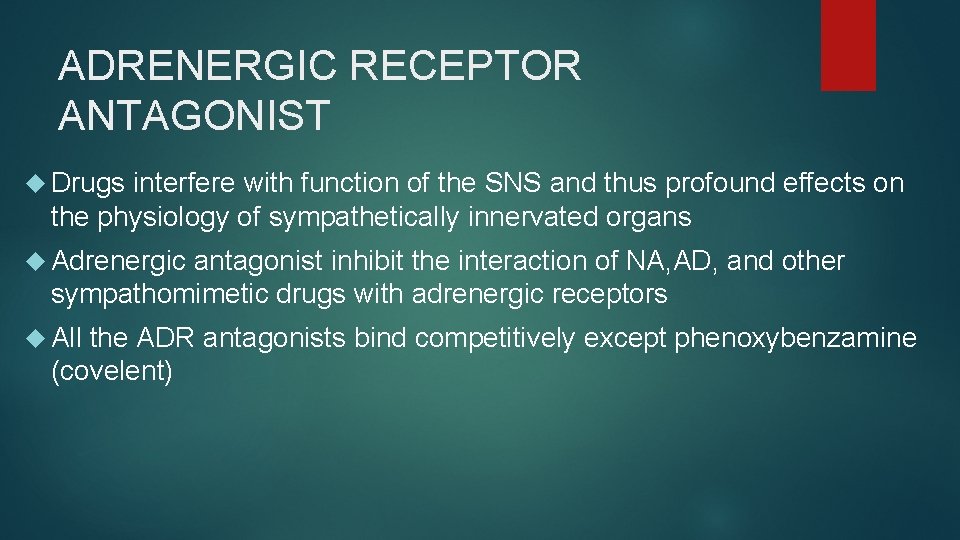
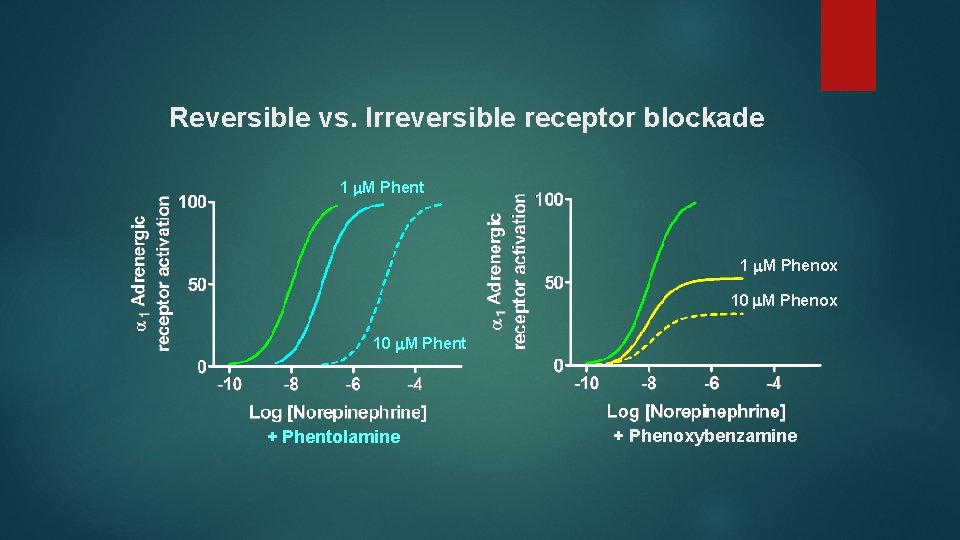
ADRENERGIC RECEPTOR ANTAGONIST Drugs interfere with function of the SNS and thus profound effects on the physiology of sympathetically innervated organs Adrenergic antagonist inhibit the interaction of NA, AD, and other sympathomimetic drugs with adrenergic receptors All the ADR antagonists bind competitively except phenoxybenzamine (covelent)
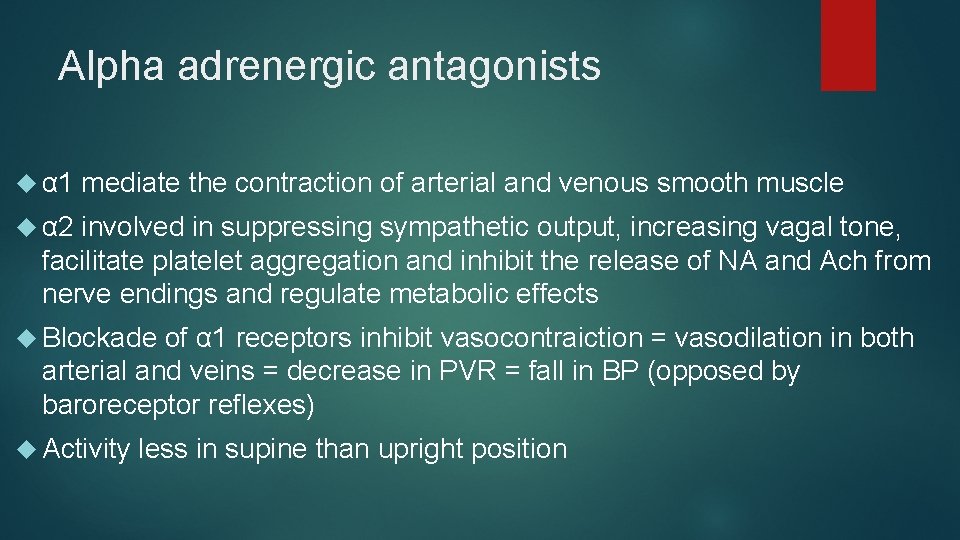
Alpha adrenergic antagonists α 1 mediate the contraction of arterial and venous smooth muscle α 2 involved in suppressing sympathetic output, increasing vagal tone, facilitate platelet aggregation and inhibit the release of NA and Ach from nerve endings and regulate metabolic effects Blockade of α 1 receptors inhibit vasocontraiction = vasodilation in both arterial and veins = decrease in PVR = fall in BP (opposed by baroreceptor reflexes) Activity less in supine than upright position
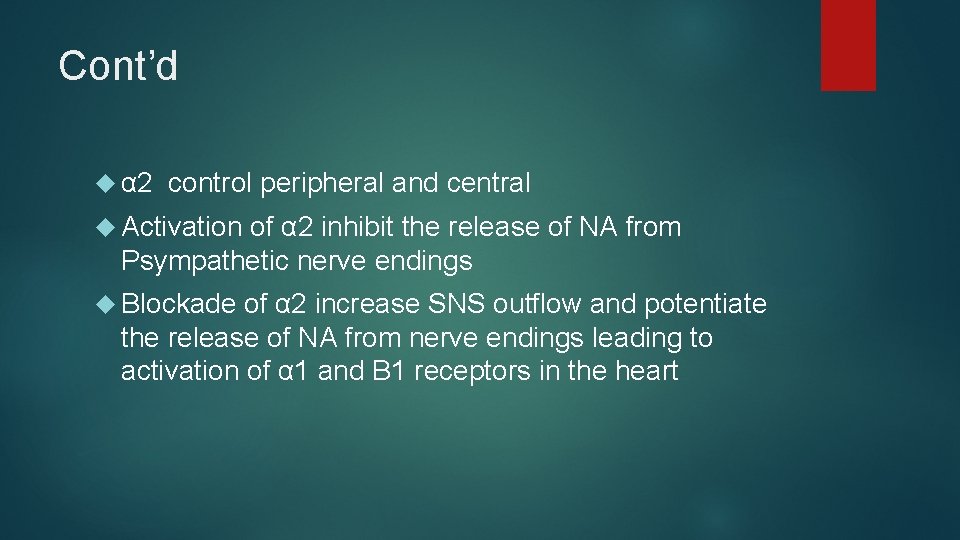
Cont’d α 2 control peripheral and central Activation of α 2 inhibit the release of NA from Psympathetic nerve endings Blockade of α 2 increase SNS outflow and potentiate the release of NA from nerve endings leading to activation of α 1 and B 1 receptors in the heart
Adrenergic receptor agonist/antagonist
Adrenergic agonist/antagonist
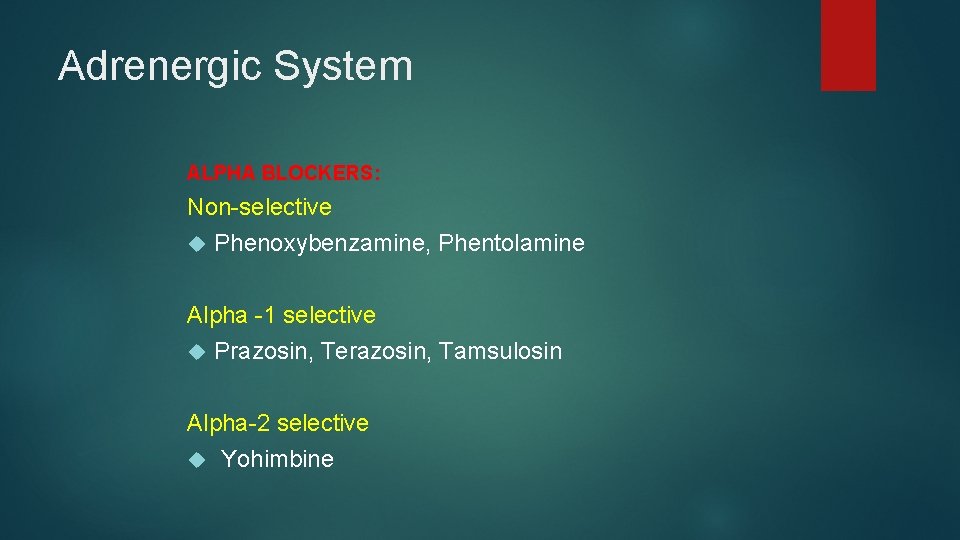
Adrenergic System ALPHA BLOCKERS: Non-selective Phenoxybenzamine, Phentolamine Alpha -1 selective Prazosin, Terazosin, Tamsulosin Alpha-2 selective Yohimbine
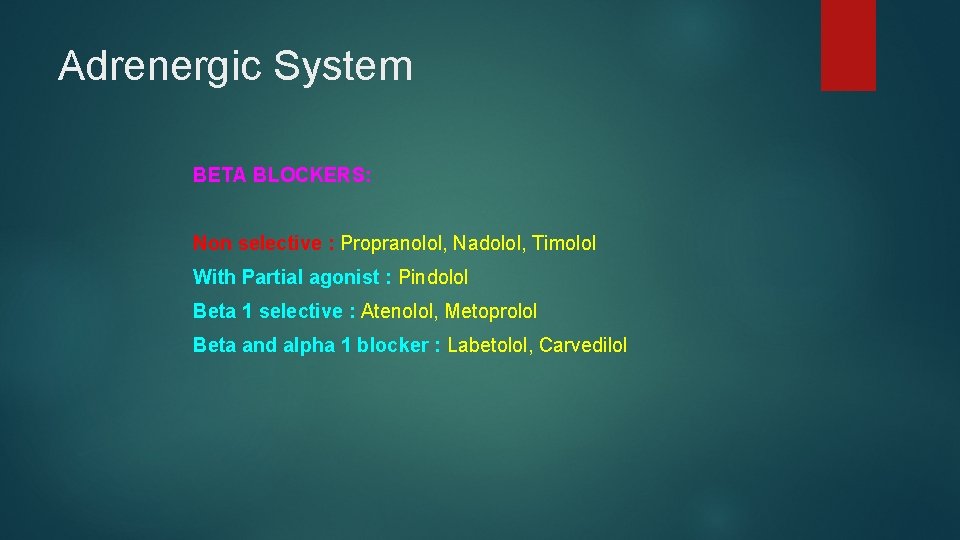
Adrenergic System BETA BLOCKERS: Non selective : Propranolol, Nadolol, Timolol With Partial agonist : Pindolol Beta 1 selective : Atenolol, Metoprolol Beta and alpha 1 blocker : Labetolol, Carvedilol
Sympatholytic pharmacology Selective vs. Non-selective Antagonist vs. Partial Agonist Reversible vs. Irreversible
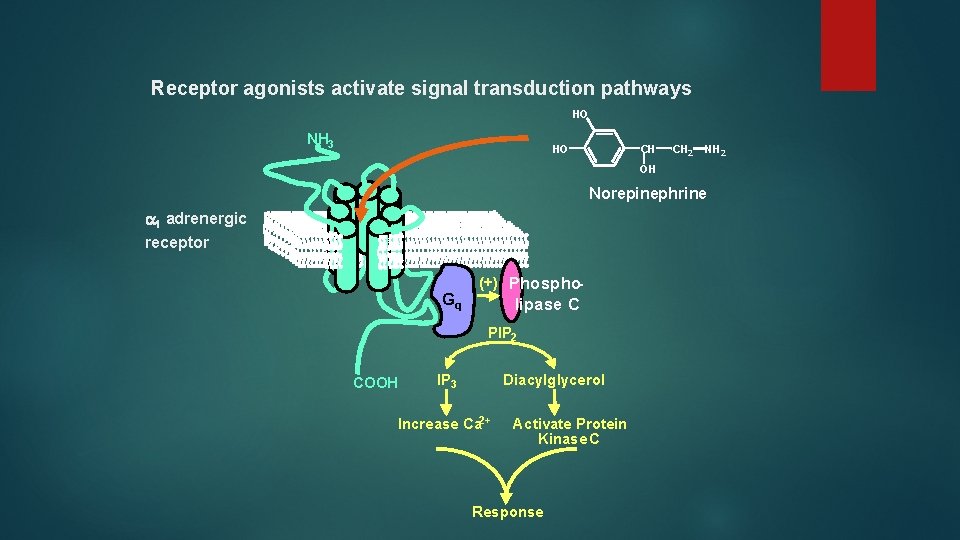
Receptor agonists activate signal transduction pathways HO NH 3 HO CH CH 2 NH 2 OH Norepinephrine a 1 adrenergic receptor Gq (+) Phospho- lipase C PIP 2 COOH IP 3 Diacylglycerol Increase Ca 2+ Activate Protein Kinase C Response
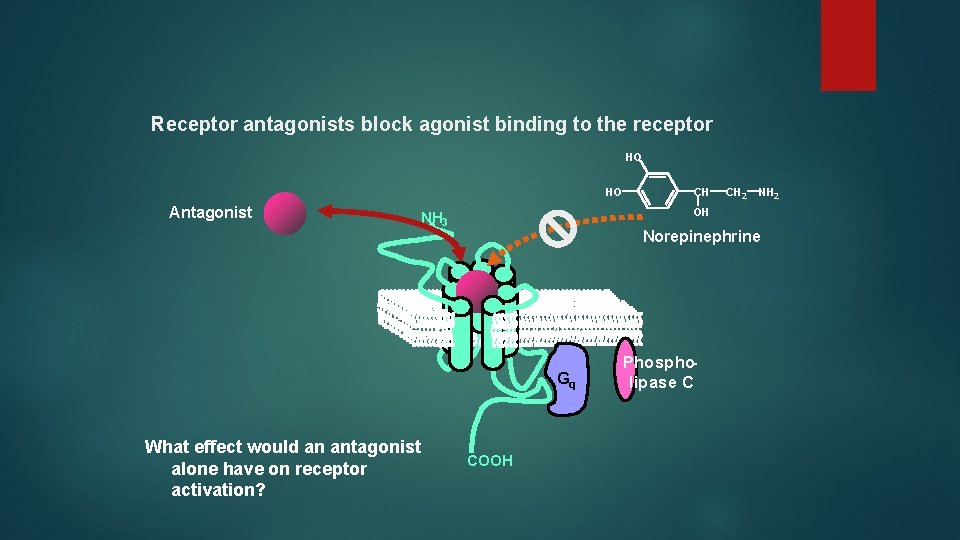
Receptor antagonists block agonist binding to the receptor HO HO Antagonist CH 2 NH 2 OH NH 3 Norepinephrine Gq What effect would an antagonist alone have on receptor activation? CH COOH Phospholipase C
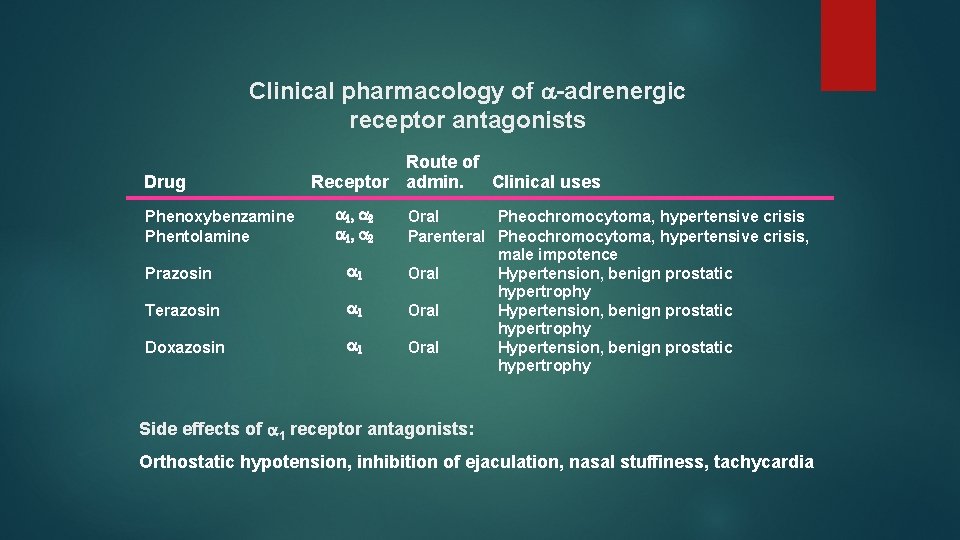
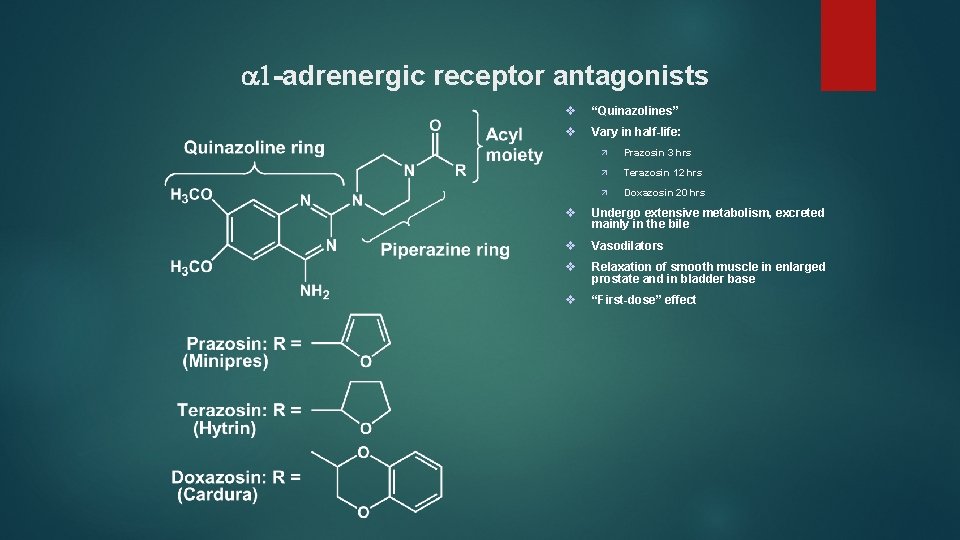
Clinical pharmacology of a-adrenergic receptor antagonists Drug Phenoxybenzamine Phentolamine Route of Receptor admin. Clinical uses a 1, a 2 Prazosin a 1 Terazosin a 1 Doxazosin a 1 Oral Pheochromocytoma, hypertensive crisis Parenteral Pheochromocytoma, hypertensive crisis, male impotence Oral Hypertension, benign prostatic hypertrophy Side effects of a 1 receptor antagonists: Orthostatic hypotension, inhibition of ejaculation, nasal stuffiness, tachycardia
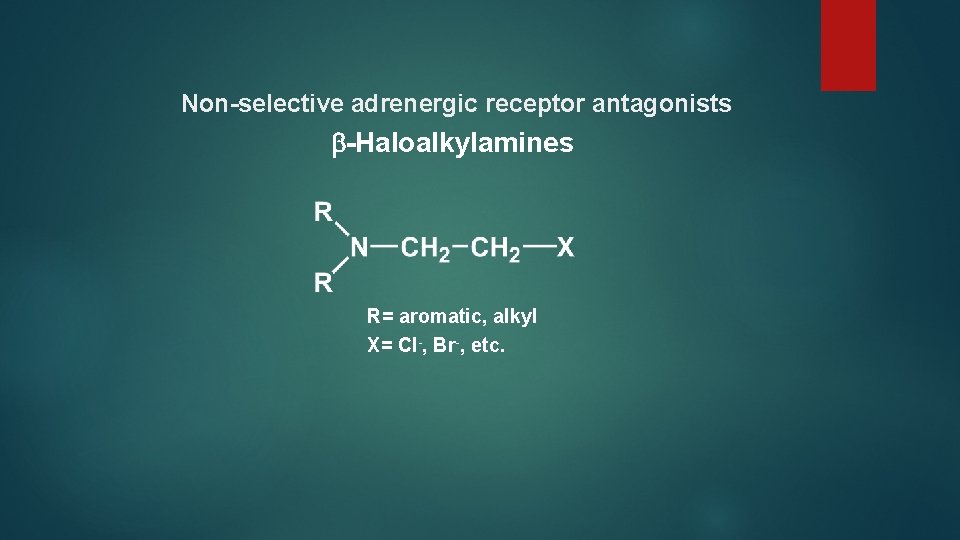
Non-selective adrenergic receptor antagonists -Haloalkylamines R= aromatic, alkyl X= Cl-, Br-, etc.
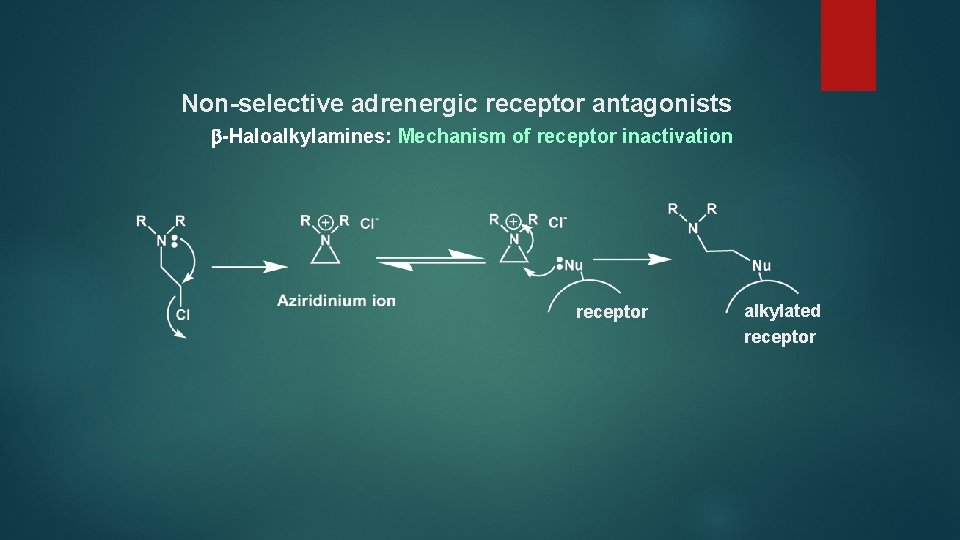
Non-selective adrenergic receptor antagonists -Haloalkylamines ] Non-selective a receptor antagonist ] Also blocks acetylcholine, histamine, and serotonin receptors ] Irreversible antagonist resulting from covalent modification of receptor Phenoxybenzamine (Dibenzyline)
Non-selective adrenergic receptor antagonists -Haloalkylamines: Mechanism of receptor inactivation receptor alkylated receptor
Non-selective adrenergic receptor antagonists Imidazolines Phentolamine (Regitine) ] Non-selective a receptor antagonist ] Competitive (reversible) blocker ] Potent vasodilator, but induces pronouced reflex tachycardia ] Block of presynaptic a 2 receptors may promote release of NE ] Also blocks 5 -HT receptors, and is a muscarinic and histamine receptor agonist
Reversible vs. Irreversible receptor blockade 1 M Phent 1 M Phenox 10 M Phent + Phentolamine + Phenoxybenzamine
a 1 -adrenergic receptor antagonists v “Quinazolines” v Vary in half-life: ä Prazosin 3 hrs ä Terazosin 12 hrs ä Doxazosin 20 hrs v Undergo extensive metabolism, excreted mainly in the bile v Vasodilators v Relaxation of smooth muscle in enlarged prostate and in bladder base v “First-dose” effect
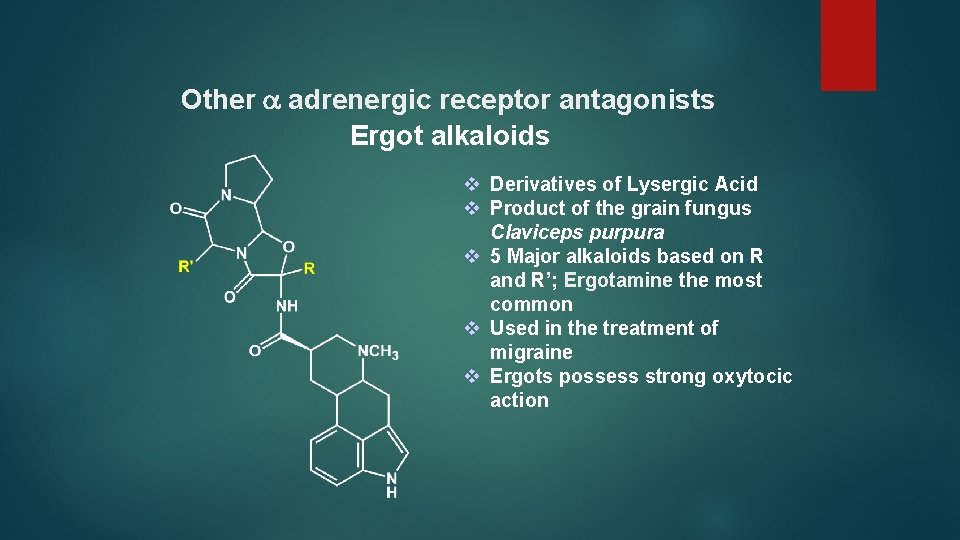
Other a adrenergic receptor antagonists Ergot alkaloids v Derivatives of Lysergic Acid v Product of the grain fungus Claviceps purpura v 5 Major alkaloids based on R and R’; Ergotamine the most common v Used in the treatment of migraine v Ergots possess strong oxytocic action
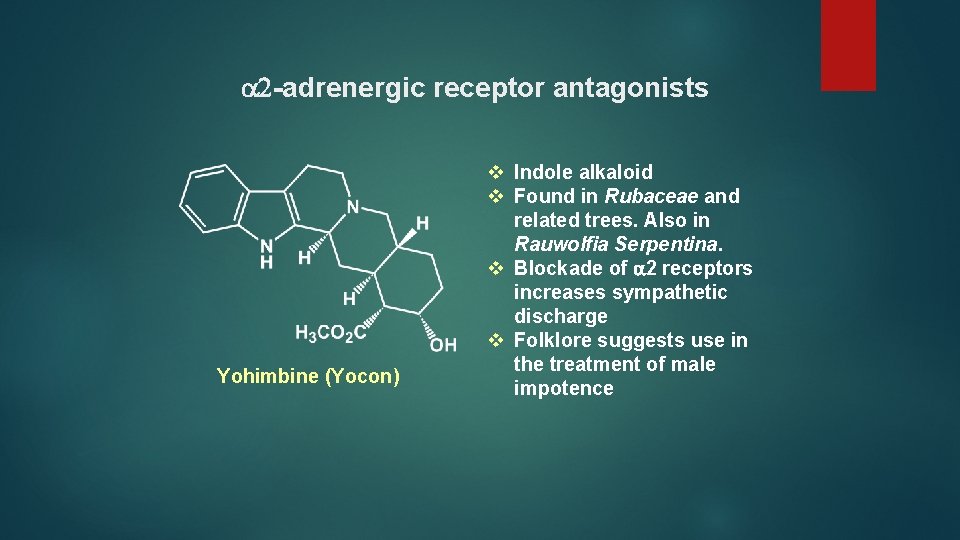
a 2 -adrenergic receptor antagonists Yohimbine (Yocon) v Indole alkaloid v Found in Rubaceae and related trees. Also in Rauwolfia Serpentina. v Blockade of a 2 receptors increases sympathetic discharge v Folklore suggests use in the treatment of male impotence
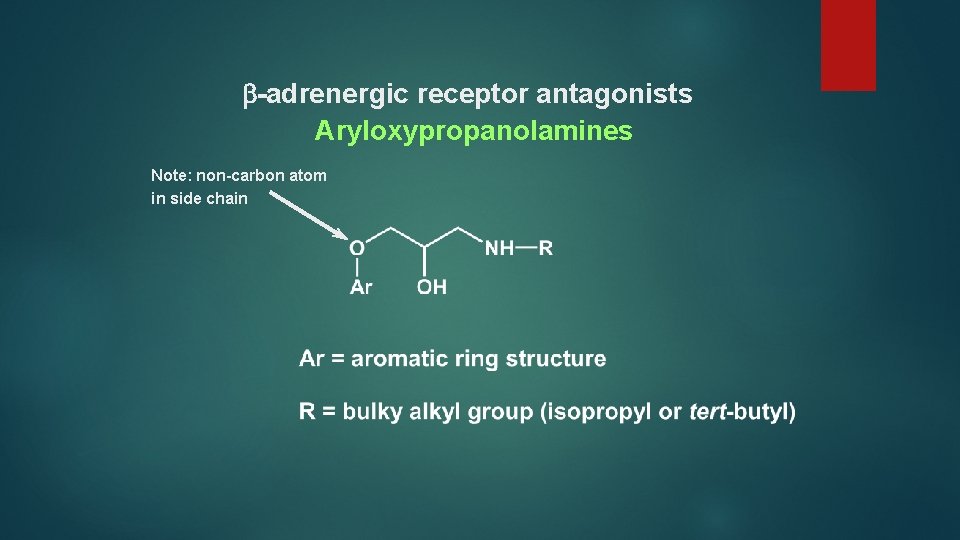
-adrenergic receptor antagonists Aryloxypropanolamines Note: non-carbon atom in side chain
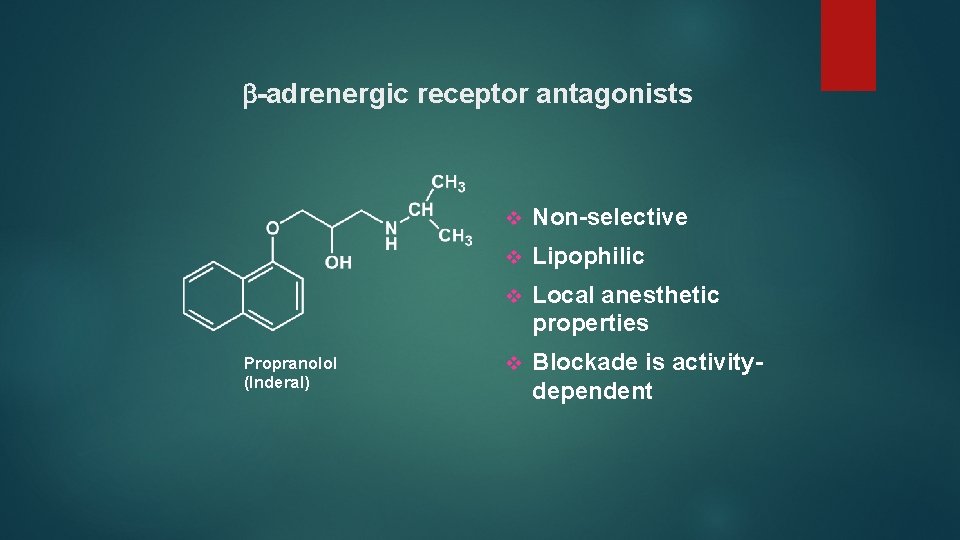
-adrenergic receptor antagonists Propranolol (Inderal) v Non-selective v Lipophilic v Local anesthetic properties v Blockade is activitydependent
-adrenergic receptor antagonists Pharmacological effects Propranolol (Inderal) Decreased cardiac output and heart rate Reduced renin release Increase VLDL, Decrease HDL Inhibit lipolysis Inhibit compensatory glycogenolysis and glucose release in response to hypoglycemia Increase bronchial airway resistance Therapeutic uses for -adrenergic receptor antagonists: Hypertension, angina, cardiac arrhythmias, migraine, stage fright, thyrotoxicosis, glaucoma, congestive heart failure (types II and III)
Non-selective -adrenergic receptor antagonists Nadolol (Corgard) Timolol (Timoptic, Blocadren) Less lipophilic than propranolol Long half-life: ~20 hours Mostly excreted unchanged in urine Administered: Oral Uses: Hypertension, angina, migraine Thiadiazole nucleus with morpholine ring Administered: Oral, Ophthalmic Uses: Hypertension, angina, migraine, glaucoma How will -blockers affect pupil size?
Non-selective -adrenergic receptor antagonists Pindolol (Visken) Possesses “Intrinsic sympathomimetic activity (ISA) Partial agonist Less likely to cause bradycardia and lipid abnormalities Administered: Oral Uses: Hypertension, angina, migraine What would a pindolol dose-response curve look like?
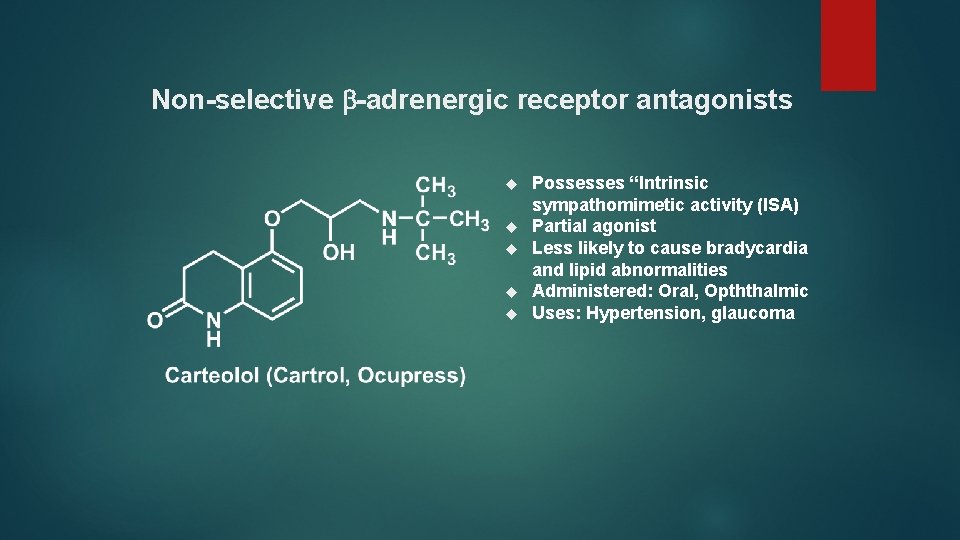
Non-selective -adrenergic receptor antagonists Possesses “Intrinsic sympathomimetic activity (ISA) Partial agonist Less likely to cause bradycardia and lipid abnormalities Administered: Oral, Opththalmic Uses: Hypertension, glaucoma
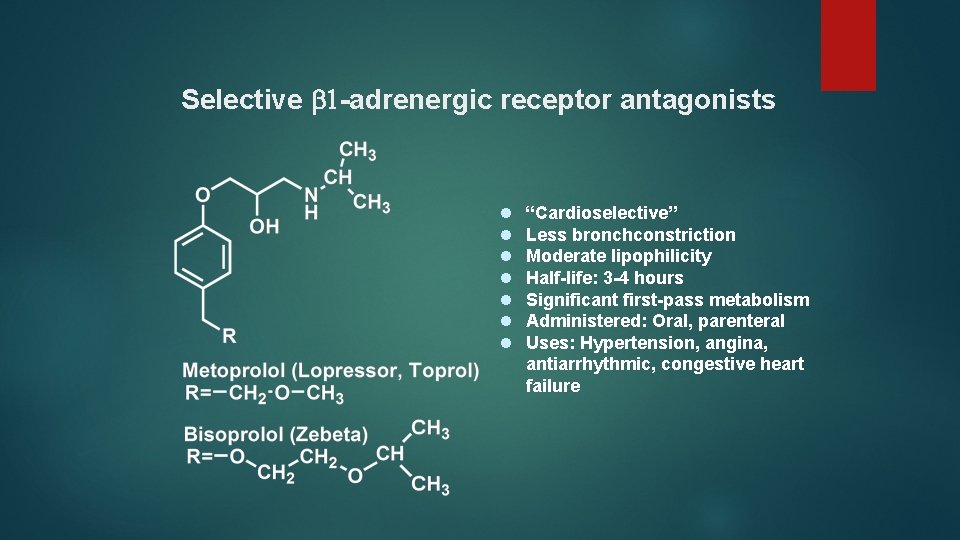
Selective 1 -adrenergic receptor antagonists l l l l “Cardioselective” Less bronchconstriction Moderate lipophilicity Half-life: 3 -4 hours Significant first-pass metabolism Administered: Oral, parenteral Uses: Hypertension, angina, antiarrhythmic, congestive heart failure
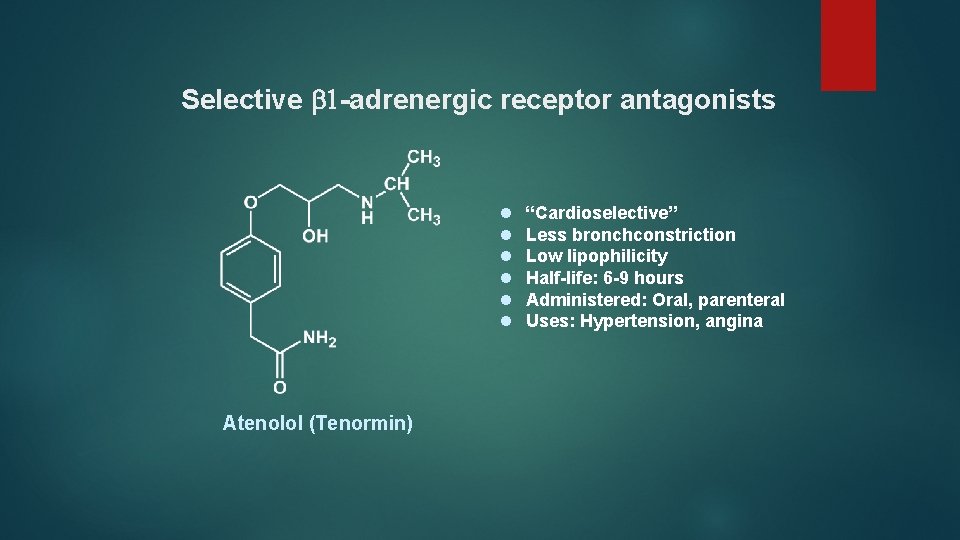
Selective 1 -adrenergic receptor antagonists l l l Atenolol (Tenormin) “Cardioselective” Less bronchconstriction Low lipophilicity Half-life: 6 -9 hours Administered: Oral, parenteral Uses: Hypertension, angina
Selective 1 -adrenergic receptor antagonists Esmolol (Brevibloc) l Very short acting l Half-life: 9 minutes l Rapid hydrolysis by esterases found in red blood cells l Administered: Parenteral Note: incompatible with sodium bicarbonate l Uses: Supraventricular tachycardia, atrial fibrillation/flutter, perioperative hypertension
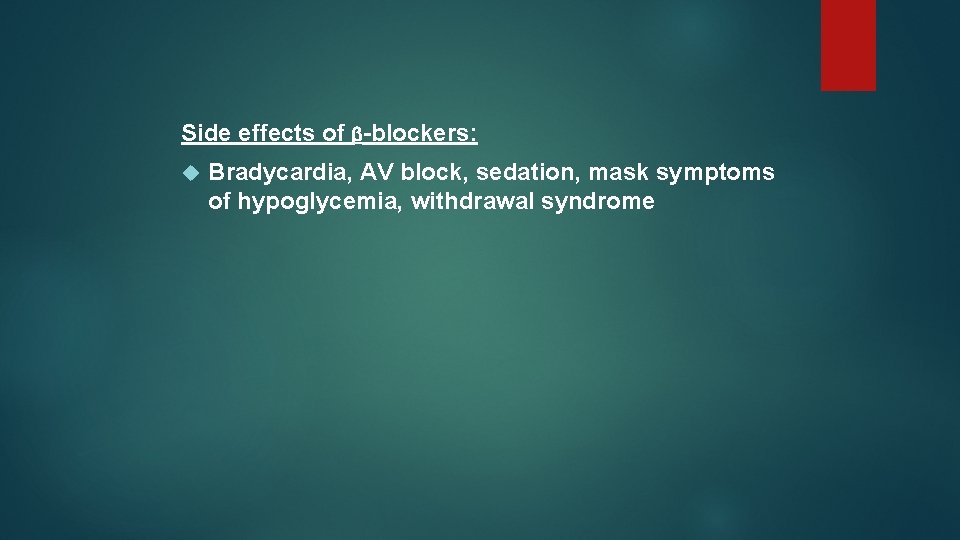
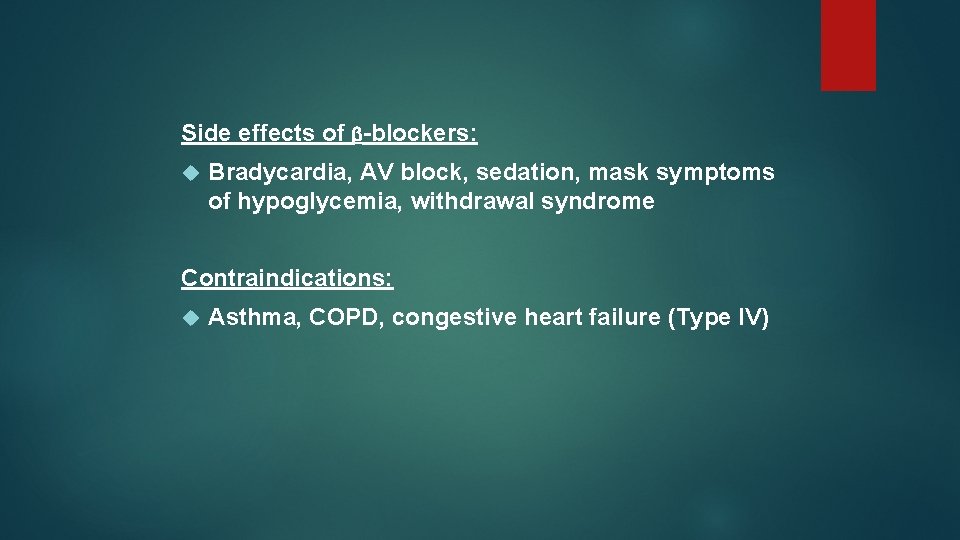
Side effects of -blockers: Bradycardia, AV block, sedation, mask symptoms of hypoglycemia, withdrawal syndrome
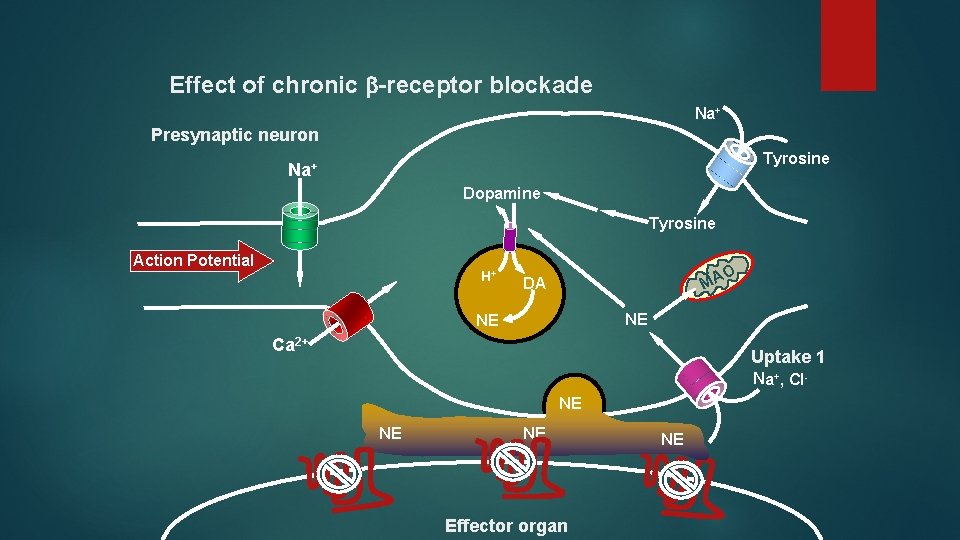
Effect of chronic -receptor blockade Na+ Presynaptic neuron Tyrosine Na+ Dopamine Tyrosine Action Potential H+ O MA DA NE NE Ca 2+ Uptake 1 Na+, Cl. NE NE NE Effector organ NE
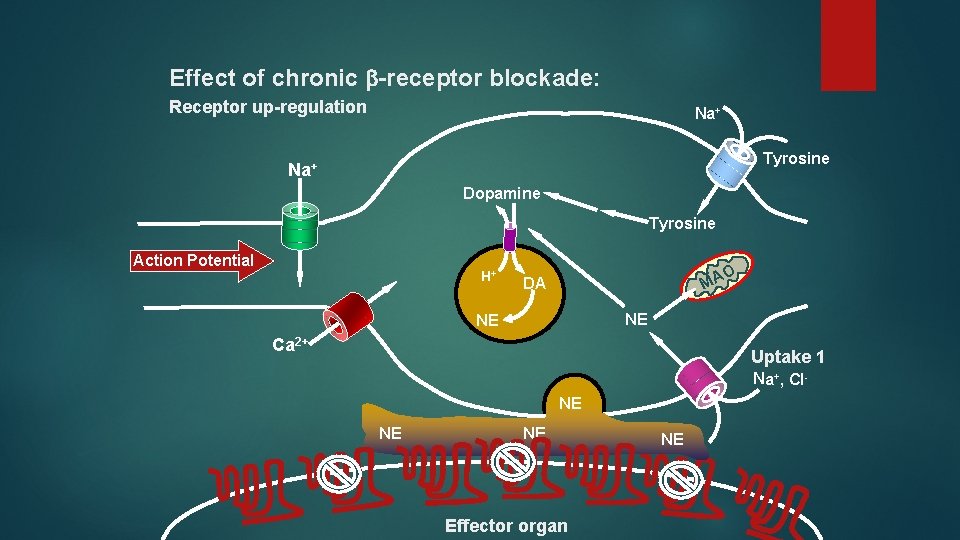
Effect of chronic -receptor blockade: Receptor up-regulation Na+ Tyrosine Na+ Dopamine Tyrosine Action Potential H+ O MA DA NE NE Ca 2+ Uptake 1 Na+, Cl. NE NE NE Effector organ NE
Side effects of -blockers: Bradycardia, AV block, sedation, mask symptoms of hypoglycemia, withdrawal syndrome Contraindications: Asthma, COPD, congestive heart failure (Type IV)
Mixed adrenergic receptor antagonists Labetalol (Normodyne, Trandate) ] Non-selective receptor antagonist ] a 1 receptor antagonist ] Two asymmetric carbons (1 and 1’) ] (1 R, 1’R)-isomer possesses blocking activity ] (1 S, 1’R)-isomer possesses greatest a 1 receptor blocking activity ] -blocking activity prevents reflex tachycardia normally associated with a 1 receptor antagonists ] Administered: Oral, parenteral ] Uses: Hypertension, hypertensive crisis
Mixed adrenergic receptor antagonists Carvedilol (Coreg) ] Non-selective receptor antagonist ] a 1 receptor antagonist ] Both enantiomers antagonize a 1 receptors ] Only (S)-enantiomer possesses blocking activity ] -blocking activity prevents reflex tachycardia normally associated with a 1 receptor antagonists ] Administered: Oral ] Uses: Hypertension, congestive heart failure (Types II and III)
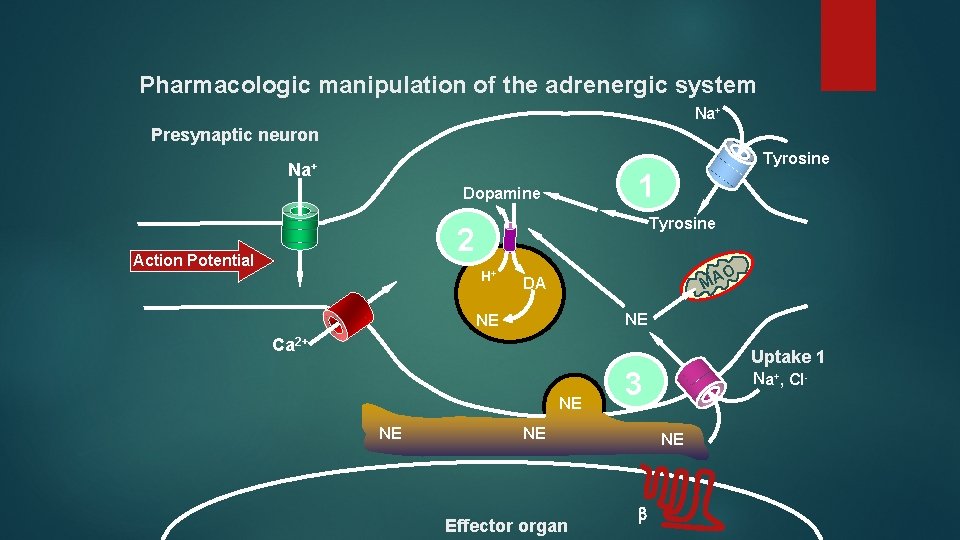
Pharmacologic manipulation of the adrenergic system Na+ Presynaptic neuron Tyrosine Na+ 1 Dopamine Tyrosine 2 Action Potential H+ O MA DA NE NE Ca 2+ NE NE 3 NE Effector organ Uptake 1 Na+, Cl- NE
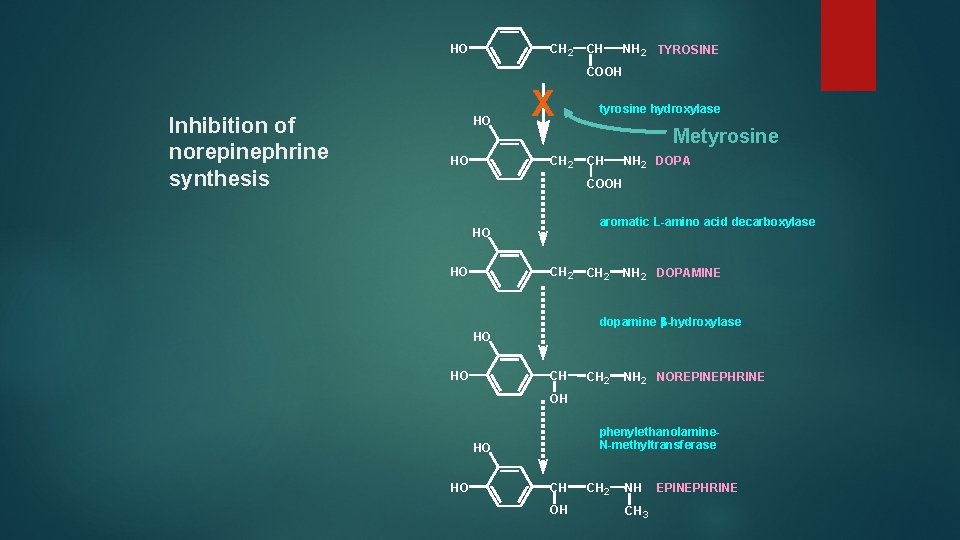
HO CH 2 CH NH 2 TYROSINE COOH Inhibition of norepinephrine synthesis HO HO X tyrosine hydroxylase Metyrosine CH 2 CH NH 2 DOPA COOH aromatic L-amino acid decarboxylase HO HO CH 2 NH 2 DOPAMINE dopamine -hydroxylase HO HO CH CH 2 NOREPINEPHRINE OH phenylethanolamine. N-methyltransferase HO HO CH OH CH 2 NH CH 3 EPINEPHRINE
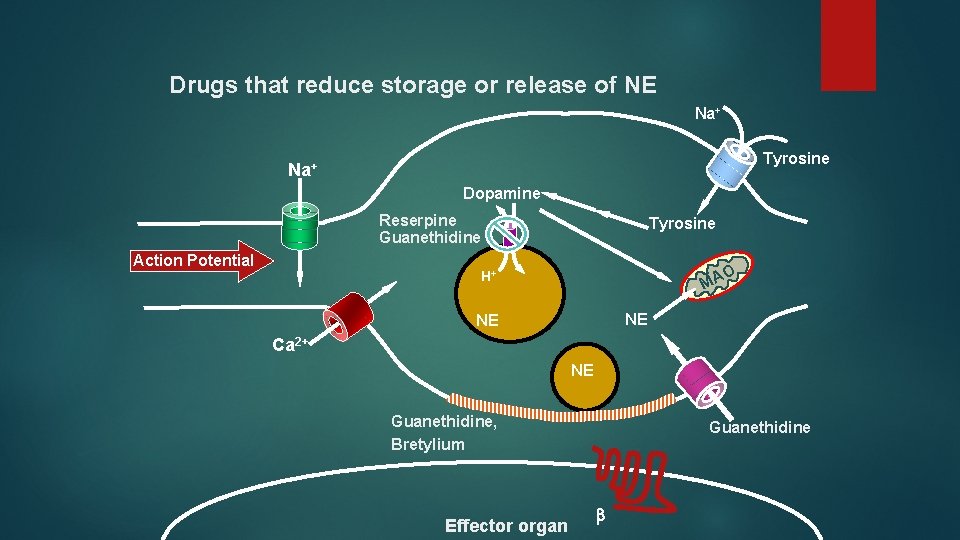
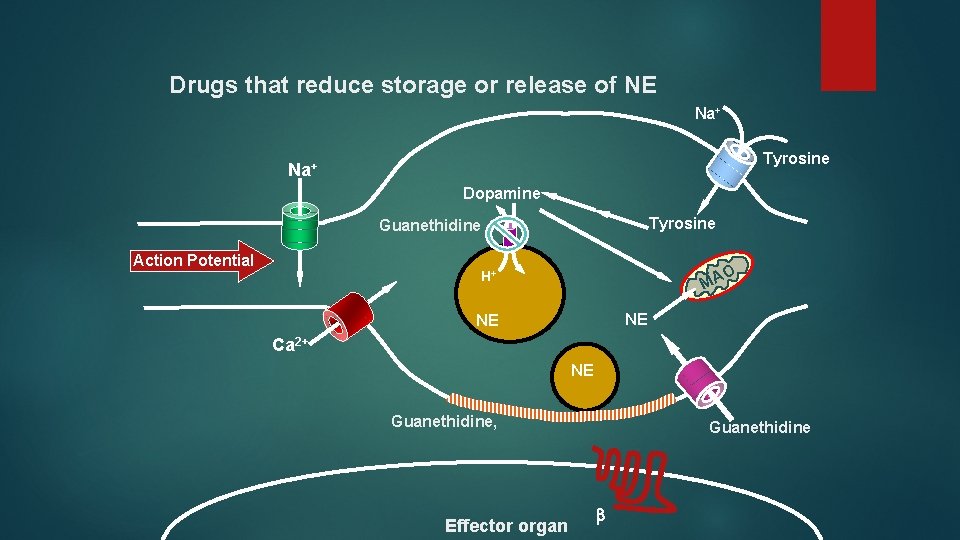
Drugs that reduce storage or release of NE Na+ Tyrosine Na+ Dopamine Reserpine Guanethidine Action Potential Tyrosine O H+ MA NE NE Ca 2+ NE Guanethidine, Bretylium Effector organ Guanethidine
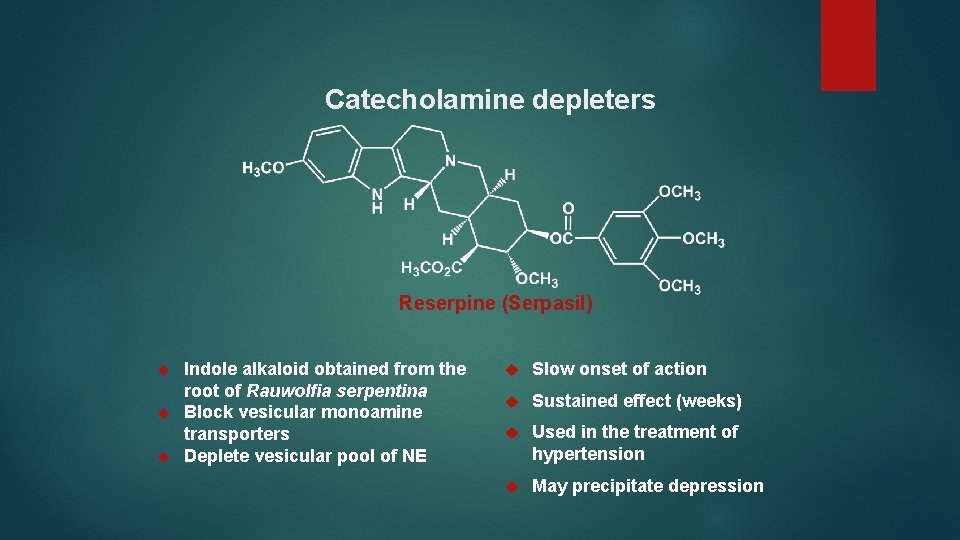
Catecholamine depleters Reserpine (Serpasil) Indole alkaloid obtained from the root of Rauwolfia serpentina Block vesicular monoamine transporters Deplete vesicular pool of NE Slow onset of action Sustained effect (weeks) Used in the treatment of hypertension May precipitate depression
Drugs that reduce storage or release of NE Guanethidine (Ismelin) Possess guanidino moiety (p. Ka > 12) Resonance stabilization of cation “spreads” positive charge over the entire four atom system Almost completely protonated at physiological p. H “Pharmacologic sympathectomy” Effects can be blocked by transport blockers Uses: Hypertension
Drugs that reduce storage or release of NE Na+ Tyrosine Na+ Dopamine Tyrosine Guanethidine Action Potential O H+ MA NE NE Ca 2+ NE Guanethidine, Effector organ Guanethidine
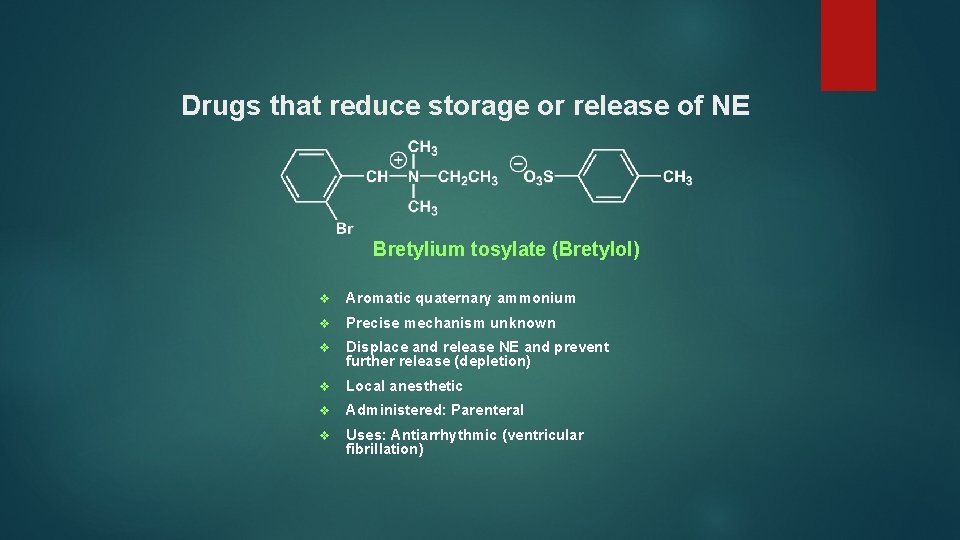
Drugs that reduce storage or release of NE Bretylium tosylate (Bretylol) v Aromatic quaternary ammonium v Precise mechanism unknown v Displace and release NE and prevent further release (depletion) v Local anesthetic v Administered: Parenteral v Uses: Antiarrhythmic (ventricular fibrillation)
OBRIGADO