
EstimationActionReflection Towards Deep Interaction Between Conversational and Recommender

Estimation–Action–Reflection: Towards Deep Interaction Between Conversational and Recommender Systems Wenqiang Lei, Xiangnan He, Yisong Miao, Qingyun Wu, Richang Hong, Min-Yen Kan, Tat-Seng Chua {wenqianglei, xiangnanhe}@gmail. com (they planned to be here) WSDM’ 2020 Houston Feb’ 04 USA 1
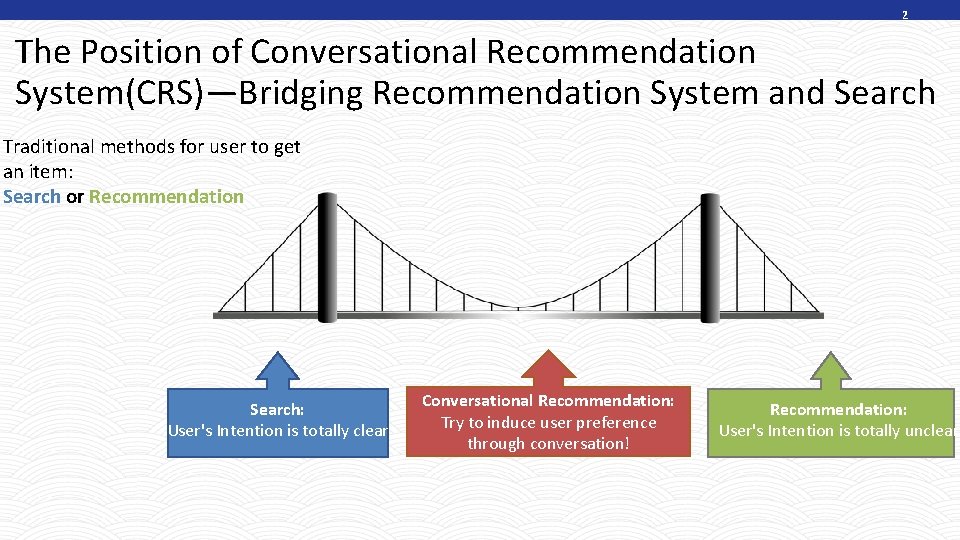
2 The Position of Conversational Recommendation System(CRS)—Bridging Recommendation System and Search Traditional methods for user to get an item: Search or Recommendation Search: User's Intention is totally clear Conversational Recommendation: Try to induce user preference through conversation! Recommendation: User's Intention is totally unclear
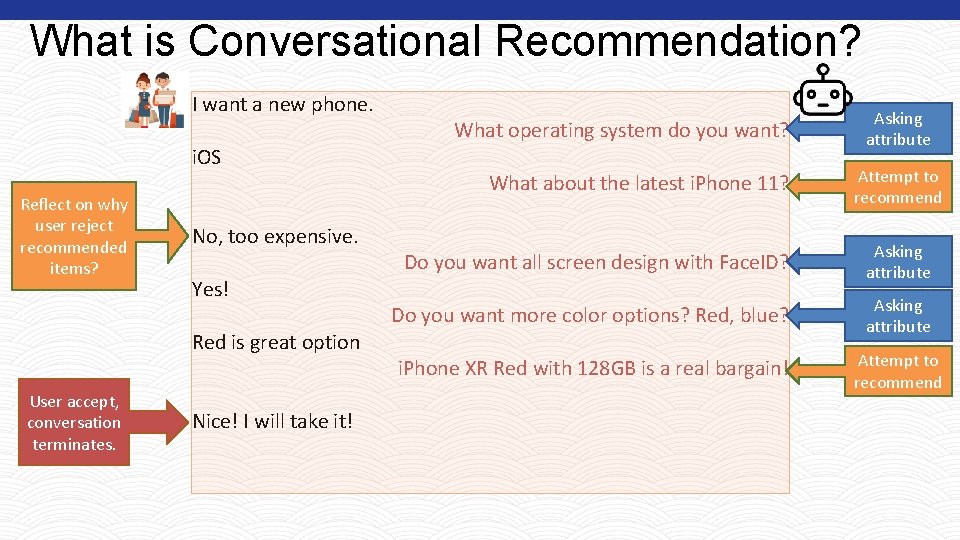
What is Conversational Recommendation? I want a new phone. i. OS Reflect on why user reject recommended items? No, too expensive. Yes! Red is great option User accept, conversation terminates. What operating system do you want? What about the latest i. Phone 11? Asking attribute Attempt to recommend Do you want all screen design with Face. ID? Asking attribute Do you want more color options? Red, blue? Asking attribute i. Phone XR Red with 128 GB is a real bargain! Attempt to recommend Nice! I will take it! 3
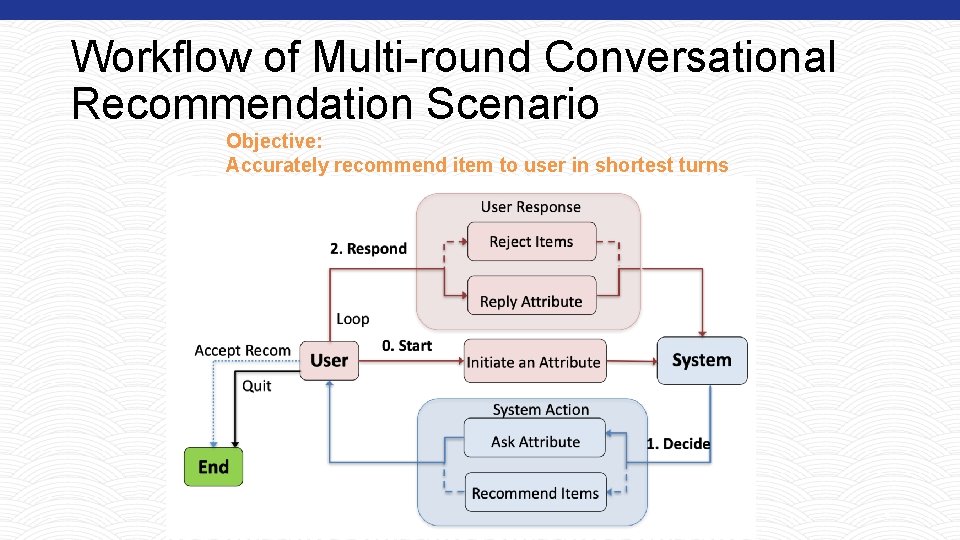
Workflow of Multi-round Conversational Recommendation Scenario Objective: Accurately recommend item to user in shortest turns 4
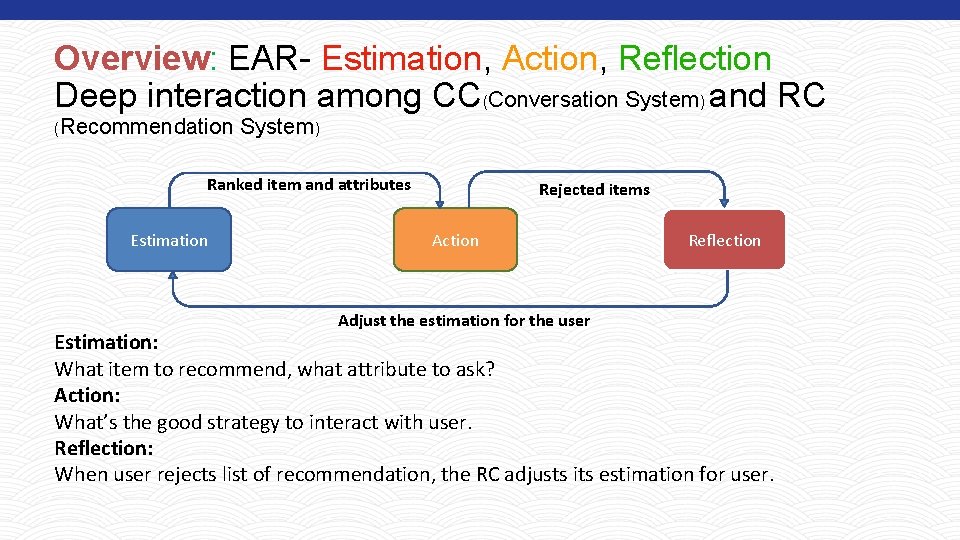
Overview: EAR- Estimation, Action, Reflection Deep interaction among CC(Conversation System) and RC (Recommendation System) Ranked item and attributes Estimation Rejected items Action Reflection Adjust the estimation for the user Estimation: What item to recommend, what attribute to ask? Action: What’s the good strategy to interact with user. Reflection: When user rejects list of recommendation, the RC adjusts its estimation for user. 5
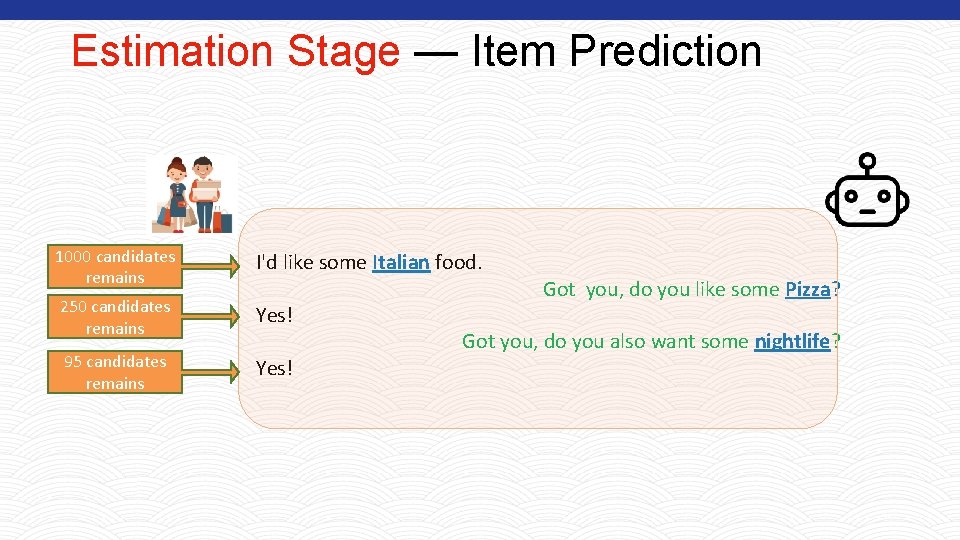
Estimation Stage — Item Prediction 1000 candidates remains I'd like some Italian food. 250 candidates remains Yes! 95 candidates remains Yes! Got you, do you like some Pizza? Got you, do you also want some nightlife? 6
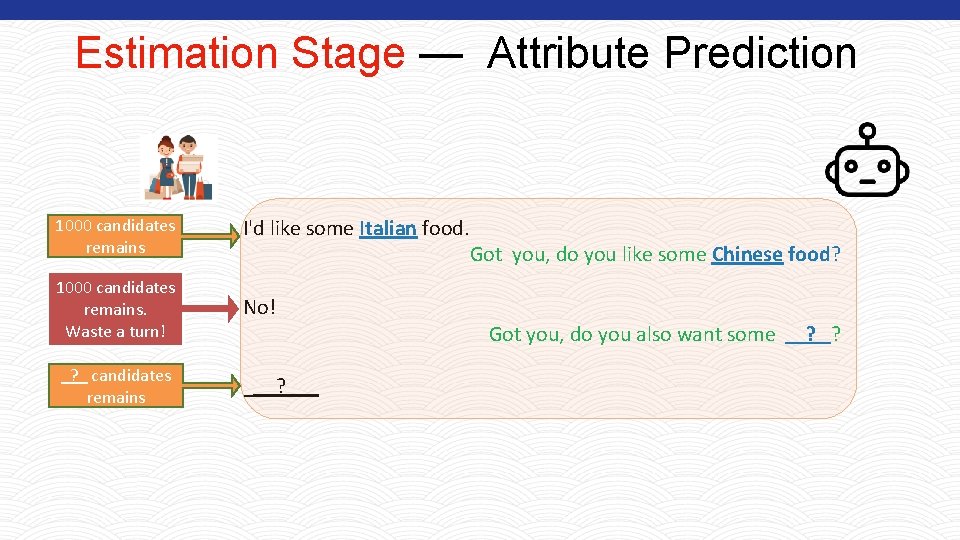
Estimation Stage — Attribute Prediction 1000 candidates remains I'd like some Italian food. 1000 candidates remains. Waste a turn! No! _? _ candidates remains ___? ___ Got you, do you like some Chinese food? Got you, do you also want some ? ?
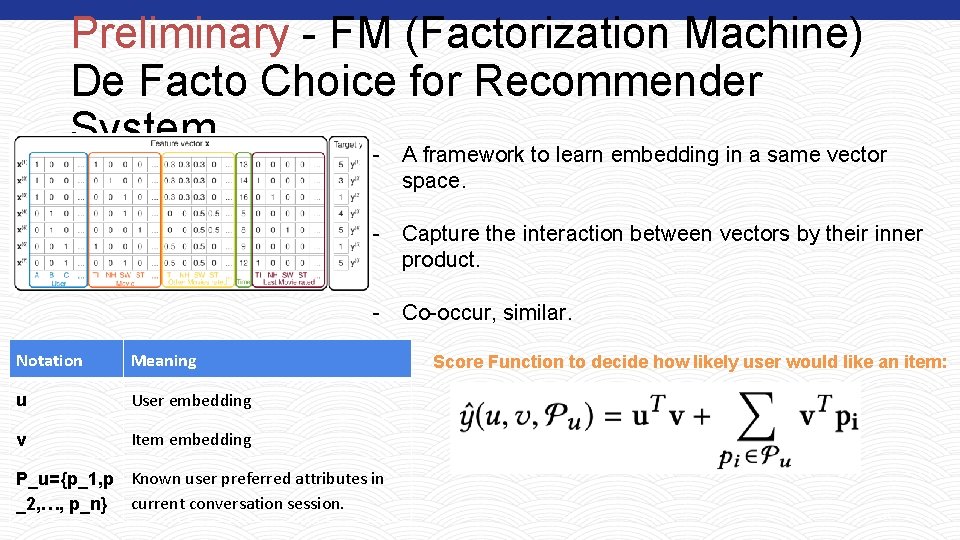
Preliminary - FM (Factorization Machine) De Facto Choice for Recommender System - A framework to learn embedding in a same vector space. - Capture the interaction between vectors by their inner product. - Co-occur, similar. Notation Meaning u User embedding v Item embedding P_u={p_1, p Known user preferred attributes in _2, …, p_n} current conversation session. Score Function to decide how likely user would like an item: 8
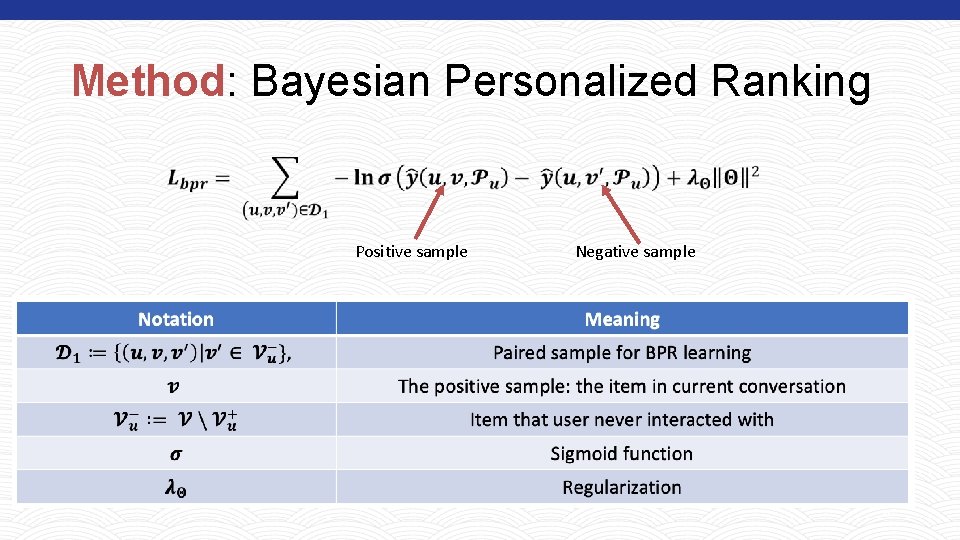
Method: Bayesian Personalized Ranking Positive sample Negative sample 9
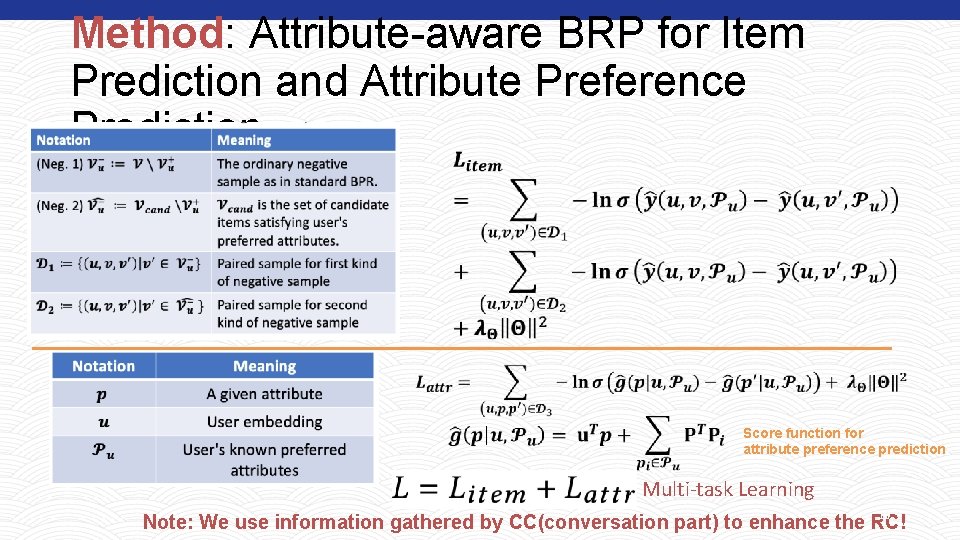
Method: Attribute-aware BRP for Item Prediction and Attribute Preference Prediction Score function for attribute preference prediction Multi-task Learning 10 Note: We use information gathered by CC(conversation part) to enhance the RC!
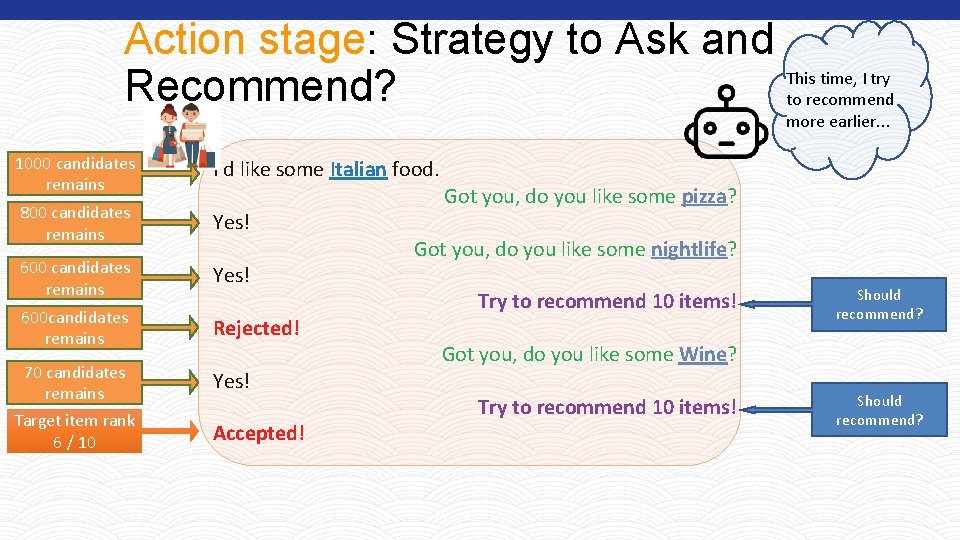
Action stage: Strategy to Ask and This time, I try Recommend? to recommend more earlier. . . 1000 candidates remains I'd like some Italian food. 800 candidates remains Yes! 600 candidates remains Rejected! 70 candidates remains Yes! Target item rank 6 / 10 Accepted! Got you, do you like some pizza? Got you, do you like some nightlife? Try to recommend 10 items! Should recommend? Got you, do you like some Wine? Try to recommend 10 items! Should recommend? 11
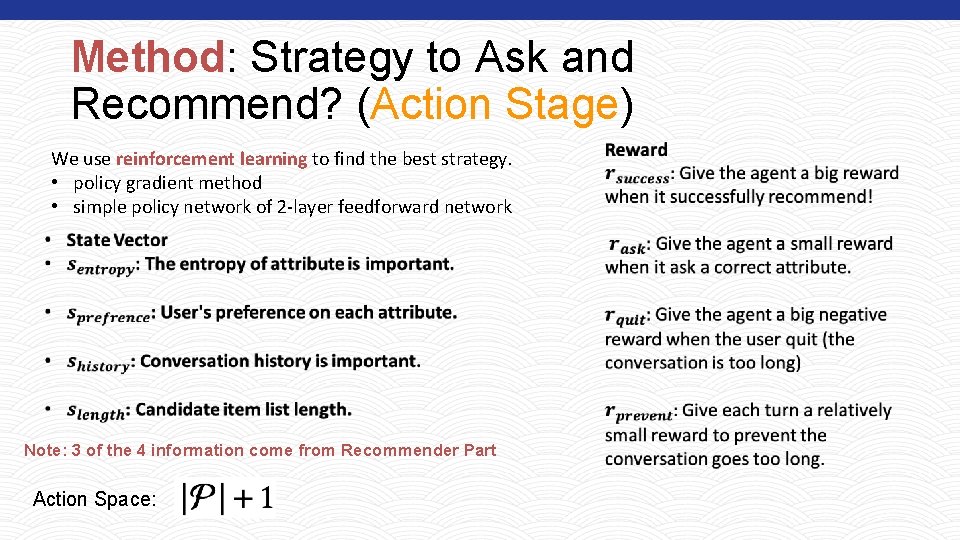
Method: Strategy to Ask and Recommend? (Action Stage) We use reinforcement learning to find the best strategy. • policy gradient method • simple policy network of 2 -layer feedforward network Note: 3 of the 4 information come from Recommender Part Action Space: 12
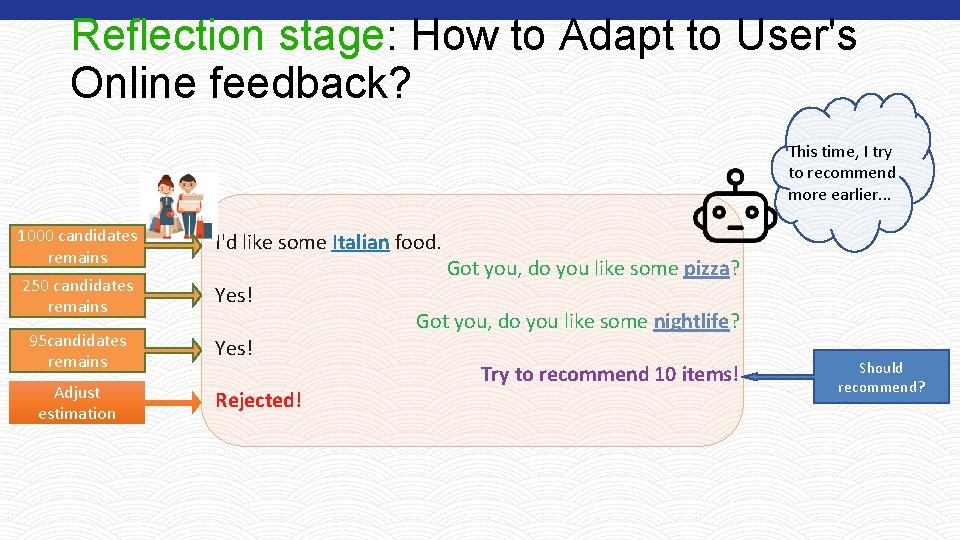
Reflection stage: How to Adapt to User's Online feedback? This time, I try to recommend more earlier. . . 1000 candidates remains I'd like some Italian food. 250 candidates remains Yes! 95 candidates remains Yes! Adjust estimation Rejected! Got you, do you like some pizza? Got you, do you like some nightlife? Try to recommend 10 items! Should recommend?
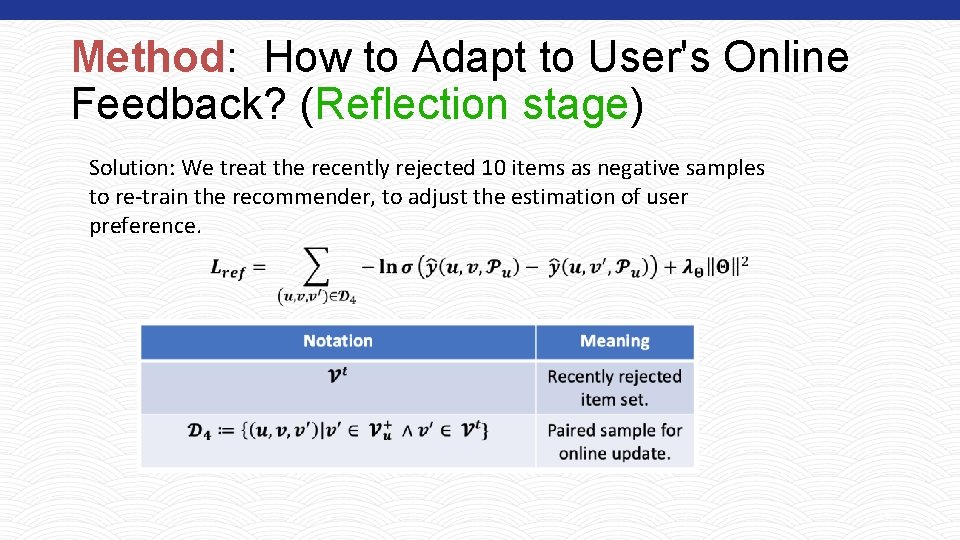
Method: How to Adapt to User's Online Feedback? (Reflection stage) Solution: We treat the recently rejected 10 items as negative samples to re-train the recommender, to adjust the estimation of user preference. 14
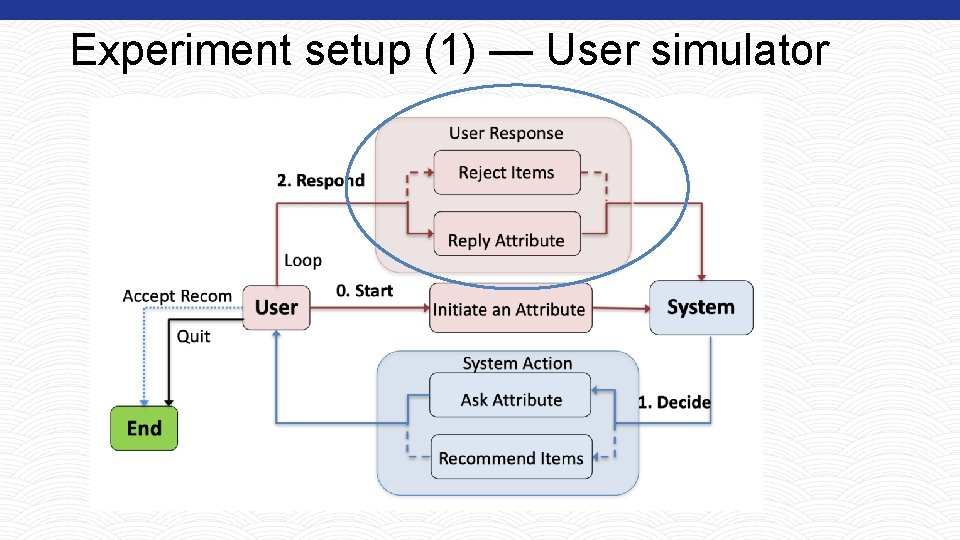
Experiment setup (1) — User simulator 15
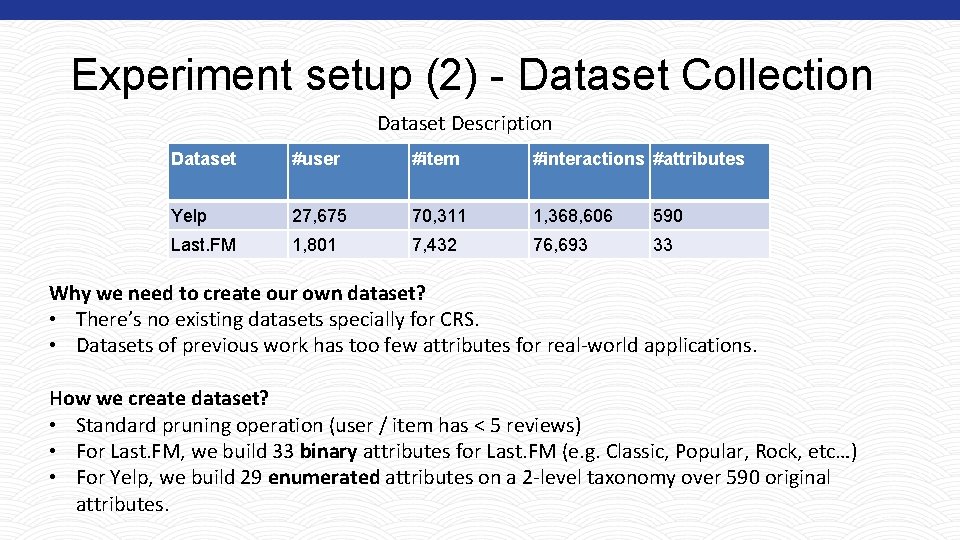
Experiment setup (2) - Dataset Collection Dataset Description Dataset #user #item #interactions #attributes Yelp 27, 675 70, 311 1, 368, 606 590 Last. FM 1, 801 7, 432 76, 693 33 Why we need to create our own dataset? • There’s no existing datasets specially for CRS. • Datasets of previous work has too few attributes for real-world applications. How we create dataset? • Standard pruning operation (user / item has < 5 reviews) • For Last. FM, we build 33 binary attributes for Last. FM (e. g. Classic, Popular, Rock, etc…) • For Yelp, we build 29 enumerated attributes on a 2 -level taxonomy over 590 original attributes. 16
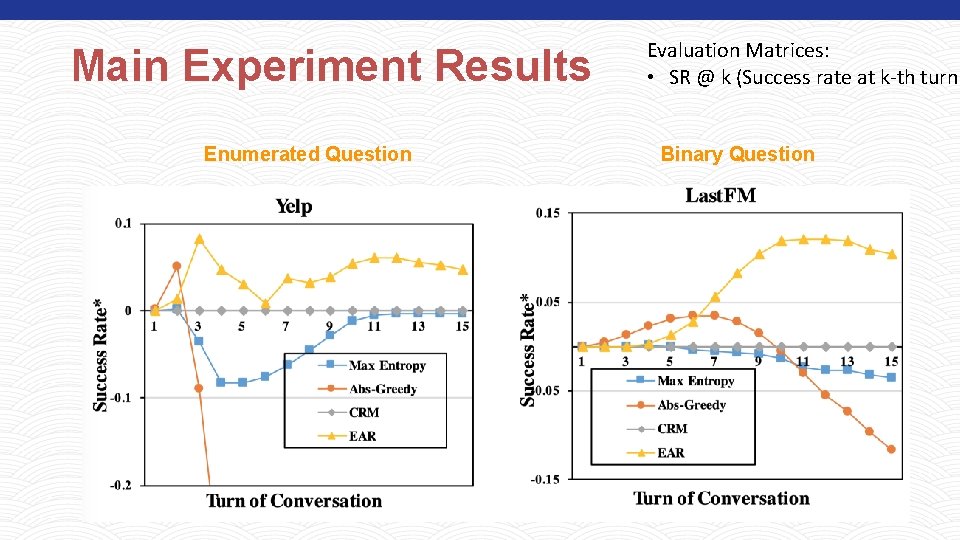
Main Experiment Results Enumerated Question Evaluation Matrices: • SR @ k (Success rate at k-th turn) Binary Question 17
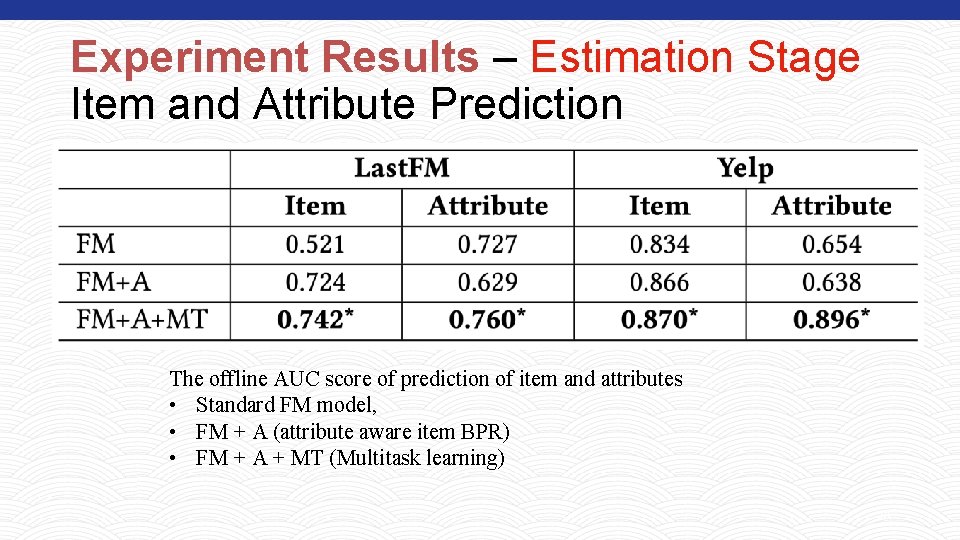
Experiment Results – Estimation Stage Item and Attribute Prediction The offline AUC score of prediction of item and attributes • Standard FM model, • FM + A (attribute aware item BPR) • FM + A + MT (Multitask learning) 18
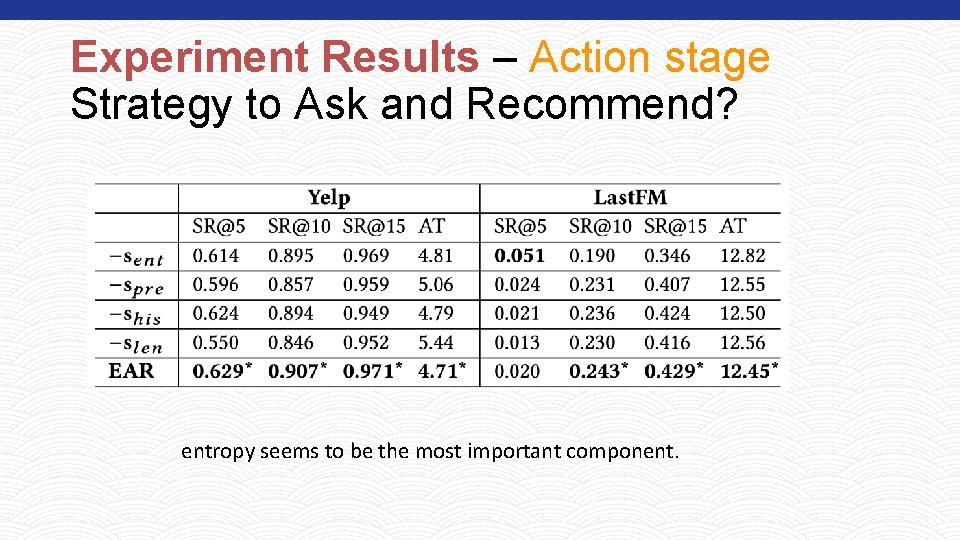
Experiment Results – Action stage Strategy to Ask and Recommend? entropy seems to be the most important component. 19
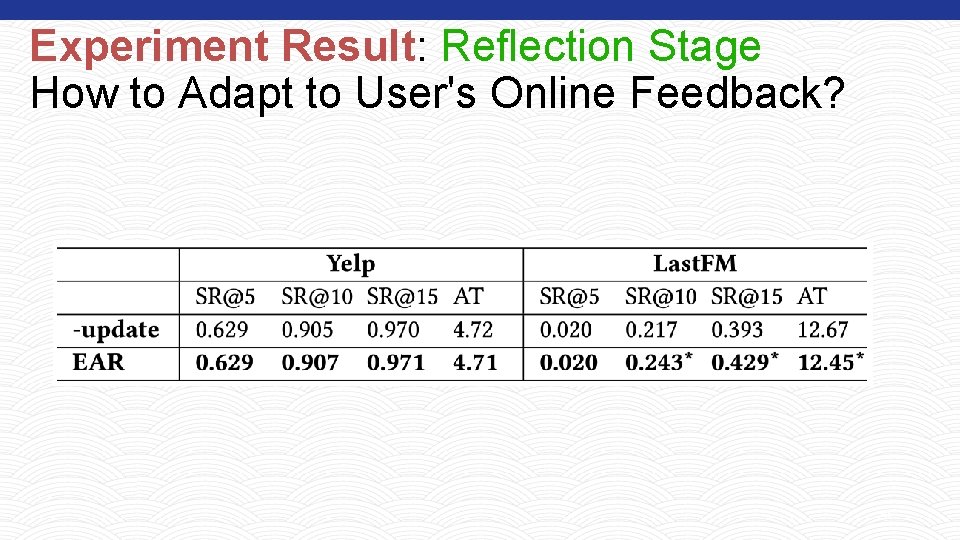
Experiment Result: Reflection Stage How to Adapt to User's Online Feedback? 20
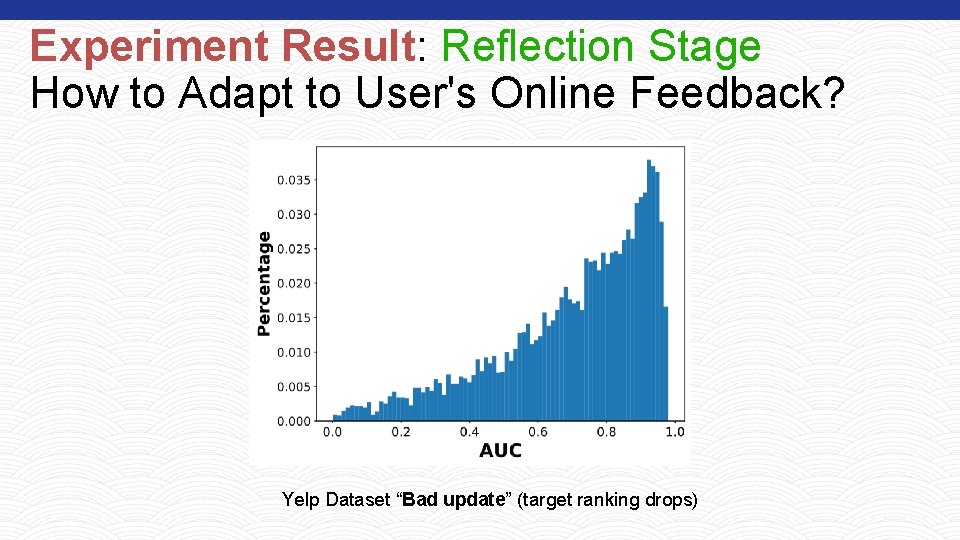
Experiment Result: Reflection Stage How to Adapt to User's Online Feedback? Yelp Dataset “Bad update” (target ranking drops) 21
Conclusion and Future Works • We formalize the task of multi-turn conversational recommendation system (CRS). • We refine the recommendation system in a conversational scenario for both item prediction and attribute prediction. • We proposes a three-stage solution EAR for CRS, outperforming state -of-the-art baselines. • We plan to do online evaluation and obtain real-world exposure data by collaborating with E-commerce companies. 22

Thank you! 23

Spare Slides 24

References Towards Deep Conversational Recommendations. Raymond Li, Samira Ebrahimi Kahou, Hannes Schulz, Vincent Michalski, Laurent Charlin, and Chris Pal. NIPS. 2018 Knowledge-aware Multimodal Dialogue Systems. Lizi Liao, Yunshan Ma, Xiangnan He, Richang Hong, and Tat-Seng Chua. ACMMM 2018 Q&R: A Two-Stage Approach toward Interactive Recommendation. Konstantina Christakopoulou, Alex Beutel, Rui Li, Sagar Jain, and Ed H Chi. . SIGKDD 2018 Towards conversational search and recommendation: System ask, user respond. Yongfeng Zhang, Xu Chen, Qingyao Ai, Liu Yang, and W Bruce Croft. CIKM 2018 Conversational Recommender System. Yueming Sun and Yi Zhang. SIGIR 2018 An Visual Dialog Augmented Interactive Recommender System. Tong Yu, Yilin Shen, and Hongxia Jin. SIGKDD 2019 25
Importance of this research project The Importance of CRS (Conversational Recommendation System): • Overcome the limitation of traditional static recommender systems, thus improve user’s satisfaction and bring revenue for business! • Embrace recent advances in conversation technology. The Advances Brought By Our Work: • We’re the first to consider a realistic multi-round conversational recommendation scenario. • Unifying CC(Conversation Component) and RC(Recommender Component), and propose a novel three-staged solution EAR. • We build two datasets by simulating user conversations to make the task suitable for offline academic research. 26
Literature Review (1) • Static Traditional Recommendation Systems: - Collaborative Filtering - Matrix Factorization - Factorization Machine - etc. . . • Limitation 1: - Offline: learn from user history data, so can only mimic user's history preference. • Limitation 2: - User cannot explicit tell system her preference. - System cannot leverage user's feedback. Existing online recommendation methods (bandit): • epsilon-greedy • Thompson-Sampling • Upper Confidence Bound (UCB) • Linear-UCB • Collaborative UCB. . . Limitation: • Can only attempt to recommend items, cannot ask attributes of item • The mathematics formulation of bandit restricts it to only recommend 1 item each turn. 27
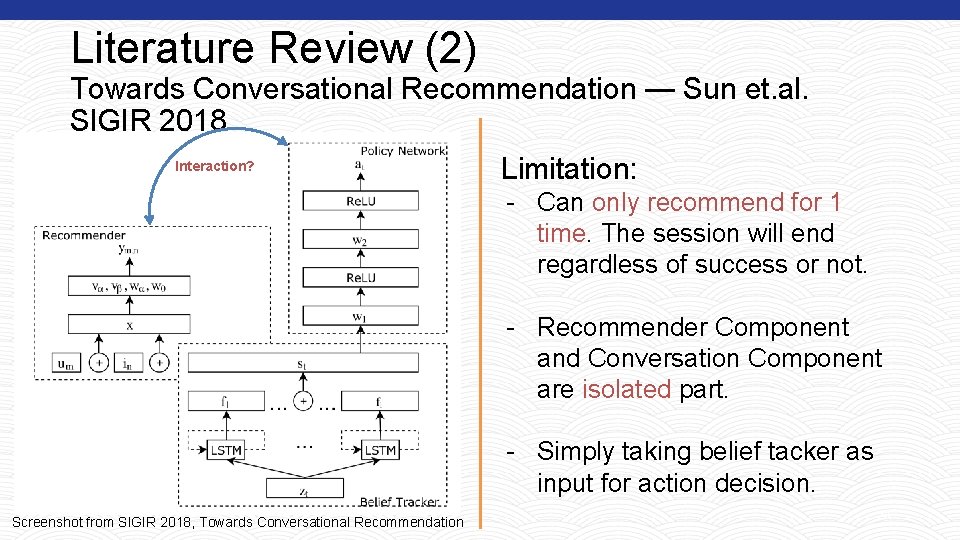
Literature Review (2) Towards Conversational Recommendation — Sun et. al. SIGIR 2018 Interaction? Limitation: - Can only recommend for 1 time. The session will end regardless of success or not. - Recommender Component and Conversation Component are isolated part. - Simply taking belief tacker as input for action decision. Screenshot from SIGIR 2018, Towards Conversational Recommendation 28
- Slides: 28