
The Sociology of Crime and Deviance Name Teacher










- Slides: 24
The Sociology of Crime and Deviance Name Teacher:
What do the terms ‘crime’ and ‘deviance’ mean to you? Crime Deviance
Types of deviance Deviance based on role/position Situational deviance
Types of deviance Historical deviance Cross cultural deviance
Controlling crime and deviance Agents of social control Formal agent How they control society The government Houses of Parliament makes Laws The police Enforce the law The court system Decide how to punish law breakers Prisons and other sanctions Different ways law breakers can be punished and controlled The army defends a country
Controlling crime and deviance Informal social control Paul Willis (1977) ‘ Learning to Labour’
Solutions to crime What are the functions of the penal system?
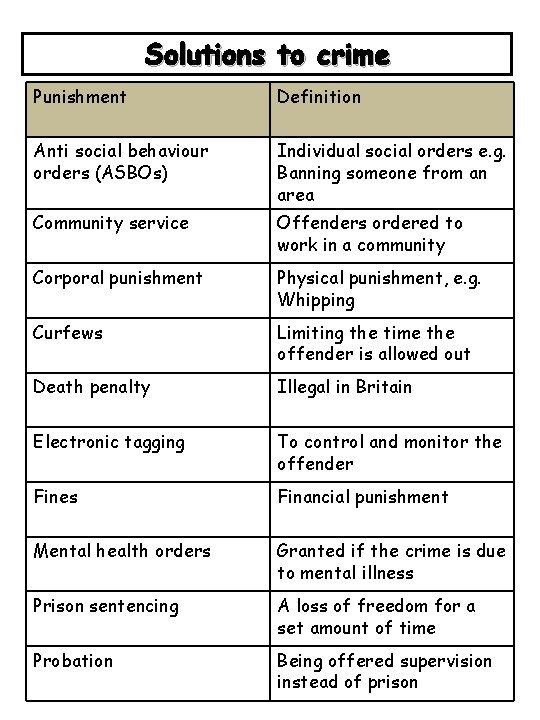
Solutions to crime Punishment Definition Anti social behaviour orders (ASBOs) Individual social orders e. g. Banning someone from an area Community service Offenders ordered to work in a community Corporal punishment Physical punishment, e. g. Whipping Curfews Limiting the time the offender is allowed out Death penalty Illegal in Britain Electronic tagging To control and monitor the offender Fines Financial punishment Mental health orders Granted if the crime is due to mental illness Prison sentencing A loss of freedom for a set amount of time Probation Being offered supervision instead of prison
Patterns of Crime Measuring Crime Official Statistics
Patterns of Crime Victim Surveys Self Report Studies
How does crime impact upon society? Crime and society
Patterns of crime by class, gender, ethnicity and age Social class and crime Gender and crime
Patterns of crime by class, gender, ethnicity and age Ethnicity and crime Age and crime
Explanations of crime: Age Peer pressure Subcultures Boredom
Explanations of crime: Age Lack of social control at home and in education Labelling
Explanations of crime: Gender socialisation Different levels of social control
Explanations of crime: Gender stereotyping
Explanations of crime: Ethnicity Poverty and unemployment Police targeting Different norms and values
Explanations of crime: Ethnicity Different and racism in the criminal justice system
Explanations of crime: Class Socialisation and subculture Lack of opportunities
Explanations of crime: Class Status frustration Marxism
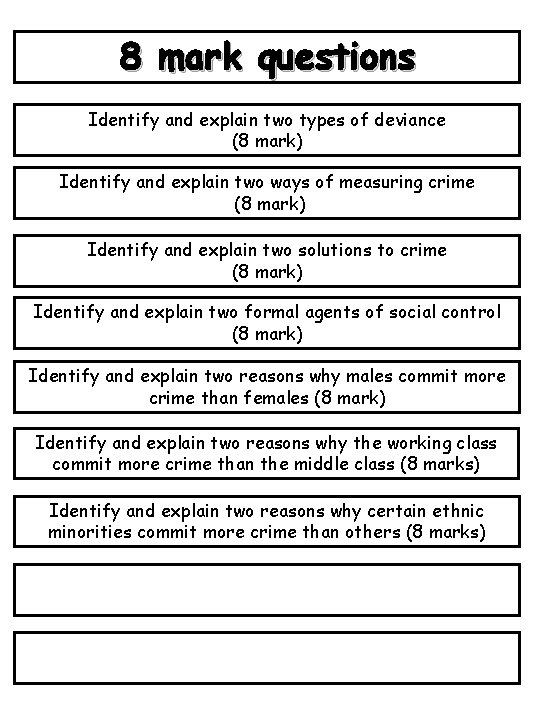
8 mark questions Identify and explain two types of deviance (8 mark) Identify and explain two ways of measuring crime (8 mark) Identify and explain two solutions to crime (8 mark) Identify and explain two formal agents of social control (8 mark) Identify and explain two reasons why males commit more crime than females (8 mark) Identify and explain two reasons why the working class commit more crime than the middle class (8 marks) Identify and explain two reasons why certain ethnic minorities commit more crime than others (8 marks)
24 mark essay questions ‘To solve crime we need loner prison sentences’ Evaluate the arguments FOR and AGAINST (24 marks) ‘All crime would be solved by introducing longer prison sentences’ Evaluate the arguments FOR and AGAINST (24 marks) ‘Official statistics provide the most accurate way of measuring crime’ Evaluate the arguments FOR and AGAINST (24 marks) ‘Deviance is always relative’ Evaluate the arguments FOR and AGAINST (24 marks) ‘The people most likely to break the law are young people’ Evaluate the arguments FOR and AGAINST (24 marks) ‘People commit crime because they are poor’ Evaluate the arguments FOR and AGAINST (24 marks)
24 mark essay questions ‘Poor people commit more crime than rich people’ Evaluate the arguments FOR and AGAINST (24 marks) ‘People define deviance in the same way’ Evaluate the arguments FOR and AGAINST (24 marks) ‘All deviance is relative’ Evaluate the arguments FOR and AGAINST (24 marks) ‘Criminal behaviour is caused by lack of money and opportunities’ Evaluate the arguments FOR and AGAINST (24 marks)