Defining Modern Advertising A complex form of communication




- Slides: 53
Defining Modern Advertising • A complex form of communication using objectives and strategies to impact consumer thoughts, feelings, and actions. • A form of marketing communication (all the techniques marketers use to reach their customers and deliver their messages).
Defining Modern Advertising Five Basic Factors of Advertising 1. Paid communication 2. Sponsor is identified 3. Tries to inform or persuade 4. Reaches a large audience 5. Message conveyed through many different kinds of largely nonpersonal mass media Principle: An effective advertisement is one that can be proven to meet its objectives.
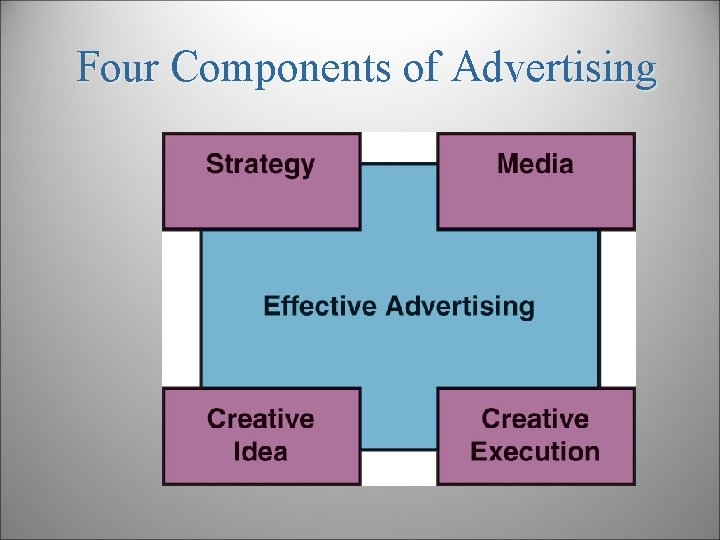
Four Components of Advertising
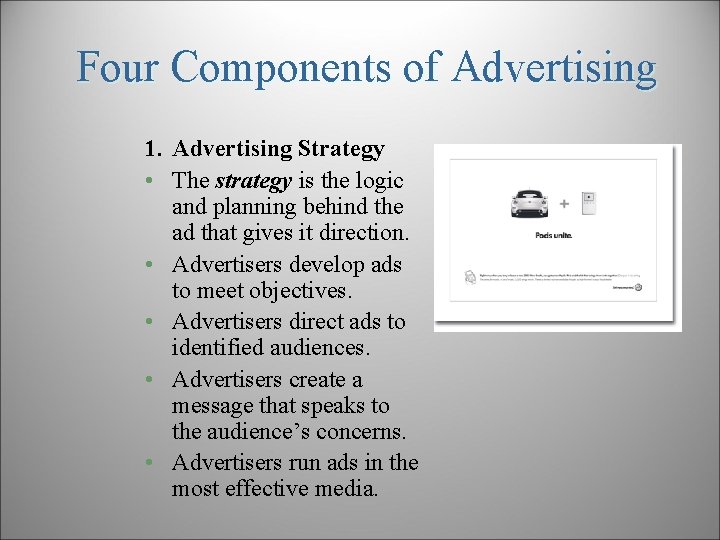
Four Components of Advertising 1. Advertising Strategy • The strategy is the logic and planning behind the ad that gives it direction. • Advertisers develop ads to meet objectives. • Advertisers direct ads to identified audiences. • Advertisers create a message that speaks to the audience’s concerns. • Advertisers run ads in the most effective media.
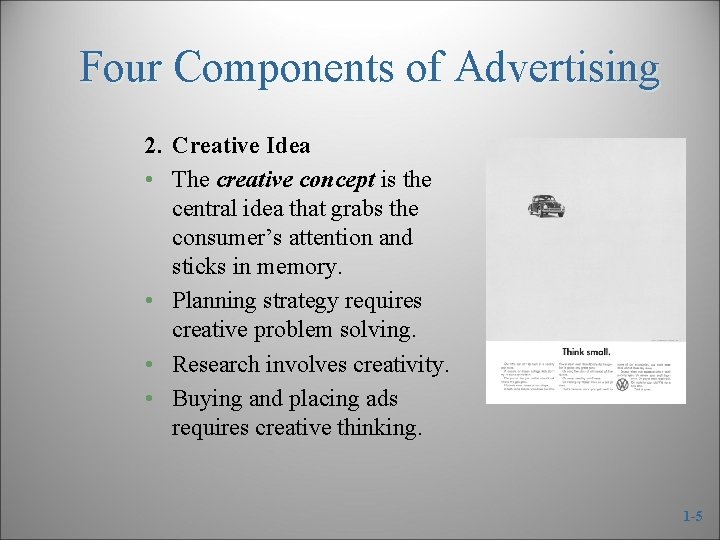
Four Components of Advertising 2. Creative Idea • The creative concept is the central idea that grabs the consumer’s attention and sticks in memory. • Planning strategy requires creative problem solving. • Research involves creativity. • Buying and placing ads requires creative thinking. 1 -5
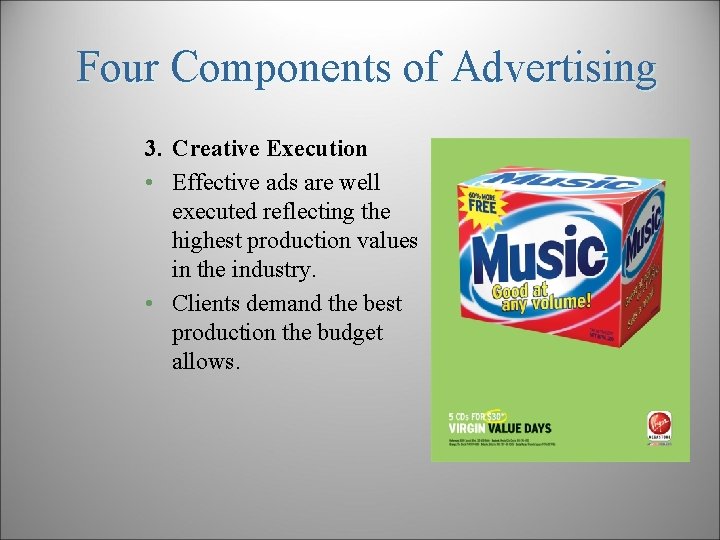
Four Components of Advertising 3. Creative Execution • Effective ads are well executed reflecting the highest production values in the industry. • Clients demand the best production the budget allows.
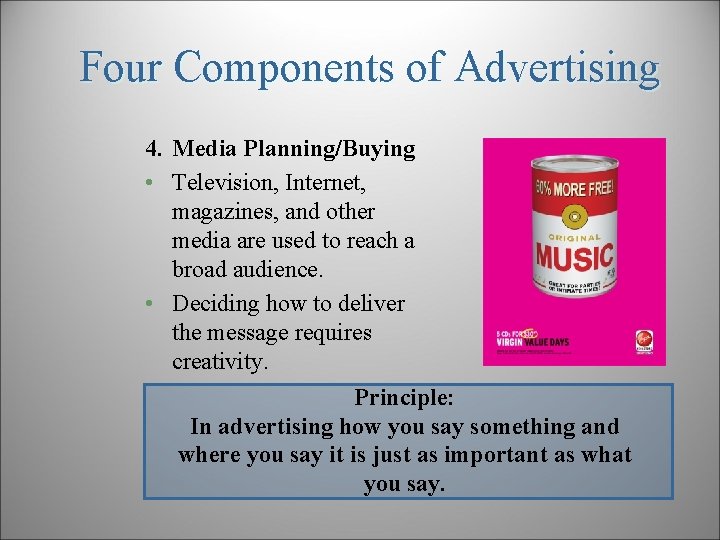
Four Components of Advertising 4. Media Planning/Buying • Television, Internet, magazines, and other media are used to reach a broad audience. • Deciding how to deliver the message requires creativity. Principle: In advertising how you say something and where you say it is just as important as what you say.
Four Roles of Advertising 1. The Marketing Role • Marketing is satisfying customer wants and needs by providing products (goods, services, and ideas). • The marketing department is responsible for selling the product using the 4 Ps (product, price, place/distribution, and promotion) and brand development. Principle: A product can be services and ideas as well as goods.
Four Roles of Advertising 2. The Communication Role • Advertising is a message to a consumer about a product, designed to create a response. • It is also a form of marketing communication. • Advertising uses mass communication to transmit product information to connect buyers and sellers in them marketplace. Principle: One of advertising’s most important strengths is its ability to reach a large audience.
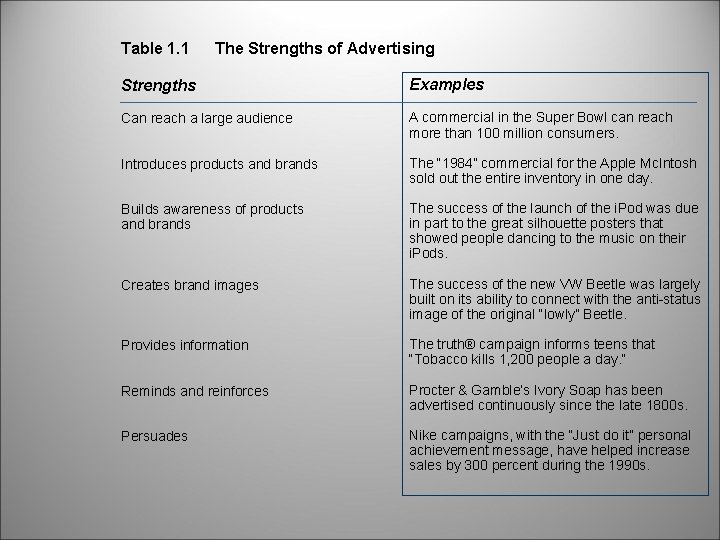
Table 1. 1 The Strengths of Advertising Strengths Examples Can reach a large audience A commercial in the Super Bowl can reach more than 100 million consumers. Introduces products and brands The “ 1984” commercial for the Apple Mc. Intosh sold out the entire inventory in one day. Builds awareness of products and brands The success of the launch of the i. Pod was due in part to the great silhouette posters that showed people dancing to the music on their i. Pods. Creates brand images The success of the new VW Beetle was largely built on its ability to connect with the anti-status image of the original “lowly” Beetle. Provides information The truth® campaign informs teens that “Tobacco kills 1, 200 people a day. ” Reminds and reinforces Procter & Gamble’s Ivory Soap has been advertised continuously since the late 1800 s. Persuades Nike campaigns, with the “Just do it” personal achievement message, have helped increase sales by 300 percent during the 1990 s.
Four Roles of Advertising 3. The Economic Role • Because it reaches large groups of people, advertising makes marketing more cost-efficient and lowers prices for consumers. • Advertising creates a demand for a brand using hard sell (persuading) and soft sell (image building) techniques.
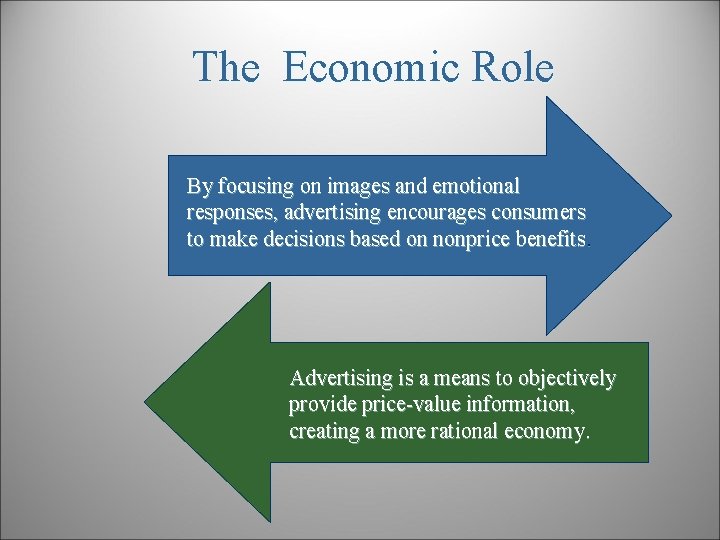
The Economic Role By focusing on images and emotional responses, advertising encourages consumers to make decisions based on nonprice benefits. Advertising is a means to objectively provide price-value information, creating a more rational economy.
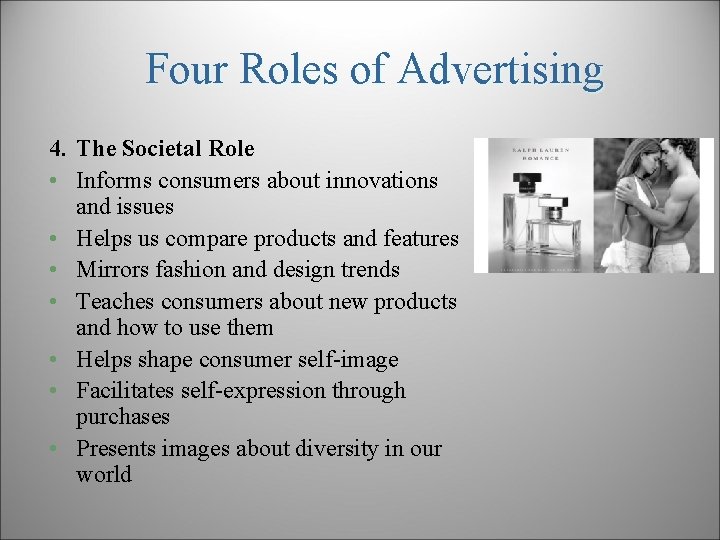
Four Roles of Advertising 4. The Societal Role • Informs consumers about innovations and issues • Helps us compare products and features • Mirrors fashion and design trends • Teaches consumers about new products and how to use them • Helps shape consumer self-image • Facilitates self-expression through purchases • Presents images about diversity in our world
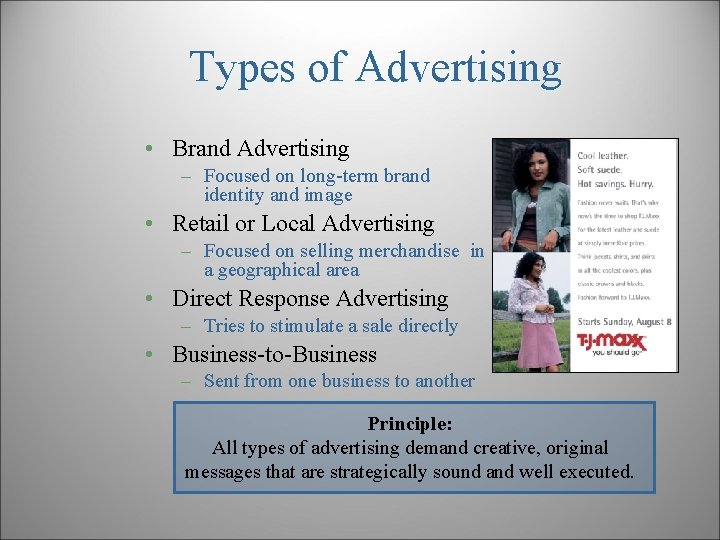
Types of Advertising • Brand Advertising – Focused on long-term brand identity and image • Retail or Local Advertising – Focused on selling merchandise in a geographical area • Direct Response Advertising – Tries to stimulate a sale directly • Business-to-Business – Sent from one business to another Principle: All types of advertising demand creative, original messages that are strategically sound and well executed.
Types of Advertising • Institutional Advertising – Focused on establishing a corporate identity or winning the public over to the organization’s point of view • Nonprofit Advertising – Used by nonprofits like charities, associations, hospitals, orchestras, museums, and churches for customer, members, volunteers, and donors • Public Service Advertising – Usually produced and run for free on behalf of a good cause
The Key Players: the Advertiser • Wants to send out a message about its business • Initiates effort by identifying a problem that advertising can solve • Selects the target audience, sets the budget, and approves the ad plan • Hires the agency – Agency of record (AOR) does the most business; manages other agencies
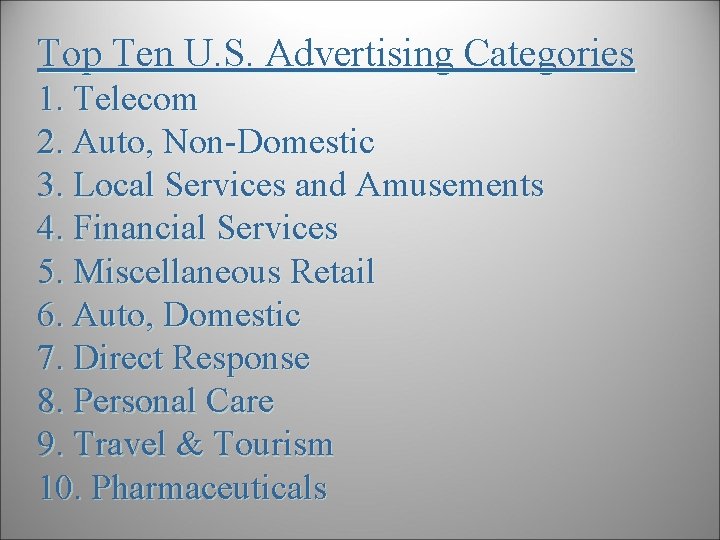
Top Ten U. S. Advertising Categories 1. Telecom 2. Auto, Non-Domestic 3. Local Services and Amusements 4. Financial Services 5. Miscellaneous Retail 6. Auto, Domestic 7. Direct Response 8. Personal Care 9. Travel & Tourism 10. Pharmaceuticals
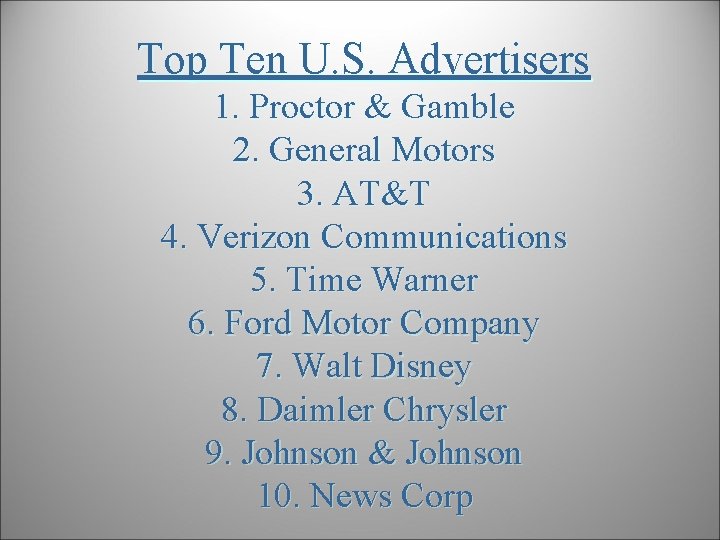
Top Ten U. S. Advertisers 1. Proctor & Gamble 2. General Motors 3. AT&T 4. Verizon Communications 5. Time Warner 6. Ford Motor Company 7. Walt Disney 8. Daimler Chrysler 9. Johnson & Johnson 10. News Corp
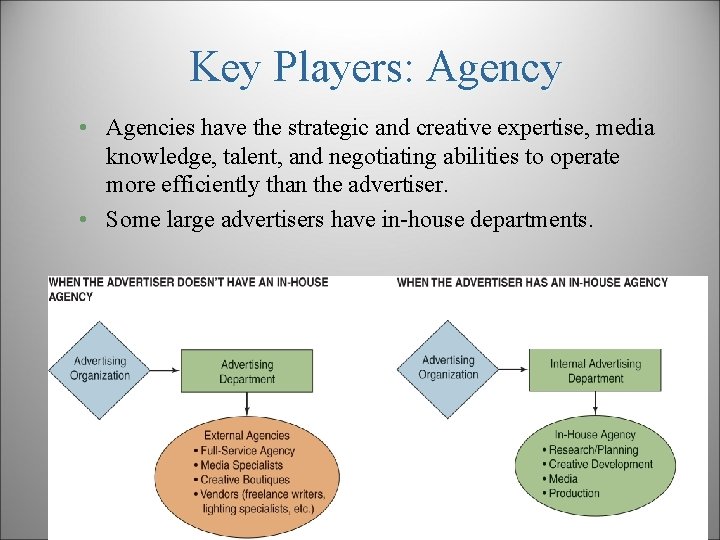
Key Players: Agency • Agencies have the strategic and creative expertise, media knowledge, talent, and negotiating abilities to operate more efficiently than the advertiser. • Some large advertisers have in-house departments. 1 -19
Key Players: Media • Media are channels of communication that carry the message to the audience • They’re vehicles, but also large media conglomerates like Time Warner and Viacom. Principle: Mass media advertising can be cost effective because the costs are spread over the large number of people the ad reaches. 1 -20
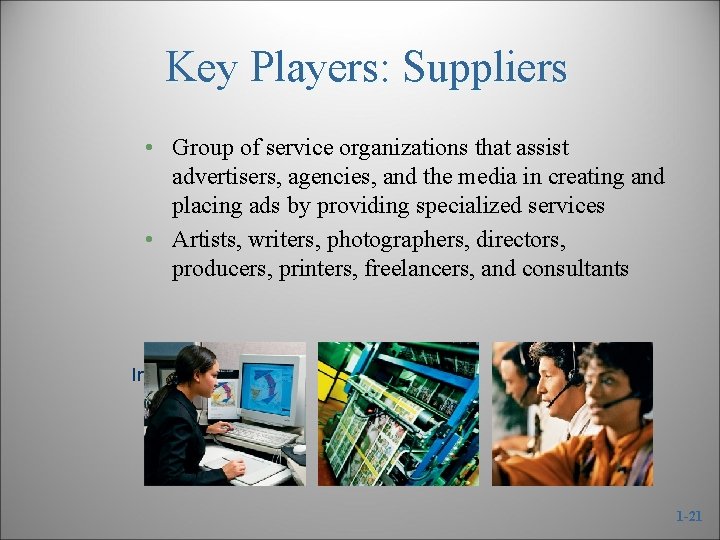
Key Players: Suppliers • Group of service organizations that assist advertisers, agencies, and the media in creating and placing ads by providing specialized services • Artists, writers, photographers, directors, producers, printers, freelancers, and consultants Insert 1 -21
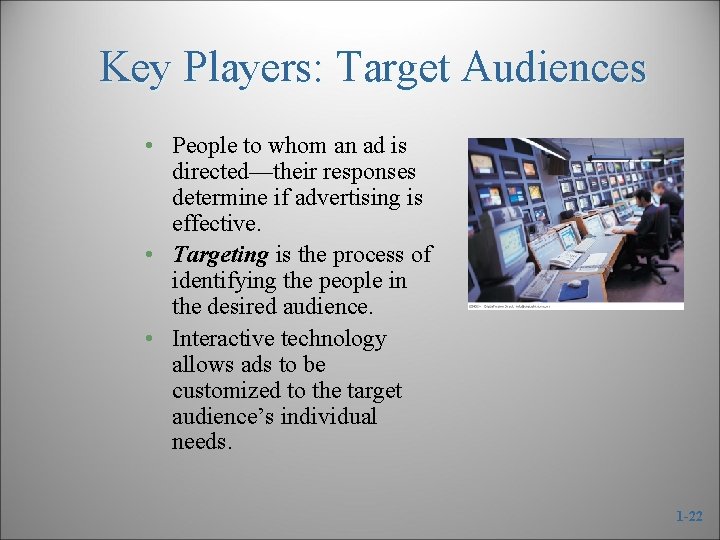
Key Players: Target Audiences • People to whom an ad is directed—their responses determine if advertising is effective. • Targeting is the process of identifying the people in the desired audience. • Interactive technology allows ads to be customized to the target audience’s individual needs. 1 -22
Current Developments The New Advertising • Electronic media are making advertising more intimate, interactive, and personalized. • Advertising must evolve to keep up with technology. • Creativity involves more than just the ad’s big idea, but finding new ways to engage consumers beyond traditional mass media. 1 -23
Current Developments Interactivity • Buzz is getting people to talk about the event, idea or brand. • People contact companies by phone, the Internet, and through friends. • Advertising must change to also become more interactive. 1 -24
Current Developments Integrated Marketing Communication (IMC) • IMC means unifying all marketing communication messages and tools to send a consistent, persuasive message promoting the brand’s goals. • Stakeholders are also important in IMC. • Synergy means messages have more impact working jointly than on their own. 1 -25
Current Developments Globalization • The elimination of trade barriers in the 1990 s opened huge international markets. • Agencies are forming multinational operations to to address these markets. • Should advertisers practice local or global advertising? 1 -26
Current Developments What makes an ad effective? • Gets attention • Creates a positive impression for a brand • Separates the brand from the competition • Influences people to respond in the desired way Principle: An ad that works—that is effective—is one where the target audience responds as the advertiser intended. 1 -27
Advertising and Ethics • Proponents – Encourages a standard of living improvement – Produces jobs – Promotes competition • Critics – Creates needs and faults – More propaganda than information – Promotes materialism
Ethics in Promotion • Not all issues can be regulated • A marketing or promotion action may be legal but not considered ethical • Marketers must make decisions regarding the appropriateness of their actions • Companies are scrutinized for their ethics
Social and Ethical Criticisms of Promotion • • • Advertising as untruthful or deceptive Advertising as offensive or in bad taste– Advertising of personal products–Sexual appeals Advertising and Children Social and Cultural Consequences–Making people buy things they don’t need–Encouraging materialism– Stereotyping–Advertisings’ influence on the media
Social and Ethical Criticisms of Promotion • Advertising as untruthful or deceptive– – General mistrust of ads –Deliberately untruthful or misleading vs. puffery – Problems often more at local level rather than national
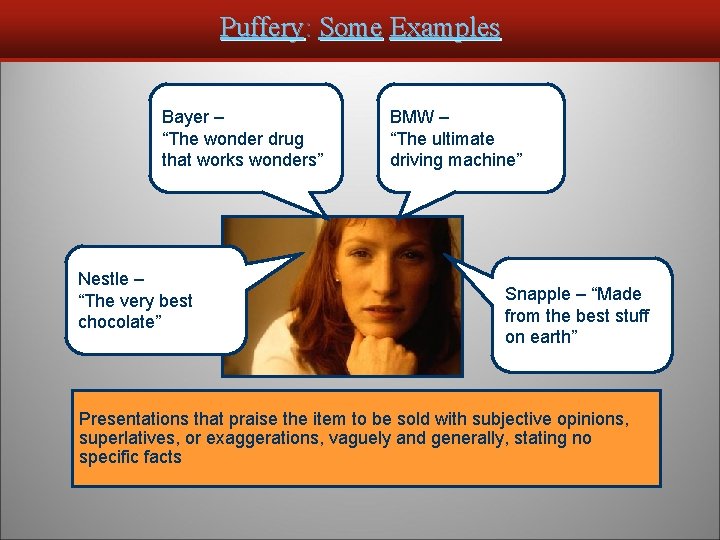
Puffery: Some Examples Bayer – “The wonder drug that works wonders” Nestle – “The very best chocolate” BMW – “The ultimate driving machine” Snapple – “Made from the best stuff on earth” Presentations that praise the item to be sold with subjective opinions, superlatives, or exaggerations, vaguely and generally, stating no specific facts
Social and Ethical Criticisms of Promotion • Advertising as offensive, in bad taste, or irritating • Advertising of personal products • Sexual appeals – �� Suggestive, demeaning, raunchy
Children and Promotion • Children's TV Watching Behavior – Children between ages 2 -11 watch on average 21. 5 hours of TV per week and may see 22, 000 commercials per year – Television is an important source of information for children about products
Children and Promotion • Some studies have shown… – Children lack experience and knowledge to evaluate advertising critically – They can not differentiate between commercials and program (fantasy vs. reality) – Children are vulnerable to advertising
Children and Promotion • ……while other studies argue that – Children must learn through the consumer socialization process; need to acquire skills to function in the marketplace – Acquired skills have helped teens evaluate ads and recognize persuasion techniques
Ethical Issues in Packaging and Branding Four Aspects: 1) Label information 2) Packaging graphics 3) Packaging safety 4) Environmental implications
Ethical Issues in Online Marketing • Overlap with ethics on advertising and promotions • Privacy is the most important ethical issue with online marketing • Invade individual’s privacy rights by selling information to other sources without the consumer’s consent
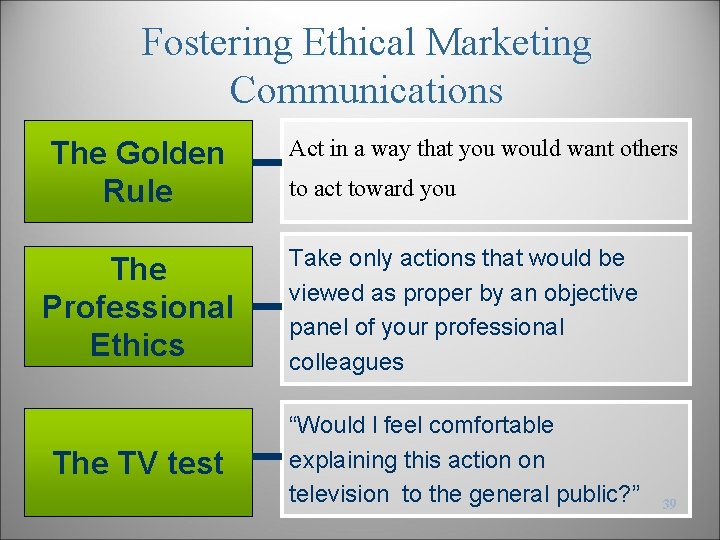
Fostering Ethical Marketing Communications The Golden Rule Act in a way that you would want others to act toward you The Professional Ethics Take only actions that would be viewed as proper by an objective panel of your professional colleagues The TV test “Would l feel comfortable explaining this action on television to the general public? ” 39
When is Regulation Justified - Benefits • Consumer choice among alternatives is improved when consumers are better informed • Product quality tends to improve in response to consumers’ changing needs and preferences • Reduced prices resulting from a reduction in a seller’s “informational market power”
When is Regulation Justified - Costs • Companies incur the cost of complying with a regulatory remedy • Enforcement costs incurred by regulatory agencies and paid for by taxpayers • Unintended side effects result from regulations at a cost to both buyers and sellers
Regulation of Deceptive Advertising FTC will find a business practice deceptive “if there is a representation, omission or practice that is likely to mislead the consumer acting reasonably in the circumstances, to the consumer’s detriment. ”
Regulation of Unfair Practices Three major areas 1. Offends public policy as it has been established by statutes 2. Is immoral, unethical, oppressive, or unscrupulous 3. Causes substantial injury to consumers, competitors, or other businesses.
Suing Competitors
Unfair Advertising Acts or practices that cause or are likely to cause substantial injury to consumers, which is not reasonably avoidable by consumers themselves and not outweighed by countervailing benefits to consumers or competition.
Regulation of Product Labeling Food and Drug Administration (FDA) – Responsible for regulating information on the packages of food and drug products – Responsible for regulating ads for prescription drugs – Requires advertisers to present a balanced perspective when advertising drugs 46
Stereotyping • Portrayal of women – Gender stereotyping – Portrayal of women as sex objects – Role portrayal of women to reflect changing role in society • Blacks and Hispanics • Gays • Elderly
Do You Agree With Leo Burnett? • “It must be said that without advertising we would have a far different nation, and one that would be much the poorer-not merely in material commodities, but in the life of the spirit. ” • These excerpters are from a speech given by Leo Burnett on the American Association or Advertising Agencies’ 50 th anniversary, April 20, 1967
Business Actions Toward Socially Responsible Marketing Enlightened marketing refers to a company’s marketing effort supporting the best long-run performance of the marketing system and consists of five principles: • Consumer-oriented marketing • Customer-value marketing • Innovative marketing • Sense-of-mission marketing • Societal marketing
Business Actions Toward Socially Responsible Marketing Enlightened Marketing Consumer-oriented marketing means that a company should view and organize its marketing activities from the consumer’s perspective Customer-value marketing means that the company should put most of its resources into customer-value-building marketing investments—long-term customer loyalty and relationships—by continually improving the value consumers receive from the firm’s market offerings Innovative marketing requires the company to continually seek real product and marketing improvements
Business Actions Toward Socially Responsible Marketing Enlightened Marketing Sense-of-mission marketing means the company should define its mission in broad social terms rather than narrow product terms Societal marketing means the company makes marketing decisions by considering consumers’ wants and interests, the company’s requirements, and society’s long-run interests • Views societal problems as opportunities • Designs pleasing and beneficial products
Business Actions Toward Socially Responsible Marketing Enlightened Marketing Deficient products have neither immediate appeal nor long-term benefits • Bad-tasting and ineffective medicine Pleasing products have high immediate satisfaction but may hurt consumers in the long run • Cigarettes and junk food
Business Actions Toward Socially Responsible Marketing Enlightened Marketing Salutary products have low appeal but may benefit consumers in the long run • Seat belts and air bags Desirable products give both immediate satisfaction and high long-term benefits • Tasty and nutritious breakfast food