Current Status of Nuclear Medicine and Radiation Therapy







- Slides: 39
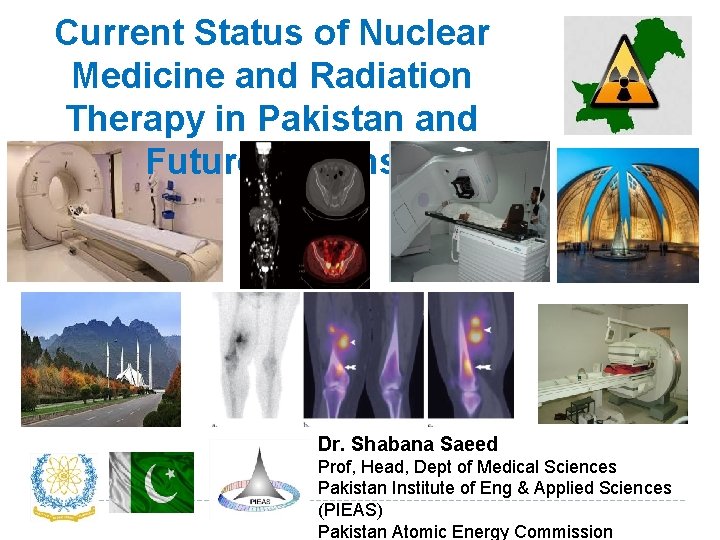
Current Status of Nuclear Medicine and Radiation Therapy in Pakistan and Future Actions Pakista Dr. Shabana Saeed n Prof, Head, Dept of Medical Sciences Pakistan Institute of Eng & Applied Sciences (PIEAS) Pakistan Atomic Energy Commission
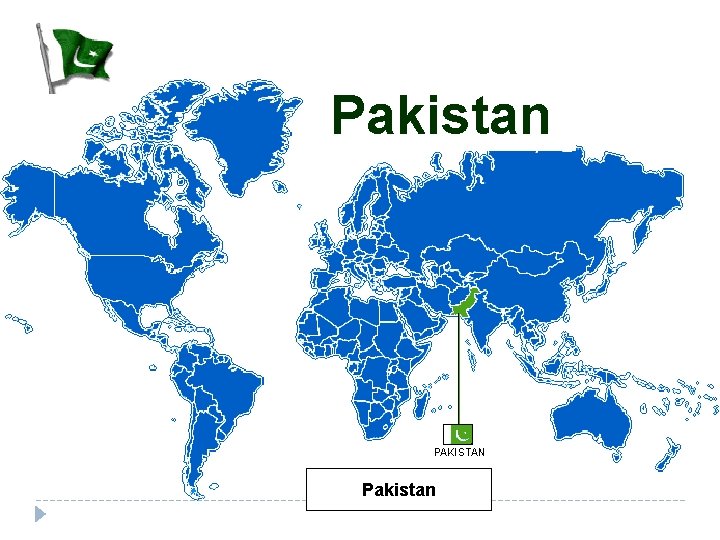
Pakistan
Total Population Estimated New Cancer cases/yr People dying from cancer /yr: 220 million >148 K >101 K Data from IARC Global. Can (2012)
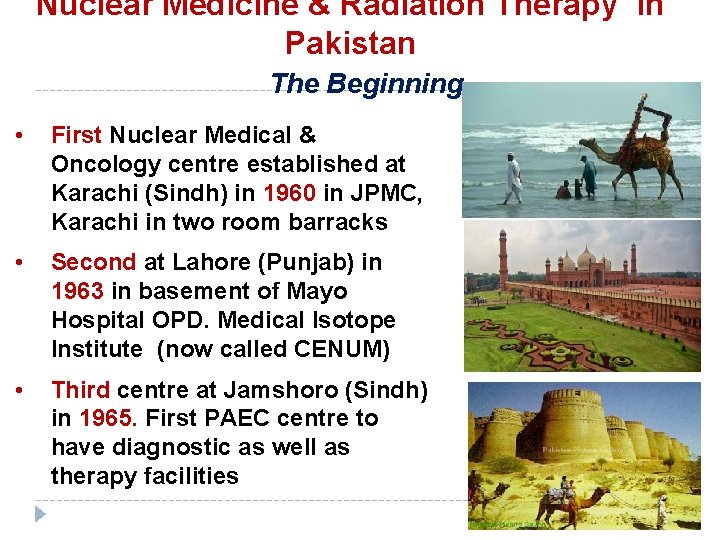
Nuclear Medicine & Radiation Therapy in Pakistan The Beginning • First Nuclear Medical & Oncology centre established at Karachi (Sindh) in 1960 in JPMC, Karachi in two room barracks • Second at Lahore (Punjab) in 1963 in basement of Mayo Hospital OPD. Medical Isotope Institute (now called CENUM) • Third centre at Jamshoro (Sindh) in 1965. First PAEC centre to have diagnostic as well as therapy facilities
NUCLEAR MEDICINE
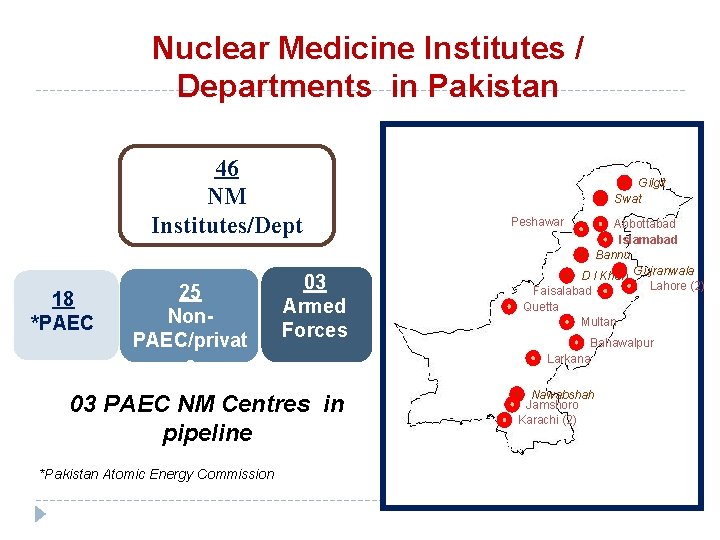
Nuclear Medicine Institutes / Departments in Pakistan Current Situation 46 NM Institutes/Dept 18 *PAEC 25 Non. PAEC/privat e 03 Armed Forces 03 PAEC NM Centres in pipeline *Pakistan Atomic Energy Commission Gilgit Swat Peshawar Abbottabad Islamabad Bannu D I Khan Gujranwala Lahore (2) Faisalabad Quetta Multan Bahawalpur Larkana Nawabshah Jamshoro Karachi (2)
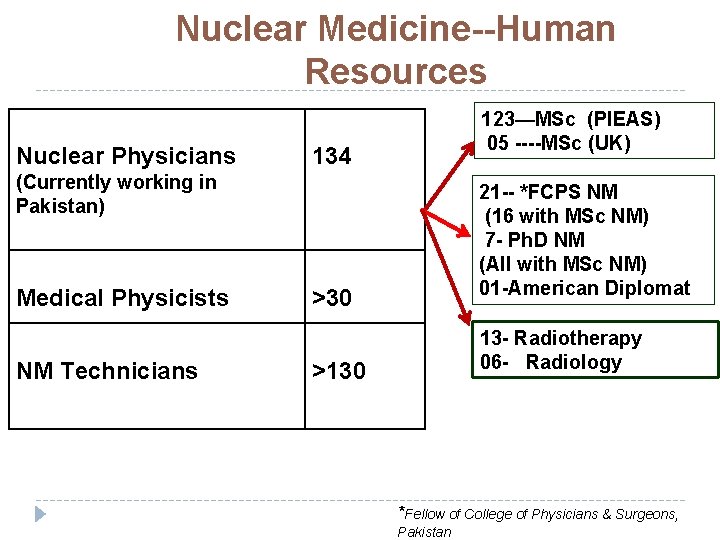
Nuclear Medicine--Human Resources Nuclear Physicians 123—MSc (PIEAS) 05 ----MSc (UK) 134 (Currently working in Pakistan) Medical Physicists NM Technicians 21 -- *FCPS NM (16 with MSc NM) 7 - Ph. D NM (All with MSc NM) 01 -American Diplomat >30 13 - Radiotherapy 06 - Radiology >130 *Fellow of College of Physicians & Surgeons, Pakistan
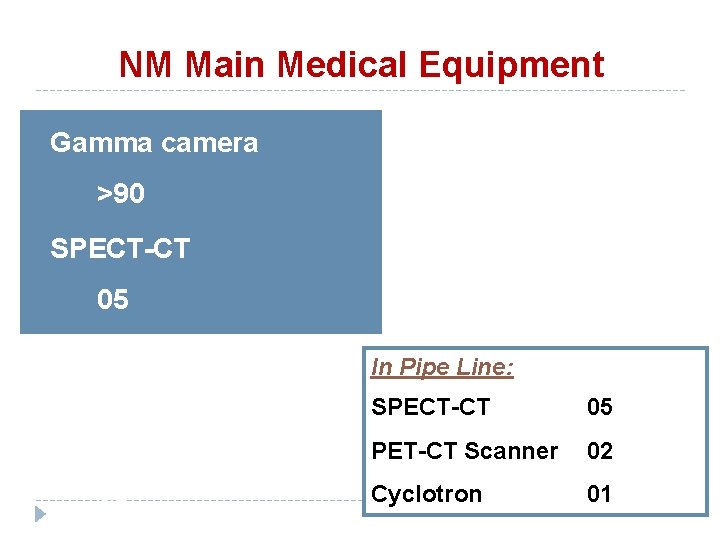
NM Main Medical Equipment Gamma camera >90 SPECT-CT 05 PET-CT Scanner 06 Cyclotron 05 In Pipe Line: SPECT-CT 05 PET-CT Scanner 02 Cyclotron 01
PET-CT Facilities in Pakistan Centre/Institution PET-CT Camera Cyclotron Shaukat Khanum Memorial Trust Hospital, Lahore Philips To. F Gemini (LSO) with 16 slice CT 18 Me. V IBA Institute of Nuclear Medicine & Oncology Lahore Discovery STE (BGO), 16 slice CT 16. 5 Me. V GE Neuro Medical Institute, Karachi Siemens (LSO), 64 slice CT 11 Me. V CTI Sindh Institute of Urology, Karachi Philips Gemini TF Astonish (Ly. SO), 64 slice CT 18 Me. V Agha Khan Hospital, Karachi Toshiba Celesteion To. F, High performance 3 D, Lu-based scintillator 32 slice CT In Pipe Line 1. Karachi Institute of Radiotherapy and Nuclear Medicine (KIRAN), Khi
Radioisotopes & Radiopharmaceuticals in Pakistan Isotope Production Division (IPD) Pakistan Institute of Nuclear Science & Technology(PINSTECH), Islamabad December 21, 1965
Production of Radioisotopes �Pakistan Institute of Nuclear Science and Technology (PINSTECH) ---two research reactors (PARR-1 and 2) �Production of radioisotopes in Pakistan Research Reactor-1 (since 1965)
Radioisotope Processing Facilities � Iodine-131 Production Cell (Technique). (Wet Distillation ) � Iodine-131 Production Cell (Dry Distillation Technique). � Phosphorus-32 Production Cell (Dry Distillation Technique). � Sulpher-35 Production Glove Box � Molybdenum-99 Loading Facility for preparation of 99 m. Tc generators. (100 Ci/batch) � Mo-99 Production facility. Hot Cell with Master Slave Manipulators. � Fume Hoods and Glove Boxes (for small scale production of different � radionuclides and R&D work) � Workshop for target preparation and sealed source fabrication � Laboratories for determination of radionuclidic, radiochemical and biological purity
131 I Processing Plant (Wet Distillation) Maximum capacity per batch 10 Ci/370 GBq. 131 I Processing Plant (Dry Distillation) Maximum capacity per batch 10 Ci/370 GBq.
99 m. Tc/99 Mo Generators Production in Pakistan �Regular production of 99 m. Tc/99 Mo Generators since 2003 �Production of 99 m. Tc/99 Mo Generators from locally produced fission Moly since 2010 �Weekly production of 32/34 generators---300600 m. Ci PAKGEN
Mo-99 extraction process at PINSTECH Ø Developed at PINSTECH with the help of German expert for separation of Mo-99 from fission products Ø Optimization of parameters was achieved in IPD laboratory Ø Fission Iodine-131 and Xenon-133 as byproduct Ø Spent HEU in small SS container for easy disposal
99 Mo Production Facility Step 1: Target Irradiation Target plates Target Holder for PARR-1 Core Step 2: Target transportation from PARR-1 to Mo-99 Target basket for dissolver Docking of container below hot cell-1 of Mo-99 Facility Mo-99 Hotcell (1 -3) Target basket Target Container for transportation Facility & container docking Fork lifter for transportation of target container
99 Mo Production Facility (Continued) Step 3: Hot Cell 1 Processes (Dissolution, Filtration, Iodine removal & acidification) In-cell equipment of Hot cell 1 Filter cake Solid waste container Xenon delay and decay cascade In-cell equipment of Hot cell-1 Filter tower for retaining radio-iodine
99 Mo Production Facility (Continued) Step 4: Hot Cell 2 Processes (Mo-99 Separation and Purification) Intermediate decay and storage system for liquid radioactive waste In-cell equipment of Hot cell-2 Medium level waste container
99 Mo Production Facility (Continued) Step 5: Hot Cell 3 Processes (Mo-99 Dispensing and transportation to generator production facility ) Product container In-cell equipment of Hot cell-3 Transport of Product container
99 Mo Production Facility (Continued) Step 6: Mo-99/Tc-99 m Generator production facility and its use in medical center for scanning Mo-99/Tc 99 m generator Mo-99/Tc-99 m Generator production facility Nuclear Medical Center Gamma camera Imaging Scan
Radioisotopes produced in PARR-1 Radio nuclide Zn-65 Chemical form Se-75 L-Selenomethionine As-77 Arsenic chloride Zinc chloride Br-82 Potassium bromide Mo-99 Ammonium bromide Dibromobenzene 99 m. Tc-Generator (n, γ) Mo-99 99 m. Tc-Generator fission Local production Maximum Activity Year / Batch m. Ci 1989 10 m. Ci 1982 m. Ci 2007 ~ 1 Ci 1972 150 m. Ci 1973 1 Ci 500 m. Ci 2002 2010 Ag-111 Silver chloride 5 m. Ci 1995 Sn-113 Tin chloride m. Ci 1996 Cd-115 Cadmium chloride 15 m. Ci 1996
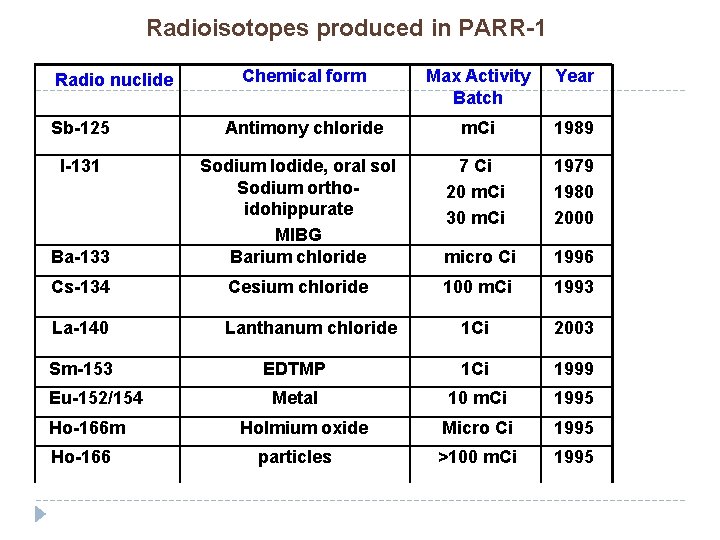
Radioisotopes produced in PARR-1 Radio nuclide Sb-125 Chemical form Max Activity Batch Year Antimony chloride m. Ci 1989 7 Ci 20 m. Ci 30 m. Ci 1979 1980 2000 Ba-133 Sodium Iodide, oral sol Sodium orthoidohippurate MIBG Barium chloride micro Ci 1996 Cs-134 Cesium chloride 100 m. Ci 1993 La-140 Lanthanum chloride 1 Ci 2003 EDTMP 1 Ci 1999 Metal 10 m. Ci 1995 Micro Ci 1995 >100 m. Ci 1995 I-131 Sm-153 Eu-152/154 Ho-166 m Ho-166 Holmium oxide particles
Radioisotopes produced in PARR-1 Radio nuclide Lu-177 Re 186/188 W-188 Au-198 Chemical form Max Activity Batch Year EDTMP 500 m. Ci 2008 EHDP 100 m. Ci 1995 5 m. Ci 1995 1 Ci 1974 1 Ci 2003 Re-188 generator Colloidal, gold chloride, Potassium auro cyanide Au-199 Gold chloride Hg-197 Neohydrin 100 m. Ci 1977 Hg-203 Neohydrin 10 m. Ci 1977 Po-210 metal Ci 1982
KITS Production at PINSTECH
Radiation Therapy
Radiation Therapy Main Medical Equipment Radiation Therapy Centers-------26 Linear Accelerators 27 Cobolt-60 units 31 Brachytherapy Units 11 Heavy ion units 0 In Pipe Line: LINACS 05 Brachytherapy Units 02
Pakistan & Status of Radiotherapy Facilities in the Region Country RT LINAC Centr es Bangladesh 15 15 Co 60 12 HDR CT Simul. TPS LDR HDR Cosimul. Manual Remot Ir-192 60 e 7 6 14 0 0 4 2 India 333 242 345 68 80 299 80 41 118 3 Nepal 5 6 2 3 3 6 0 0 2 0 Pakistan 26 27 31 5 10 12 3 1 4 3 Srilanka 7 2 11 2 2 7 0 1 2 0
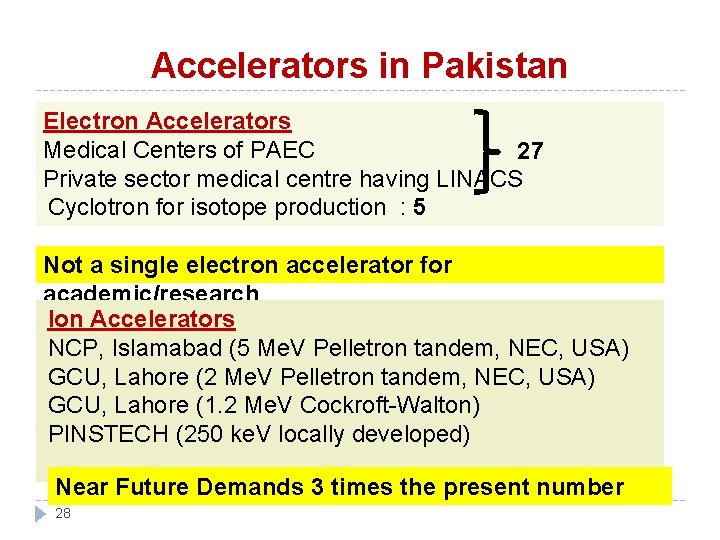
Accelerators in Pakistan Electron Accelerators Medical Centers of PAEC 27 Private sector medical centre having LINACS Cyclotron for isotope production : 5 Not a single electron accelerator for academic/research Ion Accelerators NCP, Islamabad (5 Me. V Pelletron tandem, NEC, USA) GCU, Lahore (2 Me. V Pelletron tandem, NEC, USA) GCU, Lahore (1. 2 Me. V Cockroft-Walton) PINSTECH (250 ke. V locally developed) Near Future Demands 3 times the present number 28
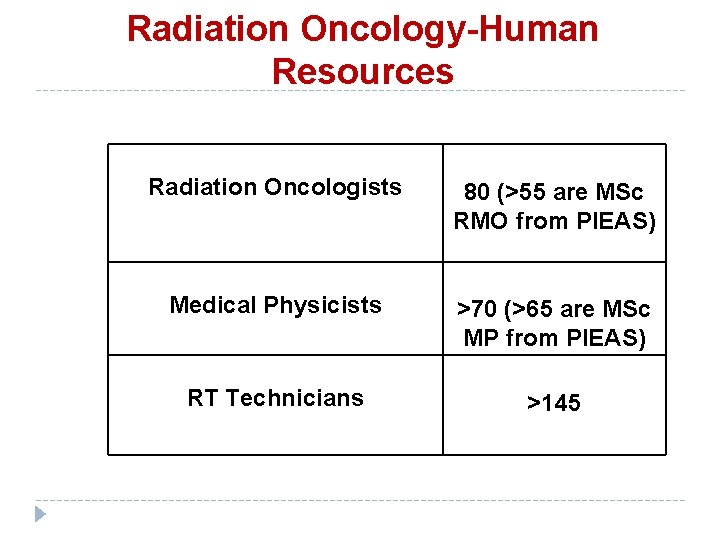
Radiation Oncology-Human Resources Radiation Oncologists 80 (>55 are MSc RMO from PIEAS) Medical Physicists >70 (>65 are MSc MP from PIEAS) RT Technicians >145
Future Actions
Completion of Indigenous Medical Linear Accelerator At PINSTECH, Islamabad
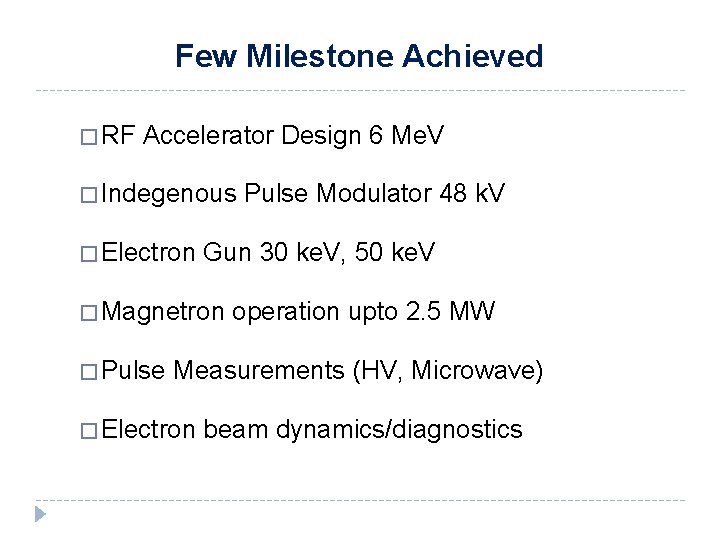
Few Milestone Achieved � RF Accelerator Design 6 Me. V � Indegenous � Electron Gun 30 ke. V, 50 ke. V � Magnetron � Pulse Modulator 48 k. V operation upto 2. 5 MW Measurements (HV, Microwave) � Electron beam dynamics/diagnostics
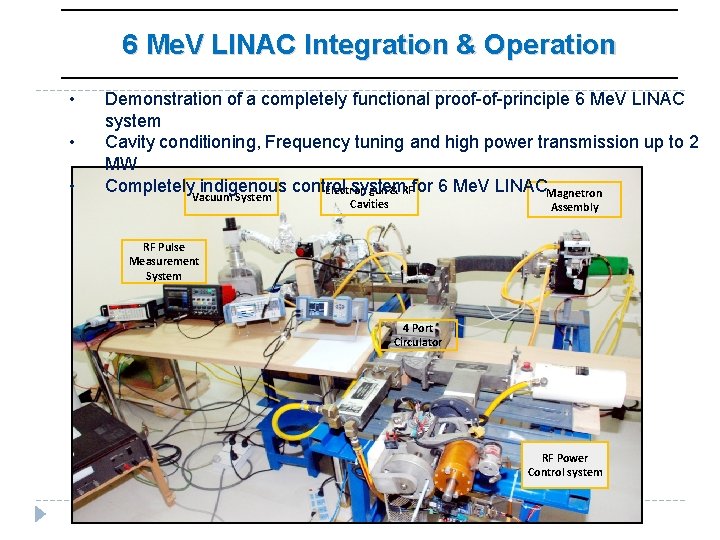
6 Me. V LINAC Integration & Operation • • • Demonstration of a completely functional proof-of-principle 6 Me. V LINAC system Cavity conditioning, Frequency tuning and high power transmission up to 2 MW Completely indigenous control system Electron gun & RFfor 6 Me. V LINACMagnetron Vacuum System Cavities Assembly RF Pulse Measurement System 4 Port Circulator RF Power Control system
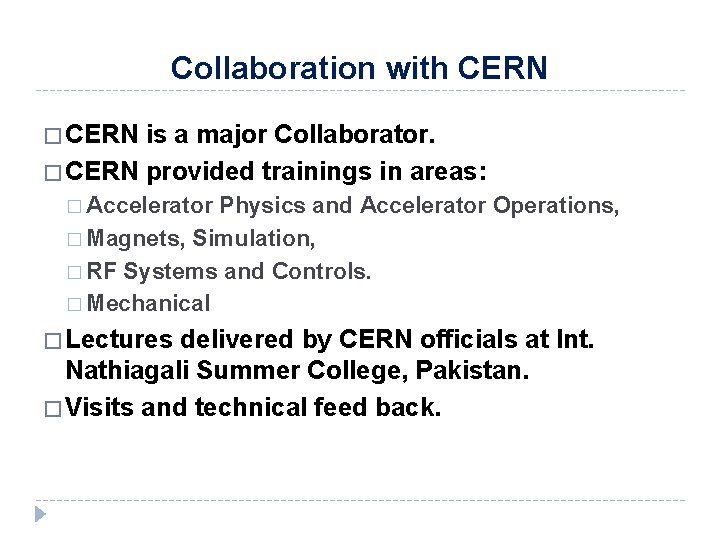
Collaboration with CERN � CERN is a major Collaborator. � CERN provided trainings in areas: � Accelerator Physics and Accelerator Operations, � Magnets, Simulation, � RF Systems and Controls. � Mechanical � Lectures delivered by CERN officials at Int. Nathiagali Summer College, Pakistan. � Visits and technical feed back.
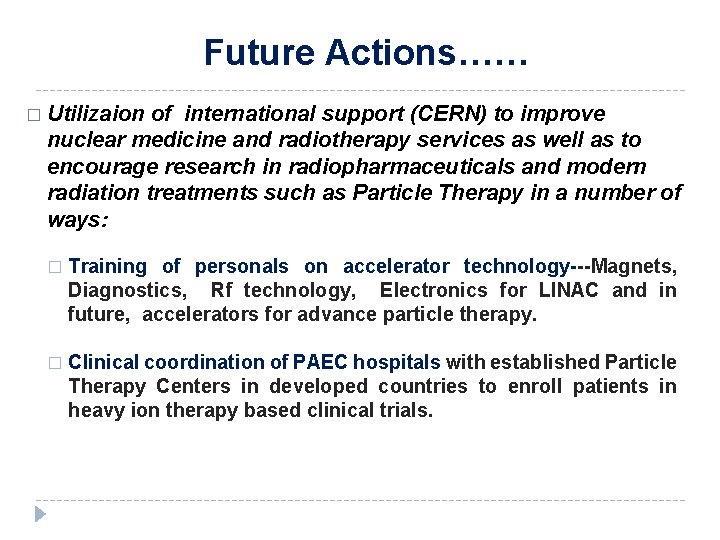
Future Actions…… � Utilizaion of international support (CERN) to improve nuclear medicine and radiotherapy services as well as to encourage research in radiopharmaceuticals and modern radiation treatments such as Particle Therapy in a number of ways: � Training of personals on accelerator technology---Magnets, Diagnostics, Rf technology, Electronics for LINAC and in future, accelerators for advance particle therapy. � Clinical coordination of PAEC hospitals with established Particle Therapy Centers in developed countries to enroll patients in heavy ion therapy based clinical trials.
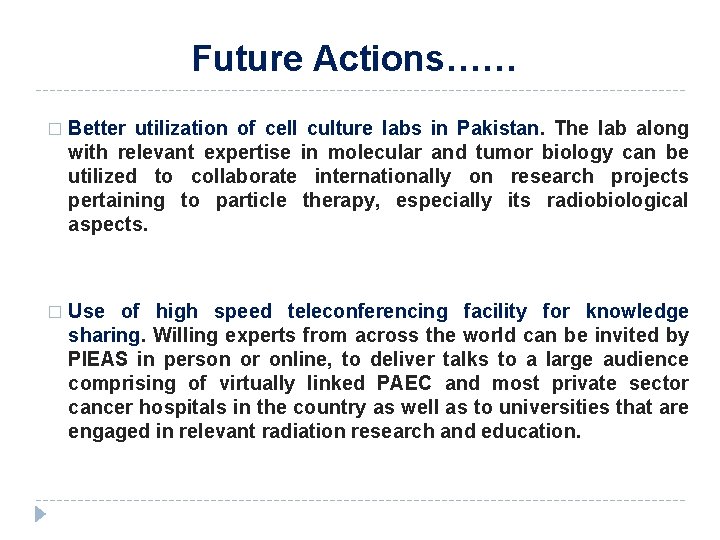
Future Actions…… � Better utilization of cell culture labs in Pakistan. The lab along with relevant expertise in molecular and tumor biology can be utilized to collaborate internationally on research projects pertaining to particle therapy, especially its radiobiological aspects. � Use of high speed teleconferencing facility for knowledge sharing. Willing experts from across the world can be invited by PIEAS in person or online, to deliver talks to a large audience comprising of virtually linked PAEC and most private sector cancer hospitals in the country as well as to universities that are engaged in relevant radiation research and education.
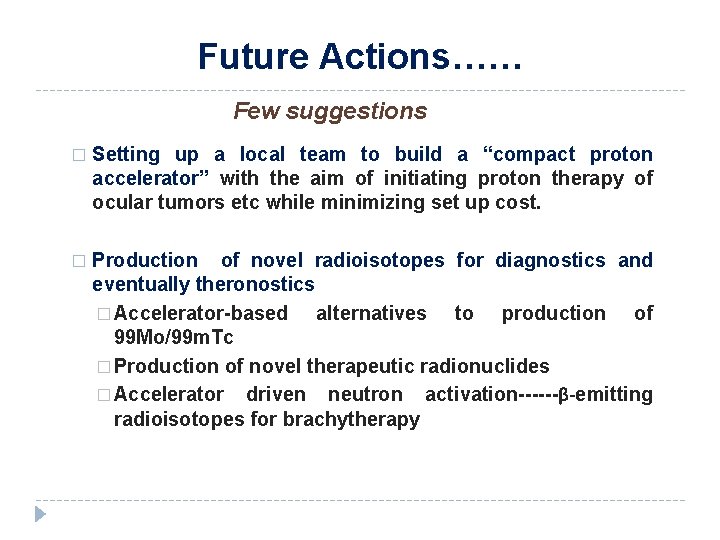
Future Actions…… Few suggestions � Setting up a local team to build a “compact proton accelerator” with the aim of initiating proton therapy of ocular tumors etc while minimizing set up cost. � Production of novel radioisotopes for diagnostics and eventually theronostics � Accelerator-based alternatives to production of 99 Mo/99 m. Tc � Production of novel therapeutic radionuclides � Accelerator driven neutron activation------β-emitting radioisotopes for brachytherapy
Summary and Conclusion � Pakistan has developed good nuclear medicine and radiotherapy programmes � It has a skilled and technology driven human resource � Adequate infrastructure for promotion of NM and Radiation Oncology � A will to provide best and latest health care to the people for improving the quality of life in Pakistan CERN Support in our Future Actions/Strategy
THANK YOU