CS 61 C Great Ideas in Computer Architecture
- Slides: 52
CS 61 C: Great Ideas in Computer Architecture Lecture 2: Numbers & C Language Prof. Yuanqing Cheng http: //www. cadetlab. cn/sp 18. html
Agenda • Numbers wrap-up • This is not on the exam! • Break • C Primer • Administrivia, Break • C Type declarations • And in Conclusion, … 2/23/2021 Spring 2018 - Lecture #2 2
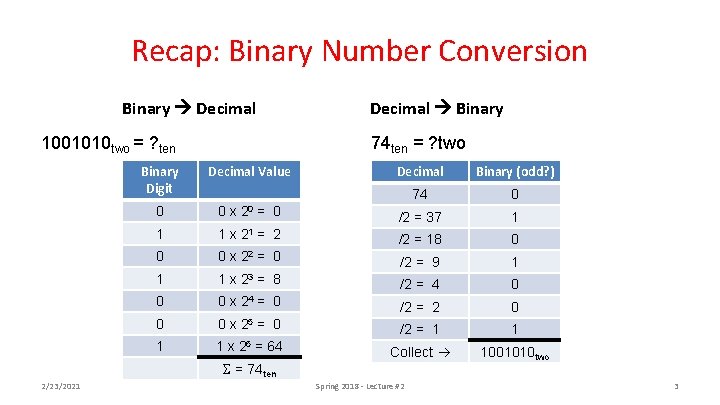
Recap: Binary Number Conversion Binary Decimal Binary 1001010 two = ? ten 74 ten = ? two Binary Digit Decimal Value 0 1 Decimal Binary (odd? ) 74 0 0 x 20 = 0 /2 = 37 1 1 x 21 = 2 /2 = 18 0 0 x 22 = 0 /2 = 9 1 1 x 23 = 8 /2 = 4 0 0 0 x 24 = 0 /2 = 2 0 0 0 x 25 = 0 /2 = 1 1 Collect 1001010 two 0 1 1 1 x 26 = 64 S = 74 ten 2/23/2021 Spring 2018 - Lecture #2 3
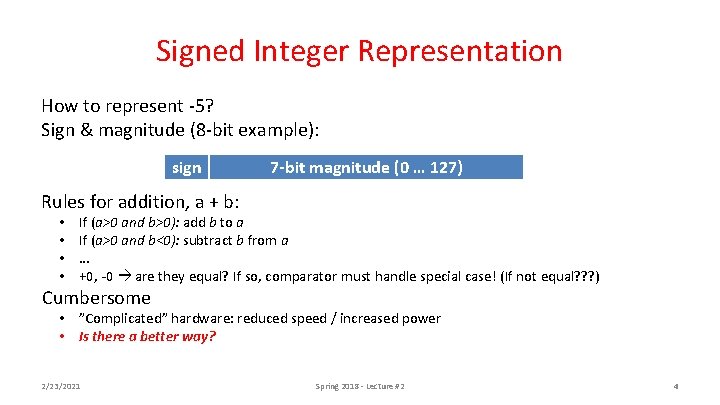
Signed Integer Representation How to represent -5? Sign & magnitude (8 -bit example): sign 7 -bit magnitude (0 … 127) Rules for addition, a + b: • • If (a>0 and b>0): add b to a If (a>0 and b<0): subtract b from a … +0, -0 are they equal? If so, comparator must handle special case! (If not equal? ? ? ) Cumbersome • ”Complicated” hardware: reduced speed / increased power • Is there a better way? 2/23/2021 Spring 2018 - Lecture #2 4
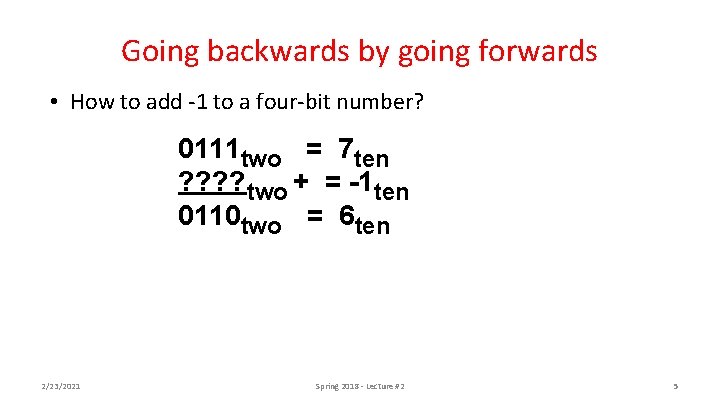
Going backwards by going forwards • How to add -1 to a four-bit number? 0111 two = 7 ten ? ? two + = -1 ten 0110 two = 6 ten 2/23/2021 Spring 2018 - Lecture #2 5
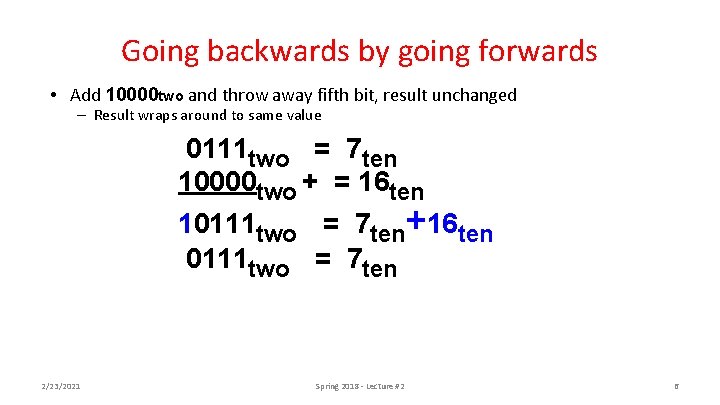
Going backwards by going forwards • Add 10000 two and throw away fifth bit, result unchanged – Result wraps around to same value 0111 two = 7 ten 10000 two + = 16 ten 10111 two = 7 ten+16 ten 0111 two = 7 ten 2/23/2021 Spring 2018 - Lecture #2 6
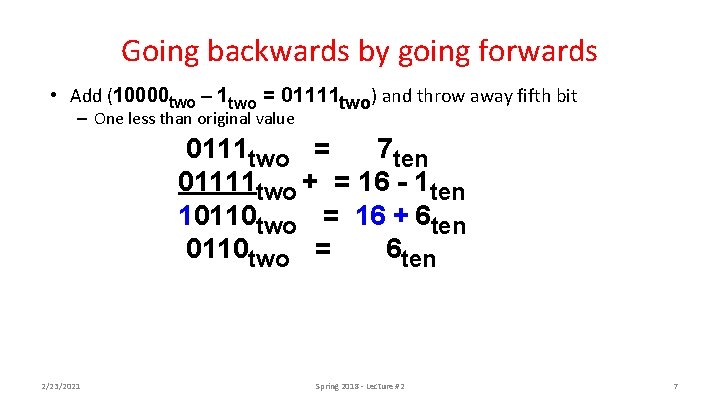
Going backwards by going forwards • Add (10000 two – 1 two = 01111 two) and throw away fifth bit – One less than original value 0111 two = 7 ten 01111 two + = 16 - 1 ten 10110 two = 16 + 6 ten 0110 two = 6 ten 2/23/2021 Spring 2018 - Lecture #2 7
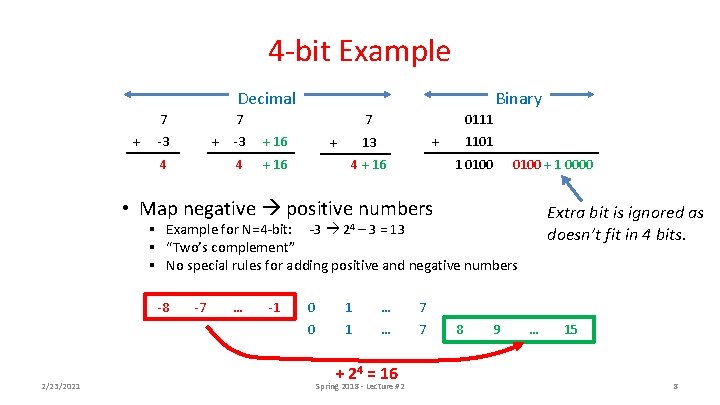
4 -bit Example Decimal 7 + Binary 7 -3 + 4 0111 7 -3 + 16 4 + 16 + + 13 1101 1 0100 4 + 16 0100 + 1 0000 • Map negative positive numbers Extra bit is ignored as doesn’t fit in 4 bits. 24 – § Example for N=4 -bit: -3 3 = 13 § “Two’s complement” § No special rules for adding positive and negative numbers -8 2/23/2021 -7 … -1 0 1 … 7 + 24 = 16 Spring 2018 - Lecture #2 8 9 … 15 8
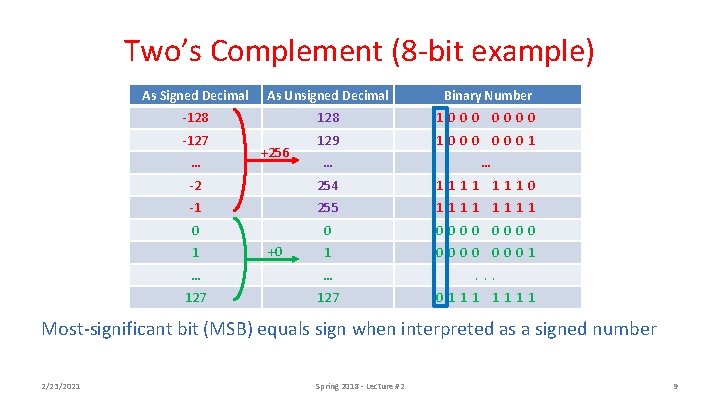
Two’s Complement (8 -bit example) As Signed Decimal As Unsigned Decimal Binary Number -128 1000 0000 129 1000 0001 … … -2 254 1111 1110 -1 255 1111 0 0 0000 1 0000 0001 … … . . . 127 0111 1111 -127 … 1 +256 +0 Most-significant bit (MSB) equals sign when interpreted as a signed number 2/23/2021 Spring 2018 - Lecture #2 9
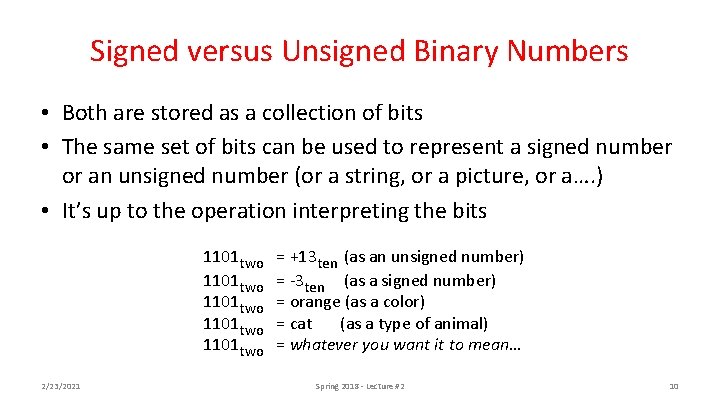
Signed versus Unsigned Binary Numbers • Both are stored as a collection of bits • The same set of bits can be used to represent a signed number or an unsigned number (or a string, or a picture, or a…. ) • It’s up to the operation interpreting the bits 1101 two 1101 two 2/23/2021 = +13 ten (as an unsigned number) = -3 ten (as a signed number) = orange (as a color) = cat (as a type of animal) = whatever you want it to mean… Spring 2018 - Lecture #2 10
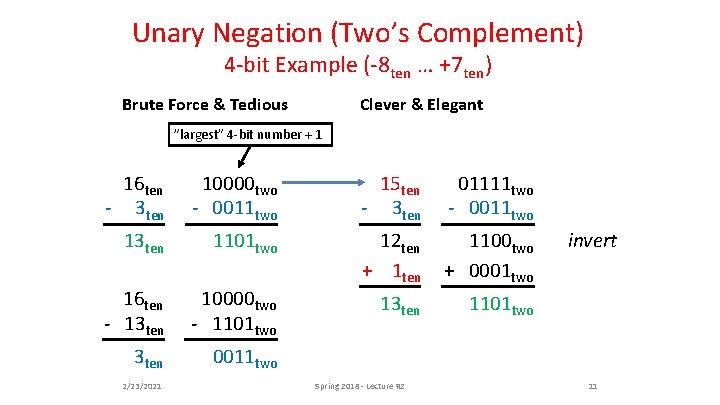
Unary Negation (Two’s Complement) 4 -bit Example (-8 ten … +7 ten) Brute Force & Tedious Clever & Elegant ”largest” 4 -bit number + 1 16 ten - 3 ten 10000 two - 0011 two 15 ten - 3 ten 01111 two - 0011 two 13 ten 1101 two 16 ten - 13 ten 10000 two - 1101 two 12 ten + 1 ten 1100 two + 0001 two 13 ten 1101 two 3 ten 0011 two 2/23/2021 Spring 2018 - Lecture #2 invert 11
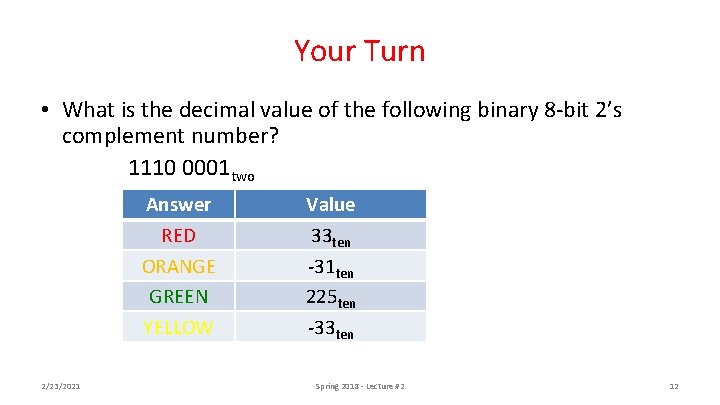
Your Turn • What is the decimal value of the following binary 8 -bit 2’s complement number? 1110 0001 two Answer RED ORANGE GREEN YELLOW 2/23/2021 Value 33 ten -31 ten 225 ten -33 ten Spring 2018 - Lecture #2 12
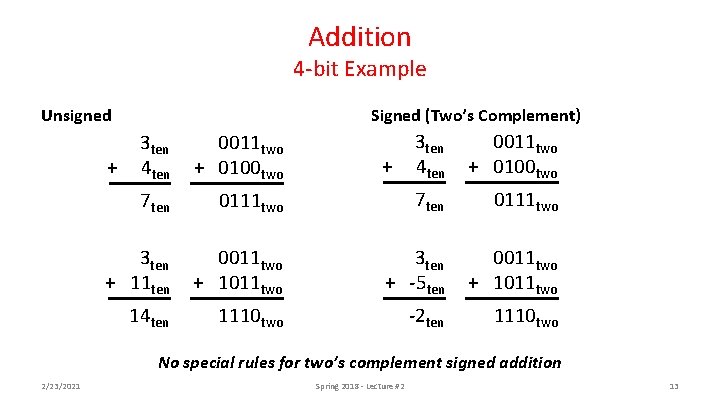
Addition 4 -bit Example Unsigned Signed (Two’s Complement) 3 ten 4 ten 0011 two + 0100 two 0111 two 7 ten 0111 two 3 ten + 11 ten 0011 two + 1011 two 3 ten + -5 ten 0011 two + 1011 two 14 ten 1110 two -2 ten 1110 two + 3 ten 4 ten 0011 two + 0100 two 7 ten + No special rules for two’s complement signed addition 2/23/2021 Spring 2018 - Lecture #2 13
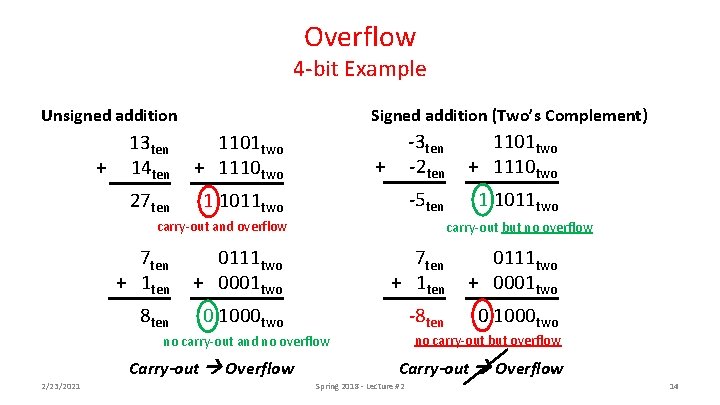
Overflow 4 -bit Example Unsigned addition + Signed addition (Two’s Complement) 13 ten 14 ten 1101 two + 1110 two 27 ten 1 1011 two + -3 ten -2 ten 1101 two + 1110 two -5 ten 1 1011 two carry-out and overflow carry-out but no overflow 7 ten + 1 ten 0111 two + 0001 two 8 ten 0 1000 two -8 ten 0 1000 two no carry-out but overflow no carry-out and no overflow Carry-out Overflow 2/23/2021 Carry-out Overflow Spring 2018 - Lecture #2 14
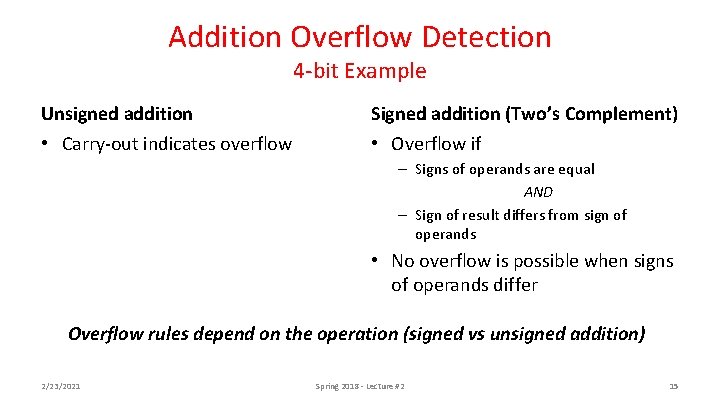
Addition Overflow Detection 4 -bit Example Unsigned addition • Carry-out indicates overflow Signed addition (Two’s Complement) • Overflow if – Signs of operands are equal AND – Sign of result differs from sign of operands • No overflow is possible when signs of operands differ Overflow rules depend on the operation (signed vs unsigned addition) 2/23/2021 Spring 2018 - Lecture #2 15
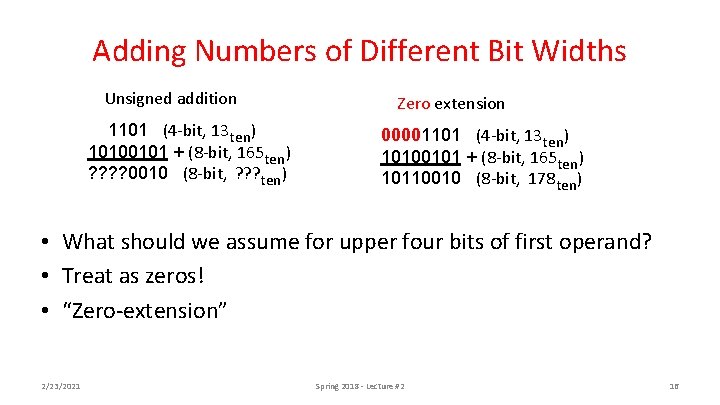
Adding Numbers of Different Bit Widths Unsigned addition 1101 (4 -bit, 13 ten) 10100101 + (8 -bit, 165 ten) ? ? 0010 (8 -bit, ? ? ? ten) Zero extension 00001101 (4 -bit, 13 ten) 10100101 + (8 -bit, 165 ten) 10110010 (8 -bit, 178 ten) • What should we assume for upper four bits of first operand? • Treat as zeros! • “Zero-extension” 2/23/2021 Spring 2018 - Lecture #2 16
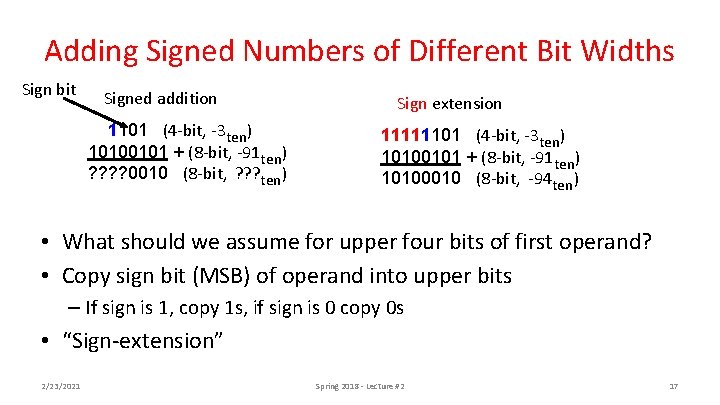
Adding Signed Numbers of Different Bit Widths Sign bit Signed addition 1101 (4 -bit, -3 ten) 10100101 + (8 -bit, -91 ten) ? ? 0010 (8 -bit, ? ? ? ten) Sign extension 11111101 (4 -bit, -3 ten) 10100101 + (8 -bit, -91 ten) 10100010 (8 -bit, -94 ten) • What should we assume for upper four bits of first operand? • Copy sign bit (MSB) of operand into upper bits – If sign is 1, copy 1 s, if sign is 0 copy 0 s • “Sign-extension” 2/23/2021 Spring 2018 - Lecture #2 17
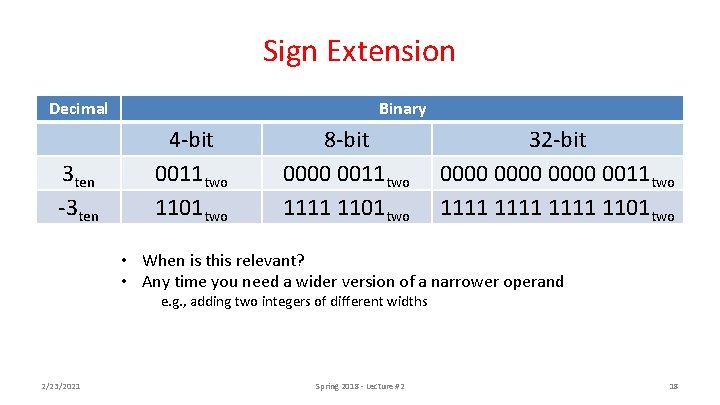
Sign Extension Decimal 3 ten -3 ten Binary 4 -bit 0011 two 1101 two 8 -bit 0000 0011 two 1111 1101 two 32 -bit 0000 0011 two 1111 1101 two • When is this relevant? • Any time you need a wider version of a narrower operand e. g. , adding two integers of different widths 2/23/2021 Spring 2018 - Lecture #2 18
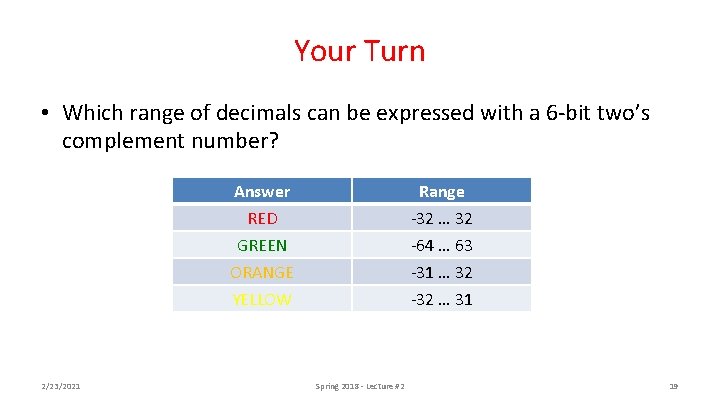
Your Turn • Which range of decimals can be expressed with a 6 -bit two’s complement number? Answer RED GREEN ORANGE YELLOW 2/23/2021 Range -32 … 32 -64 … 63 -31 … 32 -32 … 31 Spring 2018 - Lecture #2 19
Agenda • • Numbers wrap-up This is not on the exam! Break C Primer Administrivia, Break C Type declarations And in Conclusion, … 2/23/2021 Spring 2018 - Lecture #2 20
Hot. Chips 2017: Brains & Dinosaurs • Top conference introducing new processor chips 2/23/2021 21 Spring 2018 - Lecture #2
Spring 2018 - Lecture #2 2/23/2021 22
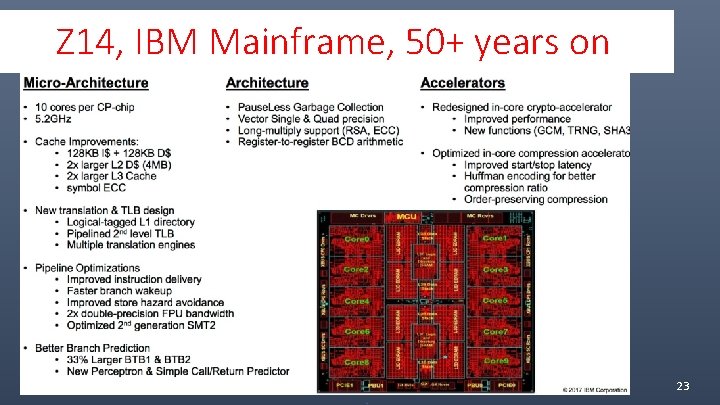
Z 14, IBM Mainframe, 50+ years on 2/23/2021 23 Spring 2018 - Lecture #2
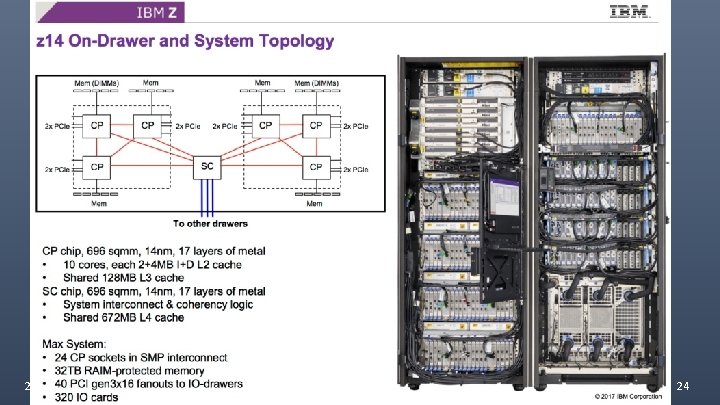
Spring 2018 - Lecture #2 2/23/2021 24
Break! 2/23/2021 Spring 2018 - Lecture #2 25
Agenda • Numbers wrap-up • This is not on the exam! • Break • C Primer • Administrivia, Break • C Type declarations • And in Conclusion, … 2/23/2021 Spring 2018 - Lecture #2 26
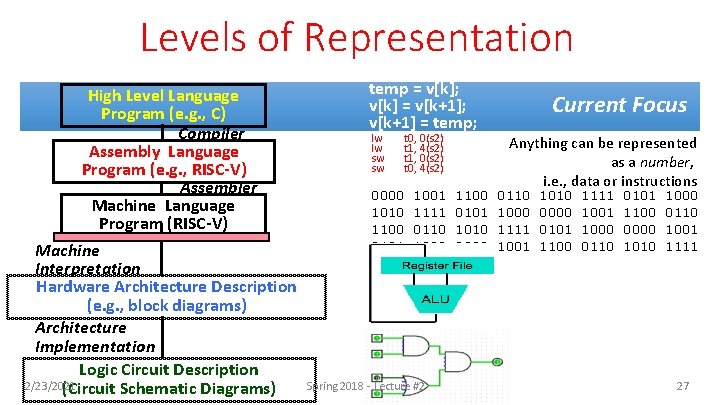
Levels of Representation High Level Language Program (e. g. , C) Compiler Assembly Language Program (e. g. , RISC-V) Assembler Machine Language Program (RISC-V) Machine Interpretation Hardware Architecture Description (e. g. , block diagrams) Architecture Implementation Logic Circuit Description 2/23/2021 (Circuit Schematic Diagrams) temp = v[k]; v[k] = v[k+1]; v[k+1] = temp; lw lw sw sw t 0, 0(s 2) t 1, 4(s 2) t 1, 0(s 2) t 0, 4(s 2) 0000 1010 1100 0101 1001 1111 0110 1000 Spring 2018 - Lecture #2 1100 0101 1010 0000 Current Focus Anything can be represented as a number, i. e. , data or instructions 0110 1000 1111 1001 1010 0000 0101 1100 1111 1000 0110 0101 1100 0000 1010 1000 0110 1001 1111 27
Introduction to C “The Universal Assembly Language” • Languages used in 61 C: • C • Assembly • Python used in two labs • Prior programming experience helpful, e. g. • Java • C++ 2/23/2021 Spring 2018 - Lecture #2 28
Survey Who has never written a program in Java or C, C++, Objective-C ? 2/23/2021 Spring 2018 - Lecture #2 29
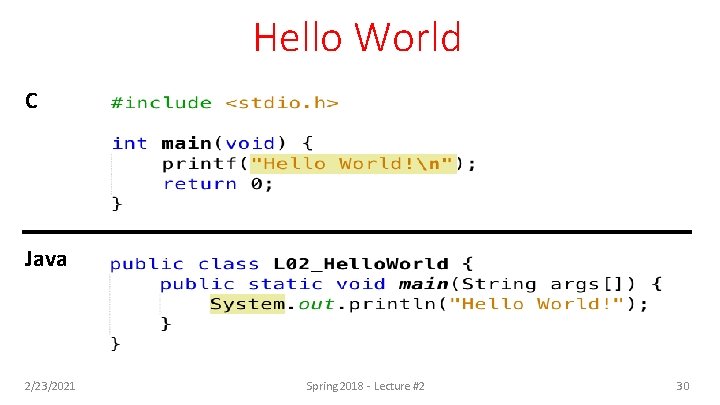
Hello World C Java 2/23/2021 Spring 2018 - Lecture #2 30
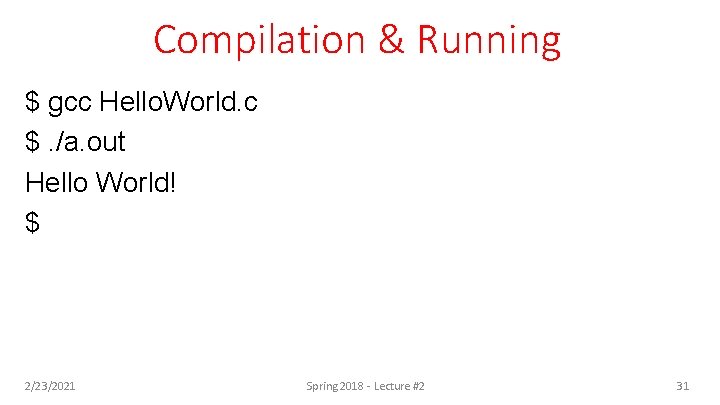
Compilation & Running $ gcc Hello. World. c $. /a. out Hello World! $ 2/23/2021 Spring 2018 - Lecture #2 31
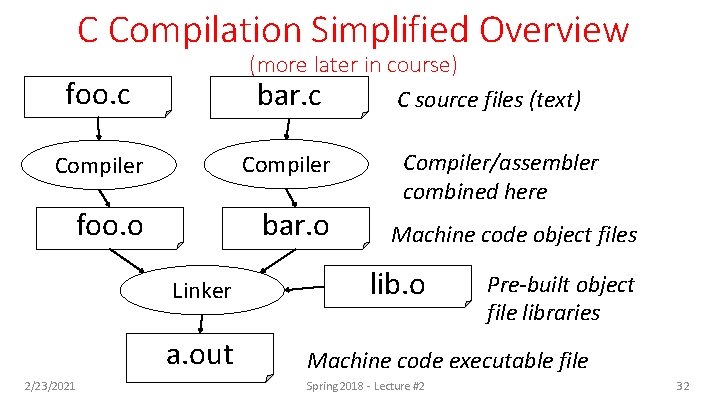
C Compilation Simplified Overview (more later in course) bar. c C source files (text) foo. c Compiler foo. o bar. o Linker a. out 2/23/2021 Compiler/assembler combined here Machine code object files lib. o Pre-built object file libraries Machine code executable file Spring 2018 - Lecture #2 32
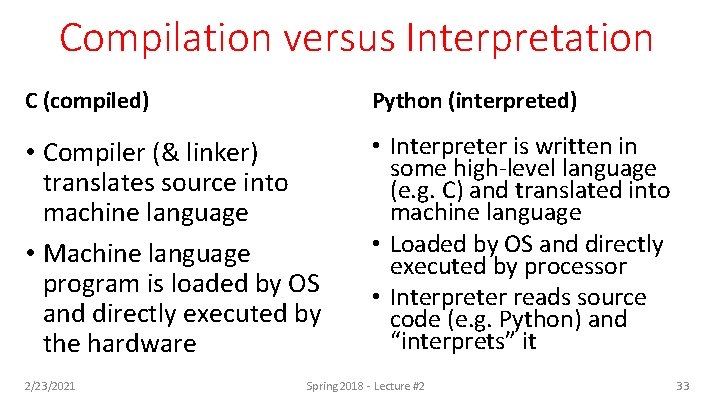
Compilation versus Interpretation C (compiled) Python (interpreted) • Compiler (& linker) translates source into machine language • Machine language program is loaded by OS and directly executed by the hardware • Interpreter is written in some high-level language (e. g. C) and translated into machine language • Loaded by OS and directly executed by processor • Interpreter reads source code (e. g. Python) and “interprets” it 2/23/2021 Spring 2018 - Lecture #2 33
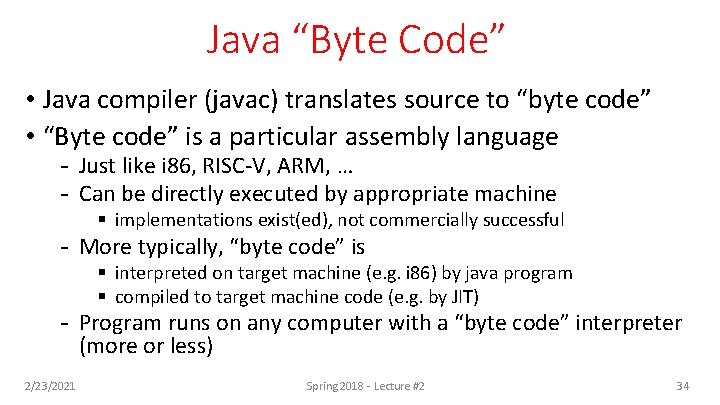
Java “Byte Code” • Java compiler (javac) translates source to “byte code” • “Byte code” is a particular assembly language - Just like i 86, RISC-V, ARM, … - Can be directly executed by appropriate machine § implementations exist(ed), not commercially successful - More typically, “byte code” is § interpreted on target machine (e. g. i 86) by java program § compiled to target machine code (e. g. by JIT) - Program runs on any computer with a “byte code” interpreter (more or less) 2/23/2021 Spring 2018 - Lecture #2 34
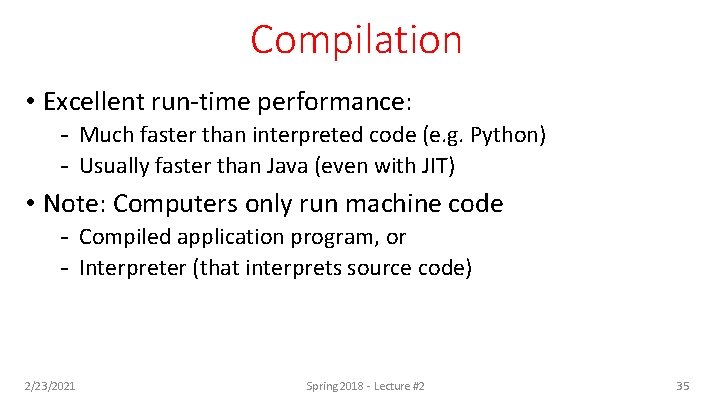
Compilation • Excellent run-time performance: - Much faster than interpreted code (e. g. Python) - Usually faster than Java (even with JIT) • Note: Computers only run machine code - Compiled application program, or - Interpreter (that interprets source code) 2/23/2021 Spring 2018 - Lecture #2 35
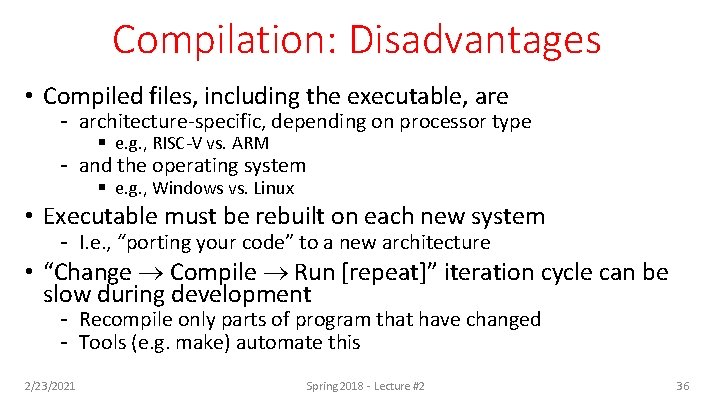
Compilation: Disadvantages • Compiled files, including the executable, are - architecture-specific, depending on processor type § e. g. , RISC-V vs. ARM - and the operating system § e. g. , Windows vs. Linux • Executable must be rebuilt on each new system - I. e. , “porting your code” to a new architecture • “Change Compile Run [repeat]” iteration cycle can be slow during development - Recompile only parts of program that have changed - Tools (e. g. make) automate this 2/23/2021 Spring 2018 - Lecture #2 36
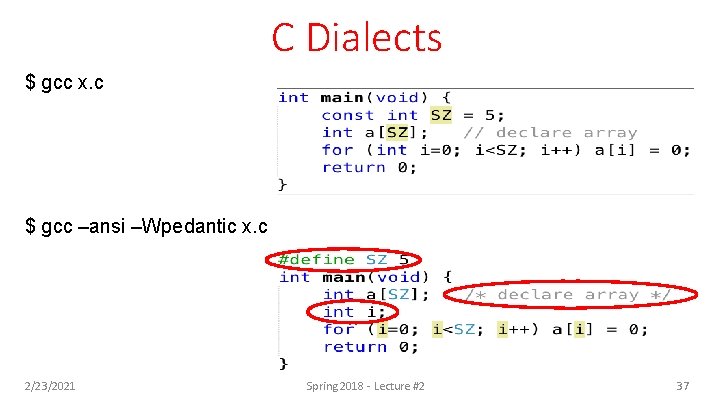
C Dialects $ gcc x. c $ gcc –ansi –Wpedantic x. c 2/23/2021 Spring 2018 - Lecture #2 37
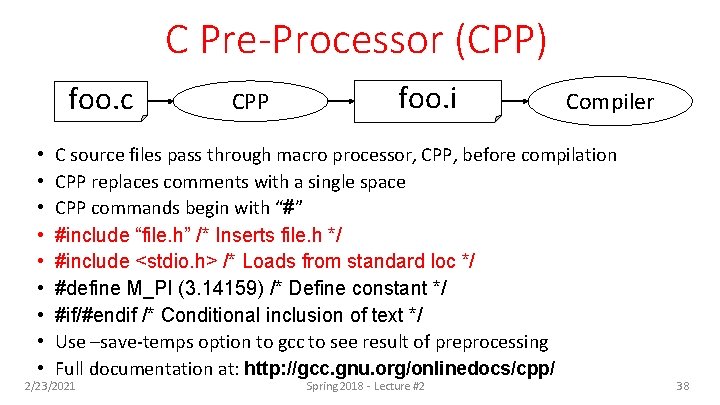
C Pre-Processor (CPP) foo. c • • • CPP foo. i Compiler C source files pass through macro processor, CPP, before compilation CPP replaces comments with a single space CPP commands begin with “#” #include “file. h” /* Inserts file. h */ #include <stdio. h> /* Loads from standard loc */ #define M_PI (3. 14159) /* Define constant */ #if/#endif /* Conditional inclusion of text */ Use –save-temps option to gcc to see result of preprocessing Full documentation at: http: //gcc. gnu. org/onlinedocs/cpp/ 2/23/2021 Spring 2018 - Lecture #2 38
Agenda • Numbers wrap-up • This is not on the exam! • Break • C Primer • Administrivia, Break • C Type declarations • And in Conclusion, … 2/23/2021 Spring 2018 - Lecture #2 39
Administratrivia • Notify me whether you choose this course or not • Labroom and Lab schedule TBD - see http: //www. cadetlab. cn/sp 18. html 2/23/2021 Spring 2018 - Lecture #2 40
Break! 2/23/2021 Spring 2018 - Lecture #2 41
Agenda • Numbers wrap-up • This is not on the exam! • Break • C Primer • Administrivia, Break • C Type declarations • And in Conclusion, … 2/23/2021 Spring 2018 - Lecture #2 42
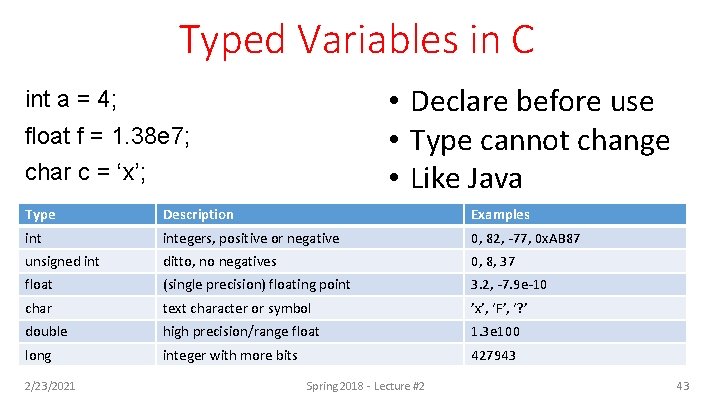
Typed Variables in C • Declare before use • Type cannot change • Like Java int a = 4; float f = 1. 38 e 7; char c = ‘x’; Type Description Examples integers, positive or negative 0, 82, -77, 0 x. AB 87 unsigned int ditto, no negatives 0, 8, 37 float (single precision) floating point 3. 2, -7. 9 e-10 char text character or symbol ’x’, ‘F’, ‘? ’ double high precision/range float 1. 3 e 100 long integer with more bits 427943 2/23/2021 Spring 2018 - Lecture #2 43
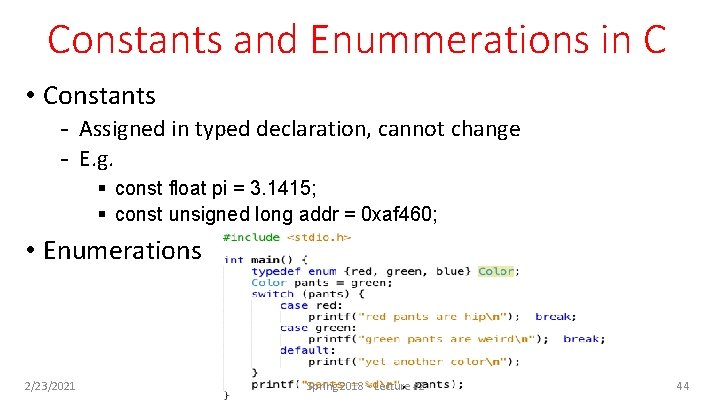
Constants and Enummerations in C • Constants - Assigned in typed declaration, cannot change - E. g. § const float pi = 3. 1415; § const unsigned long addr = 0 xaf 460; • Enumerations 2/23/2021 Spring 2018 - Lecture #2 44
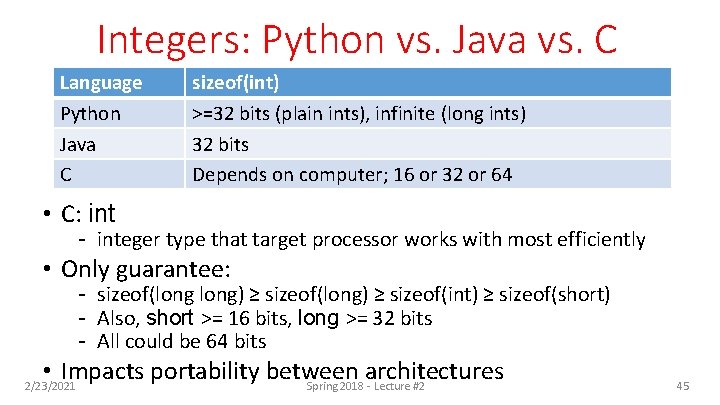
Integers: Python vs. Java vs. C Language Python Java C sizeof(int) >=32 bits (plain ints), infinite (long ints) 32 bits Depends on computer; 16 or 32 or 64 • C: int - integer type that target processor works with most efficiently • Only guarantee: - sizeof(long) ≥ sizeof(int) ≥ sizeof(short) - Also, short >= 16 bits, long >= 32 bits - All could be 64 bits • Impacts portability between architectures Spring 2018 - Lecture #2 2/23/2021 45
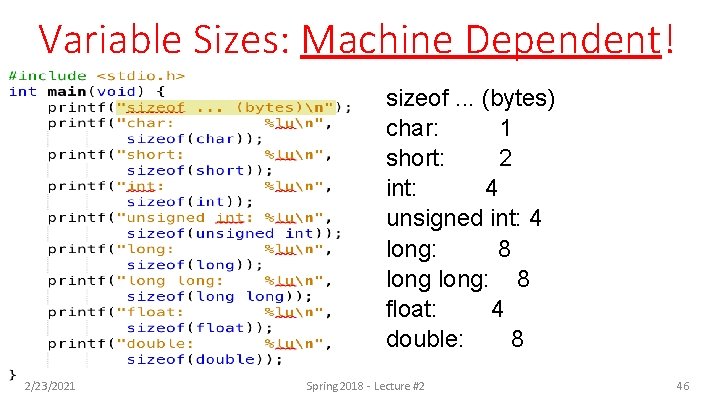
Variable Sizes: Machine Dependent! sizeof. . . (bytes) char: 1 short: 2 int: 4 unsigned int: 4 long: 8 float: 4 double: 8 2/23/2021 Spring 2018 - Lecture #2 46
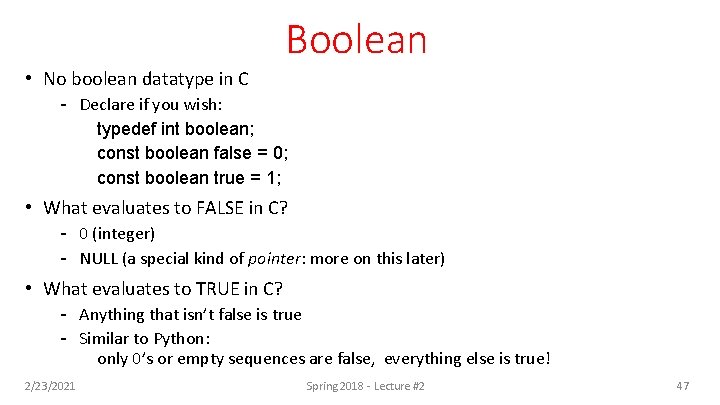
Boolean • No boolean datatype in C - Declare if you wish: typedef int boolean; const boolean false = 0; const boolean true = 1; • What evaluates to FALSE in C? - 0 (integer) - NULL (a special kind of pointer: more on this later) • What evaluates to TRUE in C? - Anything that isn’t false is true - Similar to Python: only 0’s or empty sequences are false, everything else is true! 2/23/2021 Spring 2018 - Lecture #2 47
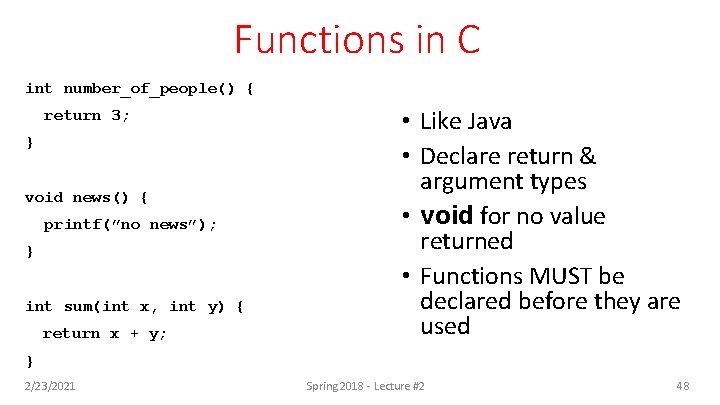
Functions in C int number_of_people() { return 3; } void news() { printf(”no news”); } int sum(int x, int y) { return x + y; • Like Java • Declare return & argument types • void for no value returned • Functions MUST be declared before they are used } 2/23/2021 Spring 2018 - Lecture #2 48
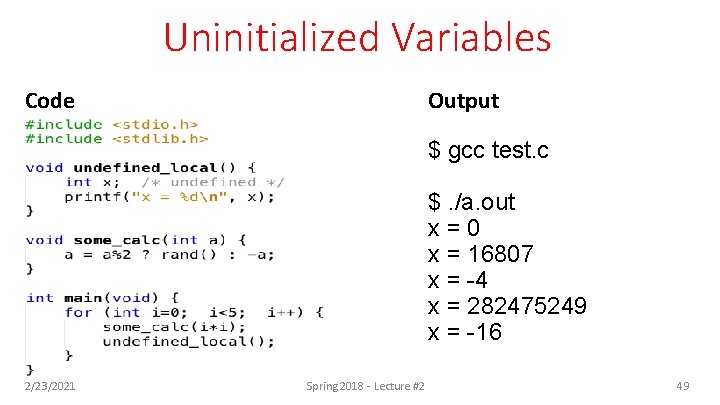
Uninitialized Variables Code Output $ gcc test. c $. /a. out x=0 x = 16807 x = -4 x = 282475249 x = -16 2/23/2021 Spring 2018 - Lecture #2 49
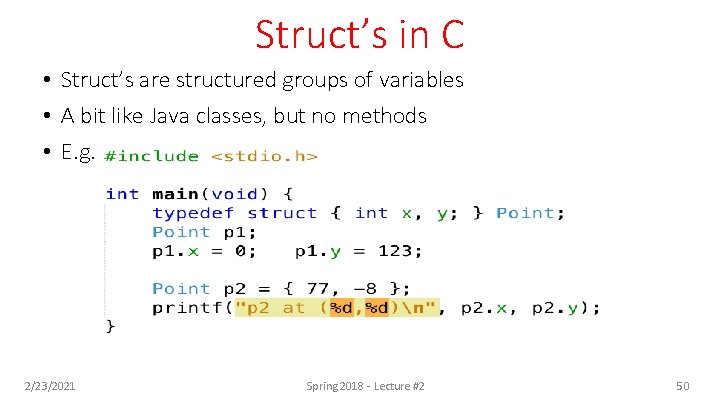
Struct’s in C • Struct’s are structured groups of variables • A bit like Java classes, but no methods • E. g. 2/23/2021 Spring 2018 - Lecture #2 50
More C … • Lecture does not cover C completely - You’ll still need your C reference for this course - K&R, The C Programming Language - & other references on the course website • Next few lectures’ focus: - Pointers & Arrays - Memory management 2/23/2021 Spring 2018 - Lecture #2 51
And In Conclusion, … • Signed integers represented in 2’s complement • C Programming Language - Popular (still!) - Similar to Java, but § no classes § explicit pointers (next lecture) - Beware § variables not initialized § variable size (# of bits) is machine & compiler dependent • C is compiled to machine code - Unlike Python or Java, which are interpreted - Compilation is faster than interpretation 2/23/2021 Spring 2018 - Lecture #2 52