
CS 61 C Great Ideas in Computer Architecture
- Slides: 33
CS 61 C: Great Ideas in Computer Architecture Open. MP, Part II Instructor: Krste Asanovic, Randy H. Katz http: //inst. eecs. Berkeley. edu/~cs 61 c/fa 12 11/30/2020 Fall 2012 -- Lecture #21 1
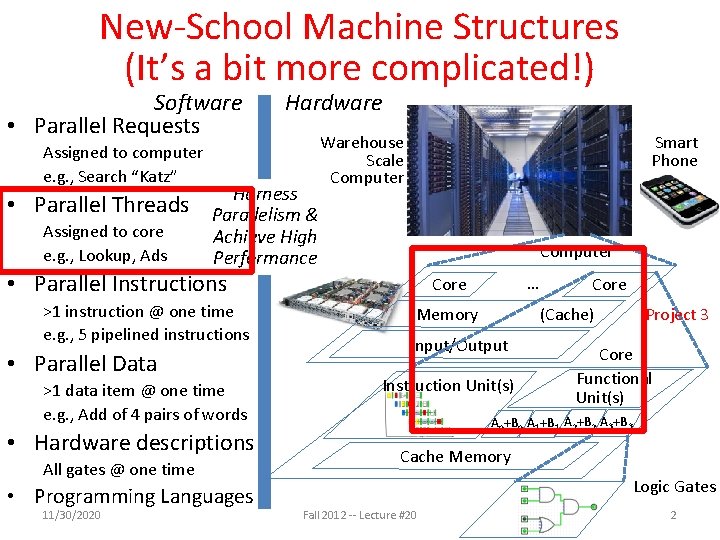
New-School Machine Structures (It’s a bit more complicated!) Software • Parallel Requests Assigned to computer e. g. , Search “Katz” • Parallel Threads Assigned to core e. g. , Lookup, Ads Hardware Harness Parallelism & Achieve High Performance Smart Phone Warehouse Scale Computer • Parallel Instructions >1 instruction @ one time e. g. , 5 pipelined instructions • Parallel Data >1 data item @ one time e. g. , Add of 4 pairs of words • Hardware descriptions All gates @ one time • Programming Languages 11/30/2020 … Core Memory Core (Cache) Input/Output Instruction Unit(s) Project 3 Core Functional Unit(s) A 0+B 0 A 1+B 1 A 2+B 2 A 3+B 3 Cache Memory Logic Gates Fall 2012 -- Lecture #20 2
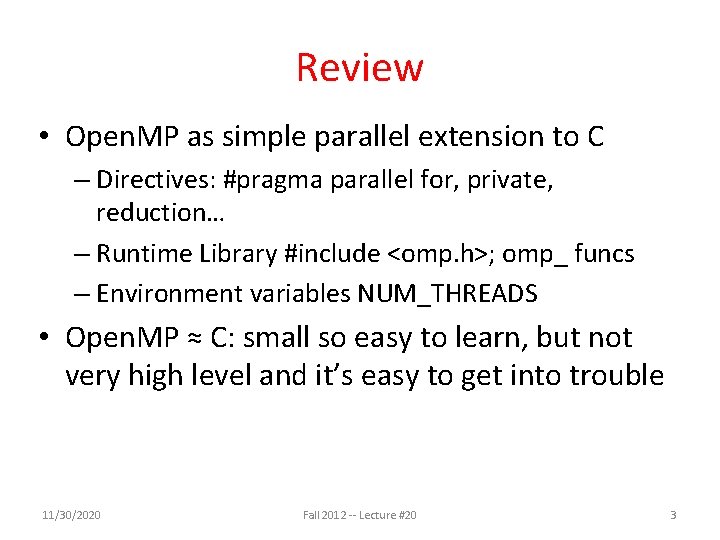
Review • Open. MP as simple parallel extension to C – Directives: #pragma parallel for, private, reduction… – Runtime Library #include <omp. h>; omp_ funcs – Environment variables NUM_THREADS • Open. MP ≈ C: small so easy to learn, but not very high level and it’s easy to get into trouble 11/30/2020 Fall 2012 -- Lecture #20 3
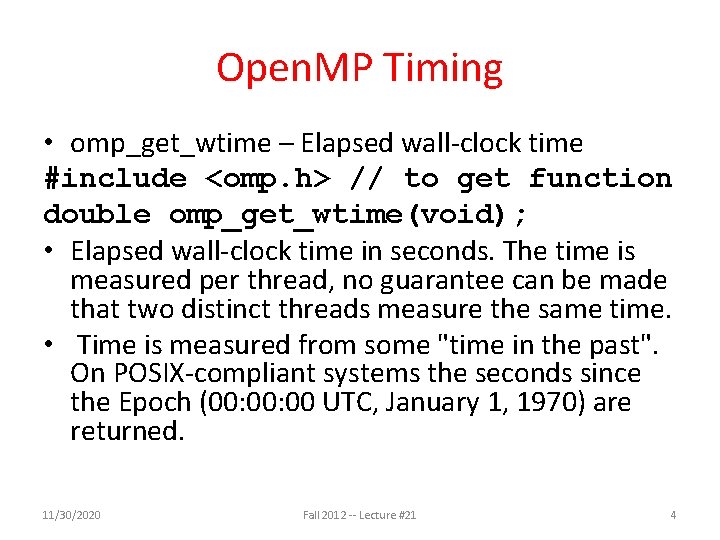
Open. MP Timing • omp_get_wtime – Elapsed wall-clock time #include <omp. h> // to get function double omp_get_wtime(void); • Elapsed wall-clock time in seconds. The time is measured per thread, no guarantee can be made that two distinct threads measure the same time. • Time is measured from some "time in the past". On POSIX-compliant systems the seconds since the Epoch (00: 00 UTC, January 1, 1970) are returned. 11/30/2020 Fall 2012 -- Lecture #21 4
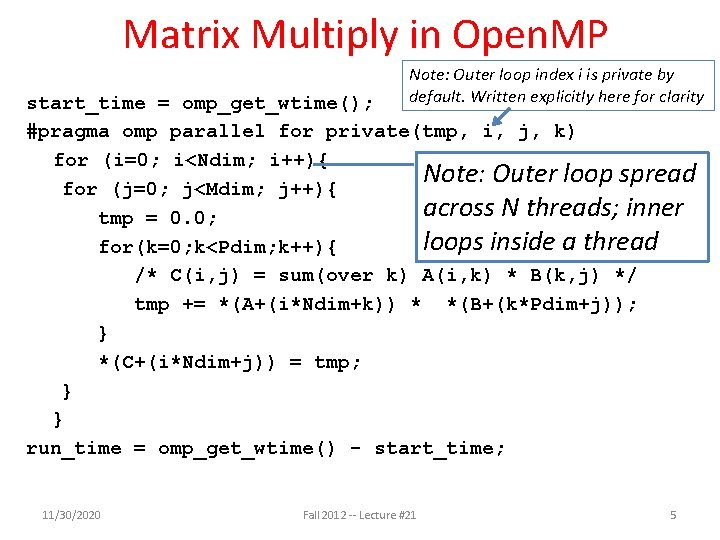
Matrix Multiply in Open. MP Note: Outer loop index i is private by default. Written explicitly here for clarity start_time = omp_get_wtime(); #pragma omp parallel for private(tmp, i, j, k) for (i=0; i<Ndim; i++){ Note: Outer loop spread for (j=0; j<Mdim; j++){ across N threads; inner tmp = 0. 0; loops inside a thread for(k=0; k<Pdim; k++){ /* C(i, j) = sum(over k) A(i, k) * B(k, j) */ tmp += *(A+(i*Ndim+k)) * *(B+(k*Pdim+j)); } *(C+(i*Ndim+j)) = tmp; } } run_time = omp_get_wtime() - start_time; 11/30/2020 Fall 2012 -- Lecture #21 5
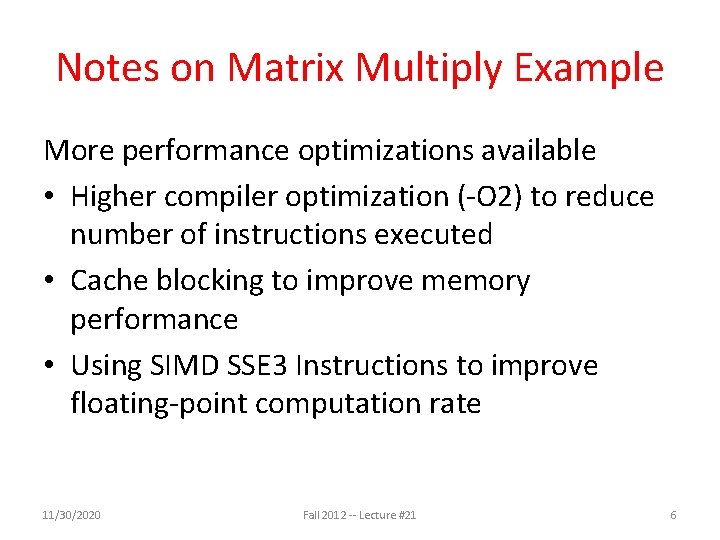
Notes on Matrix Multiply Example More performance optimizations available • Higher compiler optimization (-O 2) to reduce number of instructions executed • Cache blocking to improve memory performance • Using SIMD SSE 3 Instructions to improve floating-point computation rate 11/30/2020 Fall 2012 -- Lecture #21 6
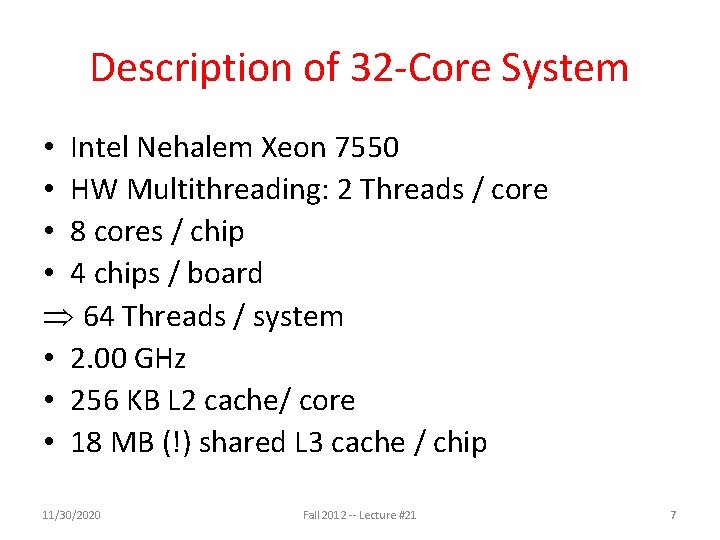
Description of 32 -Core System • Intel Nehalem Xeon 7550 • HW Multithreading: 2 Threads / core • 8 cores / chip • 4 chips / board 64 Threads / system • 2. 00 GHz • 256 KB L 2 cache/ core • 18 MB (!) shared L 3 cache / chip 11/30/2020 Fall 2012 -- Lecture #21 7
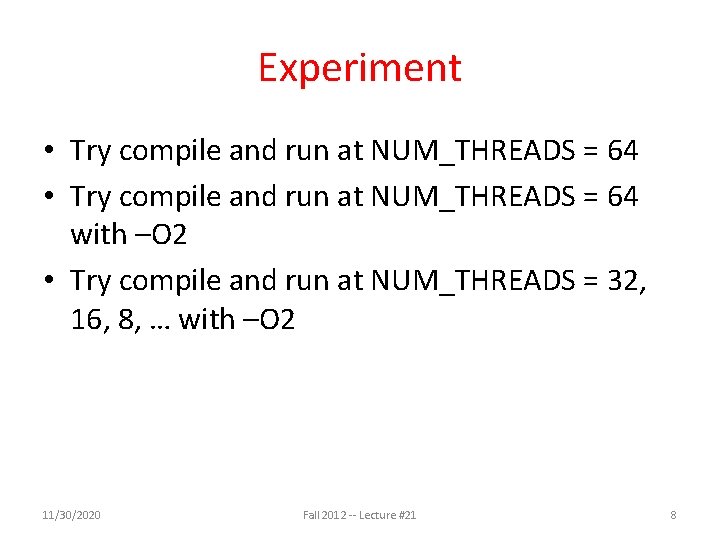
Experiment • Try compile and run at NUM_THREADS = 64 with –O 2 • Try compile and run at NUM_THREADS = 32, 16, 8, … with –O 2 11/30/2020 Fall 2012 -- Lecture #21 8
Review: Strong vs Weak Scaling • Strong scaling: problem size fixed • Weak scaling: problem size proportional to increase in number of processors – Speedup on multiprocessor while keeping problem size fixed is harder than speedup by increasing the size of the problem – But a natural use of a lot more performance is to solve a lot bigger problem Fall 2012 -- Lecture #21 11/30/2020 9
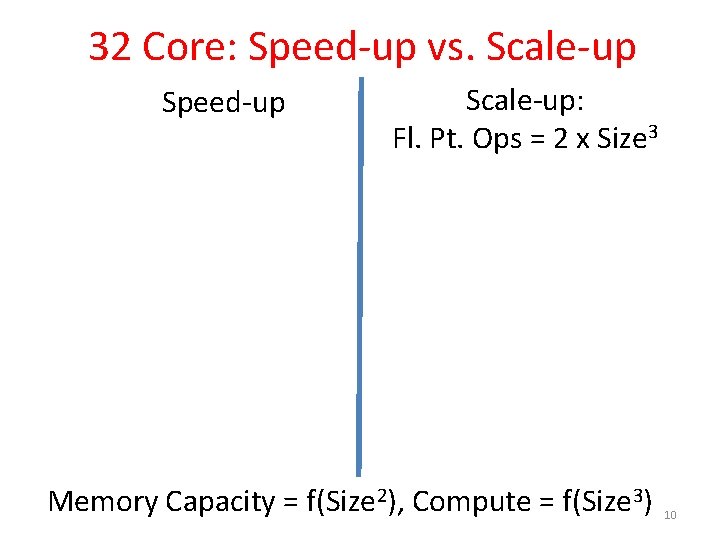
32 Core: Speed-up vs. Scale-up Speed-up Scale-up: Fl. Pt. Ops = 2 x Size 3 Memory Capacity = f(Size 2), Compute = f(Size 3) 11/30/2020 Fall 2012 -- Lecture #21 10
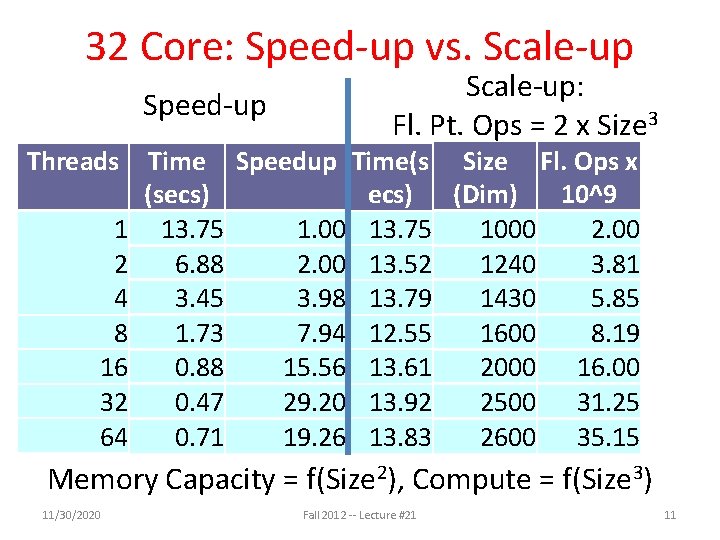
32 Core: Speed-up vs. Scale-up Speed-up Threads 1 2 4 8 16 32 64 Scale-up: Fl. Pt. Ops = 2 x Size 3 Time Speedup Time(s Size Fl. Ops x (secs) (Dim) 10^9 13. 75 1. 00 13. 75 1000 2. 00 6. 88 2. 00 13. 52 1240 3. 81 3. 45 3. 98 13. 79 1430 5. 85 1. 73 7. 94 12. 55 1600 8. 19 0. 88 15. 56 13. 61 2000 16. 00 0. 47 29. 20 13. 92 2500 31. 25 0. 71 19. 26 13. 83 2600 35. 15 Memory Capacity = f(Size 2), Compute = f(Size 3) 11/30/2020 Fall 2012 -- Lecture #21 11
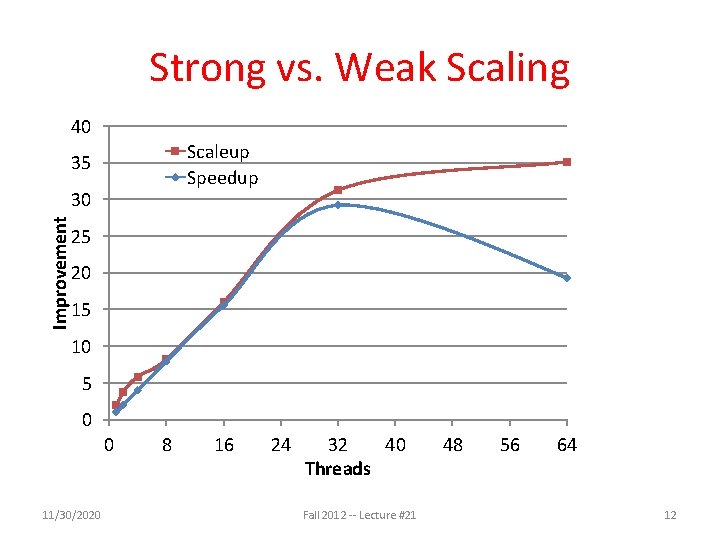
Strong vs. Weak Scaling 40 Scaleup Speedup 35 Improvement 30 25 20 15 10 5 0 0 11/30/2020 8 16 24 32 40 Threads Fall 2012 -- Lecture #21 48 56 64 12
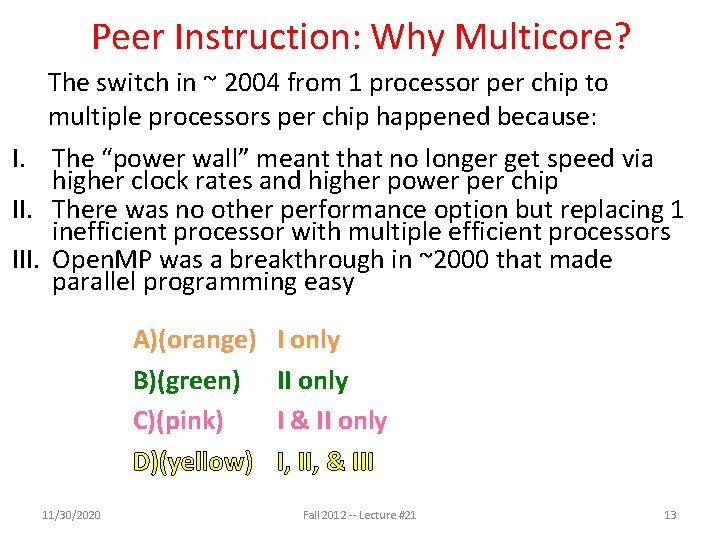
Peer Instruction: Why Multicore? The switch in ~ 2004 from 1 processor per chip to multiple processors per chip happened because: I. The “power wall” meant that no longer get speed via higher clock rates and higher power per chip II. There was no other performance option but replacing 1 inefficient processor with multiple efficient processors III. Open. MP was a breakthrough in ~2000 that made parallel programming easy A)(orange) B)(green) C)(pink) D)(yellow) 11/30/2020 I only I & II only I, II, & III Fall 2012 -- Lecture #21 13
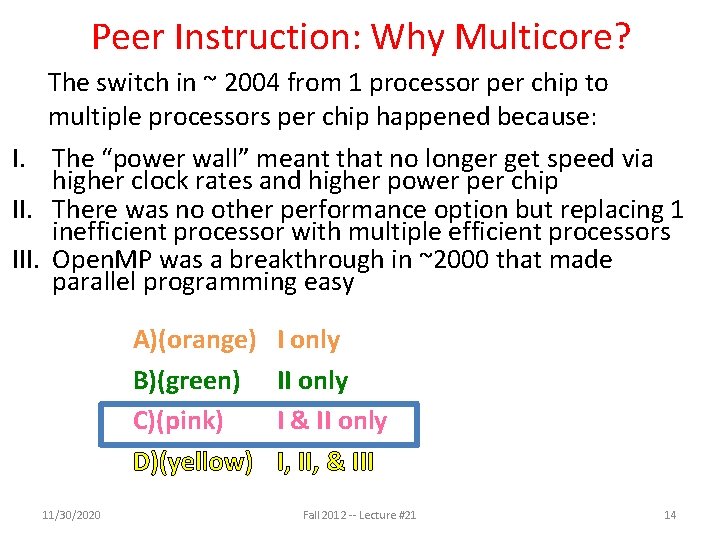
Peer Instruction: Why Multicore? The switch in ~ 2004 from 1 processor per chip to multiple processors per chip happened because: I. The “power wall” meant that no longer get speed via higher clock rates and higher power per chip II. There was no other performance option but replacing 1 inefficient processor with multiple efficient processors III. Open. MP was a breakthrough in ~2000 that made parallel programming easy A)(orange) B)(green) C)(pink) D)(yellow) 11/30/2020 I only I & II only I, II, & III Fall 2012 -- Lecture #21 14
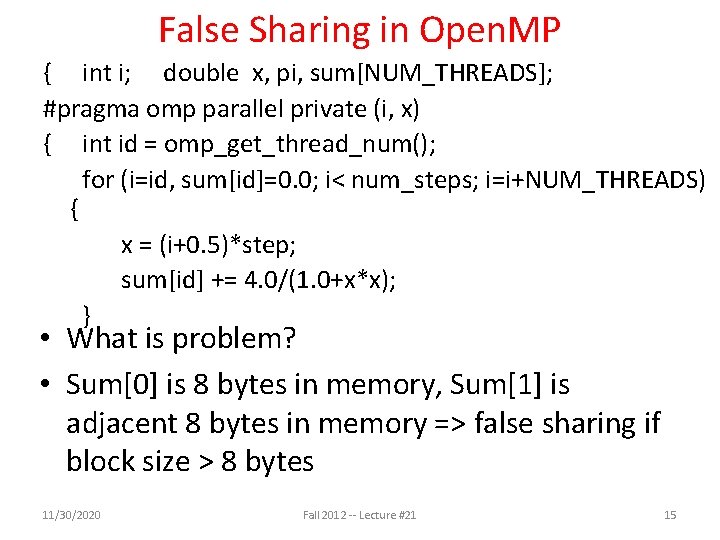
False Sharing in Open. MP { int i; double x, pi, sum[NUM_THREADS]; #pragma omp parallel private (i, x) { int id = omp_get_thread_num(); for (i=id, sum[id]=0. 0; i< num_steps; i=i+NUM_THREADS) { x = (i+0. 5)*step; sum[id] += 4. 0/(1. 0+x*x); } • What is problem? • Sum[0] is 8 bytes in memory, Sum[1] is adjacent 8 bytes in memory => false sharing if block size > 8 bytes 11/30/2020 Fall 2012 -- Lecture #21 15
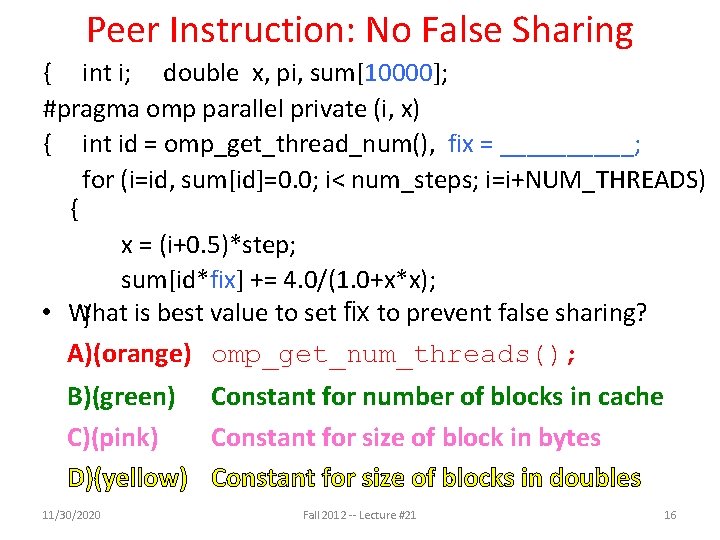
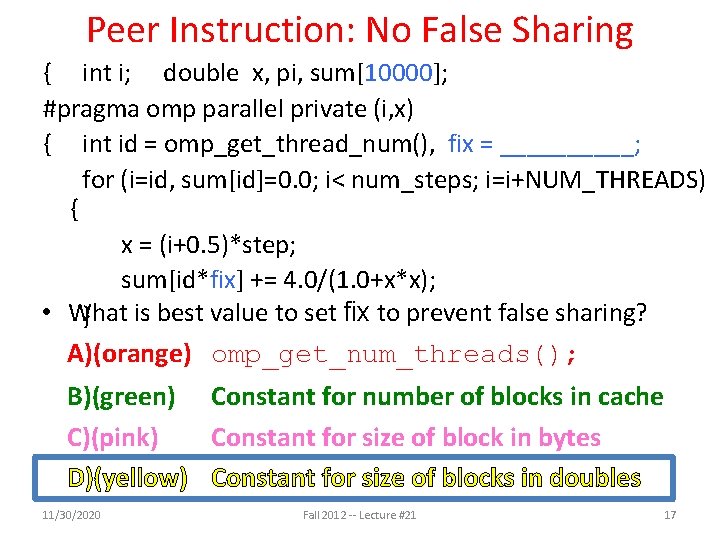
Peer Instruction: No False Sharing { int i; double x, pi, sum[10000]; #pragma omp parallel private (i, x) { int id = omp_get_thread_num(), fix = _____; for (i=id, sum[id]=0. 0; i< num_steps; i=i+NUM_THREADS) { x = (i+0. 5)*step; sum[id*fix] += 4. 0/(1. 0+x*x); • What is best value to set fix to prevent false sharing? } A)(orange) omp_get_num_threads(); B)(green) Constant for number of blocks in cache C)(pink) Constant for size of block in bytes D)(yellow) Constant for size of blocks in doubles 11/30/2020 Fall 2012 -- Lecture #21 16
Peer Instruction: No False Sharing { int i; double x, pi, sum[10000]; #pragma omp parallel private (i, x) { int id = omp_get_thread_num(), fix = _____; for (i=id, sum[id]=0. 0; i< num_steps; i=i+NUM_THREADS) { x = (i+0. 5)*step; sum[id*fix] += 4. 0/(1. 0+x*x); • What is best value to set fix to prevent false sharing? } A)(orange) omp_get_num_threads(); B)(green) Constant for number of blocks in cache C)(pink) Constant for size of block in bytes D)(yellow) Constant for size of blocks in doubles 11/30/2020 Fall 2012 -- Lecture #21 17
Administrivia • Lab 8, Data-Level Parallelism – Start this early, because you’ll need the SSE experience for project 3 a • Project 3 a, optimizing matrix manipulation code – Part a : just single-thread optimizations – DON’T USE Open. MP – (Part b: next week, use Open. MP too) • HW#5 11/30/2020 Fall 2012 -- Lecture #17 18
Midterm Regrade Request Policy • NO REQUESTS ACCEPTED UNTIL LECTURE WED OCTOBER 17, i. e. , we’ll simply delete any that come before • Must attend discussion section to learn solutions and grading process – TA signoff needed for regrade request! • Regrade requests must be accompanied by written request explaining rationale for regrade. • Modifying your copy of exam punishable by F and letter in your University record • We reserve right to regrade whole exam 11/30/2020 Fall 2012 -- Lecture #17 19
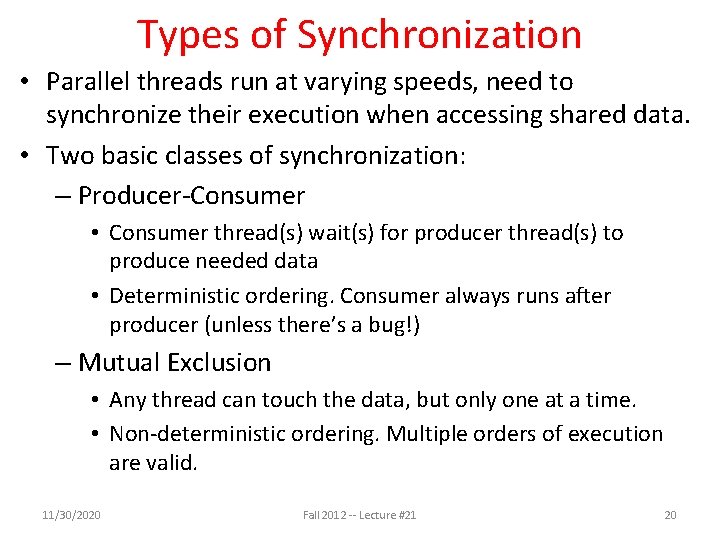
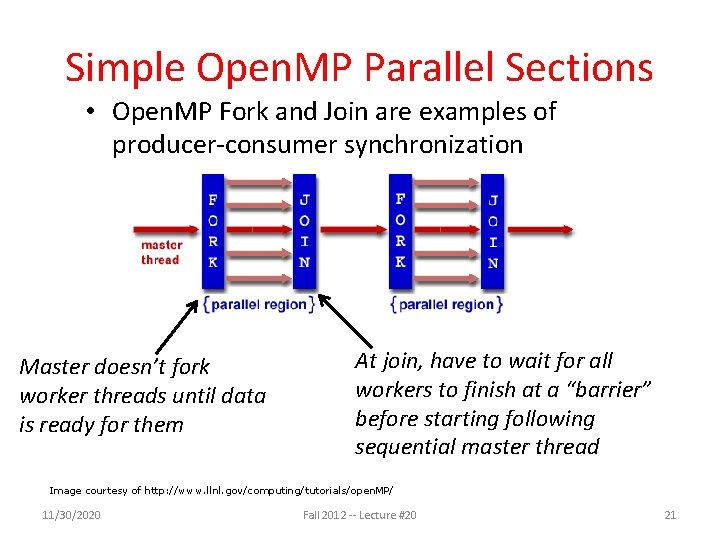
Types of Synchronization • Parallel threads run at varying speeds, need to synchronize their execution when accessing shared data. • Two basic classes of synchronization: – Producer-Consumer • Consumer thread(s) wait(s) for producer thread(s) to produce needed data • Deterministic ordering. Consumer always runs after producer (unless there’s a bug!) – Mutual Exclusion • Any thread can touch the data, but only one at a time. • Non-deterministic ordering. Multiple orders of execution are valid. 11/30/2020 Fall 2012 -- Lecture #21 20
Simple Open. MP Parallel Sections • Open. MP Fork and Join are examples of producer-consumer synchronization Master doesn’t fork worker threads until data is ready for them At join, have to wait for all workers to finish at a “barrier” before starting following sequential master thread Image courtesy of http: //www. llnl. gov/computing/tutorials/open. MP/ 11/30/2020 Fall 2012 -- Lecture #20 21
Barrier Synchronization • Barrier waits for all threads to complete a parallel section. Very common in parallel processing. • How does Open. MP implement this? 11/30/2020 Fall 2012 -- Lecture #21 22
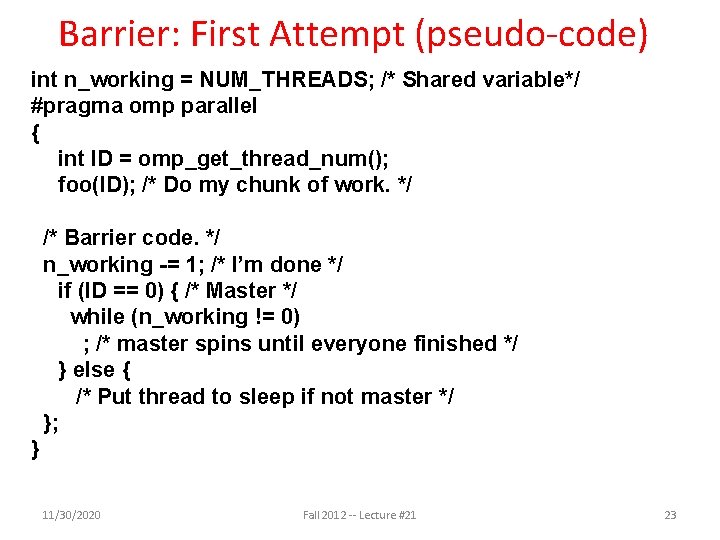
Barrier: First Attempt (pseudo-code) int n_working = NUM_THREADS; /* Shared variable*/ #pragma omp parallel { int ID = omp_get_thread_num(); foo(ID); /* Do my chunk of work. */ /* Barrier code. */ n_working -= 1; /* I’m done */ if (ID == 0) { /* Master */ while (n_working != 0) ; /* master spins until everyone finished */ } else { /* Put thread to sleep if not master */ }; } 11/30/2020 Fall 2012 -- Lecture #21 23
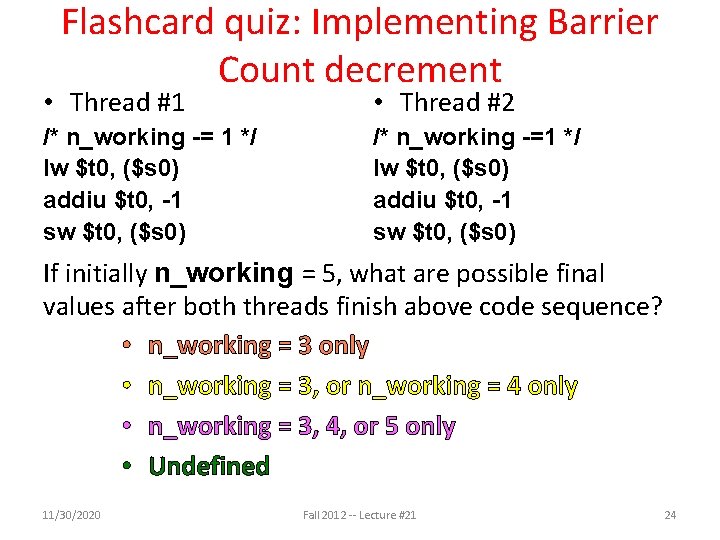
Flashcard quiz: Implementing Barrier Count decrement • Thread #1 • Thread #2 /* n_working -= 1 */ lw $t 0, ($s 0) addiu $t 0, -1 sw $t 0, ($s 0) /* n_working -=1 */ lw $t 0, ($s 0) addiu $t 0, -1 sw $t 0, ($s 0) If initially n_working = 5, what are possible final values after both threads finish above code sequence? • n_working = 3 only • n_working = 3, or n_working = 4 only • n_working = 3, 4, or 5 only • Undefined 11/30/2020 Fall 2012 -- Lecture #21 24
Review: Data Races and Synchronization • 2 memory accesses form a data race if from different threads to same location, and at least one is a write, and they occur one after another • If there is a data race, result of program can vary depending on chance (which thread first? ) • Avoid data races by synchronizing writing and reading to get deterministic behavior • Synchronization done by user-level routines that rely on hardware synchronization instructions 11/30/2020 Fall 2012 -- Lecture #20 25
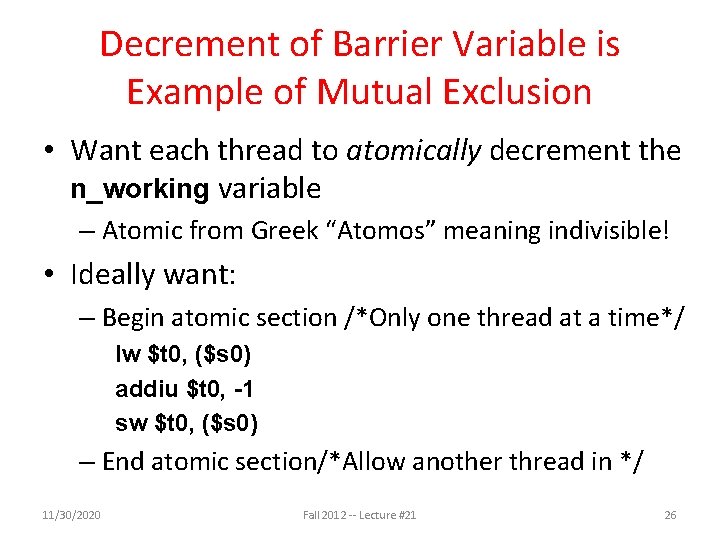
Decrement of Barrier Variable is Example of Mutual Exclusion • Want each thread to atomically decrement the n_working variable – Atomic from Greek “Atomos” meaning indivisible! • Ideally want: – Begin atomic section /*Only one thread at a time*/ lw $t 0, ($s 0) addiu $t 0, -1 sw $t 0, ($s 0) – End atomic section/*Allow another thread in */ 11/30/2020 Fall 2012 -- Lecture #21 26
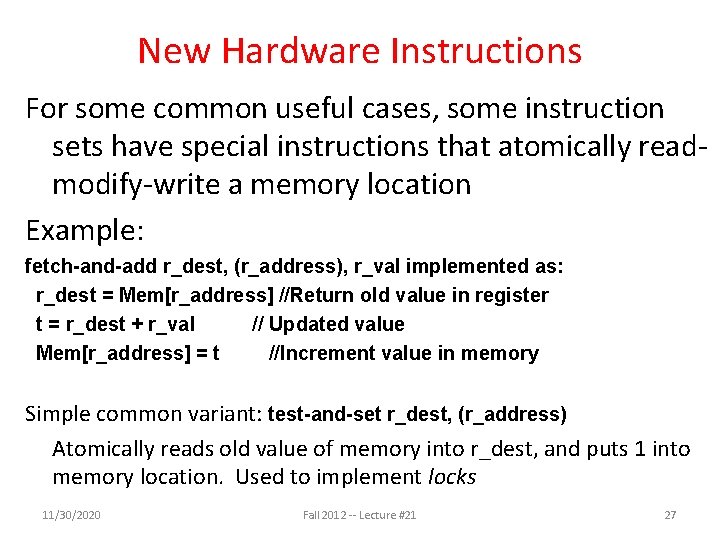
New Hardware Instructions For some common useful cases, some instruction sets have special instructions that atomically readmodify-write a memory location Example: fetch-and-add r_dest, (r_address), r_val implemented as: r_dest = Mem[r_address] //Return old value in register t = r_dest + r_val // Updated value Mem[r_address] = t //Increment value in memory Simple common variant: test-and-set r_dest, (r_address) Atomically reads old value of memory into r_dest, and puts 1 into memory location. Used to implement locks 11/30/2020 Fall 2012 -- Lecture #21 27
Use locks for more general atomic sections Atomic sections commonly called “critical sections” Acquire(lock) /* Only one thread at a time in section. */ /* Critical Section Code */ Release(lock) /* Allow other threads into section. */ • A lock is a variable in memory (one word) • Hardware atomic instruction, e. g. , test-and-set, checks and sets lock in memory 11/30/2020 Fall 2012 -- Lecture #21 28
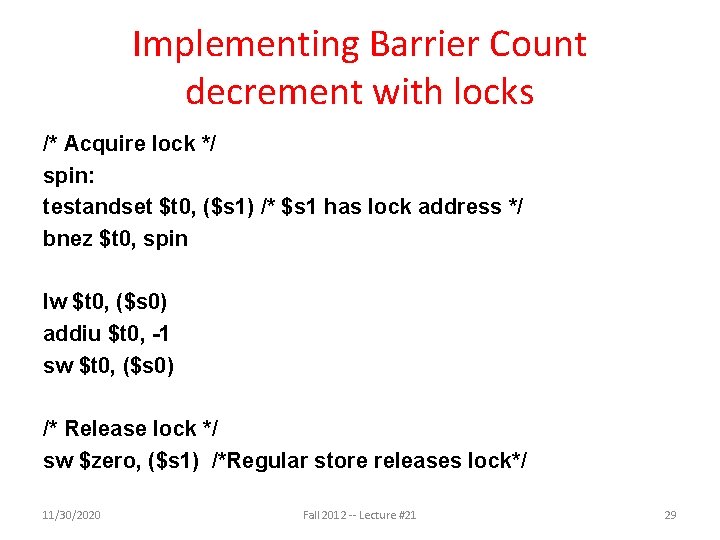
Implementing Barrier Count decrement with locks /* Acquire lock */ spin: testandset $t 0, ($s 1) /* $s 1 has lock address */ bnez $t 0, spin lw $t 0, ($s 0) addiu $t 0, -1 sw $t 0, ($s 0) /* Release lock */ sw $zero, ($s 1) /*Regular store releases lock*/ 11/30/2020 Fall 2012 -- Lecture #21 29
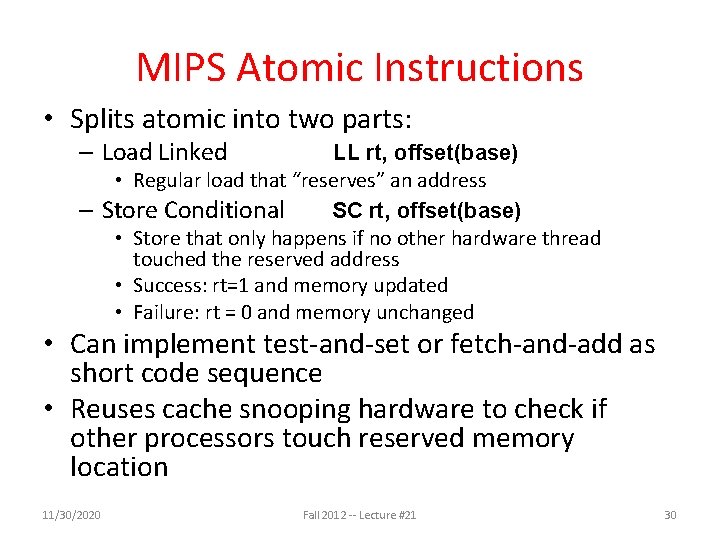
MIPS Atomic Instructions • Splits atomic into two parts: – Load Linked – LL rt, offset(base) • Regular load that “reserves” an address Store Conditional SC rt, offset(base) • Store that only happens if no other hardware thread touched the reserved address • Success: rt=1 and memory updated • Failure: rt = 0 and memory unchanged • Can implement test-and-set or fetch-and-add as short code sequence • Reuses cache snooping hardware to check if other processors touch reserved memory location 11/30/2020 Fall 2012 -- Lecture #21 30
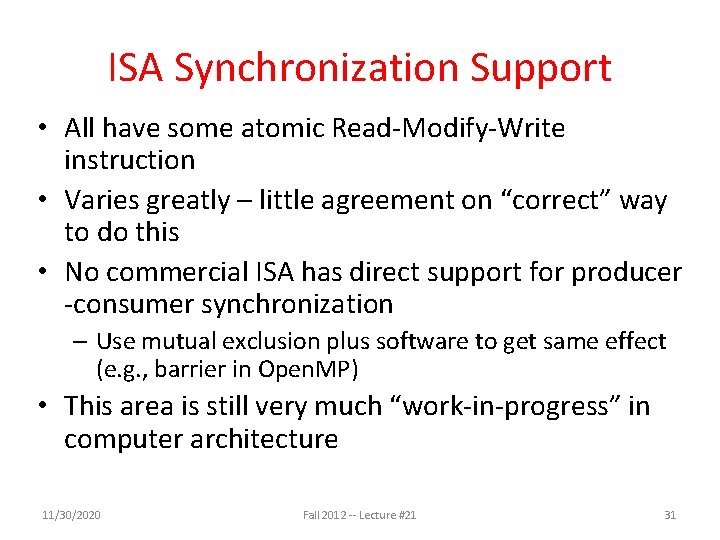
ISA Synchronization Support • All have some atomic Read-Modify-Write instruction • Varies greatly – little agreement on “correct” way to do this • No commercial ISA has direct support for producer -consumer synchronization – Use mutual exclusion plus software to get same effect (e. g. , barrier in Open. MP) • This area is still very much “work-in-progress” in computer architecture 11/30/2020 Fall 2012 -- Lecture #21 31
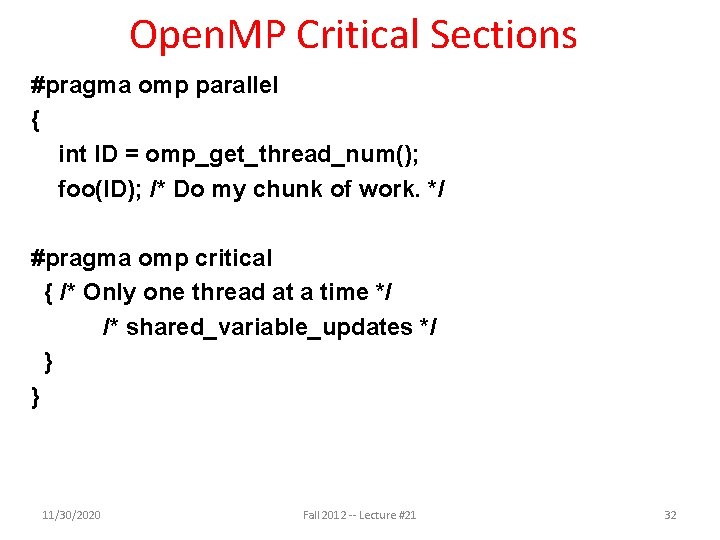
Open. MP Critical Sections #pragma omp parallel { int ID = omp_get_thread_num(); foo(ID); /* Do my chunk of work. */ #pragma omp critical { /* Only one thread at a time */ /* shared_variable_updates */ } } 11/30/2020 Fall 2012 -- Lecture #21 32
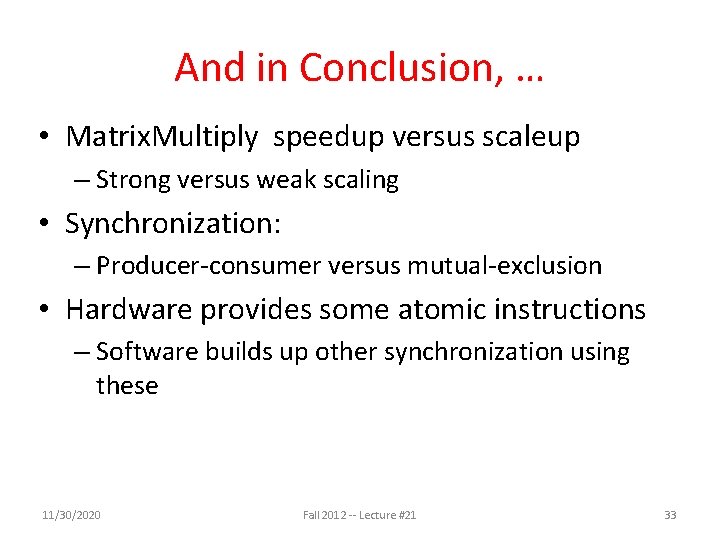
And in Conclusion, … • Matrix. Multiply speedup versus scaleup – Strong versus weak scaling • Synchronization: – Producer-consumer versus mutual-exclusion • Hardware provides some atomic instructions – Software builds up other synchronization using these 11/30/2020 Fall 2012 -- Lecture #21 33