Christ Community Church If the foundations are destroyed



- Slides: 60
Christ Community Church “If the foundations are destroyed, what can the righteous do? ” Psalm 11: 3 Winter 2015
Session Two WORLDVIEW BUILDING “Building Plan”
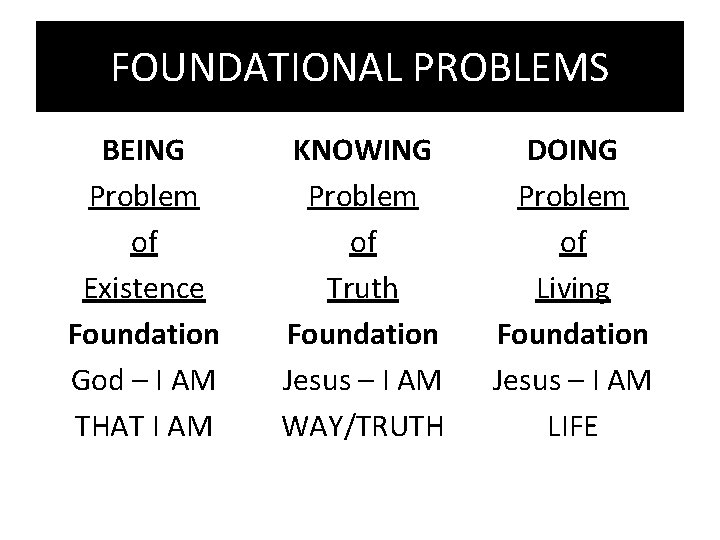
FOUNDATIONAL PROBLEMS BEING Problem of Existence Foundation God – I AM THAT I AM KNOWING Problem of Truth Foundation Jesus – I AM WAY/TRUTH DOING Problem of Living Foundation Jesus – I AM LIFE
Big Worldview Questions • Who am I? Where did I [Person] come from? • What am I worth? Why is there something rather than nothing? • What is truth? How do I know? • Why am I here? Where will I go when I die? • Why is there evil? How shall I live? • These questions are asked by all people, religious or not; and especially by agnostics and atheists!
BIG WORLDVIEW QUESTION How Do We Know? ? 5
The Problem: Wrong Thinking Revealed truth is not like some theory of science; and faith is not purely intellectual insight into some result of scientific investigation. The Bible presupposes the darkness and error of the natural man, and would therefore contradict itself, if it submitted itself to the judgment of that man.
Isaiah 55: 8 -9 “For my thoughts are not your thoughts, neither are your ways my ways, saith the LORD. For as the heavens are higher than the earth, so are my ways higher than your ways, and my thoughts than your thoughts. ”
Ephesians 1: 17 -18 “That the God of our Lord Jesus Christ, the Father of glory, may give unto you the spirit of wisdom and revelation in the knowledge of him. The eyes of your understanding being enlightened; that yet may know what is the hope of his calling, and what the riches of the glory of his inheritance in the saints. ”
What Is Truth? Jesus said, “And you will know the truth and the truth will make you free. ” John 8: 32 “Do not let your heart be troubled; believe in God, believe also in Me. In My Father’s house are many dwelling places; if it were not so, I would have told you; for I go to prepare a place for you. If I go and prepare a place for you, I will come again and receive you to Myself, that where I am, there you may be also. And you know the way where I am going. ” Thomas said to Him, “Lord, we do not know where You are going, how do we know the way? ” Jesus said to him, “I am the way, and the truth, and the life; no one comes to the Father but through Me. ” John 14: 1 -6
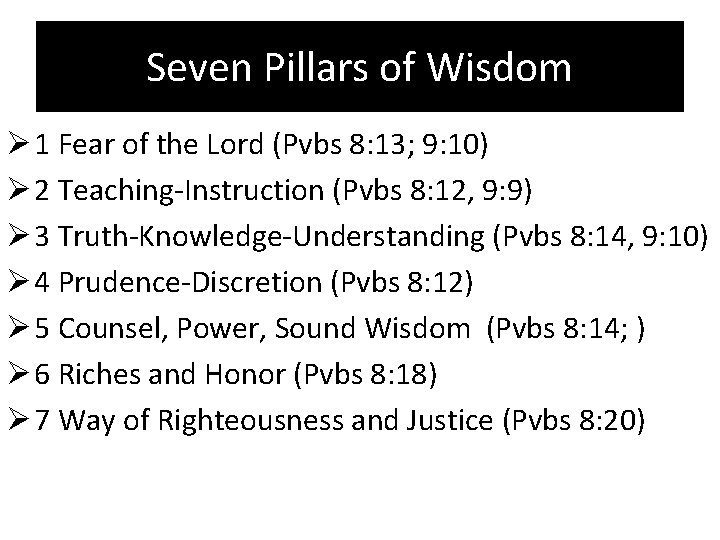
Seven Pillars of Wisdom Ø 1 Fear of the Lord (Pvbs 8: 13; 9: 10) Ø 2 Teaching-Instruction (Pvbs 8: 12, 9: 9) Ø 3 Truth-Knowledge-Understanding (Pvbs 8: 14, 9: 10) Ø 4 Prudence-Discretion (Pvbs 8: 12) Ø 5 Counsel, Power, Sound Wisdom (Pvbs 8: 14; ) Ø 6 Riches and Honor (Pvbs 8: 18) Ø 7 Way of Righteousness and Justice (Pvbs 8: 20)
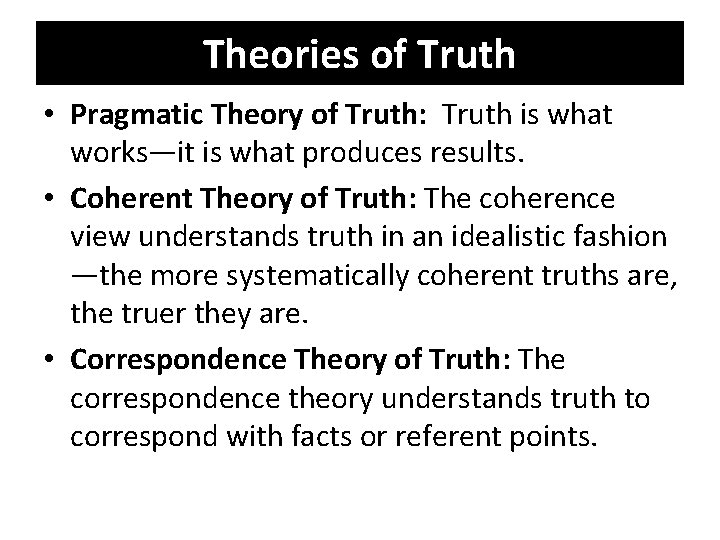
Theories of Truth • Pragmatic Theory of Truth: Truth is what works—it is what produces results. • Coherent Theory of Truth: The coherence view understands truth in an idealistic fashion —the more systematically coherent truths are, the truer they are. • Correspondence Theory of Truth: The correspondence theory understands truth to correspond with facts or referent points.
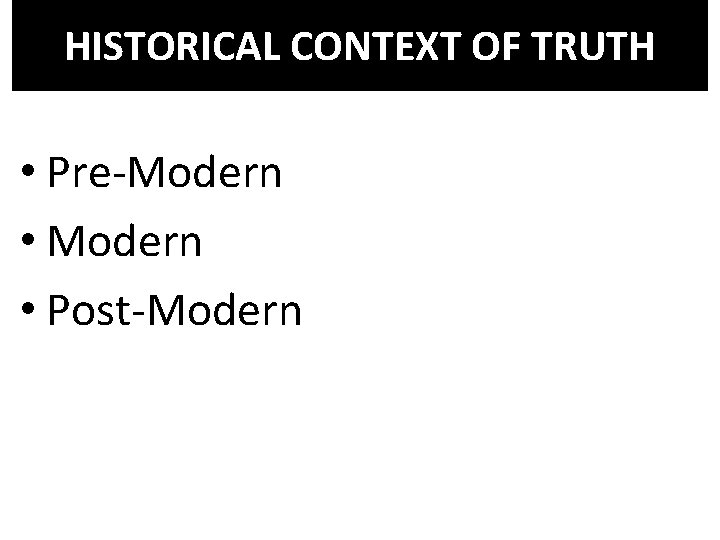
HISTORICAL CONTEXT OF TRUTH • Pre-Modern • Post-Modern
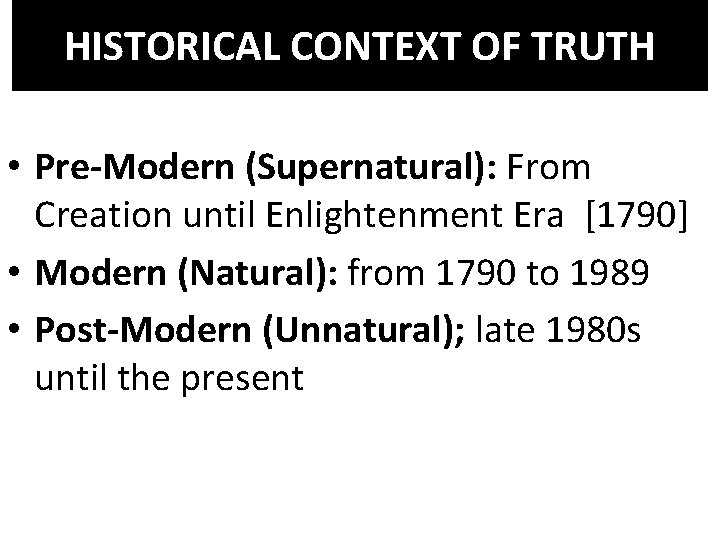
HISTORICAL CONTEXT OF TRUTH • Pre-Modern (Supernatural): From Creation until Enlightenment Era [1790] • Modern (Natural): from 1790 to 1989 • Post-Modern (Unnatural); late 1980 s until the present
PRE-MODERN Supernatural Monotheism: To say the premodern idea of truth was supernatural is to simply say that people by and large still recognized that there was something beyond the physical material realm of existence…it was metaphysical! It was beyond the natural realm of existence …it was supernatural! So, they not only believed in the objective reality of the physical, material, natural world but also of that world that was beyond the limits of the natural…it was the realm of the spiritual, transcendent, reality that was really the source of the natural.
PRE-MODERN • Pre-moderns embraced the objectivity of truth in both the natural and supernatural. • There is an objective, or external realm that is transcendent – “Reality existed independently of any individual apprehension of it” – For the Christian pre-moderns, this independently existing realm of transcendence was the mind of God. Erickson, Evangelical Interpretation, 100.
MODERN Natural Materialism : With the modern scientific method natural (materialism) became the primary mode of explanation of reality, from Hume’s skepticism to Darwin’s evolutionism. “Scientific knowledge became the model for all knowledge: data had to be obtained or observed empirically, or they were suspect. Meanwhile religion, was relegated to the category of mere private opinion as it was based on ‘faith’, while reason became the guide to all true knowledge and the basis of public discourse. ”
MODERN • Modernity depended on “meta-narratives” (“universal “narratives” or accounts of reality, of the way things are”). . These “meta-narratives include Marxism, Hegel’s theory of universal spirit, the post. Enlightenment view of progress; and in theology, the view that we should accept as rational in the field of theology only what is judged rational by any reasonable and intelligent person. ” Carson, GOG, 63. • Modernity embraced individualism. “Truth being objective, individuals can discover it by their own efforts. ” Erickson, Postmodernizing the Faith, 17.
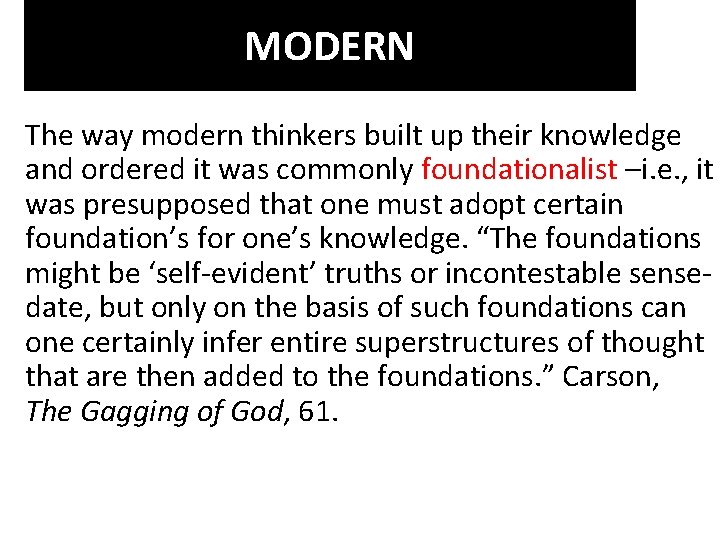
MODERN The way modern thinkers built up their knowledge and ordered it was commonly foundationalist –i. e. , it was presupposed that one must adopt certain foundation’s for one’s knowledge. “The foundations might be ‘self-evident’ truths or incontestable sensedate, but only on the basis of such foundations can one certainly infer entire superstructures of thought that are then added to the foundations. ” Carson, The Gagging of God, 61.
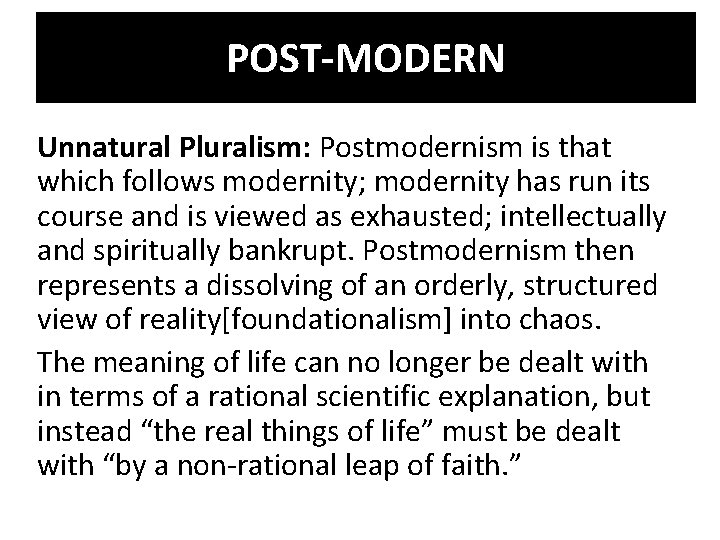
POST-MODERN Unnatural Pluralism: Postmodernism is that which follows modernity; modernity has run its course and is viewed as exhausted; intellectually and spiritually bankrupt. Postmodernism then represents a dissolving of an orderly, structured view of reality[foundationalism] into chaos. The meaning of life can no longer be dealt with in terms of a rational scientific explanation, but instead “the real things of life” must be dealt with “by a non-rational leap of faith. ”
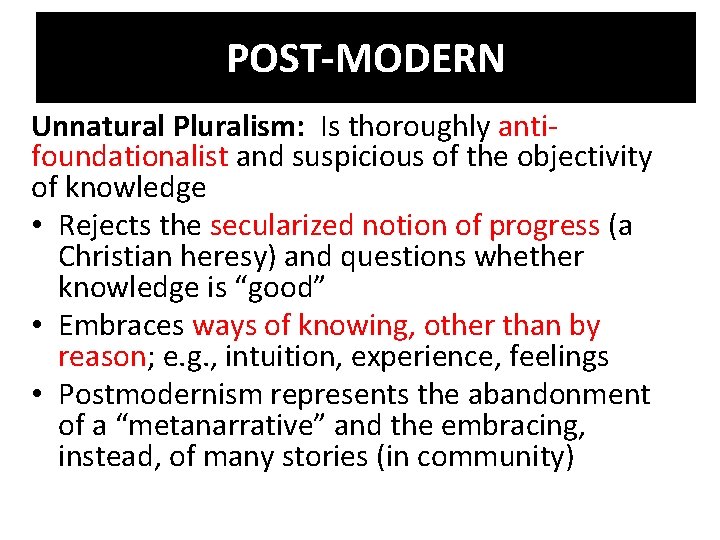
POST-MODERN Unnatural Pluralism: Is thoroughly antifoundationalist and suspicious of the objectivity of knowledge • Rejects the secularized notion of progress (a Christian heresy) and questions whether knowledge is “good” • Embraces ways of knowing, other than by reason; e. g. , intuition, experience, feelings • Postmodernism represents the abandonment of a “metanarrative” and the embracing, instead, of many stories (in community)
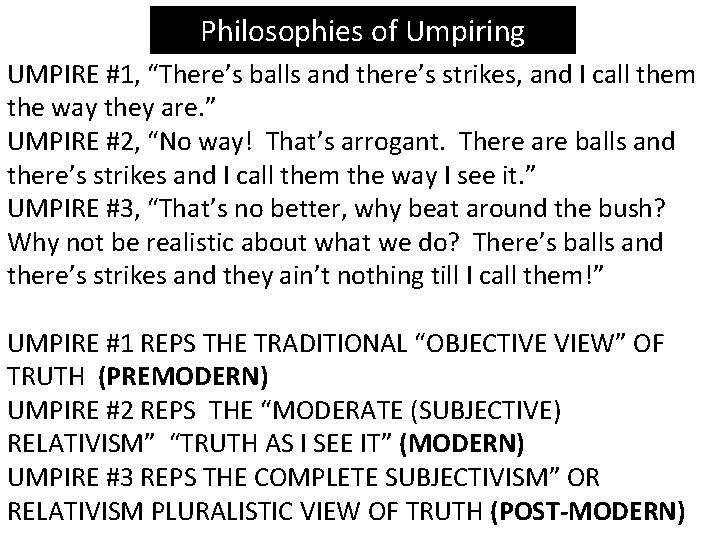
Philosophies of Umpiring UMPIRE #1, “There’s balls and there’s strikes, and I call them the way they are. ” UMPIRE #2, “No way! That’s arrogant. There are balls and there’s strikes and I call them the way I see it. ” UMPIRE #3, “That’s no better, why beat around the bush? Why not be realistic about what we do? There’s balls and there’s strikes and they ain’t nothing till I call them!” UMPIRE #1 REPS THE TRADITIONAL “OBJECTIVE VIEW” OF TRUTH (PREMODERN) UMPIRE #2 REPS THE “MODERATE (SUBJECTIVE) RELATIVISM” “TRUTH AS I SEE IT” (MODERN) UMPIRE #3 REPS THE COMPLETE SUBJECTIVISM” OR RELATIVISM PLURALISTIC VIEW OF TRUTH (POST-MODERN)
IN THE PRE-MODERN • There was belief in the “Correspondence Theory of Truth” which asserted that “true ideas are those that accurately correspond to the state of affairs as it is. ” • In terms of understanding Scripture, the pre-modern period accepted that “the meaning of a text was. . . within that text in a rather literal or straightforward fashion. . Hermeneutics was in this approach virtually equivalent to exegesis. ” • The premodern understanding of reality was teleological [the end or completion of something]. There was believed to be a purpose in the universe. ” Erickson, Postmodernizing the Faith, 15
Pre-Modern vs Modern Pre-Moderns viewed life in the world as a personal, holistic and nonscientific relationship with nature. They sought meaning in mythical and poetic images of nature, with its life, death and seasons. Time was primarily a matter of the long rhythms of nature, not the physics and exactitude of clocks and day planners. Wisdom, rather than science, was the key to unlocking the living structure and order in creation; the key to a well-lived life was a welldeveloped sense of wisdom.
Pre-Modern vs Modern In our Western, postindustrial context we interpret human experience primarily through the authority of the scientific mind, and we are assured that our “neutral” and “objective” observations will give us truth about the world. Our mechanistic, sterile, view of the world with its critical lens orients us to our experience through psychological, social or scientific concepts…, anyone who speaks seriously of mystery, the transcendent or the spiritual seems increasingly out of touch with reality.
IN THE POST-MODERN – The roots of despair began with Hegel and his dialectic, an attack on the older rational model – The meaning of life can no longer be dealt with in terms of a rational explanation, but instead “the real things of life” must be dealt with “by a nonrational leap of faith. ”
IN THE POST-MODERN • Francis Schaeffer: a “line of despair” bisects history, in Europe around 1890; in the U. S. after 1935. Schaeffer, The God Who is There, CW, I: 8. – “This despair began in the discipline of philosophy, and spread successively to art, music, general culture, and finally, theology. ” Erickson, PTF, 65.
Abraham Kuyper “But this naturally all falls away when you encounter a difference of principle, and when you come to deal with two kinds of people, i. e. with those who part company because of a difference which does not find its origin within the circle of our human consciousness, but outside of it. And the Christian religion places before us just this supremely important fact. For it speaks of a regeneration, of a “being begotten anew”, followed by an enlightenment, which changes man in his very being; and that indeed by a change or transformation which is effected by a supernatural cause…. . This “regeneration” breaks humanity in two, and repeals the unity of the human consciousness…. ”
Abraham Kuyper “We speak none too emphatically, therefore, when we speak of two kinds of people. Both are human, but one is inwardly different from the other, and consequently feels a different content rising from his consciousness; thus they face the cosmos from different points of view, and are impelled by different impulses. And the fact that there are two kinds of people occasions of necessity the fact of two kinds of human life and consciousness of life, and of two kinds of science; for which reason the idea of the unity of science, taken in its absolute sense, implies the denial of the fact of palingenesis [new birth], and therefore from principle leads to the rejection of the Christian religion. ”
Francis Schaeffer “What does all this mean in practice to us today? I must say, I really am not sure all that it means to us in practice at this moment. To begin, however, it certainly means this: We have been utterly foolish in our concentration on bits and pieces, and in our complete failure to face the total world view that is rooted in a false view of reality. And we have not understood that this view of reality inevitably brings forth totally different and wrong and inhuman results in all of life. ”
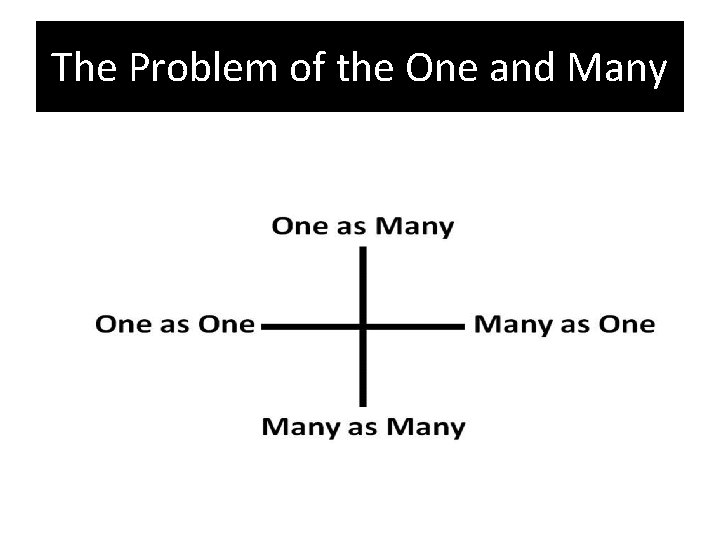
The Problem of the One and Many
All human cultures in some way have to deal with accounting for the myriad of objects surrounding them and the fact that they are changing. For instance, every human being begins as an infant and then grows into an adult. Every adult is a different object than they were as an infant—in fact, they are unrecognizable as being the same object. Yet we recognize that they are the same object , that something has remained the same even though the infant has changed into an object that is nowhere close to its original state. We can see the same stability and constancy even across objects. While the world is full of trees, there is still some constancy and stability to "treeness" which never seems to change.
This observation of the world of phenomena leads many cultures to believe that the MANY things and their changes can ultimately be related back to a single ONE object, material, or idea. The problem of finding the one thing that lies behind all things in the universe is called the problem of the one and the many. Basically stated, the problem of the one and the many begins from the assumption that the universe is one thing. Because it is one thing, there must be one, unifying aspect behind everything. This aspect could be material, such as water, or air, or atoms. It could be an idea, such as number, or "mind. "
It could be divine, such as the Christian concept of God or the Chinese concept the Dao or Tao, the Great Ultimate which is divided into two opposite forces (yang and yin). The problem, of course, is figuring out what that one, unifying idea is. As a result, the problem of the one and the many still dominates concepts of the universe, including modern physics, which has set for itself the goal of finding theory that will "unify" (unify means "make into one thing") the laws of physics.
Before the Fall
The Fall
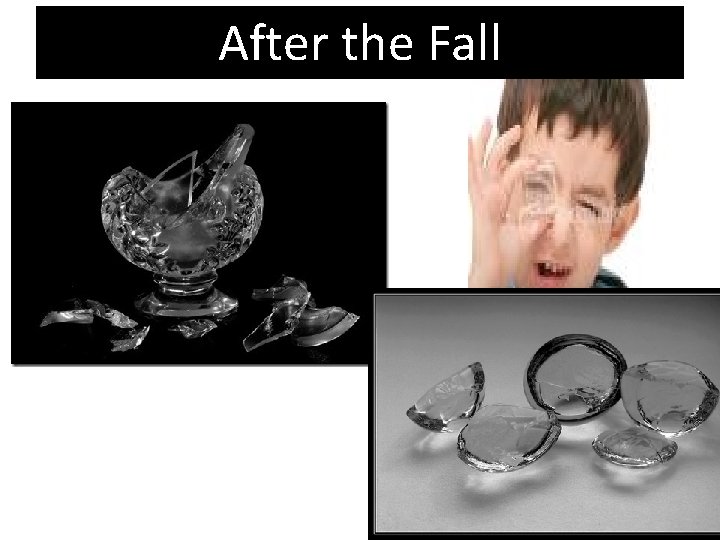
After the Fall
Religion and Idolatry • When fallen men lifted up their eyes to observe the cosmos they saw the many [pluralism]; and immediately began the process of trying to comprehend and integrate the many into the one ultimate absolute. • The problem was “how do I [one of the many] reconcile myself with the Ultimate One of God. ” This is the genesis of all man’s worldviews [religious, philosophic, etc…]. The sages themselves not to mention the general population still struggled within their finitude and despite all their efforts to lift themselves up they would all without exception succumb to Idolatry.
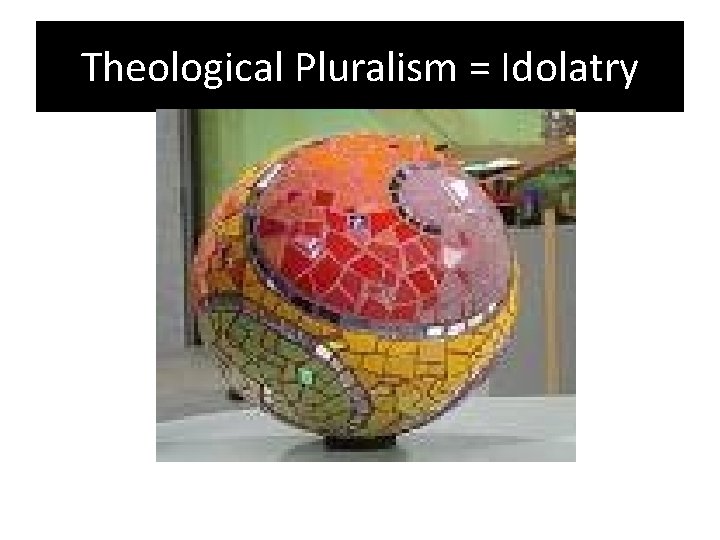
Theological Pluralism = Idolatry
Idolatry • “Idolatry is the product of vain minds and darkened hearts, as they imitated the true God in their false deities. . The wickedness of idolatry is more than the sins of idolatry; it is a false representation of the true God. They imitated the glory or value of God to make a counterfeit religion. ” (Mc. Beth)
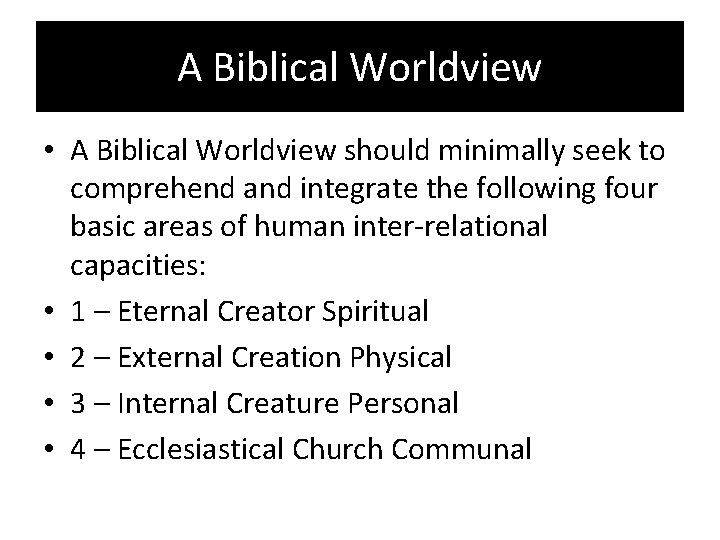
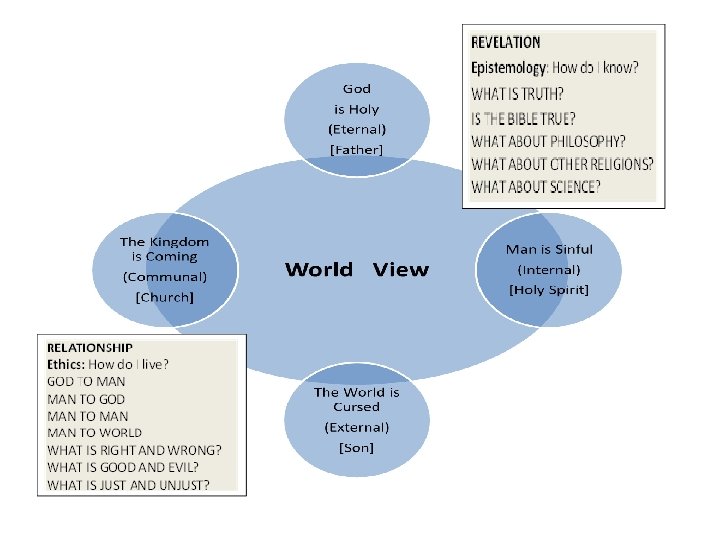
A Biblical Worldview • A Biblical Worldview should minimally seek to comprehend and integrate the following four basic areas of human inter-relational capacities: • 1 – Eternal Creator Spiritual • 2 – External Creation Physical • 3 – Internal Creature Personal • 4 – Ecclesiastical Church Communal
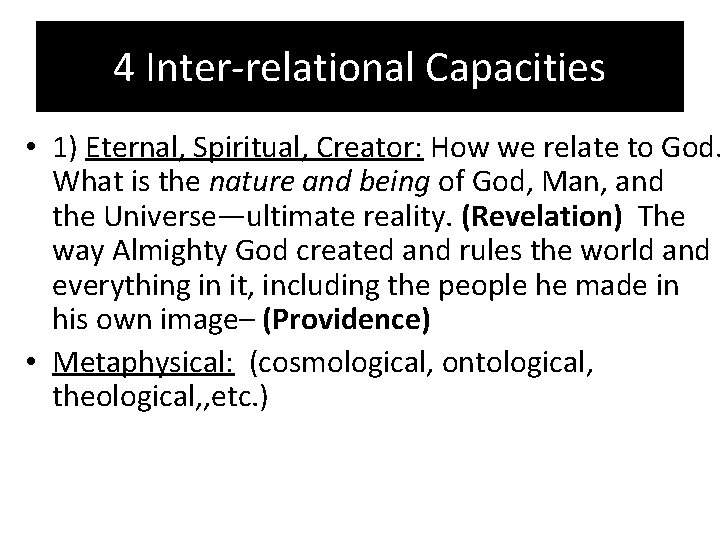
4 Inter-relational Capacities • 1) Eternal, Spiritual, Creator: How we relate to God. What is the nature and being of God, Man, and the Universe—ultimate reality. (Revelation) The way Almighty God created and rules the world and everything in it, including the people he made in his own image– (Providence) • Metaphysical: (cosmological, ontological, theological, , etc. )
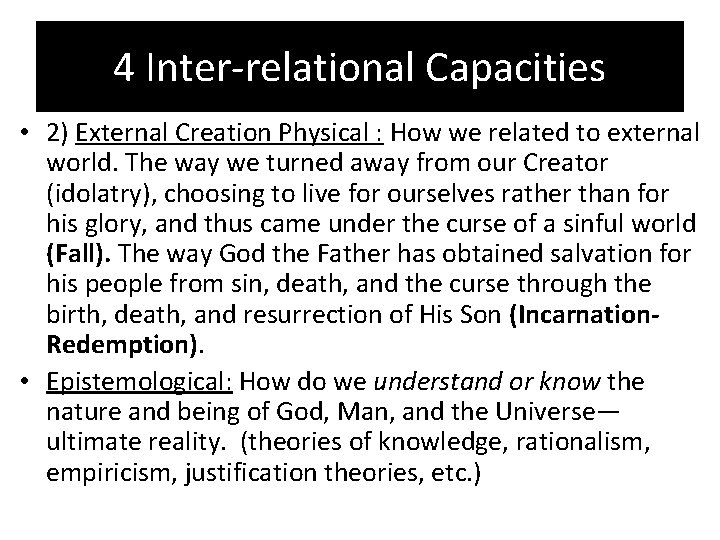
4 Inter-relational Capacities • 2) External Creation Physical : How we related to external world. The way we turned away from our Creator (idolatry), choosing to live for ourselves rather than for his glory, and thus came under the curse of a sinful world (Fall). The way God the Father has obtained salvation for his people from sin, death, and the curse through the birth, death, and resurrection of His Son (Incarnation. Redemption). • Epistemological: How do we understand or know the nature and being of God, Man, and the Universe— ultimate reality. (theories of knowledge, rationalism, empiricism, justification theories, etc. )
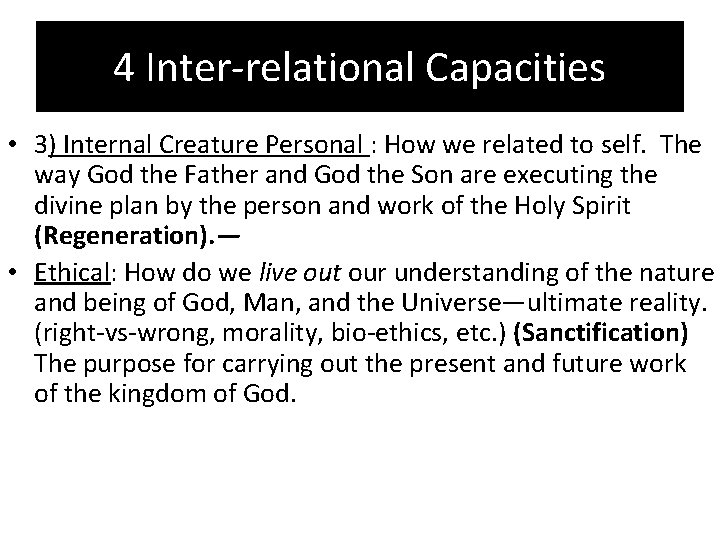
4 Inter-relational Capacities • 3) Internal Creature Personal : How we related to self. The way God the Father and God the Son are executing the divine plan by the person and work of the Holy Spirit (Regeneration). — • Ethical: How do we live out our understanding of the nature and being of God, Man, and the Universe—ultimate reality. (right-vs-wrong, morality, bio-ethics, etc. ) (Sanctification) The purpose for carrying out the present and future work of the kingdom of God.
4 Inter-relational Capacities • 4) Ecclesiastical Church Communal : How we related to those “called out” as the body of Christ…the Community of God. The way we gather to gather and worship and Praise Triune God. Head; God the Father and God the Son and God the Holy Spirit (Exaltation of God). — • Teleological: To what end do we live out our understanding of the nature and being of God, Man, and the Universe—ultimate reality. (ultimate importance, happiness, pleasure). (Glory of God).
What is a Worldview? • Worldview is an individual as well as a group phenomenon. The term worldview is used to refer to the common concept of reality shared by a particular group of people, usually referred to as a culture, or an ethnic group. • Worldview is the cognitive organizational framework in each individual's mind of how the world ultimately works. Obviously, some worldviews are less developed than others. • S B PARK illustration.
WHAT IS A WORLDVIEW? • A worldview is a framework or set of fundamental beliefs through which we view our world and our place in it. • Your worldview entails a storyline, which provides you with a presupposed foundational understanding of your role in life. • Your worldview is the integrative and interpretative framework by which reality (good verse evil, order and disorder, etc. ) are judged. Your worldview helps you answer the big questions of life.
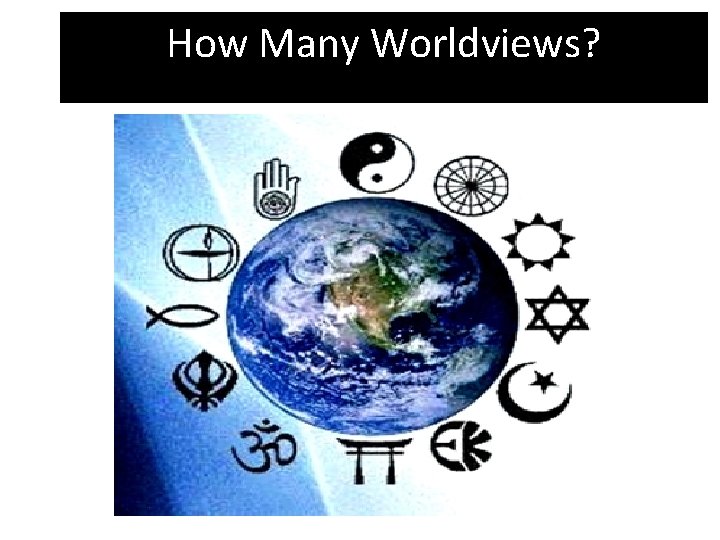
How Many Worldviews? • Biblically I argue there is only one ultimate worldview —God’s worldview! • Among men, however, there are many worldviews religions, philosophies, etc… All of these worldviews, however, can ultimately be housed within the finite, fallen, and flawed, multi-cultural framework of man. • These other worldviews are constantly being cast and recast by the fleshly forces of syncretism, pluralism, and pragmatism into one mass worldview in opposition to God’s worldview.
How Many Worldviews?
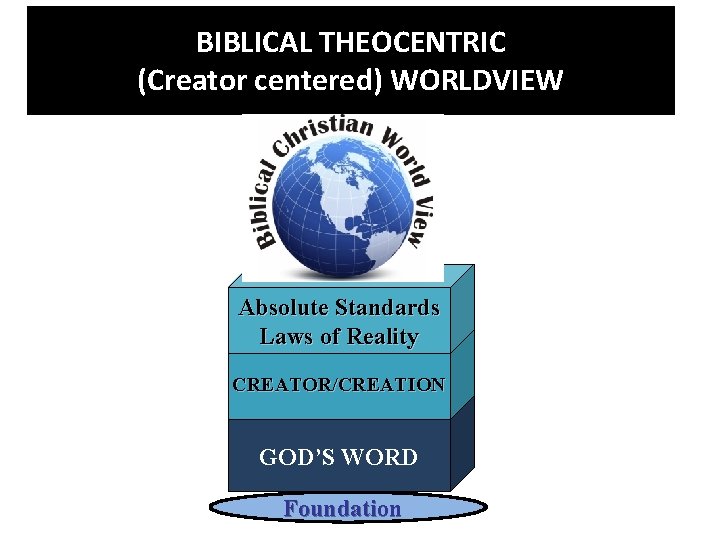
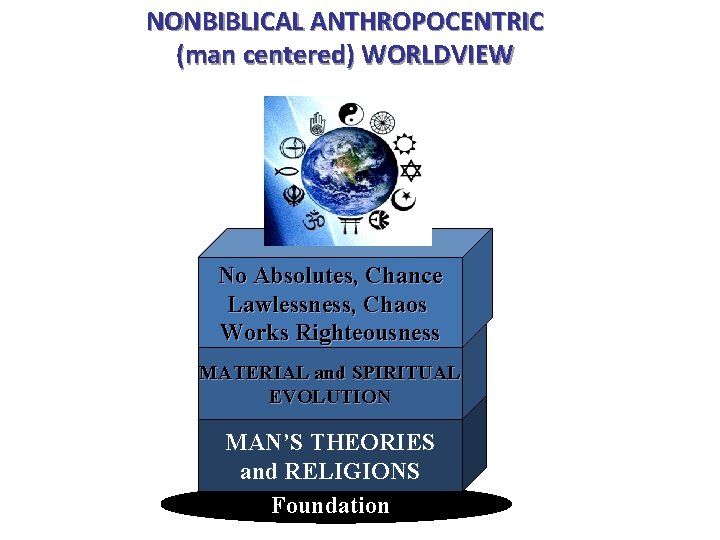
THE TWO COMPETING FOUNDATIONAL WORLDVIEWS There are many worldviews (religions, philosophies, myths, sciences, etc…) however, all of them can ultimately be reduced and housed within the following two foundational worldviews.
BIBLICAL THEOCENTRIC (Creator centered) WORLDVIEW Absolute Standards Laws of Reality CREATOR/CREATION GOD’S WORD Foundation
NONBIBLICAL ANTHROPOCENTRIC (man centered) WORLDVIEW No Absolutes, Chance Lawlessness, Chaos Works Righteousness MATERIAL and SPIRITUAL EVOLUTION MAN’S THEORIES and RELIGIONS Foundation
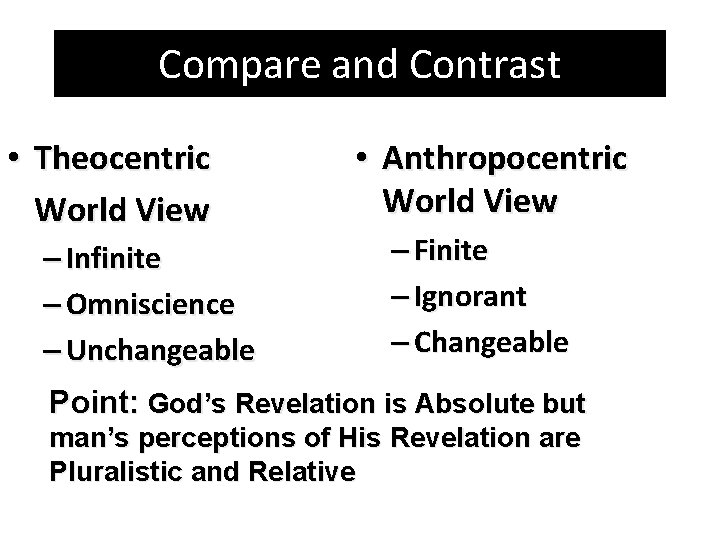
Compare and Contrast • Theocentric World View – Infinite – Omniscience – Unchangeable • Anthropocentric World View – Finite – Ignorant – Changeable Point: God’s Revelation is Absolute but man’s perceptions of His Revelation are Pluralistic and Relative
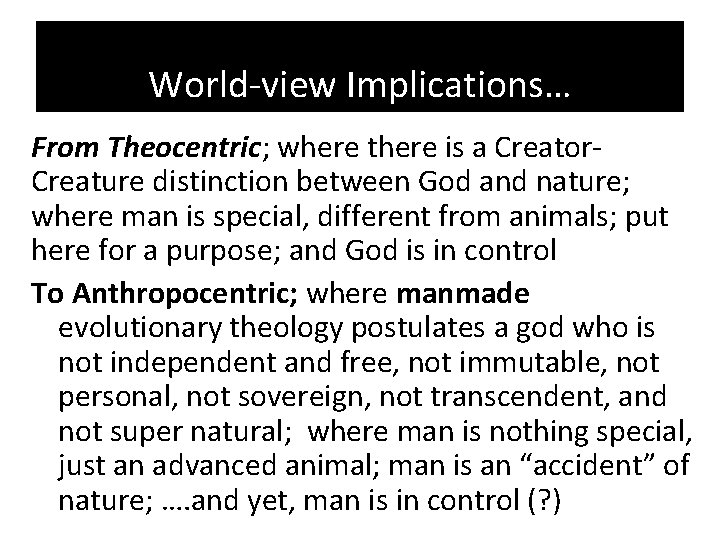
World-view Implications… From Theocentric; where there is a Creator. Creature distinction between God and nature; where man is special, different from animals; put here for a purpose; and God is in control To Anthropocentric; where manmade evolutionary theology postulates a god who is not independent and free, not immutable, not personal, not sovereign, not transcendent, and not super natural; where man is nothing special, just an advanced animal; man is an “accident” of nature; …. and yet, man is in control (? )
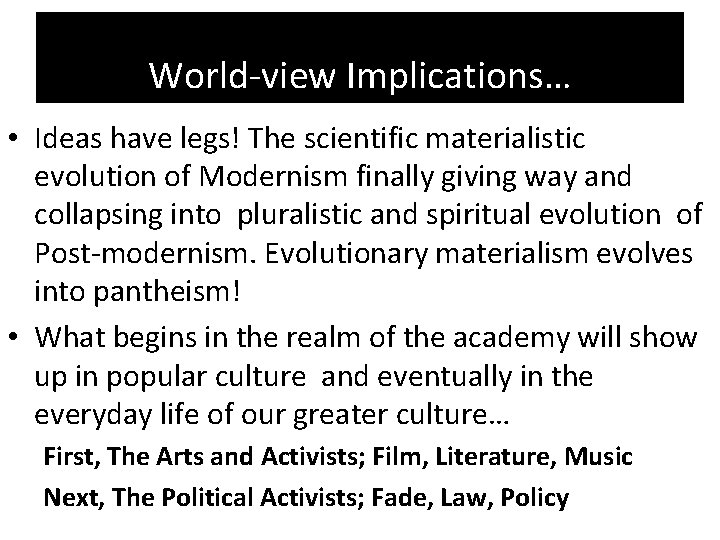
World-view Implications… • Ideas have legs! The scientific materialistic evolution of Modernism finally giving way and collapsing into pluralistic and spiritual evolution of Post-modernism. Evolutionary materialism evolves into pantheism! • What begins in the realm of the academy will show up in popular culture and eventually in the everyday life of our greater culture… First, The Arts and Activists; Film, Literature, Music Next, The Political Activists; Fade, Law, Policy
The Response-Defending the Truth: Apologetics? Christians are called upon to refute error. The apologists in the early church were required to answer false charges against Christians. In 1 Peter 3: 15 -16 we have the classic verse for apologetics, “always be prepared to give an answer for the reason of the hope that is within you, yet do it with gentleness. ” That is an imperative in Greek, and it is not just applied to pastors and theologians. It is for everybody. It is a command.
Apologetics primarily deals with defending the Christian view of reality and knowledge as the one and only valid way of knowing truth. Accordingly, a sound system of defending the Christian faith must be worked out philosophically before it can be implemented practically. Does the process of discerning truth make the Creator or the creature the final reference point of truth?
Biblical Presuppositionalism “We are destroying speculations and every lofty thing raised up against the knowledge of God, and we are taking every thought captive to the obedience of Christ. ” (II Corinthians 10: 5)
Presuppositionalism • Presuppositionalism: the acceptance that certain fundamental or foundational presuppositions (beliefs --philosophical, religious, or scientific) are true. • Your presuppositions determine your worldview— your grid for interpreting ultimate reality. • That which a person considers to be the truth of what exists. • That which provides a basis for values and decision making.
BIBLICIAL PRESUPPOSITIONAL VIEW In this course I have assumed a correspondence theory of truth that is referential to Scripture and grounded in the Triune Godhead as revealed in both Scripture and Creation. In this theory it is presupposed that Divine revelation in Scripture and Creation has provided the categories, defined the questions, and detailed the methods for knowing truth. All other theories of truth (coherence, pragmatic, etc. ) are considered subordinate and therefore dependent upon the correspondence theory. It is the argument that this is the only worldview that offers any basis upon which to judge anything as to its cogency, validity, authenticity, rationality, soundness, or any other measurement of reality.