Chapter 7 Alkenes and Alkynes I Properties and




- Slides: 27
Chapter 7 Alkenes and Alkynes I: Properties and Synthesis Elimination Reactions of Alkyl Halides
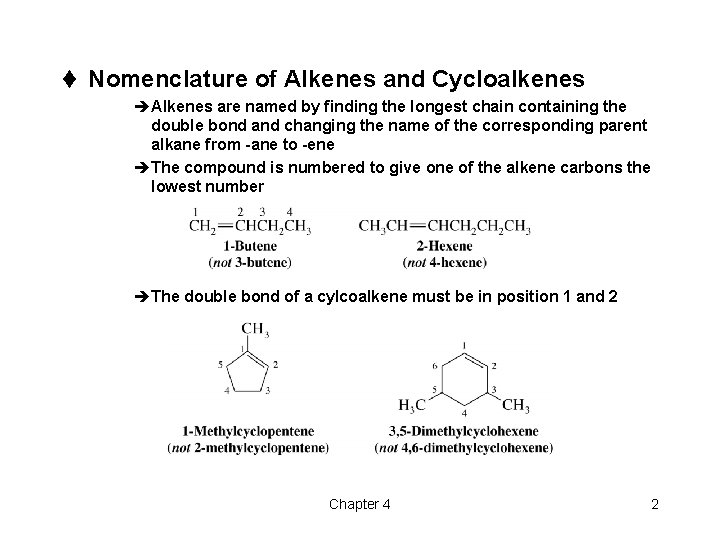
t Nomenclature of Alkenes and Cycloalkenes èAlkenes are named by finding the longest chain containing the double bond and changing the name of the corresponding parent alkane from -ane to -ene èThe compound is numbered to give one of the alkene carbons the lowest number èThe double bond of a cylcoalkene must be in position 1 and 2 Chapter 4 2
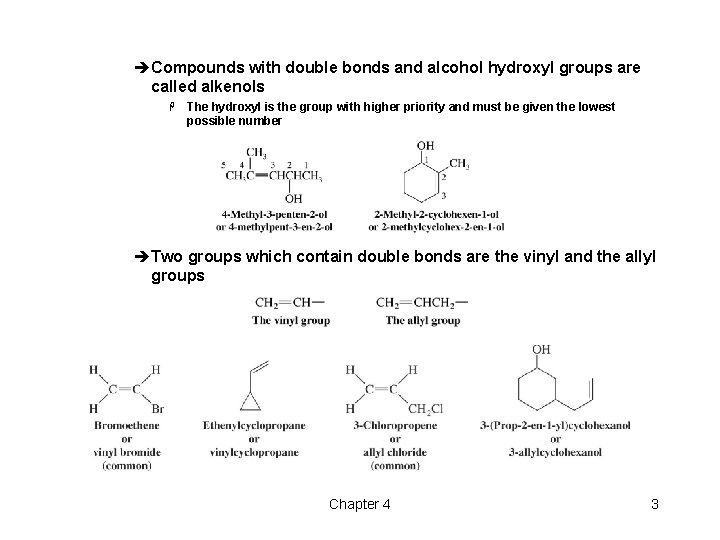
èCompounds with double bonds and alcohol hydroxyl groups are called alkenols H The hydroxyl is the group with higher priority and must be given the lowest possible number èTwo groups which contain double bonds are the vinyl and the allyl groups Chapter 4 3
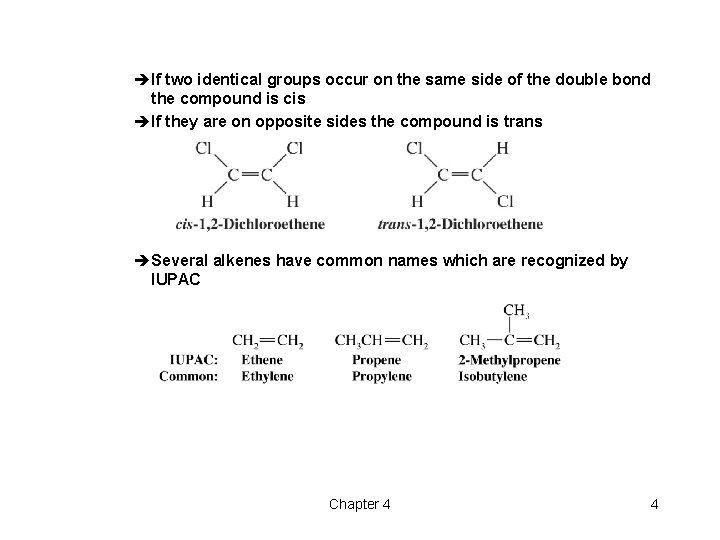
èIf two identical groups occur on the same side of the double bond the compound is cis èIf they are on opposite sides the compound is trans èSeveral alkenes have common names which are recognized by IUPAC Chapter 4 4
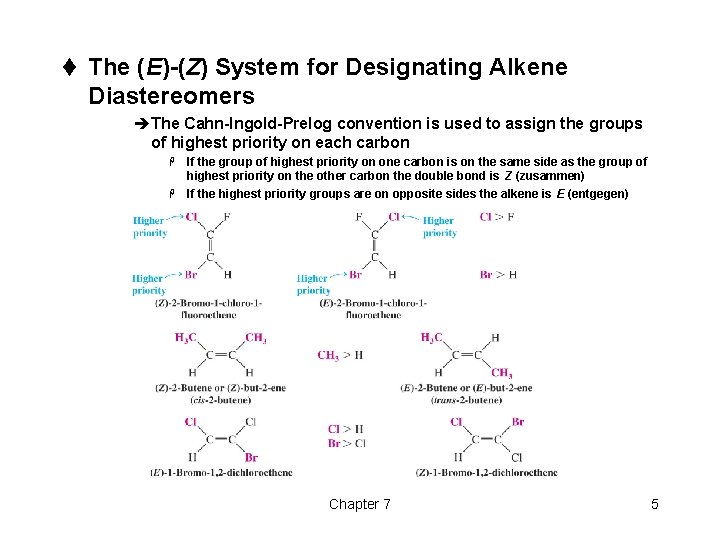
t The (E)-(Z) System for Designating Alkene Diastereomers èThe Cahn-Ingold-Prelog convention is used to assign the groups of highest priority on each carbon If the group of highest priority on one carbon is on the same side as the group of highest priority on the other carbon the double bond is Z (zusammen) H If the highest priority groups are on opposite sides the alkene is E (entgegen) H Chapter 7 5
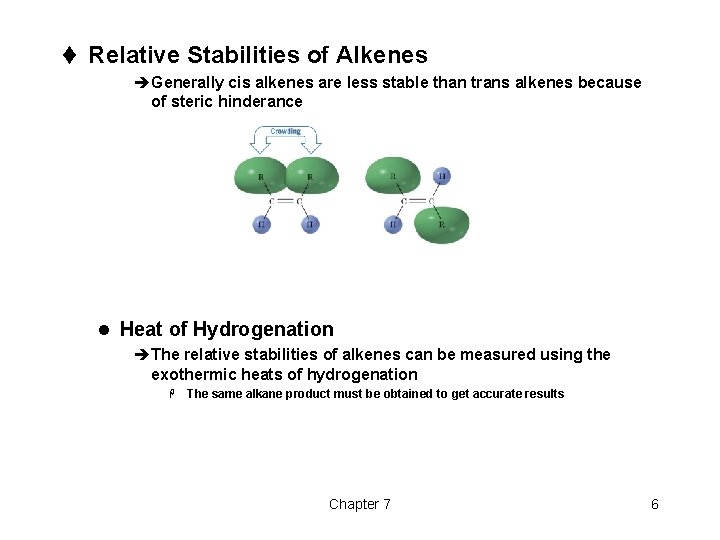
t Relative Stabilities of Alkenes èGenerally cis alkenes are less stable than trans alkenes because of steric hinderance l Heat of Hydrogenation èThe relative stabilities of alkenes can be measured using the exothermic heats of hydrogenation H The same alkane product must be obtained to get accurate results Chapter 7 6
èHeats of hydrogenation of three butene isomers: l Overall Relative Stabilities of Alkenes èThe greater the number of attached alkyl groups (i. e. the more highly substituted the carbon atoms of the double bond), the greater the alkene’s stability Chapter 7 7
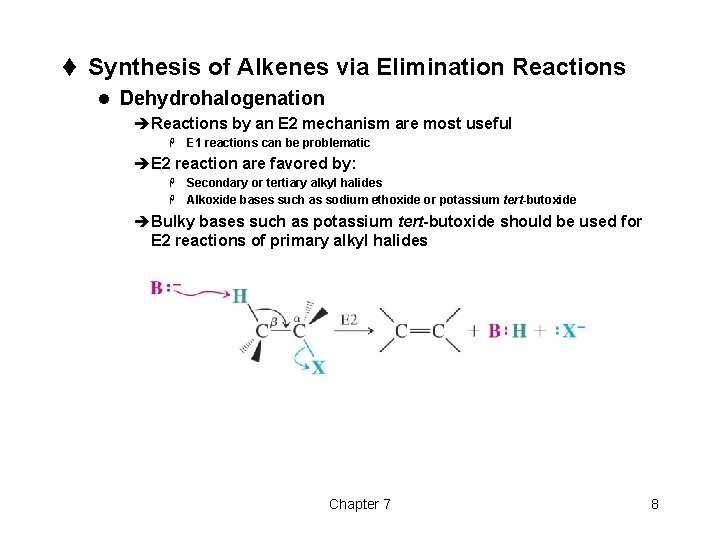
t Synthesis of Alkenes via Elimination Reactions l Dehydrohalogenation èReactions by an E 2 mechanism are most useful H E 1 reactions can be problematic èE 2 reaction are favored by: Secondary or tertiary alkyl halides H Alkoxide bases such as sodium ethoxide or potassium tert-butoxide H èBulky bases such as potassium tert-butoxide should be used for E 2 reactions of primary alkyl halides Chapter 7 8
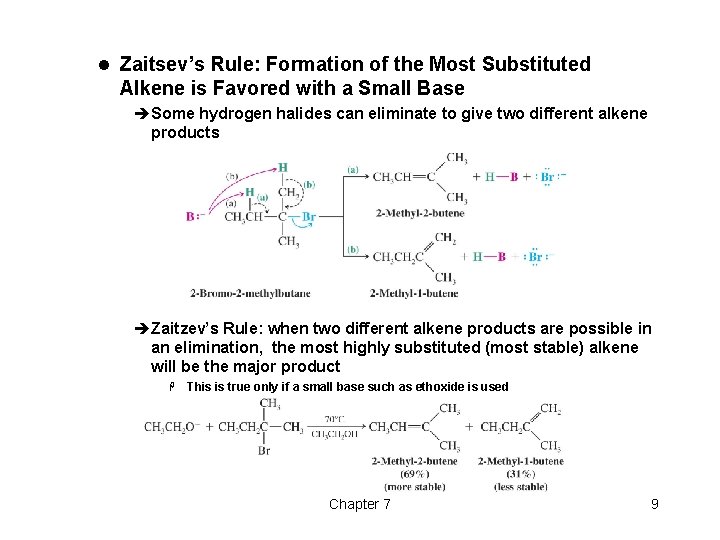
l Zaitsev’s Rule: Formation of the Most Substituted Alkene is Favored with a Small Base èSome hydrogen halides can eliminate to give two different alkene products èZaitzev’s Rule: when two different alkene products are possible in an elimination, the most highly substituted (most stable) alkene will be the major product H This is true only if a small base such as ethoxide is used Chapter 7 9
l Formation of the Least Substituted Alkene Using a Bulky Base èBulky bases such as potassium tert-butoxide have difficulty removing sterically hindered hydrogens and generally only react with more accessible hydrogens (e. g. primary hydrogens) Chapter 7 10
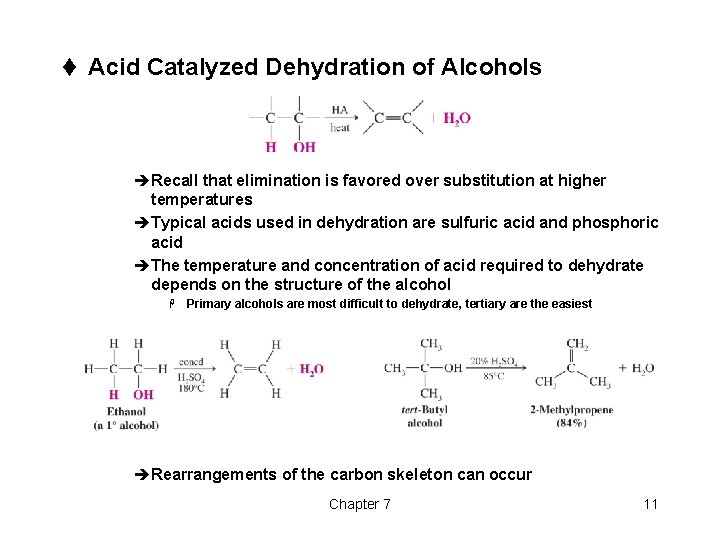
t Acid Catalyzed Dehydration of Alcohols èRecall that elimination is favored over substitution at higher temperatures èTypical acids used in dehydration are sulfuric acid and phosphoric acid èThe temperature and concentration of acid required to dehydrate depends on the structure of the alcohol H Primary alcohols are most difficult to dehydrate, tertiary are the easiest èRearrangements of the carbon skeleton can occur Chapter 7 11
l Mechanism for Dehydration of Secondary and Tertiary Alcohols: An E 1 Reaction èOnly a catalytic amount of acid is required since it is regenerated in the final step of the reaction Chapter 7 12
l Carbocation Stability and the Transition State èRecall the stability of carbocations is: è The second step of the E 1 mechanism in which the carbocation forms is rate determining èThe transition state for this reaction has carbocation character èTertiary alcohols react the fastest because they have the most stable tertiary carbocation-like transition state in the second step Chapter 7 13
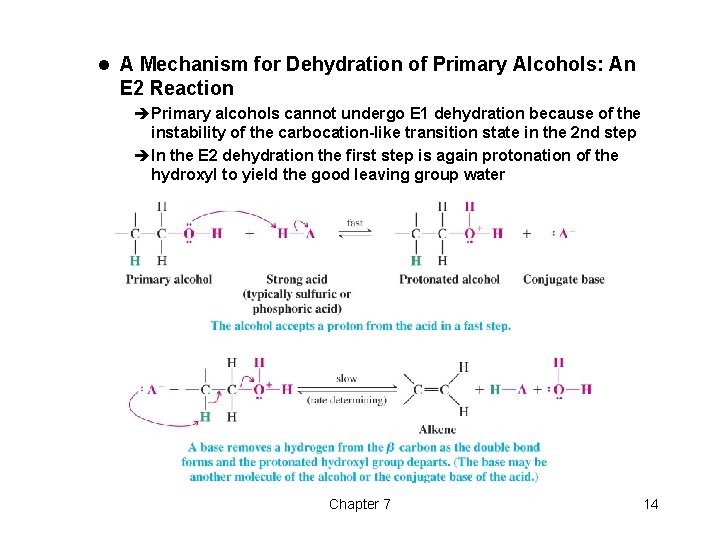
l A Mechanism for Dehydration of Primary Alcohols: An E 2 Reaction èPrimary alcohols cannot undergo E 1 dehydration because of the instability of the carbocation-like transition state in the 2 nd step èIn the E 2 dehydration the first step is again protonation of the hydroxyl to yield the good leaving group water Chapter 7 14
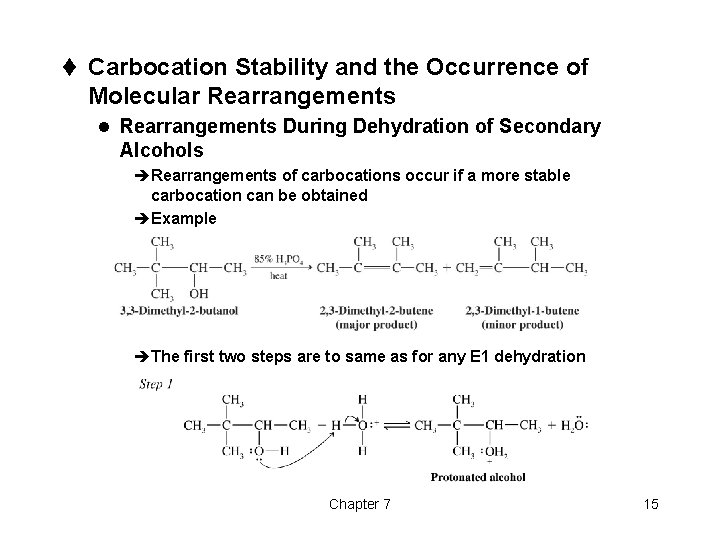
t Carbocation Stability and the Occurrence of Molecular Rearrangements l Rearrangements During Dehydration of Secondary Alcohols èRearrangements of carbocations occur if a more stable carbocation can be obtained èExample èThe first two steps are to same as for any E 1 dehydration Chapter 7 15
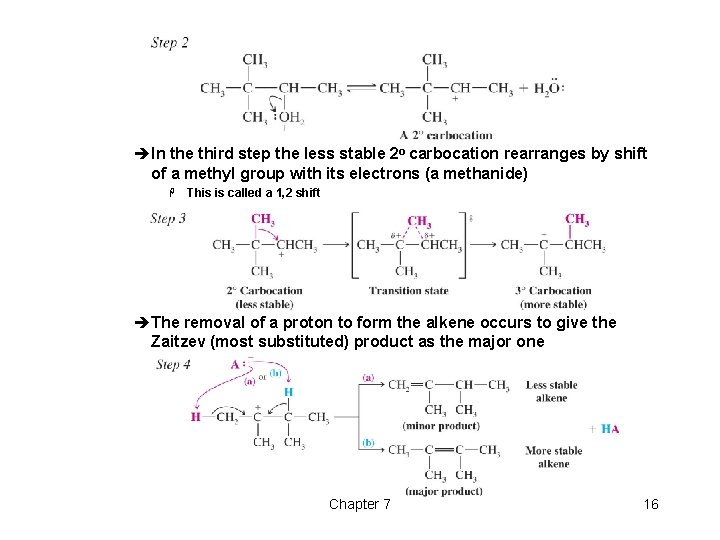
èIn the third step the less stable 2 o carbocation rearranges by shift of a methyl group with its electrons (a methanide) H This is called a 1, 2 shift èThe removal of a proton to form the alkene occurs to give the Zaitzev (most substituted) product as the major one Chapter 7 16
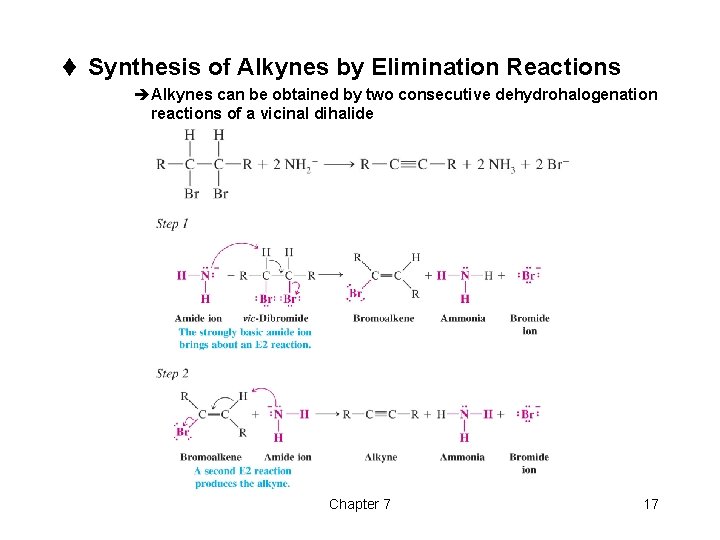
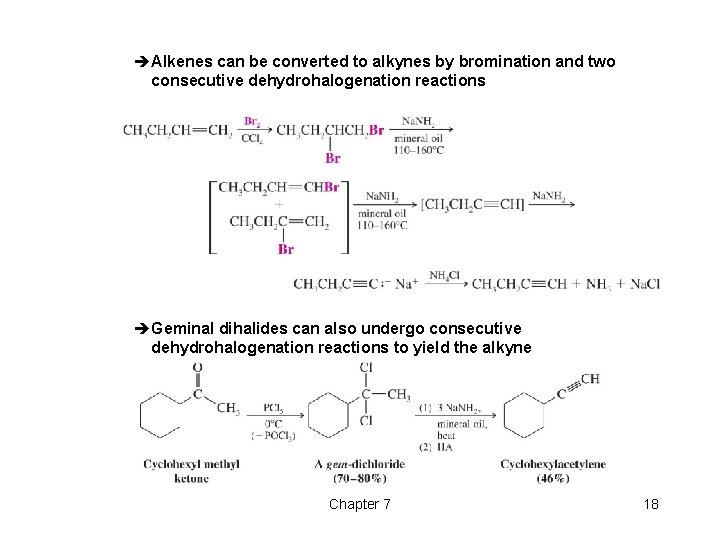
t Synthesis of Alkynes by Elimination Reactions èAlkynes can be obtained by two consecutive dehydrohalogenation reactions of a vicinal dihalide Chapter 7 17
èAlkenes can be converted to alkynes by bromination and two consecutive dehydrohalogenation reactions èGeminal dihalides can also undergo consecutive dehydrohalogenation reactions to yield the alkyne Chapter 7 18
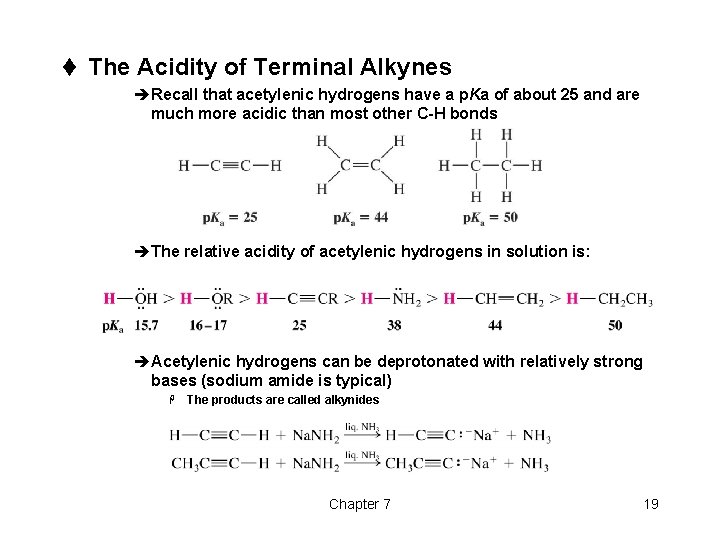
t The Acidity of Terminal Alkynes èRecall that acetylenic hydrogens have a p. Ka of about 25 and are much more acidic than most other C-H bonds èThe relative acidity of acetylenic hydrogens in solution is: èAcetylenic hydrogens can be deprotonated with relatively strong bases (sodium amide is typical) H The products are called alkynides Chapter 7 19
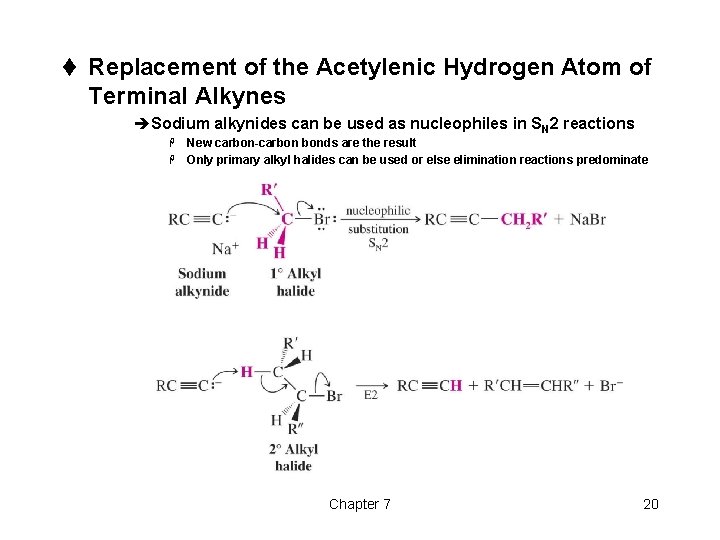
t Replacement of the Acetylenic Hydrogen Atom of Terminal Alkynes èSodium alkynides can be used as nucleophiles in SN 2 reactions New carbon-carbon bonds are the result H Only primary alkyl halides can be used or else elimination reactions predominate H Chapter 7 20
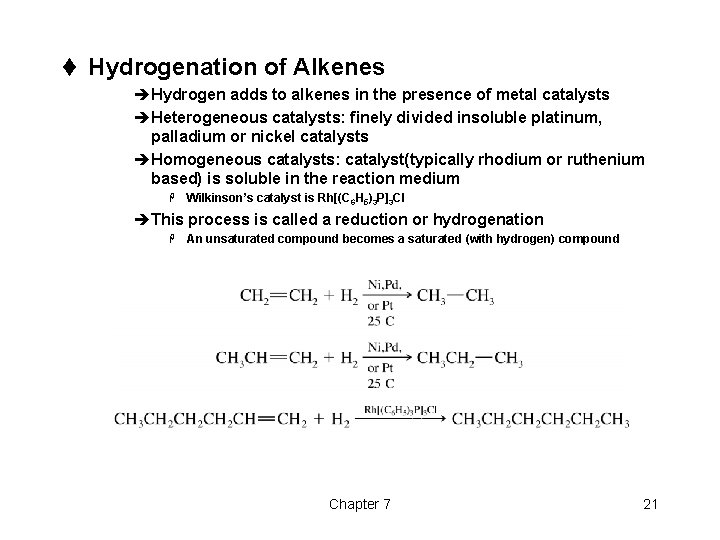
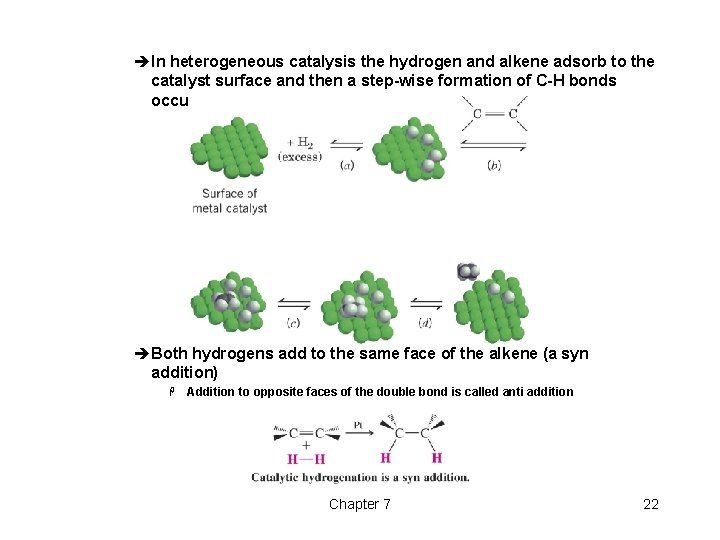
t Hydrogenation of Alkenes èHydrogen adds to alkenes in the presence of metal catalysts èHeterogeneous catalysts: finely divided insoluble platinum, palladium or nickel catalysts èHomogeneous catalysts: catalyst(typically rhodium or ruthenium based) is soluble in the reaction medium H Wilkinson’s catalyst is Rh[(C 6 H 5)3 P]3 Cl èThis process is called a reduction or hydrogenation H An unsaturated compound becomes a saturated (with hydrogen) compound Chapter 7 21
èIn heterogeneous catalysis the hydrogen and alkene adsorb to the catalyst surface and then a step-wise formation of C-H bonds occurs èBoth hydrogens add to the same face of the alkene (a syn addition) H Addition to opposite faces of the double bond is called anti addition Chapter 7 22
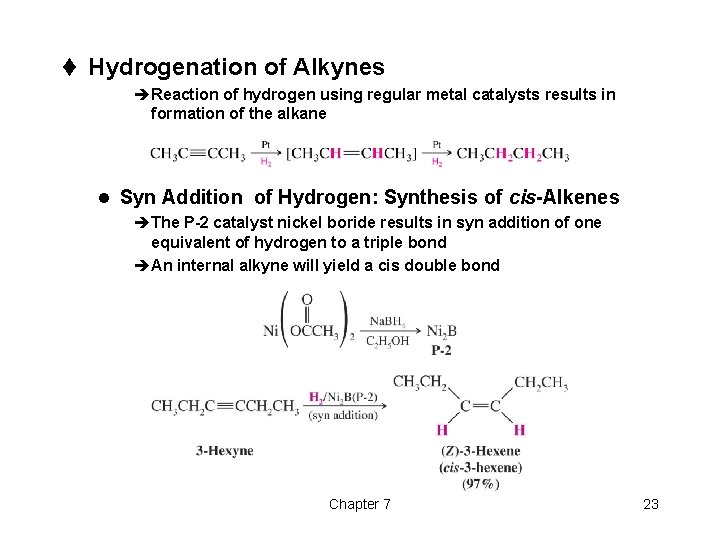
t Hydrogenation of Alkynes èReaction of hydrogen using regular metal catalysts results in formation of the alkane l Syn Addition of Hydrogen: Synthesis of cis-Alkenes èThe P-2 catalyst nickel boride results in syn addition of one equivalent of hydrogen to a triple bond èAn internal alkyne will yield a cis double bond Chapter 7 23
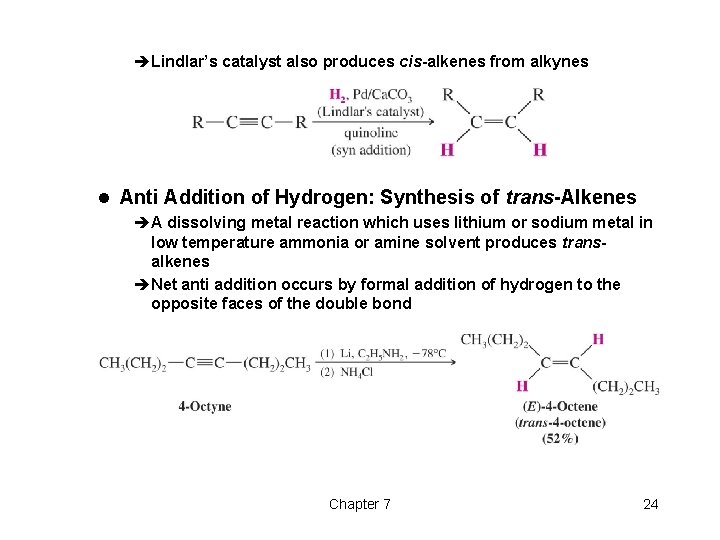
èLindlar’s catalyst also produces cis-alkenes from alkynes l Anti Addition of Hydrogen: Synthesis of trans-Alkenes èA dissolving metal reaction which uses lithium or sodium metal in low temperature ammonia or amine solvent produces transalkenes èNet anti addition occurs by formal addition of hydrogen to the opposite faces of the double bond Chapter 7 24
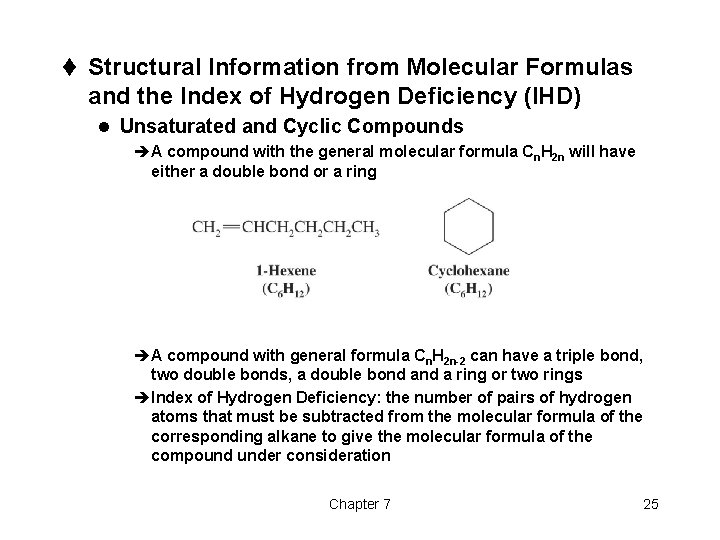
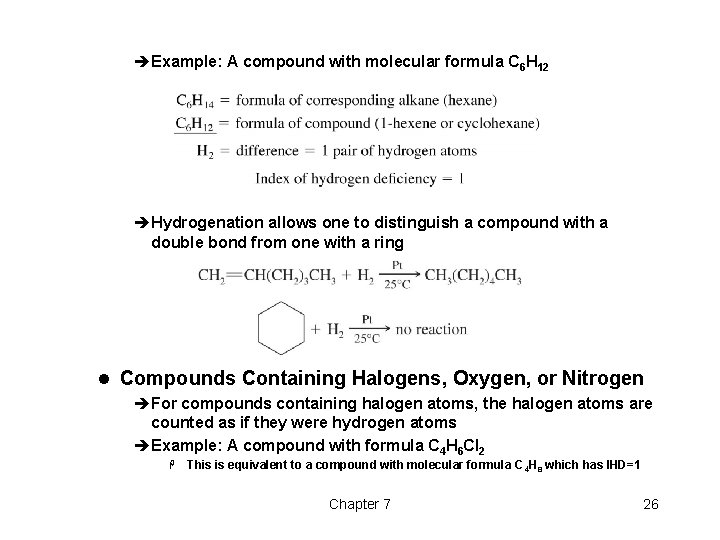
t Structural Information from Molecular Formulas and the Index of Hydrogen Deficiency (IHD) l Unsaturated and Cyclic Compounds èA compound with the general molecular formula Cn. H 2 n will have either a double bond or a ring èA compound with general formula Cn. H 2 n-2 can have a triple bond, two double bonds, a double bond a ring or two rings èIndex of Hydrogen Deficiency: the number of pairs of hydrogen atoms that must be subtracted from the molecular formula of the corresponding alkane to give the molecular formula of the compound under consideration Chapter 7 25
èExample: A compound with molecular formula C 6 H 12 èHydrogenation allows one to distinguish a compound with a double bond from one with a ring l Compounds Containing Halogens, Oxygen, or Nitrogen èFor compounds containing halogen atoms, the halogen atoms are counted as if they were hydrogen atoms èExample: A compound with formula C 4 H 6 Cl 2 H This is equivalent to a compound with molecular formula C 4 H 8 which has IHD=1 Chapter 7 26
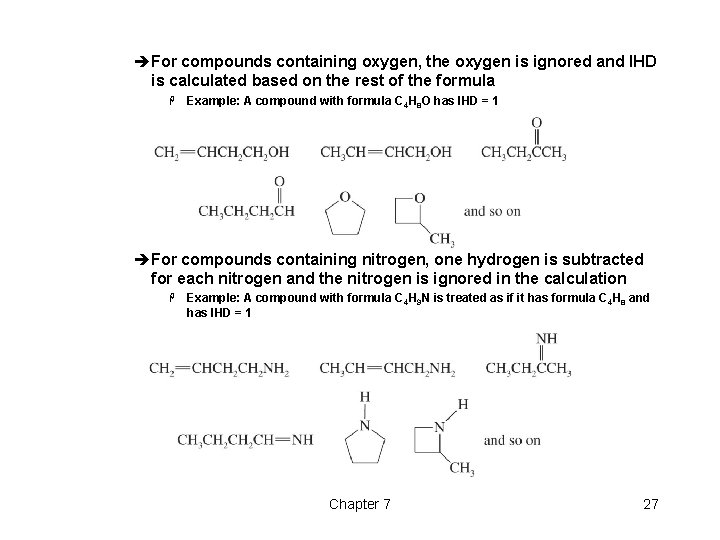
èFor compounds containing oxygen, the oxygen is ignored and IHD is calculated based on the rest of the formula H Example: A compound with formula C 4 H 8 O has IHD = 1 èFor compounds containing nitrogen, one hydrogen is subtracted for each nitrogen and the nitrogen is ignored in the calculation H Example: A compound with formula C 4 H 9 N is treated as if it has formula C 4 H 8 and has IHD = 1 Chapter 7 27