CHAPTER 4 SECTION 4 3 RIEMANN SUMS AND
- Slides: 38
CHAPTER 4 SECTION 4. 3 RIEMANN SUMS AND DEFINITE INTEGRALS
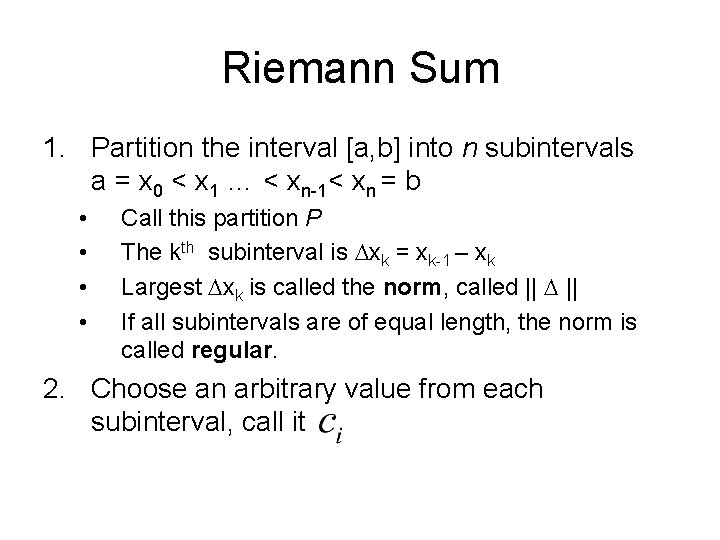
Riemann Sum 1. Partition the interval [a, b] into n subintervals a = x 0 < x 1 … < xn-1< xn = b • • Call this partition P The kth subinterval is xk = xk-1 – xk Largest xk is called the norm, called || If all subintervals are of equal length, the norm is called regular. 2. Choose an arbitrary value from each subinterval, call it
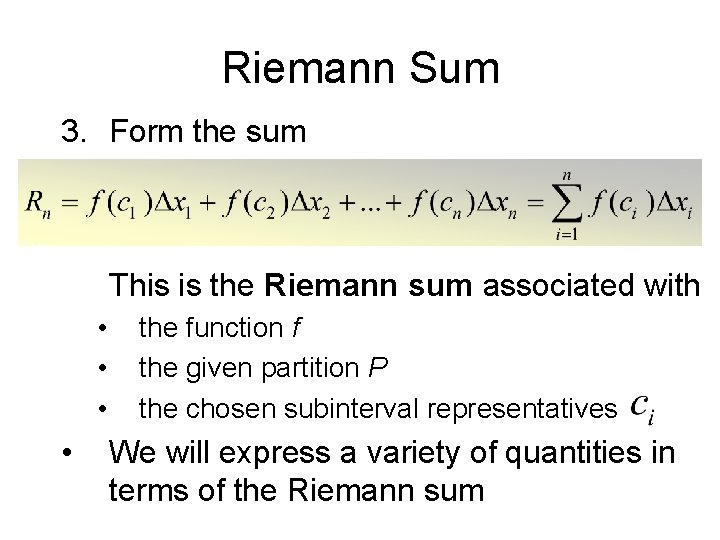
Riemann Sum 3. Form the sum This is the Riemann sum associated with • • the function f the given partition P the chosen subinterval representatives We will express a variety of quantities in terms of the Riemann sum
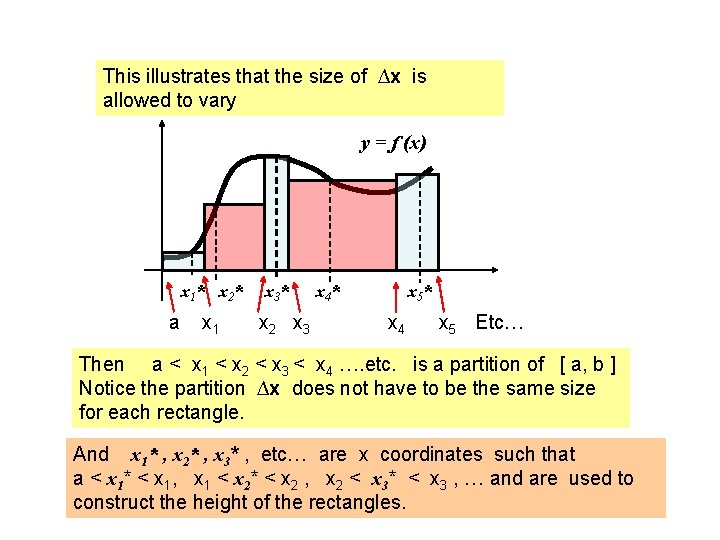
This illustrates that the size of ∆x is allowed to vary y = f (x) x 1* x 2* a x 1 x 3* x 2 x 3 x 4* x 5* x 4 x 5 Etc… Then a < x 1 < x 2 < x 3 < x 4 …. etc. is a partition of [ a, b ] Notice the partition ∆x does not have to be the same size for each rectangle. And x 1* , x 2* , x 3* , etc… are x coordinates such that a < x 1* < x 1, x 1 < x 2* < x 2 , x 2 < x 3* < x 3 , … and are used to construct the height of the rectangles.
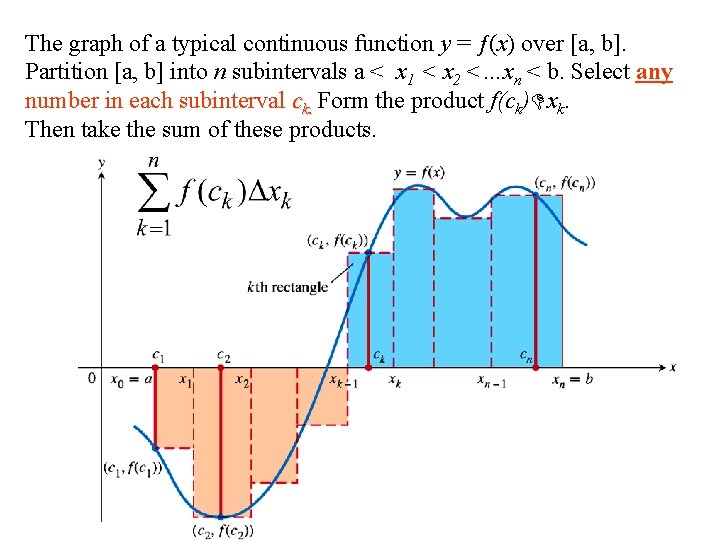
The graph of a typical continuous function y = ƒ(x) over [a, b]. Partition [a, b] into n subintervals a < x 1 < x 2 <…xn < b. Select any number in each subinterval ck. Form the product f(ck) xk. Then take the sum of these products.
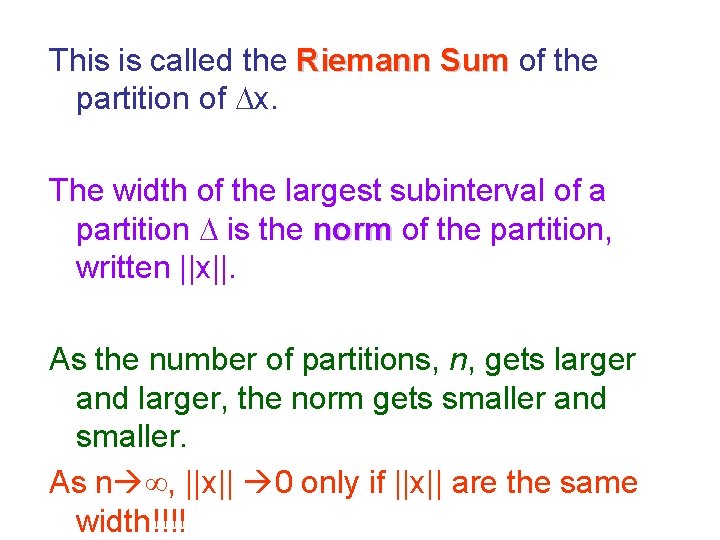
This is called the Riemann Sum of the partition of x. The width of the largest subinterval of a partition is the norm of the partition, written ||x||. As the number of partitions, n, gets larger and larger, the norm gets smaller and smaller. As n , ||x|| 0 only if ||x|| are the same width!!!!
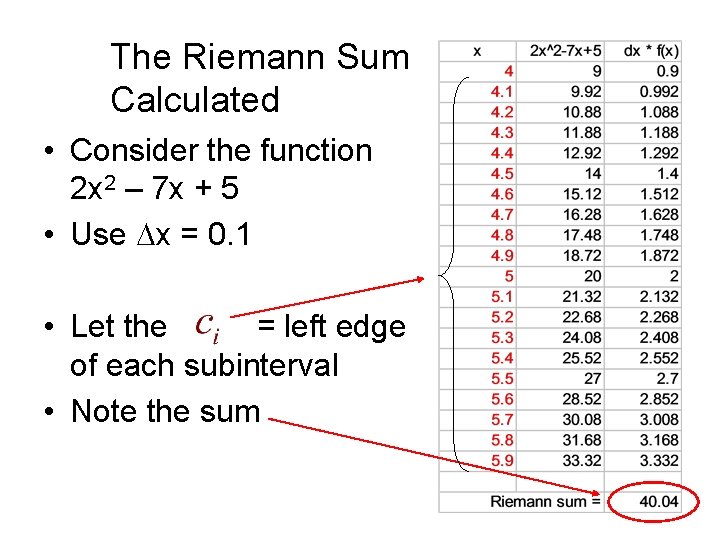
The Riemann Sum Calculated • Consider the function 2 x 2 – 7 x + 5 • Use x = 0. 1 • Let the = left edge of each subinterval • Note the sum
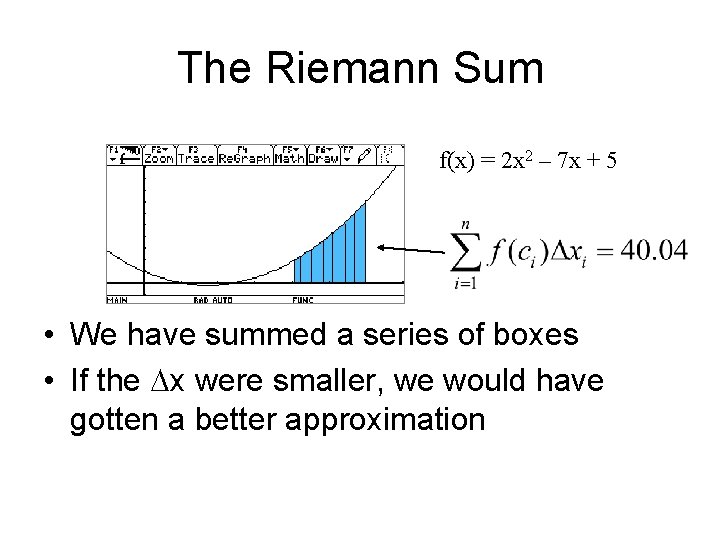
The Riemann Sum f(x) = 2 x 2 – 7 x + 5 • We have summed a series of boxes • If the x were smaller, we would have gotten a better approximation
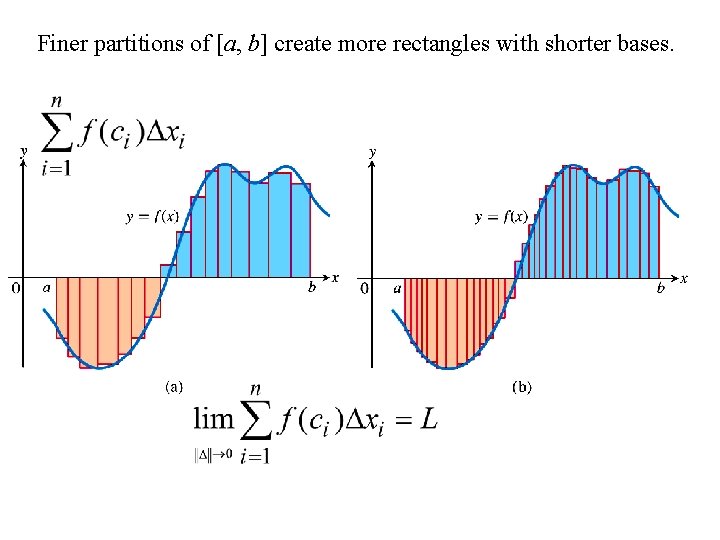
Finer partitions of [a, b] create more rectangles with shorter bases.
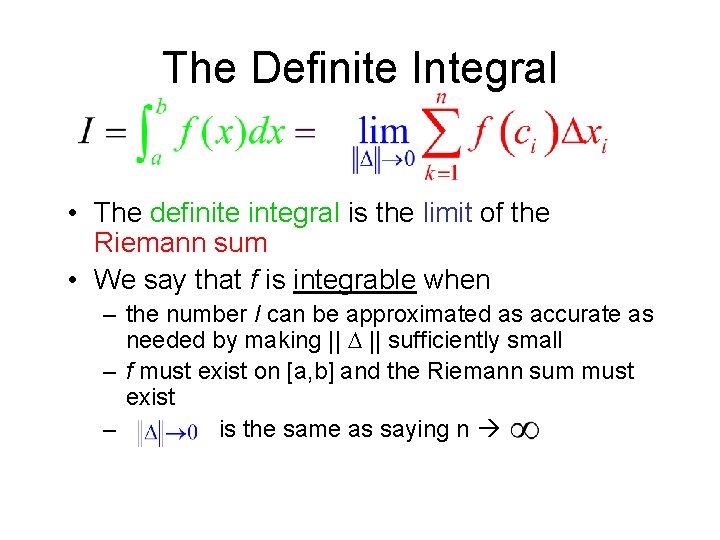
The Definite Integral • The definite integral is the limit of the Riemann sum • We say that f is integrable when – the number I can be approximated as accurate as needed by making || sufficiently small – f must exist on [a, b] and the Riemann sum must exist – is the same as saying n
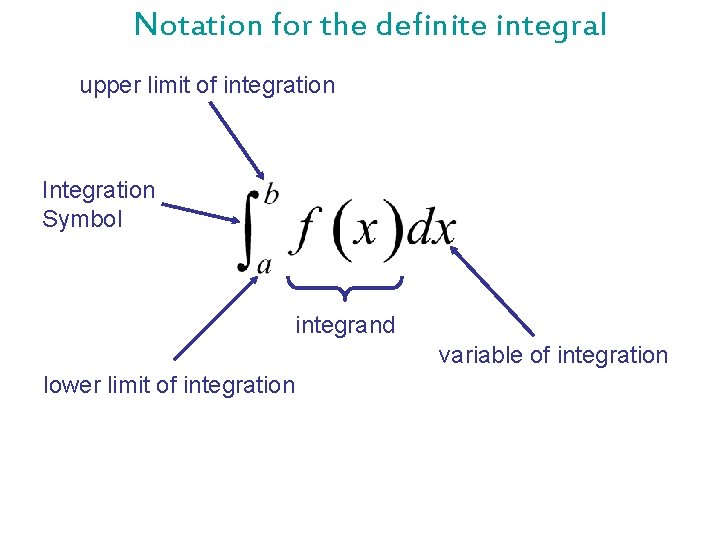
Notation for the definite integral upper limit of integration Integration Symbol integrand variable of integration lower limit of integration
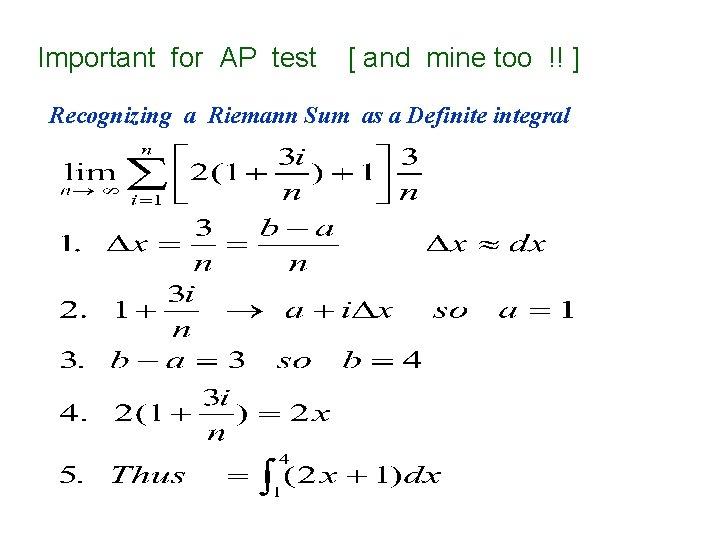
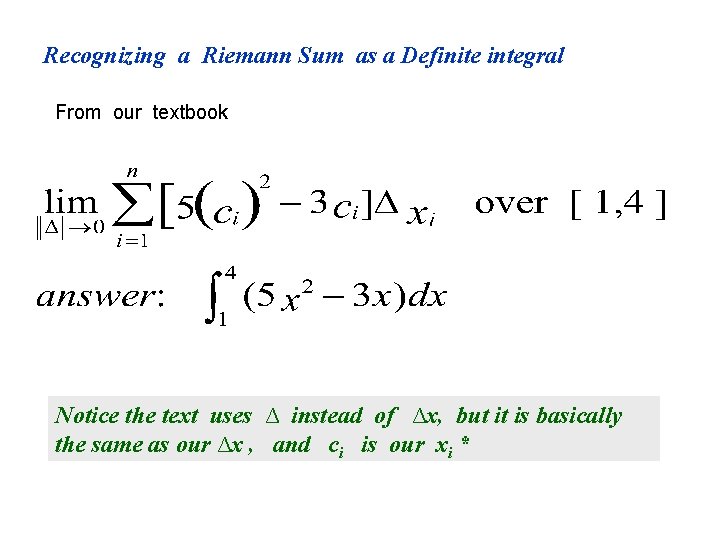
Important for AP test [ and mine too !! ] Recognizing a Riemann Sum as a Definite integral
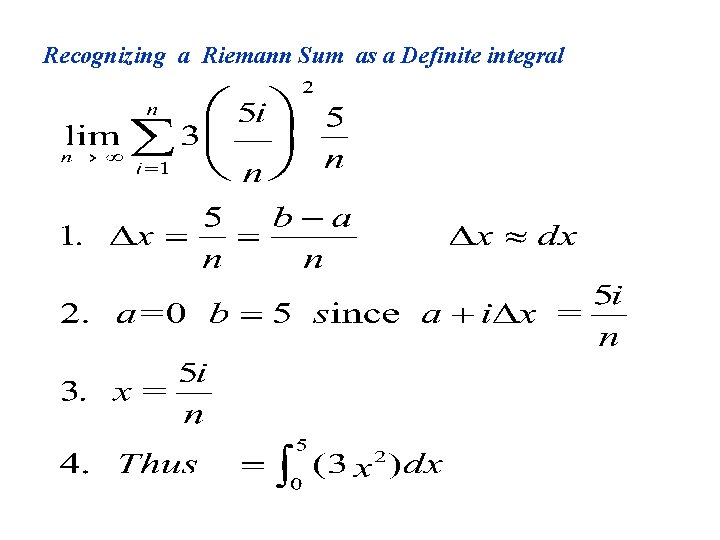
Recognizing a Riemann Sum as a Definite integral
Recognizing a Riemann Sum as a Definite integral From our textbook Notice the text uses ∆ instead of ∆x, but it is basically the same as our ∆x , and ci is our xi *
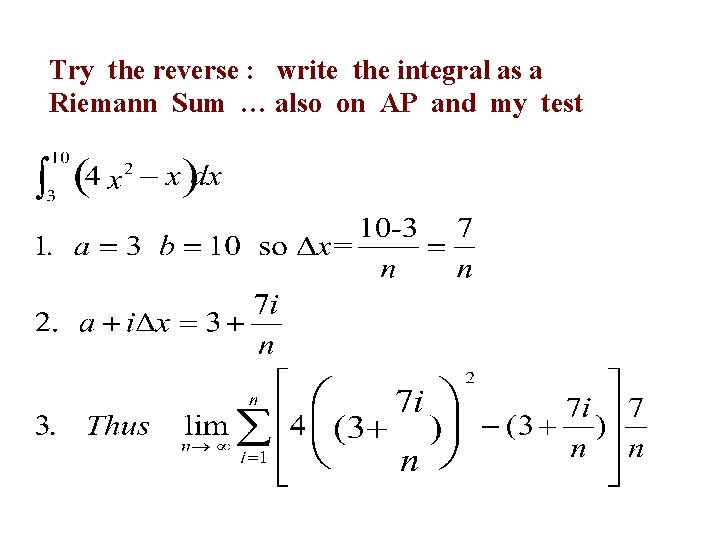
Try the reverse : write the integral as a Riemann Sum … also on AP and my test
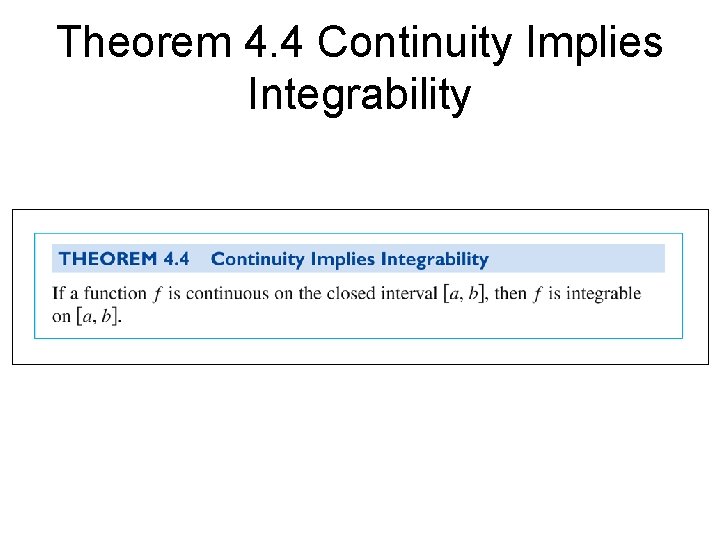
Theorem 4. 4 Continuity Implies Integrability
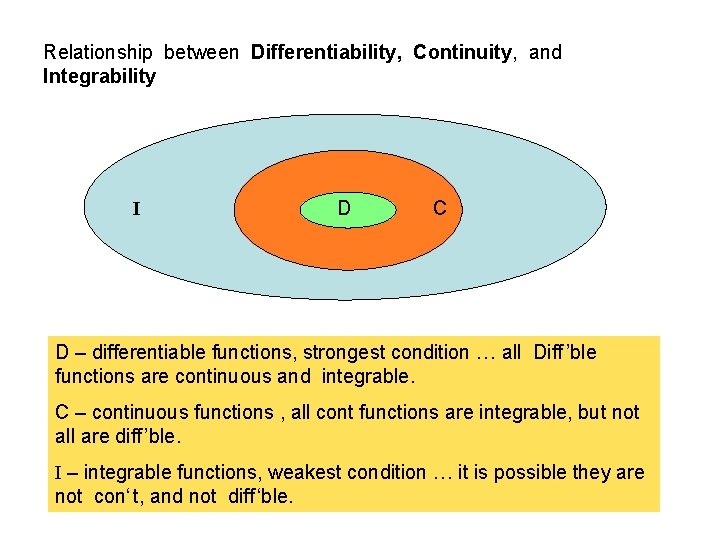
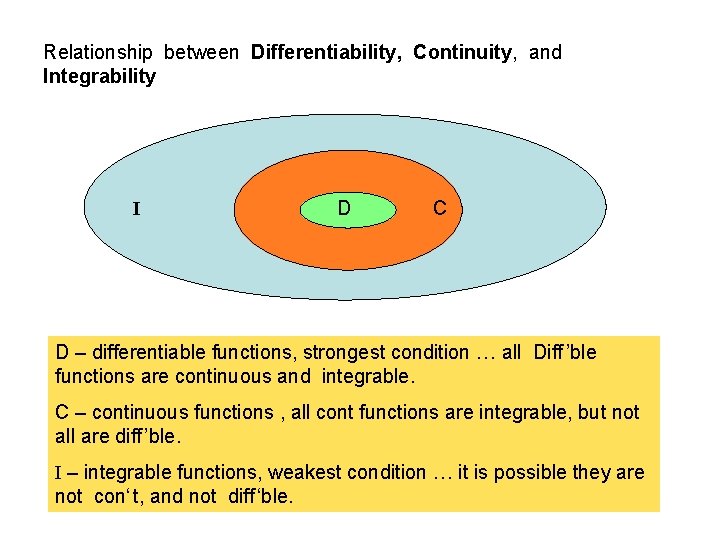
Relationship between Differentiability, Continuity, and Integrability I D C D – differentiable functions, strongest condition … all Diff ’ble functions are continuous and integrable. C – continuous functions , all cont functions are integrable, but not all are diff ’ble. I – integrable functions, weakest condition … it is possible they are not con‘ t, and not diff ‘ble.
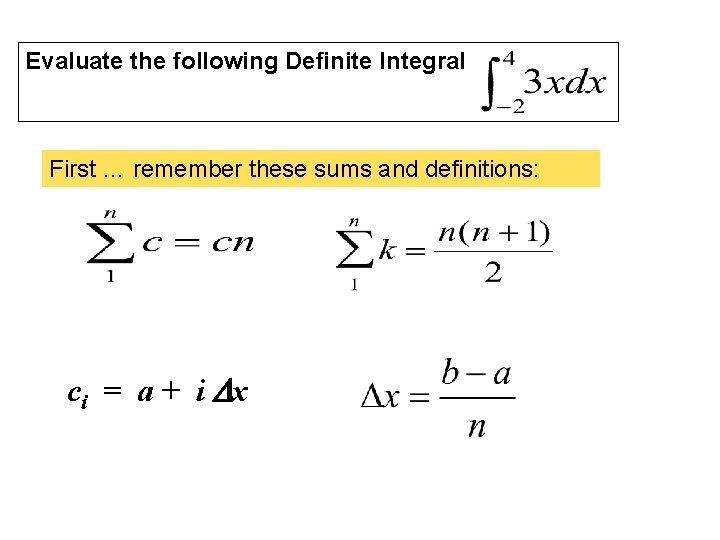
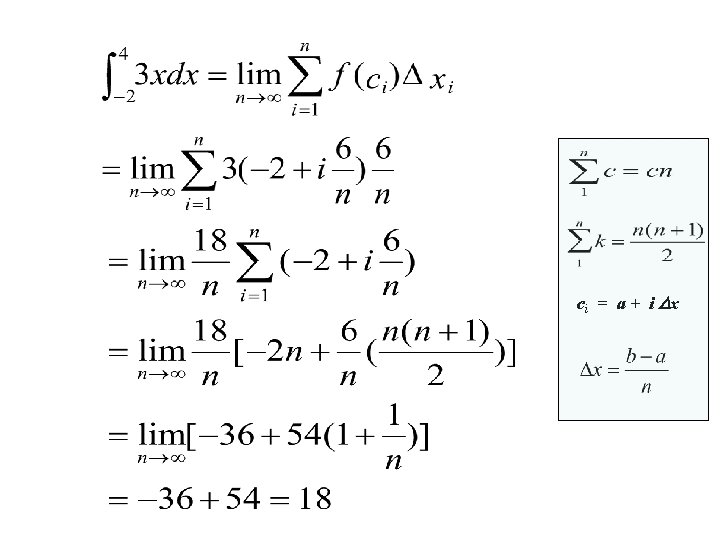
Evaluate the following Definite Integral First … remember these sums and definitions: ci = a + i x
ci = a + i x
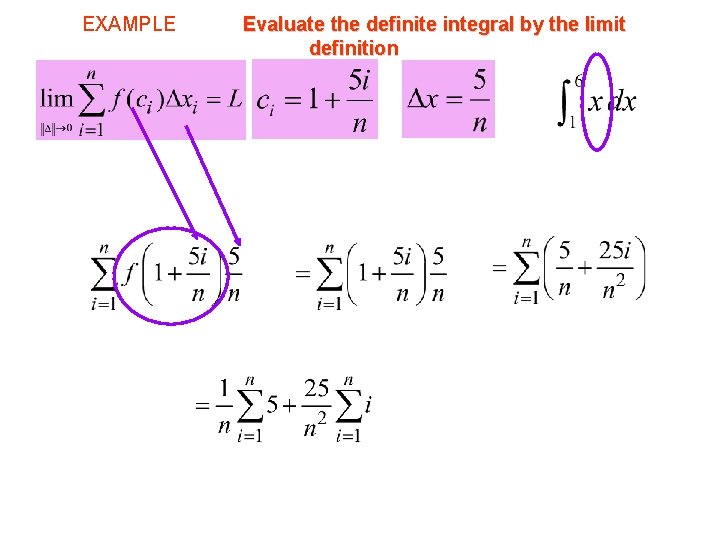
EXAMPLE Evaluate the definite integral by the limit definition
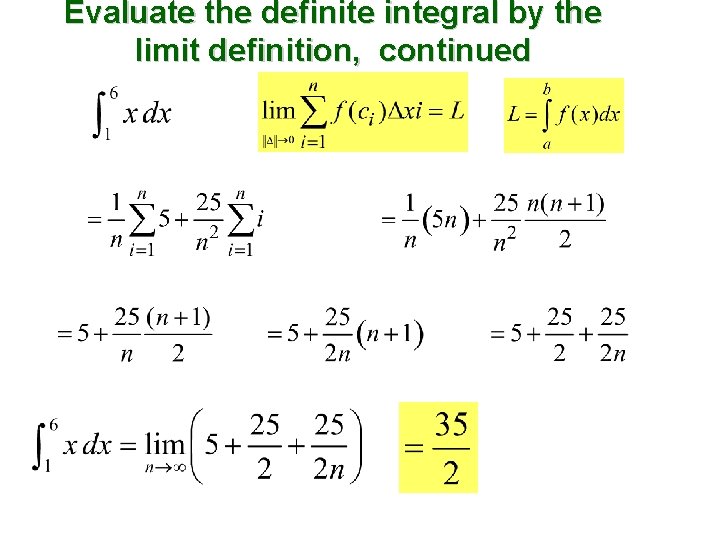
Evaluate the definite integral by the limit definition, continued
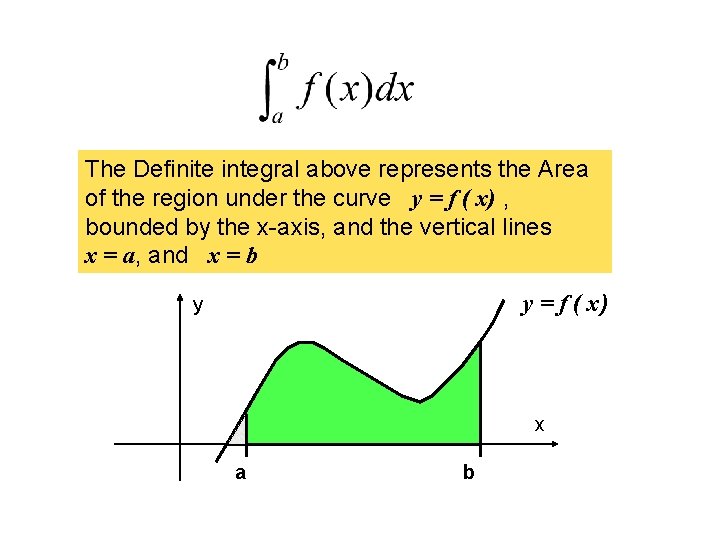
The Definite integral above represents the Area of the region under the curve y = f ( x) , bounded by the x-axis, and the vertical lines x = a, and x = b y = f ( x) y x a b
Theorem 4. 4 Continuity Implies Integrability
Relationship between Differentiability, Continuity, and Integrability I D C D – differentiable functions, strongest condition … all Diff ’ble functions are continuous and integrable. C – continuous functions , all cont functions are integrable, but not all are diff ’ble. I – integrable functions, weakest condition … it is possible they are not con‘ t, and not diff ‘ble.
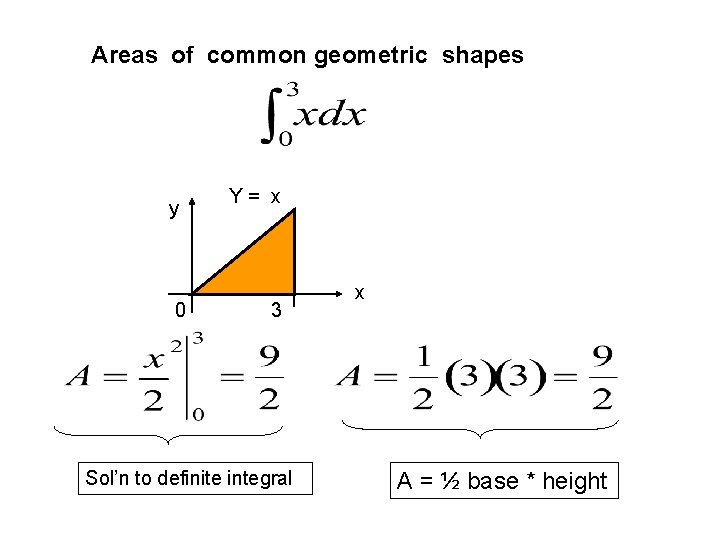
Areas of common geometric shapes y 0 Y= x 3 Sol’n to definite integral x A = ½ base * height
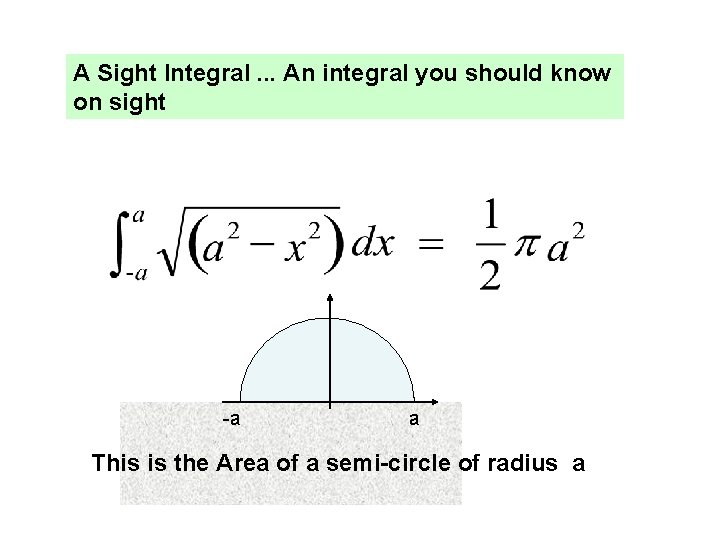
A Sight Integral. . . An integral you should know on sight -a a This is the Area of a semi-circle of radius a
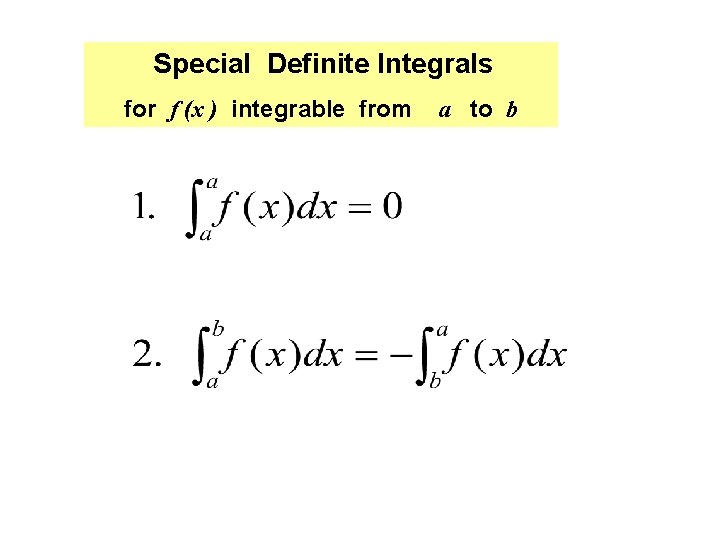
Special Definite Integrals for f (x ) integrable from a to b
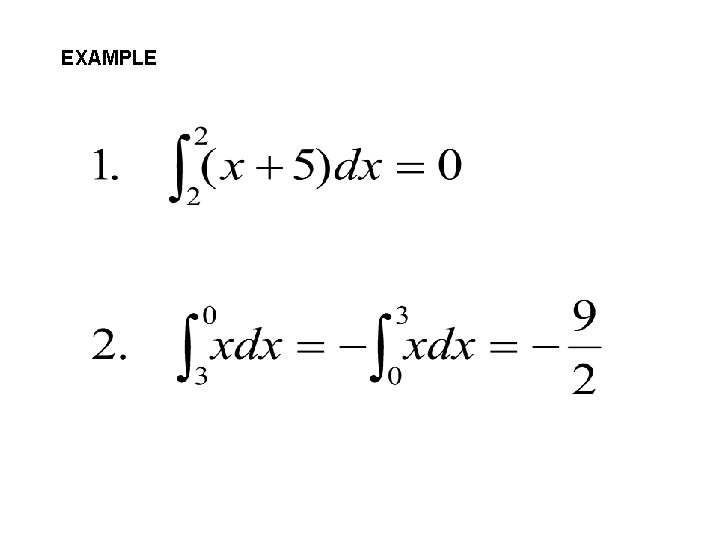
EXAMPLE
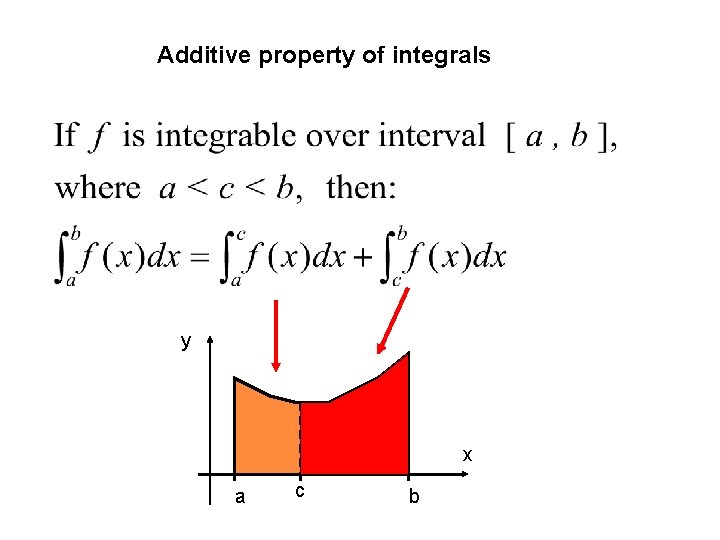
Additive property of integrals y x a c b
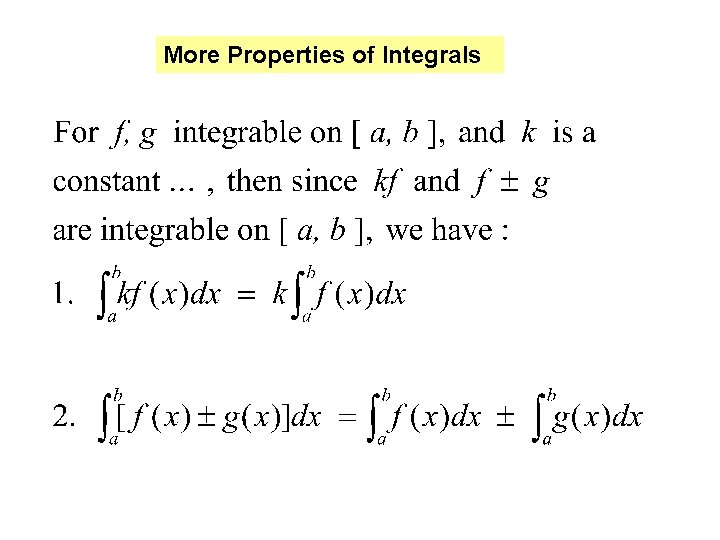
More Properties of Integrals
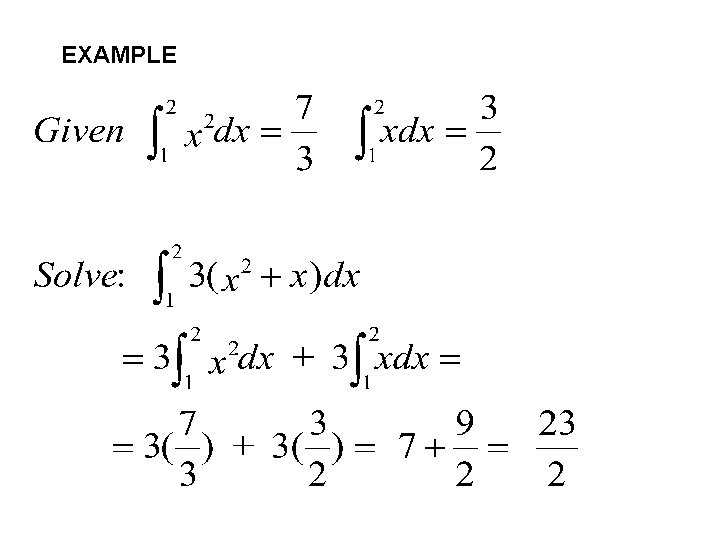
EXAMPLE
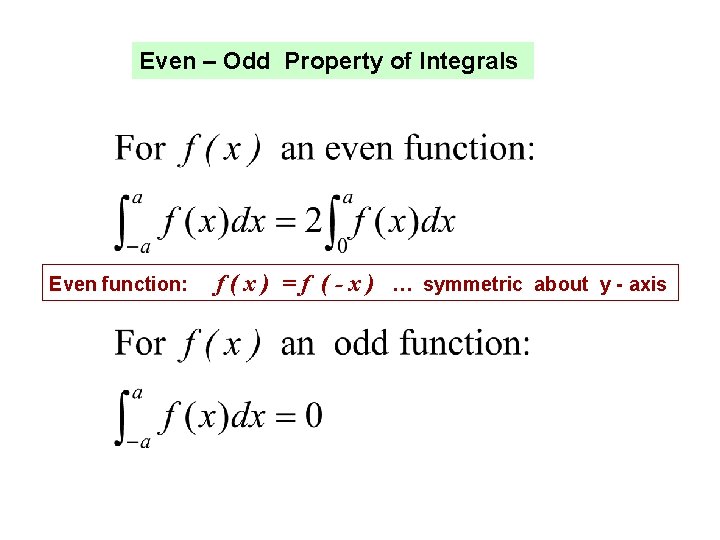
Even – Odd Property of Integrals Even function: f ( x ) = f ( - x ) … symmetric about y - axis
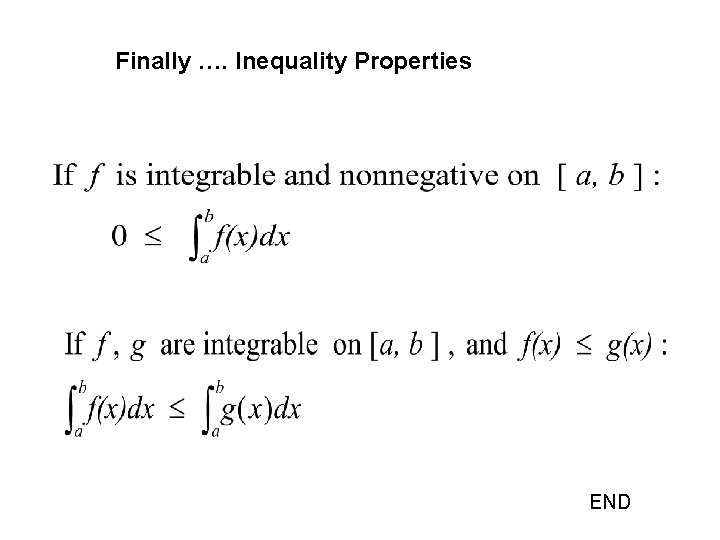
Finally …. Inequality Properties END
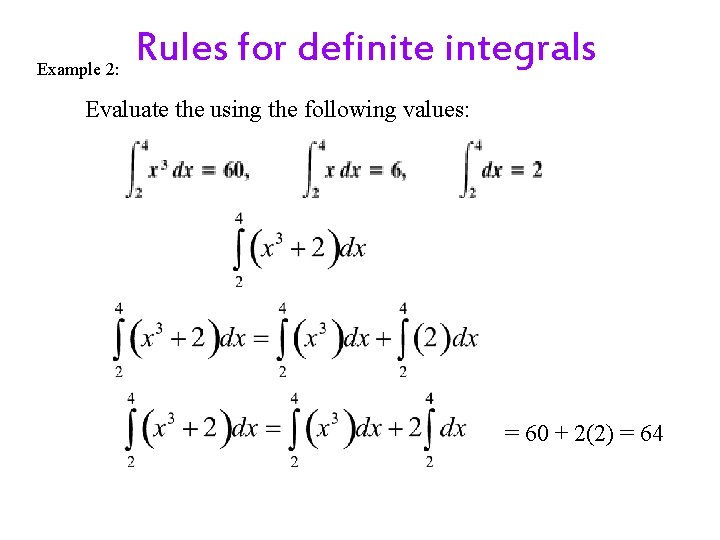
Example 2: Rules for definite integrals Evaluate the using the following values: = 60 + 2(2) = 64
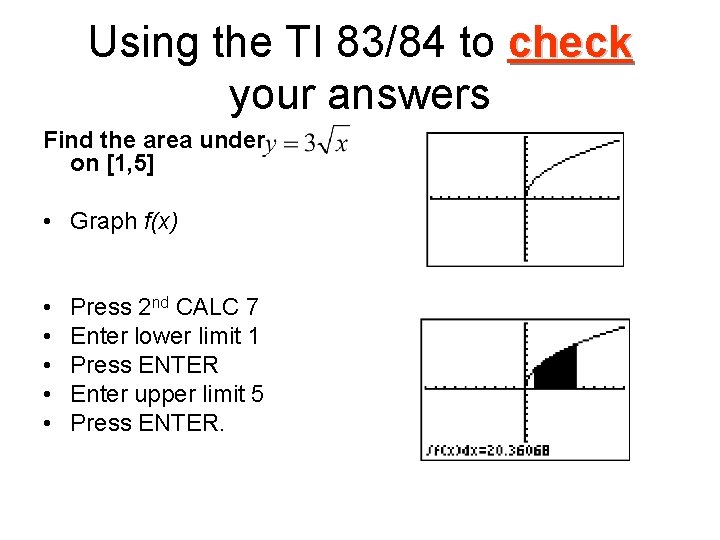
Using the TI 83/84 to check your answers Find the area under on [1, 5] • Graph f(x) • • • Press 2 nd CALC 7 Enter lower limit 1 Press ENTER Enter upper limit 5 Press ENTER.
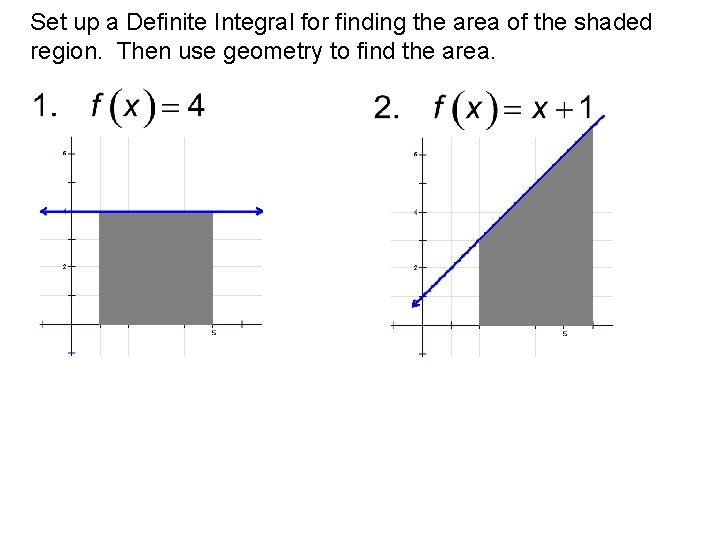
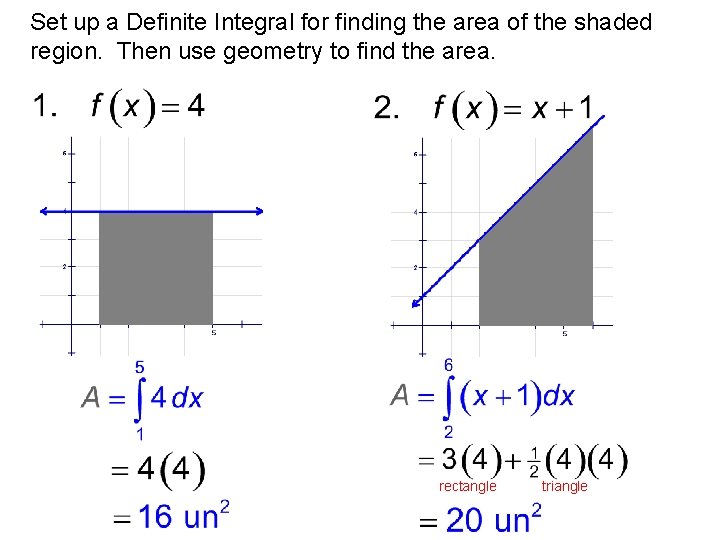
Set up a Definite Integral for finding the area of the shaded region. Then use geometry to find the area.
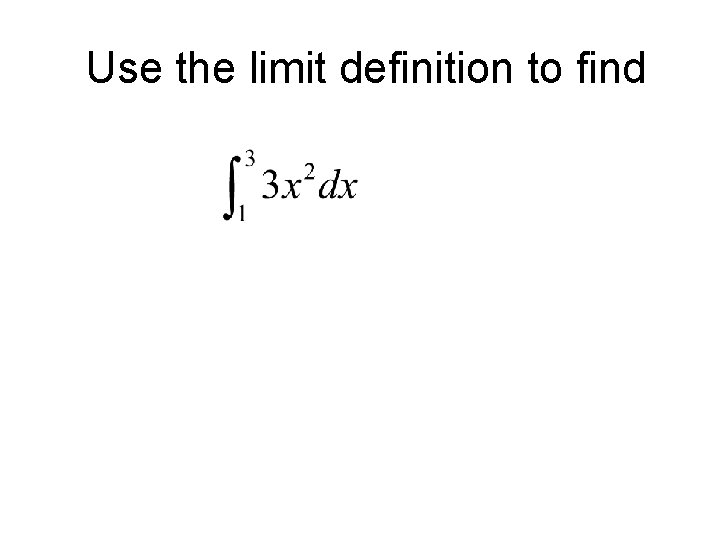
Use the limit definition to find
Set up a Definite Integral for finding the area of the shaded region. Then use geometry to find the area. rectangle triangle