
Section 8 2 Series Practice HW from Stewart











- Slides: 33
Section 8. 2: Series Practice HW from Stewart Textbook (not to hand in) p. 575 # 9 -15 odd, 19, 21, 23, 25, 31, 33
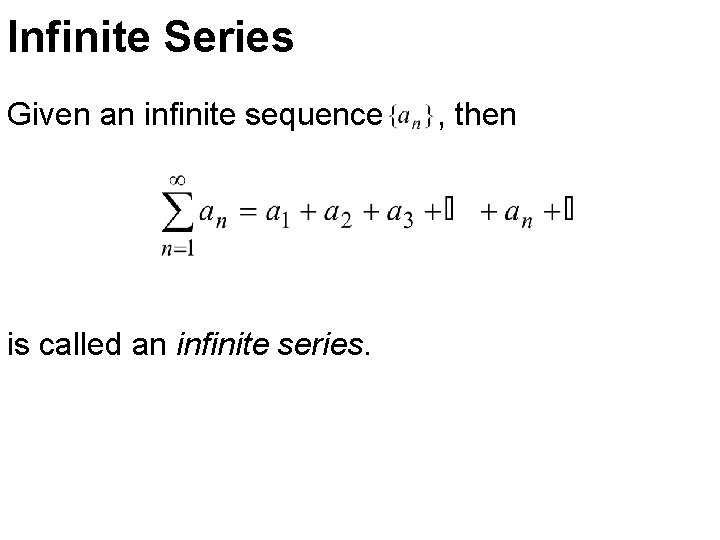
Infinite Series Given an infinite sequence is called an infinite series. , then
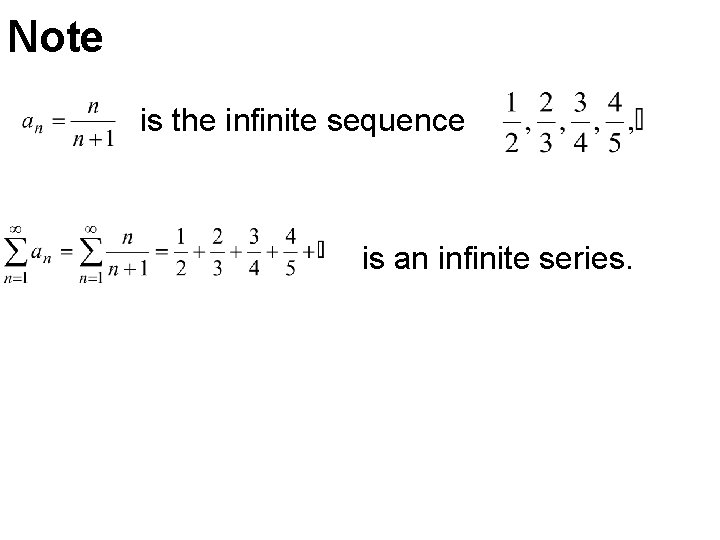
Note is the infinite sequence is an infinite series.
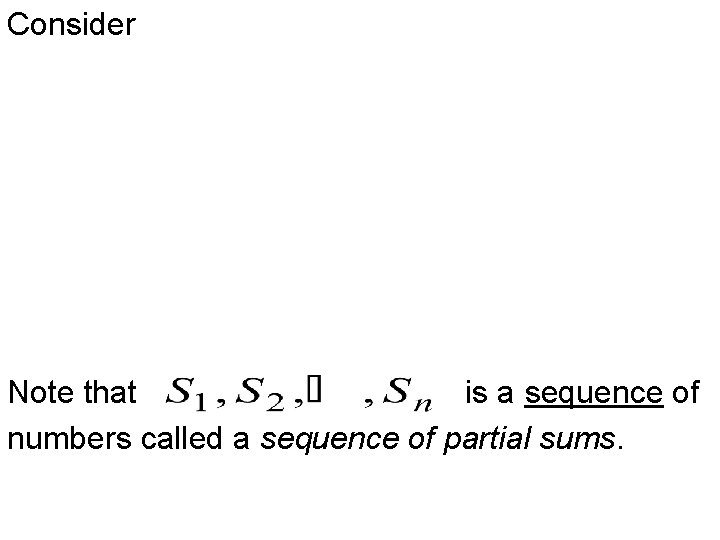
Consider Note that is a sequence of numbers called a sequence of partial sums.
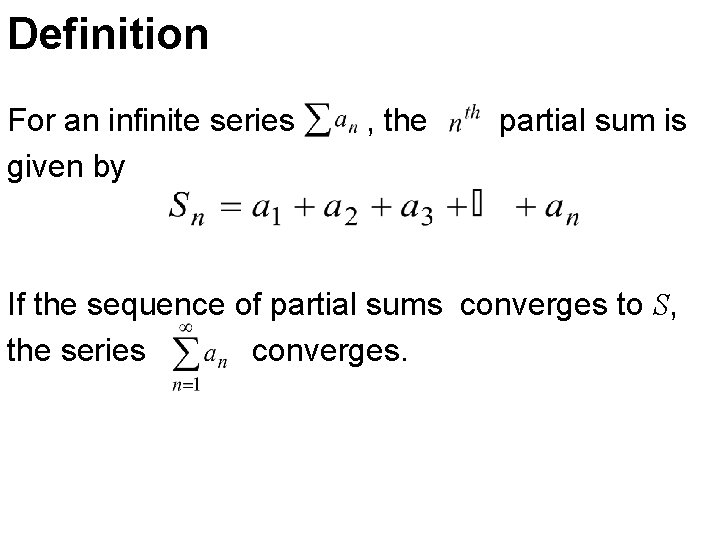
Definition For an infinite series given by , the partial sum is If the sequence of partial sums converges to S, the series converges.
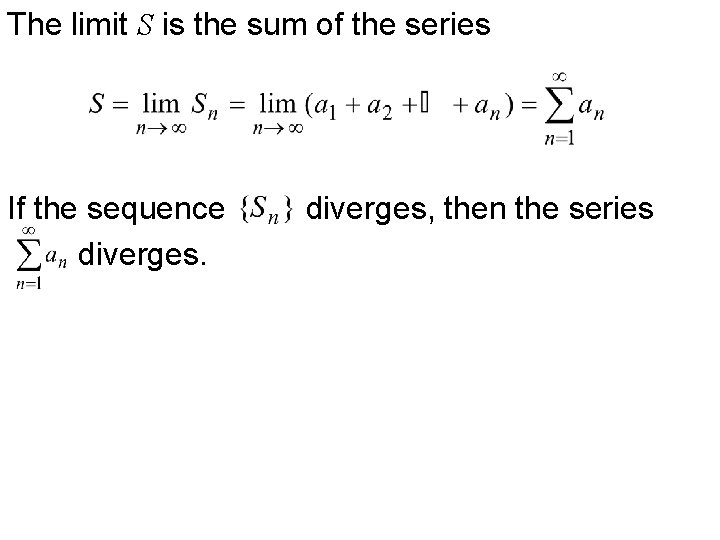
The limit S is the sum of the series If the sequence diverges, then the series
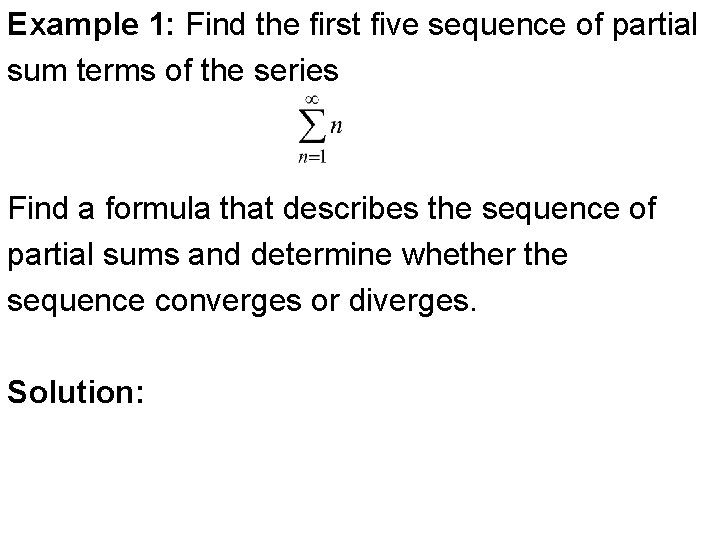
Example 1: Find the first five sequence of partial sum terms of the series Find a formula that describes the sequence of partial sums and determine whether the sequence converges or diverges. Solution:
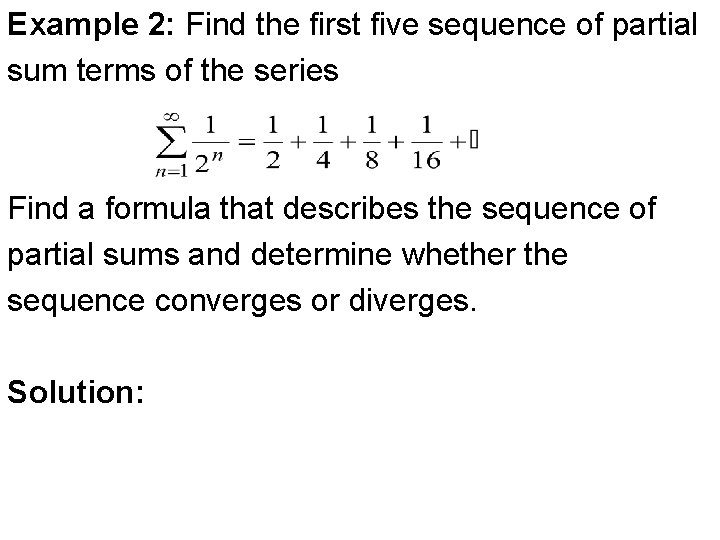
Example 2: Find the first five sequence of partial sum terms of the series Find a formula that describes the sequence of partial sums and determine whether the sequence converges or diverges. Solution:
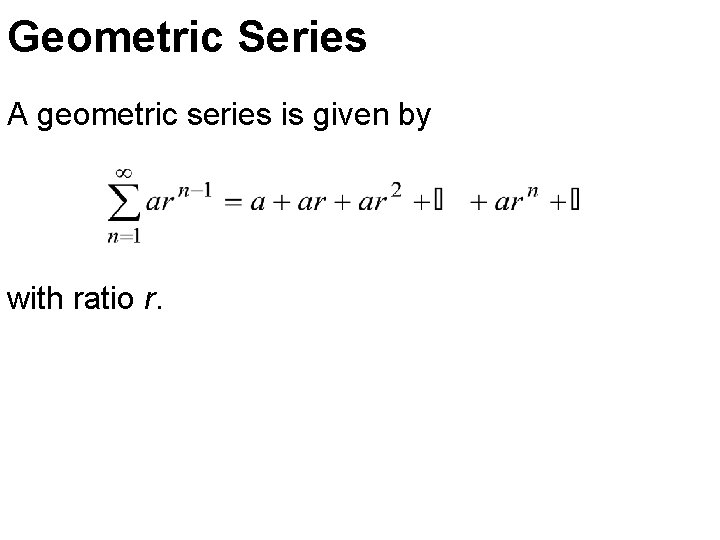
Geometric Series A geometric series is given by with ratio r.
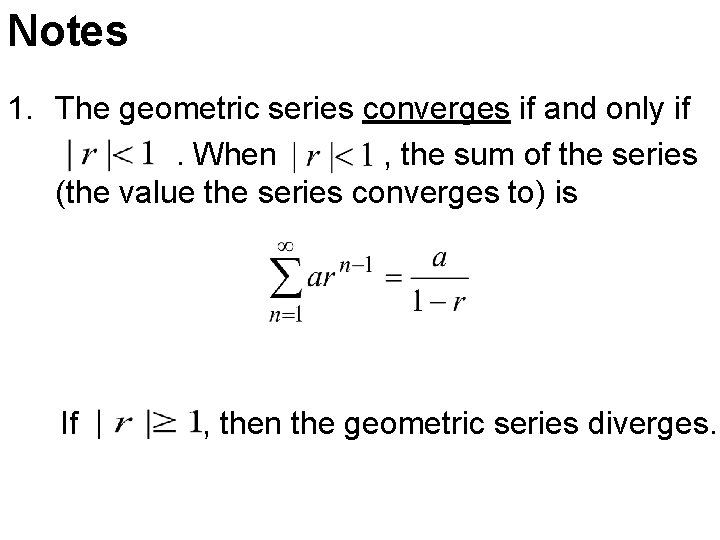
Notes 1. The geometric series converges if and only if. When , the sum of the series (the value the series converges to) is If , then the geometric series diverges.
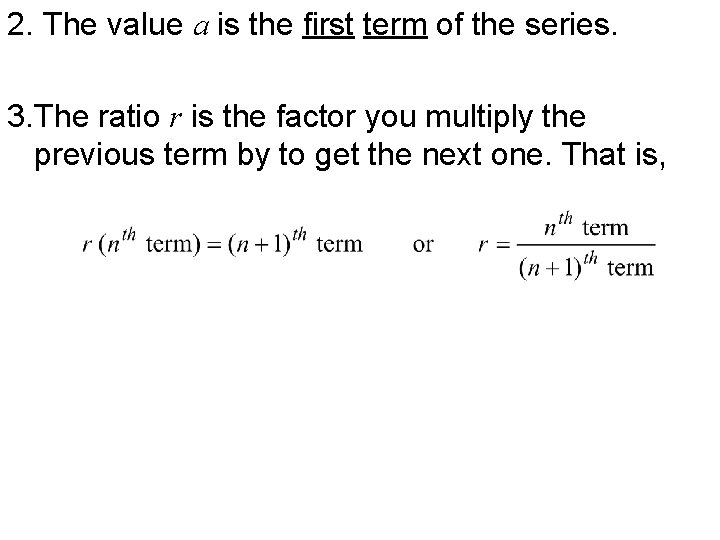
2. The value a is the first term of the series. 3. The ratio r is the factor you multiply the previous term by to get the next one. That is,
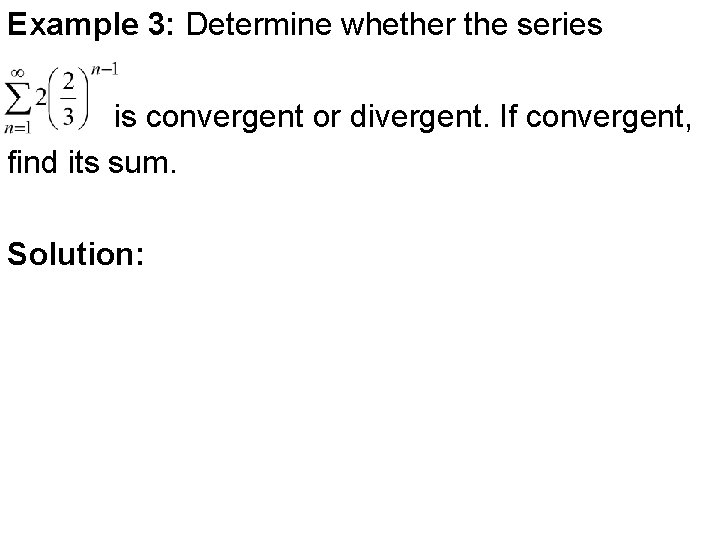
Example 3: Determine whether the series is convergent or divergent. If convergent, find its sum. Solution:
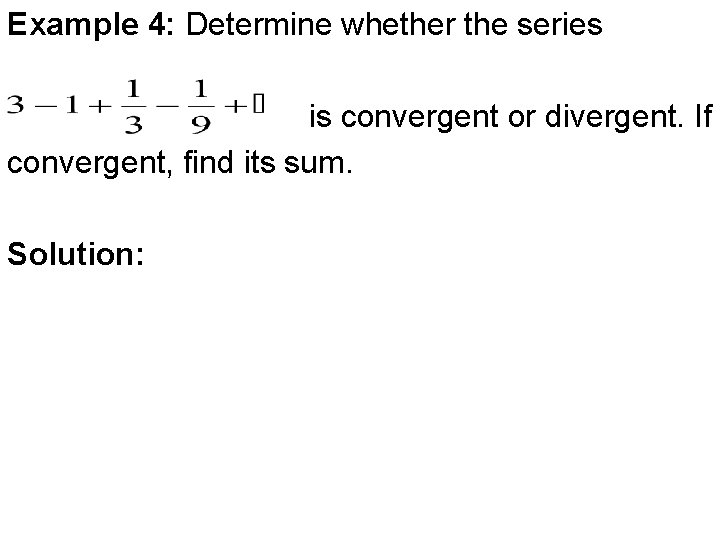
Example 4: Determine whether the series is convergent or divergent. If convergent, find its sum. Solution:
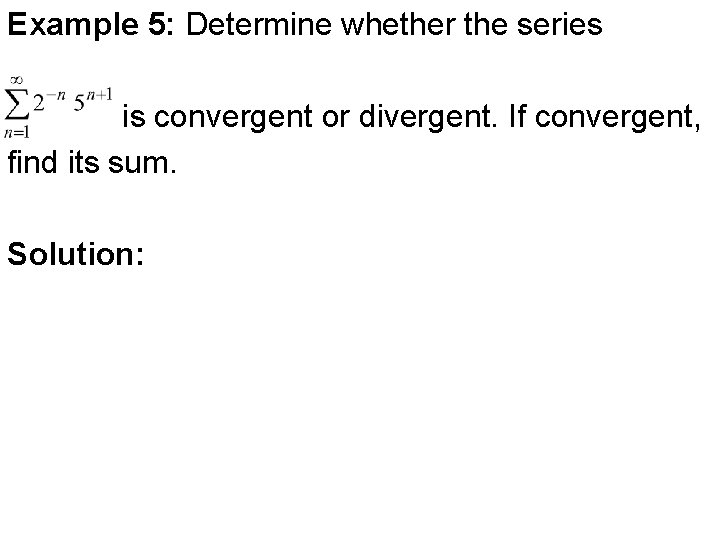
Example 5: Determine whether the series is convergent or divergent. If convergent, find its sum. Solution:
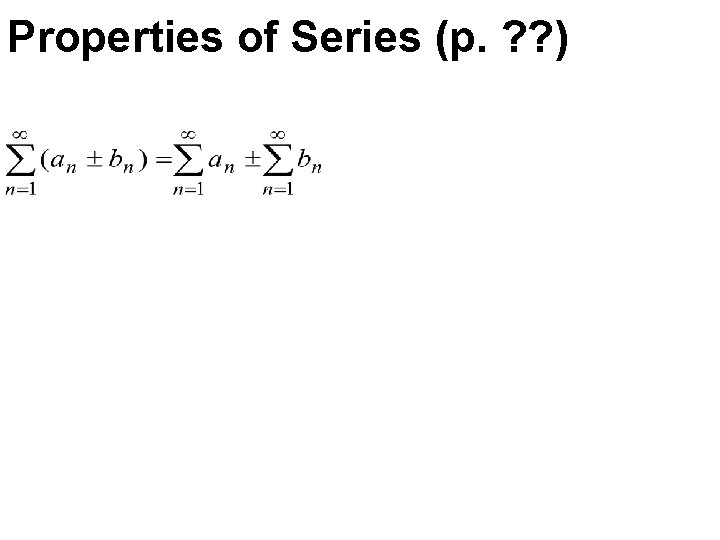
Properties of Series (p. ? ? )
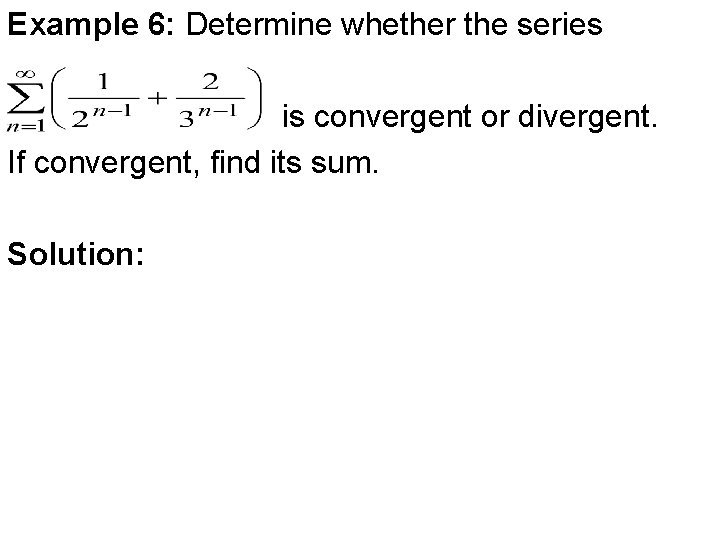
Example 6: Determine whether the series is convergent or divergent. If convergent, find its sum. Solution:
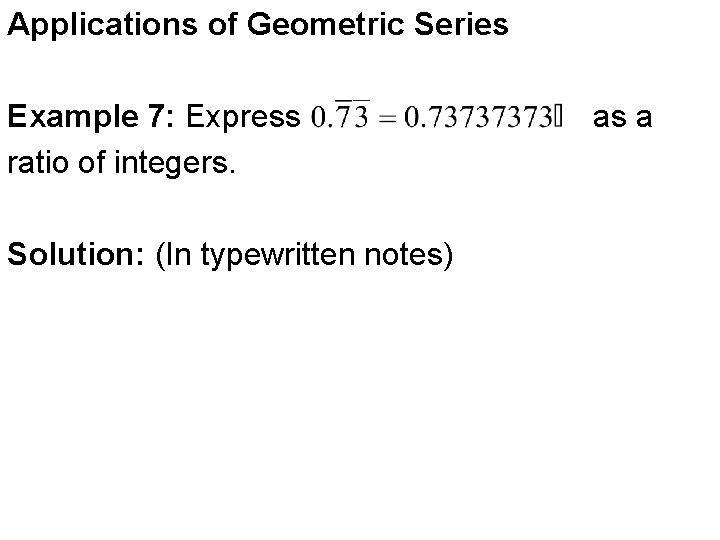
Applications of Geometric Series Example 7: Express ratio of integers. Solution: (In typewritten notes) as a
Tests For Non-Geometric Series Most series are not geometric – that is, there is not a ratio r that you multiply each term to get to the next term. We will be looking at other ways to determine the convergence and divergence of series in upcoming sections.
Some other ways to test series 1. Divergence Test: If the sequence does not converge to 0, then the series diverges. Note: This is only a test for divergence – if the sequence converges to 0 does not necessarily mean the series converges.
2. Examine the partial sums to determine convergence or divergence (Examples 1 and 2 of this section). 3. Techniques discussed in upcoming sections.
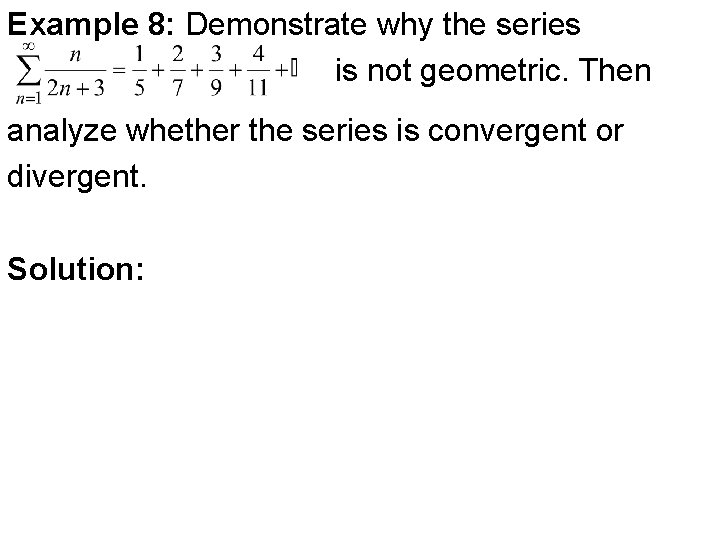
Example 8: Demonstrate why the series is not geometric. Then analyze whether the series is convergent or divergent. Solution:
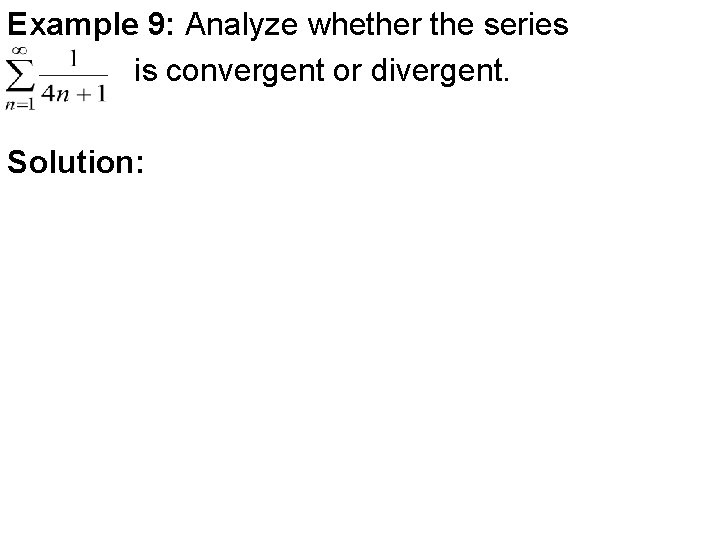
Example 9: Analyze whether the series is convergent or divergent. Solution: