Chapter 4 Personal and Professional Qualities of a





- Slides: 43
Chapter 4 Personal and Professional Qualities of a Health Care Worker © 2009 Delmar, Cengage Learning
4: 1 Personal Appearance • Appearance communicates level of confidence and positive self-esteem • First impressions are based on appearances and form quickly • Rules about appearance may vary • Certain professional standards apply to most health careers © 2009 Delmar, Cengage Learning
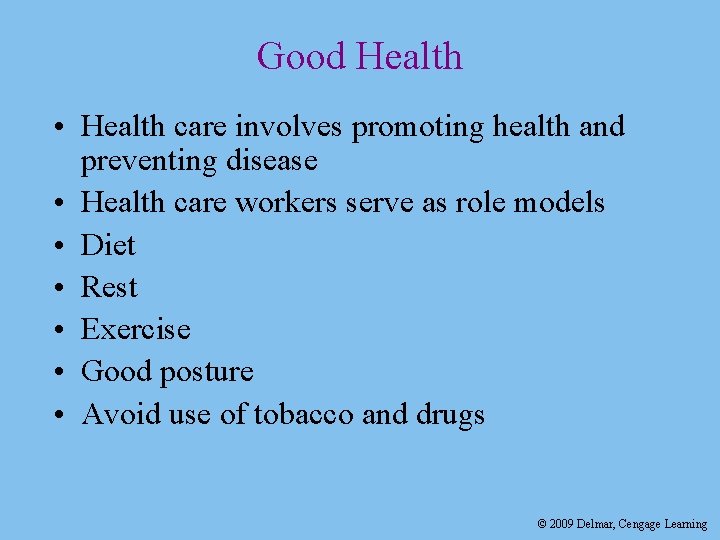
Good Health • Health care involves promoting health and preventing disease • Health care workers serve as role models • Diet • Rest • Exercise • Good posture • Avoid use of tobacco and drugs © 2009 Delmar, Cengage Learning
Uniform Considerations • • • Required in some health occupations Neat, well-fitting, clean, and wrinkle-free Choose undergarments that will not show Avoid extreme styles Follow standards established by place of employment © 2009 Delmar, Cengage Learning
Regular Clothing • Some occupations allow use of regular clothing in lieu of uniforms • Must be clean, neat, and in good repair • Style that allows for body movements • Should be appropriate for position • Washable and less expensive to maintain © 2009 Delmar, Cengage Learning
Other Considerations • • Name badge Shoes Personal hygiene Nails Hair Jewelry Makeup and tattoos © 2009 Delmar, Cengage Learning
Summary • Find out rules or standards established by the agency • Abide by the rules • Maintain a neat, clean, professional appearance at all times © 2009 Delmar, Cengage Learning
4: 2 Personal Characteristics • Certain personal/professional characteristics and attitudes apply to all health occupations • You should make every effort to develop these characteristics and attitudes and incorporate them into your personality © 2009 Delmar, Cengage Learning
Desirable Characteristics • • Empathy Honesty Dependability Willingness to learn Patience Acceptance of criticism Enthusiasm (continues) © 2009 Delmar, Cengage Learning
Desirable Characteristics (continued) • • • Self-motivation or self-initiative Tact Competence Responsibility Discretion Team player © 2009 Delmar, Cengage Learning
4: 3 Effective Communications • Health care workers must be able to relate to patients, family, coworkers, and others • Understanding communication skills assists in this process • Communication: exchange of information, thoughts, ideas, and feelings (continues) © 2009 Delmar, Cengage Learning
Effective Communications (continued) • Verbal: spoken words • Written • Nonverbal: facial expressions, body language, and touch (continues) © 2009 Delmar, Cengage Learning
Effective Communications (continued) • Essential elements – – Sender Message Receiver Feedback (continues) © 2009 Delmar, Cengage Learning
Effective Communications (continued) • • • Message must be clear How sender delivers message How receiver hears message How receiver understands message Avoid interruptions and distractions © 2009 Delmar, Cengage Learning
Listening • • • Essential to communications Attempt to hear what other is really saying Need constant practice Good listening skills techniques Observe speaker closely Reflect statements back to speaker © 2009 Delmar, Cengage Learning
Nonverbal Communication • Facial expressions, body language, gestures, eye contact, and touch • Can conflict with verbal message • Be aware of own and other’s nonverbals • Don’t always need verbals to communicate effectively • When verbal and nonverbal agree, message more likely understood © 2009 Delmar, Cengage Learning
Barriers to Communication • Something that gets in the way or limits clear communications • Common barriers – Physical disabilities – Psychological attitudes and prejudice – Cultural diversity © 2009 Delmar, Cengage Learning
Recording and Reporting • • Observe and record observations Use all senses in the process Report promptly and accurately Criteria for recording observations on a patient’s health care record • HIPAA regulations © 2009 Delmar, Cengage Learning
Summary • Good communication skills allow development of good interpersonal relationships • Health care worker also relates more effectively with coworkers and other individuals © 2009 Delmar, Cengage Learning
4: 4 Teamwork • In any health career, you will be part of an interdisciplinary health care team • Team concept was created to provide quality holistic health care for every patient • Teamwork consists of many professionals, with different levels of education, ideas, backgrounds, and interests, working together for the good of the patient © 2009 Delmar, Cengage Learning
Teamwork Concepts • Teamwork improves communication and continuity of care • Every person on the team must understand the role of each team member • A leader is an important part of any team • Good interpersonal relationships essential • Legal responsibilities © 2009 Delmar, Cengage Learning
Good Interpersonal Relationship Guidelines • Poor relationships interfere with quality of care, goals, and work satisfaction • Respect differences due to cultural and ethnic backgrounds, gender, age, socioeconomic status, lifestyle preference, beliefs, and levels of education • Show sensitivity to the hopes, feelings, and needs of team members (continues) © 2009 Delmar, Cengage Learning
Good Interpersonal Relationship Guidelines (continued) • Golden Rule: treat others as you would want to be treated • Have a positive attitude • Be willing to laugh at yourself • Be friendly and cooperative • Assist others • Listen carefully (continues) © 2009 Delmar, Cengage Learning
Good Interpersonal Relationship Guidelines (continued) • • • Respect the opinion of others Be open-minded and willing to compromise Don’t criticize others Practice good communication skills Support and encourage team members Perform your duties to the best of your ability © 2009 Delmar, Cengage Learning
Conflict Resolution • • • Deal with conflict in a positive way Meet with people involved to discuss it Listen to each other’s point of view Avoid accusations and hostility Solve problems cooperatively (continues) © 2009 Delmar, Cengage Learning
Conflict Resolution (continued) • Sometimes a mediator may be needed • Grievance policies define official process • To meet team goals, conflict must be resolved as quickly as possible © 2009 Delmar, Cengage Learning
Summary • Effective teams are the result of hard work, patience, commitment, and practice • When each individual participates fully in the team and makes every effort to contribute, the team achieves success © 2009 Delmar, Cengage Learning
4: 5 Professional Leadership • Purpose: encourage people to work together and do their best to achieve common goals • Definition of a leader • Myths • Characteristics of a leader • Categories of leaders © 2009 Delmar, Cengage Learning
Types of Leaders • Democratic • Laissez-faire • Autocratic © 2009 Delmar, Cengage Learning
Summary • All types of leadership have advantages and disadvantages • In some rare situations, an autocratic leader may be beneficial • Democratic leader usually presented as most effective for group interactions • Respecting the rights and opinions of others is an important guide for a leader © 2009 Delmar, Cengage Learning
4: 6 Stress • • Definition of stress Stressors What causes stress Sympathetic nervous system response Parasympathetic nervous system recovery Stress is universal Benefits of stress (continues) © 2009 Delmar, Cengage Learning
Stress (continued) • • Negative effects of stress Learning to control stress Stressors—how to problem solve Managing stress reactions – – Stop Breathe Reflect Choose © 2009 Delmar, Cengage Learning
Stress-Reducing Techniques • • • Live a healthy life Take breaks Relax with a warm bath Listen to quiet, soothing music Close your eyes, take deep breaths, and relax each muscle group • Seek support from others (continues) © 2009 Delmar, Cengage Learning
Stress-Reducing Techniques (continued) • • Meditate Use imagery Enjoy yourself Renew yourself Think positively Develop outside interests Seek assistance or delegate tasks Avoid too many commitments © 2009 Delmar, Cengage Learning
Summary • • Stress is constant and cannot be avoided Be aware of causes Learn how to respond Solve problems effectively Practice techniques to reduce Be mindful of patient’s stress Patients can use same coping techniques © 2009 Delmar, Cengage Learning
4: 7 Time Management • • Definition Helps prevent or reduce stress First step is to keep an activity record Start to organize time based on information collected in activity record © 2009 Delmar, Cengage Learning
Setting Goals • Why set goals? • Short- and long-term goals • Completion of goals results in satisfaction, sense of accomplishment, and motivation to attempt other goals (continues) © 2009 Delmar, Cengage Learning
Setting Goals (continued) • Take the opportunity when starting high school to set short-term goals for researching careers in health care • Talk with a guidance or career counselor • Make sure you are taking the courses that are needed • Establish your own goals © 2009 Delmar, Cengage Learning
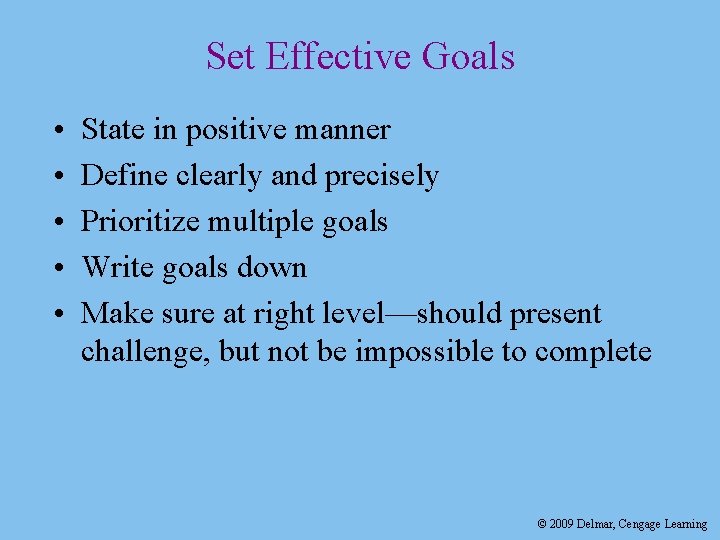
Set Effective Goals • • • State in positive manner Define clearly and precisely Prioritize multiple goals Write goals down Make sure at right level—should present challenge, but not be impossible to complete © 2009 Delmar, Cengage Learning
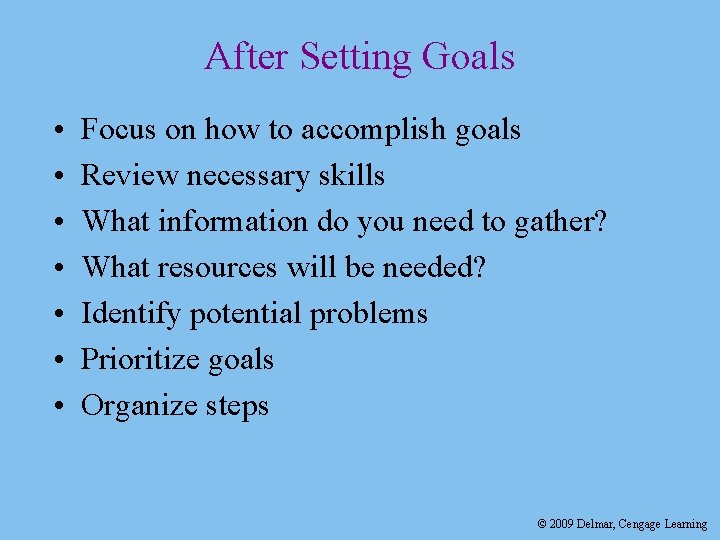
After Setting Goals • • Focus on how to accomplish goals Review necessary skills What information do you need to gather? What resources will be needed? Identify potential problems Prioritize goals Organize steps © 2009 Delmar, Cengage Learning
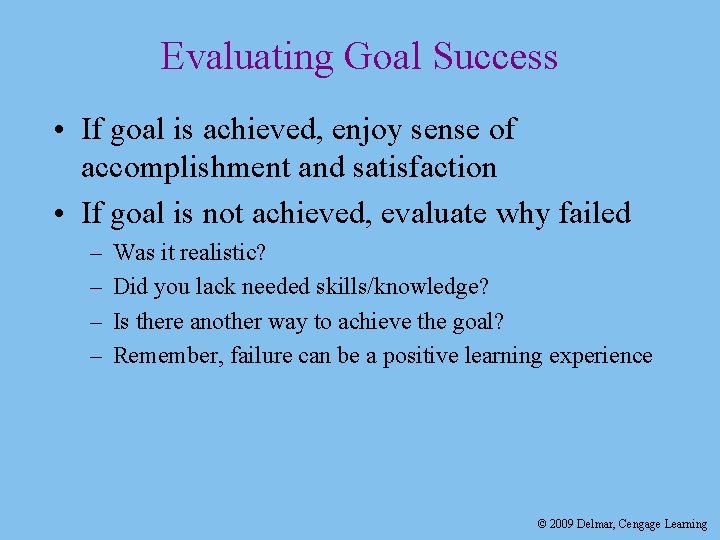
Evaluating Goal Success • If goal is achieved, enjoy sense of accomplishment and satisfaction • If goal is not achieved, evaluate why failed – – Was it realistic? Did you lack needed skills/knowledge? Is there another way to achieve the goal? Remember, failure can be a positive learning experience © 2009 Delmar, Cengage Learning
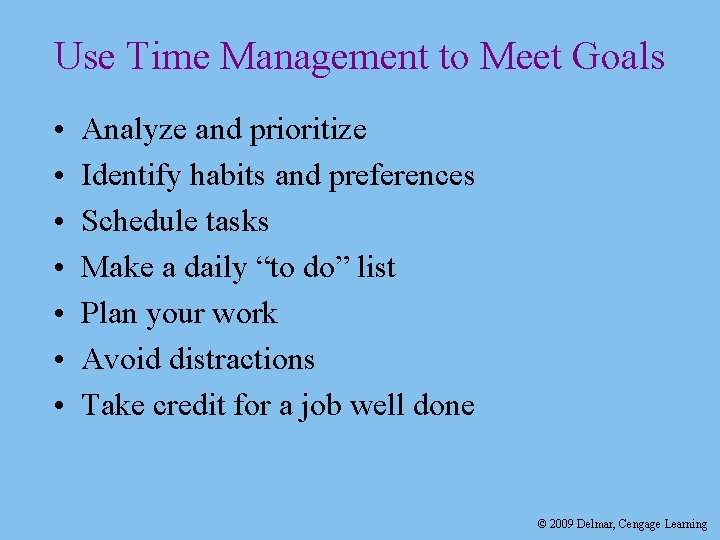
Use Time Management to Meet Goals • • Analyze and prioritize Identify habits and preferences Schedule tasks Make a daily “to do” list Plan your work Avoid distractions Take credit for a job well done © 2009 Delmar, Cengage Learning
Summary • Time management provides for an organized and efficient use of time • Won’t always succeed when unexpected events occur • If fail, reevaluate goals and revise the plan • Patience, practice, and an honest effort are the best guides to a healthier, more content life © 2009 Delmar, Cengage Learning