Software Its Nature and Qualities Ch 2 1
- Slides: 20
Software Its Nature and Qualities Ch. 2 1
Outline • Software engineering (SE) is an intellectual activity and thus human-intensive • Software is built to meet a certain functional goal and satisfy certain qualities • Software processes also must meet certain qualities Ch. 2 2
Software product • Different from traditional types of products – intangible • difficult to describe and evaluate – human intensive • involves only trivial “manufacturing” process Ch. 2 3
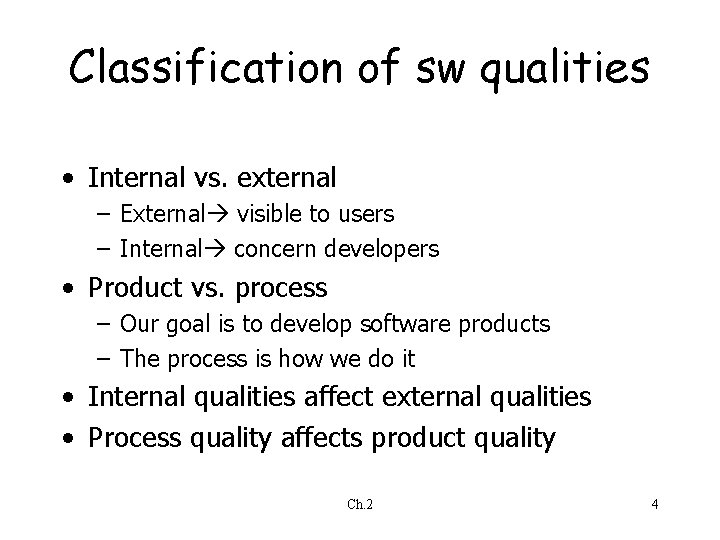
Classification of sw qualities • Internal vs. external – External visible to users – Internal concern developers • Product vs. process – Our goal is to develop software products – The process is how we do it • Internal qualities affect external qualities • Process quality affects product quality Ch. 2 4
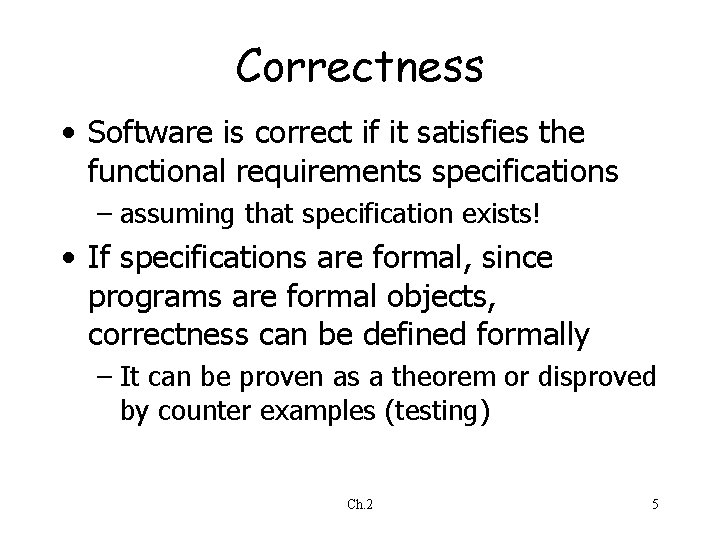
Correctness • Software is correct if it satisfies the functional requirements specifications – assuming that specification exists! • If specifications are formal, since programs are formal objects, correctness can be defined formally – It can be proven as a theorem or disproved by counter examples (testing) Ch. 2 5
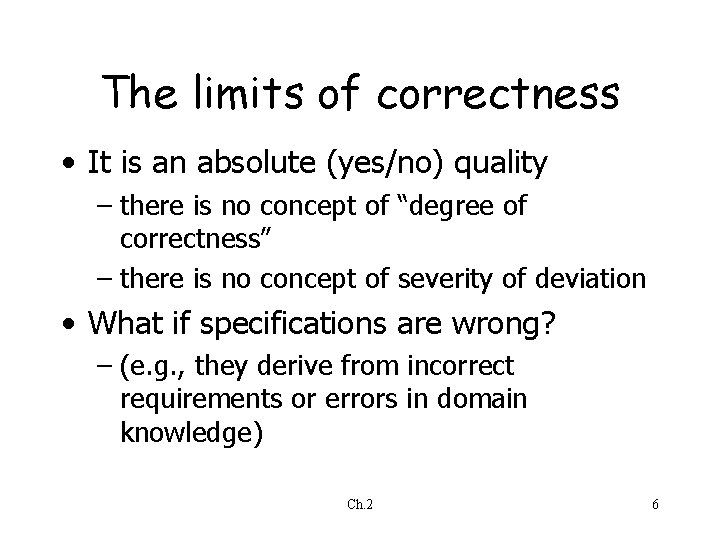
The limits of correctness • It is an absolute (yes/no) quality – there is no concept of “degree of correctness” – there is no concept of severity of deviation • What if specifications are wrong? – (e. g. , they derive from incorrect requirements or errors in domain knowledge) Ch. 2 6
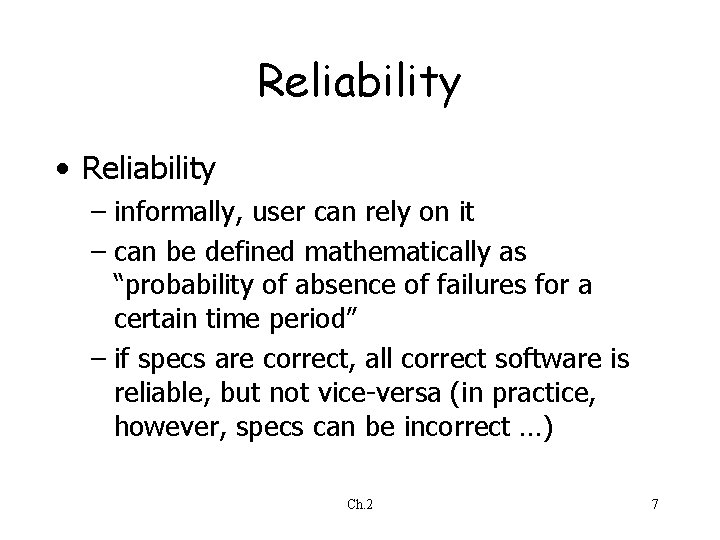
Reliability • Reliability – informally, user can rely on it – can be defined mathematically as “probability of absence of failures for a certain time period” – if specs are correct, all correct software is reliable, but not vice-versa (in practice, however, specs can be incorrect …) Ch. 2 7
Robustness • Robustness – software behaves “reasonably” even in unforeseen circumstances (e. g. , incorrect input, hardware failure) Ch. 2 8
Performance • Efficient use of resources – memory, processing time, communication • Can be verified • complexity analysis • performance evaluation (on a model, via simulation) • Performance can affect scalability • a solution that works on a small local network may not work on a large intranet Ch. 2 9
Usability • Expected users find the system easy to use • Other term: user-friendliness • Affected mostly by user interface • e. g. , visual vs. textual Ch. 2 10
Verifiability • How easy it is to verify properties – mostly an internal quality – can be external as well (e. g. , security critical application) Ch. 2 11
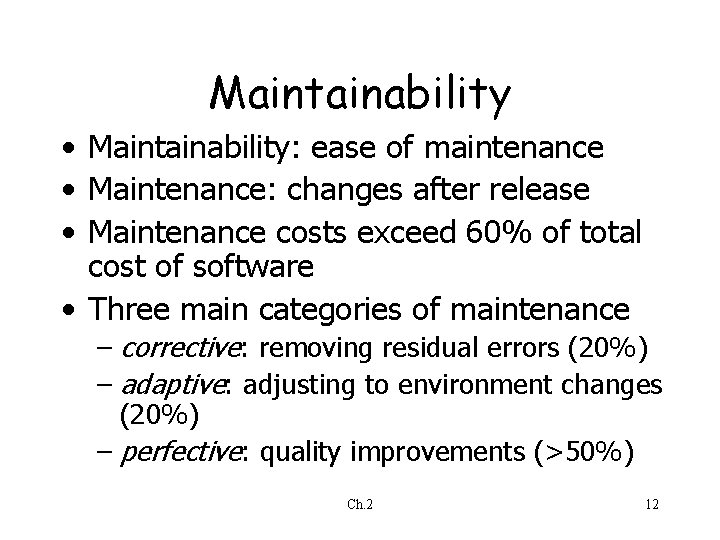
Maintainability • Maintainability: ease of maintenance • Maintenance: changes after release • Maintenance costs exceed 60% of total cost of software • Three main categories of maintenance – corrective: removing residual errors (20%) – adaptive: adjusting to environment changes (20%) – perfective: quality improvements (>50%) Ch. 2 12
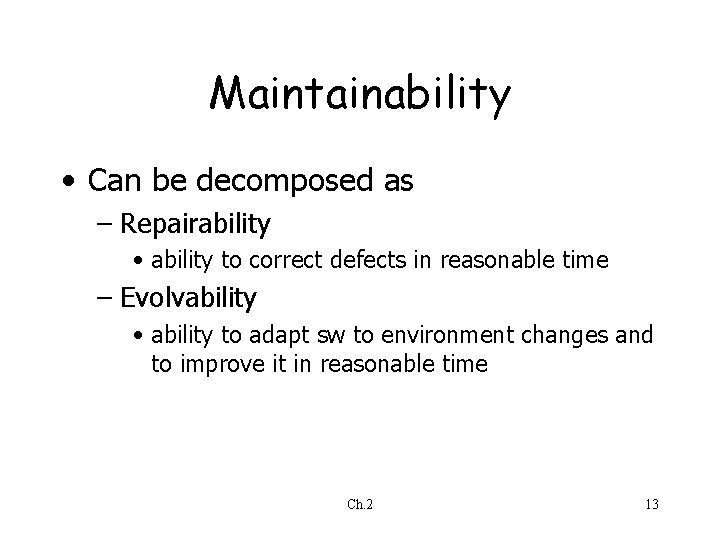
Maintainability • Can be decomposed as – Repairability • ability to correct defects in reasonable time – Evolvability • ability to adapt sw to environment changes and to improve it in reasonable time Ch. 2 13
Reusability • Existing product (or components) used (with minor modifications) to build another product – (Similar to evolvability) • Also applies to process Ch. 2 14
Portability • Software can run on different hw platforms or sw environments • Relevant as new platforms and environments are introduced • Relevant when downloading software in a heterogeneous network environment Ch. 2 15
Understandability • Ease of understanding software • Program modification requires program understanding Ch. 2 16
Interoperability • Ability of a system to coexist and cooperate with other systems – e. g. , word processor and spreadsheet Ch. 2 17
Typical process qualities • Productivity – denotes its efficiency and performance • Timeliness – ability to deliver a product on time • Visibility – all of its steps and current status are documented clearly Ch. 2 18
Timeliness: issues • Often the development process does not follow the evolution of user requirements • A mismatch occurs between user requirements and status of the product Ch. 2 19
Quality measurement • Many qualities are subjective • No standard metrics defined for most qualities Ch. 2 20