
Chapter 4 Becoming a Culinary Professional Section 4

Chapter 4 Becoming a Culinary Professional Section 4. 1 Employability Skills • To be employed in the foodservice industry, you must draw on skills that help you find and keep a job. Glencoe Culinary Essentials Chapter 4 Becoming a Culinary Professional 1

Chapter 4 Becoming a Culinary Professional Sharpen Your Basic Skills • Math Skills • Most foodservice workers will need to know how to make change To count back the correct amount of change to a customer from the money he or she has paid for a check. Glencoe Culinary Essentials Chapter 4 Becoming a Culinary Professional 2
Chapter 4 Becoming a Culinary Professional Sharpen Your Basic Skills • Listening and Speaking Skills • Practice active listening during conversations and when on the phone. active listening The skill of paying attention and interacting with the speaker. Glencoe Culinary Essentials Chapter 4 Becoming a Culinary Professional 3

Chapter 4 Becoming a Culinary Professional Sharpen Your Basic Skills • Reading Skills • Read ingredient labels, equipment manuals, menus. • Writing Skills • Communicate with co-workers and customers. Glencoe Culinary Essentials Chapter 4 Becoming a Culinary Professional 4

Chapter 4 Becoming a Culinary Professional Work Ethic • Developing a good work ethic leads to success in your career. work ethic A personal commitment to doing your very best as part of the team. Glencoe Culinary Essentials Chapter 4 Becoming a Culinary Professional 5

Chapter 4 Becoming a Culinary Professional Work Ethic • Qualities that make a good work ethic: • responsibility • flexibility responsibility flexibility Your ability to be aware of what a particular situation demands of you. The ability to adapt willingly to changing circumstances. Glencoe Culinary Essentials Chapter 4 Becoming a Culinary Professional 6
Chapter 4 Becoming a Culinary Professional Work Ethic • Qualities that make a good work ethic: • honesty • reliability honesty reliable When you are truthful and loyal in your words and actions. When other people can count on you to do what you say you will do. Glencoe Culinary Essentials Chapter 4 Becoming a Culinary Professional 7

Chapter 4 Becoming a Culinary Professional Work Ethic • Qualities that make a good work ethic: • teamwork • commitment to quality, and excellence teamwork Learning to effectively communicate, resolve conflicts, and develop negotiation skills. commitment The dedication that you show to doing something. Glencoe Culinary Essentials Chapter 4 Becoming a Culinary Professional 8

Chapter 4 Becoming a Culinary Professional Leadership Skills • Employers expect leadership skills in their employees. leadership The ability to motivate others to cooperate in doing a common task. Glencoe Culinary Essentials Chapter 4 Becoming a Culinary Professional 9
Chapter 4 Becoming a Culinary Professional Leadership Skills • Leadership Organizations • Family, Career and Community Leaders of America (FCCLA) • Skills. USA Glencoe Culinary Essentials Chapter 4 Becoming a Culinary Professional 10
Chapter 4 Becoming a Culinary Professional Leadership Skills • Key resources: • time • energy • money • things • people resource The raw material with which you do your work. How do you effectively use key resources in your daily life? Glencoe Culinary Essentials Chapter 4 Becoming a Culinary Professional 11
Chapter 4 Becoming a Culinary Professional Section 4. 2 Seeking Employment • Learn how to seek and apply for a job in the foodservice industry. Glencoe Culinary Essentials Chapter 4 Becoming a Culinary Professional 12
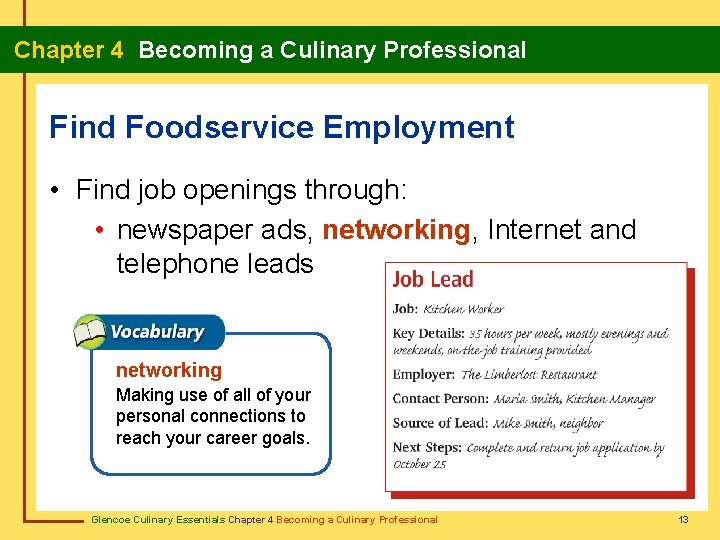
Chapter 4 Becoming a Culinary Professional Find Foodservice Employment • Find job openings through: • newspaper ads, networking, Internet and telephone leads networking Making use of all of your personal connections to reach your career goals. Glencoe Culinary Essentials Chapter 4 Becoming a Culinary Professional 13
Chapter 4 Becoming a Culinary Professional Find Foodservice Employment • Find job openings through: • professional organizations, trade publications, employment agencies trade publication employment agency A magazine or newsletter produced by and for members of the foodservice industry. A business that put employers in touch with potential employees. Glencoe Culinary Essentials Chapter 4 Becoming a Culinary Professional 14
Chapter 4 Becoming a Culinary Professional Find Foodservice Employment • You will need a résumé and will be asked to fill out a job application when you apply for a job. résumé job application A summary of your career objectives, work experience, job qualifications, education, and training. A form that employers use to collect personal information and previous work experience from job applicants. Glencoe Culinary Essentials Chapter 4 Becoming a Culinary Professional 15
Chapter 4 Becoming a Culinary Professional Find Foodservice Employment • Prepare a job portfolio: • résumé, letter of application, letter of reference, list of references, health record, and a copy of your Social Security card job portfolio A collection of papers and samples that can be given to a potential employer. Glencoe Culinary Essentials Chapter 4 Becoming a Culinary Professional 16
Chapter 4 Becoming a Culinary Professional The Interview Process • During the Interview: • wear appropriate clothing • be prompt and courteous • shake hands, make eye contact, speak clearly, use good manners Glencoe Culinary Essentials Chapter 4 Becoming a Culinary Professional 17

Chapter 4 Becoming a Culinary Professional The Interview Process • After the Interview: • send a thank-you letter • follow up • review the session • If You are Offered the Job: • accept the offer, ask for time to consider, or turn down the job offer Glencoe Culinary Essentials Chapter 4 Becoming a Culinary Professional 18
Chapter 4 Becoming a Culinary Professional Section 4. 3 On the Job • Employees have certain guaranteed rights. • Employees also have responsibilities to their employer. • If you work well, you may gain opportunities for advancement. Glencoe Culinary Essentials Chapter 4 Becoming a Culinary Professional 19
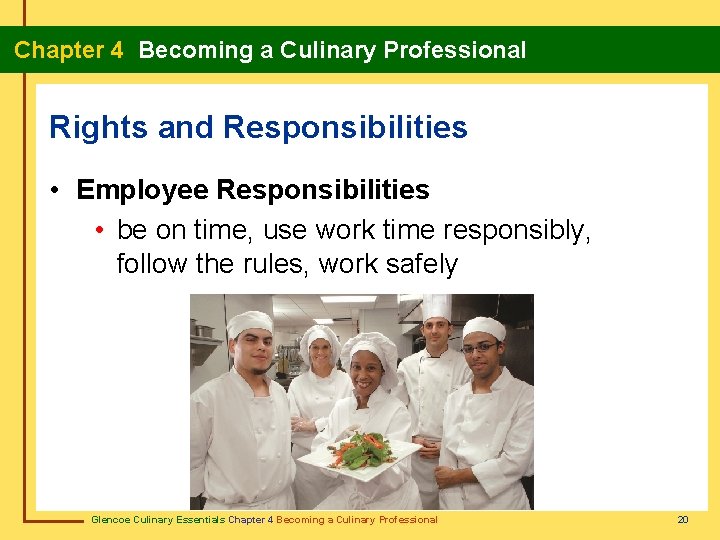
Chapter 4 Becoming a Culinary Professional Rights and Responsibilities • Employee Responsibilities • be on time, use work time responsibly, follow the rules, work safely Glencoe Culinary Essentials Chapter 4 Becoming a Culinary Professional 20
Chapter 4 Becoming a Culinary Professional Rights and Responsibilities • Job advancement: • more responsibilities • move to another job • begin your own business • Two qualities to help you advance are initiative and the desire to learn. Glencoe Culinary Essentials Chapter 4 Becoming a Culinary Professional initiative The energy required to begin new tasks and see them through. 21
Chapter 4 Becoming a Culinary Professional Rights and Responsibilities • Employer Responsibilities • pay you no less than minimum wage • supply what you need to do the job • eliminate discrimination minimum wage The lowest hourly amount a worker can earn. discrimination Unfair treatment based on age, gender, race, ethnicity, religion, physical appearance, disability, or other factors. Glencoe Culinary Essentials Chapter 4 Becoming a Culinary Professional 22
Chapter 4 Becoming a Culinary Professional Rights and Responsibilities • Employer Responsibilities • provide safe working conditions • provide financial help through workers’ compensation Insurance that pays medical expenses and lost wages if you are injured on the job. Glencoe Culinary Essentials Chapter 4 Becoming a Culinary Professional 23
Chapter 4 Becoming a Culinary Professional Rights and Responsibilities • Employees and employers must display ethical behavior on the job. ethics Your internal guidelines to distinguish right from wrong. How can you show ethical behavior at school and at home? Glencoe Culinary Essentials Chapter 4 Becoming a Culinary Professional 24
Chapter 4 Becoming a Culinary Professional Wages and Benefits • When you accept a job, you trade your skills and efforts for wages and benefits. • Benefits may include insurance, paid vacations, and savings plans. benefits Services or payments provided by an employer in addition to wages. Glencoe Culinary Essentials Chapter 4 Becoming a Culinary Professional 25
Chapter 4 Becoming a Culinary Professional Wages and Benefits • Your pay is subject to deductions for taxes, insurance, and other fees. • Some workers earn tips, which need to be reported as earned money. deduction The money withheld from your gross pay for taxes, insurance, and other fees. tip A small bonus payment from a customer as a reward for excellent service. Glencoe Culinary Essentials Chapter 4 Becoming a Culinary Professional 26
- Slides: 26