
Values Principles Personal Moral Qualities Respecting Human Rights













- Slides: 19
• Values • Principles • Personal Moral Qualities
• • • Respecting Human Rights and Dignity. Ensuring the integrity of practitioner-client relationships. Enhancing the quality of professional knowledge and it’s application. Alleviating personal distress and suffering. Fostering a sense of self that is meaningful to the person(s) concerned. Increasing personal effectiveness. Enhancing the quality of relationships between people. Appreciating the variety of human experience and culture. Striving for the fair and adequate provision of counselling and psychotherapy services.
� “Because their practise is well established and wide spread in the delivery of services; and what they do carries significant risk to patients and the public if poorly done, the government today announces that it is planning to introduce statutory regulation for psychotherapists and counsellors and other psychological therapists. ” (Depart. Health White paper’s Trust)
� Fidelity � Autonomy � Beneficence � Non-maleficence � Justice � Self-respect
� Being trustworthy is regarded as fundamental to understanding and resolving ethical issues. Practitioners who adopt this principle: act in accordance with the trust placed in them; regard confidentiality as an obligation arising from the clients trust; restrict any disclosure of confidential information about clients to furthering the purposes for which it was originally disclosed.
� This principle emphasises the importance of the client’s commitment to participating in counselling or psychotherapy, usually on a voluntary basis. Practitioners who respect their clients’ autonomy: ensure accuracy in any advertising or information given in advance of services offered; seeked freely given and adequately informed consent; engage in explicit contracting in advance of any commitment by the client; protect privacy; protect confidentiality; normally make any disclosures of confidential information conditional on the consent of the person concerned; and inform the client in advance of any foreseeable conflicts of interest or as soon as possible after such conflicts become apparent. The principle of autonomy opposes the manipulation of clients against their will, even for beneficial social ends.
� The principle of beneficence means acting in the best interests of the client based on professional assessment. It directs attention to working strictly with one’s limits of competence and providing services on the basis of adequate training or experience. Ensuring that the client’s best interests are achieved requires systematic monitoring of practice and outcomes by the best available means. It is considered important that research and systematic reflection inform practise. There is an obligation to use regular and on-going supervision to enhance the quality of the services provided and to commit to updating practice by continuing professional development. An obligation to act in the best interests of a client may become paramount when working with clients whose capacity for autonomy is diminished because of immaturity, lack of understanding, extreme distress, serious disturbance or other significant personal constraints.
• Non-maleficence involves: avoiding sexual, financial, emotional or any other form of client exploitation; avoiding incompetence or malpractice; not providing services when unfit to do so due to illness, personal circumstances or intoxification. The practitioner has an ethical responsibility to strive to mitigate any harm caused to a client even when the harm is unavoidable or unintended. Holding appropriate insurance may assist in restitution. Practitioners have a personal responsibility to challenge, where appropriate, the incompetence or malpractise of others; and to contribute to any investigation and/or adjudication concerning professional practise which falls below that of a reasonably competent practitioner and/or risks bringing discredit upon the profession.
• The principle of justice requires being just and fair to all clients and respecting their human rights and dignity. It directs attention to considering conscientiously any legal requirements and obligations, and remaining alert to any potential conflicts between legal and ethical obligations. Justice in the distribution of services requires the ability to determine impartially in the provision of services for clients and the allocation of services between clients. A commitment to fairness requires the ability to appreciate differences between people and to be commited to equality of opportunity, and avoiding discrimination against people or groups contrary to their legitimate personal or social characteristics. Practitioners have a duty to strive to ensure a fair provision of counselling and psychotherapy services, accessible and appropriate to the needs of potential clients.
• The principle of self respect means the practitioner appropriately applies all the above principles as entitlements for self. This includes seeking counselling or therapy and other opportunities for personal development as required. Their is an ethical responsibility to use supervision for appropriate personal and professional support and development, and to seek training and other opportunities for continuing professional development. Guarding against financial liabilities arising from work undertaken usually obtaining appropriate insurance. The principles of selfrespect encourages active engagement in life enhancing activities and relationships that are independent of relationships in counselling and psychotherapy.
• The practitioners personal moral qualities are of the upmost importance to clients. Many of the personal qualities considered important in the provision of services have an ethical or moral component and are therefore considered as virtues or good personal qualities. It is inappropriate to prescribe that all practitioners possess these qualities, since it is fundamental that these personal qualities are deeply rooted in the person concerned and developed out of personal commitment rather than the requirement of an external authority. Personal qualities to which counsellors and psychotherapists are strongly encouraged to aspire to include:
• • • Empathy: the ability to communicate understanding of another person’s experience from that person perspective. Sincerity: a personal commitment to consistency between what is professed and what is done. Integrity: commitment to being moral in daelings with others, personal straight forwardness, honesty and coherence. Resilience: the capacity to work with the client’s concerns without being personally diminished. Respect: showing appropriate esteem to others and their understanding of themselves.
• • • Humility: the ability to assess accurately and acknowledge one’s own strength and weaknesses. Competence: the effective deployment of the skills and knowledge needed to do what is required. Fairness: the consistent application of appropriate criteria to inform decisions and actions. Wisdom: possession of sound judgement that informs practise. Courage: the capacity to act in spite of known fears, risks and uncertainty.
� In respect of the fact that agencies delivering counselling services are usually an organisational member of BACP /IACP each individual involved in whatever role in the agency is bound to adhere to the BACP /IACP guidelines for best practise.
• • Providing a good Standard of practice and care. Good Quality of Care. Maintaining competent practice. Keeping trust (all on pg. 5 of ethical framework) Teaching and training Supervising and Managing (pg. 6)
� Researching � Fitness to practice � If things go wrong with own clients � Responsibilities to all clients � Working with colleagues
• • Working in teams Awareness of context Making and receiving referrals Probity in professional practice Providing clients with adequate information Financial arrangements Conflicts of interest (all on pg. 8) Care of self as a practitioner (pg. 9)
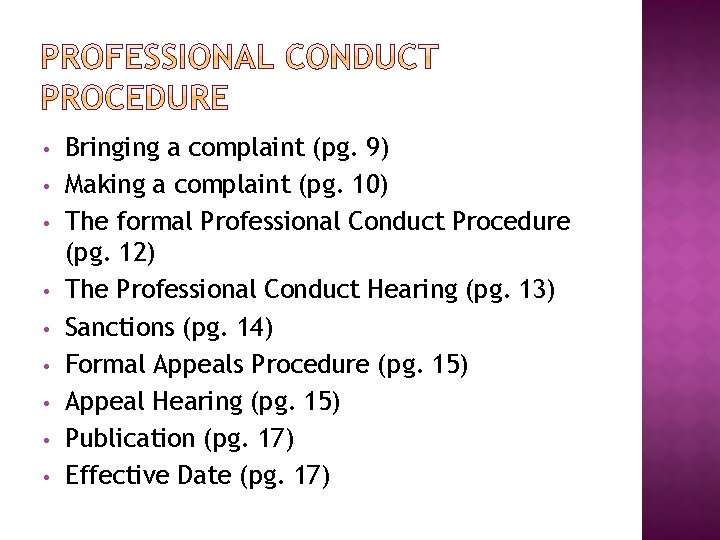
• • • Bringing a complaint (pg. 9) Making a complaint (pg. 10) The formal Professional Conduct Procedure (pg. 12) The Professional Conduct Hearing (pg. 13) Sanctions (pg. 14) Formal Appeals Procedure (pg. 15) Appeal Hearing (pg. 15) Publication (pg. 17) Effective Date (pg. 17)
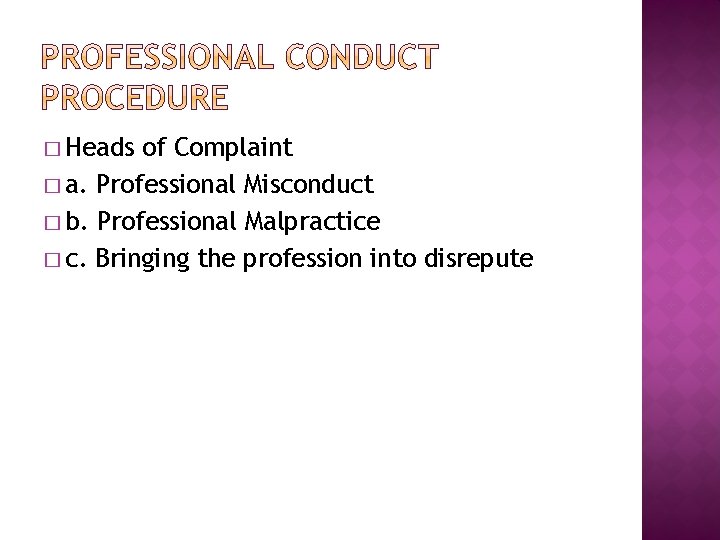
� Heads of Complaint � a. Professional Misconduct � b. Professional Malpractice � c. Bringing the profession into disrepute