Chapter 4 Federalism Government Honors Federalism is a






- Slides: 56
Chapter 4 - Federalism Government Honors
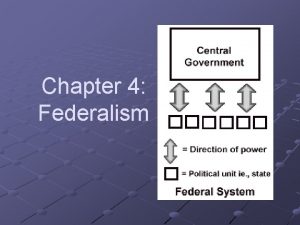
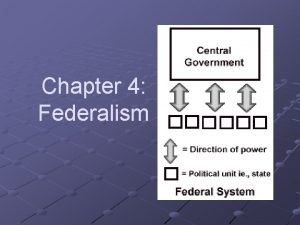
Federalism is a system of government in which a written constitution divides the powers of government on territorial basis between a central or national government and several regional governments known as states or provinces.
Federalism The founding fathers created the idea of Federalism because under the Articles of Confederation, the national government was too weak. But the founding fathers wanted to preserve the self-governing attitude of the states and not have them lose power with a strong federal government. Perfect solution for them was the idea of federalism.
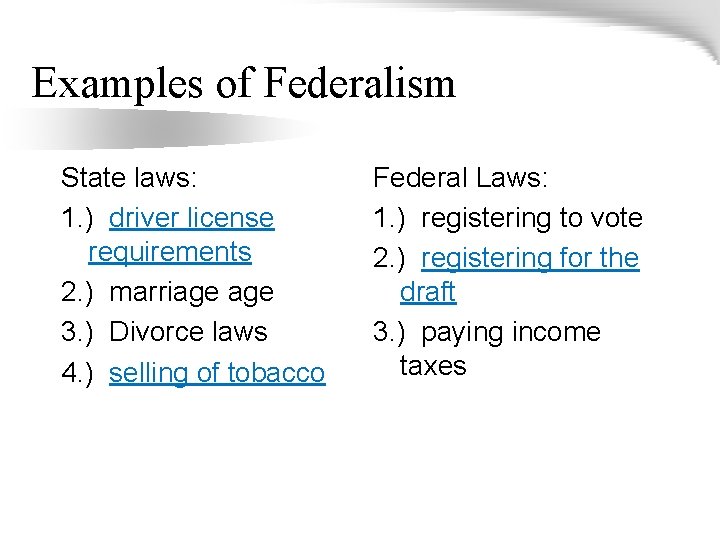
Examples of Federalism State laws: 1. ) driver license requirements 2. ) marriage 3. ) Divorce laws 4. ) selling of tobacco Federal Laws: 1. ) registering to vote 2. ) registering for the draft 3. ) paying income taxes
The Division of Power-Constitution The Constitution provides the structure for the idea of Federalism. The Constitution gives the National Government powers and then reserves powers for the State Governments. The population of the U. S. answers to at least two levels of government, state and federal.
State and Federal government focuses on national concerns like defense and foreign policies. State government focuses on matters of local concerns. P. 89 for examples of differences between the states and their laws.
Delegated Powers are powers that are given (granted) to the federal government by the Constitution. Three types of Delegated Powers: 1. ) Expressed Powers 2. ) Implied Powers 3. ) Inherent Powers
Expressed Powers: Expressed powers are sometimes known as enumerated powers. These powers are spelled out by the Constitution. They are found in Article I, Section 8 of the Constitution. In the 18 clauses of the Constitution, there are 27 expressed powers given to the Legislative Branch.
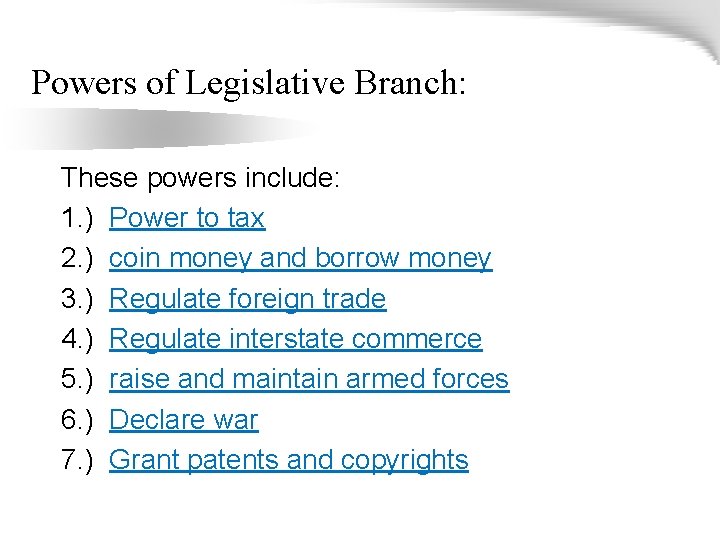
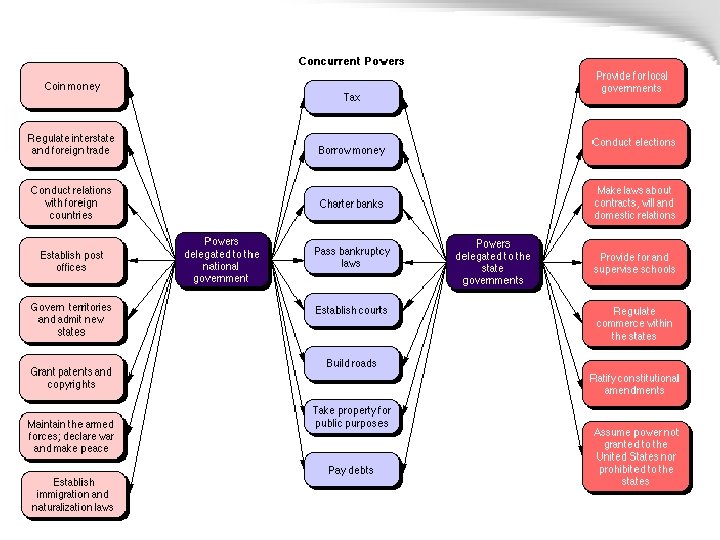
Powers of Legislative Branch: These powers include: 1. ) Power to tax 2. ) coin money and borrow money 3. ) Regulate foreign trade 4. ) Regulate interstate commerce 5. ) raise and maintain armed forces 6. ) Declare war 7. ) Grant patents and copyrights
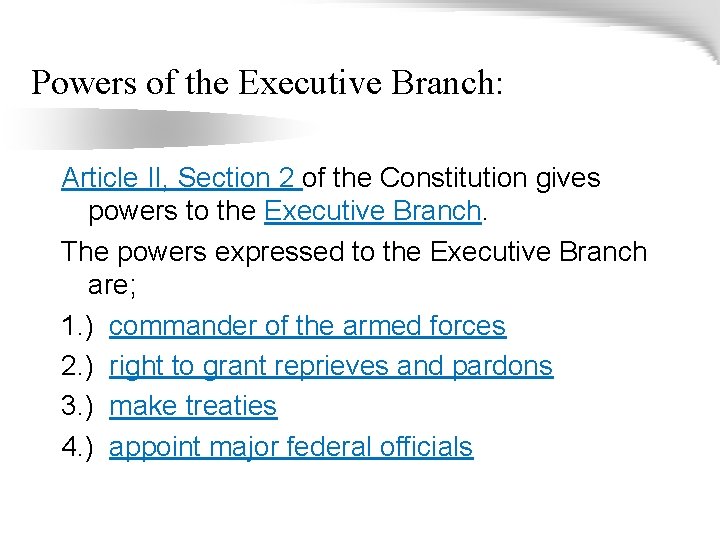
Powers of the Executive Branch: Article II, Section 2 of the Constitution gives powers to the Executive Branch. The powers expressed to the Executive Branch are; 1. ) commander of the armed forces 2. ) right to grant reprieves and pardons 3. ) make treaties 4. ) appoint major federal officials
Powers of the Judicial Branch The Supreme Court powers are spelled out in Article III of the Constitution which says that “the judicial power of the United States” to the Supreme Court and other courts in the federal judiciary.
Implied Powers of the Federal Government Implied Powers are not clearly stated by the Constitution but they are “implied” by a suggestion. In Article I, section 8, Clause 18 is known as the Elastic Clause. The Elastic Clause gives Congress to “make all Laws which shall be necessary and proper for carrying” out their job.
Implied Powers of Congress A major example of implied powers is the creation of the national bank by Congress under president Washington. With the Mc. Cullough vs. Maryland case, the Supreme court validated the powers of the elastic clause. Other examples of implied powers include: 1. ) regulation of labor 2. ) building a 42, 000 highway system 3. ) racial discrimination 4. ) federal crimes
Inherent Powers of the Federal Government Inherent Powers are powers the National Government has gained over the years. They are not expressed in the Constitution but it was clear that the Founding Fathers did want the National Government to have the powers. There are only a few inherent powers. The inherent powers are implied from the expressed powers. For example, Congress has the express powers to control foreign trade therefore Congress has the right to regulate immigration. President can write a treaty and Congress has the power to approve treaty which gives them the power to acquire land through a treaty.
Powers Denied to the National Government The National Government cannot; 1. ) Levy taxes on exports 2. ) take private property without payment of compensation 3. ) break the rights of citizen protected in the Bill of Rights These non-powers are found in Article 1, section 9 and the 1 st 8 amendments.
Powers Denied to the National Government: The National Government is limited by the powers given to it by the Constitution. For example: 1. ) No National School System 2. ) No National Divorce or Marriage Laws This is known as the Silence of the Constitution.
Powers Denied to the National Government: The third way the National Government is denied power is the protection of the federal system itself. The National Government cannot do anything that will threaten the existence of the system.
The States Powers: The powers given to a State are known as Reserved Powers because the Constitution does not grant them to the National Government and they are not denied to the States. These powers are found in the 10 th Amendment. The powers of the State are Huge!
Reserved Powers of the States: States can: 1. ) set marriage rules 2. ) age to buy liquor 3. ) licenses for professions 4. ) public schools and requirements 5. ) regulate public utilities in the state
Powers denied to the States: States are denied powers that are given to the federal government, for example, 1. ) the states cannot make a treaty with a foreign country 2. ) the state cannot coin money
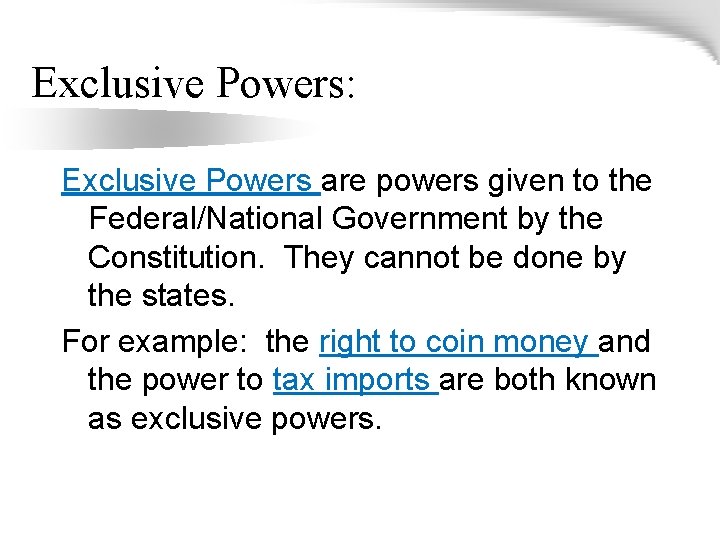
Exclusive Powers: Exclusive Powers are powers given to the Federal/National Government by the Constitution. They cannot be done by the states. For example: the right to coin money and the power to tax imports are both known as exclusive powers.
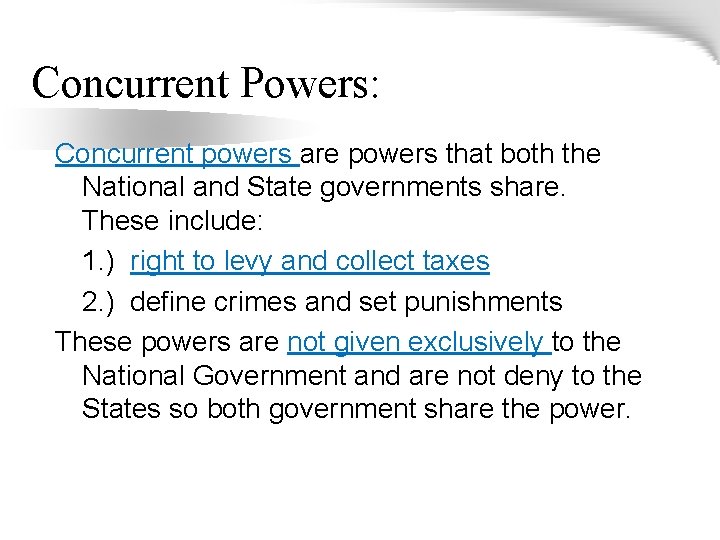
Concurrent Powers: Concurrent powers are powers that both the National and State governments share. These include: 1. ) right to levy and collect taxes 2. ) define crimes and set punishments These powers are not given exclusively to the National Government and are not deny to the States so both government share the power.
Until tomorrow …
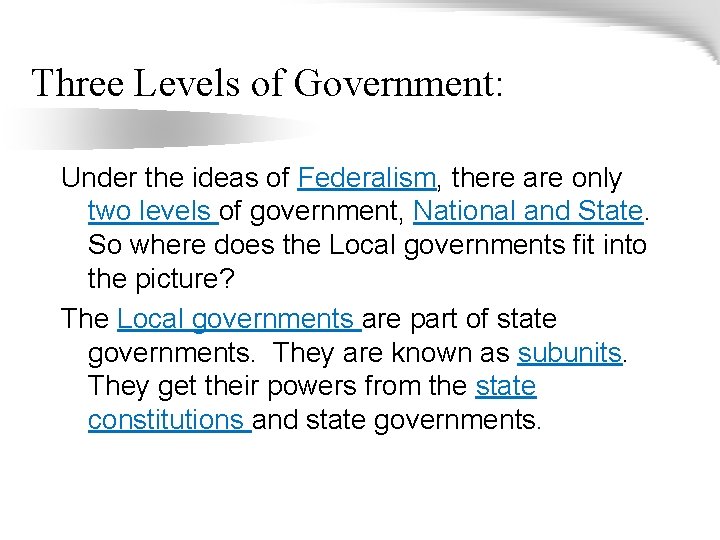
Three Levels of Government: Under the ideas of Federalism, there are only two levels of government, National and State. So where does the Local governments fit into the picture? The Local governments are part of state governments. They are known as subunits. They get their powers from the state constitutions and state governments.
Supreme Law of the Land: The Supremacy Clause in the U. S. Constitution was the way the Founding Fathers insured that Federal Government would always be above the State Governments. The Supremacy Clause is found in Article VI, section 2: “This Constitution, and the Laws of the United States which shall be made in Pursuance thereof; and all treaties made, or which shall states, shall be the Supreme Law of the Land: ” The Constitution is the Law of the Land above all state laws.
Supreme Court Duty: It is the duty of the Supreme Court to be the umpire between Federal and State conflicts. First time there was a state and federal conflict was in the Mc. Culloch vs. Maryland case. The State of Maryland wanted to tax the Federal national bank. Supreme Court Chief Justice, John Marshall made two very important rulings: 1. ) the state could not tax a federal institution 2. ) the bank was constitutional and the elastic clause was constitutional
National Governments obligations to the States: The Constitution is very clear about the National Governments obligations to the States in Article IV. The National Government is require to provide each State with a Republican form of government which normally means a representative government.
Obligations to the States: The Courts refused to define what a Republican Form of Government mean. This idea of Republican Form of Government came up during the time known as Reconstruction when Congress ruled that the southern States were not being a republican form of government and Congress passed the 13 th, 14 th, and 15 th amendment. The southern states were not allowed back into the union until the states ratified these amendments.
National Government must protect the states from invasion and internal disorder: In Article IV, section 4, the Constitution says that the National Government must protect them against invasion and domestic violence. The National Government bring in troops to restore order from domestic violence is very rare.
Restoring Order: National Troops were used in 1957 in Arkansas with the Little Rock Nine with President Eisenhower. They were used again in 1960 s with President Johnson due to all the race violence. The President normally, only sends troops when the governor of the state request them. However, if a national law is being broken the president doesn’t have to ask permission.
Territorial Integrity: National Government must respect the Territorial Integrity of the State. The National Government must recognize the legal existence and the physical boundaries of each State. Each state is protected by its equal representation in Legislative Branch by Article V of the Constitution.
New States: Only the Legislative branch has the power to admit a new state in the union. However, a new state cannot be created by taking land from an existing state with the state’s legislature consent. Congress has admitted 37 states.
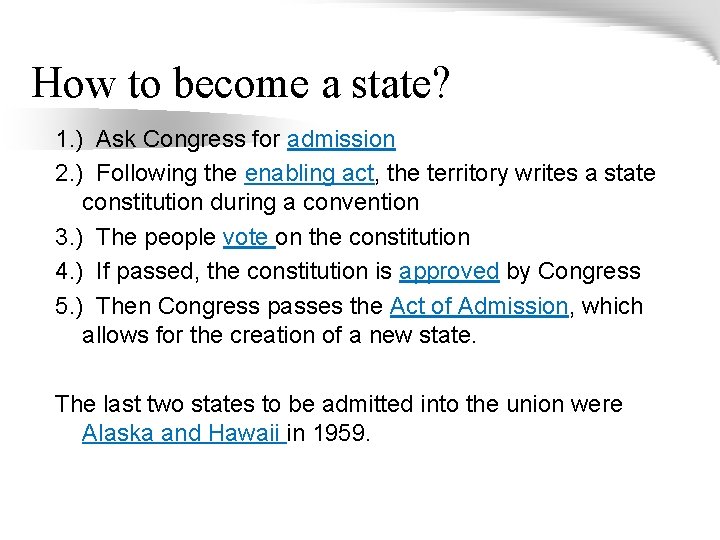
How to become a state? 1. ) Ask Congress for admission 2. ) Following the enabling act, the territory writes a state constitution during a convention 3. ) The people vote on the constitution 4. ) If passed, the constitution is approved by Congress 5. ) Then Congress passes the Act of Admission, which allows for the creation of a new state. The last two states to be admitted into the union were Alaska and Hawaii in 1959.
Conditions for Admissions: The National Government can require certain conditions before a territory can become a state. For example: In 1896, when Utah filed to be a state, they were required to outlaw the practice of polygamy. Polygamy is the practice of having more than one wife.
Cooperative Federalism: Under the ideas of Federalism, the states and the National government have to cooperate with each other. This includes the areas of Federal Government Grants and the services the states performs for the Federal Government.
Federal Grants in-Aid The Federal government steps in to help the states’ with their programs. For example: The federal government helps the states with federal land for schools and colleges. In 1930’s, the federal government gave millions to the states to help out with the economic crisis. Congress set up hundreds of grant in aid programs in the areas of education, mass transit, highway construction, health care, and on the job training.
Federal Grants in aid: About 25% of the states’ budget is from federal grant money. This is a great example of the cooperation between the Federal and State Government.
Revenue Sharing: This was an idea from 1972 to 1987. Under this idea, the National government and the State government shared the federal tax revenue. This was roughly about $83 billion dollars. Revenue Sharing was stopped during the Reagan years.
Time to work on Ch. 4 Work
Types of Federal Grants: There are three types of Grants-in- aid for the federal government. 1. ) Categorical Grants 2. ) Block Grants 3. ) Project Grants
Categorical Grants: Categorical grants are designed for a specific purpose. Categorical grants have conditions attached to the granting of the money known as strings. There are three strings attached to Categorical grants: 1. ) Federal money must be used for a specific purpose 2. ) State must match the funds 3. ) an agency must be in charge of the grants 4. ) guideline for the purpose must be followed.
Block Grants: Block grants are used more than categorical grants. They cover issues like health care, social services or welfare. Block grants have fewer strings attached, giving the states more freedom in using the money.
Project Grants: Project Grants are grants given to the states, and private agencies. These grants are given to the National Institutes of Health for support scientists engaged in research on cancer, diabetes, neurological disease and other medical issues.
Other forms of Federal Aid: For Example: FBI gives help to the local and state police. Federal Army equips and trains the National Guard units in the states.
State Aid To the National Government: The states also help the national government in several ways: 1. ) the states run and pay for the federal elections 2. ) naturalization of aliens as American citizens 3. ) Arresting criminals of federal crimes by local police and keeping them in local jails. Etc, etc.
Interstate Problems: One of the major reasons for the writing of the Constitution was the problems between the states under the Articles of Confederation. The Constitution not only strengthened the federal government but it ended the conflicts between the states.
Interstate Compacts: While a state cannot enter into a foreign agreement they can enter into a interstate compact. An interstate compact is an agreement between two states. There are 26 interstate Compacts. Example: New York and New Jersey with the Port Authority. Alabama, Georgia and Florida sharing water.
Compact for Supervision of Parolees and Probationers and the Compact on Juveniles All states are members of the compact for supervision of Parolees and Probationers and the compact on Juveniles. These two compacts allow States to share important law enforcement data to aid in obtaining of criminals who cross state lines.
Full Faith and Credit Clause: Full Faith and Credit Clause are discussed in Article IV, section 1. Under this clause, every state must respect the validity of the states public acts and judicial proceedings. Such as documents like birth certificates, marriage licenses, deed to property, car registrations and other issues when a judge makes a decision. For example: a ruling in Florida applies in Georgia too.
Exceptions to the Full Faith and Credit Clause There are two exceptions to the Full Faith and Credit Clause: 1. ) Only applies to civil matters 2. ) Divorces in one states cannot be granted to another states’ residents
Williams vs. North Carolina: Divorces can only be granted by a state if the citizen is a bona fide resident of the state. In the case, Williams vs. North Carolina, a man and a woman both married to other people moved to Nevada to get a “quickie divorce”. They lived in Nevada for 6 weeks (the minimum period to get a divorce). They both got their divorces and then married each other. They moved back to North Carolina and the state did not honor their divorces. The Supreme Court backed their decision.
Extradition: Under the Constitution in Article IV, section 2, Clause 2, it talks about the extradition. Extradition is the legal process in bring a criminal who has crossed state lines to avoid being captured back to the state they fled from. This process is a very routine matter except when a governor contest the extradition because he feels the charges are unfair or racial motivated. In 1987, the Supreme Court gave the federal government the power to order a governor to hand over a fugitive.
Privileges and Immunities: Under Article IV, Section 2, Clause 1 of the Constitution, the ideas of Privileges and Immunities are discussed. It says that no states can draw unreasonable distinctions between its own residents and those persons who happen to live in other States. Each state must recognize the right of any American to travel between states and the ability to move to another state. However, a state can have requirements in order to be known as a citizen of the state. For example, a person must live in a state for a certain length of time before they can run for a public office of that state. Or a state can require the people of the state to have a citizen license to hunt which is cheaper than the non-residence license. Same thing as out of state tuition for residence who do not live in the state.
The End!