
Federalism l SHAIK ANSAR BASHA Federalism Form of
Federalism l SHAIK ANSAR BASHA
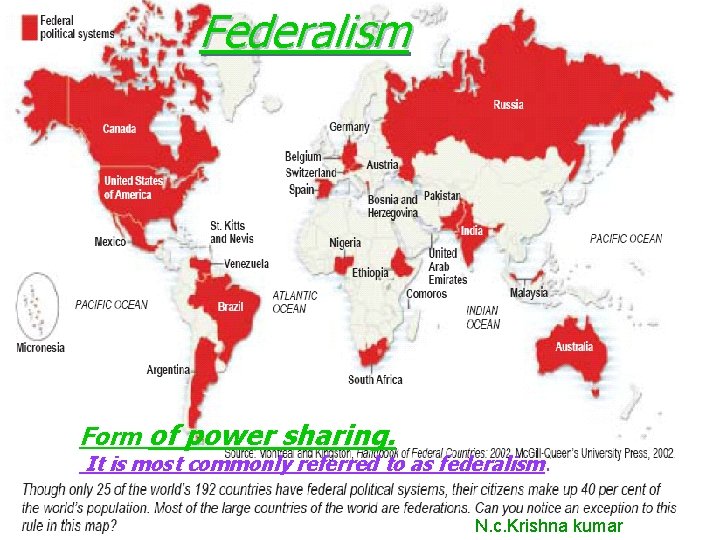
Federalism Form of power sharing. It is most commonly referred to as federalism. N. c. Krishna kumar
What is federalism? l Federalism is a system ofgovernment in which the power is divided between a central authority and various constituent units of the country. l Usually, a federation has two levels of government. One is the government for the entire country that is usually responsible for a few subjects of common national interest
l. The others are governments at the level of provinces or states that look after much of the day-to-day administering of their state. Both these levels of governments enjoy their power independent of the other.
FEDERATIONS & UNITARY GOVTS l Federations are contrasted with unitary governments. l Under the unitary system, eithere is only one level of government or the subunits are subordinate to the central government. l The central government can pass on orders to the provincial or the local government.
l. But in a federal system, the central government cannot order the state government to do something. State government has powers of its own for which it is not answerable to the central government.
l 1. There are two or more levels (or tiers) of government. l 2. Different tiers of government govern the same citizens, but each tier has its own JURISDICTION in specific matters of legislation, taxation and administration.
THE KEY FEATURES OF FEDERAL GOVT l 3. The jurisdictions of the respective levels or tiers of government are specified in the constitution. So the existence and authority of each tier of government is constitutionally guaranteed.
l 4. The fundamental provisions of the constitution cannot be unilaterally changed by one level of government. Such changes require the consent of both the levels of government
Courts have the power to interpret the constitution and the powers of different levels of government. The highest court acts as an umpire if disputes arise between different levels of government in the exercise of the irrespective powers l 5. l 6. Sources of revenue for each level of government are clearly specified to ensure its financial autonomy.
An ideal federal system has both aspects : mutual trust and agreement to live together. l 7. The federal system thus has dual objectives: to safeguard and promote unity of the country, while at the same time accommodate regional diversity. Therefore, two aspects are crucial for the institutions and practice of federalism.
l The Constitution declared India as a Union of States. Although it did not use the word federation, the Indian Union is based on the principles of federalism. l The Constitution originally provided for a two-tier system of government l Union Government l State Government

Later, a third tier of federalism was added in the form of Panchayats and Municipalities. l Three fold distribution of legislative powers between the Union Government and the State Governments. l THE UNION LIST l THE STATE LIST l CONCURRENT LIST
Union List includes subjects of national importance such as defence of the country, foreign affairs, banking, communications and currency. State List contains subjects of State and local importance such as police, trade, commerce, agriculture and irrigation.
Concurrent List l includes subjects of common interest to both the Union Government as well as the State Governments, such as education, forest, trade unions, marriage, adoption and succession. Both the Union as well as State government can make laws l This sharing of power between the Union Government and the State governments is basic to the structure of the Constitution.

l The judiciary plays an important role in overseeing the implementation of constitutional provisions and procedures. In case of any dispute about the division of powers, the High Courts and the Supreme Court make a decision.
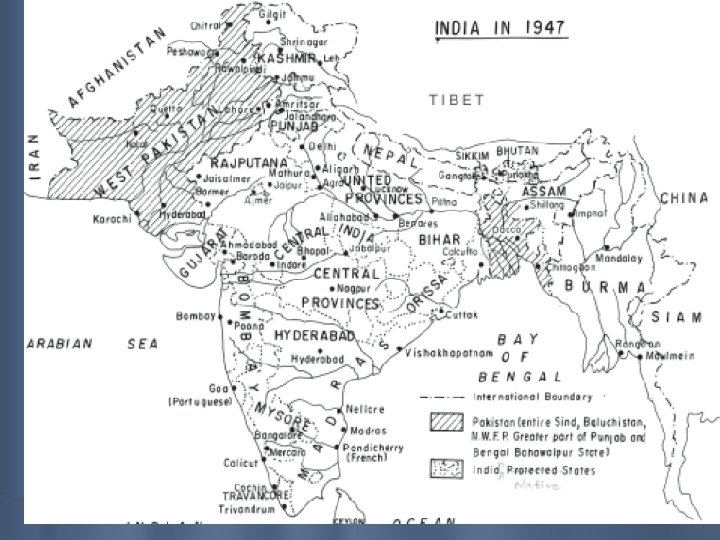
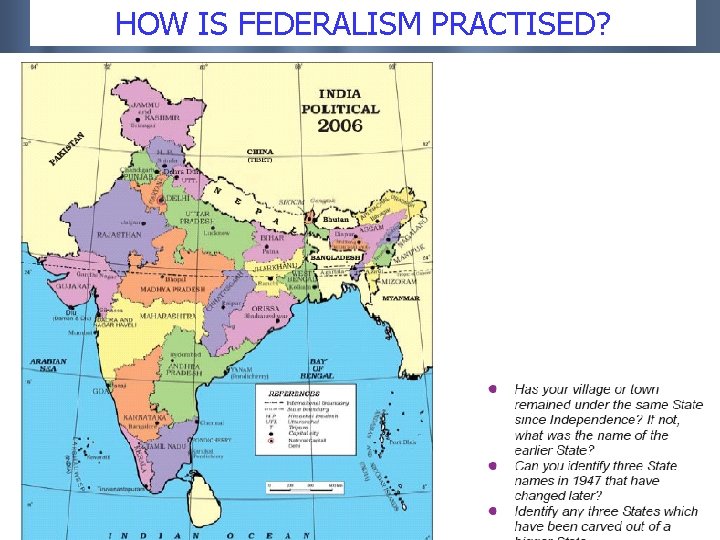
HOW IS FEDERALISM PRACTISED?

The real success of federalism in India can be attributed to the nature of democratic politics in our country. This ensured that the spirit of federalism, respect for diversity and desire for living together became a shared ideal in our country. Let us look at some of the major ways in which this happened.
l Linguistic States l People who spoke the same language lived in the same State. Some States were created not on the basis of language but to recognise differences based on culture, ethnicity or geography. These include States like Nagaland, Uttarakhand Jharkhand.
Language policy Our Constitution did not give the status of national language to any one language. At the beginning Hindi was identified as the official language. Besides Hindi, there are 21 other languages recognised as Scheduled Languages by the Constitution. Later HINDI AND ENGLISH languages were identified as OFFICIAL LANGUAGES
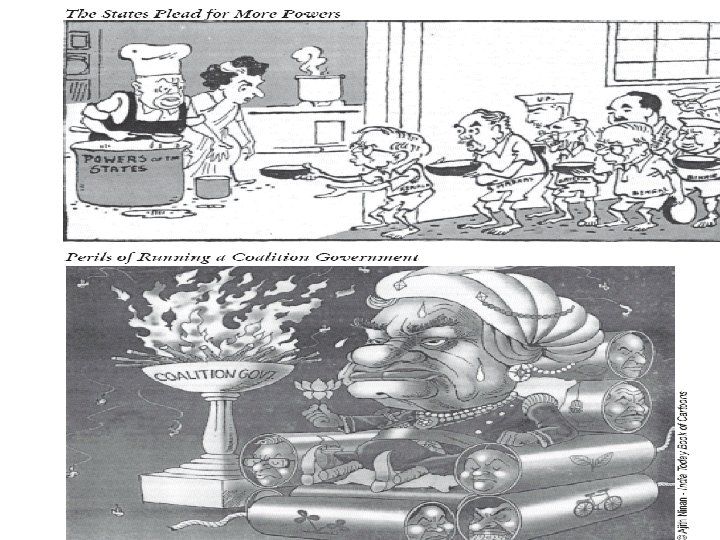
Centre-State relations Restructuring the Centre-State relations is one more way in which federalism has been strengthened in practice. after 1990 saw the rise of regional political parties in many States of the country. This was also the beginning of the era of COALITION govts at the Centre. Since no single party got a clear majority in the Lok Sabha, the major national parties had to enter into an alliance with many parties including several regional parties to form a govt at the Centre.
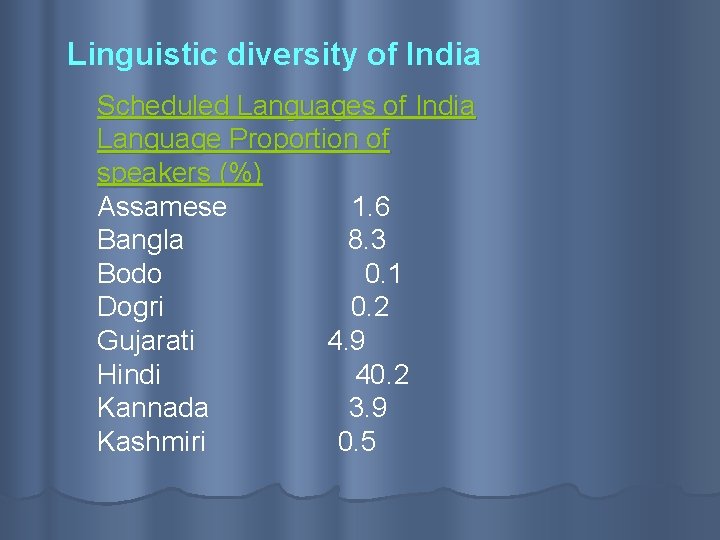
Linguistic diversity of India Scheduled Languages of India Language Proportion of speakers (%) Assamese 1. 6 Bangla 8. 3 Bodo 0. 1 Dogri 0. 2 Gujarati 4. 9 Hindi 40. 2 Kannada 3. 9 Kashmiri 0. 5
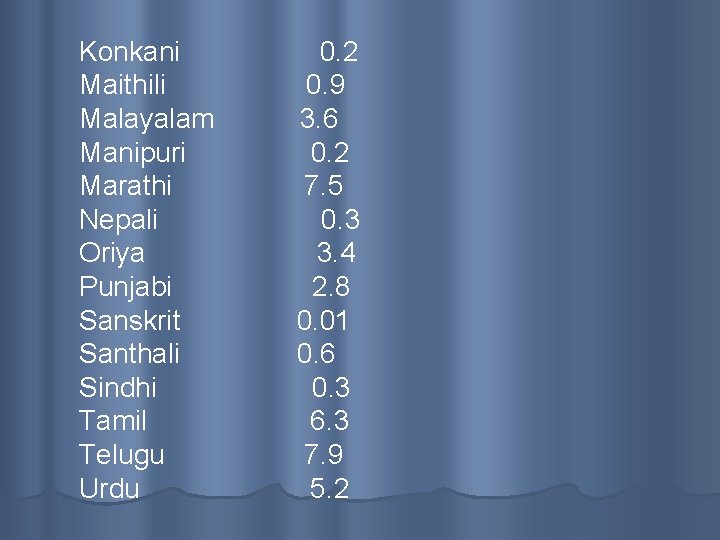
Konkani Maithili Malayalam Manipuri Marathi Nepali Oriya Punjabi Sanskrit Santhali Sindhi Tamil Telugu Urdu 0. 2 0. 9 3. 6 0. 2 7. 5 0. 3 3. 4 2. 8 0. 01 0. 6 0. 3 6. 3 7. 9 5. 2
Decentralisation in India a vast country like India cannot be run only through two-tiers of governments. States in India are as large as independent countries of Europe. Federal power sharing in India needs another tier of GOVT, below that of the State GOVT. This is the rationale for Decentralisation of power. Thus, resulted a third-tier of GOVT, called local government
A major step towards decentralisation was taken in 1992. The Constitution was amended to make third-tier of democracy more powerful and effective.
�� Now it is constitutionally mandatory to hold regular elections to local GOVT bodies. �� Seats are reserved in the elected bodies and the executive heads of these institutions for the Scheduled Castes, Scheduled Tribes and Other Backward Classes. �� At least one-third of all positions are reserved for women. �� An independent institution called the State Election Commission has been created in each State to conduct panchayat and municipal elections. �� The State GOVTS are required to share some powers and revenue with local GOVT bodies. The nature of sharing varies from State to State.

- Slides: 29