CHAPTER 4 DIFFERENTIATION NHAAIMKUNIMAP INTRODUCTION Differentiation Process of

- Slides: 50
CHAPTER 4 DIFFERENTIATION NHAA/IMK/UNIMAP
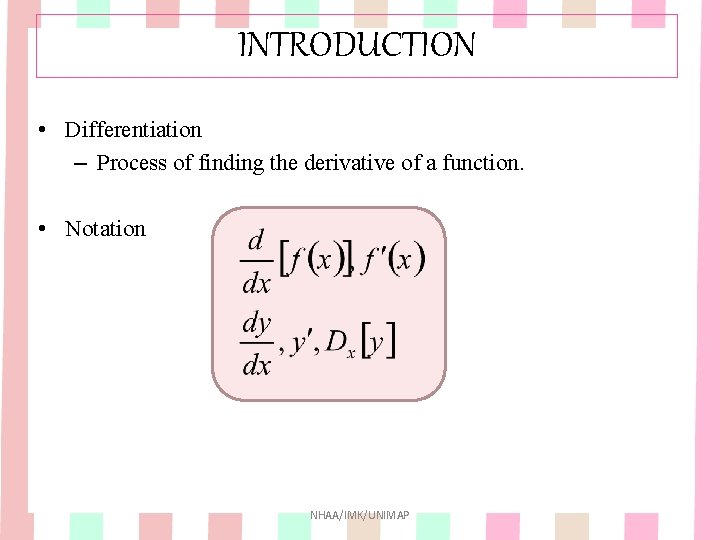
INTRODUCTION • Differentiation – Process of finding the derivative of a function. • Notation NHAA/IMK/UNIMAP
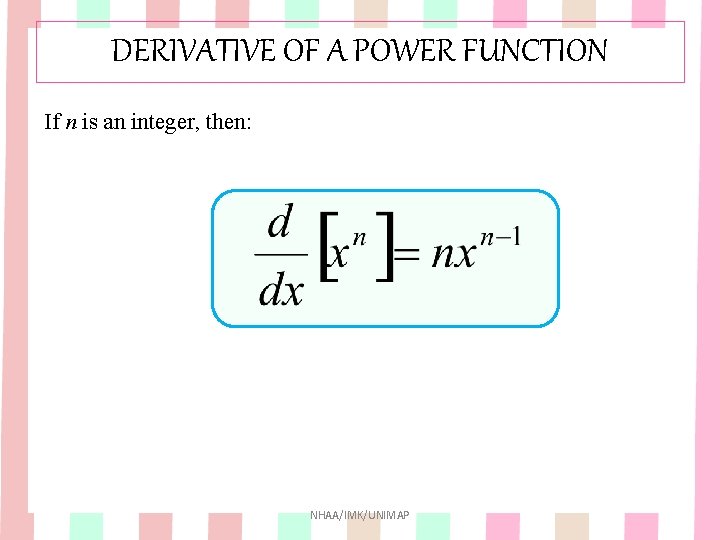
DERIVATIVE OF A POWER FUNCTION If n is an integer, then: NHAA/IMK/UNIMAP
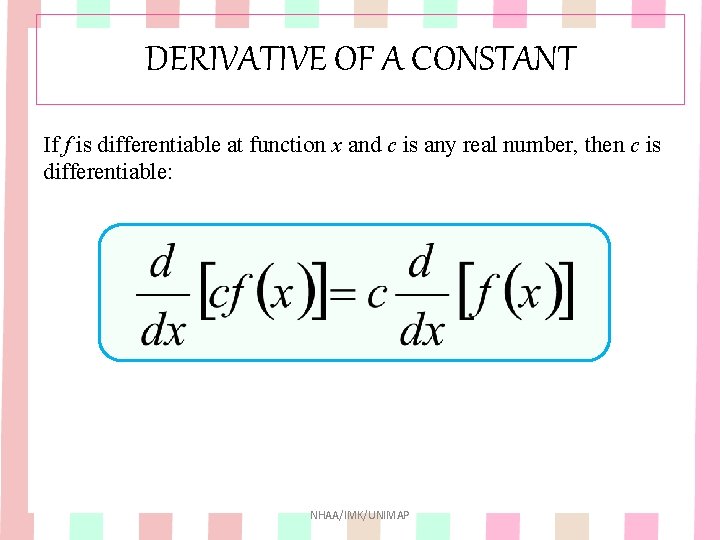
DERIVATIVE OF A CONSTANT If f is differentiable at function x and c is any real number, then c is differentiable: NHAA/IMK/UNIMAP
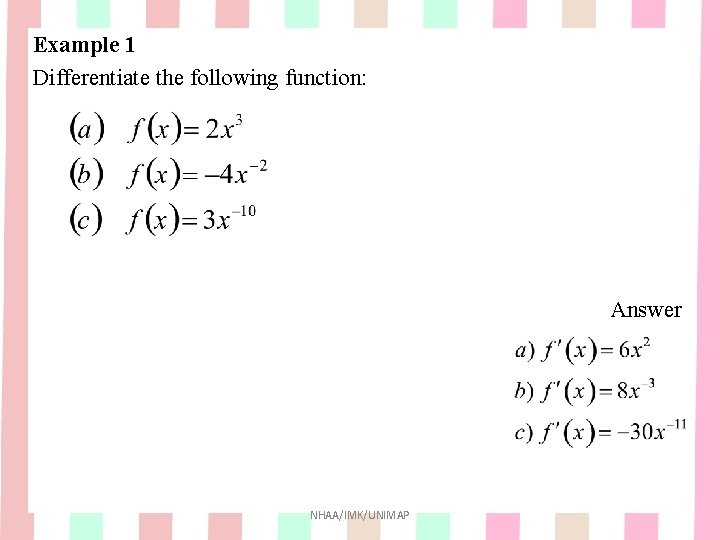
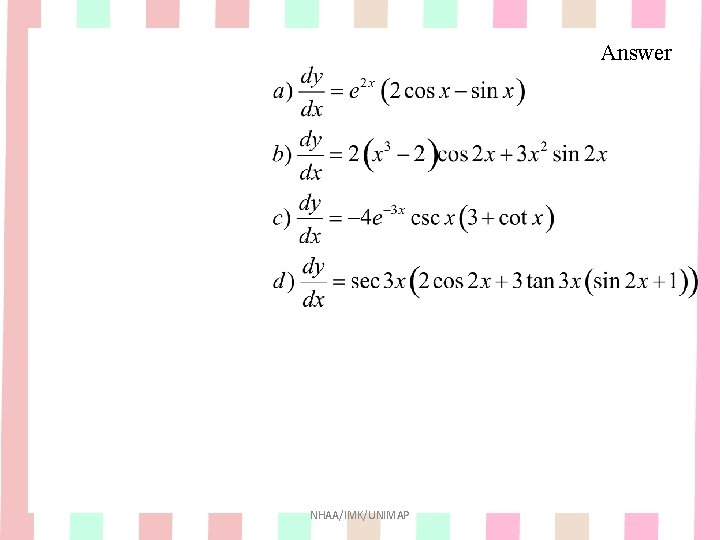
Example 1 Differentiate the following function: Answer NHAA/IMK/UNIMAP
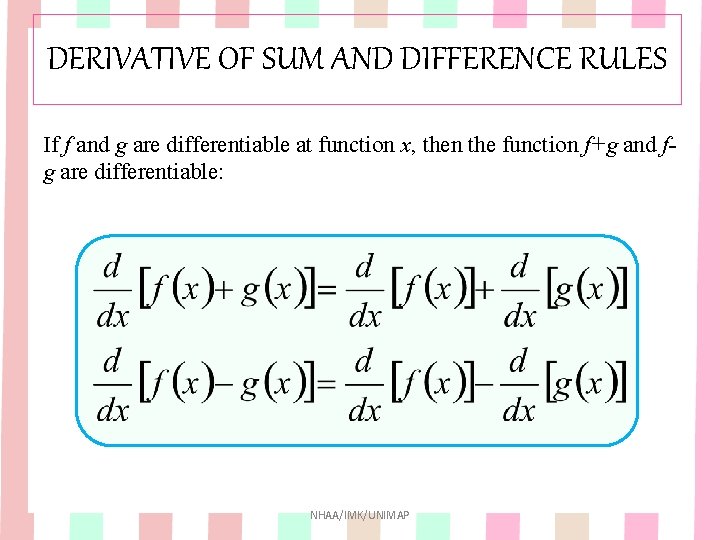
DERIVATIVE OF SUM AND DIFFERENCE RULES If f and g are differentiable at function x, then the function f+g and fg are differentiable: NHAA/IMK/UNIMAP
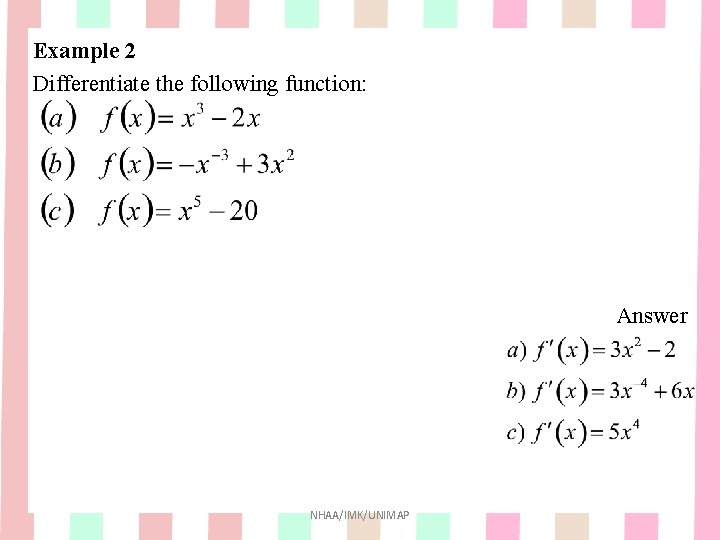
Example 2 Differentiate the following function: Answer NHAA/IMK/UNIMAP
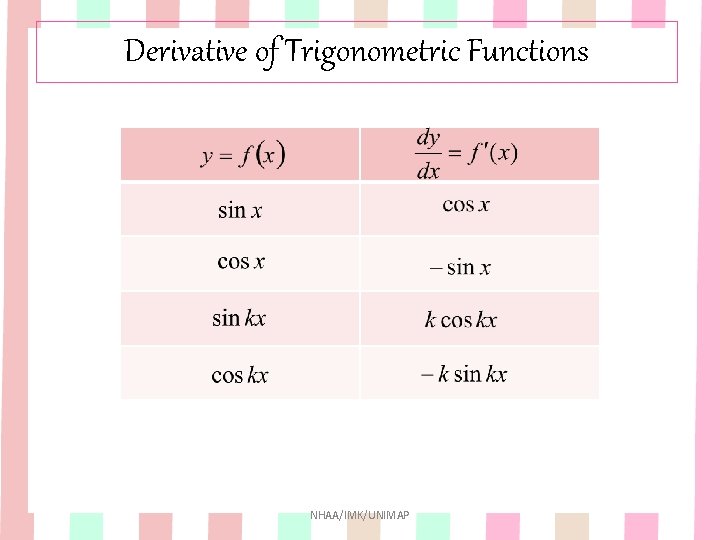
Derivative of Trigonometric Functions NHAA/IMK/UNIMAP
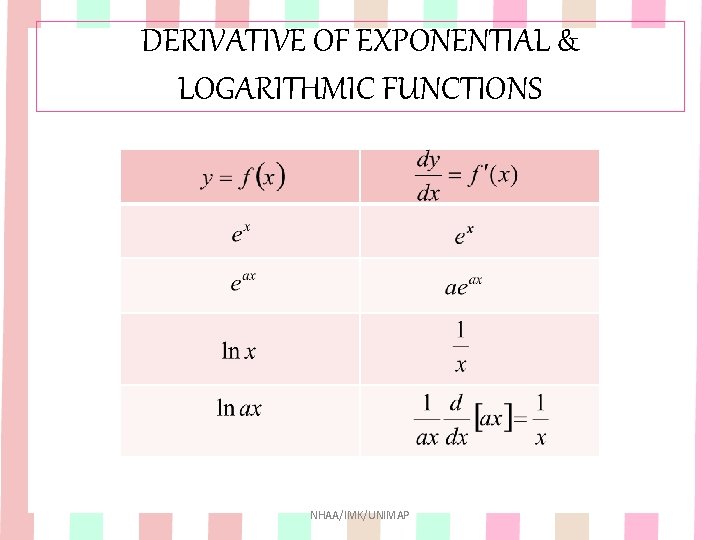
DERIVATIVE OF EXPONENTIAL & LOGARITHMIC FUNCTIONS NHAA/IMK/UNIMAP
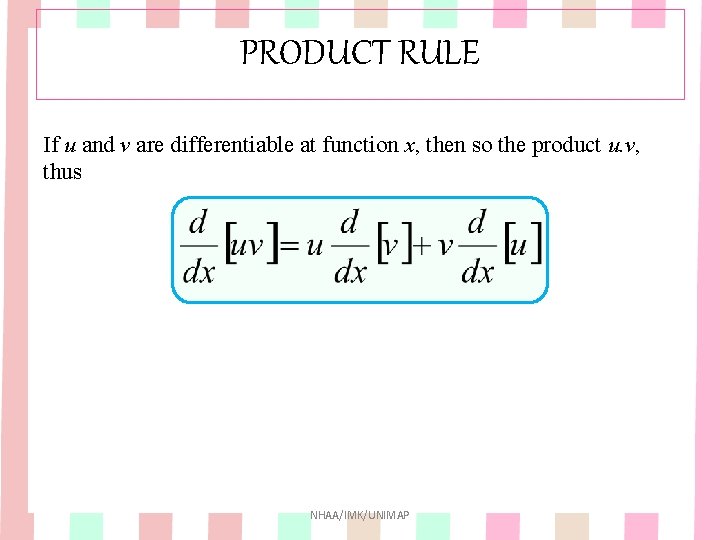
PRODUCT RULE If u and v are differentiable at function x, then so the product u. v, thus NHAA/IMK/UNIMAP
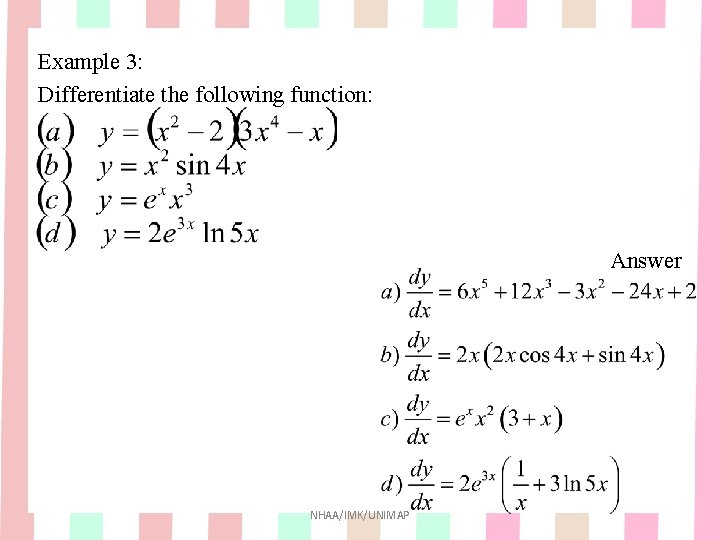
Example 3: Differentiate the following function: Answer NHAA/IMK/UNIMAP
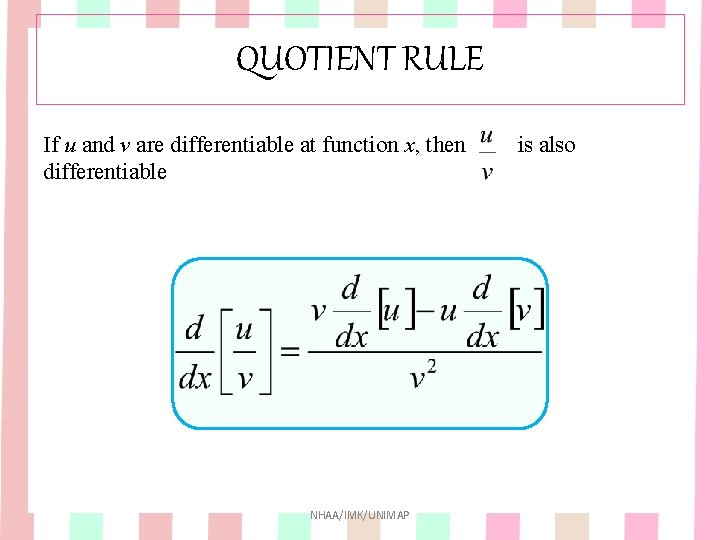
QUOTIENT RULE If u and v are differentiable at function x, then differentiable NHAA/IMK/UNIMAP is also
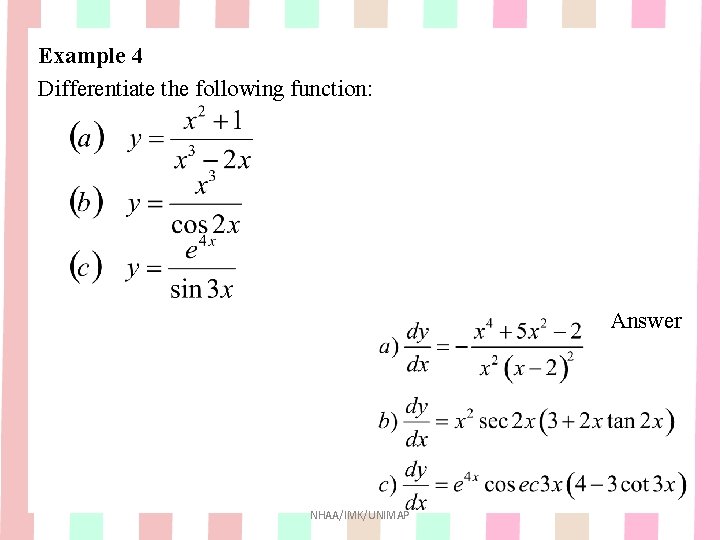
Example 4 Differentiate the following function: Answer NHAA/IMK/UNIMAP
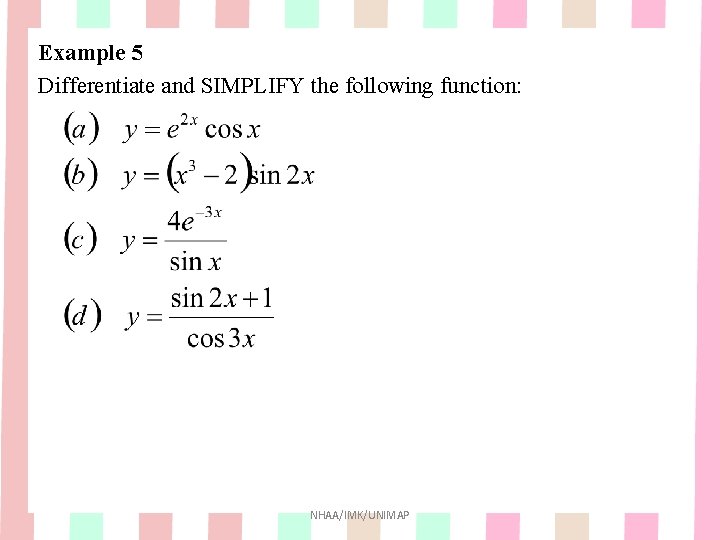
Example 5 Differentiate and SIMPLIFY the following function: NHAA/IMK/UNIMAP
Answer NHAA/IMK/UNIMAP
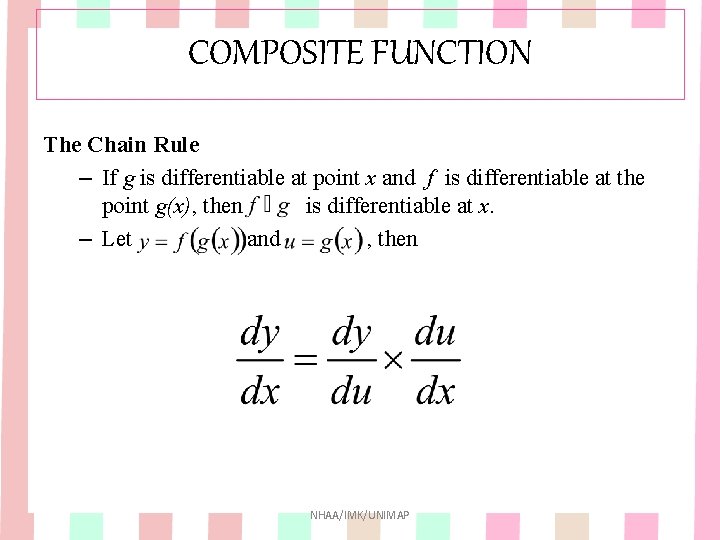
COMPOSITE FUNCTION The Chain Rule – If g is differentiable at point x and f is differentiable at the point g(x), then is differentiable at x. – Let and , then NHAA/IMK/UNIMAP
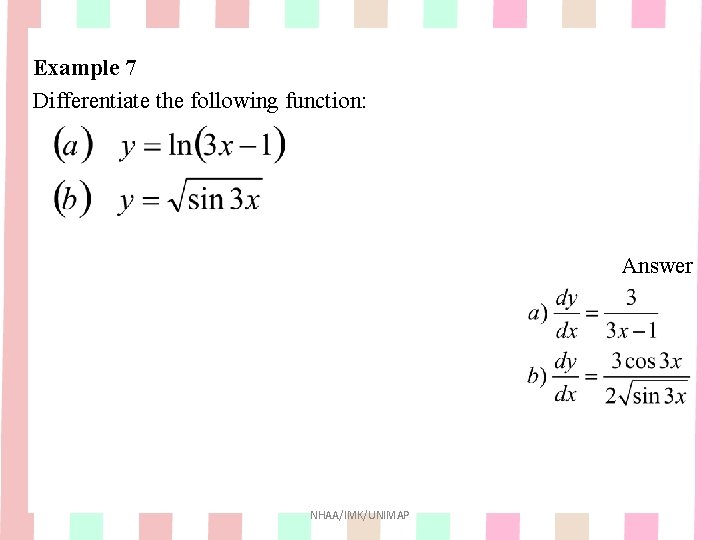
Example 7 Differentiate the following function: Answer NHAA/IMK/UNIMAP
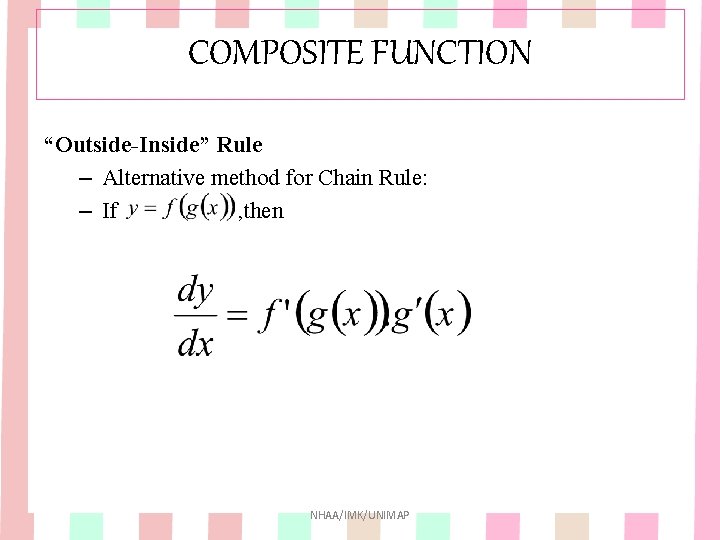
COMPOSITE FUNCTION “Outside-Inside” Rule – Alternative method for Chain Rule: – If , then NHAA/IMK/UNIMAP
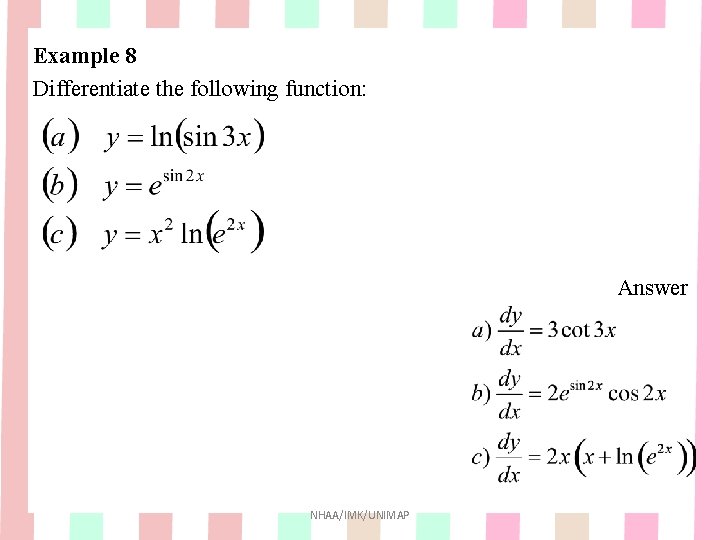
Example 8 Differentiate the following function: Answer NHAA/IMK/UNIMAP
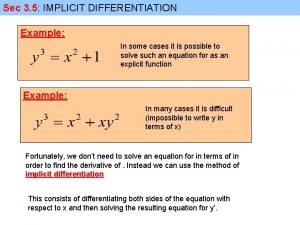
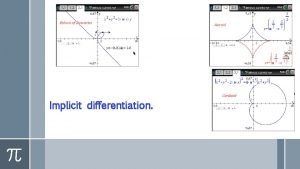
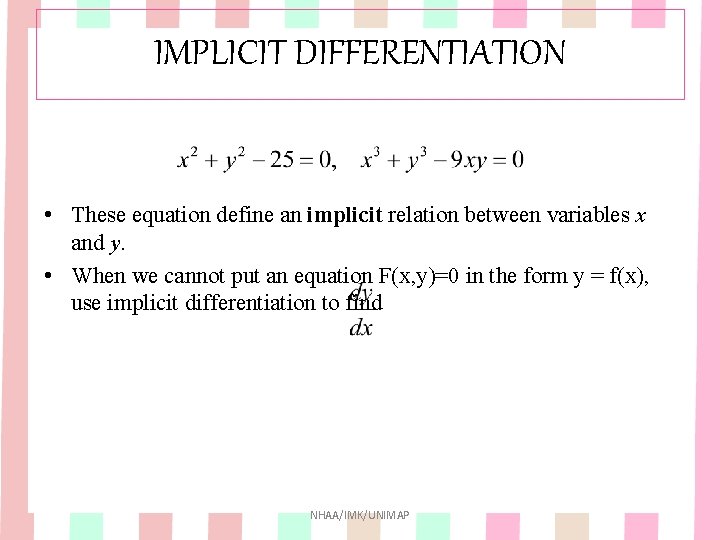
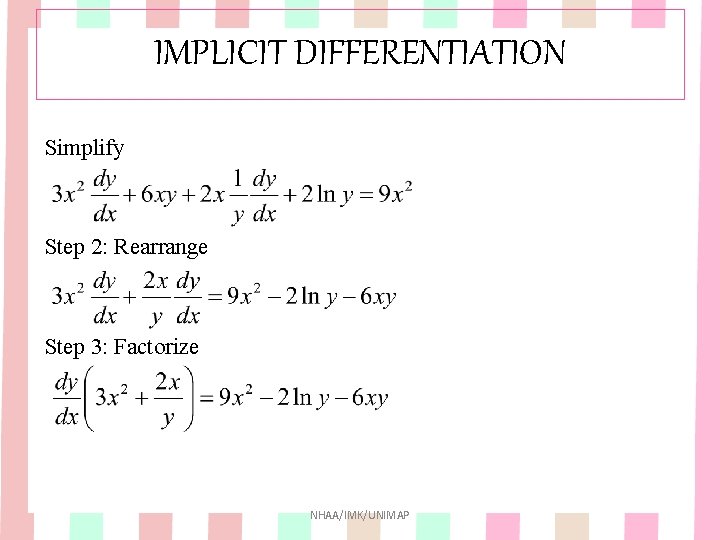
IMPLICIT DIFFERENTIATION • These equation define an implicit relation between variables x and y. • When we cannot put an equation F(x, y)=0 in the form y = f(x), use implicit differentiation to find NHAA/IMK/UNIMAP
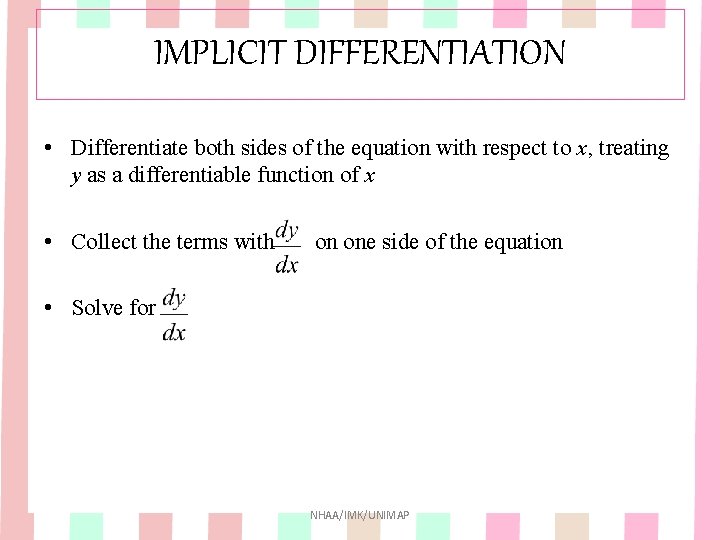
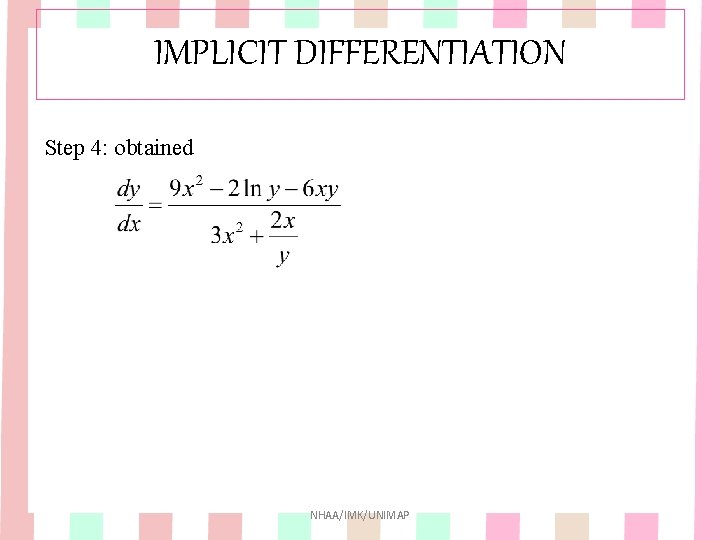
IMPLICIT DIFFERENTIATION • Differentiate both sides of the equation with respect to x, treating y as a differentiable function of x • Collect the terms with on one side of the equation • Solve for NHAA/IMK/UNIMAP
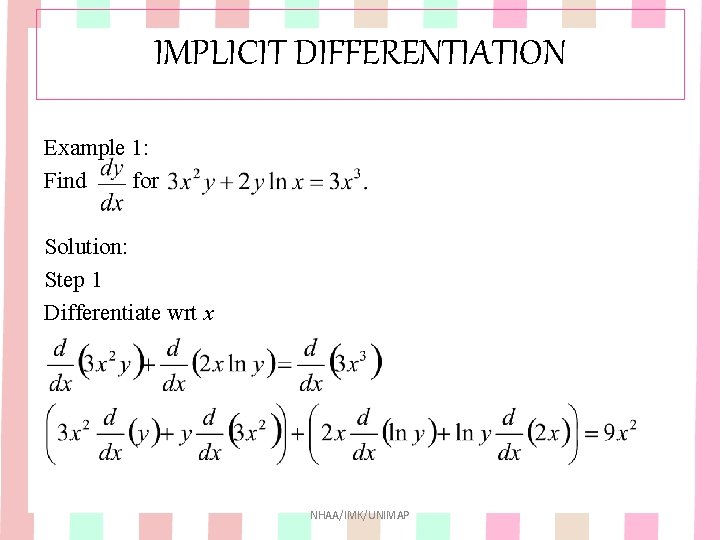
IMPLICIT DIFFERENTIATION Example 1: Find for Solution: Step 1 Differentiate wrt x NHAA/IMK/UNIMAP
IMPLICIT DIFFERENTIATION Simplify Step 2: Rearrange Step 3: Factorize NHAA/IMK/UNIMAP
IMPLICIT DIFFERENTIATION Step 4: obtained NHAA/IMK/UNIMAP
CHAPTER 4 APPLICATION: (I) TANGENT LINE (II) RELATED RATES (III) MINIMUM AND MAXIMUM VALUES
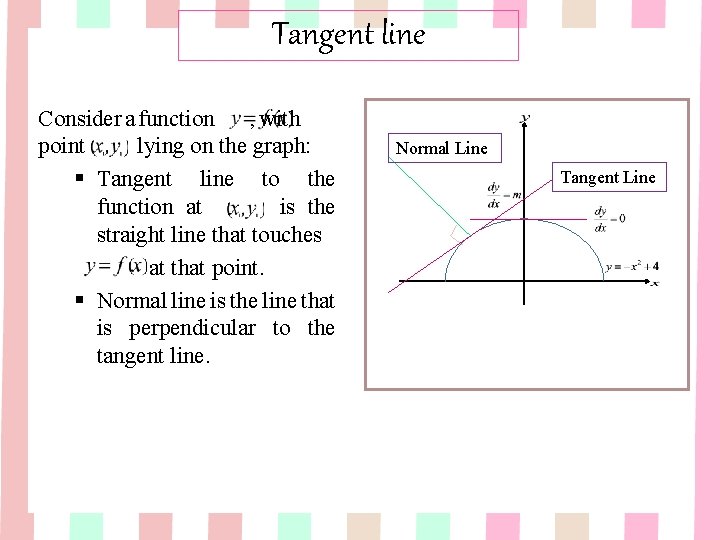
Tangent line Consider a function , with point lying on the graph: § Tangent line to the function at is the straight line that touches at that point. § Normal line is the line that is perpendicular to the tangent line. Normal Line Tangent Line
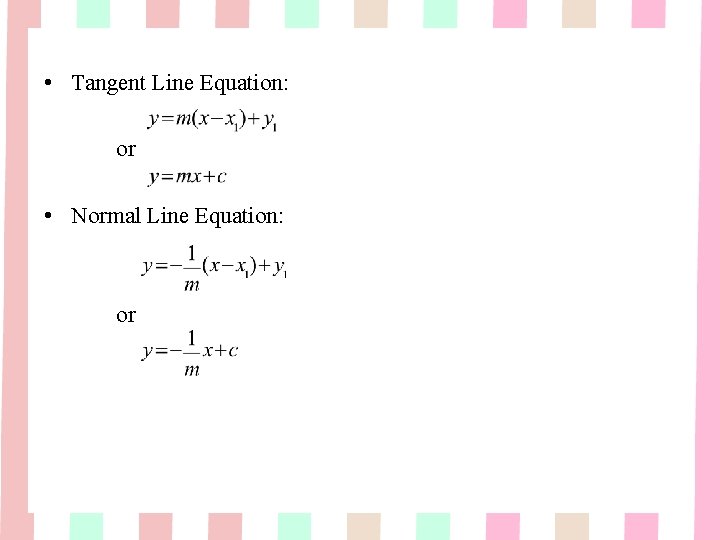
• Tangent Line Equation: or • Normal Line Equation: or
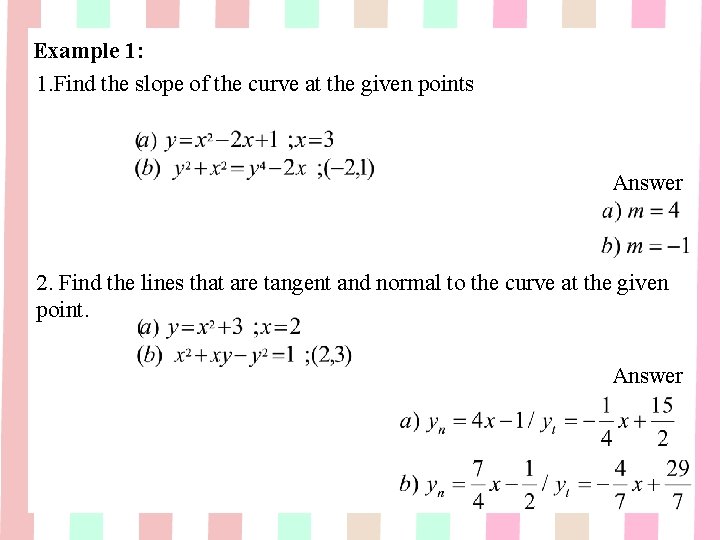
Example 1: 1. Find the slope of the curve at the given points Answer 2. Find the lines that are tangent and normal to the curve at the given point. Answer
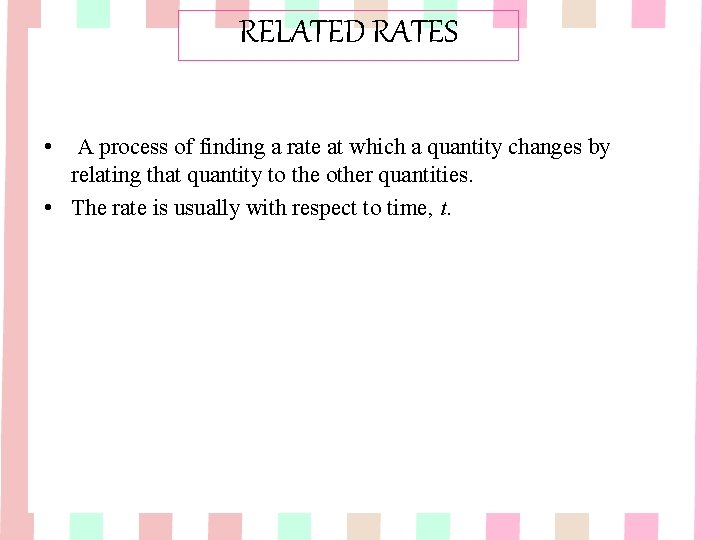
RELATED RATES • A process of finding a rate at which a quantity changes by relating that quantity to the other quantities. • The rate is usually with respect to time, t.
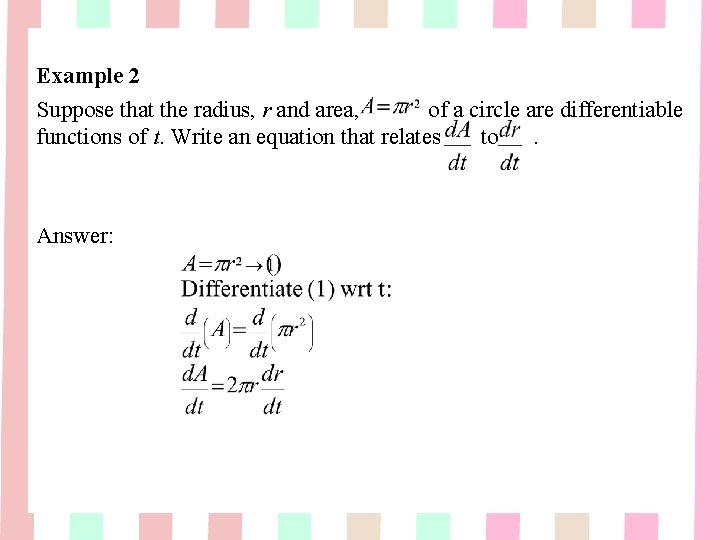
Example 2 Suppose that the radius, r and area, of a circle are differentiable functions of t. Write an equation that relates to. Answer:
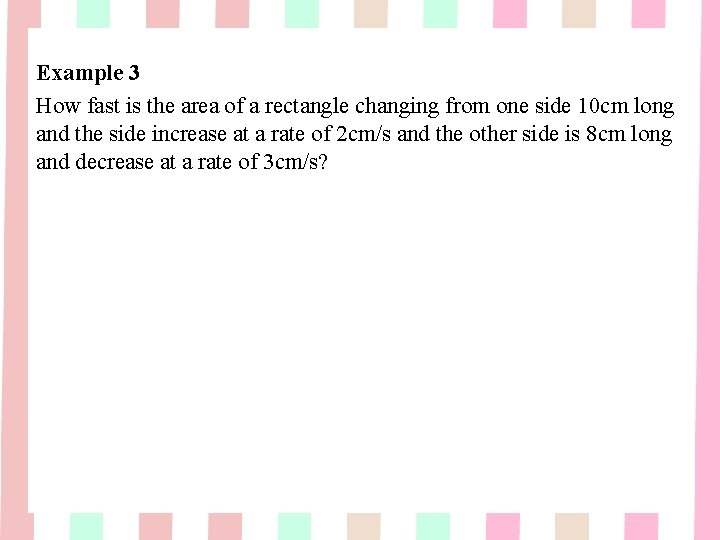
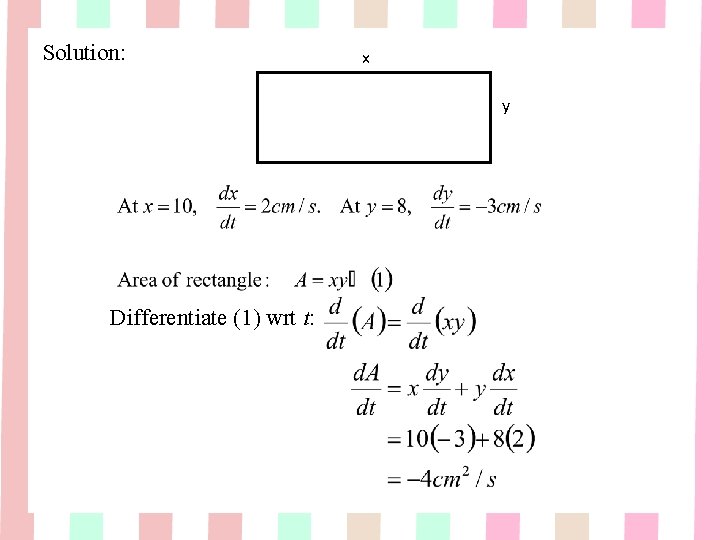
Example 3 How fast is the area of a rectangle changing from one side 10 cm long and the side increase at a rate of 2 cm/s and the other side is 8 cm long and decrease at a rate of 3 cm/s?
Solution: x y Differentiate (1) wrt t:
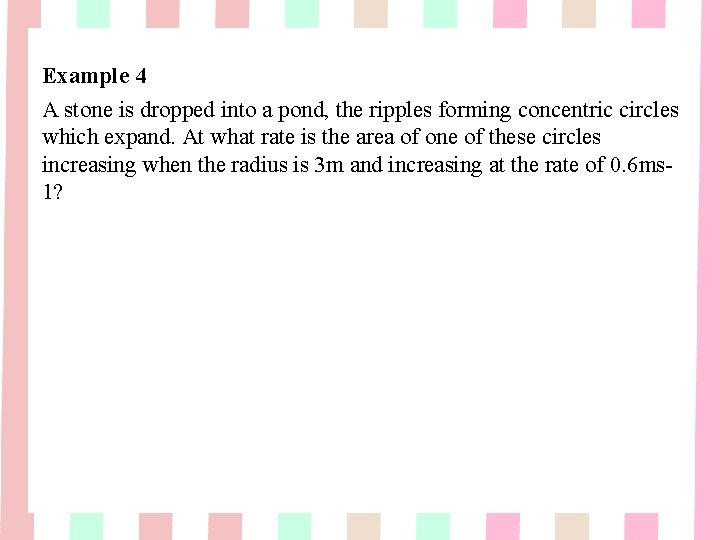
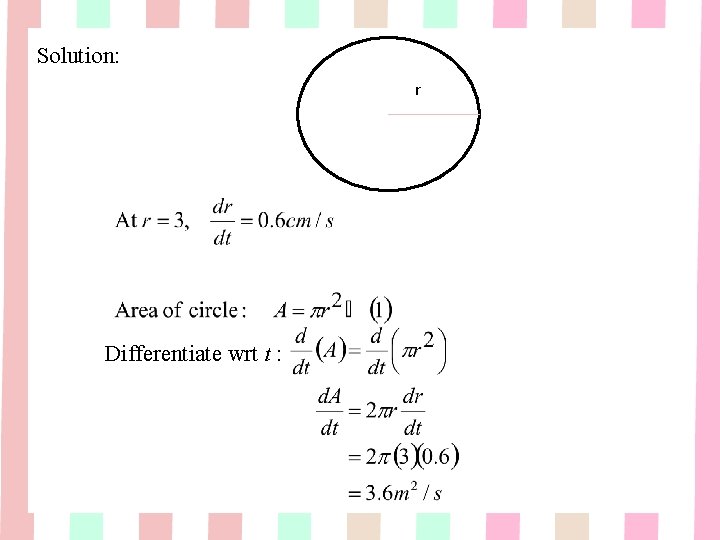
Example 4 A stone is dropped into a pond, the ripples forming concentric circles which expand. At what rate is the area of one of these circles increasing when the radius is 3 m and increasing at the rate of 0. 6 ms 1?
Solution: r Differentiate wrt t :
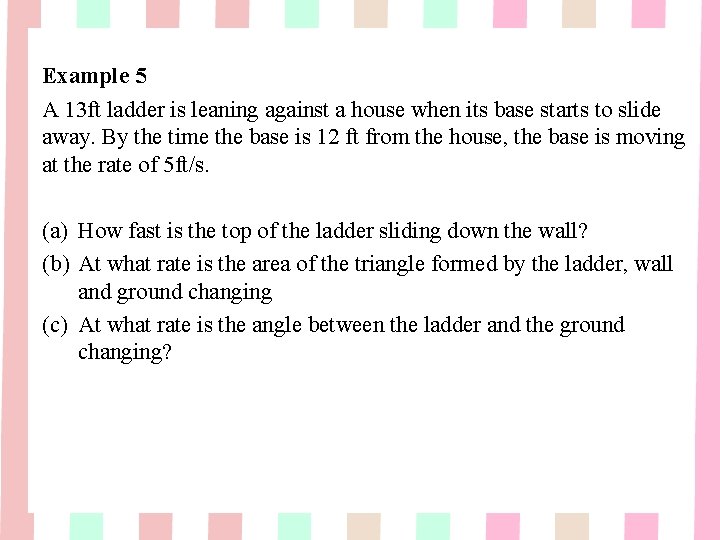
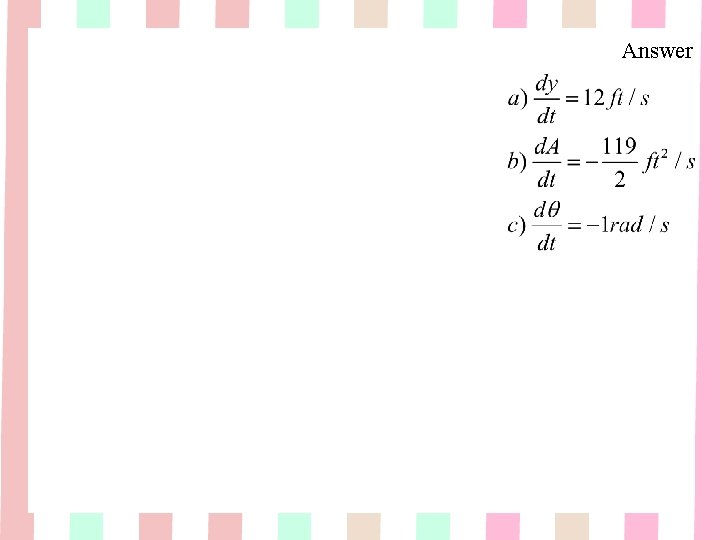
Example 5 A 13 ft ladder is leaning against a house when its base starts to slide away. By the time the base is 12 ft from the house, the base is moving at the rate of 5 ft/s. (a) How fast is the top of the ladder sliding down the wall? (b) At what rate is the area of the triangle formed by the ladder, wall and ground changing (c) At what rate is the angle between the ladder and the ground changing?
Answer
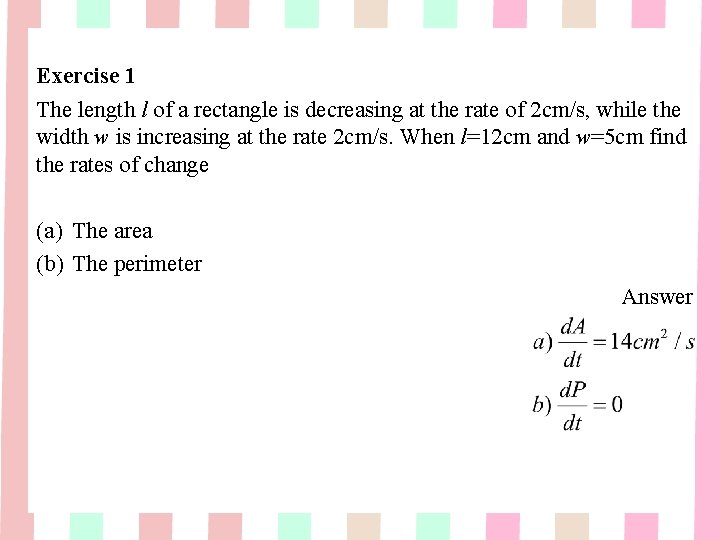
Exercise 1 The length l of a rectangle is decreasing at the rate of 2 cm/s, while the width w is increasing at the rate 2 cm/s. When l=12 cm and w=5 cm find the rates of change (a) The area (b) The perimeter Answer
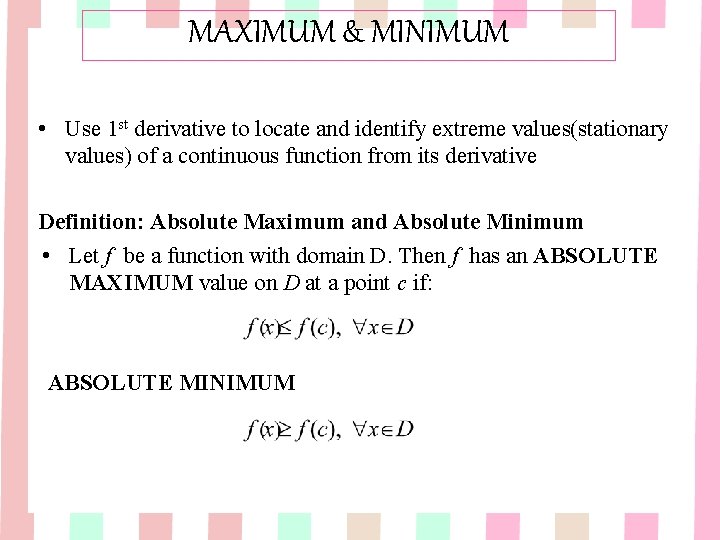
MAXIMUM & MINIMUM • Use 1 st derivative to locate and identify extreme values(stationary values) of a continuous function from its derivative Definition: Absolute Maximum and Absolute Minimum • Let f be a function with domain D. Then f has an ABSOLUTE MAXIMUM value on D at a point c if: ABSOLUTE MINIMUM
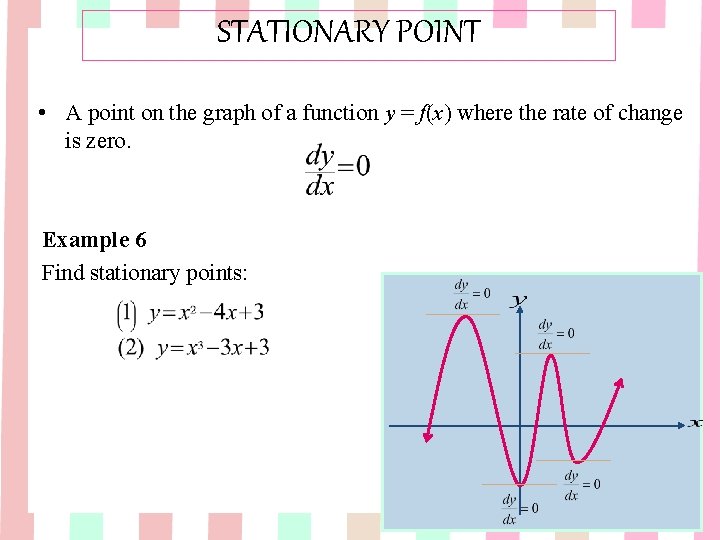
STATIONARY POINT • A point on the graph of a function y = f(x) where the rate of change is zero. Example 6 Find stationary points:
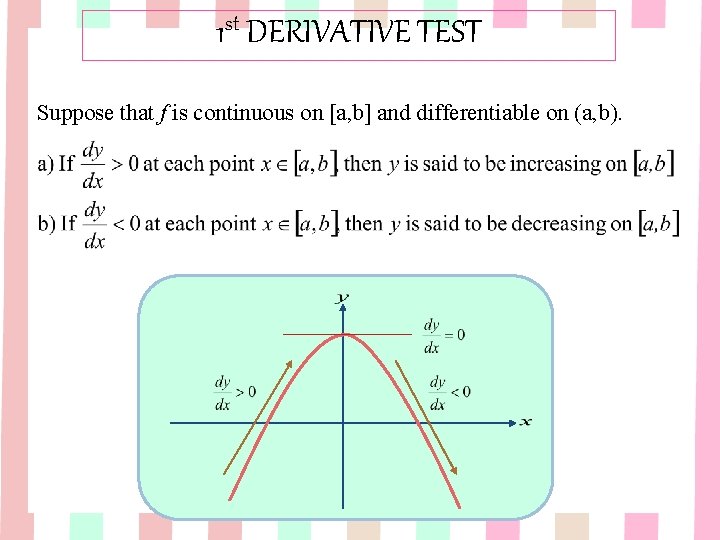
1 st DERIVATIVE TEST Suppose that f is continuous on [a, b] and differentiable on (a, b).
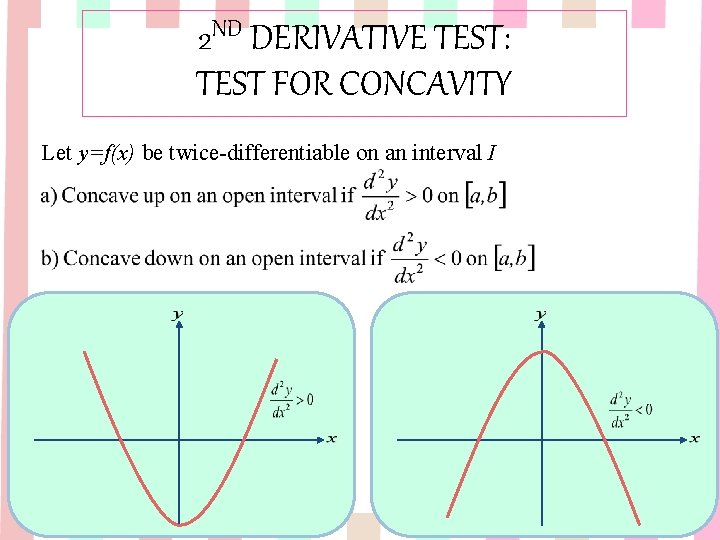
2 ND DERIVATIVE TEST: TEST FOR CONCAVITY Let y=f(x) be twice-differentiable on an interval I
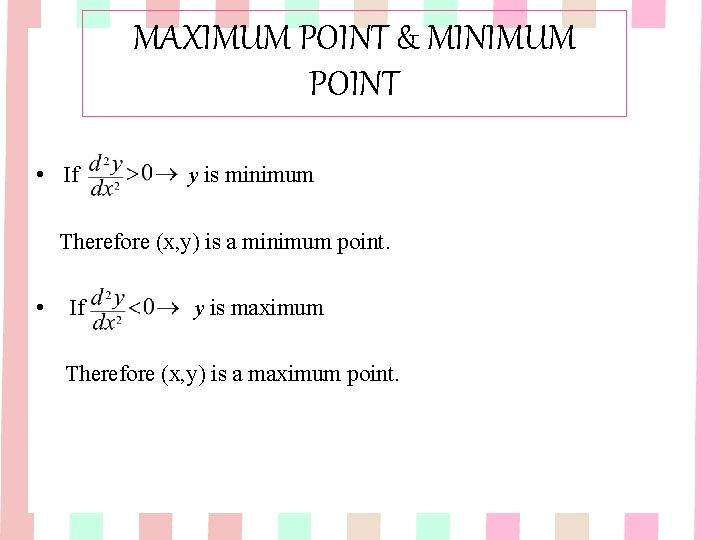
MAXIMUM POINT & MINIMUM POINT • If y is minimum Therefore (x, y) is a minimum point. • If y is maximum Therefore (x, y) is a maximum point.
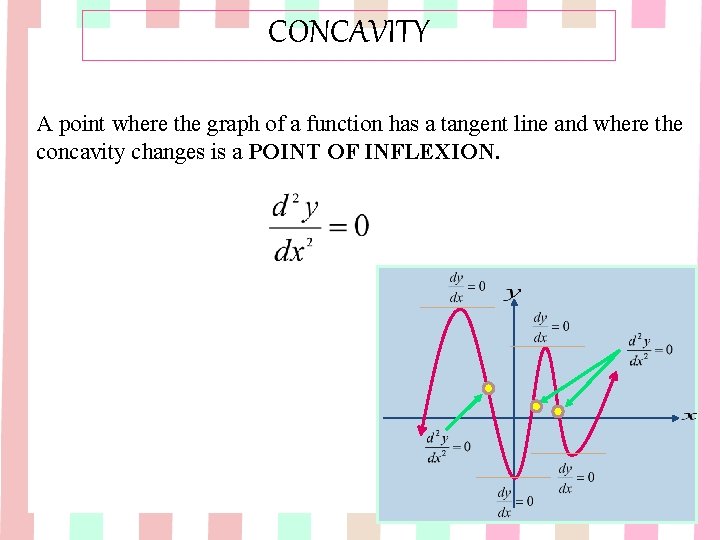
CONCAVITY A point where the graph of a function has a tangent line and where the concavity changes is a POINT OF INFLEXION.
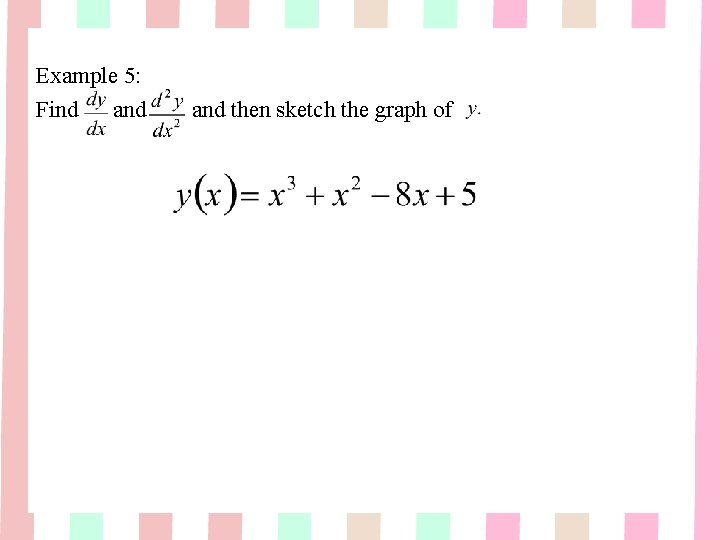
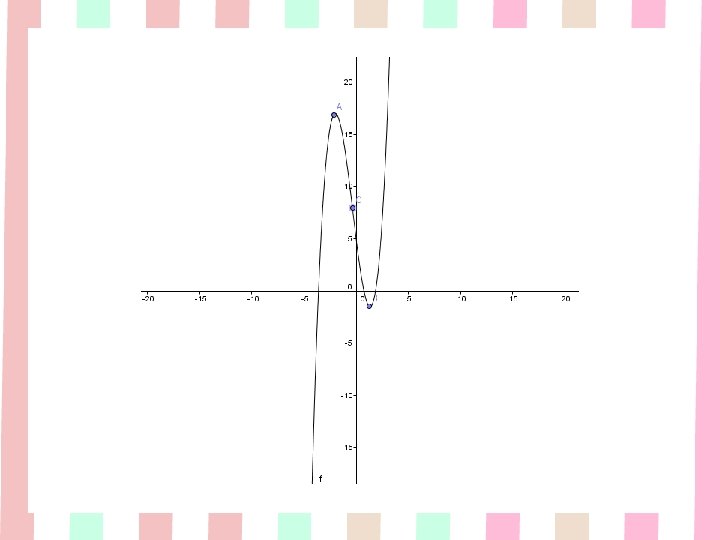
Example 5: Find and then sketch the graph of
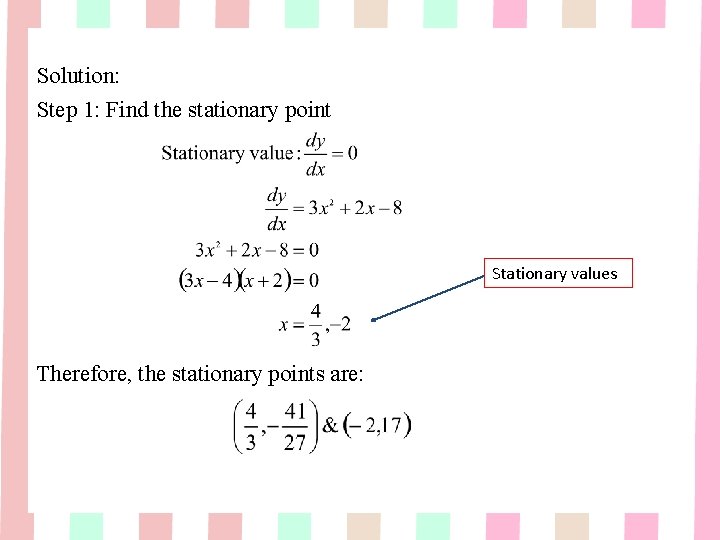
Solution: Step 1: Find the stationary point Stationary values Therefore, the stationary points are:
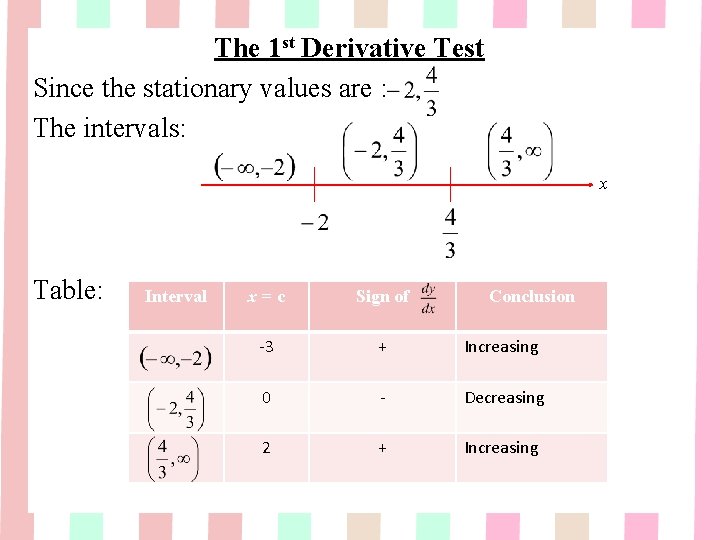
The 1 st Derivative Test Since the stationary values are : The intervals: x Table: Interval x=c Sign of Conclusion -3 + Increasing 0 - Decreasing 2 + Increasing
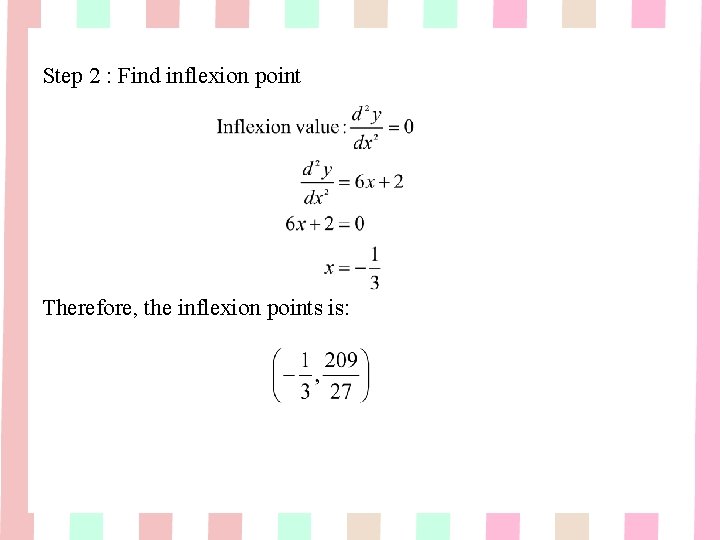
Step 2 : Find inflexion point Therefore, the inflexion points is:
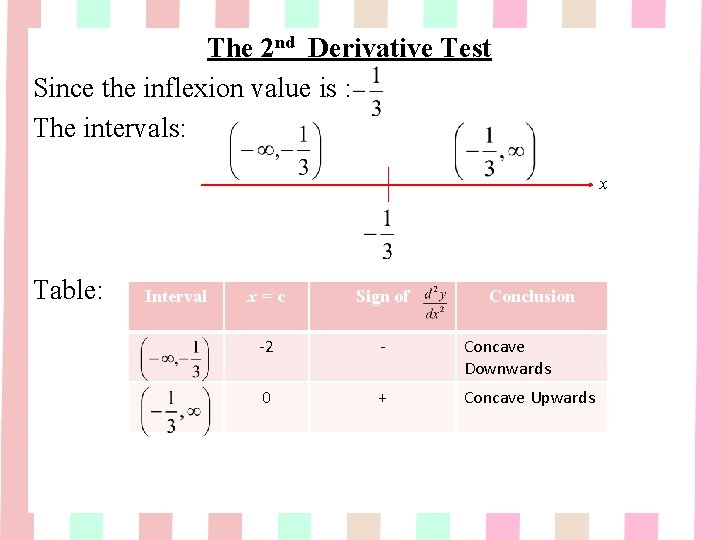
The 2 nd Derivative Test Since the inflexion value is : The intervals: x Table: Interval x=c Sign of Conclusion -2 - Concave Downwards 0 + Concave Upwards
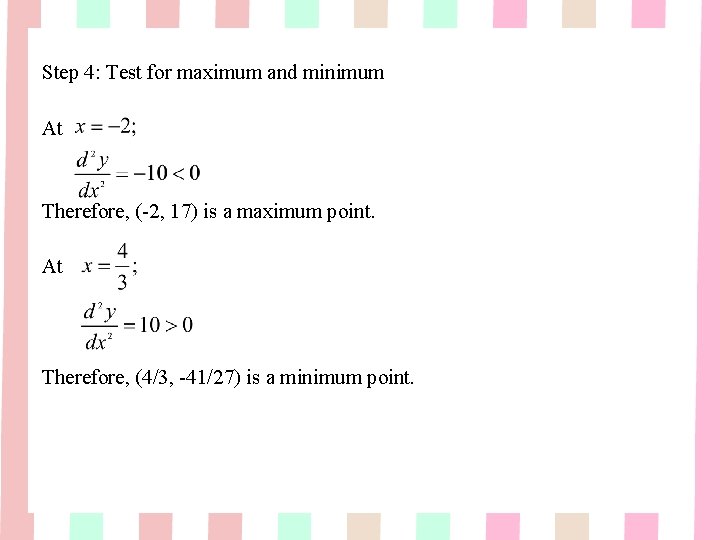
Step 4: Test for maximum and minimum At Therefore, (-2, 17) is a maximum point. At Therefore, (4/3, -41/27) is a minimum point.