
Chapter 4 METAL CASTING PROCESS Objectives Contents 1
Chapter 4: METAL CASTING PROCESS Objectives / Contents : 1. Describe the fundamentals of metal casting. 2. Describe and discuss the process and equipment of metal casting. 3. Review the economical aspect of casting.
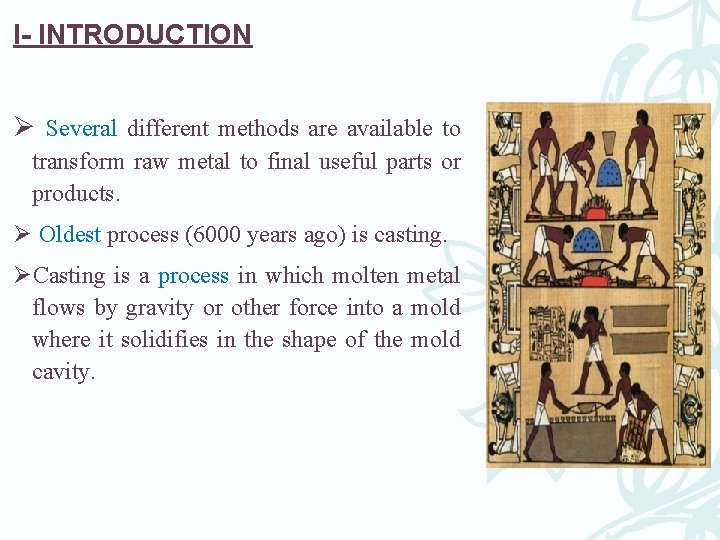
I- INTRODUCTION Ø Several different methods are available to transform raw metal to final useful parts or products. Ø Oldest process (6000 years ago) is casting. ØCasting is a process in which molten metal flows by gravity or other force into a mold where it solidifies in the shape of the mold cavity.

INTRODUCTION The casting process basically involves: Pouring molten metal into a mold Allowing it to cool and solidify Removing the metal from the mold.
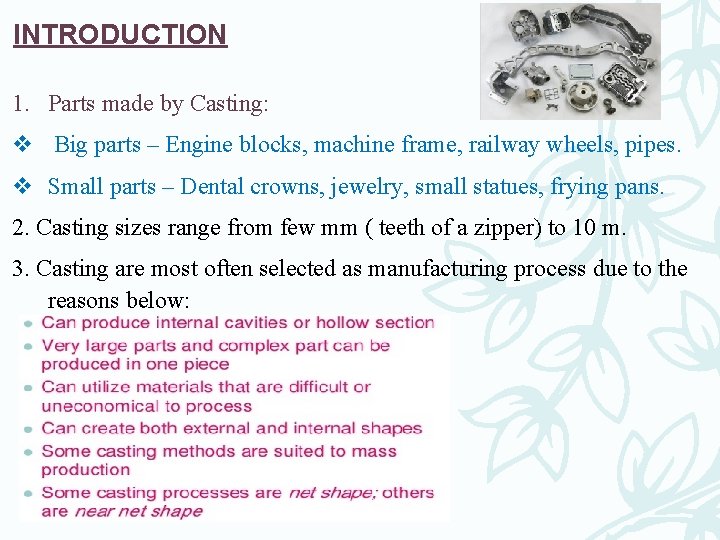
INTRODUCTION 1. Parts made by Casting: v Big parts – Engine blocks, machine frame, railway wheels, pipes. v Small parts – Dental crowns, jewelry, small statues, frying pans. 2. Casting sizes range from few mm ( teeth of a zipper) to 10 m. 3. Casting are most often selected as manufacturing process due to the reasons below:
INTRODUCTION As with all other process or operations, an fundamental understanding of casting process is essential for the production of high quality and economical casting products Important considerations: ü Flow of the molten metal into the mold cavity. - Fluid-flow characteristics ü Solidification and cooling of the metal in the mold -Thermal properties of metal ü Influence of the type of mold material -Rate of cooling -Defects in metal casting
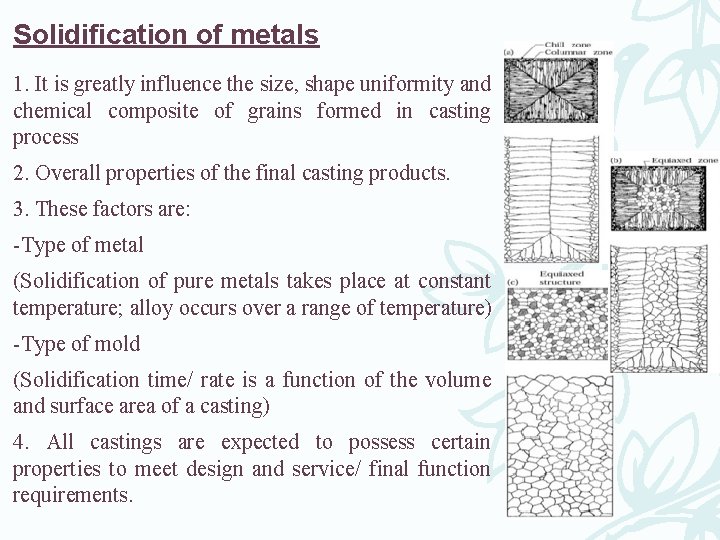
Solidification of metals 1. It is greatly influence the size, shape uniformity and chemical composite of grains formed in casting process 2. Overall properties of the final casting products. 3. These factors are: -Type of metal (Solidification of pure metals takes place at constant temperature; alloy occurs over a range of temperature) -Type of mold (Solidification time/ rate is a function of the volume and surface area of a casting) 4. All castings are expected to possess certain properties to meet design and service/ final function requirements.

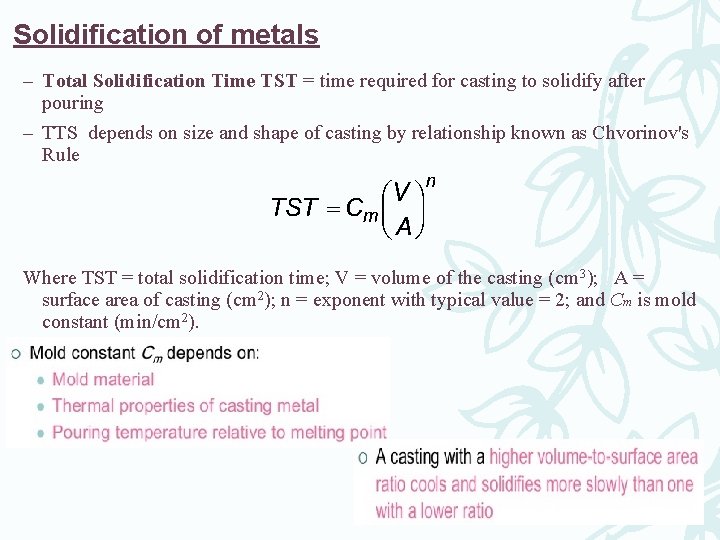
Solidification of metals – Total Solidification Time TST = time required for casting to solidify after pouring – TTS depends on size and shape of casting by relationship known as Chvorinov's Rule Where TST = total solidification time; V = volume of the casting (cm 3); A = surface area of casting (cm 2); n = exponent with typical value = 2; and Cm is mold constant (min/cm 2).
Solidification of metals – Total Solidification Time TST = time required for casting to solidify after pouring – TTS depends on size and shape of casting by relationship known as Chvorinov's Rule Where TST = total solidification time; V = volume of the casting (cm 3); A = surface area of casting (cm 2); n = exponent with typical value = 2; and Cm is mold constant (min/cm 2).
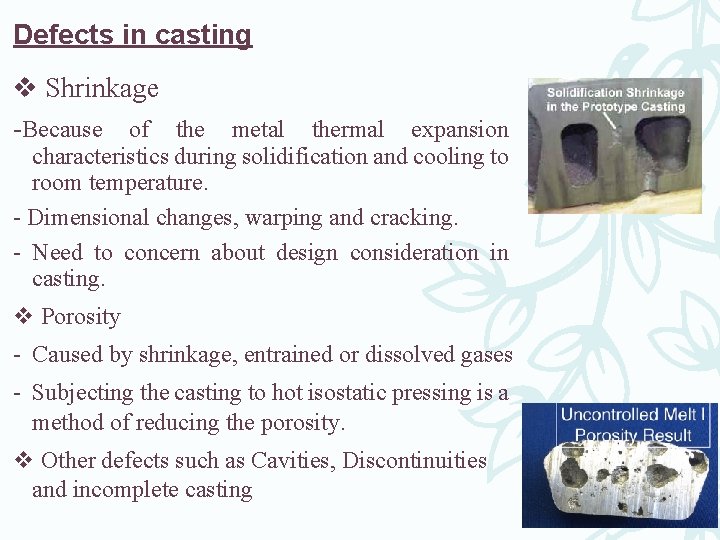
Defects in casting v Shrinkage -Because of the metal thermal expansion characteristics during solidification and cooling to room temperature. - Dimensional changes, warping and cracking. - Need to concern about design consideration in casting. v Porosity - Caused by shrinkage, entrained or dissolved gases - Subjecting the casting to hot isostatic pressing is a method of reducing the porosity. v Other defects such as Cavities, Discontinuities and incomplete casting
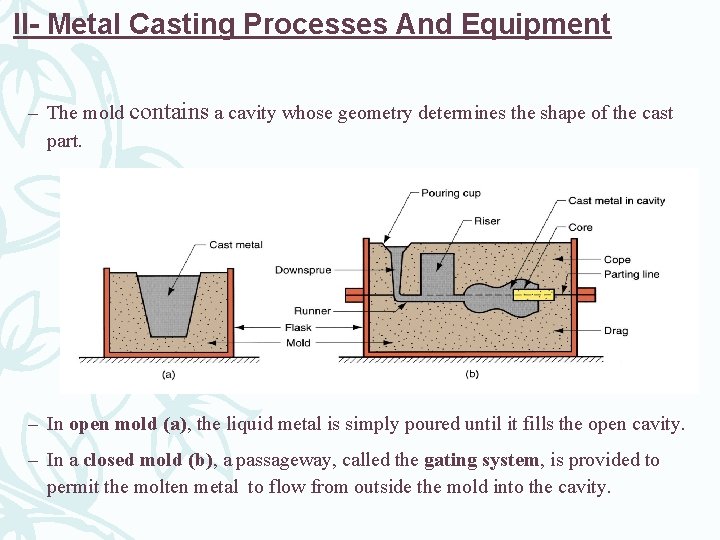
II- Metal Casting Processes And Equipment – The mold contains a cavity whose geometry determines the shape of the cast part. – In open mold (a), the liquid metal is simply poured until it fills the open cavity. – In a closed mold (b), a passageway, called the gating system, is provided to permit the molten metal to flow from outside the mold into the cavity.
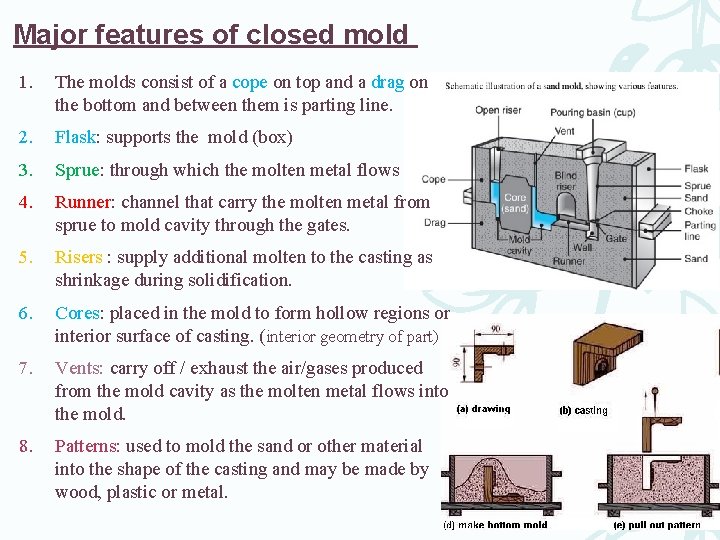
Major features of closed mold 1. The molds consist of a cope on top and a drag on the bottom and between them is parting line. 2. Flask: supports the mold (box) 3. Sprue: through which the molten metal flows 4. Runner: channel that carry the molten metal from sprue to mold cavity through the gates. 5. Risers : supply additional molten to the casting as shrinkage during solidification. 6. Cores: placed in the mold to form hollow regions or interior surface of casting. (interior geometry of part) 7. Vents: carry off / exhaust the air/gases produced from the mold cavity as the molten metal flows into the mold. 8. Patterns: used to mold the sand or other material into the shape of the casting and may be made by wood, plastic or metal.
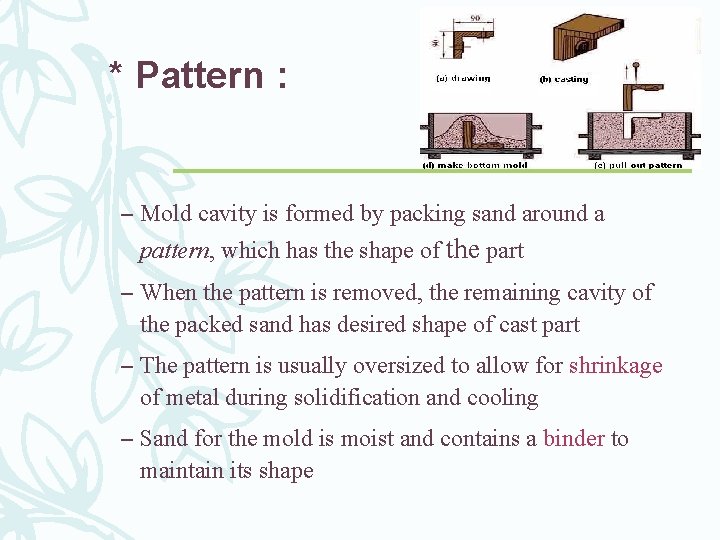
* Pattern : – Mold cavity is formed by packing sand around a pattern, which has the shape of the part – When the pattern is removed, the remaining cavity of the packed sand has desired shape of cast part – The pattern is usually oversized to allow for shrinkage of metal during solidification and cooling – Sand for the mold is moist and contains a binder to maintain its shape
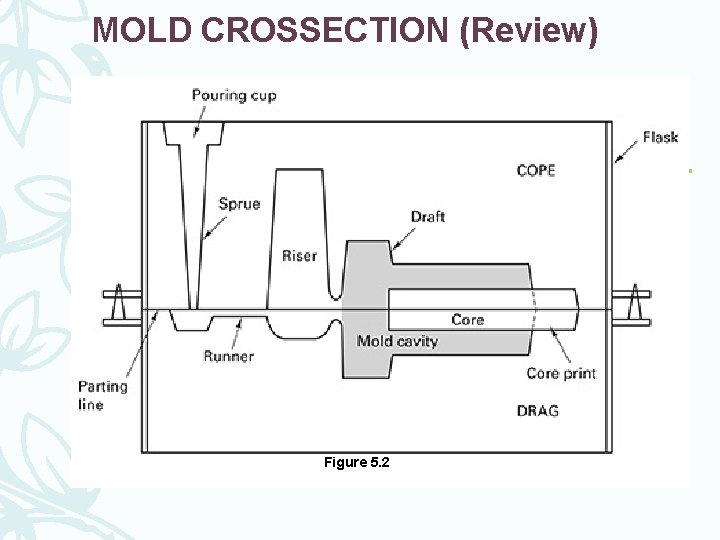
MOLD CROSSECTION (Review) Figure 5. 2
Casting Operations Six basic steps of casting 1. Mold cavity is produced having the desired shape and size of the part – Takes shrinkage into account 2. Melting process – Provides molten material at the proper temperature (Pure Aluminum 660°C, Iron 1537°C and Tungsten 3410 °C) 3. Pouring technique – Molten metal is poured into the mold at a proper rate to ensure that erosion and or defects are minimized (Bernoulli’s Theorem and mass continuity)
Casting Operations 4. Solidification process Controlled solidification allows the product to have desired properties Mold should be designed so that shrinkage is controlled 5. Mold removal The casting is removed from the mold 6. Cleaning, finishing, and inspection operations Excess material along parting lines may have to be machined
- Slides: 15