Chapter 3 CREATIVE EXPERIENCES Copyright 2012 Cengage Learning
- Slides: 41
Chapter 3 CREATIVE EXPERIENCES Copyright 2012 Cengage Learning. All Rights Reserved.
Objectives • After reading this chapter, you should be able to: – Explain how children express their creativity through play. – List at least three characteristics of play. – List the five different types of play. – Discuss multiple literacies. – Discuss how young children use language creatively. – Develop creative experiences in music and movement. – Discuss three ways adults can facilitate children’s creative expression. – Engage children in mark-making activities. Copyright 2012 Cengage Learning. All Rights Reserved.
Creativity and creative expression— whether demonstrated through art, thinking, play, language, music, or movement—foster the development of the whole child, including physical, social-emotional, cognitive, and creative domains. Copyright 2012 Cengage Learning. All Rights Reserved.
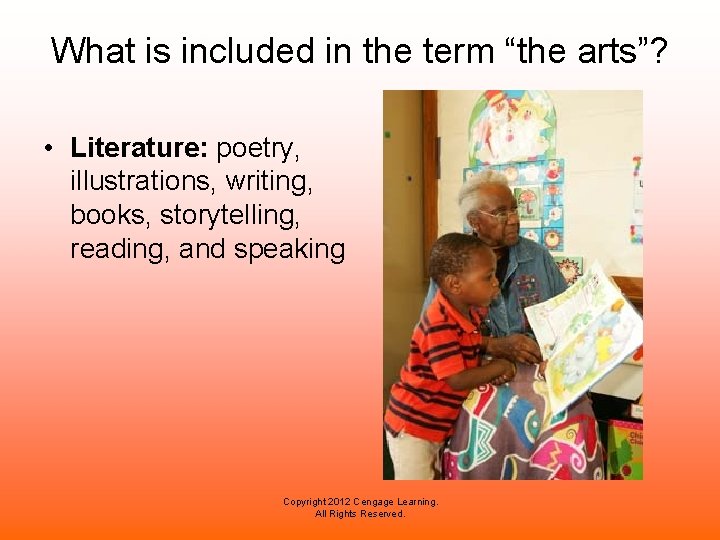
What is included in the term “the arts”? • Literature: poetry, illustrations, writing, books, storytelling, reading, and speaking Copyright 2012 Cengage Learning. All Rights Reserved.
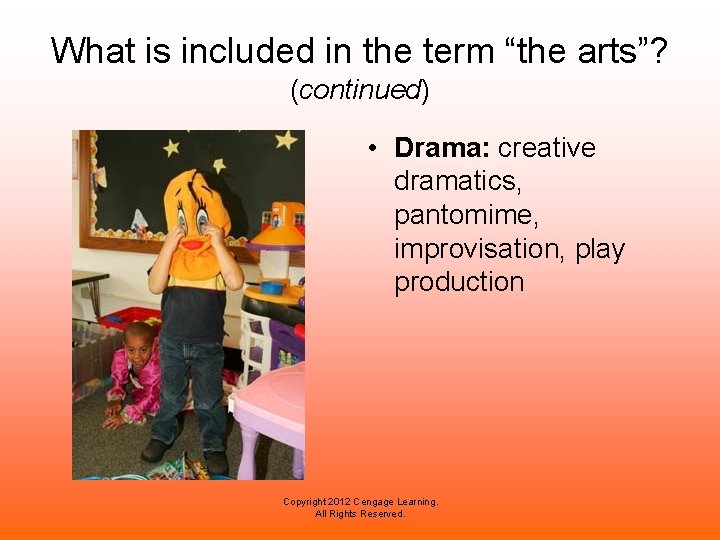
What is included in the term “the arts”? (continued) • Drama: creative dramatics, pantomime, improvisation, play production Copyright 2012 Cengage Learning. All Rights Reserved.
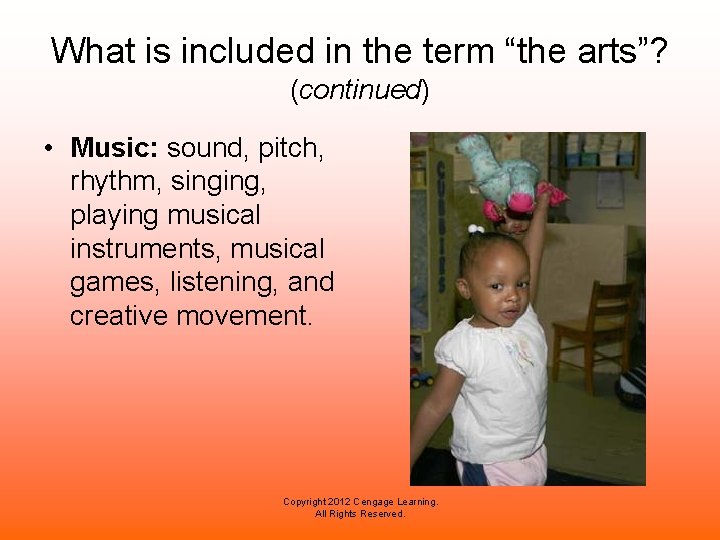
What is included in the term “the arts”? (continued) • Music: sound, pitch, rhythm, singing, playing musical instruments, musical games, listening, and creative movement. Copyright 2012 Cengage Learning. All Rights Reserved.
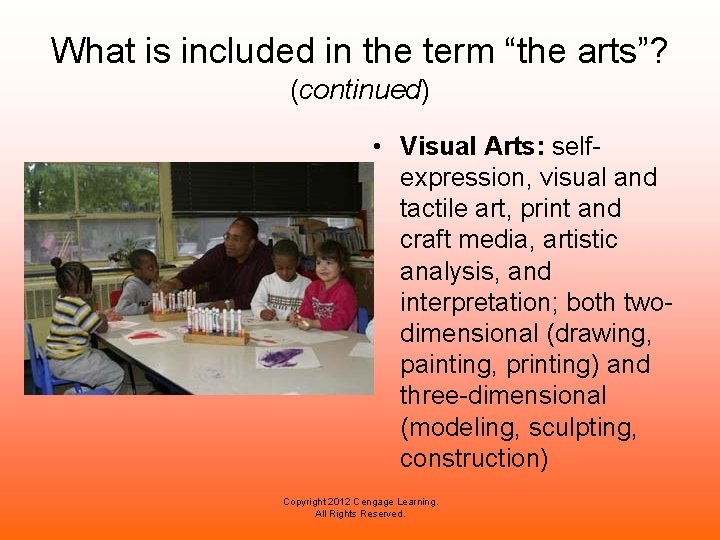
What is included in the term “the arts”? (continued) • Visual Arts: selfexpression, visual and tactile art, print and craft media, artistic analysis, and interpretation; both twodimensional (drawing, painting, printing) and three-dimensional (modeling, sculpting, construction) Copyright 2012 Cengage Learning. All Rights Reserved.
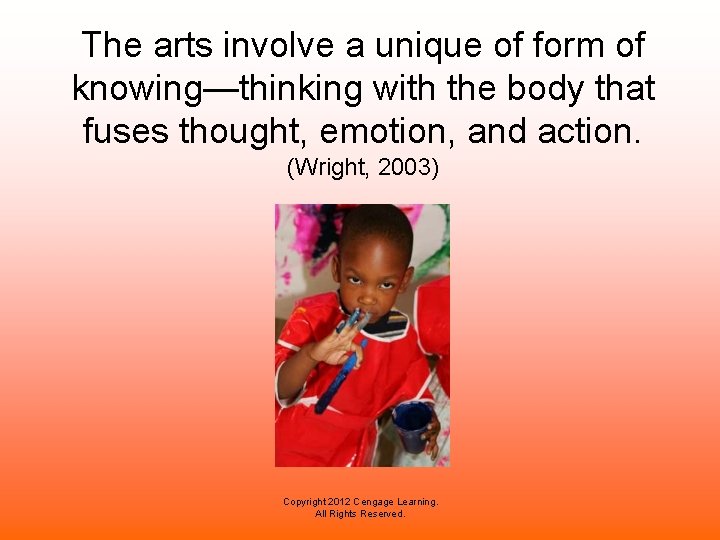
The arts involve a unique of form of knowing—thinking with the body that fuses thought, emotion, and action. (Wright, 2003) Copyright 2012 Cengage Learning. All Rights Reserved.
Children Express Creativity through Play • • Building with blocks, stacking or fitting them together Playing with empty boxes Filling and emptying containers with water Using kitchen tools and containers to scoop, sift, and mold sand Pounding and hammering nails into soft wood; sawing and gluing wood pieces together Pretending to serve lunch to baby dolls, using pretend food Making up new versions of tag, hide-and-seek, hopscotch, or jump rope Using poker chips as money at the outdoor fast-food drive-through Copyright 2012 Cengage Learning. All Rights Reserved.
What is Play? 1. Play is pleasurable and enjoyable. Children play because it is fun. 2. Play has no extrinsic goals. Children are intrinsically motivated to play. 3. Play is spontaneous and voluntary. Play empowers children to make decisions. 4. Play involves active engagement on the part of the player. 5. Play is linked with non-play areas (Garvey, 1990). Copyright 2012 Cengage Learning. All Rights Reserved.
The Benefits of Play • Make-believe play strengthens a variety of specific mental abilities. • Language is greatly enriched by play experiences. • Make-believe fosters young children’s ability to reason about impossible or absurd situations. • Young children who especially enjoy pretending or are given encouragement to engage in fantasy play score higher on tests of imagination and creativity (Berk, 1994). Copyright 2012 Cengage Learning. All Rights Reserved.
Types of Play • Physical play – Involves motor activity and movement – Entails gross motor and fine motor activity – Outdoor play activities such as running, climbing, sliding, riding tricycles, jumping – Fine motor activities such as stringing beads, pegs and peg-boards, parquetry and design blocks, puzzles, small blocks, sewing and lacing cards, and table toys Copyright 2012 Cengage Learning. All Rights Reserved.
Suggested Areas and Recommended Materials for Outdoor Play • Water: water table, dishpans or tubs, kitchen gadgets, and containers • Sand: sandbox or sand table, dishpans or tubs, kitchen gadgets, and containers • Carpentry: woodworking table with sturdy tools, goggles, and lightweight woods • Climbing equipment: flexible, multipurpose for large muscle activities like climbing, jumping, and sliding • Riding vehicles: simple and complex, one- and twopassenger; a clearly defined one-way path, traffic cones and signs • Art: art materials on a cart and easels that are freestanding or attached to a fence Copyright 2012 Cengage Learning. All Rights Reserved.
Suggested Areas and Recommended Materials for Outdoor Play (continued) • Music: music and movement materials, including dance props, rhythm instruments, recorded music and player • Pets or small animals and cages • Garden and gardening tools • Playhouse: dress-up clothes, bridge, stage, elevated platform or other structure for dramatic play • Shady areas for looking at books or storytelling • Obstacle course: stations to jump on and off, crawl through, etc. Copyright 2012 Cengage Learning. All Rights Reserved.
Suggested Areas and Recommended Materials for Outdoor Play (continued) • Construction: large and small blocks, barrels, boards, planks, lumber, old sheets, crates, cardboard boxes, appliance cartons, large sheets of cardboard, tires, tree stump, etc. • Assorted props: balance beam, balls in a variety of sizes, jump ropes, bean bags, hoops, ring toss, parachute, flat wooden ladder, cargo net, low basketball hoop and net, etc. • Storage shed or area that can be locked Copyright 2012 Cengage Learning. All Rights Reserved.
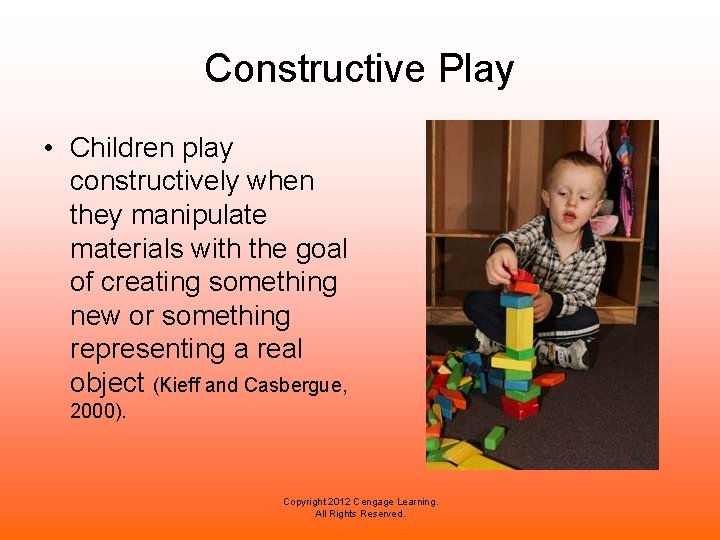
Constructive Play • Children play constructively when they manipulate materials with the goal of creating something new or something representing a real object (Kieff and Casbergue, 2000). Copyright 2012 Cengage Learning. All Rights Reserved.
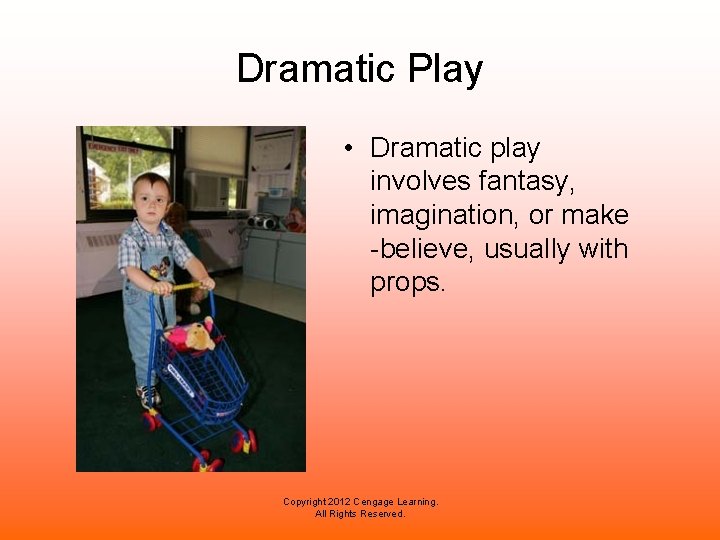
Dramatic Play • Dramatic play involves fantasy, imagination, or make -believe, usually with props. Copyright 2012 Cengage Learning. All Rights Reserved.
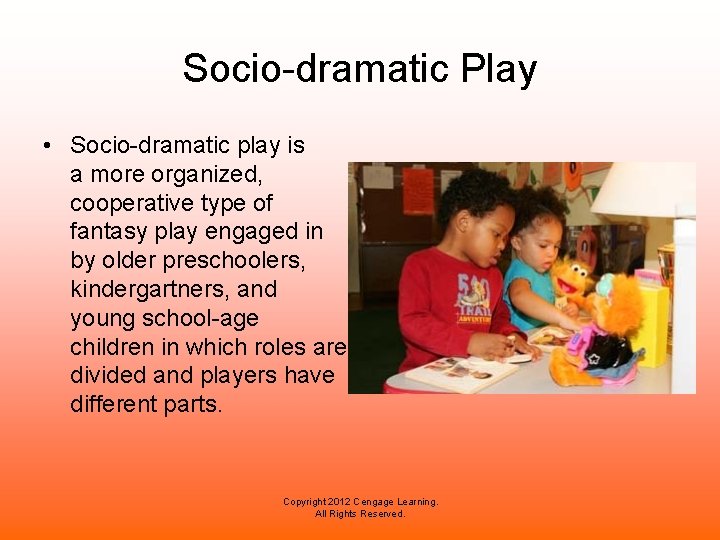
Socio-dramatic Play • Socio-dramatic play is a more organized, cooperative type of fantasy play engaged in by older preschoolers, kindergartners, and young school-age children in which roles are divided and players have different parts. Copyright 2012 Cengage Learning. All Rights Reserved.
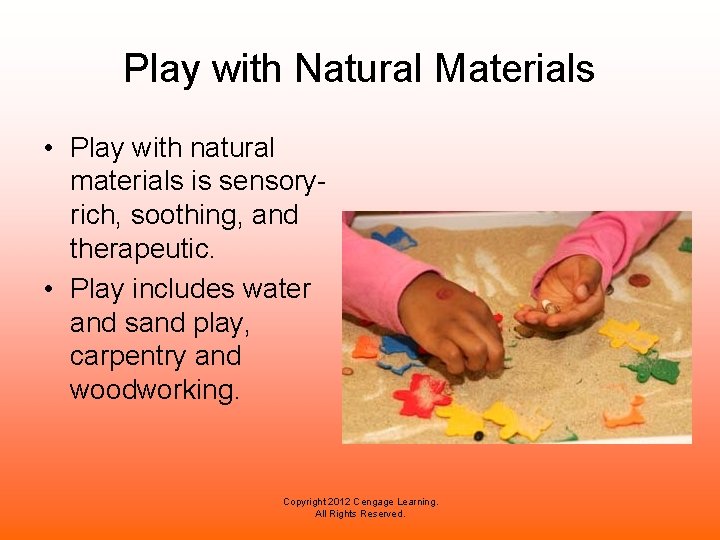
Play with Natural Materials • Play with natural materials is sensoryrich, soothing, and therapeutic. • Play includes water and sand play, carpentry and woodworking. Copyright 2012 Cengage Learning. All Rights Reserved.
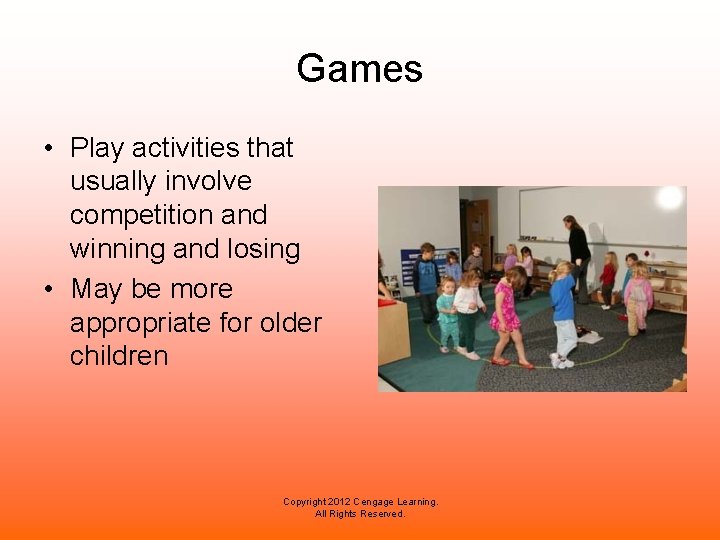
Games • Play activities that usually involve competition and winning and losing • May be more appropriate for older children Copyright 2012 Cengage Learning. All Rights Reserved.
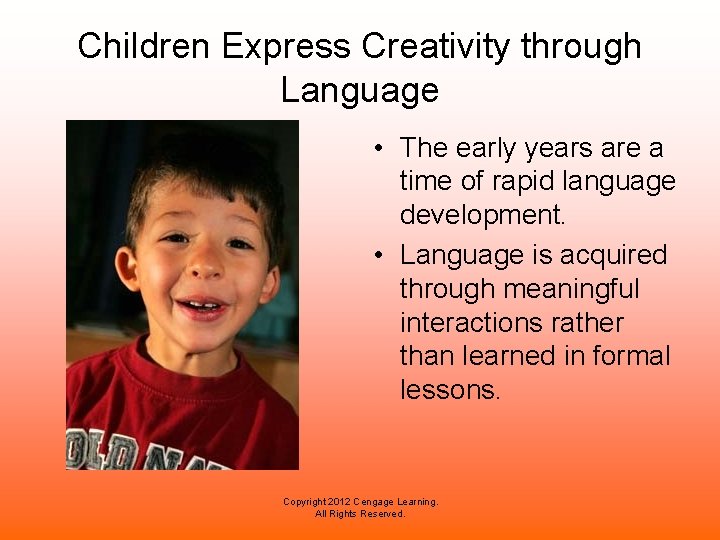
Children Express Creativity through Language • The early years are a time of rapid language development. • Language is acquired through meaningful interactions rather than learned in formal lessons. Copyright 2012 Cengage Learning. All Rights Reserved.
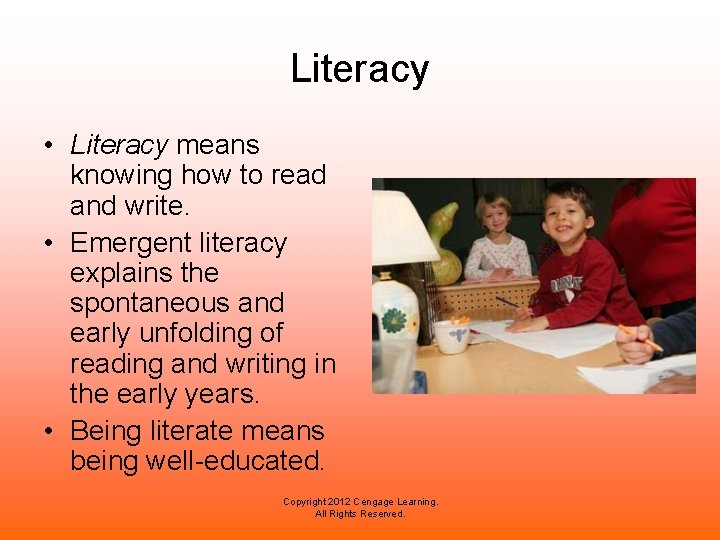
Literacy • Literacy means knowing how to read and write. • Emergent literacy explains the spontaneous and early unfolding of reading and writing in the early years. • Being literate means being well-educated. Copyright 2012 Cengage Learning. All Rights Reserved.
Multiple Literacies • Acknowledges multimodal ways of thinking • Views children as remakers, transformers, and re-shapers of knowledge who use a range of representational resources and multiple modes of thinking. • Technologic literacy (computers, Internet, digital media, etc. ) • Mathematical and scientific literacies • Visual and media literacy • Artistic literacy Copyright 2012 Cengage Learning. All Rights Reserved.
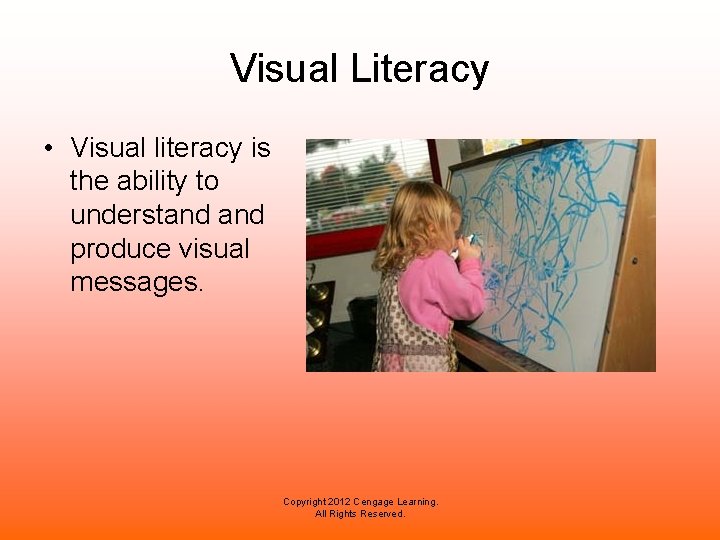
Visual Literacy • Visual literacy is the ability to understand produce visual messages. Copyright 2012 Cengage Learning. All Rights Reserved.
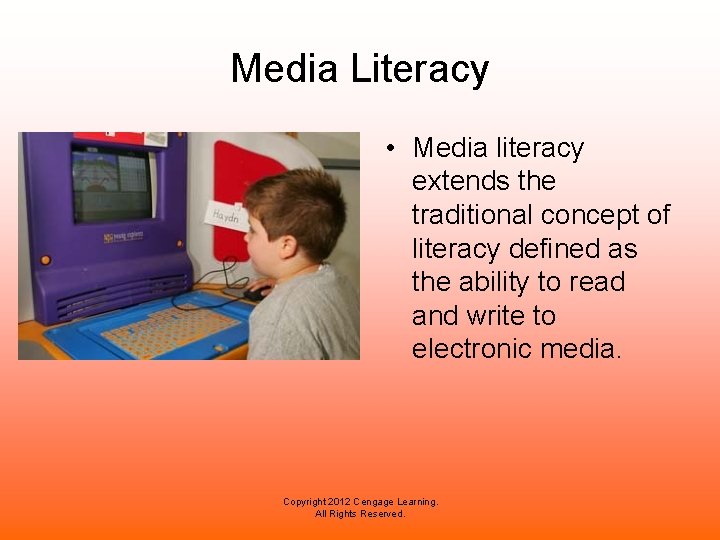
Media Literacy • Media literacy extends the traditional concept of literacy defined as the ability to read and write to electronic media. Copyright 2012 Cengage Learning. All Rights Reserved.
Children Express Creativity through Music and Movement • Music experiences for infants and toddlers – Infants and toddlers experience music by hearing it, by feeling it, and by experimenting with musical sounds and vocalizations. – Infants and toddlers should experience music daily while receiving caring, physical contact (Pica, 2004). Copyright 2012 Cengage Learning. All Rights Reserved.
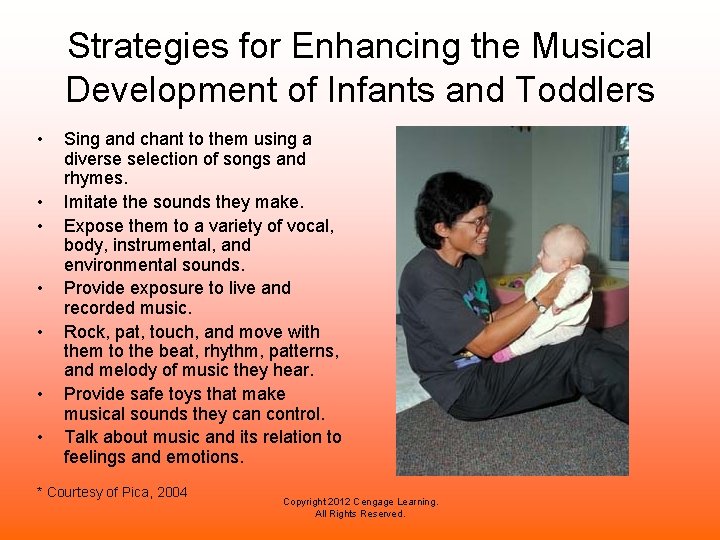
Strategies for Enhancing the Musical Development of Infants and Toddlers • • Sing and chant to them using a diverse selection of songs and rhymes. Imitate the sounds they make. Expose them to a variety of vocal, body, instrumental, and environmental sounds. Provide exposure to live and recorded music. Rock, pat, touch, and move with them to the beat, rhythm, patterns, and melody of music they hear. Provide safe toys that make musical sounds they can control. Talk about music and its relation to feelings and emotions. * Courtesy of Pica, 2004 Copyright 2012 Cengage Learning. All Rights Reserved.
Children Express Creativity through Music and Movement • Two-year-olds – Use their bodies in response to music, often by bouncing up and down – Can learn short, simple songs – Show increasing ability to follow directions in songs – Respond enthusiastically to favorite songs, often asking to hear them repeatedly – May sing parts of songs, but seldom sing with a group – Enjoy experimenting with sounds – Can discriminate among songs * Courtesy of Pica, 2004 Copyright 2012 Cengage Learning. All Rights Reserved.
Children Express Creativity through Music and Movement • Three-year-olds – Have greater rhythmic ability – Can recognize and sing parts of familiar tunes, though usually not on pitch – Make up their own songs – Walk, run, and jump to music – Enjoy dramatizing songs * Courtesy of Pica, 2004 Copyright 2012 Cengage Learning. All Rights Reserved.
Children Express Creativity through Music and Movement • Four-year-olds – Can grasp basic musical concepts like tempo, volume, and pitch – Show a dramatic increase in vocal range and rhythmic ability – Create new lyrics for songs – Enjoy more complex songs – Love silly songs – Prefer “active” listening (singing, moving, doing finger plays, accompanying music with instruments) * Courtesy of Pica, 2004 Copyright 2012 Cengage Learning. All Rights Reserved.
Children Express Creativity through Music and Movement • Five- to six-year-olds – Can reproduce a melody – Begin to synchronize movements with the music’s rhythm – Enjoy singing and moving with a group – Enjoy call-and-response songs – Have fairly established musical preferences – Can perform two movements simultaneously * Courtesy of Pica, 2004 Copyright 2012 Cengage Learning. All Rights Reserved.
Children Express Creativity through Music and Movement • Seven- to eight-year-olds – – Are learning to read lyrics Can learn simple folk dances taught by adults Enjoy musical duets with friends May display a desire to study dance or play an instrument – Can synchronize movements to the beat of music – Can compare three or more sounds * Courtesy of Pica, 2004 Copyright 2012 Cengage Learning. All Rights Reserved.
Why Music and Movement are Important • Early interaction with music positively affects the quality of children’s lives. • Successful experiences help children bond socially, emotionally, and cognitively with others. • Early music experiences provide the foundation for later music experiences. Copyright 2012 Cengage Learning. All Rights Reserved.
What should an early childhood music program entail? • • • Singing Moving Listening to music Creating music Playing instruments Responding to visual and verbal representations of sound • Diverse cultural experiences of music Copyright 2012 Cengage Learning. All Rights Reserved.
Listening to Music • Involves perceiving and making sense out of musical input • Is a learned skill • Involves three related auditory skills: – Awareness – Discrimination – Sequencing Copyright 2012 Cengage Learning. All Rights Reserved.
Stages of Musical Skills Development • Musical awareness stage: Children use their senses to touch, manipulate, and gain an initial awareness of musical sound. • Musical exploration stage: Children’s musical play behaviors include moving, listening, playing rhythm instruments, and singing; perform rhythm patterns and a steady beat; begin to discriminate basic musical ideas. • Musical inquiry and utilization stages: Children begin to translate musical understandings through singing, moving, and playing rhythm instruments; follow song pictures and puzzles; verbalize musical elements; solve more complex musical problems. (MENC, 1991) Copyright 2012 Cengage Learning. All Rights Reserved.
Singing • Children’s singing progresses from listening to tagging on to joining in and culminates in independent singing (Wolf, 1994). • Preschoolers join in singing as part of a group. • Kindergartners are comfortable singing in a group or alone. Copyright 2012 Cengage Learning. All Rights Reserved.
Making Music with Rhythm Instruments • Rhythm (percussion) instruments – – – – Drums Tambourines Sticks Triangles Maracas Cymbals Sandpaper blocks • Melodic instruments – – Xylophone Piano Keyboard Tone bells Copyright 2012 Cengage Learning. All Rights Reserved.
Moving to Music • Movement involves three major skills categories: – Locomotor: moving the whole body from one point to another – Non-locomotor: movements requiring balance – Manipulative: controlling an object with either large or small muscles Copyright 2012 Cengage Learning. All Rights Reserved.
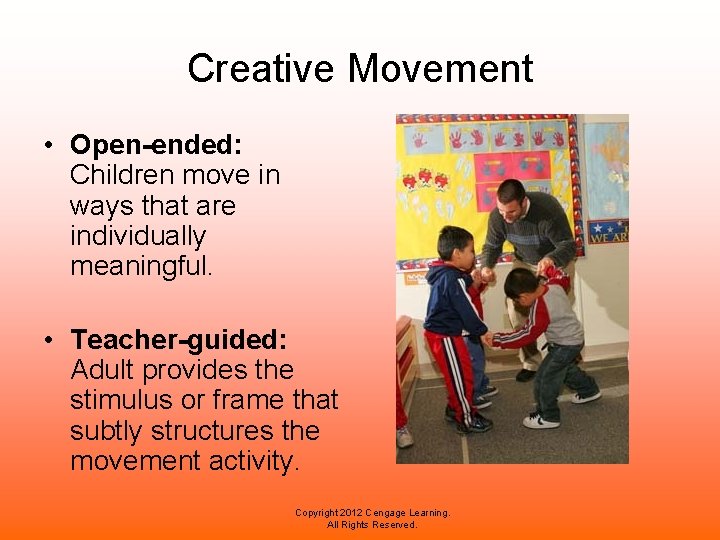
Creative Movement • Open-ended: Children move in ways that are individually meaningful. • Teacher-guided: Adult provides the stimulus or frame that subtly structures the movement activity. Copyright 2012 Cengage Learning. All Rights Reserved.
Facilitating Children’s Creative Expression • Provide ample blocks of time. • Provide ample space indoors and outdoors. • Provide resources including open-ended toys, props, materials, and creative junk. • Provide a psychologically safe environment. • Play a variety of roles. • Comment on and interpret the content and processes of children’s play. Copyright 2012 Cengage Learning. All Rights Reserved.